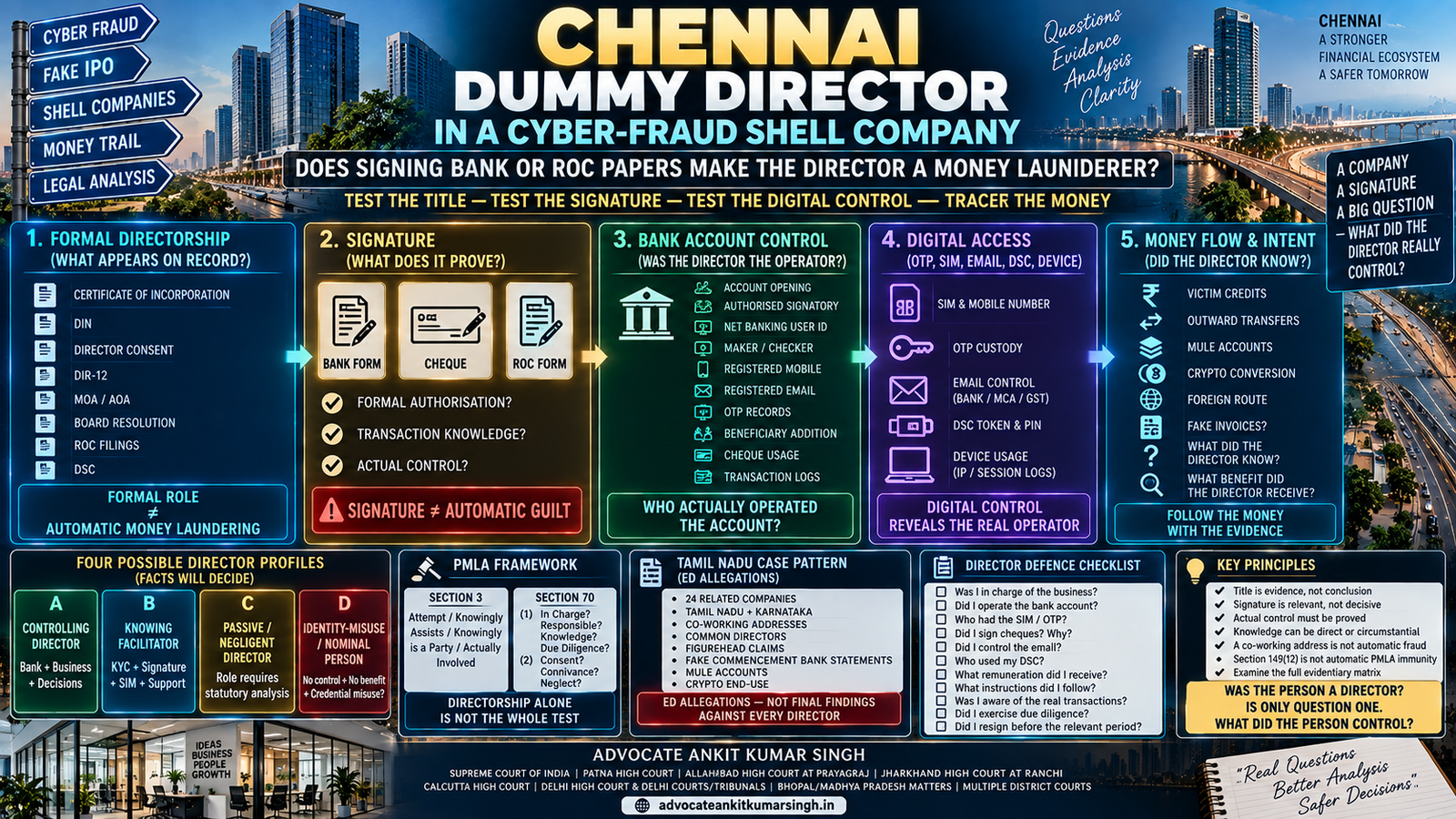
Chennai Dummy Director in a Cyber-Fraud Shell Company: Does Signing Bank or ROC Papers Make the Director a Money Launderer?
Legal research and analysis by Advocate Ankit Kumar Singh
Legally reviewed and updated: 16 September 2026
Summary: In Chennai, examine the difficult position of persons whose names were used as directors of companies later linked to cyber-fraud proceeds. The Chennai article should distinguish formal directorship from actual control by testing bank access, cheque signing, OTP or SIM custody, email use, remuneration, instructions, incorporation documents and knowledge of the company's real transactions.
Direct Answer: Signing a Bank or ROC Paper Does Not Automatically Make a Director a Money Launderer
A person's name appearing as a director on MCA records is relevant evidence of formal corporate status.
Likewise, signing a bank-account-opening form, board resolution, ROC filing or cheque may be relevant evidence of participation.
But none of those facts, taken mechanically and in isolation, automatically establishes the offence of money laundering.
The stronger PMLA question is:
WHAT DID THE DIRECTOR ACTUALLY KNOW, CONTROL, AUTHORISE, SIGN, RECEIVE, FACILITATE OR BENEFIT FROM?
The Tamil Nadu Cyber-Fraud Dummy-Director Pattern
ED's official cybercrime prosecution material concerning fake IPO, investment and digital-arrest scams described 24 related shell companies in Tamil Nadu, Karnataka and other places.
ED alleged that common directors appeared across several companies and that many directors claimed they did not understand their roles and were merely figureheads.
ED separately alleged that persons operating the network arranged dummy directors, company addresses, incorporation documents and bank accounts.
These remain agency allegations and should not be written as final findings of guilt against every named director.
Why This Creates a Difficult Legal Problem
A cyber-fraud shell company may contain three different kinds of persons:
- the person shown as director;
- the person controlling the bank account;
- the person controlling the criminal proceeds.
Sometimes they are the same person.
Sometimes they are entirely different.
PMLA Section 3: Actual or Knowing Participation Matters
Section 3 focuses on involvement in a process or activity connected with proceeds of crime, including attempts, knowing assistance, knowing participation and actual involvement.
Therefore:
DIRECTORSHIP
≠
AUTOMATIC SECTION 3 OFFENCE.
The alleged conduct connected with proceeds of crime must be identified.
PMLA Section 70: When Can a Company Director Face Liability?
Section 70 addresses offences involving companies.
The statutory analysis includes whether the individual was, at the relevant time:
- in charge of the company; and
- responsible to the company for conduct of its business.
The provision also recognises a defence concerning absence of knowledge or exercise of due diligence.
Section 70(2) separately addresses consent, connivance or neglect by directors and other company officers.
Therefore “Director” Is the Beginning of the Inquiry — Not the End
A useful role analysis asks:
DIRECTOR ON PAPER?
        ↓
FORMALLY AUTHORISED?
        ↓
BANK ACCESS?
        ↓
OTP / SIM ACCESS?
        ↓
EMAIL ACCESS?
        ↓
DSC ACCESS?
        ↓
PAYMENT INSTRUCTIONS?
        ↓
KNOWLEDGE OF VICTIM CREDITS?
        ↓
PERSONAL BENEFIT?
        ↓
ACTUAL CONTROL?
What Does Signing the Bank Account Opening Form Prove?
It can prove formal involvement in opening the corporate banking relationship.
It may establish that the person:
- presented himself or herself to the bank;
- provided KYC;
- accepted a formal role;
- was identified as authorised signatory.
But it does not automatically establish who later operated every transaction.
RBI KYC Records Can Help Identify Formal Banking Authority
RBI's current KYC framework requires company-account documentation such as:
- certificate of incorporation;
- constitutional documents;
- PAN;
- board resolution;
- authority of persons transacting for the company;
- identity of persons authorised to act;
- beneficial-owner information.
This can establish formal banking authority.
It should then be compared with actual electronic-operation data.
Formal Bank Authority and Actual Bank Operation Are Different Questions
| Formal Record | Actual-Control Record |
|---|---|
| Board resolution | Net-banking logs |
| Authorised signatory | Transaction initiator |
| Specimen signature | Cheque use |
| Registered mobile | OTP device |
| Registered email | Login/session use |
| Power of attorney | Actual payment instructions |
Who Actually Operated the Account?
Obtain and compare:
ACCOUNT OPENING FORM

BOARD RESOLUTION

SIGNATORY MANDATE

NET-BANKING USER ID

MAKER ID

CHECKER / APPROVER ID

REGISTERED MOBILE

OTP LOG

REGISTERED EMAIL

LOGIN IP

DEVICE INFORMATION

BENEFICIARY-ADDITION HISTORY

CHEQUE IMAGE

BRANCH INSTRUCTIONS
Cheque Signing: One Signature Can Mean Very Different Things
Ask:
- Was the cheque blank when signed?
- Who filled the beneficiary?
- Who inserted the amount?
- Did the director know the purpose?
- Was there a supporting invoice?
- Was it one isolated cheque or a repeated pattern?
A knowingly issued cheque directing alleged proceeds of crime to another laundering account is factually different from a pre-signed cheque later misused without the director's knowledge.
OTP and SIM Custody Can Be More Important Than the Name on the Bank Mandate
In a digitally operated company account, investigators should identify:
- registered mobile number;
- SIM subscriber;
- actual SIM possessor;
- device IMEI where lawfully available;
- OTP messages;
- banking-app device;
- transaction timestamps.
The Tamil Nadu cyber-fraud investigation itself involved allegations concerning SIM cards linked to shell-company accounts and WhatsApp operations.
A SIM in the Director's Name Is Not Automatically Proof of Every Transaction
The correct questions are:
WHO POSSESSED THE SIM?

WHO USED THE DEVICE?

WHO RECEIVED OTPs?

WHO LOGGED INTO THE BANK?

WHO APPROVED THE BENEFICIARY?

WHO APPROVED THE TRANSFER?
Email Control Is Another Attribution Layer
Compare:
- bank email;
- MCA email;
- GST email;
- company email;
- password-reset notices;
- transaction alerts;
- beneficiary-addition alerts.
Then identify the person who actually controlled those credentials.
What Does Signing ROC Papers Prove?
ROC filings can prove formal corporate participation.
But their evidentiary significance depends upon:
- which form was signed;
- what representation was made;
- whether that representation was true;
- whether the director knew it was false;
- who prepared the filing;
- who controlled the DSC;
- who instructed the professional filing it.
DIR-12 and Director Consent
Section 152 of the Companies Act requires a director to consent to hold office.
Current MCA's DIR-12 process records appointment or changes concerning directors and incorporates director-consent information.
Therefore a person whose valid consent and digital signature appear in the appointment process cannot casually say that the existence of the directorship had absolutely no documentary basis.
But that still does not establish operational control of later cyber-fraud transactions.
DSC Control Can Become Critical
Ask:
WHO OBTAINED THE DSC?

WHO HELD THE TOKEN?

WHO KNEW THE PIN?

WHERE WAS IT STORED?

WHO USED IT?

FROM WHICH DEVICE?

WHICH ROC FORMS WERE FILED?

WHO INSTRUCTED THE CA / CS?
The fact that the DSC was issued in a director's name does not automatically prove who physically operated it on every occasion.
Incorporation Documents Should Be Reconstructed One by One
| Record | Question |
|---|---|
| DIN | Who applied? |
| Director consent | Was it genuine? |
| DIR-12 | Who filed/signed? |
| MOA/AOA | Did the director sign? |
| INC-20A | Did the director authorise it? |
| DSC | Who possessed it? |
| Email/mobile | Who controlled them? |
Remuneration Can Help Explain the Director's Real Role
Check whether the person received:
- salary;
- director sitting fee;
- commission;
- cash;
- reimbursement;
- fixed amount for lending name/documents;
- transaction-linked payment;
- portion of the disputed money.
The amount, timing and explanation can materially affect the role analysis.
Who Was Giving Instructions?
This is often more important than the MCA master data.
Search for:
- WhatsApp instructions;
- Telegram messages;
- email directions;
- payment sheets;
- beneficiary lists;
- OTP requests;
- instructions to bank officials;
- instructions to CA/CS;
- instructions to directors.
The person giving operational instructions may be the real controlling mind even if another person's name appears as director.
Knowledge of the Company's Real Transactions Is Critical
Ask whether the director knew:
- what the company supposedly sold;
- why strangers were transferring crores;
- who the customers were;
- why funds moved out immediately;
- why crypto exchanges or mule accounts were receiving money;
- whether invoices were genuine;
- whether victims had any commercial relationship with the company.
A “Dummy Director” Defence Must Be Tested, Not Merely Asserted
A person may genuinely have been a name-lender with minimal involvement.
But if the evidence shows:
KYC PROVIDED
+
ACCOUNT OPENED
+
SIM HANDED OVER
+
OTP SHARED
+
FALSE ROC PAPERS SIGNED
+
TRANSACTIONS KNOWINGLY FACILITATED
+
PAYMENT RECEIVED
the label “dummy director” does not by itself eliminate potential PMLA exposure.
Conversely, Formal Directorship Does Not Automatically Establish Operational Guilt
A materially different case may exist where:
- signatures were forged;
- DSC was misused;
- bank access was never provided;
- the director never received an OTP;
- no email was controlled;
- no benefit was received;
- no instructions were given;
- no victim transaction was known;
- complaint was made promptly after discovery.
Section 70(1): Four Questions to Ask
1. WAS THE PERSON IN CHARGE?

2. WAS THE PERSON RESPONSIBLE FOR CONDUCT OF THE BUSINESS?

3. DID THE CONTRAVENTION OCCUR WITHOUT THE PERSON'S KNOWLEDGE?

4. DID THE PERSON EXERCISE DUE DILIGENCE?
Section 70(2): Another Route to Individual Responsibility
Even where the precise Section 70(1) position is disputed, Section 70(2) requires examination of whether the contravention occurred with:
- consent;
- connivance;
- neglect;
of the director or other officer.
Madras High Court Guidance
Madras High Court decisions including C. Manoharan v Assistant Director and S. Jayalakshmi v Directorate of Enforcement demonstrate that Section 70 PMLA can extend to persons actually responsible for corporate conduct and cannot always be defeated merely by relying upon a formal corporate distinction.
But these decisions should not be misread as creating automatic criminal liability for every person whose name appears as director.
The facts and statutory ingredients remain central.
What About an Independent or Non-Executive Director?
Section 149(12) of the Companies Act contains a special liability framework for independent directors and certain non-executive directors under that Act.
It refers to knowledge attributable through Board processes, consent, connivance and diligence.
However:
SECTION 149(12) SHOULD NOT BE TREATED AS AN AUTOMATIC IMMUNITY FROM PMLA.
PMLA liability must still be separately assessed under Sections 3 and 70.
Resignation Can Be Highly Relevant
If a director claims to have resigned before the cyber-fraud transactions, verify:
- resignation letter;
- company acknowledgment;
- DIR-12;
- DIR-11 where applicable;
- MCA record;
- bank mandate change;
- DSC usage;
- OTP access;
- transaction dates.
Build the Director Timeline
APPOINTMENT
     ↓
BANK ACCOUNT OPENING
     ↓
BANK MANDATE
     ↓
MOBILE / EMAIL REGISTRATION
     ↓
FIRST VICTIM CREDIT
     ↓
FIRST OUTWARD TRANSFER
     ↓
ROC FILINGS
     ↓
CRYPTO / LAYERING ACTIVITY
     ↓
RESIGNATION
A time-specific role analysis is much stronger than a generic statement that someone “was a director.”
Four Different Director Profiles
1. Controlling Director
Actually manages the company, bank accounts and financial decisions.
2. Knowing Facilitator / Name-Lender
May not manage the entire business but knowingly supplies identity, KYC, signatures, SIM, bank authority or DSC to facilitate transactions.
3. Passive or Negligent Director
Formal role exists, but the relevant statutory responsibility, knowledge, due diligence and neglect require close analysis.
4. Genuine Identity-Misuse / Nominal Person
May have no bank access, no OTP, no operational control, no financial benefit and potentially forged or misused credentials.
These categories should not be treated as legally identical.
Director Attribution Checklist
□ DIRECTOR APPOINTMENT DATE

□ DIRECTOR CONSENT

□ DIR-12

□ DIN

□ DSC CONTROL

□ ROC FILINGS SIGNED

□ BANK ACCOUNT OPENING SIGNATURE

□ BOARD RESOLUTION

□ AUTHORISED SIGNATORY STATUS

□ CHEQUE SIGNATURES

□ NET-BANKING USER

□ MAKER / CHECKER ROLE

□ REGISTERED MOBILE

□ SIM CUSTODY

□ OTP ACCESS

□ REGISTERED EMAIL

□ DEVICE ACCESS

□ LOGIN IP / SESSION

□ BENEFICIARY ADDITION

□ WHATSAPP / TELEGRAM INSTRUCTIONS

□ CA / CS INSTRUCTIONS

□ REMUNERATION

□ SHAREHOLDING

□ PERSONAL RECEIPTS

□ KNOWLEDGE OF VICTIM CREDITS

□ KNOWLEDGE OF MONEY FLOW

□ RESIGNATION DATE

□ DUE-DILIGENCE EVIDENCE
Frequently Asked Questions
1. Does being a director automatically make someone liable under PMLA?
No. The statutory and factual role must be examined.
2. Does signing a bank-account-opening form prove money laundering?
No. It proves relevant formal involvement in account opening but does not by itself prove knowing laundering of proceeds.
3. Does signing an ROC form prove that the director controlled the company?
Not necessarily. The type of filing, the representation made, DSC usage and actual operational evidence must be examined.
4. What if the director signed cheques?
The number, purpose, beneficiary, timing and director's knowledge become important.
5. What if the director gave blank signed cheques?
That fact requires investigation into why the cheques were supplied, who later completed them and whether misuse was known or foreseeable.
6. Why is SIM custody important?
Because corporate banking OTPs and transaction authentication may depend upon the registered SIM.
7. Does a SIM registered in the director's name prove operation?
No. Actual possession and use should be established.
8. Why does email control matter?
Banking, ROC, GST and transaction notifications may identify the actual operational controller.
9. What if the director's DSC was used by someone else?
The custody and use of the DSC should be forensically and factually examined.
10. Does being called a “dummy director” give legal immunity?
No. It is a factual description, not a statutory immunity.
11. Can a genuinely unaware director have a defence?
Knowledge, responsibility, actual role, due diligence and the Section 70 framework become important.
12. Does director remuneration matter?
Yes. It may help explain whether the person was an active manager, passive office-holder or paid facilitator.
13. What if the person resigned before the transactions?
The effective resignation date and cessation of actual control should be compared with the transaction chronology.
14. What if the company account was actually operated by another person?
Bank logs, OTPs, SIMs, devices, emails and instructions may help establish that fact.
15. What is the most important question?
What did the director actually know, control, authorise, facilitate or receive in relation to the alleged proceeds of crime?
AI-Search Quick Answer
Signing a bank or ROC document does not by itself make a Chennai shell-company director a money launderer. The signature may prove formal participation, but PMLA liability requires examination of the person's actual role under Sections 3 and 70. Relevant evidence includes bank authority and actual net-banking use, cheque signing, SIM/OTP custody, email and device control, DSC usage, remuneration, communications, instructions, knowledge of victim credits, financial benefit and the director's timeline. A genuine figurehead, a knowing facilitator and the person actually controlling the laundering account are not automatically the same legal category.
Key Takeaway
Do not use this formula:
DIRECTOR + SIGNATURE = MONEY LAUNDERER.
Use:
WHAT DID THE PERSON SIGN?
WHAT DID THE PERSON KNOW?
WHAT BANK ACCESS DID THE PERSON HAVE?
WHO HELD THE SIM?
WHO RECEIVED OTPs?
WHO CONTROLLED THE EMAIL?
WHO USED THE DSC?
WHO GAVE INSTRUCTIONS?
WHO RECEIVED MONEY?
WHO ACTUALLY CONTROLLED THE COMPANY?
TEST THE TITLE — TEST THE SIGNATURE — TEST THE DIGITAL CONTROL — TEST THE MONEY FLOW — THEN ATTRIBUTE THE ROLE.
Professional Legal Coordination
Advocate Ankit Kumar Singh undertakes legal research and professional coordination concerning PMLA investigations, Chennai and Tamil Nadu cyber-fraud matters, dummy-director allegations, shell-company investigations, company bank-account attribution, Section 50 summons, ROC and digital-signature evidence, OTP/SIM and device records, attachment and connected financial-crime litigation according to the facts, accepted engagement, jurisdiction and applicable procedure.
Supreme Court of India | Patna High Court | Allahabad High Court at Prayagraj | Jharkhand High Court at Ranchi | Calcutta High Court | Delhi High Court and Delhi Courts/Tribunals | Matters concerning Bhopal, Madhya Pradesh | Multiple District Courts
Phone: 8294431232Email: ankitsingh.legum@gmail.com
Website: advocateankitkumarsingh.in
No conclusion concerning criminal responsibility should be drawn merely from a directorship, signature, DIN, ROC filing or bank mandate without examining the applicable statutory ingredients and the person's actual conduct.
Official and Judicial Research Sources
- Directorate of Enforcement Annual Report 2024-25: official cyber-scam case study involving 24 shell companies in Tamil Nadu and Karnataka, fake IPO / stock-investment fraud, digital arrest, alleged common/figurehead directors, co-working registrations and crypto conversion.
- ED Press Release dated 2 November 2024: records the prosecution complaint concerning cybercrime proceeds, 24 related companies, common directors and allegations that several directors claimed they were unaware and merely figureheads.
- ED Press Release dated 14 September 2024: allegations concerning persons in Tamil Nadu arranging dummy directors, addresses, incorporation documents and bank accounts for cyber-fraud shell companies.
- Prevention of Money-Laundering Act, 2002 — Section 3: offence of money laundering and knowing/actual involvement framework.
- Prevention of Money-Laundering Act, 2002 — Section 70: offences by companies; persons in charge/responsible; knowledge, due diligence, consent, connivance and neglect.
- C. Manoharan v Assistant Director, Madras High Court, 22 November 2024: Section 70 discussion in a company-related PMLA prosecution.
- S. Jayalakshmi v Directorate of Enforcement, Madras High Court, 28 August 2024: consideration of company/shareholder role and Section 70 PMLA.
- Companies Act, 2013 — Section 152: appointment, DIN and consent-to-act framework for directors.
- MCA Form DIR-12 / current instruction material: appointment and changes relating to directors and current integration of director consent into the filing process.
- Companies Act, 2013 — Section 149(12): specific liability framework for independent and certain non-executive directors under the Companies Act; not an automatic PMLA immunity.
- RBI Master Direction — KYC: company-account CDD, board authority, authorised persons, legal-entity documents and beneficial-owner verification.
Agency press releases contain investigative allegations. Judicial observations from bail, revision or quashing proceedings should be used only for the propositions actually considered and should not be converted into final findings of guilt.
Add Advocate Ankit Kumar Singh as a Preferred Source on Google
Readers who want more PMLA, ED, cyber-fraud, shell-company and director-liability research from Advocate Ankit Kumar Singh can add advocateankitkumarsingh.in as a Preferred Source on Google.
Add advocateankitkumarsingh.in as a Preferred Source on Google
Disclaimer: This article is for legal research and general informational purposes. Formal directorship, DIN, ROC signatures, company-bank KYC or cheque signatures may be relevant evidence but should not be treated in isolation as conclusive proof of money laundering. Liability under PMLA depends on the statutory framework and the person's actual role, responsibility, knowledge, control, assistance, consent, connivance, neglect, due diligence and connection with proceeds of crime.