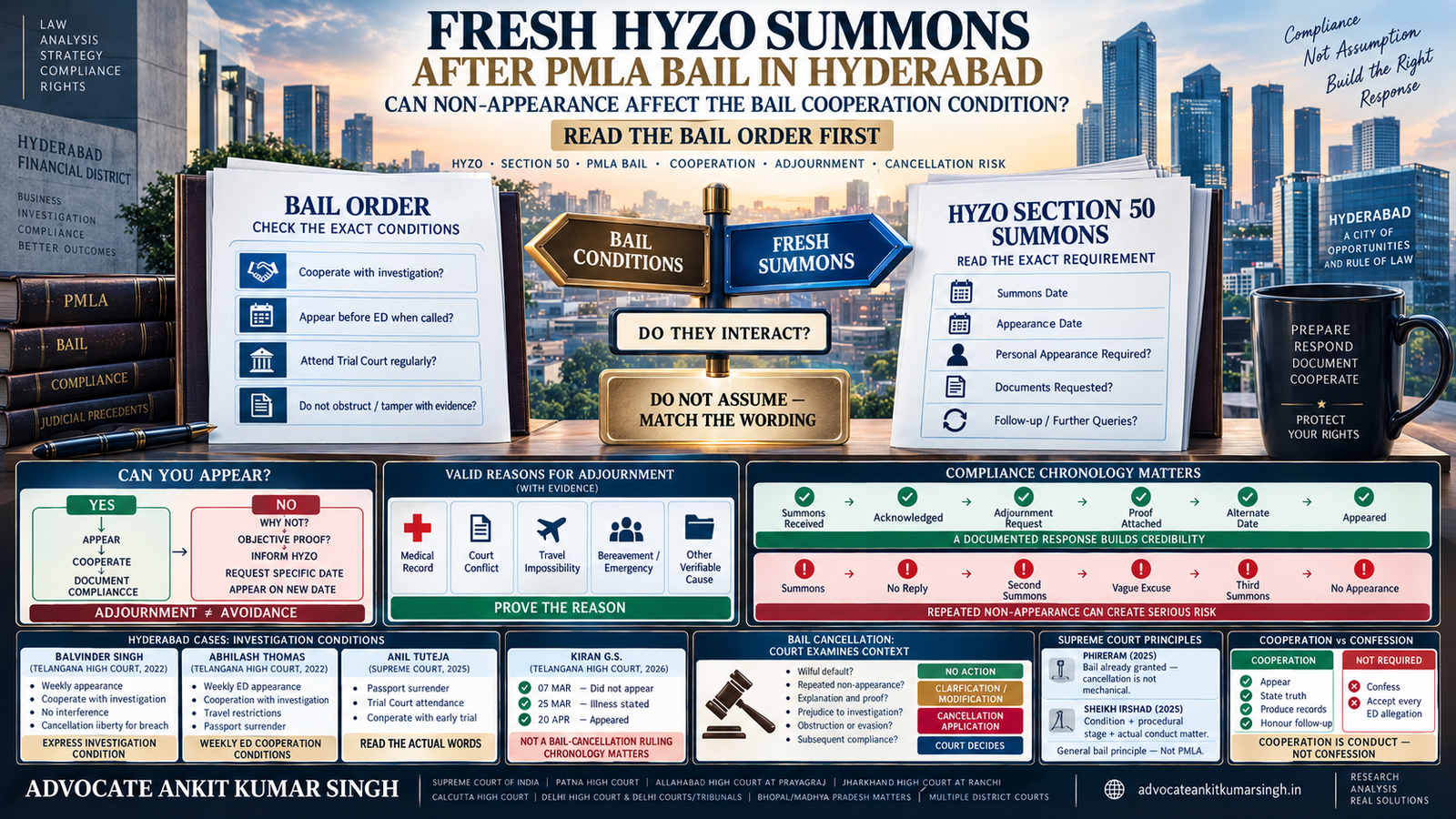
Fresh HYZO Summons After PMLA Bail in Hyderabad: Can Non-Appearance Affect the Bail Cooperation Condition?
Legal research and analysis by Advocate Ankit Kumar Singh
Legally reviewed and updated: 14 September 2026
Summary: In a Hyderabad PMLA case where bail has already been granted, examine how a fresh HYZO Section 50 summons interacts with conditions requiring cooperation, attendance or non-obstruction. The Hyderabad article should distinguish a justified adjournment from deliberate non-compliance and explain why the exact bail order must be reviewed before deciding how to respond.
Direct Answer: Read the Bail Order Before Deciding How to Respond to the Fresh HYZO Summons
A fresh Section 50 summons from the Hyderabad Zonal Office after grant of PMLA bail should not be ignored merely because bail has already been granted.
Section 50 and the bail order perform different legal functions.
The first question is:
WHAT EXACTLY DOES THE OPERATIVE BAIL ORDER REQUIRE?
A bail order may require:
- cooperation with investigation;
- appearance before ED when called;
- periodic appearance before the investigating authority;
- regular attendance before the Special Court;
- cooperation with trial;
- non-interference with witnesses;
- non-tampering with evidence.
Those conditions should not be treated as interchangeable.
Bail Does Not End HYZO's Section 50 Power
Section 50 PMLA empowers specified Enforcement Directorate officers to summon a person whose attendance is considered necessary:
- to give evidence;
- to produce records;
- during an investigation or proceeding under PMLA.
The statutory framework therefore does not create the following rule:
“Once bail is granted, ED cannot question me again.”
If lawful further investigation remains pending, additional Section 50 process may continue according to law.
Section 50 Obligation and Bail-Condition Obligation Must Be Analysed Separately
FRESH HYZO SUMMONS
        ↓
SECTION 50 OBLIGATION?
        ↓
YES — STATUTORY ANALYSIS

SEPARATELY:

WHAT DOES BAIL ORDER SAY?
        ↓
INVESTIGATION COOPERATION?
TRIAL COOPERATION?
PERIODIC ED APPEARANCE?
NO OBSTRUCTION?
        ↓
BAIL-BREACH ANALYSIS
A particular act may potentially engage both regimes.
But the legal basis should still be identified separately.
Four Common Types of Bail Cooperation Conditions
Type 1 — General Investigation Cooperation
“The accused shall cooperate with the investigation.”
Type 2 — Specific ED Appearance
“The accused shall appear before the investigating authority / ED as and when called.”
Type 3 — Periodic Reporting
“The accused shall appear before the authority every Friday between specified hours.”
Type 4 — Trial-Focused Cooperation
“The accused shall regularly attend the Special Court and cooperate with early disposal of the case.”
The legal consequences of a fresh HYZO summons may differ depending on which wording appears in the actual order.
Telangana High Court: Some HYZO Bail Orders Expressly Require ED Cooperation
In Sri Balvinder Singh v. Directorate of Enforcement, the Telangana High Court granted bail in connection with ECIR/HYZO/08/2015 subject to conditions including:
- weekly appearance before the authorities;
- cooperation with investigation;
- non-interference with officers or witnesses;
- restriction on foreign travel;
- passport surrender.
The Court expressly preserved liberty to seek cancellation if a condition was violated.
Where a bail order uses this kind of language, a later unexplained failure to appear can become directly relevant to the bail conditions themselves.
Abhilash Thomas: Another Hyderabad Example of Express Investigation Conditions
In Abhilash Thomas v. Directorate of Enforcement, the Telangana High Court similarly imposed:
- weekly appearance;
- cooperation with investigation;
- non-interference;
- passport and travel restrictions.
The order again permitted the authorities to approach the Court if the imposed conditions were violated.
These Hyderabad cases demonstrate why the phrase:
“MY BAIL HAS BEEN GRANTED.”
is not enough.
The actual conditions must be extracted word-for-word.
Anil Tuteja: A Different Form of Cooperation Condition
In Anil Tuteja v. Directorate of Enforcement, the Supreme Court's April 2025 bail order required, among other things:
- surrender of passport;
- an undertaking to regularly and punctually attend the Trial Court if cognizance was taken;
- cooperation with the Trial Court for early disposal.
The Supreme Court gave ED liberty to seek cancellation if the appellant failed to cooperate with the Special Court or breached any bail condition.
This wording is materially different from a condition saying:
“Appear before ED whenever summoned.”
The distinction does not remove the separate statutory obligation under Section 50.
It means only that the alleged breach of bail must be matched to the condition actually imposed.
Step One After Receiving the Summons: Extract the Bail Conditions
| Condition | Exact Wording | Relevant to Fresh Summons? |
|---|---|---|
| Cooperate with investigation | Copy exact text | Potentially yes |
| Appear before ED when called | Copy exact text | Directly relevant |
| Weekly ED reporting | Copy exact text | Directly relevant |
| Attend Trial Court | Copy exact text | Different obligation |
| No witness influence | Copy exact text | Separate conduct issue |
Step Two: Read the Fresh HYZO Summons Carefully
Record:
- summons number;
- file / ECIR reference;
- date of issuance;
- appearance date;
- appearance time;
- officer;
- whether personal appearance is expressly required;
- documents requested;
- period covered;
- whether this is a first or follow-up summons.
A Single Genuine Adjournment Is Not the Same as Deliberate Avoidance
Consider two situations.
Situation A — Documented Inability
SUMMONS RECEIVED
        ↓
SERIOUS MEDICAL PROBLEM
        ↓
HYZO INFORMED BEFORE DATE
        ↓
MEDICAL RECORD ATTACHED
        ↓
SPECIFIC ALTERNATE DATE OFFERED
        ↓
PERSON APPEARS ON ALTERNATE DATE
Situation B — Avoidance
SUMMONS RECEIVED
        ↓
NO APPEARANCE
        ↓
NO REPLY
        ↓
SECOND SUMMONS
        ↓
VAGUE EXCUSE
        ↓
NO SUPPORTING DOCUMENT
        ↓
THIRD DATE MISSED
        ↓
PERSON UNREACHABLE / ATTEMPTS DEPARTURE
These should not be described by the same single word:
“NON-APPEARANCE.”
What Makes an Adjournment Request Credible?
A stronger request contains:
- immediate acknowledgment of summons;
- precise reason for inability;
- objective supporting proof;
- clear statement that there is no intention to avoid investigation;
- specific alternative dates;
- commitment to preserve and produce requested records;
- actual later compliance.
Medical Adjournment: Attach Evidence, Not Just the Word “Illness”
Potential evidence includes:
- hospital admission record;
- doctor's consultation;
- investigation report;
- prescription;
- surgery schedule;
- medical advice concerning travel or rest.
The document should ideally correlate with the summons date.
A medical paper from an unrelated period may not adequately explain the non-appearance.
Kiran G.S. 2026: Hyderabad Summons Chronology Shows Why Dates Matter
In Kiran G.S. v. Union of India, the Telangana High Court recorded a HYZO Section 50 chronology involving ECIR/HYZO/34/2025.
The record included:
- a required appearance on 7 March 2026;
- non-appearance;
- a further date of 25 March 2026;
- the petitioner's stated inability to attend due to ill-health;
- eventual appearance on 20 April 2026.
That writ concerned different allegations and was not a bail-cancellation ruling.
Its usefulness here is evidentiary:
COURTS CAN SEE THE COMPLETE SUMMONS CHRONOLOGY — NOT MERELY THE SENTENCE “THE PERSON DID NOT APPEAR.”
A Prompt Adjournment Is Better Than a Retrospective Excuse
Where possible, communicate before the required appearance time.
A contemporaneous email is materially stronger than an explanation first invented after:
- another summons;
- an LOC;
- a cancellation application;
- a warrant request;
- an adverse ED filing.
Offer a Real Alternative Date
Avoid:
“I will attend whenever convenient.”
Prefer:
“I remain available to appear on 22, 23 or 24 September 2026, or on another proximate date directed by your office.”
This shows that the request concerns scheduling rather than avoidance.
Produce What Can Be Produced Even If Personal Appearance Must Be Adjourned
Suppose the summons requires:
- bank statements;
- company records;
- property documents.
If those records are available, consider whether they can be supplied with the adjournment communication or on the earliest permissible date.
That creates a materially different record from complete silence.
Repeated Unsupported Adjournments Can Become Dangerous
In Amanatullah Khan v. Directorate of Enforcement, repeated failure to join investigation pursuant to multiple Section 50 summons was treated as materially relevant when the Court considered anticipatory bail.
The broader lesson is not that every adjournment is non-cooperation.
It is:
THE MORE TIMES AN APPEARANCE IS DEFERRED, THE MORE IMPORTANT THE QUALITY OF THE EXPLANATION AND THE SUBSEQUENT CONDUCT BECOME.
Amrit Pal Singh: Unsupported Repeated Excuses Can Look Like Avoidance
In a 2025 Delhi High Court matter, ED relied upon multiple summons that the applicant had not attended while seeking adjournments on different grounds.
ED's argument emphasised the absence of sufficient substantiation for the repeated inability to appear.
The practical lesson is:
ONE GENUINE ADJOURNMENT
+
PROOF
+
NEXT-DATE APPEARANCE

IS FACTUALLY DIFFERENT FROM:

REPEATED ADJOURNMENTS
+
WEAK PROOF
+
NO ACTUAL APPEARANCE.
Does Bail Mean ED Needs Court Permission Before Every Fresh Summons?
No general rule should be stated that Section 50 power ends merely because bail has been granted.
A fresh summons may arise from:
- further investigation;
- new bank records;
- new statements;
- supplementary money-trail analysis;
- new documents;
- questions concerning connected entities;
- authentication of records.
Any challenge to the summons must therefore rest on an identifiable legal ground rather than on bail alone.
Further Investigation Can Continue After Bail
Grant of bail concerns the person's liberty pending investigation or trial.
It does not ordinarily amount to a judicial declaration that:
- investigation is complete forever;
- no supplementary investigation can occur;
- ED can never call the person again.
The exact procedural stage must be checked.
But “Cooperation” Does Not Mean Confession
The person may:
- appear;
- state the truth;
- produce documents;
- deny the allegation;
- dispute beneficial ownership;
- dispute money-laundering character;
- state an honestly held lack of knowledge.
Procedural cooperation should not be measured by whether ED received an admission of guilt.
The Supreme Court has again cautioned in recent criminal-investigation jurisprudence that cooperation cannot simply mean furnishing a confession convenient to the prosecution.
Non-Confession and Non-Appearance Must Not Be Confused
| Conduct | Issue |
|---|---|
| Appears and denies allegation | Not automatically non-cooperation |
| Appears and says truthfully “I do not know” | Credibility can be tested |
| Requests time to retrieve documents | Depends on genuineness and later compliance |
| Repeatedly ignores personal-appearance summons | Potentially serious |
| Destroys evidence | Serious obstruction concern |
| Influences witnesses | Serious bail-cancellation concern |
If HYZO Alleges Bail Breach, Bail Does Not Normally Vanish Automatically
Where ED considers the person's conduct a violation of bail, it may seek appropriate relief before the competent Court according to law.
The Court can then examine:
- what condition actually existed;
- whether it was breached;
- whether the breach was wilful;
- what explanation exists;
- whether the person later cured the default;
- whether investigation or trial was prejudiced;
- whether cancellation is proportionate.
Phireram 2025: Bail Cancellation Is Not the Same as Initial Bail Refusal
The Supreme Court reiterated that cancellation of bail already granted occupies a different legal space from deciding whether bail should originally be granted.
Post-bail circumstances that can justify cancellation may include:
- interference with administration of justice;
- evasion;
- absconding risk;
- witness intimidation;
- evidence tampering;
- abuse of the concession of bail.
The Court emphasised that bail should not be cancelled mechanically.
Sheikh Irshad 2025: Even an Express Reporting Condition Must Be Considered in Context
In Sheikh Irshad @ Monu v. State of Maharashtra, the Supreme Court considered bail that had been cancelled because the accused had not periodically reported to a police station.
The Supreme Court noted:
- chargesheet had already been filed;
- trial was pending;
- the accused was appearing before the Trial Court.
The Court restored bail and held that cancellation merely on that reporting default was not the correct approach in those circumstances.
This was not a PMLA case.
Its broader relevance is that:
THE PURPOSE OF THE CONDITION, PROCEDURAL STAGE AND ACTUAL CONDUCT MUST BE EXAMINED BEFORE LIBERTY IS REVOKED.
This Does Not Mean a Bail Condition Can Be Ignored
The safe strategy is not to test whether a court will later excuse the breach.
If compliance is genuinely impossible:
- write promptly;
- give proof;
- seek adjournment;
- offer an alternative date;
- where appropriate, seek clarification/modification from the Court.
When Should the Bail Court Be Approached?
Court clarification may be considered where:
- the bail condition fixes a specific reporting schedule that has become impossible;
- serious illness prevents compliance;
- overseas residence creates a recurring physical-appearance problem;
- HYZO and the bail order appear to impose conflicting dates;
- the person needs a longer accommodation rather than a one-date adjournment;
- ED asserts that a particular request itself violates or engages the bail condition.
The appropriate remedy depends on the actual order and forum.
Do Not Unilaterally Rewrite the Bail Condition
If the order says:
“Appear every Friday.”
the accused should not simply decide:
“Once every month should be enough.”
If the condition has become unnecessary, oppressive or impractical, seek modification from the competent Court rather than silently changing it.
Build a Post-Bail Summons Compliance Matrix
| Date | Requirement | Response | Proof | Result |
|---|---|---|---|---|
| 01/09/2026 | Summons received | Acknowledged | Complete | |
| 08/09/2026 | Personal appearance | Medical adjournment requested | Hospital record | Alternate date requested |
| 12/09/2026 | Documents | Produced | Covering letter | Complete |
| 15/09/2026 | Rescheduled appearance | Appeared | Communication / record | Complete |
Keep the Bail Order Beside the Summons Matrix
| Bail Condition | Fresh Event | Compliance Position |
|---|---|---|
| Cooperate with investigation | Fresh HYZO summons | Appearance / justified adjournment |
| Do not tamper | Documents requested | Preserved / produced |
| Attend Special Court | Trial date | Appeared / exempted |
| No foreign travel without permission | Travel proposed | Permission sought |
What Should a Written Adjournment Request Contain?
- summons number;
- date of summons;
- appearance date;
- ECIR/file reference;
- precise inability;
- supporting record;
- statement of continued cooperation;
- specific alternative dates;
- status of requested documents;
- contact details.
What Weakens the Post-Bail Position?
- ignoring summons entirely;
- responding only after the appearance date;
- repeated vague excuses;
- unsupported illness;
- avoiding all alternate dates;
- remaining unreachable;
- withholding documents without explanation;
- leaving India contrary to bail conditions;
- contacting witnesses;
- destroying or altering records;
- misrepresenting the contents of the bail order.
What Strengthens the Post-Bail Position?
- copy of the exact bail order;
- full summons chronology;
- prompt responses;
- objective proof for every unavoidable absence;
- specific alternative dates;
- actual later appearances;
- document-production acknowledgments;
- regular Trial Court attendance;
- no evidence tampering;
- no witness interference;
- no breach of passport/travel conditions.
Forensic Decision Tree: Fresh HYZO Summons After Bail
PMLA BAIL GRANTED
       ↓
READ OPERATIVE CONDITIONS
       ↓
FRESH HYZO SECTION 50 SUMMONS
       ↓
PERSONAL APPEARANCE REQUIRED?
       ↓
CAN PERSON APPEAR?
     /          \
   YES           NO
   ↓              ↓
APPEAR       WHY NOT?
                 ↓
          OBJECTIVE PROOF?
                 ↓
        INFORM HYZO PROMPTLY
                 ↓
        OFFER SPECIFIC DATE
                 ↓
        PRODUCE AVAILABLE RECORDS
                 ↓
        HONOUR NEXT DATE
                 ↓
NOW ASK:
DID BAIL ORDER REQUIRE
ED / INVESTIGATION COOPERATION?
                 ↓
WAS THERE AN ACTUAL,
WILFUL BREACH?
                 ↓
ANY PREJUDICE / OBSTRUCTION?
                 ↓
ED MAY SEEK RELIEF
                 ↓
COURT DECIDES BAIL CONSEQUENCE