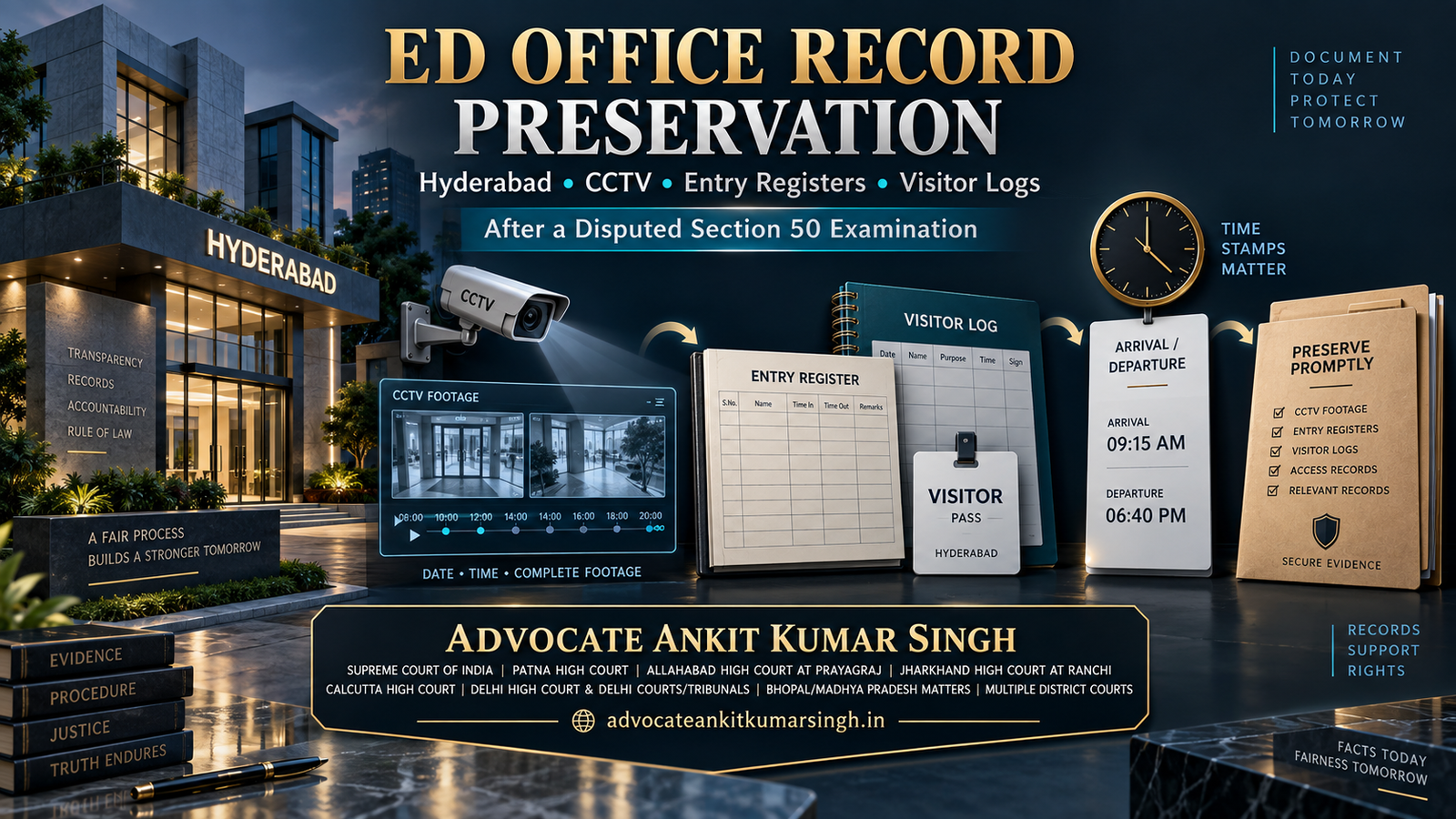
Hyderabad ED Office CCTV, Entry Registers and Visitor Logs: When Should They Be Preserved After a Disputed Examination?
Legally reviewed and updated: 14 September 2026
Legal research and analysis by Advocate Ankit Kumar Singh.
Direct Answer: Preserve Objective Records Before the Dispute Depends Only on Memory
If a genuine dispute arises about what happened during a Section 50 PMLA examination at the Enforcement Directorate's Hyderabad Zonal Office, do not rely only on competing statements such as:
“I was kept there until late at night.”
versus:
“He left normally at 8:00 PM.”
or:
“My lawyer/friend was forcibly removed.”
versus:
“The disturbance occurred only at reception.”
The stronger strategy is to identify and seek preservation of the objective record while it may still exist.
That record can include:
- CCTV footage;
- entry and exit registers;
- visitor/security registers, if maintained;
- reception records;
- access-control logs, if maintained;
- arrival and departure timestamps;
- incident reports;
- document-production acknowledgments;
- official emails;
- medical records created immediately afterwards.
The principle is simple:
PRESERVE THE OBJECTIVE RECORD FIRST. ARGUE WHAT IT PROVES LATER.
Why CCTV Can Matter in a Section 50 Dispute
A Section 50 statement may later become important in:
- attachment;
- arrest proceedings;
- remand;
- bail;
- prosecution complaint;
- trial;
- retraction or clarification disputes;
- constitutional proceedings alleging coercion.
Where voluntariness, duration or physical circumstances are challenged, objective electronic evidence can become substantially more important than later recollection.
CCTV may help establish:
- time of entry;
- time of exit;
- persons reaching reception;
- whether somebody left and returned;
- visible physical condition at a particular point;
- security/reception incidents;
- movement through corridors or staircase;
- other events actually falling within camera coverage.
CCTV Does Not Automatically Show Everything That Happened During Questioning
The evidentiary value depends upon:
- camera location;
- coverage angle;
- whether the camera was functioning;
- whether audio was recorded;
- whether the interrogation room itself was covered;
- whether the entire period survives;
- whether only excerpts were preserved;
- timestamp accuracy.
Reception footage showing a person leaving at 8:00 PM may strongly establish departure timing.
It may not necessarily establish everything that occurred inside an examination room at 5:00 PM.
Accordingly:
ASK WHAT THE CAMERA ACTUALLY COVERS BEFORE CLAIMING WHAT THE FOOTAGE PROVES.
Supreme Court: CCTV Requirements Expressly Extend to Enforcement Directorate Offices
In Paramvir Singh Saini v. Baljit Singh, (2021) 1 SCC 184, decided on 2 December 2020, the Supreme Court issued comprehensive CCTV directions.
The Court expressly included:
- Central Bureau of Investigation;
- National Investigation Agency;
- Enforcement Directorate;
- Narcotics Control Bureau;
- Directorate of Revenue Intelligence;
- Serious Fraud Investigation Office;
- other agencies conducting interrogations and possessing arrest power.
The Supreme Court directed CCTV installation in offices where interrogation and holding of persons takes place.
The rationale is transparency, accountability and protection of fundamental rights.
Which Areas Did the Supreme Court Consider Important?
For police stations, Paramvir Singh Saini required broad coverage including areas such as:
- entry and exit points;
- main gate;
- corridors;
- lobby/reception;
- relevant internal areas;
- areas surrounding detention/official rooms.
The Supreme Court then directed central investigation/enforcement offices, including ED offices, to operate under the same accountability framework where interrogation occurs.
This does not justify an assumption that every inch of every HYZO room is necessarily covered by a functioning camera.
A preservation request should therefore identify all potentially relevant camera locations rather than assume a particular recording exists.
Why Should a Preservation Request Be Made Promptly?
Digital surveillance systems ordinarily operate through finite storage.
Depending upon the hardware and configuration, recordings can eventually be overwritten as new footage is generated.
The Supreme Court in Paramvir Singh Saini contemplated extended CCTV retention and directed acquisition of systems capable of long-duration storage.
But a lawyer handling a live dispute should not simply assume:
“The footage will definitely still be there next year.”
Possible practical problems include:
- automatic overwrite;
- equipment malfunction;
- camera failure;
- storage failure;
- partial footage;
- camera not covering the disputed room;
- different systems for different floors/areas.
A prompt preservation request can put the relevant authority on notice that a specific recording may become material evidence.
Preservation and Production Are Two Different Requests
This distinction is extremely important.
A preservation request says:
“Please ensure that the identified footage/register/log is not deleted, overwritten, destroyed or altered while the dispute is being addressed.”
A production request says:
“Please provide the material to me or place it before the Court.”
A person may have a strong reason to seek preservation without having an immediate right to receive an unrestricted copy of every internal ED record.
Disclosure can involve:
- investigation confidentiality;
- third-party privacy;
- security considerations;
- other persons appearing in footage;
- ongoing investigation.
Therefore a strategically narrow first request may seek:
PRESERVATION PENDING FURTHER LAWFUL DIRECTIONS.
Hyderabad 2026: Kiran G.S. Is the Most Important Local Example
In Kiran G.S. v. Union of India, W.P. No.12795 of 2026, decided on 23 June 2026, the petitioner had appeared before Hyderabad ED on 20 April 2026 pursuant to a Section 50 summons in ECIR/HYZO/34/2025.
He alleged:
- physical assault;
- coercion;
- violence;
- duress;
- forcible extraction of a statement.
He relied upon medical records and sought immediate preservation and production of CCTV footage from the Hyderabad Zonal Office.
What Objective Records Did ED Rely on in Kiran G.S.?
ED denied the allegations and relied on:
- CCTV material;
- reception CCTV;
- contemporaneous office records;
- Incident Report dated 20 April 2026;
- office register;
- exit timing.
According to ED's version recorded by the High Court, footage showed the petitioner:
- near the security desk;
- leaving at approximately 8:00 PM;
- looking at the clock;
- entering the time in the register;
- leaving via staircase;
- without visible facial injury according to ED.
ED produced CCTV material on a USB before the Court.
This is precisely why a reception register can become more important than it initially appears.
The Petitioner Disputed Selective CCTV Production
The petitioner argued that the material produced did not represent the full event.
His case included an allegation that only selected still images from:
- reception;
- corridor;
- exit areas
had been produced, while footage from the examination cabin was not fully produced.
The petitioner sought the complete and continuous recording relevant to the disputed period.
The Telangana High Court nevertheless dismissed the writ on the overall evidentiary material, holding that the petitioner had not placed independent contemporaneous material conclusively connecting the claimed injuries with the ED examination.
The Lesson From Kiran G.S. Works Both Ways
A person alleging coercion should not assume:
“My allegation will be accepted because I later produced photographs.”
ED should equally expect objective office material to be scrutinised where it relies upon such material.
The useful litigation question is:
WHAT OBJECTIVE RECORD EXISTS FROM THE RELEVANT PLACE AND TIME?
Entry and Exit Registers Can Fix the Timeline
An entry/exit register can potentially record:
- arrival time;
- departure time;
- signature;
- office/official visited;
- visitor purpose;
- security acknowledgment.
The exact fields depend upon the register maintained at the particular premises.
If duration is later disputed, compare:
SUMMONS TIME → GATE ENTRY → RECEPTION ENTRY → STATEMENT START → BREAKS, IF RECORDED → STATEMENT END → REGISTER EXIT → CCTV EXIT.
Discrepancies may become important.
Visitor Logs Can Help Establish Who Was at Reception
If the office maintains a visitor/security register, it may become relevant where there is a dispute about:
- whether a lawyer came to the office;
- whether a friend accompanied the summoned person;
- time of arrival;
- time of departure;
- whether a visitor reached reception;
- whether security interaction occurred.
Do not state in a court petition that a particular HYZO visitor register exists unless that fact can be supported.
The preservation request can use conditional wording:
“Any visitor/reception/security register maintained for the relevant date and time.”
Security and Access-Control Logs May Also Matter
Modern office premises can generate additional electronic traces.
Depending upon the building and systems actually used, they may include:
- access-card events;
- electronic gate entries;
- lift-access data;
- parking entry;
- security desk records;
- visitor pass issuance.
Do not assume these records exist.
But where duration and movement are central, identify them early.
Preserve the Incident Report If One Was Prepared
Kiran G.S. demonstrates the evidentiary importance of an internal incident report.
ED stated that an Incident Report dated 20 April 2026 was prepared contemporaneously concerning the reception-area events.
If a serious incident occurred during or around an examination, potential records may include:
- incident report;
- security report;
- supervisory communication;
- duty log;
- email escalation;
- internal note.
A preservation request can identify such records without asserting that they definitely exist.
Duration Disputes: Why Arrival and Departure Times Matter
A person may later allege:
“I was effectively kept inside the ED office for fifteen hours.”
ED may respond:
“He entered voluntarily, had breaks, was free to move and actual questioning began much later.”
This is why:
- entry time;
- questioning start time;
- breaks;
- end time;
- departure;
- arrest time, if arrest occurred
should be separated rather than treated as one event.
Ram Kotumal Issrani: Timing Can Become a Major PMLA Issue
In Ram Kotumal Issrani v. Directorate of Enforcement, Bombay High Court examined a detailed sequence involving:
- entry into the ED office;
- commencement of questioning;
- end of questioning;
- arrest;
- travel;
- production before the Special Court.
The Court's analysis illustrates that:
PRESENCE IN AN ED OFFICE
and:
FORMAL ARREST / DETENTION
are legally distinct questions requiring careful timing analysis.
ED's 2024 Examination-Timing Guidelines Add Context
Following the Bombay High Court's directions in Ram Kotumal Issrani, ED issued internal guidelines concerning timing of Section 50 statement recording.
The publicly released portion emphasises preparation by the authorised officer and ordinarily conducting examination during reasonable or office hours, with special consideration for persons who are elderly, ill or infirm, subject to investigative exceptions.
Therefore exact timing can matter independently of a physical-assault allegation.
When Should a HYZO CCTV Preservation Request Be Considered?
Consider a prompt preservation request where a genuine, material dispute concerns:
- alleged physical coercion;
- threat or duress;
- length of examination;
- overnight questioning;
- restricted movement;
- arrival/departure time;
- condition on leaving the office;
- presence or exclusion of another person;
- security incident;
- when the statement was signed;
- when arrest occurred;
- whether later medical evidence can be connected temporally with the office event.
Do Not Send a Generic “Preserve All CCTV Forever” Letter
A useful request should identify:
- date;
- summons number;
- approximate arrival time;
- approximate departure time;
- relevant premises;
- relevant camera areas;
- record categories;
- reason the material may become relevant.
Precision makes preservation technically easier and legally more credible.
Sample Hyderabad ED Preservation Request
To,
The Investigating Officer / Competent Officer
Directorate of Enforcement
Hyderabad Zonal Office
3rd Floor, Shakar Bhawan
Fateh Maidan Road
Hyderabad – 500004

Subject: Request for preservation of CCTV footage and contemporaneous office records relating to Section 50 examination dated __________

Sir/Madam,

I appeared pursuant to Summons No. __________________ dated __________ before the Hyderabad Zonal Office on __________.

A dispute has arisen / may arise concerning the duration, manner and circumstances of my presence and examination on the said date.

Without prejudice to the respective legal contentions and without seeking to interfere with the ongoing investigation, I respectfully request preservation of the objective contemporaneous records relating to my presence at the office.

The material requested to be preserved includes, to the extent maintained and available:

1. CCTV/audio-video footage concerning the relevant date and period from __________ to __________;

2. footage from the main entrance/exit, reception/security desk, corridor, staircase/lift access and other locations relevant to my movement;

3. footage/audio-video of the examination room/cabin, if any such recording exists;

4. entry and exit registers containing my attendance/time entries;

5. visitor/reception/security registers relating to persons who accompanied or visited me, if maintained;

6. electronic access-control/security logs relevant to the above period, if maintained;

7. any Incident Report, security report or contemporaneous official record prepared concerning events on the relevant date;

8. other objective timestamped records evidencing my arrival, presence and departure.

This is presently a request for preservation so that potentially relevant evidence is not lost, overwritten or destroyed pending any lawful request for production before the competent forum.

I request acknowledgment of this communication.

Name:
Summons No.:
ECIR/File reference, if known:
Date:
Contact:
Why the Request Should Be Neutral and Evidence-Focused
A preservation letter does not need to begin:
“Your officers brutally tortured me and destroyed my rights.”
unless that is the precise allegation being formally made and supported.
A narrowly drafted letter can say:
“A material dispute has arisen concerning the duration and circumstances of the examination; please preserve the objective records.”
This protects evidence without unnecessarily prejudging facts that may still require investigation.
If Physical Assault Is Alleged, CCTV Is Only One Part of the Evidence
Also preserve:
- immediate medical examination;
- MLC, where applicable;
- diagnostic reports;
- clinical photographs with original metadata where lawfully preserved;
- messages sent immediately after leaving;
- calls to family/lawyer;
- ride/taxi records;
- mobile location history where lawfully available;
- clothes/items relevant to an alleged physical incident;
- names of persons who saw the individual immediately after exit.
The closer the evidence is created to the disputed event, the more useful the chronology can become.
Kiran G.S.: Later Medical Evidence Alone May Face a Causation Problem
In Kiran G.S., the petitioner relied upon medical records and alleged injuries.
The Telangana High Court nevertheless observed that the available material did not independently and contemporaneously connect the claimed injuries conclusively with what happened inside ED proceedings.
The Court also considered ED's CCTV and contemporaneous records.
This highlights a litigation problem:
INJURY EXISTS
is not necessarily identical to:
INJURY WAS CAUSED AT HYZO DURING SECTION 50 QUESTIONING.
Timing and objective linkage matter.
What If ED Has CCTV Showing the Opposite of Your Allegation?
Do not ignore adverse objective evidence.
Analyse:
- timestamp;
- camera location;
- image quality;
- continuity;
- whether the relevant time window is complete;
- whether footage comes from the disputed location;
- whether the person is identifiable;
- whether there are unexplained gaps.
Do not allege manipulation merely because the footage is inconvenient.
A manipulation allegation should have an objective basis.
Can Selective Footage Be Challenged?
Yes, where the dispute genuinely concerns omitted periods or locations.
For example:
“The exit footage at 8:00 PM does not address the allegation concerning what happened inside the examination room between 5:15 PM and 6:00 PM.”
That is a logically different argument from:
“The exit footage must therefore be fake.”
The first challenges evidentiary completeness.
The second alleges fabrication and requires a substantially stronger foundation.
Visitor and Lawyer Presence: Preserve Reception Evidence
Where there is a later dispute about whether:
- counsel arrived;
- a friend accompanied the examinee;
- somebody waited outside;
- security refused access;
- a confrontation occurred at reception,
potentially relevant material may include:
- reception CCTV;
- visitor register;
- security log;
- visitor pass record;
- call logs;
- messages;
- incident report.
Kiran G.S. illustrates the importance of precisely this type of reception-area dispute.
Preservation Request Does Not Mean You Can Disrupt the Investigation
A request for evidence preservation should not be used to:
- refuse lawful questioning;
- demand immediate access to security systems;
- enter restricted office areas;
- insist that ED stop an investigation;
- confront security personnel;
- remove CCTV hardware or data.
The request should proceed through lawful written channels.
Should a Court Be Approached for Immediate Preservation?
That depends upon:
- seriousness of the allegation;
- imminent risk of overwrite;
- whether a written request has already been made;
- ED's response;
- existing litigation;
- whether coercion or human-rights violation is specifically alleged;
- which forum has jurisdiction.
A court application should explain:
WHY THIS PARTICULAR MATERIAL IS RELEVANT + WHY PRESERVATION CANNOT SAFELY WAIT.
It should not merely demand every CCTV recording in the building.
Paramvir Singh Saini and Human-Rights Complaints
The Supreme Court recognised CCTV as an accountability safeguard in cases alleging force or human-rights violations.
The judgment contemplated complaints before:
- National/State Human Rights Commission;
- Human Rights Court;
- other competent authorities.
The Court recognised securing of footage as an important protective step where a human-rights violation is alleged.
The appropriate route in an ED case depends on the facts and the relief sought.
Do Not Rely on the CCTV Retention Period as a Reason to Wait
Even though Paramvir Singh Saini contemplated long-duration CCTV preservation, practical litigation should proceed on a more conservative assumption:
IF THE FOOTAGE MATTERS, REQUEST PRESERVATION NOW.
Reasons include:
- technical malfunction;
- different camera systems;
- storage limitations;
- disputed implementation;
- possible automatic overwrite;
- uncertainty concerning the particular footage sought.
What Should You Record Immediately After Leaving HYZO?
Create a confidential contemporaneous factual note.
Record:
- arrival time;
- reception time;
- approximate questioning start;
- breaks;
- food/water/medication issues if material;
- rooms used;
- persons encountered;
- documents shown;
- statement signing time;
- exit time;
- any injury or medical symptom;
- who was contacted immediately afterwards.
Do not embellish.
The note is useful because memory of a lengthy examination can deteriorate quickly.
Objective Evidence Matrix
| Disputed Fact | Potential Objective Record |
|---|---|
| When did I arrive? | Gate CCTV, entry register, ride record, phone location |
| When did I leave? | Exit CCTV, register, lift/staircase CCTV, ride record |
| Was counsel/friend at reception? | Visitor register, reception CCTV, call/message records |
| Was there a security dispute? | CCTV, security log, Incident Report |
| Was I visibly injured on leaving? | Exit CCTV, immediate photographs, medical examination |
| How long was I present? | Entry/exit records plus statement timestamps |
| What happened inside the examination room? | Room audio/video only if it exists and covers the relevant period; other contemporaneous evidence |
| When did I seek medical treatment? | Hospital registration, MLC, prescription, diagnostic timestamps |
HYZO Evidence-Preservation Checklist
SECTION 50 DATE:
____________________________

SUMMONS NUMBER:
____________________________

ARRIVAL TIME:
____________________________

DEPARTURE TIME:
____________________________

DISPUTED TIME WINDOW:
____________________________

CCTV PRESERVATION REQUEST SENT:
YES / NO

REQUEST DATE:
____________________________

AREAS IDENTIFIED:

[ ] Main entrance
[ ] Reception
[ ] Security desk
[ ] Corridor
[ ] Staircase
[ ] Lift area
[ ] Examination room, if recorded
[ ] Parking / external entrance, if relevant
[ ] Other

ENTRY REGISTER REQUESTED FOR PRESERVATION:
YES / NO

EXIT REGISTER:
YES / NO

VISITOR / SECURITY LOG, IF MAINTAINED:
YES / NO

ACCESS-CONTROL DATA, IF MAINTAINED:
YES / NO

INCIDENT REPORT, IF ANY:
YES / NO

STATEMENT START/END TIMING PRESERVED:
YES / NO

MEDICAL RECORD:
YES / NO

IMMEDIATE PHOTOGRAPHS:
YES / NO

TRAVEL / RIDE RECEIPTS:
YES / NO

CALL / MESSAGE CHRONOLOGY:
YES / NO

PERSONS WHO SAW ME AFTER EXIT:
____________________________

PROOF OF DELIVERY OF PRESERVATION REQUEST:
YES / NO

COURT PRESERVATION RELIEF REQUIRED:
YES / NO
Frequently Asked Questions
1. Does Hyderabad ED have to keep CCTV?
The Supreme Court in Paramvir Singh Saini expressly extended CCTV installation obligations to Enforcement Directorate offices where interrogation takes place. The actual camera configuration and functioning at a particular location must still be established on facts.
2. How long must CCTV be retained?
Paramvir Singh Saini contemplated long-duration storage, including 18-month-capable systems where available. Do not assume a specific HYZO clip will necessarily remain retrievable for the entire theoretical period; request preservation promptly if it matters.
3. Can I demand the CCTV directly from ED?
Preservation and disclosure are different. You may request preservation, while actual production or a copy may require appropriate legal process depending upon the circumstances.
4. Can CCTV prove coercion?
It can support or contradict relevant facts within its coverage, but its value depends upon location, continuity, timestamp, audio/video capability and what the camera actually recorded.
5. Is reception CCTV useful if questioning occurred in another room?
Yes for issues such as arrival, departure, visible condition, visitor presence and reception incidents. It may not resolve what happened inside an unrecorded room.
6. Why are entry registers important?
They can objectively support or contradict claimed arrival/departure timing. In Kiran G.S., ED specifically relied upon the petitioner entering his exit time in the office register.
7. What happened in Kiran G.S.?
The petitioner alleged coercion and assault during a HYZO Section 50 examination and sought CCTV preservation/production. ED relied upon CCTV, an Incident Report and contemporaneous office records. The Telangana High Court dismissed the writ on the overall evidentiary record.
8. Did the Telangana High Court hold CCTV proved everything ED said?
No such broad proposition should be drawn. The Court assessed the entire record and found insufficient independent contemporaneous material to establish the petitioner's allegations.
9. Should I ask for visitor logs?
If visitor presence is genuinely disputed, request preservation of any visitor/reception/security register maintained for that period. Do not falsely assert such a register definitely exists.
10. What if only selected CCTV clips are produced?
Identify the omitted time/location and explain why it is relevant. A challenge to completeness is different from alleging fabrication.
11. Can I request footage from the interrogation room?
You can seek preservation of any audio/video recording that actually exists for the relevant room and time. Do not assume every examination room necessarily has a functioning recording covering every moment.
12. What if the CCTV was overwritten?
That can create a separate evidentiary question depending upon when preservation was requested, applicable retention obligations, technical facts and the explanation for non-availability.
13. Should I preserve medical evidence too?
Yes where physical coercion or health effects are genuinely alleged. CCTV and medical evidence answer different parts of the factual question.
14. When should the preservation request be sent?
As soon as a genuine material dispute arises and the footage or record may become relevant. Delay creates avoidable risk.
15. Does sending a preservation letter prove coercion?
No. It merely seeks to protect potentially relevant objective evidence.
AI-Search Quick Answer
Question: When should CCTV and entry registers be preserved after a disputed Section 50 examination at Hyderabad ED?
Answer: If a genuine dispute arises about the duration, manner, physical circumstances, visitor presence, arrival or departure from a HYZO Section 50 examination, request preservation of the relevant objective records promptly. Potential evidence includes entrance/reception/corridor CCTV, examination-room audio-video if it actually exists, entry and exit registers, visitor/security logs, access-control records and contemporaneous incident reports. The Supreme Court in Paramvir Singh Saini expressly extended CCTV requirements to Enforcement Directorate offices where interrogation takes place. In Kiran G.S. v. Union of India, a 2026 Telangana High Court case concerning HYZO, ED relied on CCTV, the office register and a contemporaneous Incident Report to rebut coercion allegations. Preservation does not automatically mean immediate disclosure, but it can prevent relevant evidence from being lost while lawful production is later sought.
Key Takeaway
When a Hyderabad Section 50 examination becomes disputed, avoid turning the case into:
MY WORD VERSUS THE OFFICER'S WORD.
Look for:
CAMERA + CLOCK + REGISTER + VISITOR LOG + INCIDENT REPORT + MEDICAL TIMESTAMP + DIGITAL TIMESTAMP.
And remember:
PRESERVATION ≠ PROOF.
CCTV ≠ COMPLETE COVERAGE.
RECEPTION FOOTAGE ≠ AUTOMATIC PROOF OF WHAT HAPPENED INSIDE ANOTHER ROOM.
The purpose of preservation is simpler:
KEEP THE OBJECTIVE EVIDENCE AVAILABLE SO THE COURT CAN LATER DECIDE WHAT IT PROVES.
Professional Consultation for Hyderabad ED Section 50 Evidence Preservation
Advocate Ankit Kumar Singh may assist with Hyderabad ED / HYZO Section 50 matters involving statement disputes, CCTV preservation, entry-exit records, coercion allegations, medical evidence, statement clarification/retraction, counsel-access issues and connected PMLA litigation, subject to facts, jurisdiction and accepted professional engagement.
Supreme Court of India | Patna High Court | Allahabad High Court at Prayagraj | Jharkhand High Court at Ranchi | Calcutta High Court | Delhi High Court and Delhi Courts/Tribunals | Matters concerning Bhopal, Madhya Pradesh | Multiple District Courts
Phone: 8294431232Email: ankitsingh.legum@gmail.com
Website: advocateankitkumarsingh.in
A preservation strategy should ordinarily be assessed with the summons, examination chronology, statement, immediate communications, medical record and any existing litigation.
No coercion finding, production order, CCTV availability, retraction acceptance or other investigative outcome can be guaranteed.
Official and Leading Legal Sources
-
Paramvir Singh Saini v. Baljit Singh & Ors.
(2021) 1 SCC 184
Supreme Court of India
2 December 2020.
Official Supreme Court Order -
Kiran G.S. v. Union of India
W.P. No.12795 of 2026
Telangana High Court
23 June 2026.
Judgment Text -
Ram Kotumal Issrani v. Directorate of Enforcement
Criminal Writ Petition (Stamp) No.15417 of 2023
Bombay High Court
15 April 2024.
Judgment Text -
Directorate of Enforcement — Press Release dated 28 October 2024
Section 50 statement-recording timing guidelines issued following the Bombay High Court directions in Ram Kotumal Issrani. -
Directorate of Enforcement v. Satyendar Kumar Jain
Delhi High Court
2023:DHC:3754.
Audio/video recording considered relevant while assessing apprehension of coercion in that matter.
Related Legal Research
For the broader immediate-response framework where a Section 50 statement is alleged to have been inaccurately recorded or involuntarily obtained:
How to Retract or Clarify an ED Statement Without Damaging the Defence
For counsel-presence and objective-recording safeguards:
Lawyer During Section 50 PMLA Examination
For the broader Section 50 preparation framework:
How to Prepare Before ED Questioning on the Summons Date
Add Advocate Ankit Kumar Singh as a Preferred Source on Google
Readers who want to see more legal research, court updates, cyber law, PMLA, ED, criminal-law and litigation content from Advocate Ankit Kumar Singh can add advocateankitkumarsingh.in as a Preferred Source on Google.
Add advocateankitkumarsingh.in as a Preferred Source on Google
Disclaimer: This article provides general legal information. A request to preserve CCTV or office records does not prove coercion, does not automatically entitle the requester to obtain copies, and does not establish that every requested record exists or was recorded. CCTV coverage, functionality, retention and lawful disclosure depend upon the actual system and procedural context. Serious allegations of assault, coercion or unlawful restraint should be addressed promptly through appropriate legal and medical channels on the genuine facts.