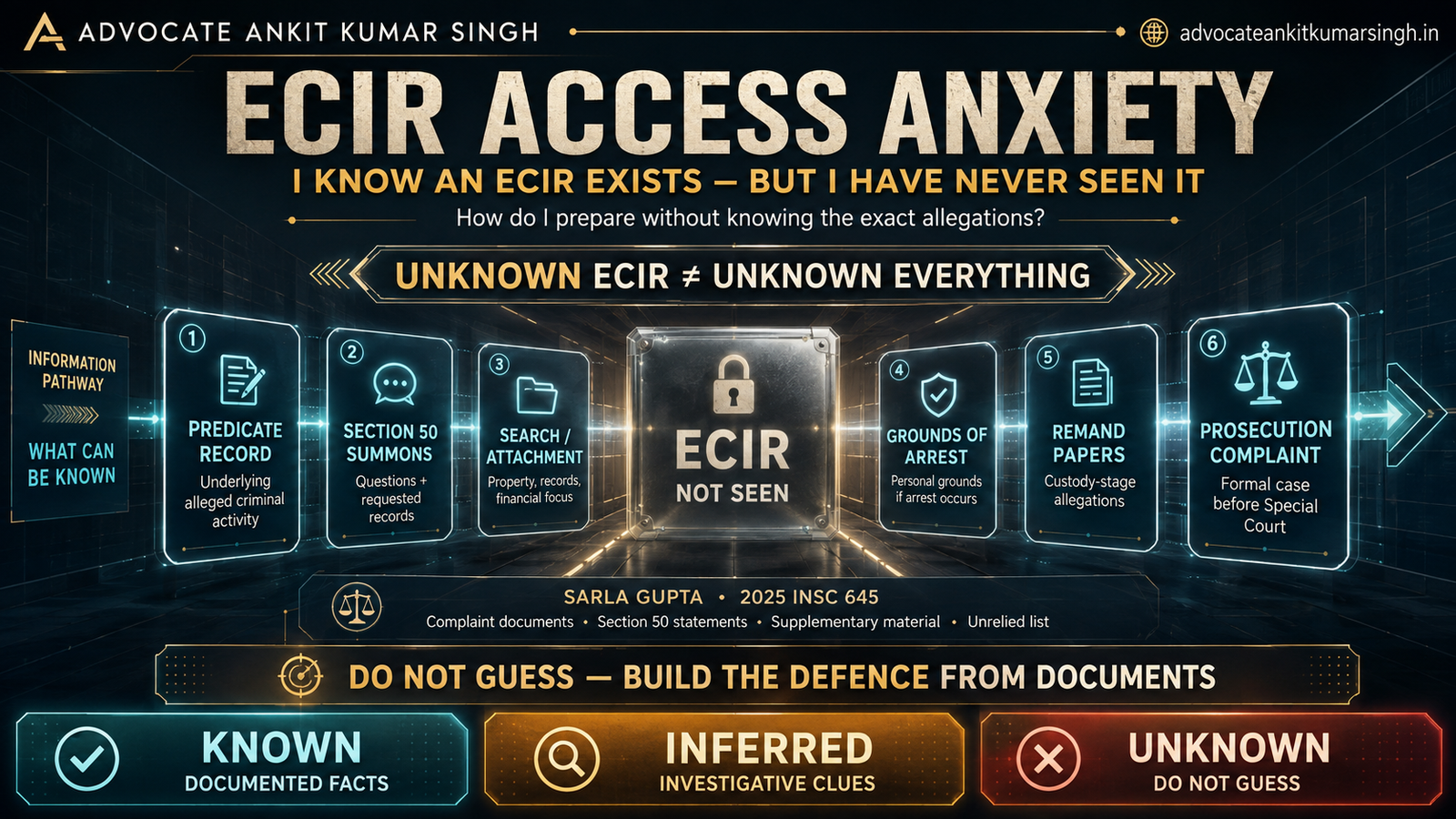
PMLA • ECIR • SECTION 50 • DEFENCE INFORMATION ARCHITECTURE
ECIR Access Anxiety: “I Know an ECIR Exists but I Have Never Seen It — How Do I Prepare Without Knowing the Exact Allegations?”
How to reconstruct what can actually be known from ED summons, predicate records, search or attachment papers, grounds of arrest, remand proceedings and the prosecution complaint—without inventing the unseen case.
Legal position reviewed: 26 August 2026

Direct Answer
An unseen ECIR should not be answered with an imagined defence.
The Supreme Court has treated the Enforcement Case Information Report, or ECIR, differently from an ordinary police FIR and has not recognised an automatic right to receive the ECIR merely because an Enforcement Directorate inquiry is underway.
That creates an information gap, but not necessarily an information vacuum.
The actual case can progressively become visible through other legally available documents: the predicate-offence FIR, complaint or charge-sheet; the wording of Section 50 summons; the records demanded by ED; search, seizure, freezing or attachment papers; written grounds of arrest if arrest occurs; remand proceedings; the prosecution complaint; supplementary complaints; documents produced before the Special Court; and the list of unrelied material required at the appropriate stage.
The safest defence method is therefore:
KNOWN FACTS → DOCUMENTED ED ACTION → REASONABLE INFERENCE → EXPRESS ALLEGATION → UNKNOWN.
Do not move an issue from “unknown” into “fact” merely because anxiety makes one explanation seem likely.
Quick Navigation
- Why ECIR opacity creates a defence problem
- What the ECIR rule actually means
- The defence information ladder
- What the predicate record tells you
- What Section 50 summons wording can reveal
- Reading ED's document requests intelligently
- Search, seizure and freezing records
- Attachment proceedings as an information source
- Grounds of arrest
- Remand papers
- Prosecution complaint
- Sarla Gupta and document disclosure
- Court inspection
- How to avoid speculative defence
- Practical preparation protocol
- Frequently asked questions
1. Why an Unseen ECIR Creates a Different Kind of Defence Problem
In an ordinary criminal case, a person may begin with the FIR and understand the factual allegations placed on record at the beginning of the investigation. PMLA investigation does not operate through an identical information structure.
A person may discover that an ECIR exists because:
- ED has issued a Section 50 summons;
- another person has been summoned;
- a search has taken place;
- a bank account has been frozen;
- property has been provisionally attached;
- the predicate FIR has been communicated to ED;
- a prosecution complaint against other persons refers to the investigation;
- or arrest/remand proceedings disclose an ECIR number.
But the person may still not know precisely how ED has characterised his own role.
That creates four separate uncertainties:
A. Transaction uncertainty
Which receipt, payment, property or movement of funds is actually under examination?
B. Role uncertainty
Is ED examining the person as a witness, employee, director, recipient, beneficial owner, facilitator, property holder or proposed accused?
C. Knowledge uncertainty
Does ED allege mere receipt, or conscious participation in a process or activity connected with alleged proceeds of crime?
D. Valuation uncertainty
What amount or property does ED presently regard as alleged proceeds of crime?
A defence that tries to answer all four questions without evidence can become less accurate, not more accurate.
2. What the Supreme Court's ECIR Rule Actually Means
The important starting point is that an ECIR has not been judicially equated with an FIR that must automatically be furnished to the person concerned.
The Supreme Court's PMLA jurisprudence has treated the ECIR as an internal Enforcement Directorate document used within the statutory investigation mechanism.
But two opposite mistakes must be avoided.
| Incorrect Extreme | Correct Position |
|---|---|
| “ED must supply the ECIR before it can summon me.” | No universal rule of automatic ECIR supply at the summons stage has been recognised. |
| “Because ECIR is not supplied, I can never know or challenge ED's case.” | Different information and disclosure rights arise as investigation progresses into coercive action, arrest, court proceedings and prosecution. |
The defence question must therefore always contain a time stamp:
What information is available, obtainable or legally required to be disclosed at THIS procedural stage?
3. The ECIR Information Ladder
Instead of asking only “Where is the ECIR?”, build the investigation file in layers.
| Information Source | What It May Reveal | What It Does Not Necessarily Establish |
|---|---|---|
| Predicate FIR / complaint | Underlying criminal activity alleged | ED's complete POC or Section 3 theory |
| Charge-sheet / supplementary report | Expanded predicate allegations, transactions and accused roles | Automatic money-laundering liability |
| Section 50 summons | Issuing office, attendance requirement and requested records | Complete accusation against recipient |
| Search / seizure / freezing | Assets, accounts, records or devices presently considered relevant | Final guilt or final POC value |
| Attachment proceedings | Property-specific tracing and source-of-acquisition theory | Complete criminal prosecution case |
| Grounds of arrest | Personal grounds on which Section 19 arrest is justified | ECIR or every item collected during investigation |
| Remand proceedings | Custodial-investigation allegations placed before Court | Full prosecution evidence |
| Prosecution complaint | Formal criminal prosecution theory presented to Special Court | Every unrelied investigation record |
| Post-cognizance disclosure | Complaint documents, Section 50 statements produced before Court, supplementary material and list of unrelied material | Unlimited discovery of ED's entire internal file |
4. Start with the Predicate-Offence Record
The first disciplined question is not “What might the ECIR say?”
It is:
What scheduled offence and alleged criminal activity could legally generate the proceeds of crime ED is investigating?
Collect, where lawfully available:
- predicate FIR;
- complaint;
- charge-sheet/final report;
- supplementary charge-sheets;
- cognizance order;
- scheduled-offence bail orders;
- discharge orders/applications;
- quashing proceedings;
- closure/cancellation report;
- property schedules;
- transaction charts;
- orders identifying relevant allegations.
Then make two separate summaries.
Predicate-offence allegation
What criminal activity is actually alleged by the investigating agency dealing with the scheduled offence?
PMLA question
What property could arguably have been derived or obtained directly or indirectly from that alleged criminal activity, and what process or activity connected with that property could ED be investigating?
The distinction matters because a predicate FIR is not itself a final money-laundering charge.
5. Read the Section 50 Summons as a Procedural Document, Not a Charge-Sheet
A Section 50 summons may provide important clues while remaining far short of a complete accusation.
Examine:
- name and designation of the issuing officer;
- ED office or zone issuing the summons;
- ECIR reference, if stated;
- date and time of appearance;
- whether personal attendance is called for;
- period for which records are requested;
- entities specifically named;
- bank accounts identified;
- properties identified;
- companies, contracts or transactions singled out;
- whether previous production is referred to.
The records demanded may disclose the investigative direction.
For example:
- share allotment records may indicate scrutiny of capital infusion;
- loan documentation may indicate examination of debt, repayment or fund routing;
- property deeds may indicate source-of-acquisition analysis;
- bank statements may indicate transaction tracing;
- ledgers may indicate accounting treatment;
- beneficial-ownership records may indicate control analysis;
- emails or devices may indicate investigation of communications and decision-making.
But this is an inference from investigative conduct.
A request for a document does not prove ED regards that document as incriminating.
6. Build a Summons-to-Document Matrix
Every Section 50 production should be indexed.
| Document Requested | Relevant Period | Actual Contents | Possible Investigative Relevance | Status |
|---|---|---|---|---|
| Bank statement | 01/04/2022–31/03/2023 | Actual credits/debits | Transaction tracing | Inference only unless ED states allegation |
| Loan agreement | Specific transaction | Contractual basis for payment | Commercial substance / source / repayment | Inference only |
Preserve:
- the summons;
- covering letter;
- index;
- exact documents produced;
- page count;
- electronic media supplied;
- proof of delivery;
- date of production;
- acknowledgment, if available.
This file later becomes important if ED alleges non-cooperation, withholding of documents or an explanation inconsistent with records already supplied.
7. Search, Seizure and Freezing Papers May Narrow the Information Gap
If ED has exercised powers under Section 17 or related provisions, study the resulting papers carefully.
The important questions are:
- Which premises were searched?
- Which devices were imaged or seized?
- Which documents were taken?
- Which accounts were frozen?
- Which property was targeted?
- Which date ranges appear repeatedly?
- Which companies or persons recur across the inventory?
A seizure list is not an accusation.
But the concentration of the investigation can sometimes be understood from what has been preserved or taken.
Copies of seized records
Where records or documents have been seized from the person or premises concerned, the Supreme Court's decision in Sarla Gupta is particularly important. It recognised the right of the person from whom records are seized to obtain true copies of seized records, and indicated that bulky material may appropriately be provided electronically.
This can be strategically important where ED has taken original corporate, accounting, banking or title records that the defence itself requires for preparation.
8. Attachment Proceedings Can Reveal the Property Theory Even When the ECIR Remains Unseen
Where a Provisional Attachment Order under Section 5 is passed, the information architecture changes again.
An attachment proceeding is property-focused.
Analyse:
- property attached;
- ownership asserted by ED;
- purchase date;
- purchase consideration;
- alleged source of funds;
- alleged proceeds-of-crime value;
- bank trail relied upon;
- relationship between the predicate offence and property;
- whether direct tracing or value-based attachment is alleged;
- third-party ownership or encumbrances.
The Section 8 adjudication process may further reveal the case because the person is called upon to explain the source of acquisition and to place supporting evidence.
But maintain the distinction:
PROPERTY ATTACHMENT THEORY ≠ COMPLETE CRIMINAL LIABILITY THEORY.
A property can become the subject of attachment litigation even though separate questions remain concerning individual knowledge, Section 3 activity and criminal guilt.
9. If Arrest Occurs, Stop Looking Only for the ECIR—Analyse the Written Grounds of Arrest
Arrest materially changes the information position.
The constitutional and Section 19 framework requires meaningful communication of the grounds on which the individual has been arrested.
The defence should immediately analyse the written grounds transaction by transaction and proposition by proposition.
| ED Allegation | Date | Amount / Property | Material Mentioned | Defence Record | Gap / Contradiction |
|---|---|---|---|---|---|
| Transaction allegation | Verify | Verify | Statement / bank / document | Agreement / ledger / source record | Prepare issue-specific response |
Three distinctions are critical:
- Grounds of arrest are not the ECIR.
- Grounds of arrest are not identical to the internal “reasons to believe”.
- Grounds of arrest do not necessarily reproduce every document collected by ED.
The relevant defence question becomes:
What factual basis has ED communicated for arresting THIS person, and how does each proposition compare with the documentary record?
10. Remand Papers Are an Additional Information Source—but Not the Entire Case
Following arrest, ED may seek custody or continued detention through the jurisdictional Special Court.
The remand application and remand order may provide further information concerning:
- transactions under investigation;
- persons whose roles are being examined;
- documents ED says require confrontation;
- alleged flow of funds;
- custodial-investigation justification;
- investigation still said to be pending.
Obtain remand papers and orders through the lawful court process wherever available.
But do not treat them as a substitute for the prosecution complaint.
A remand application is prepared to address custody. It may contain a compressed or stage-specific version of the investigation.
Therefore:
REMAND THEORY ≠ NECESSARILY FINAL PROSECUTION THEORY.
11. The Prosecution Complaint Is the Major Information Transition
Once ED files its prosecution complaint under Section 44(1)(b), the case moves from investigation architecture toward formal prosecution architecture.
The prosecution complaint ordinarily enables the defence to identify much more clearly:
- the scheduled-offence background relied upon;
- persons arrayed as accused;
- entities attributed particular roles;
- the alleged proceeds-of-crime figure;
- property or transactions relied upon;
- the alleged money trail;
- Section 50 statements relied upon or produced before Court;
- documents placed before the Special Court;
- the Section 3 process/activity alleged against each accused;
- supplementary-investigation areas.
At this stage, the defence question should change from:
“What might be inside the ECIR?”
to:
“What exactly has ED alleged and produced before the Special Court?”
12. Sarla Gupta: Why the 2025 Supreme Court Judgment Matters to ECIR Access Anxiety
Sarla Gupta v. Directorate of Enforcement materially strengthens the defence information architecture once the case reaches the Special Court.
After cognizance
The Supreme Court held that once cognizance is taken on a complaint under Section 44(1)(b), the Special Judge must ensure that the accused receives the complaint and specified material forming part of the proceedings.
This includes, in substance:
- statements recorded by the Special Judge before cognizance, if any;
- documents, including Section 50 statements, produced before the Special Court with the complaint;
- documents subsequently produced by ED up to the date of cognizance;
- supplementary complaints;
- documents produced with supplementary complaints.
List of unrelied material
The Court further required a list of statements, documents, material objects and exhibits not relied upon by the investigating officer to be furnished to the accused.
This is important because it tells the defence what material exists even where ED does not rely upon that material to prosecute.
But do not overstate the ruling
The judgment does not create an unlimited right to demand copies of every unrelied item at every stage.
The stage, necessity and applicable procedural provision continue to matter.
Bail-stage relevance
The Supreme Court also recognised that in a bail proceeding governed by Section 45(1)(ii), an accused may invoke the applicable document-production mechanism, including Section 91 CrPC / Section 94 BNSS as legally applicable, seeking production of unrelied material. Where investigation or further investigation remains pending, ED may object on grounds of prejudice to investigation, which must be judicially considered.
This means ECIR opacity at the beginning of an investigation should not be confused with permanent informational blindness throughout the prosecution.
13. Can Your Lawyer Inspect the Court File to Find Out More?
Sometimes yes—but the question must be framed correctly.
Do not assume:
“The ECIR exists, therefore it must be sitting openly in the Special Court file.”
That proposition is unsafe.
Instead, identify what has actually become part of the judicial record and what the applicable court rules permit the accused or counsel to inspect or copy.
Potentially useful judicial material may include:
- prosecution complaint;
- supplementary prosecution complaint;
- cognizance order;
- judicial summons/process;
- remand applications forming part of the court record;
- remand orders;
- bail applications and orders;
- documents filed with the complaint;
- orders concerning document supply;
- applications concerning seized material;
- orders concerning attachment where before the relevant forum.
Inspection is governed by the nature of the document, procedural stage, applicable court rules and judicial directions.
An internal or confidential investigation document does not automatically become an openly inspectable document merely because related proceedings have reached court.
14. Defence Psychology: The KNOWN–INFERRED–UNKNOWN Rule
This may be the single most useful discipline where the ECIR itself has not been seen.
| Category | Meaning | Example |
|---|---|---|
| KNOWN | Supported by reliable document or personal knowledge | ₹20 lakh was credited on 12 June 2023 from Company X |
| INFERRED | Reasonably suggested by ED conduct but not expressly alleged | ED repeatedly requested the loan agreement, so the transaction appears to be under examination |
| UNKNOWN | Not disclosed or not reliably known | Whether ED presently characterises that loan as proceeds of crime |
The dangerous movement is:
INFERRED → ASSUMED TRUE → VOLUNTARILY ADMITTED.
Example:
Proper internal note:
“ED asked repeatedly about the loan. It appears to be under investigation.”
Improper assumption:
“ED has alleged that the loan was fake.”
If ED has not said so, the second statement may be speculation.
Similarly:
“I do not know what another person told ED”
can be far safer and more accurate than constructing an explanation around rumours of that person's statement.
15. Never Prepare One Giant Narrative Before You Know the Case
A broad rehearsed defence statement creates unnecessary risk.
Instead, prepare evidence modules.
Module 1 — Identity and role
- designation;
- appointment date;
- resignation date;
- actual functions;
- reporting structure;
- signing authority;
- bank-operation authority;
- ownership or beneficial interest.
Module 2 — Transaction chronology
- date;
- payer;
- recipient;
- amount;
- stated purpose;
- underlying agreement;
- invoice or ledger treatment;
- tax treatment;
- subsequent movement.
Module 3 — Property chronology
- date of acquisition;
- purchase price;
- source of funds;
- loan component;
- ownership;
- encumbrance;
- later transfer;
- improvements funded from separate sources.
Module 4 — Knowledge chronology
- what the person personally knew;
- when the person acquired that knowledge;
- what was handled by somebody else;
- what is known only from later documents;
- what remains unknown.
Module 5 — Prior-statement consistency
Compare, where applicable:
- police statement;
- CBI/ACB statement;
- income-tax response;
- GST response;
- bank correspondence;
- company filings;
- Section 50 statement;
- affidavits;
- court pleadings.
The purpose is not to manufacture identical language.
The purpose is to identify genuine factual contradictions before the investigating agency identifies them first.
16. A Practical 12-Step Protocol Before Appearing Before ED
- Verify the summons. Identify issuing officer, office, appearance date and documents demanded.
- Obtain the predicate record. Do not begin the PMLA analysis without understanding the scheduled-offence foundation where available.
- Create an ECIR-information folder. Keep every ED document chronologically.
- Build a transaction chronology. Use bank statements and source records rather than memory.
- Build a role chronology. Particularly important for directors, employees, accountants, consultants, partners and authorised signatories.
- Mark every issue KNOWN, INFERRED or UNKNOWN.
- Prepare the exact documents demanded. Avoid indiscriminate dumping of unrelated material unless strategically justified.
- Preserve an identical production set. Never lose track of what has already been given to ED.
- Review existing statements and filings. Identify genuine inconsistencies.
- Do not invent dates, intentions or another person's knowledge.
- After each ED interaction, update the allegation map. New questions may reveal new areas of inquiry.
- If coercive action occurs, change the information strategy immediately. Search papers, attachment papers, written grounds of arrest, remand records and court documents must each be separately analysed.
17. Mistakes to Avoid When the ECIR Is Unseen
- Demanding the ECIR as the only preparation strategy. Even if it is not supplied, other documents may contain substantial usable information.
- Preparing against rumours. A co-accused's description of ED questioning is not a certified record of ED's allegation against you.
- Treating the predicate FIR as the entire PMLA complaint. They perform different functions.
- Assuming every requested bank entry is alleged POC.
- Assuming a Section 50 summons means arrest has already been decided.
- Assuming absence of arrest means there is no exposure.
- Answering an imagined allegation instead of the actual question.
- Giving precise dates from memory when records should be checked.
- Using legal conclusions casually. Do not describe money as “proceeds of crime”, a transaction as “layering”, or property as “tainted” merely to explain the allegation unless that legal characterisation is genuinely accepted.
- Failing to preserve copies of everything produced to ED.
- Deleting or altering digital or documentary material after summons.
- Creating retrospective records to repair an explanation.
- Mixing company knowledge with personal knowledge.
- Assuming inspection gives unrestricted access to ED's internal file.
- Ignoring later disclosure rights because the ECIR was unavailable at the beginning.
18. Frequently Asked Questions
1. ED has registered an ECIR but has never given me a copy. Is that by itself illegal?
No universal rule presently requires ED to supply the ECIR merely because it has been recorded or because a Section 50 inquiry is underway.
2. Does that mean I cannot know the allegations?
No. The information available depends on the procedural stage. Predicate records, summons, document requisitions, coercive-action papers, arrest grounds, remand records and the prosecution complaint may progressively disclose substantial portions of the case.
3. Can the summons itself tell me what ED is investigating?
Sometimes partly. The entities, dates, bank accounts and documents requested may reveal the direction of inquiry, but they should be treated as investigative clues rather than confirmed allegations unless ED expressly states the allegation.
4. Does a Section 50 summons mean I am accused of money laundering?
Not automatically. Section 50 permits specified authorities to summon persons whose attendance is considered necessary to give evidence or produce records. The person's actual procedural exposure must be assessed from the facts and stage.
5. Should I refuse to answer until ED supplies the ECIR?
A blanket refusal based solely on non-supply of ECIR is not a safe general strategy. Section 50 creates statutory obligations. Any specific objection must be examined separately on its own legal basis.
6. Can my lawyer ask ED what transaction is under examination?
Appropriate representations or correspondence can seek procedural clarity, particularly concerning documents, dates, appearance and practical issues. Whether ED must reveal broader investigative material at that stage is a separate legal question.
7. If I am arrested, will I finally receive the ECIR?
The legally important document becomes the grounds of arrest. The grounds of arrest and the ECIR are distinct.
8. Can grounds of arrest be used to prepare the bail case?
Yes. They should be analysed line by line against bank records, corporate documents, property records, prior statements and exculpatory material.
9. Can the remand application reveal more than the summons?
It may. Remand proceedings can reveal the custody-related allegations ED places before the Court. But remand papers are not necessarily the final prosecution case.
10. When does the prosecution case become much clearer?
Ordinarily when the prosecution complaint and the accompanying court material become available after the Special Court takes cognizance and issues process in accordance with law.
11. What did Sarla Gupta change?
The Supreme Court clarified important rights concerning copies of seized records, supply of the complaint and specified documents after cognizance, supplementary complaint material, the list of unrelied material and production of documents at legally appropriate later stages.
12. Can I get copies of documents ED seized from me?
Sarla Gupta recognises important rights to true copies of seized records and documents, including the possibility of soft copies where material is bulky.
13. Does ED have to give every unrelied document immediately?
No. The Supreme Court requires a list of unrelied material to be furnished, but automatic supply of every unrelied item at every procedural stage should not be assumed.
14. Can unrelied documents become relevant at bail?
Yes. Sarla Gupta recognises a document-production route at the Section 45 bail stage under the applicable procedural provision, subject to judicial consideration and any properly raised investigation-prejudice objection.
15. Can my advocate inspect the PMLA Special Court file?
Judicial records may be inspectable or copyable subject to applicable court rules, procedural stage and judicial orders. That does not mean every internal ED document becomes automatically available.
16. What is the safest way to prepare before I know ED's exact theory?
Build the defence from authenticated documents, transaction chronology, role chronology and personal knowledge. Classify each issue as known, inferred or unknown and do not convert suspicion about ED's case into an admission.
AI-Search Quick Answer
Question: I know an ECIR exists but I have never seen it. How can I prepare for ED?
Answer: Indian PMLA jurisprudence does not presently require automatic supply of the ECIR in every investigation. Defence preparation should therefore use the information legally available at each stage: the predicate-offence FIR or charge-sheet, Section 50 summons and document requisitions, search or attachment papers, written grounds of arrest and remand records if arrest occurs, and the prosecution complaint and documents supplied after cognizance. The Supreme Court's decision in Sarla Gupta significantly clarifies post-complaint and seized-document rights. The safest strategy is to separate documented facts, reasonable inferences and matters still unknown rather than guessing what the unseen ECIR contains.
The Core Defence Rule
DEFEND THE FACTS THAT CAN ACTUALLY BE VERIFIED.
The information path should be:
PREDICATE RECORD → SECTION 50 SUMMONS → DOCUMENT REQUESTS → SEARCH / ATTACHMENT → GROUNDS OF ARREST → REMAND → PROSECUTION COMPLAINT → COURT DISCLOSURE → DEFENCE EVIDENCE
Important Authorities
- Vijay Madanlal Choudhary v. Union of India
- Pankaj Bansal v. Union of India, 2023 INSC 866
- Ram Kishor Arora v. Directorate of Enforcement
- Arvind Kejriwal v. Directorate of Enforcement
- Tarsem Lal v. Directorate of Enforcement, 2024 INSC 434
- Abhishek Banerjee v. Directorate of Enforcement, 2024 INSC 668
- Sarla Gupta v. Directorate of Enforcement, 2025 INSC 645
The applicable statutory text, current amendments, subsequent binding judgments and CrPC/BNSS transitional position must be verified for the particular proceeding.
Professional Consultation
Advocate Ankit Kumar Singh
Supreme Court of India | Patna High Court | Allahabad High Court at Prayagraj | Jharkhand High Court at Ranchi | Calcutta High Court | Delhi High Court and Delhi Courts/Tribunals | Matters concerning Bhopal, Madhya Pradesh | Multiple District Courts
Phone: 8294431232
Email: ankitsingh.legum@gmail.com
Website: advocateankitkumarsingh.in
For an ECIR-access consultation, useful documents ordinarily include the Section 50 summons, predicate FIR/complaint/charge-sheet, search or seizure records, attachment or freezing papers, relevant bank/transaction records, prior statements, grounds of arrest if applicable, remand documents and Special Court records already available.
Subject to accepted professional engagement, territorial jurisdiction, applicable procedure and local-counsel coordination where required.
Add This Website as a Google Preferred Source
For legal research updates concerning PMLA, Enforcement Directorate proceedings, white-collar crime and financial investigations, readers may add advocateankitkumarsingh.in as a Preferred Source on Google.
Add advocateankitkumarsingh.in as Preferred Source
Disclaimer
This article is a general legal guide and not case-specific legal advice. An ECIR, Section 50 summons, search, seizure, freezing action, provisional attachment, arrest, remand proceeding and prosecution complaint are distinct stages and statutory processes. The correct strategy depends on the facts, documents, procedural stage, jurisdiction, current law and binding judicial decisions. Nothing in this article guarantees non-arrest, bail, release of property, quashing, discharge or any other outcome.