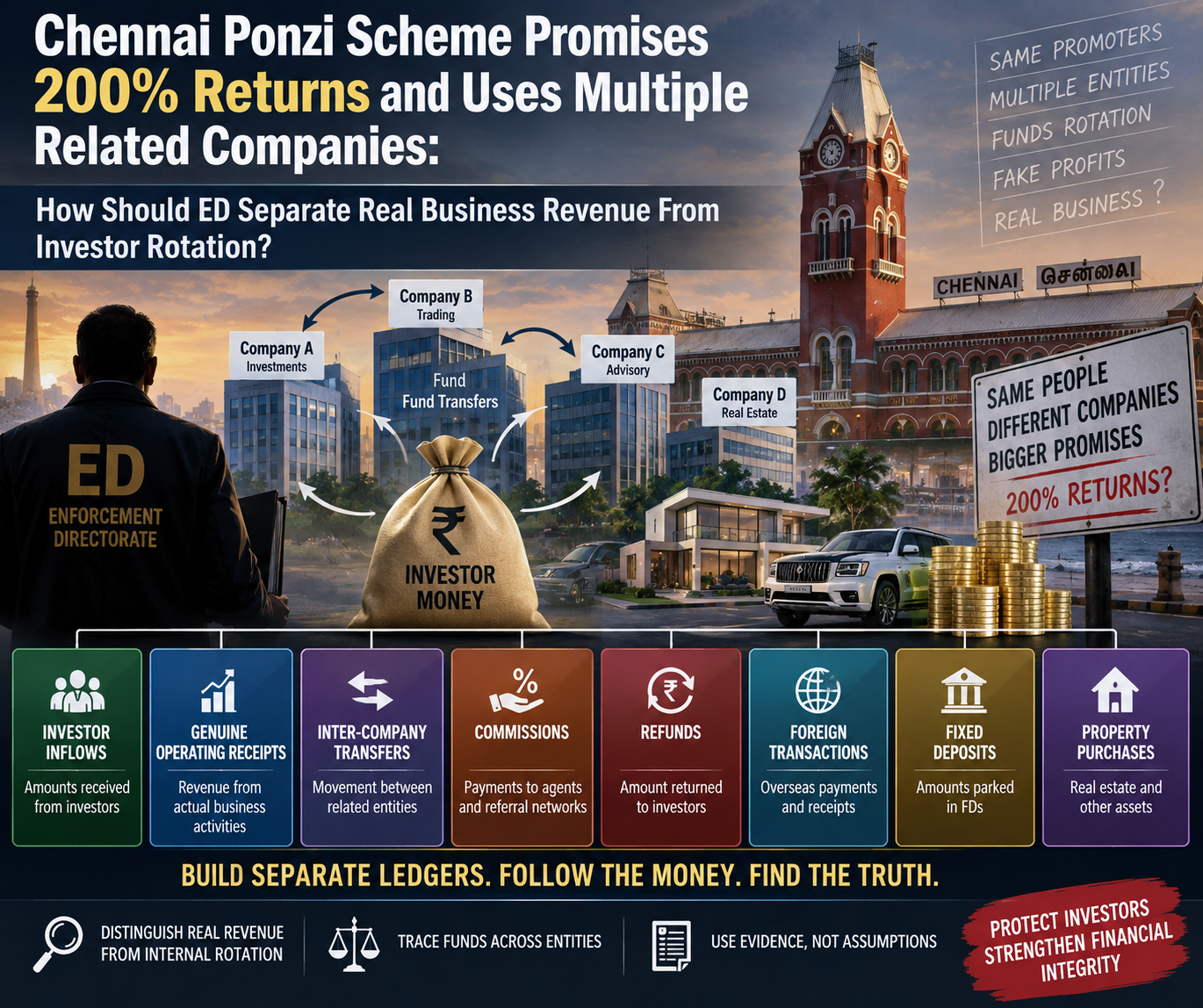
PMLA • ED • CHENNAI • PONZI SCHEME • FUND-FLOW FORENSICS • RELATED ENTITIES
Chennai Ponzi Scheme Promises 200% Returns and Uses Multiple Related Companies: How Should ED Separate Real Business Revenue From Investor Rotation?
Legal research and analysis by Advocate Ankit Kumar Singh
Legally reviewed and updated: 16 September 2026
Summary: In Chennai, analyse schemes that use several entities and promise extraordinary returns while moving funds among related accounts. The Chennai article should build separate ledgers for investor inflows, genuine operating receipts, inter-company transfers, commissions, refunds, foreign transactions, fixed deposits and property purchases so internal rotation is not mistaken for new economic income
Direct Answer: The Same Money Must Not Become “Fresh Revenue” Every Time It Crosses a Company
In a multi-company investment investigation, the starting point should be economic source rather than the number of bank credits.
If an investor deposits ₹1 crore into Company A, Company A transfers ₹1 crore to Company B, Company B sends it to Company C, and Company C places the money in a fixed deposit, the banking system may show gross credits or movements far exceeding ₹1 crore.
But economically there may still be only one original external ₹1 crore corpus.
Those later transfers may be highly relevant to an allegation of layering, concealment, diversion or ultimate beneficial use. But they should not automatically be counted as four separate sources of new business income.
A reliable forensic reconstruction therefore needs separate ledgers for:
- fresh investor money;
- genuine third-party operating revenue;
- inter-company transfers;
- investor returns;
- principal refunds;
- referral or mobilisation commissions;
- foreign transactions;
- fixed-deposit placements and maturities;
- property acquisitions; and
- other independently sourced capital, borrowings or receipts.
The central forensic question is:
DID NEW ECONOMIC VALUE ENTER THE GROUP, OR DID AN EXISTING CORPUS SIMPLY MOVE TO ANOTHER ACCOUNT?
The June 2026 Unique Exports Investigation: What ED Publicly Stated
The Directorate of Enforcement issued a press release dated 17 June 2026 stating that its Chennai Zonal Office had conducted searches on 16 June 2026 under Section 17(1) of the Prevention of Money-Laundering Act, 2002 at eight business and residential premises situated in Chennai, Erode, Coimbatore and Krishnagiri districts.
According to the ED, its investigation arose from FIRs registered by Tamil Nadu Police and Karnataka Police.
ED alleged that a Ponzi scheme was operated in the name of M/s Unique Exports and that hundreds of investors were induced to invest on the representation that money would be deployed in the export of agricultural produce such as onion, potato and other commodities.
The public release alleged that schemes promised returns exceeding 200% within a short period and that investors were also offered commissions for bringing relatives and friends into the schemes.
ED further named the following entities:
- M/s Unique Exports;
- M/s East Valley Agro Farms;
- M/s Unique Rubber Industries;
- M/s Unique International Group;
- M/s Sara Exports;
- M/s Indo Russian Rare Earth Metals; and
- M/s Indo Russian Business Associates.
ED alleged that these entities were used to create bank accounts for accepting investor money and layering funds.
The agency stated that approximately ₹400 crore had been fraudulently raised from the public and alleged that proceeds were diverted into immovable-property investment, fixed deposits, foreign transactions and transfers to associates and related entities.
Digital devices and documents were reportedly seized and the investigation was expressly described as continuing.
Accordingly, the public release is an important research anchor, but it is not a final adjudication of guilt and does not disclose the complete bank-account or investor-level evidence.
Why Multiple Companies Create a Serious Accounting Problem
Consider a simplified group:
INVESTORS
   ↓
UNIQUE EXPORTS
   ↓
RELATED ENTITY A
   ↓
RELATED ENTITY B
   ↓
FIXED DEPOSIT / PROPERTY / FOREIGN PAYMENT
A conventional account-by-account review may record a ₹10 crore credit at every stage.
If the same ₹10 crore moves through four entities, the combined bank statements may display ₹40 crore of credits.
That does not necessarily mean ₹40 crore of independent external money entered the economic group.
The investigation must therefore distinguish:
- gross banking movement;
- fresh external inflow;
- internal redistribution;
- actual operating revenue;
- investor liabilities;
- money paid out;
- money converted into assets; and
- the legally alleged proceeds-of-crime corpus.
Those figures can be very different.
The Master Transaction Register Should Come Before the Conclusions
Every material transaction should first receive a unique transaction identification number.
| Field | What Should Be Recorded |
|---|---|
| Transaction ID | Unique forensic identifier |
| Date / time | Exact credit or debit timestamp where available |
| Originating account | Bank, account and entity |
| Receiving account | Bank, account and entity |
| Amount | Exact amount |
| UTR / cheque reference | Bank-level transaction identifier |
| External or internal | Whether money entered from outside the controlled group |
| Transaction class | Investor / sale / transfer / refund / commission / FD / property / foreign / other |
| Documentary support | Agreement, invoice, ledger, receipt, bank advice, property deed etc. |
| Next destination | Where the funds subsequently travelled |
| Ultimate economic beneficiary | Who ultimately obtained control, property or value |
Classification should follow evidence rather than assumptions based merely on the entity name.
Ledger 1: Fresh Investor Inflows
The investor ledger should identify money entering the group from persons subscribing to the alleged investment schemes.
For each investor:
- investor identity;
- bank account from which funds originated;
- amount transferred;
- date;
- recipient entity;
- scheme or plan represented to the investor;
- promised return;
- maturity date;
- referral agent, if any;
- commission paid for sourcing that investor;
- amount later returned as principal;
- amount characterised as return/profit; and
- balance allegedly outstanding.
Each original external contribution should be counted once as fresh investor money.
Rollovers Must Not Be Mistaken for Fresh Investment
An investor may be told that a matured amount has been “reinvested” into a new scheme.
Suppose:
ORIGINAL INVESTMENT: ₹10 LAKH

MATURITY STATEMENT:
₹10 LAKH PRINCIPAL
+ ₹5 LAKH PROMISED RETURN

NEW CERTIFICATE ISSUED:
₹15 LAKH "REINVESTMENT"
If no ₹15 lakh actually entered the bank account from the investor at that stage, the new certificate does not represent ₹15 lakh of fresh external collection.
It may represent an accounting rollover or an accrued contractual liability.
The distinction is fundamental when computing actual money mobilised.
Ledger 2: Genuine Operating Revenue
If the group claims that agricultural exports generated substantial revenue, actual customer receipts should be independently identified.
For every material commercial receipt ask:
- Who was the customer?
- Was that customer independent or related?
- What goods were sold?
- Was there a commercial invoice?
- Was produce genuinely procured?
- Were goods transported?
- Was warehousing used?
- Was a shipping bill generated?
- Was there a bill of lading or equivalent shipping evidence?
- Do Customs records support export?
- Did the foreign buyer actually remit payment?
- Can the remittance be linked to the identified shipment?
- Does the sale appear in the books and tax records where applicable?
- What was the actual gross margin?
A receipt from a genuine unrelated customer for goods actually supplied is analytically different from investor money that merely enters an account carrying the name “Exports”.
Investor Money Is Not Business Turnover Merely Because It Enters a Business Account
Bank statements record money movement. They do not themselves determine the legal or accounting character of every credit.
A ₹20 lakh credit could represent:
- customer sales revenue;
- investor principal;
- inter-company transfer;
- bank borrowing;
- promoter capital;
- sale of an asset;
- refund;
- matured fixed-deposit proceeds;
- interest;
- foreign export proceeds; or
- another source.
Characterisation therefore requires source documentation.
Ledger 3: Inter-Company Transfers
Every transfer among controlled or related entities should be separately tagged as an internal movement unless evidence establishes a genuinely independent commercial receipt.
For each transfer ask:
- Was it a loan?
- Was it repayment of an earlier loan?
- Was it capital?
- Was it purchase consideration?
- Was it reimbursement?
- Was it treasury movement?
- Was it supported by an invoice?
- Did any goods or services actually move?
- Was substantially the same sum immediately moved onward?
- Did the money ultimately return to a related person or entity?
The Anti-Double-Counting Rule
INVESTOR → COMPANY A = ₹10 CRORE
COMPANY A → COMPANY B = ₹10 CRORE
COMPANY B → COMPANY C = ₹10 CRORE
COMPANY C → FIXED DEPOSIT = ₹10 CRORE

FRESH EXTERNAL MONEY:
₹10 CRORE

GROSS RECORDED MOVEMENTS:
₹40 CRORE

THE TWO NUMBERS ANSWER DIFFERENT QUESTIONS.
The internal transfers may be important evidence regarding alleged layering. But gross transactional volume should not be automatically represented as fresh income.
Ledger 4: Investor Returns
A payment described as “profit”, “monthly return”, “dividend”, “bonus” or “ROI” should be traced backwards to the money that actually funded it.
Possible funding sources include:
- genuine operating profit;
- realisation of genuine trade receivables;
- interest income;
- sale of an asset;
- bank borrowing;
- fresh investor money;
- another related entity;
- promoter funds; or
- an unidentified source.
The Ponzi-Rotation Test
NEW INVESTOR B
      ↓
₹10 LAKH ENTERS GROUP
      ↓
₹3 LAKH SENT TO EARLIER INVESTOR A
      ↓
DESCRIBED AS "RETURN"
For Investor A, ₹3 lakh may be a payment received.
From the system-wide perspective, however, investigators must determine whether that payment was financed by real business profit or by the capital of a later investor.
Can an Agricultural Export Business Economically Produce a 200% Return?
Extraordinary promised returns make the economics of the stated business especially important.
The inquiry should compare the promised investor yield with the actual achievable business margin.
For example:
EXPORT SALES
- COST OF ONION / POTATO / PRODUCE
- PACKING
- TRANSPORT
- WAREHOUSING
- QUALITY LOSS / SPOILAGE
- FREIGHT
- PORT / CLEARING COST
- INSURANCE
- FINANCE COST
- SALARIES
- TAX / COMPLIANCE COST
= REAL OPERATING PROFIT
If the investor scheme promises more than 200% while the actual underlying trade generates only an ordinary trading margin, the investigator should identify the independent economic source capable of funding the difference.
The extraordinary promise is an investigative lead. The bank and commercial evidence must still establish what actually occurred.
Ledger 5: Principal Refunds
Principal repayment should not be merged with investment return.
Suppose an investor originally contributed ₹10 lakh:
ORIGINAL PRINCIPAL: ₹10 LAKH

RETURN / PROFIT PAID: ₹2 LAKH

PRINCIPAL REFUNDED: ₹4 LAKH

PRINCIPAL OUTSTANDING: ₹6 LAKH
Calling the entire ₹6 lakh payment a “refund” would conceal the difference between repayment of capital and payment of alleged profit.
Each refund should therefore be linked back to the original investment ID.
Ledger 6: Referral and Mobilisation Commissions
ED's Unique Exports release specifically stated that investors were allegedly encouraged to bring relatives and friends by offering commissions.
A separate referral ledger should therefore identify:
- agent or introducer;
- investor introduced;
- investment amount sourced;
- commission formula;
- actual commission paid;
- bank account receiving commission;
- cash component, if any;
- source account funding the commission;
- whether commission increased with recruitment levels; and
- whether the recipient independently performed any other service.
Commission is an outflow. It should not be counted as a separate corpus merely because it later appears as income in the recipient's account.
Ledger 7: Foreign Transactions
The ED release identifies foreign transactions as one alleged destination category. That description should trigger transaction-level verification, not an assumption that every cross-border payment was unlawful.
Separate at least:
- foreign buyer receipts for genuine exports;
- advance export receipts;
- import payments;
- freight or logistics charges;
- payments for genuine overseas services;
- related-party remittances;
- capital transactions;
- refunds;
- foreign investments; and
- transactions for which no commercial basis is established.
A genuine export receipt should ordinarily be capable of reconciliation with its export invoice, shipping documentation, buyer, banking trail and relevant foreign-exchange/export realisation material.
The investigation should therefore ask whether the foreign transaction represents new third-party commercial value or merely another movement of the original investor corpus.
Ledger 8: Fixed Deposits
A fixed deposit creates another common double-counting problem.
BANK ACCOUNT
₹5 CRORE
   ↓
FIXED DEPOSIT
₹5 CRORE
   ↓
FD MATURES
₹5 CRORE + INTEREST
   ↓
BANK ACCOUNT
The ₹5 crore principal has not become fresh revenue merely because:
- it left the operating account;
- appeared as an FD;
- matured; and
- returned to a bank account.
The original principal and the interest component should be separated.
A fixed deposit can nevertheless be highly significant for tracing, preservation, attachment and identification of the form into which an alleged corpus was converted.
Ledger 9: Property Purchases
The ED release also refers to immovable-property investment.
For every property allegedly connected with the fund trail identify:
- buyer;
- seller;
- agreement date;
- registration date;
- purchase consideration;
- stamp-duty value;
- bank account funding payment;
- intermediate entities through which funds travelled;
- loan component;
- independent lawful contribution, if any;
- beneficial ownership;
- subsequent transfer, mortgage or sale; and
- connection asserted with the alleged proceeds of crime.
A property purchase represents an end-use or conversion of value. It is not another fresh inflow simply because the property itself later has a monetary value.
A Consolidated Group Ledger Is Essential
Reviewing each company independently can conceal circularity.
A better reconstruction places all relevant controlled accounts into one chronological database.
| Economic Bucket | Fresh Value? | Core Question |
|---|---|---|
| New investor deposit | Potentially yes | Did new external investor money enter? |
| Independent customer payment | Potentially yes | Was real business supplied? |
| A → B group transfer | Normally no new group-level value | Why was it moved? |
| Investor return payment | No | What source funded it? |
| Principal refund | No | Which original investment did it repay? |
| Referral commission | No | Was it funded from investor corpus or operating profit? |
| FD placement | No | What was source of principal? |
| FD maturity principal | No | Is this simply return of earlier principal? |
| FD interest | Yes, separate income component | What corpus generated the interest? |
| Property purchase | No | What funds purchased the asset? |
| Foreign buyer receipt | Potentially yes | Does it match a genuine export? |
| Foreign related-party transfer | Depends on source | Is it independent external value or recycled money? |
The “First External Origin” Rule
For every material corpus, identify the first point at which value entered the controlled economic group.
WHERE DID THIS MONEY FIRST COME FROM?

INVESTOR?
CUSTOMER?
BANK?
PROMOTER?
ASSET BUYER?
FOREIGN CUSTOMER?
TAX REFUND?
INTEREST?
ANOTHER GROUP COMPANY?
UNKNOWN?
Once a corpus has been tagged with an origin ID, later transfers should ordinarily retain lineage to that original source unless independent value is added.
This prevents the accounting system from creating fictional economic growth merely through internal movement.
A Worked Example: How ₹25 Crore Can Become ₹90 Crore of Gross Bank Credits
Assume:
- fresh investor money: ₹20 crore;
- genuine unrelated export receipts: ₹5 crore.
Total fresh external inflow:
₹25 CRORE
The ₹20 crore investor corpus then moves:
INVESTORS → COMPANY A               ₹20 CRORE
COMPANY A → COMPANY B               ₹18 CRORE
COMPANY B → COMPANY C               ₹15 CRORE
COMPANY C → FD                      ₹10 CRORE
FD MATURITY → COMPANY C             ₹10 CRORE + INTEREST
COMPANY C → PROPERTY SELLER          ₹7 CRORE
COMPANY B → EARLIER INVESTORS        ₹3 CRORE
Adding every debit and credit can produce a very large transaction figure.
But a source-of-funds analysis must keep asking:
HOW MUCH NEW VALUE ENTERED, WHERE DID IT COME FROM, AND WHAT HAPPENED TO THAT SAME VALUE AFTER ENTRY?
Gross transactional movement, alleged investor mobilisation, outstanding investor liability, property acquired, money presently available and legally identified proceeds of crime are therefore separate metrics.
PMLA Legal Framework: Why Source Identification Matters
Section 2(1)(u) of the PMLA defines “proceeds of crime” around property derived or obtained, directly or indirectly, as a result of criminal activity relating to a scheduled offence, together with the statutory value-related components of that definition.
This makes source analysis legally important.
The Supreme Court's 2026 decision in M/s Nav Nirman Builders & Developers Pvt. Ltd. v. Union of India, 2026 INSC 130, reiterated the statutory scope of Section 2(1)(u), including value-equivalent property in the circumstances contemplated by the provision.
Importantly, while discussing Vijay Madanlal Choudhary, the Court reiterated the distinction that property does not become proceeds of crime merely because it is somehow connected with a criminal case. The statutory derivation or obtaining requirement remains central.
In Pavana Dibbur v. Directorate of Enforcement, the Supreme Court likewise emphasised that existence of proceeds of crime is fundamental to the offence under Section 3 PMLA and that the existence of a scheduled offence is a condition precedent for proceeds of crime.
Accordingly, a large bank turnover figure cannot replace the legal exercise of identifying property allegedly generated through criminal activity relating to the scheduled offence.
Section 23 and Interconnected Transactions
Section 23 PMLA contains a statutory presumption concerning interconnected transactions in the circumstances specified by that provision.
That makes complete transaction documentation particularly important where multiple companies and accounts are involved.
But the existence of several connected transfers should not be reduced to the proposition that every transfer represents independent proceeds of crime or fresh investor collection.
One issue concerns whether transactions form an interconnected laundering structure.
A different accounting issue concerns whether those transactions represent the same economic corpus moving repeatedly.
Both questions should be answered.
Why the Corporate Structure Alone Is Not Enough
Seven related entities may be evidentially important.
But company count by itself does not determine the legal character of the funds.
For each entity ask:
- What business did it actually conduct?
- Did it have independent customers?
- Did it purchase goods?
- Did it employ staff?
- Did it maintain inventory?
- Did it bear commercial risk?
- Did it earn an independent margin?
- Did it have a genuine reason to receive the questioned funds?
- Was it merely a temporary pass-through account?
- Who controlled its banking?
- What happened immediately after funds arrived?
Corporate complexity can support an investigative hypothesis. The fund trail and business evidence must establish what the complexity actually accomplished.
Digital Evidence Can Connect the Financial Ledgers
ED stated that digital devices including laptops, pen drives and mobile phones were seized during the June 2026 searches.
Depending on the evidence lawfully recovered, potentially relevant material may include:
- investor databases;
- scheme brochures;
- return calculators;
- WhatsApp or messaging instructions;
- banking credentials;
- accounting software;
- spreadsheets;
- commission records;
- property schedules;
- foreign counterparty correspondence;
- export documentation;
- internal fund-transfer instructions;
- beneficial ownership records; and
- communications concerning investor repayments.
The evidentiary value of any recovered material depends on authenticity, attribution, context and the applicable law.
Seven Reconciliations That Should Ultimately Agree
- Investor register ↔ bank credits
- Sales ledger ↔ genuine customer receipts
- Inter-company ledger ↔ corresponding counterparty entries
- Investor payout ledger ↔ bank debits
- Fixed-deposit register ↔ bank placement and maturity entries
- Property schedule ↔ actual purchase consideration trail
- Foreign transaction register ↔ underlying commercial and banking documentation
Unexplained differences between these reconciliations can provide investigative leads.
Five Numbers That Must Never Be Confused
| Number | Meaning |
|---|---|
| Gross bank turnover | Total debits/credits, potentially including repeated internal movements |
| Fresh investor mobilisation | External investor principal actually entering the system |
| Genuine operating revenue | Independent commercial receipts supported by real business |
| Investor liability/loss computation | Requires principal, refunds, returns and outstanding amounts to be separately reconciled |
| Proceeds-of-crime computation | Legal PMLA calculation requiring nexus with criminal activity relating to the scheduled offence |
They answer different questions and should not be casually substituted for one another.
Forensic Flowchart: From Investor Money to Final Economic Destination
Forensic fund-flow model: distinguish external economic inflow from repeated internal movement before analysing final destination and PMLA consequences.Plain-text alternative: External investor money and genuine customer revenue are first separately identified. Each corpus receives an origin ID. Related-company transfers retain that lineage and are not automatically treated as new revenue. Investor payouts, commissions, fixed deposits, property acquisitions and foreign transactions are then traced to determine the ultimate use of the original corpus.
Documents Required for a Serious Multi-Company Reconstruction
Banking
- complete bank statements;
- account-opening documents;
- bank mandates;
- UTR-level transaction data;
- fixed-deposit receipts;
- lien documents;
- loan documents;
- foreign-remittance records.
Investor Records
- application forms;
- receipts;
- scheme brochures;
- contracts;
- maturity statements;
- return statements;
- referral records;
- refund records.
Business Records
- sales invoices;
- purchase invoices;
- supplier ledgers;
- customer ledgers;
- inventory records;
- warehouse records;
- transport records;
- shipping documents;
- customs records;
- foreign buyer correspondence;
- tax and accounting records.
Corporate Records
- incorporation records;
- directors and shareholders;
- beneficial ownership;
- board resolutions;
- inter-company agreements;
- loan ledgers;
- related-party disclosures.
Asset Records
- sale deeds;
- agreements for sale;
- property-payment schedules;
- vehicle purchase documents;
- fixed-deposit schedules;
- investment statements.
Common Analytical Mistakes
- Adding every company credit together without eliminating internal transfers.
- Treating every credit as sales revenue.
- Counting a rollover as fresh investor money.
- Combining principal refunds and promised returns.
- Counting an FD placement and FD maturity as separate new income.
- Treating every foreign transaction as export revenue.
- Ignoring independent genuine customer receipts.
- Using the number of companies as a substitute for tracing actual funds.
- Failing to identify the ultimate beneficiary.
- Equating gross turnover with legally established proceeds of crime.
Frequently Asked Questions
1. Does transferring money through seven companies mean seven times the income?
No. The same corpus may pass through several accounts. Each transfer may require investigation, but fresh economic inflow should be distinguished from internal movement.
2. Does a transfer between related companies automatically prove money laundering?
No. Its source, purpose, documentation, onward movement and ultimate beneficiary must be examined. Inter-company transfers can be commercially genuine or may form part of alleged layering depending on the evidence.
3. Is every investor payment automatically proceeds of crime?
The PMLA analysis depends on the criminal activity relating to the scheduled offence, the property allegedly derived or obtained from that activity and the statutory ingredients of the Act.
4. Can genuine business revenue coexist with alleged investor money?
Yes. A mixed account may contain several types of receipts. Source segregation is therefore essential.
5. Should an FD maturity be counted as fresh revenue?
The maturity principal normally represents return of the corpus placed into the FD. The interest component is analytically separate.
6. How should property purchases be analysed?
Trace the purchase consideration back through the bank chain and identify each independent funding source, including any documented loan or lawful contribution.
7. Why do foreign transactions require separate analysis?
Because a foreign credit could represent genuine export proceeds, capital, refund or another transaction, while an outward payment may relate to imports, services, investment or another purpose. The underlying documents determine the character.
8. Why are promised returns above 200% important?
They make it important to test whether the stated agricultural-export economics were capable of generating the promised yield and, if not, what source actually financed payments to investors.
9. Did ED finally prove the entire ₹400 crore allegation?
The 17 June 2026 public release describes the investigation and allegations and states that further investigation is in progress. It should not be described as a final conviction or adjudication.
10. What is the most important forensic question?
Identify where each material corpus first entered the group and preserve that source identity while tracing every subsequent transfer.
AI-Search Quick Answer
How should ED separate genuine revenue from investor rotation in a multi-company Ponzi investigation?
Build a consolidated transaction database and separately classify fresh investor deposits, independent customer receipts, related-company transfers, investor returns, principal refunds, referral commissions, foreign transactions, fixed deposits and property purchases. Give each external corpus a source ID and preserve that identity through later internal transfers. This prevents the same money from being counted repeatedly as fresh economic income merely because it moved through several related accounts.
Key Takeaway
The number of companies does not determine the amount of money.
The number of bank transfers does not determine the amount of fresh revenue.
And gross bank turnover does not automatically determine the amount of proceeds of crime.
In a case involving extraordinary return promises and multiple related entities, the strongest financial reconstruction follows each corpus from its first external origin through every internal movement and finally to the person, asset or transaction in which the economic value ultimately rests.
SOURCE → CHARACTER → INTERNAL MOVEMENT → PAYOUT → ASSET / BENEFICIARY → LEGAL NEXUS
That approach allows genuine business receipts to remain identifiable while also exposing any recycling of later investor funds, circular movement, unsupported corporate transfers or conversion of the alleged corpus into other forms of property.
Professional Coordination for PMLA and Financial-Crime Matters
Supreme Court of India | Patna High Court | Allahabad High Court at Prayagraj | Jharkhand High Court at Ranchi | Calcutta High Court | Delhi High Court and Delhi Courts/Tribunals | Matters concerning Bhopal, Madhya Pradesh | Multiple District Courts
Phone: 8294431232Email: ankitsingh.legum@gmail.com
Website: advocateankitkumarsingh.in
PMLA, Enforcement Directorate, financial-crime, bank-tracing and connected litigation work depends upon the individual facts, documents, territorial jurisdiction and accepted professional engagement. Outstation matters may require local or authorised counsel. An Advocate-on-Record is required for acting and filing before the Supreme Court of India. No arrest, bail, attachment, unfreezing, quashing, investigation or judicial outcome can be guaranteed.
Official Sources
- Directorate of Enforcement — Press Release dated 17 June 2026 concerning search operations in the M/s Unique Exports & others Ponzi investigation: Official ED Press Release
- India Code — Prevention of Money-Laundering Act, 2002: PMLA, 2002
- Supreme Court of India — M/s Nav Nirman Builders & Developers Pvt. Ltd. v. Union of India, 2026 INSC 130: Judgment dated 6 February 2026
- Supreme Court of India — Pavana Dibbur v. Directorate of Enforcement, 2023 INSC 1029: Judgment dated 29 November 2023
- Directorate of Enforcement — Annual Report 2025-26, including discussion of Ponzi/investment-fraud and layering typologies: ED Annual Report 2025-26
Add Advocate Ankit Kumar Singh as a Preferred Source on Google
Readers who want to see more legal research, court updates, cyber law, PMLA, ED, criminal-law and litigation content from Advocate Ankit Kumar Singh can add advocateankitkumarsingh.in as a Preferred Source on Google.
Add advocateankitkumarsingh.in as a Preferred Source on Google
Legal Research Disclaimer: This article is an educational analysis based on publicly available material as reviewed on 16 September 2026. Allegations concerning M/s Unique Exports, named individuals or related entities remain allegations unless established through the competent judicial process. The ED press release expressly states that investigation is continuing. This article does not determine guilt, quantify the final proceeds of crime or substitute for examination of the FIRs, ECIR-related record, bank statements, relied-upon documents, statements, prosecution complaint or orders in an individual matter.