PMLA / ENFORCEMENT DIRECTORATE
Non-Cooperation Psychology Under PMLA: Is Denial or “I Do Not Remember” the Same as Non-Cooperation?
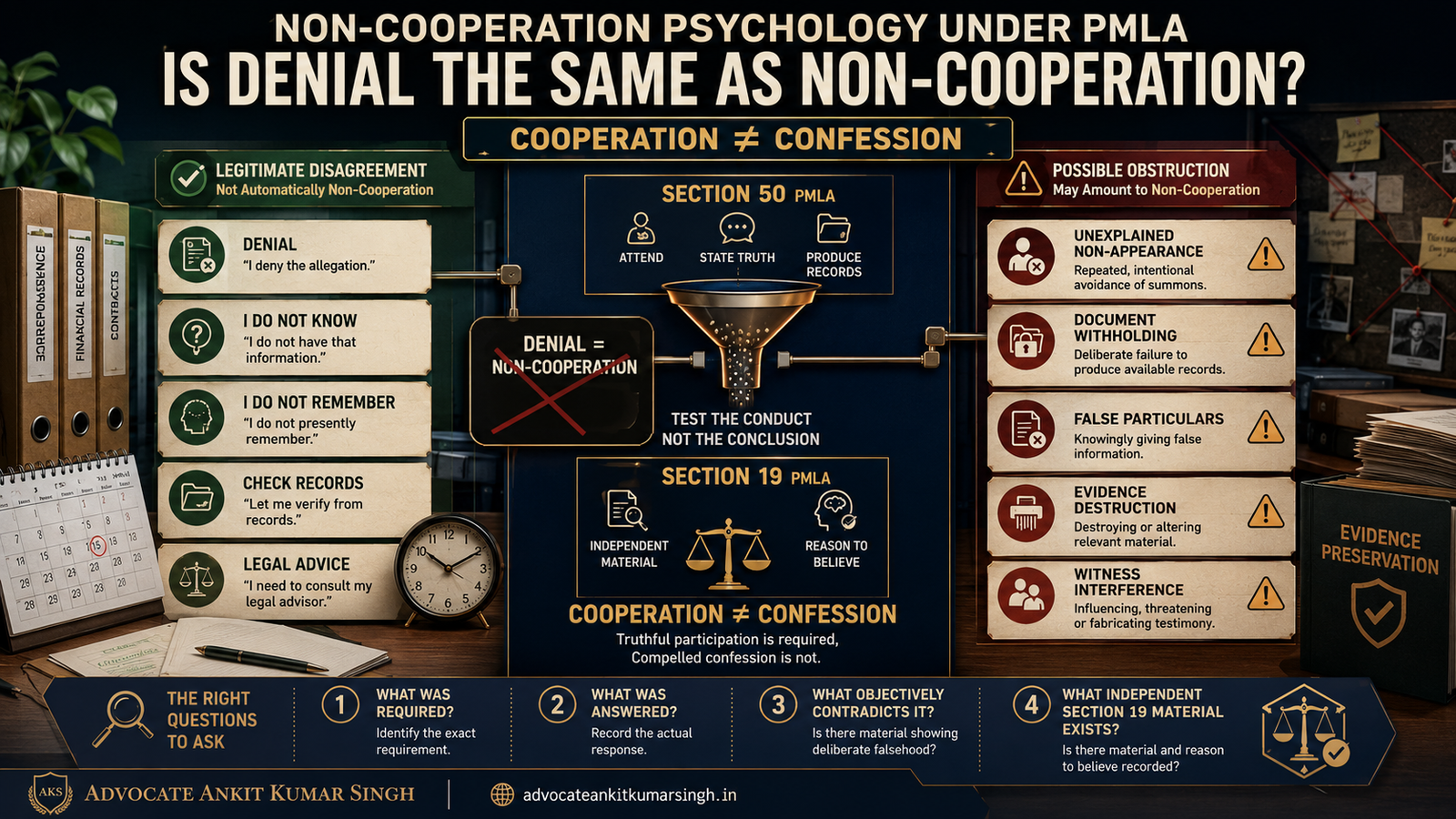
ED says a person was “non-cooperative”. But was there genuine obstruction—or merely disagreement with the allegation, imperfect memory, reliance on documents, or refusal to confess?

Direct Answer
No. Disagreement is not automatically non-cooperation, and cooperation does not mean confession.
A person summoned by the Enforcement Directorate under Section 50 of the Prevention of Money-Laundering Act, 2002 cannot ordinarily ignore a lawful summons, deliberately conceal documents or knowingly furnish false particulars. Section 50 creates real obligations concerning attendance, examination and production of records.
But the obligation to participate truthfully cannot be converted into an obligation to accept ED's allegation.
A truthful answer may be:
- “I deny that allegation.”
- “That interpretation is incorrect.”
- “I do not know.”
- “I do not presently remember.”
- “I need to see the records before answering accurately.”
- “That transaction was handled by another department.”
The Supreme Court's reasoning in Pankaj Bansal v. Union of India draws an important boundary. Mere non-cooperation in response to Section 50 cannot itself substitute for the statutory foundation required under Section 19, and an investigating authority cannot expect an admission of guilt and treat everything short of such admission as an evasive answer.
That principle does not protect deliberate obstruction. Destruction of evidence, deliberate withholding of available records, knowingly false particulars, repeated intentional avoidance of summons or strategically fabricated memory loss may create an entirely different factual situation.
The legally useful question is therefore:
What exactly did the person fail to do, was the person legally required and practically able to do it, and what objective material demonstrates that the failure was deliberate?
Cooperation Is Conduct — Not Agreement With ED
Investigations necessarily operate through hypotheses. An officer may believe that a company was controlled by a particular person, that a transaction was fictitious, that certain funds represented proceeds of crime, or that an invoice was merely accommodation.
The person questioned may disagree.
That disagreement cannot automatically answer whether the person cooperated.
A person may:
- appear pursuant to every summons;
- submit requested bank statements;
- produce agreements and accounting records;
- identify relevant employees;
- provide device or email particulars;
- answer questions for several hours;
- give written explanations;
and still deny the central allegation.
Such denial may be completely consistent with procedural cooperation.
Conversely, another person may appear polite and agreeable while secretly destroying records or influencing witnesses.
The law should therefore examine conduct rather than attitude.
A Practical Classification of “Non-Cooperation”
| Conduct | Automatic non-cooperation? | Correct inquiry |
|---|---|---|
| Simple denial of allegation | No | Did the person nevertheless attend, answer and provide records? |
| “I do not remember” | No | Is the memory limitation objectively plausible? |
| Seeking legal advice | No | Was advice sought legitimately or used as a pretext to evade a lawful obligation? |
| Requesting time to obtain documents | No | Were the records later produced and was the request reasonable? |
| Repeated unexplained non-appearance | Potentially relevant | Was summons served and was avoidance deliberate? |
| Withholding available records | Potentially serious | Were records specifically demanded and within possession or control? |
| Knowingly false particulars | Potentially serious | Is there objective evidence showing deliberate falsity rather than error? |
| Evidence destruction | Strong obstruction concern | Was relevant material intentionally destroyed after knowledge of investigation? |
What Section 50 PMLA Actually Requires
Section 50 confers important powers upon designated Enforcement Directorate officers to summon persons whose attendance is considered necessary for giving evidence or producing records during proceedings under the Act.
A responsible defence analysis must therefore avoid the opposite exaggeration.
Pankaj Bansal does not convert Section 50 questioning into an optional conversation.
A person cannot ordinarily assume:
- “I need not appear.”
- “I may intentionally lie.”
- “I can conceal demanded documents.”
- “I can destroy material once summons is received.”
- “I can fabricate ignorance about something I personally handled.”
The stronger and legally accurate proposition is:
Pankaj Bansal: “Evasive” Cannot Simply Mean “Did Not Admit Guilt”
The decision in Pankaj Bansal v. Union of India is central to the modern law governing this issue.
Section 19 requires an authorised officer to possess relevant material and, on the basis of that material, record reasons to believe that the person has been guilty of an offence punishable under the PMLA.
That statutory requirement cannot be replaced by dissatisfaction with answers given during questioning.
The deeper constitutional concern is obvious.
If “cooperation” were defined as acceptance of ED's allegation, every denial would become evidence of obstruction and every confession would become evidence of cooperation.
That would distort both Section 50 and Section 19.
Santosh: Non-Confession Is Not Non-Cooperation
The Supreme Court's decision in Santosh S/o Dwarkadas Fafat v. State of Maharashtra, although not a PMLA decision, provides an important principle concerning custodial interrogation.
Investigating agencies cannot treat custody primarily as a mechanism to secure confession.
Merely because a person continues to deny the allegation does not automatically establish failure to cooperate.
At the same time, the judgment does not protect actual obstruction.
The correct distinction is:
Non-confession is protected from being automatically labelled non-cooperation.
Actual obstruction may still have legal consequences.
The Hardest Category: “I Do Not Remember”
Human memory is not a perfect transaction database.
Businesspeople, employees, directors, accountants and professionals may participate in hundreds or thousands of transactions over several years.
Questions asked during investigation may concern:
- an old transaction;
- an exact date;
- an account entry;
- a name mentioned years ago;
- an invoice handled by another employee;
- a telephone conversation;
- an approval contained only in electronic records.
In such circumstances, “I do not presently remember” may be more truthful than guessing.
But the same phrase can also be abused.
Indicators consistent with genuine memory limitation
- The transaction is several years old.
- The person handled hundreds of similar transactions.
- The question seeks exact figures requiring reference to accounts.
- The person identifies records that can clarify the issue.
- The person says “I cannot accurately answer without seeing the file”.
- The person later corrects the answer after viewing contemporaneous documents.
- The memory limitation is consistent rather than selectively convenient.
Indicators requiring closer scrutiny
- The transaction occurred only days earlier.
- The transaction was unusually large or personally negotiated.
- Messages show detailed personal involvement.
- The person claims no recollection despite recently discussing the same event.
- The claimed memory gap changes after each new document is shown.
- Relevant records were deleted or concealed.
None of these factors automatically proves money laundering.
They merely help determine whether a claimed memory limitation is genuine or potentially strategic.
“I Do Not Know”, “I Do Not Remember” and “I Refuse to Answer” Are Different
These responses should not be mechanically compressed into one label.
“I do not know”
This concerns absence of knowledge.
“I do not remember”
This concerns absence of present recollection.
“I refuse to answer”
This is a deliberate decision not to provide a substantive response.
Their legal and evidentiary consequences may differ substantially.
A statement simply recording “the person remained evasive” may therefore be too vague to permit meaningful judicial review unless the underlying question and answer are identified.
Legal Advice Is Not Itself Non-Cooperation
Seeking legal advice before responding to coercive investigative process is not itself evidence of obstruction.
Legal advice may be required concerning:
- scope of the summons;
- documents demanded;
- privileged communications;
- records belonging to another company;
- electronic evidence preservation;
- correction of earlier answers;
- possible exposure in the scheduled offence;
- constitutional protection against self-incrimination;
- distinction between personal knowledge and company records.
However, consulting counsel does not create a blanket immunity from every statutory obligation under Section 50.
The correct inquiry remains question-specific and status-specific.
Vijay Madanlal: Why This Is Not a Simple “Right to Silence” Article
A responsible analysis must account for Vijay Madanlal Choudhary v. Union of India.
The Supreme Court upheld the statutory architecture of Section 50 and examined the obligations imposed upon summoned persons as well as the Article 20(3) framework.
It would therefore be inaccurate to convert Pankaj Bansal into an unrestricted proposition that anyone summoned by ED can simply decline to participate.
The sharper distinction is:
- truthful statutory participation; and
- compelled agreement with the investigator's theory.
The former may be required by statute.
The latter cannot become the legal definition of cooperation.
What Genuine Non-Cooperation May Look Like
1. Repeated intentional non-appearance
Repeated failure to attend after valid service, without credible explanation, may be materially different from seeking one reasonable adjournment because of illness, travel impossibility or another genuine circumstance.
2. Deliberate document withholding
A serious allegation should identify:
- which document was demanded;
- when it was demanded;
- whether the person possessed or controlled it;
- whether adequate time was provided;
- what explanation was offered;
- what evidence shows intentional withholding.
3. Knowingly false particulars
Knowingly giving false information about bank accounts, beneficial ownership, devices, companies, transactions or email accounts may be substantially different from simply denying an allegation.
But error, approximation and deliberate falsity must not be treated as synonymous.
4. Evidence destruction
Deleting messages, destroying accounting records, altering documents or instructing others to conceal evidence after becoming aware of the investigation may provide concrete evidence of obstruction.
5. Witness interference
Attempting to influence, threaten or coordinate false testimony is qualitatively different from denying personal involvement.
6. Strategic false amnesia
An investigator may legitimately test claimed memory failure against contemporaneous records.
But “false memory loss” should be demonstrated through objective contradiction—not inferred merely because the desired admission was not obtained.
The Psychology Problem: When Disagreement Starts Looking Like Defiance
Confirmation bias
Once an investigative theory has formed, an answer supporting the theory may instinctively appear credible while an answer contradicting it may appear evasive.
That intuition is not evidence.
Confession bias
Progress toward an admission may unconsciously be treated as progress toward “cooperation”.
This is precisely why investigators and courts must distinguish confession from procedural cooperation.
Repetition effect
Repeated questioning may reveal genuine contradiction.
But minor variations may also arise because of:
- fatigue;
- question wording;
- passage of time;
- attempts to clarify an earlier answer;
- imperfect recollection.
Authority-pressure response
Some people become highly agreeable under official pressure. Others become nervous, defensive or terse.
Neither reaction, standing alone, proves guilt or non-cooperation.
A Better Investigator's Protocol for Recording Non-Cooperation
Where an officer genuinely believes that a person is obstructing investigation, a structured record is substantially stronger than generic language.
- Identify the precise question, summons requirement or document demand.
- Record the person's actual answer or conduct.
- Identify objective material contradicting the answer, where applicable.
- Explain how the conduct obstructed a legitimate investigative step.
- Keep that issue analytically separate from the independent Section 19 reason-to-believe exercise.
For example:
“The witness was evasive”
is substantially less useful than:
“The witness denied control over Account X despite corporate records, email correspondence and account-opening documentation showing that he personally authorised operation of the account.”
The second formulation is capable of judicial examination.
A Judicial Review Matrix for Courts
| Judicial question | Purpose |
|---|---|
| What exact conduct was called non-cooperation? | Prevents vague labels replacing facts. |
| Was the person legally required to perform that act? | Separates statutory obligation from investigator preference. |
| Was performance practically possible? | Relevant to unavailable records, illness and genuine inability. |
| Was the answer a denial or an actual refusal? | A denial cannot automatically be treated as non-response. |
| Why was the answer described as evasive? | Requires objective explanation. |
| Was ED effectively demanding an admission? | Cooperation cannot be measured by confession. |
| What independent Section 19 material existed? | Non-cooperation cannot replace the statutory arrest foundation. |
| Was the alleged obstruction contemporaneously recorded? | Later reconstruction requires careful scrutiny. |
Manideep Mago: The Necessary Qualification
Later PMLA decisions demonstrate why the defence proposition must not be overstated.
The principle is not:
A court may still examine other specific allegations and independent material relied upon by the authorised officer.
Accordingly, a reference to non-cooperation does not automatically invalidate an arrest where the record contains other legally relevant grounds.
The more precise proposition is:
Section 19: The Arrest Question Remains Separate
Section 19 requires the authorised officer to possess material and to record reasons to believe that the person has been guilty of an offence punishable under the PMLA.
That requirement is not satisfied merely by writing:
- “He did not cooperate.”
- “He denied the allegation.”
- “He did not give satisfactory answers.”
- “He remained evasive.”
- “He failed to confess despite confrontation.”
The issue must remain:
What material independently supports the statutory reason to believe?
The Section 19 exercise may be judicially reviewed without converting arrest review into a mini-trial.
A court need not finally decide guilt in order to examine whether the statutory threshold was actually applied.
What a Person Should Preserve if ED Later Alleges Non-Cooperation
- Every summons received.
- Proof of every appearance.
- Email communications with ED.
- Adjournment requests.
- Medical records supporting inability to attend.
- Travel records where relevant.
- Copies of every document submitted.
- Covering letters.
- Document indexes.
- Acknowledgements.
- Written explanations submitted to ED.
- Records showing that requested material was unavailable.
- Records identifying another entity holding the document.
- Documents later used to refresh memory.
- Corrections voluntarily supplied after discovering an earlier mistake.
This creates a contemporaneous chronology capable of answering a later allegation that the person simply “did not cooperate”.
Practical Non-Cooperation Evidence Chart
| Date | ED requirement | Response | Proof | Disputed issue |
|---|---|---|---|---|
| DD/MM/YYYY | Personal appearance | Appeared | Attendance record | None |
| DD/MM/YYYY | Bank statements | Produced | Covering letter | ED says incomplete |
| DD/MM/YYYY | Question on old transaction | Could not remember without ledger | Ledger later supplied | Whether answer was evasive |
Mistakes That Can Convert a Strong Position Into a Weak One
Guessing
A confident but inaccurate answer may create an unnecessary contradiction.
Where recollection genuinely requires documents, saying so clearly may be more accurate than guessing.
Giving approximate figures as exact figures
Clearly identify estimates.
Ignoring summons
Challenging a summons legally and simply failing to appear are fundamentally different strategies.
Producing documents without acknowledgement
Later disputes may arise over what was actually supplied.
Destroying records
Evidence preservation should begin immediately once investigation is known.
Changing answers without explanation
Where an earlier genuine factual mistake is discovered, transparent correction may be materially different from unexplained contradiction.
Assuming legal advice creates blanket immunity
The statutory and constitutional position is more nuanced.
Assuming Pankaj Bansal means non-cooperation never matters
Genuine obstruction may still be relevant when supported by specific conduct and independent material.
For Investigators: A More Defensible Meaning of Cooperation
Distinguishing denial from obstruction strengthens rather than weakens investigation.
- Record what the person actually did.
- Do not measure cooperation by admission.
- Do not call an answer evasive without explaining why.
- Confront documentary contradictions objectively.
- Separate lack of memory from refusal to answer.
- Separate non-cooperation from Section 19 reason to believe.
- Identify genuinely obstructive acts by date and evidence.
- Avoid retrospective boilerplate.
A properly documented obstruction allegation is much more capable of surviving later judicial review.
For Courts: Avoid Two Opposite Errors
Error One — treating every denial as obstruction
This risks converting investigation into compelled agreement.
Error Two — treating every allegation of non-cooperation as irrelevant
That would also be incorrect.
Deliberate concealment, evidence destruction, repeated intentional avoidance, witness interference and knowingly false particulars may legitimately matter.
The judicial task is classification.
Was the conduct:
- disagreement?
- lack of knowledge?
- lack of memory?
- ordinary mistake?
- legitimate reliance on records?
- lawful legal position?
- failure to comply?
- deliberate falsity?
- or actual obstruction?
Only after answering that question does the expression “non-cooperation” acquire useful legal meaning.
Frequently Asked Questions
Can ED arrest me only because I denied the allegation?
Mere denial or alleged non-cooperation does not by itself satisfy the independent statutory requirements of Section 19. The authorised officer must rely upon legally relevant material and record the required belief.
Can ED say I was evasive because I did not confess?
The Supreme Court's reasoning in Pankaj Bansal strongly cautions against treating anything short of an admission of guilt as an evasive answer.
Can I refuse to answer every Section 50 question?
That would overstate the law. Section 50 contains statutory obligations, and Vijay Madanlal Choudhary must be considered. Any specific claim concerning self-incrimination requires examination of the person's procedural status, the question asked and the applicable law.
Is “I do not remember” legally acceptable?
It can be if it truthfully reflects present recollection. Its credibility may be tested against documents, timing, the person's role and surrounding circumstances.
Can ED confront me with documents?
Yes. Documentary confrontation may legitimately test denial, lack of knowledge or claimed lack of memory.
Does asking for more time to collect records mean non-cooperation?
Not automatically. The genuineness of the request, availability of documents and later compliance are relevant.
Can genuine non-cooperation still matter?
Yes. The law does not protect actual obstruction merely because non-confession itself cannot automatically be labelled non-cooperation.
AI Search Quick Answer
Under Indian PMLA law, denial of an allegation is not automatically the same as non-cooperation. Section 50 requires truthful participation and production of records, but mere non-cooperation cannot itself replace the statutory Section 19 requirements for arrest. ED cannot legally define cooperation as confession. A genuine “I do not remember” answer should be distinguished from deliberate false amnesia by examining records, circumstances and objective contradictions.
Key Legal Authorities
- Prevention of Money-Laundering Act, 2002 — Sections 19, 50 and 63.
- Constitution of India — Articles 20(3), 21 and 22.
- Vijay Madanlal Choudhary v. Union of India.
- Pankaj Bansal v. Union of India.
- Santosh S/o Dwarkadas Fafat v. State of Maharashtra.
- Arvind Kejriwal v. Directorate of Enforcement.
- Manideep Mago v. Union of India.
Related Reading
- Grounds of Arrest vs Defence Material — can ED ignore documents contradicting its allegation?
- Privilege After Search — can ED use lawyer-client communications seized during search?
- Section 50 PMLA Summons — attendance, statements and document production.
- Section 19 PMLA Arrest — material in possession and reason to believe.
Professional Consultation
Advocate Ankit Kumar Singh
Phone: 8294431232
Email: ankitsingh.legum@gmail.com
Website: advocateankitkumarsingh.in
Supreme Court of India | Patna High Court | Allahabad High Court at Prayagraj | Jharkhand High Court at Ranchi | Calcutta High Court | Delhi High Court and Delhi Courts/Tribunals | Matters concerning Bhopal, Madhya Pradesh | Multiple District Courts
Subject to accepted professional engagement, territorial jurisdiction, applicable procedure and local-counsel coordination where required.
Add This Website as a Preferred Source on Google
For detailed legal research on PMLA, Enforcement Directorate proceedings, economic offences and white-collar criminal defence, you may add advocateankitkumarsingh.in as a Preferred Source on Google.
Add as Google Preferred SourceDisclaimer: This article is a general legal research guide and does not constitute case-specific legal advice. Whether particular conduct amounts to non-cooperation, whether constitutional protections apply to a specific question or statement, and whether an arrest satisfies Sections 19 and 50 PMLA depend upon the facts, documents, procedural stage, status of the person, jurisdiction and law applicable at the relevant time. Judicial precedents must be applied to their actual facts and ratio. No outcome is guaranteed.