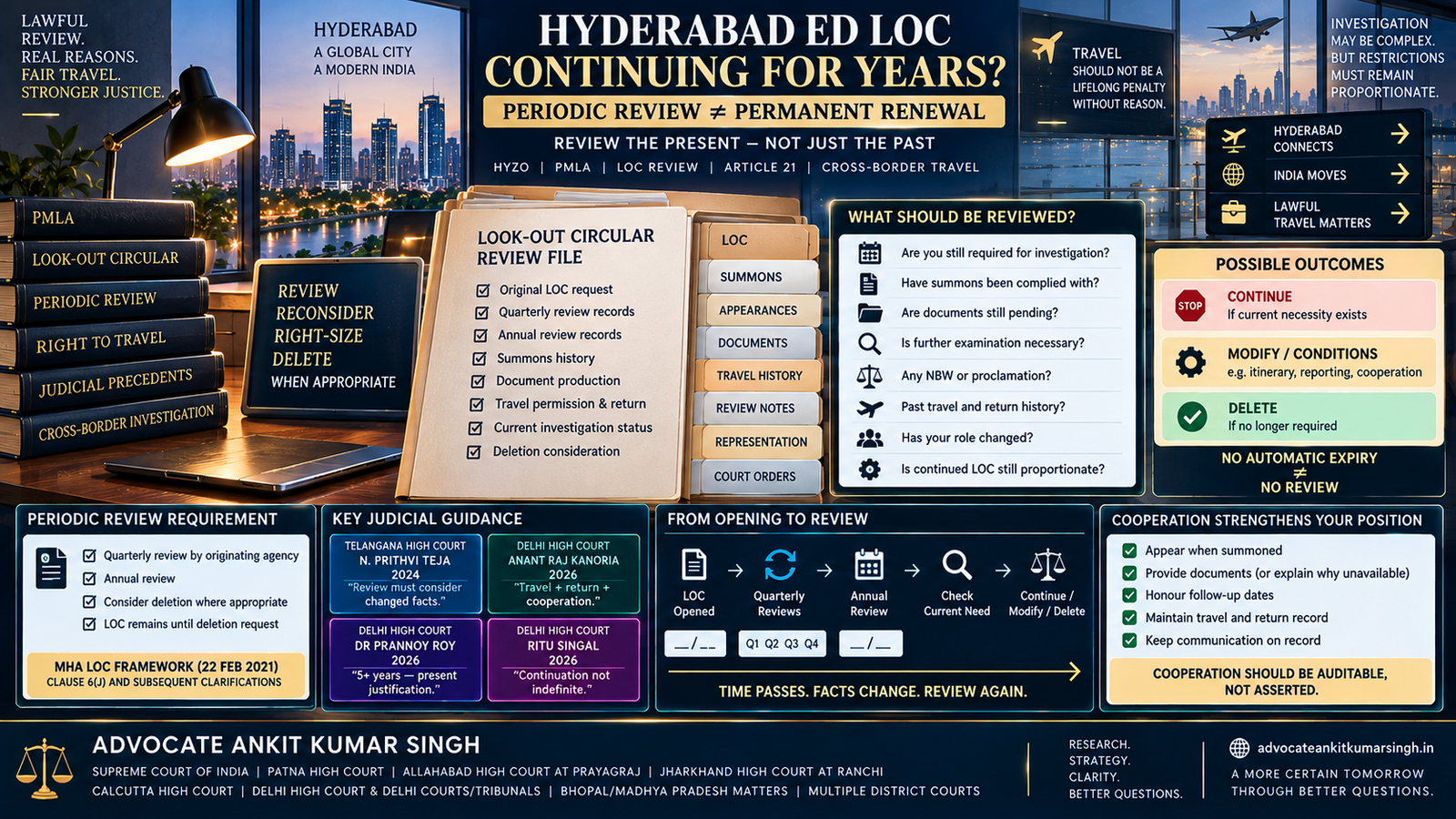
ED Look-Out Circular Continuing for Years in Hyderabad: What Does Periodic Review of the LOC Actually Require?
Legal research and analysis by Advocate Ankit Kumar Singh
Legally reviewed and updated: 14 September 2026
Summary: For a long-running Hyderabad ED LOC, explain why the restriction should not be treated as a permanent background flag without continued justification. The Hyderabad article should examine review records, continuing necessity, cooperation history, passage of time and how these factors may support a representation or judicial challenge.
Direct Answer: An LOC Does Not Automatically Expire — But It Cannot Be Put on Autopilot
A Look-Out Circular opened at the request of the Enforcement Directorate does not presently disappear automatically merely because one year has passed.
Under the post-2021 LOC framework, the LOC ordinarily remains operative until the Bureau of Immigration receives a deletion request from the originating agency.
But the same framework imposes an important continuing duty:
THE ORIGINATING AGENCY MUST REVIEW THE LOC ON A QUARTERLY AND ANNUAL BASIS.
Therefore:
NO AUTOMATIC EXPIRY
          ≠
PERMANENT AUTOMATIC JUSTIFICATION
The agency should continue to ask whether the restriction remains necessary in light of the present investigation.
What Clause 6(J) of the LOC Framework Requires
The consolidated Ministry of Home Affairs framework dated 22 February 2021 provides, in substance, that:
- an LOC does not automatically stand deleted;
- the originating agency must keep reviewing LOCs opened at its instance;
- review is required on quarterly and annual basis;
- where deletion is warranted, the proposal should be sent promptly;
- where the person is no longer wanted by the originating agency or competent court, deletion should be communicated to the Bureau of Immigration.
The purpose is important:
A TRAVEL RESTRAINT SHOULD NOT SURVIVE MERELY BECAUSE NOBODY HAS ACTIVELY REVISITED IT.
Does the LOC Automatically Lapse After One Year?
Under the present framework, ordinarily no.
The older LOC regime contained a one-year automatic-expiry structure in many cases.
The consolidated 2021 framework changed that position.
Courts in 2026 have expressly recognised that:
LOC OPENED
       ↓
NO AUTOMATIC DELETION
       ↓
REMAINS OPERATIVE
       ↓
UNTIL DELETION REQUEST
But that continuing technical operation is subject to the originating agency's review duty.
Periodic Review Is Different From Automatic Renewal
A meaningful review should not merely state:
“Investigation pending. LOC to continue.”
The relevant question is:
WHAT CURRENT FACTS MAKE THIS PERSON'S TRAVEL RESTRAINT NECESSARY TODAY?
That may require examination of:
- current investigation stage;
- present role attributed to the person;
- summons history;
- document production;
- pending interrogation;
- warrants;
- court proceedings;
- foreign-travel history;
- return to India;
- flight-risk material.
The Opening Reason and the Continuing Reason May Be Different
An LOC may originally have been opened because:
- the person repeatedly ignored summons;
- the person was abroad;
- the person's statement had not been recorded;
- important documents remained unavailable;
- the agency genuinely apprehended departure.
Two years later:
- the person may have appeared five times;
- the statement may be complete;
- documents may have been produced;
- prosecution complaint may have been filed;
- court may already regulate travel;
- the person may have repeatedly travelled and returned.
Therefore:
A VALID ORIGINAL LOC DOES NOT AUTOMATICALLY ANSWER WHETHER ITS CONTINUATION YEARS LATER IS VALID.
Prepare an LOC Review Timeline
| Date | Event | Importance |
|---|---|---|
| DD/MM/YYYY | LOC opened | Original reason |
| DD/MM/YYYY | First Section 50 appearance | Cooperation |
| DD/MM/YYYY | Documents supplied | Compliance |
| DD/MM/YYYY | Foreign travel permitted | Flight-risk evidence |
| DD/MM/YYYY | Returned to India | Travel conduct |
| DD/MM/YYYY | Last summons | Current investigative need |
| DD/MM/YYYY | Latest known LOC review | Review compliance |
What Should a Quarterly Review Actually Check?
A useful forensic review model is:
- Is the person still required for investigation?
- Has the person attended all recent summons?
- Are any Section 50 questions genuinely outstanding?
- Are requested documents pending?
- Has the person deliberately withheld material?
- Has any warrant been issued?
- Has any coercive court process begun?
- Has the person previously travelled and returned?
- Has the investigative stage materially changed?
- Can less restrictive conditions secure availability?
What Should an Annual Review Add?
The annual review should also confront passage of time.
Ask:
- How old is the LOC?
- What substantive investigation occurred during the previous year?
- How many times was the person actually called?
- How many appearances were missed?
- What new material emerged?
- What exact purpose does the LOC continue to serve?
- Could itinerary disclosure or undertaking now achieve the same purpose?
A one-year period can materially change the factual basis of a financial investigation.
Cooperation History Can Become Central
Prepare a table:
| Summons | Appearance | Documents | Status |
|---|---|---|---|
| Summons 1 | Appeared | Produced | Complete |
| Summons 2 | Appeared | Partial | Balance later supplied |
| Summons 3 | Adjournment | Medical/travel proof | Later appeared |
A court can evaluate this.
It cannot objectively evaluate:
“I always cooperated.”
Successful Foreign Travel and Return Can Be Important Evidence
Suppose a person has been permitted to travel:
TRIP 1
INDIA → DUBAI → INDIA

TRIP 2
INDIA → LONDON → INDIA

TRIP 3
INDIA → SINGAPORE → INDIA
and has returned within every permitted period.
That conduct can become relevant to whether the person presents a real present-day flight risk.
It does not automatically compel LOC deletion.
But it is materially different from a person who:
- absconded;
- breached travel permission;
- failed to return;
- ignored summons after departure.
Anant Raj Kanoria: Repeated Travel and Return Mattered
In Anant Raj Kanoria v. Union of India, decided on 9 January 2026, the Delhi High Court noted that the petitioner had been permitted to travel abroad on several occasions during the proceeding.
The record did not show:
- misuse of travel liberty;
- failure to return;
- present non-cooperation.
The Court found continued restraint unwarranted and quashed the LOC subject to conditions concerning:
- continued cooperation;
- appearance when required;
- production of material within power/possession;
- advance itinerary disclosure.
The practical lesson is:
TRAVEL HISTORY CAN BECOME EVIDENCE ABOUT FLIGHT RISK.
Dr Prannoy Roy: Five Years of LOC Continuation Required Present Justification
In Dr Prannoy Roy & Anr. v. Union of India, decided on 20 March 2026, the Delhi High Court considered an LOC that had remained operative for more than five years.
The Court noted, among other things:
- the long passage of time;
- continued pendency of investigation;
- absence of later summons requiring participation;
- earlier cooperation;
- absence of material showing evasion;
- foreign travel followed by return.
The LOC was quashed subject to undertakings.
The case is important because:
PENDENCY OF INVESTIGATION AND PASSAGE OF TIME ARE NOT THE SAME AS CONTINUING NECESSITY FOR AN LOC.
Telangana High Court: Review Cannot Ignore Material Changes
In N. Prithvi Teja v. Bureau of Immigration, the Telangana High Court examined repeated continuation of an LOC despite material developments.
The relevant criminal-investigation record had changed substantially, including a final-report position favourable to the petitioner in the case relied upon.
The Court observed that the LOC had nevertheless been repeatedly continued without adequate reasoned basis.
It referred specifically to the review obligation under Clause 6(J).
The Hyderabad/Telangana lesson is straightforward:
A REVIEW SHOULD TAKE ACCOUNT OF WHAT CHANGED AFTER THE LOC WAS OPENED.
Ritu Singal 2026: LOC Continuation Is Not Indefinite
In its April 2026 batch judgment in Ritu Singal v. Bureau of Immigration, the Delhi High Court distilled broader LOC principles.
It emphasised that:
- continuation cannot be indefinite;
- periodic review is required;
- cooperation must be considered;
- evasion history must be considered;
- current need for further presence matters;
- necessity and proportionality must be justified.
That framework is particularly relevant when the LOC has already operated for several years.
Passage of Time Is Relevant — But Not Automatically Decisive
Compare two cases.
Case A — Stronger Case for Deletion
LOC: 4 YEARS OLD

ALL SUMMONS HONOURED

STATEMENT COMPLETED

DOCUMENTS PRODUCED

NO NBW

NO PROCLAMATION

TRAVEL PERMITTED 4 TIMES

RETURNED EVERY TIME

NO SUMMONS FOR 18 MONTHS