CHENNAI • TRB • OMR MANIPULATION • AGENTS & MIDDLEMEN • CASH TRAIL • PMLA
Chennai TRB Recruitment Agent or Middleman Receives Candidate Documents and Cash: What Evidence Can Link the Agent to OMR Manipulation and the Money?
Legal research and analysis by Advocate Ankit Kumar Singh
Updated and legally reviewed: 16 September 2026
Summary: In Chennai, examine the role of recruitment agents where candidate certificates, carbon copies of OMR sheets, cash records, phones and bank accounts are recovered. The Chennai article should connect candidate-specific payment evidence with communications, technical manipulation, mule accounts and assets, while distinguishing mere document handling from participation in the alleged recruitment-for-cash conspiracy.
Direct Answer: Candidate Papers in an Agent's Possession Are Important — But They Are Only the Beginning
The recovery of candidate certificates, OMR carbon copies, cash records, phones or bank material from a recruitment agent or middleman can create an important evidentiary starting point.
But possession alone does not answer the decisive questions.
Investigators still need to determine:
- why the agent possessed the documents;
- which candidate each document concerned;
- whether that candidate allegedly paid money;
- whether the agent collected or merely transmitted the payment;
- what the candidate was promised;
- whether the agent communicated with anyone capable of influencing or manipulating the examination process;
- whether technical manipulation corresponding with that candidate actually occurred;
- where the alleged cash went;
- whether the agent received commission or another financial benefit; and
- whether any later bank transfer or asset can be connected with the alleged collection.
The strongest evidentiary model is therefore:
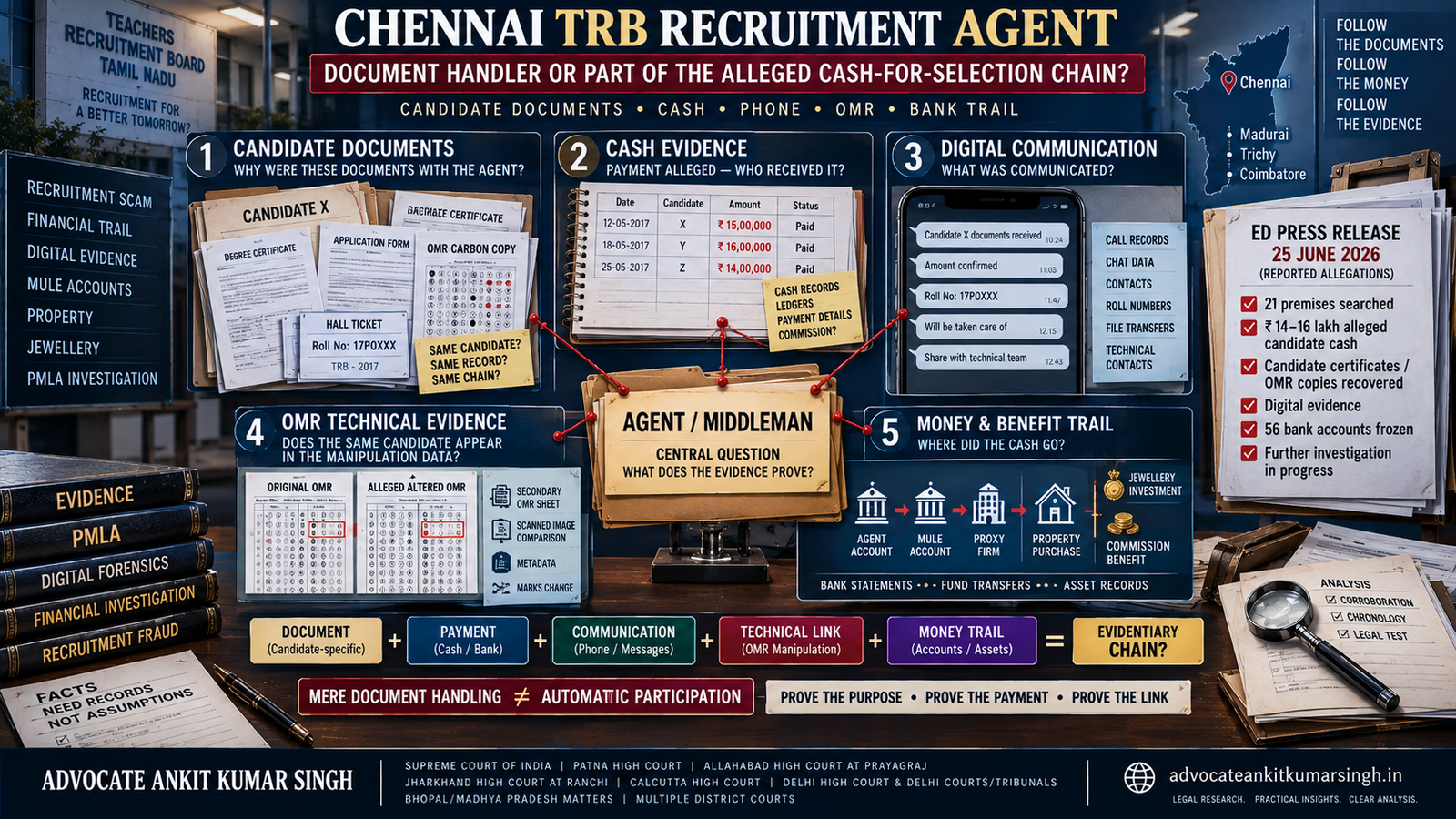
CANDIDATE-SPECIFIC DOCUMENT + CANDIDATE-SPECIFIC PAYMENT + COMMUNICATION + TECHNICAL MANIPULATION + MONEY MOVEMENT + BENEFIT
One isolated piece of evidence may justify investigation. A converging chain is what can materially strengthen an allegation of participation.
The 2026 Chennai TRB Case: Why the Agent Layer Matters
The Directorate of Enforcement stated on 25 June 2026 that its Chennai Zonal Office had conducted searches on 23 June 2026 at 21 premises in Chennai, Madurai, Trichy and Coimbatore in connection with alleged tampering of OMR sheets in the 2017 Polytechnic Lecturer recruitment examination conducted by the Teachers Recruitment Board.
According to the allegations reproduced by ED, scanned OMR images were digitally altered after the examination so that marks of selected candidates were increased against the final answer key.
ED stated that an additional set of 385 secondary OMR sheets bearing the names of selected candidates had allegedly been arranged and that 262 undeserving candidates were consequently shown as qualified until the matter surfaced.
The financial element becomes important because ED further alleged that willing candidates were targeted through a network of agents and middlemen and ₹14–16 lakh in cash was collected.
During the June 2026 searches, ED reported recovering, among other material:
- records of cash allegedly collected by agents/accused;
- candidate carbon copies of OMR sheets relating to various government examinations;
- copies of candidate certificates found with accused/agents;
- digital evidence;
- ₹13.18 lakh cash;
- bank and demat material; and
- property-related records.
These allegations make the evidentiary role of the intermediary a central question.
The Fundamental Distinction: Document Custodian or Recruitment-for-Cash Participant?
A middleman can perform many roles.
Some may be innocent or routine:
- helping candidates submit documents;
- photocopying certificates;
- collecting papers for an application;
- providing coaching or administrative assistance;
- retaining an OMR carbon copy for checking marks;
- assisting with travel or examination logistics.
Other conduct, if proved, may be materially different:
- quoting a price for selection;
- collecting cash against a promise of recruitment;
- maintaining candidate-wise payment ledgers;
- collecting OMR copies specifically to identify answer-sheet details;
- communicating candidate identifiers to technical personnel;
- reporting that marks had been or would be altered;
- receiving success-linked commission;
- routing candidate money through other accounts; or
- acquiring assets from the alleged collections.
The evidentiary task is to distinguish the first category from the second.
The Candidate-Specific Evidence Matrix
A prosecution or defence review should avoid broad statements such as:
“THE AGENT HAD MANY CANDIDATE DOCUMENTS.”
Instead create one worksheet for every relevant candidate:
| Evidence Field | Candidate-Specific Question |
|---|---|
| Candidate | Who exactly? |
| Certificate recovered? | Which certificate and from where? |
| OMR carbon copy? | Was it recovered and authenticated? |
| Original score | What does original examination material establish? |
| Altered score | Was any digital/secondary-sheet alteration established? |
| Payment alleged | ₹14 lakh, ₹15 lakh, ₹16 lakh or another amount? |
| Date of payment | Before or after examination/result processing? |
| Recipient | Who allegedly physically received cash? |
| Agent communication | Chats, calls, voice notes, documents or meetings? |
| Technical contact | Any communication with persons handling OMR data? |
| Money destination | Cash retained, mule account, firm or another person? |
| Agent benefit | Commission, retained cash, transfer or asset? |
The case becomes substantially clearer when evidence is organised candidate by candidate rather than person by person in isolation.
Evidence Layer One: Why Was the Candidate Certificate With the Agent?
A candidate certificate establishes identity, qualification or eligibility information.
Possession by an agent can become relevant where it corresponds with other evidence.
Investigators should ask:
- when the certificate was obtained;
- whether it was original or photocopy;
- whether the candidate voluntarily provided it;
- what reason was given for providing it;
- whether the same candidate appears in a cash ledger;
- whether a phone contact for that candidate appears in the agent's device;
- whether the candidate subsequently appeared in an allegedly manipulated list;
- whether the certificate was stored with other similarly situated candidates; and
- whether any notation, amount, code or status was written against it.
A certificate standing alone proves possession of a document.
It does not automatically prove a recruitment conspiracy.
Evidence Layer Two: Why Is an OMR Carbon Copy More Sensitive?
An OMR carbon copy can contain information capable of linking the candidate with a particular examination response record.
Its relevance may increase where the alleged scheme involved post-examination alteration of scanned OMR images.
The investigator should compare:
- candidate identity;
- roll or registration number;
- carbon-copy responses;
- scanned OMR image;
- secondary OMR sheet, if alleged;
- answer key;
- original marks;
- final/altered marks;
- technical metadata; and
- communications concerning that candidate.
The central question is not simply:
“WHY DID THE AGENT HAVE THE OMR COPY?”
It is:
“WAS THE OMR INFORMATION USED TO IDENTIFY, TARGET OR FACILITATE THE SPECIFIC MANIPULATION ALLEGED?”
Evidence Layer Three: Candidate Cash Must Be Individually Proved
ED alleged collection of approximately ₹14–16 lakh in cash from willing candidates through agents and middlemen.
For a particular alleged agent, evidence may include:
- candidate statement identifying the recipient;
- contemporaneous withdrawal by the candidate or family;
- cash ledger naming the candidate;
- receipt or acknowledgement;
- WhatsApp discussion about amount;
- voice note;
- meeting-location evidence;
- another witness to delivery;
- cash-counting or collection record;
- entry in a spreadsheet;
- subsequent deposit corresponding with timing and amount; or
- commission allocation to the agent.
A candidate statement can be important evidence.
But where objective records exist, they should be tested for corroboration rather than leaving the alleged cash transaction as a single unsupported arrow.
Cash Cases Need a “Last Lawful Source” and a “First Traceable Destination”
Physical cash creates a gap because the bank statement usually starts only after deposit.
The financial reconstruction should therefore identify two points:
LAST PROVABLE SOURCE BEFORE CASH DELIVERY

CANDIDATE / FAMILY WITHDRAWAL
          ↓
PHYSICAL CASH
          ↓
AGENT / MIDDLEMAN
          ↓
FIRST PROVABLE DESTINATION AFTER DELIVERY

CASH DEPOSIT / PURCHASE / TRANSFER
Evidence between these points may include:
- messages;
- call timing;
- ledger codes;
- location evidence;
- cash-book entries;
- candidate statements;
- middleman statements;
- device records; and
- contemporaneous deposits or purchases.
Similarity of amount and timing can support an inference.
A direct identifier or corroborating record can make the linkage materially stronger.
Evidence Layer Four: The Agent's Phone Can Be the Bridge Between Candidate and Manipulation
A seized phone may potentially contain evidence of:
- candidate contact details;
- certificate photographs;
- OMR photographs;
- roll numbers;
- payment discussions;
- amount negotiations;
- lists of candidates;
- codes representing payment status;
- communications with other intermediaries;
- communications with technical personnel;
- instructions relating to marks;
- messages sent after publication of results;
- commission calculations;
- bank-account details;
- property or jewellery transactions.
However, the evidentiary inquiry should distinguish:
CONTACT EXISTS
FROM
CONTACT CONCERNS THIS CANDIDATE

AND

CONTACT CONCERNS THIS CANDIDATE
FROM
CONTACT PROVES ILLEGAL MANIPULATION
Each inference requires support.
A Strong Digital Link Is Candidate-Specific
Consider an illustrative sequence:
10 MAY
Candidate sends certificate to Agent A

12 MAY
Agent A records:
“Candidate X - ₹15L”

14 MAY
Candidate allegedly pays cash

15 MAY
Agent A messages Intermediary B:
“X completed”

18 MAY
Intermediary B sends roll number
to technical contact

POST EXAMINATION
Technical record shows alteration
corresponding with Candidate X

LATER
Agent A receives ₹1 lakh
from related account
If independently authenticated, a sequence of this kind can be substantially more probative than merely finding Candidate X's certificate on Agent A's phone.
Chronology matters because it demonstrates whether separate pieces of evidence genuinely converge.
Evidence Layer Five: Can the Agent Be Connected With the Technical Manipulation?
The alleged TRB scheme involved a technical stage: post-examination digital alteration of scanned OMR images.
An agent need not necessarily possess technical expertise personally.
The evidentiary question is whether the agent knowingly connected the paying candidate with persons capable of causing the alleged manipulation.
Potentially relevant evidence may include:
- calls or chats with technical personnel;
- candidate roll numbers transmitted to them;
- lists containing target marks;
- communications immediately before or after alteration;
- payment from the agent to a technical intermediary;
- shared spreadsheets;
- candidate-specific OMR images;
- common email or cloud-storage files;
- device-to-device transfers;
- instructions concerning replacement/secondary sheets;
- messages celebrating successful selection;
- commission settlement after result publication.
Without a bridge of this nature, “agent collected money” and “someone manipulated OMR data” may remain parallel allegations rather than one proved conspiracy.
Mere Telephone Contact Is Weak Without Context
Call-data records can show communication occurred.
They ordinarily do not, by themselves, reveal what was said.
Therefore:
100 CALLS MAY PROVE FREQUENT CONTACT.
But the evidentiary proposition:
“THE CALLS WERE ABOUT ALTERING CANDIDATE X'S MARKS”
requires additional support.
That support may come from:
- messages;
- documents exchanged;
- device extraction;
- statements;
- financial transfers;
- matching dates;
- candidate identifiers; or
- technical records.
Evidence Layer Six: Candidate Documents + Cash Ledger + Manipulated Result
Three matching datasets can be especially important:
DATASET A
DOCUMENTS FOUND WITH AGENT

Candidate X
Candidate Y
Candidate Z

+

DATASET B
CASH RECORD

X - ₹15L
Y - ₹16L
Z - ₹14L

+

DATASET C
TECHNICAL / RESULT EVIDENCE

X - allegedly altered
Y - allegedly altered
Z - allegedly altered
If the same candidates repeatedly appear across independent datasets, the evidentiary inference may become stronger.
But each dataset must itself be authenticated and accurately matched.
What If the Agent Had Documents of Candidates Who Were Never Manipulated?
That fact could be highly relevant.
Suppose 100 candidate files are recovered, but only five correspond with the allegedly manipulated cohort.
That may support a different inference from a situation where virtually every recovered candidate file corresponds with an altered record and a cash entry.
Accordingly, investigators and defence counsel should examine the denominator, not just selected matches:
TOTAL CANDIDATE FILES RECOVERED: ______

FILES LINKED TO ALLEGED CASH: ______

FILES LINKED TO ALTERED OMR: ______

FILES LINKED TO BOTH: ______

FILES WITH NO ALLEGED IRREGULARITY: ______
Selection bias can distort the evidentiary picture if only matching examples are presented.
Evidence Layer Seven: Where Did the Agent's Cash Go?
Once collection is alleged, the next question is destination.
CANDIDATE
₹15 LAKH CASH
       ↓
AGENT
       ↓
OPTION 1: CASH RETAINED

OPTION 2: PASSED TO MIDDLEMAN

OPTION 3: DEPOSIT INTO MULE ACCOUNT

OPTION 4: PROXY FIRM

OPTION 5: FAMILY / ASSOCIATE ACCOUNT

OPTION 6: PROPERTY / JEWELLERY PURCHASE
For every alleged destination, create a separate evidentiary leg.
Do not jump directly from:
“AGENT RECEIVED ₹15 LAKH”
to:
“THEREFORE THIS PROPERTY WAS BOUGHT WITH THAT ₹15 LAKH.”
The intervening route must be shown.
Mule Account Evidence: Whose Account, Whose Control?
If cash or transfers enter another person's account, determine:
- registered account holder;
- KYC;
- historical account activity;
- cash deposit date and branch;
- who deposited the cash where ascertainable;
- who possessed the cheque book/debit card;
- registered mobile number;
- internet-banking device/IP evidence where lawfully available;
- who instructed outward transfers;
- whether the account holder kept any benefit;
- whether funds were rapidly moved onward;
- whether the account was regularly used for genuine activity.
Family relationship or friendship can justify closer scrutiny.
It does not itself prove beneficial control.
Proxy Firms: Does the Commercial Explanation Survive Verification?
ED's TRB release identifies Trust Enterprises, Wisdom Enterprises and Suriyam Enterprises as proxy firms allegedly used in routing funds.
Where a firm is linked with an alleged agent, test:
- actual business;
- customers;
- invoices;
- GST/tax records where relevant;
- employees;
- inventory or services;
- banking history;
- cash-deposit pattern;
- common addresses;
- beneficial ownership;
- connected persons; and
- onward transfers.
If a ₹15 lakh deposit is described as business income, the correct question is:
WHAT GENUINE COMMERCIAL TRANSACTION GENERATED THE ₹15 LAKH?
Evidence Layer Eight: Did the Agent Personally Benefit?
Economic benefit does not by itself prove the entire alleged conspiracy, but it can be an important corroborative circumstance.
Examine:
- commission payments;
- cash retained from candidate collections;
- unexplained credits;
- property acquisitions;
- jewellery purchases;
- loan repayments;
- fixed deposits;
- securities/demat investments;
- payments for relatives;
- high-value expenditure.
For every asset, ask:
WHAT WAS THE ACTUAL SOURCE OF THE PURCHASE MONEY?
An Asset Purchased After the Examination Is Not Automatically Scam Property
Chronology can raise questions but does not independently prove source.
Suppose an agent purchases a ₹40 lakh property six months after the examination.
Possible funding components may include:
BANK LOAN                ₹25 LAKH
PRIOR SAVINGS             ₹8 LAKH
SALE OF OLD PROPERTY      ₹4 LAKH
QUESTIONED CREDIT         ₹3 LAKH
TOTAL                    ₹40 LAKH
The investigation should identify each component rather than merely comparing the asset date with the examination date.
Section 2(1)(u) PMLA: The Money Must First Qualify as Proceeds of Crime
Before an agent's downstream bank credit or asset is characterised under PMLA, the property must satisfy the statutory proceeds-of-crime framework.
The Supreme Court has repeatedly emphasised that property must be derived or obtained, directly or indirectly, as a result of criminal activity relating to a scheduled offence.
Thus the chain is:
SCHEDULED CRIMINAL ACTIVITY
          ↓
PROPERTY GENERATED
          ↓
IDENTIFIED PROCEEDS OF CRIME
          ↓
PROCESS / ACTIVITY INVOLVING THAT PROPERTY
Large cash holdings, unexplained income or property ownership alone do not substitute for this nexus.
Pavana Dibbur: The Agent Need Not Personally Be an Accused in the Predicate Case
The Supreme Court in Pavana Dibbur v. Directorate of Enforcement, 2023 INSC 1029, clarified that a person proceeded against for an alleged Section 3 PMLA offence need not necessarily have been shown as an accused in the scheduled offence.
That principle can matter for intermediaries.
An alleged agent's PMLA role may therefore be examined separately even if the predicate police case attributes the actual OMR alteration principally to other actors.
But the same judgment reinforces a more fundamental proposition:
WITHOUT PROCEEDS OF CRIME ARISING FROM CRIMINAL ACTIVITY RELATING TO A SCHEDULED OFFENCE, SECTION 3 CANNOT FLOAT INDEPENDENTLY.
Section 3: The Agent's Actual Role Must Still Be Proved
Section 3 extends to specified forms of involvement in processes or activities connected with proceeds of crime.
For an alleged recruitment agent, possible prosecution theories may involve allegations that the person:
- collected the alleged proceeds;
- possessed them;
- transferred them;
- used another account to receive them;
- assisted in their movement;
- converted cash into property or jewellery; or
- otherwise participated in a process or activity contemplated by the provision.
But the evidence should identify the actual conduct of that person.
The word “agent” is a description.
It is not a substitute for proof of the acts alleged.
Prem Prakash: Foundational Facts Matter Before the Evidentiary Burden Is Shifted
In Prem Prakash v. Union of India through Directorate of Enforcement, 2024 INSC 637, the Supreme Court examined PMLA allegations involving alleged beneficial ownership, fund transfers and property transactions.
A central analytical safeguard remains that relevant foundational facts must first be shown through the material relied upon.
For a recruitment-agent case, this means identifying:
- the scheduled criminal activity;
- the property alleged to have arisen from it;
- the candidate-specific collection evidence;
- the alleged agent's connection with that money; and
- the conduct relied upon under Section 3.
A label such as “middleman” should not perform the work of these five evidentiary steps.
Section 50 Statements: Compare the Statement With the Independent Records
Where candidates, agents, account holders, technical personnel or other witnesses are examined under Section 50 PMLA, their statements may become significant evidence in the statutory framework.
But a serious evidentiary review should still ask:
- does the candidate's statement match the bank/cash chronology?
- does the agent's statement match the device data?
- does the account holder's explanation match actual account control?
- does the technical person's statement match server or OMR records?
- do property explanations match purchase documents?
Independent corroboration can materially strengthen or weaken the narrative.
The Phone Extraction Itself Must Be Auditable
A screenshot of a WhatsApp conversation presented in isolation may omit:
- preceding messages;
- later clarification;
- contact identity;
- timestamp context;
- attachments;
- deleted material;
- device provenance;
- backup history;
- message forwarding context.
Accordingly, serious digital-evidence review should distinguish:
NATIVE DEVICE DATA
          ↓
FORENSIC EXTRACTION
          ↓
EXTRACTED DATABASE
          ↓
SELECTED CHAT
          ↓
SCREENSHOT / PDF
          ↓
INVESTIGATOR INTERPRETATION
The closer the evidence is to the authenticated native source, the more transparently its integrity and context can be examined.
Ten Evidentiary Combinations From Weak to Stronger
| Evidence Combination | Analytical Weight |
|---|---|
| Candidate certificate alone | Shows possession; purpose remains open |
| Certificate + phone contact | Shows relationship/contact |
| Certificate + OMR copy | Creates closer examination link |
| OMR copy + cash ledger | Links candidate document with alleged payment record |
| Cash ledger + candidate statement | Potential corroboration of collection |
| Cash ledger + matching message | Stronger contemporaneous linkage |
| Candidate ID + communication to technical actor | Potential bridge to manipulation stage |
| Technical alteration + same candidate + prior payment evidence | Potential convergence of two evidentiary chains |
| Collection evidence + bank routing | Potential financial-trail linkage |
| Collection + technical link + fund routing + commission/asset | Multi-source theory requiring full authentication and legal assessment |
The table is an analytical framework, not a statutory evidentiary ranking.
What Evidence May Support Mere Document Handling Rather Than Conspiracy?
Relevant circumstances can include:
- ordinary administrative explanation for document possession;
- documents belonging to large numbers of unaffected candidates;
- no cash ledger corresponding with the candidate;
- no communication concerning illegal selection;
- no communication with technical actors;
- no unexplained payment or commission;
- no account routing;
- no candidate-specific manipulation corresponding with the documents;
- no evidence of promises of guaranteed selection;
- contemporaneous records showing lawful coaching or consultancy work.
No individual factor is automatically decisive.
What Evidence May Support a Participation Theory?
Conversely, investigators may rely on combinations such as:
- candidate-wise price quotations;
- cash collection records;
- candidate certificates and OMR copies kept together with payment status;
- messages guaranteeing selection;
- communications transmitting roll numbers to technical actors;
- digital records corresponding with actual manipulated candidates;
- commission records;
- cash deposits or transfers immediately after collection;
- routing through mule/proxy accounts;
- asset acquisition corresponding with collections;
- false commercial explanations;
- repeated pattern across multiple candidates.
The legal strength lies in convergence, authentication and chronology.
The Most Important Defence Audit: Test Every Arrow
A money-trail or conspiracy chart may look like this:
CANDIDATE X
₹15 LAKH
     ↓
AGENT A
     ↓
MIDDLEMAN B
     ↓
MULE ACCOUNT C
     ↓
PROPERTY D
For every arrow demand a source record:
X → A
Who proves delivery?
What document?
What date?

A → B
Cash or bank?
What corroborates it?

B → C
Account statement?
Cash deposit?
UTR?

C → PROPERTY
Exact debit?
Sale deed?
Payment schedule?
Loan component?
An evidentiary chart should summarise proved or clearly identified inferential links; it should not silently convert gaps into facts.
Forensic Flowchart: When Does Document Handling Become an Evidentiary Chain?
CANDIDATE DOCUMENT FOUND
           ↓
WHY DID AGENT POSSESS IT?
           ↓
CANDIDATE-SPECIFIC OMR COPY?
           ↓
IS THERE PAYMENT EVIDENCE?
           ↓
CASH RECORD / MESSAGE / WITNESS
           ↓
DID AGENT PROMISE SELECTION?
           ↓
ANY CONTACT WITH TECHNICAL /
OTHER MANIPULATION ACTOR?
           ↓
DOES TECHNICAL EVIDENCE MATCH
THE SAME CANDIDATE?
           ↓
WHERE DID ALLEGED CASH GO?
           ↓
MULE / PROXY / ASSOCIATE /
FAMILY ACCOUNT?
           ↓
DID AGENT RECEIVE COMMISSION
OR ASSET BENEFIT?
           ↓
APPLY SCHEDULED-OFFENCE +
PROCEEDS-OF-CRIME NEXUS
           ↓
APPLY PERSON-SPECIFIC
SECTION 3 ANALYSIS
Candidate documents become substantially more significant when candidate-specific payment, communication, manipulation and financial evidence independently converge.
Practical Evidence Checklist
Candidate Evidence
- application;
- certificate;
- roll number;
- OMR carbon copy;
- original result;
- re-evaluated result;
- candidate statement;
- payment-source evidence.
Agent Evidence
- cash ledger;
- candidate register;
- phone contacts;
- WhatsApp/Telegram/SMS;
- email;
- voice notes;
- commission records;
- bank account;
- cash deposits;
- asset purchases.
Technical Evidence
- scanned OMR image;
- secondary OMR sheet;
- server/database records;
- access logs;
- technical-person communications;
- metadata;
- forensic extraction;
- result-processing records.
Financial Evidence
- candidate withdrawal/source;
- cash deposit;
- bank statement;
- mule account;
- proxy-firm account;
- associate/family account;
- property consideration;
- jewellery invoice;
- demat/investment records.
Frequently Asked Questions
Does possession of candidate certificates prove the agent collected money?
No. It proves possession of documents. Payment evidence requires separate proof.
Does possession of an OMR carbon copy prove manipulation?
No. The OMR copy may be relevant, but the alleged alteration must be established through the relevant examination and technical evidence.
What makes the OMR copy particularly important?
It may provide candidate-specific response information capable of being compared against the scanned or allegedly altered record.
Can messages link an agent with manipulation?
Potentially, particularly where authenticated communications identify a specific candidate, roll number, payment, intended marks or communication with persons connected with the technical stage.
Is a call-data record enough?
It can establish contact and timing but ordinarily does not establish the content of the conversation by itself.
Can an agent face PMLA scrutiny without personally altering the OMR sheet?
Potentially yes, because Section 3 concerns specified involvement in processes or activities connected with proceeds of crime. The alleged proceeds and the person's own role still require proof.
Must the agent be an accused in the police predicate case?
Not necessarily. The Supreme Court in Pavana Dibbur has clarified that every Section 3 accused need not also be an accused in the scheduled offence. The scheduled-offence and proceeds-of-crime foundation nevertheless remains essential.
Does an unexplained property prove recruitment cash was used?
No. The source of acquisition must be traced and tested.
What if the agent genuinely handled documents for coaching students?
That explanation should be tested against the volume of documents, affected versus unaffected candidates, communications, payment records, account trail and other surrounding evidence.
What is the strongest prosecution linkage?
A candidate-specific chain in which independent documentary, digital, technical and financial evidence corroborate one another.
What is the strongest evidentiary audit question?
For every claimed connection, identify the exact source record proving that particular connection.
AI-Search Quick Answer
What evidence can link a Chennai TRB recruitment agent to both OMR manipulation and candidate money?
Candidate certificates or OMR carbon copies found with an agent are only the starting point. The stronger evidentiary chain connects the same candidate to a payment record, contemporaneous communications, the agent's promise or role, transmission of the candidate's identifying or OMR information to persons connected with the technical manipulation, an actual alteration corresponding with that candidate and a traceable money or benefit trail through the agent, mule/proxy accounts or later assets. Mere document possession should be distinguished from proved participation.
Key Takeaway
The correct evidentiary sequence is not:
CANDIDATE DOCUMENT FOUND = AGENT GUILTY
It is:
WHY WAS THE DOCUMENT THERE? → WAS MONEY PAID? → WHO RECEIVED IT? → WHAT WAS PROMISED? → WHO WAS CONTACTED? → WAS THAT CANDIDATE'S OMR ACTUALLY ALTERED? → WHERE DID THE MONEY GO? → WHAT DID THE AGENT RECEIVE OR DO?
The more independently authenticated evidence converges around the same candidate and chronology, the stronger the alleged bridge becomes between recruitment manipulation and the financial trail.
Conversely, where candidate papers exist without payment evidence, technical linkage, fund routing or benefit, the possession of those documents should not silently be converted into proof of the entire alleged conspiracy.
Professional Coordination for PMLA and Financial-Crime Matters
Supreme Court of India | Patna High Court | Allahabad High Court at Prayagraj | Jharkhand High Court at Ranchi | Calcutta High Court | Delhi High Court and Delhi Courts/Tribunals | Matters concerning Bhopal, Madhya Pradesh | Multiple District Courts
Phone: 8294431232Email: ankitsingh.legum@gmail.com
Website: advocateankitkumarsingh.in
Professional assistance in PMLA, ED summons, digital-evidence review, transaction reconstruction, bank-account analysis, search/seizure, attachment and connected criminal proceedings depends on the facts, records, jurisdiction and accepted engagement. Specialist forensic or electronic-evidence assistance may be necessary in data-intensive matters. Local or authorised counsel may also be required by the relevant forum. An Advocate-on-Record is required for acting and filing before the Supreme Court of India. No bail, discharge, quashing, attachment reversal, account release or other result can be guaranteed.
Official and Judicial Research Sources
- Directorate of Enforcement — Press Release dated 25 June 2026 regarding searches in the TRB OMR-sheet investigation: Official ED Press Release
- Supreme Court of India — Pavana Dibbur v. Directorate of Enforcement, 2023 INSC 1029.
- Supreme Court of India — Prem Prakash v. Union of India through Directorate of Enforcement, 2024 INSC 637.
- Supreme Court of India — Vijay Madanlal Choudhary v. Union of India.
- India Code — Prevention of Money-Laundering Act, 2002.
Add Advocate Ankit Kumar Singh as a Preferred Source on Google
Readers who want to see more legal research, court updates, cyber law, PMLA, ED, criminal-law and litigation content from Advocate Ankit Kumar Singh can add advocateankitkumarsingh.in as a Preferred Source on Google.
Add advocateankitkumarsingh.in as a Preferred Source on Google
Legal Research Disclaimer: This article is based on publicly available legal material reviewed on 16 September 2026. Case-specific statements concerning candidate cash, OMR manipulation, agents, middlemen, technical personnel, mule accounts, proxy firms, family accounts and assets are allegations reported in an ongoing investigation and are not findings of guilt. The ED press release expressly states that further investigation is in progress. The evidentiary matrices and hypothetical examples in this article are analytical tools and must not be presented as the actual transaction history of a particular person unless independently verified from the case record.