CHENNAI • TASMAC • PMLA • LIQUOR SUPPLIERS • PRIVATE VENDORS • KICKBACK ALLEGATIONS
Chennai TASMAC-Linked PMLA Investigation: How Can a Liquor Supplier or Private Vendor Prove Genuine Commercial Payments Were Not Kickbacks?
Legal research and analysis by Advocate Ankit Kumar Singh
Updated and legally reviewed: 17 September 2026
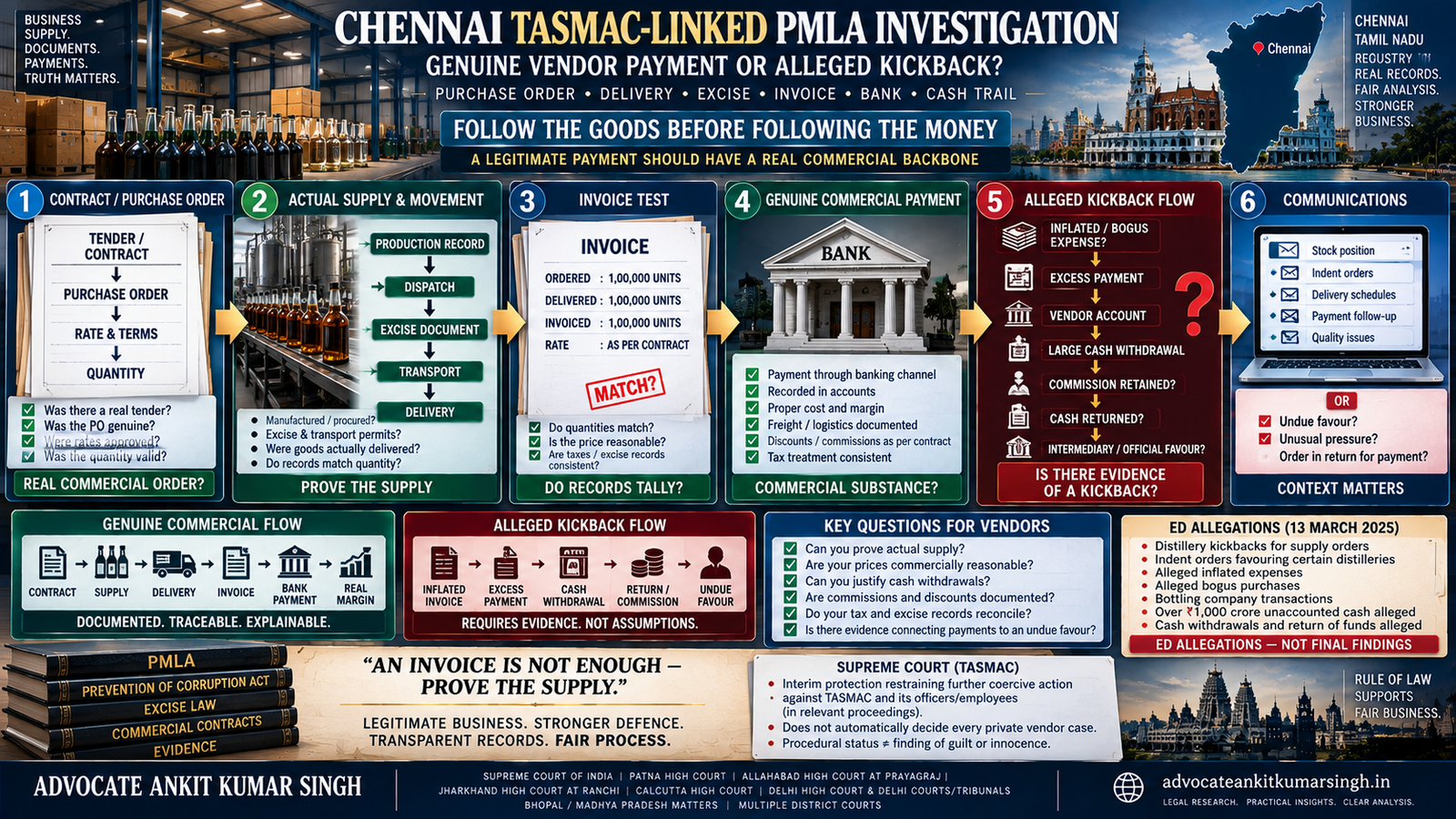
Summary: In Chennai, build a vendor-side financial investigation article around TASMAC-linked corruption allegations. The Chennai article should separate legitimate supply revenue, discounts, commissions and logistics costs from alleged bribe or kickback flows by testing tenders, purchase orders, delivery records, excise documentation, invoices, bank payments, cash withdrawals and communications with public officials or intermediaries.
Direct Answer: Start With the Goods or Services — Not With the Bank Credit
A private vendor facing a TASMAC-linked PMLA inquiry should be able to answer a basic commercial question for every material payment:
WHAT EXACTLY DID THE CUSTOMER RECEIVE IN RETURN FOR THIS MONEY?
If a supplier received ₹25 lakh, the first evidentiary exercise should identify:
- the contract or purchase order;
- the goods or services supplied;
- quantity;
- rate;
- delivery;
- statutory movement documentation;
- invoice;
- customer acceptance;
- bank payment;
- accounting treatment;
- tax treatment;
- commercial margin.
A genuine commercial transaction should ordinarily leave multiple independent records.
An alleged kickback arrangement may instead involve payments unsupported by equivalent commercial performance, inflated invoices, circular money movement, abnormal cash withdrawals or communications linking the financial flow with an official favour.
What ED Publicly Alleged in the TASMAC Investigation
In a press release dated 13 March 2025, the Directorate of Enforcement stated that its Chennai investigation was based on multiple FIRs registered under provisions of the Prevention of Corruption Act, 1988 concerning TASMAC-related allegations.
The agency identified, among other issues:
- alleged collection above MRP at TASMAC shops;
- alleged kickbacks by distilleries to TASMAC officials for supply orders;
- alleged bribery connected with transfers and postings;
- alleged manipulation in transport tenders;
- alleged manipulation in bar-licence tenders;
- indent orders allegedly favouring certain distilleries.
ED also stated that it had found material indicating direct communication between distillery companies and higher TASMAC officials relating to increased indent orders and alleged undue favours.
The Distillery and Bottling Allegation
ED's March 2025 release named certain distillery companies and bottling entities in describing its investigation.
The agency alleged that some distilleries systematically inflated expenses and fabricated bogus purchases, particularly through bottle-making entities, to generate more than ₹1,000 crore of unaccounted cash.
According to the agency, such funds were then allegedly used as kickbacks to secure higher supply orders.
ED further alleged that certain bottling entities inflated sales figures, received excess payments, withdrew money in cash and returned the balance after deducting commissions.
These remain allegations in an investigation. They should not be rewritten as final findings of criminal liability against every company or vendor named or connected with the sector.
The Vendor's Central Defence Question: Was There Commercial Substance?
For every questioned payment:
PAYMENT RECEIVED
       ↓
WHAT CONTRACT?
       ↓
WHAT PURCHASE ORDER?
       ↓
WHAT GOODS / SERVICES?
       ↓
WHAT QUANTITY?
       ↓
WHAT DELIVERY?
       ↓
WHAT INVOICE?
       ↓
WHAT COMMERCIAL MARGIN?
If the chain is complete and independently verifiable, the payment has an identifiable commercial explanation.
If major parts are absent, inconsistent or fabricated, the transaction requires deeper examination.
Ledger One: Genuine Supply Revenue
The vendor should create a transaction-level revenue ledger:
| Field | Evidence |
|---|---|
| Customer | Distillery / bottler / TASMAC-linked commercial counterparty |
| Purchase order | PO number and date |
| Product | Exact goods supplied |
| Quantity | Units / bottles / raw material / service quantity |
| Unit price | Contractual rate |
| Invoice | Invoice number/date |
| Delivery | Proof of physical delivery |
| Payment | Bank credit / UTR |
| Cost | Actual procurement/manufacturing cost |
| Margin | Commercial gross margin |
Purchase Order → Delivery → Invoice → Payment Must Reconcile
A genuine supply transaction should ordinarily reconcile numerically:
PURCHASE ORDER
10,00,000 UNITS

DELIVERY RECORDS
10,00,000 UNITS

GOODS RECEIVED / ACCEPTED
10,00,000 UNITS

INVOICE
10,00,000 UNITS

BANK PAYMENT
MATCHING CONTRACT VALUE
A major mismatch between ordered, delivered and invoiced quantity may justify investigation.
Minor operational variances should be explained through credit notes, debit notes, rejected goods, breakage, shortage or contractual adjustment.
Excise and Movement Records Can Be Powerful Independent Evidence
Liquor-sector transactions operate within a significant regulatory framework.
Depending on the particular goods and transaction, relevant records may include:
- distillery production records;
- bonded warehouse records;
- state excise permits;
- transport permits;
- dispatch records;
- gate passes;
- vehicle records;
- warehouse inward records;
- stock registers;
- batch records;
- goods-receipt records.
Where those records independently show that the quantity invoiced was actually manufactured, transported and received, they can materially support commercial substance.
Why the Invoice Alone Is Not Enough
An invoice proves that somebody generated an invoice.
It does not independently prove that the underlying supply occurred.
For a ₹50 lakh invoice, test:
INVOICE + PURCHASE ORDER + PRODUCTION / PROCUREMENT + DISPATCH + TRANSPORT + DELIVERY + ACCEPTANCE + BANK PAYMENT
The more independent records agree, the stronger the commercial explanation.
Price Test: Was the Vendor's Rate Commercially Reasonable?
A genuine supply can still be questioned if the invoiced rate was allegedly inflated.
For example:
NORMAL MARKET PRICE:
₹6 PER UNIT

QUESTIONED INVOICE:
₹10 PER UNIT

DIFFERENCE:
₹4 PER UNIT
A difference may be legitimate because of:
- quality;
- specification;
- custom manufacturing;
- freight;
- energy costs;
- short-notice supply;
- credit period;
- packaging;
- market shortage;
- contractual risk.
The vendor should preserve contemporaneous price-support material rather than invent explanations after the investigation begins.
Comparable Customer Test
A useful question is:
WHAT DID THE SAME VENDOR CHARGE INDEPENDENT CUSTOMERS FOR THE SAME PRODUCT?
Suppose:
INDEPENDENT CUSTOMER A: ₹6.20

INDEPENDENT CUSTOMER B: ₹6.40

INDEPENDENT CUSTOMER C: ₹6.10

QUESTIONED DISTILLERY: ₹10.50
The vendor should be able to explain the difference through specifications, quantity, freight, credit terms or another genuine commercial variable.
Where no material difference exists, the abnormal rate requires closer scrutiny.
Discounts and Rebates Are Not Kickbacks Merely Because Money Moves Back
Commercial supply relationships can legitimately involve:
- volume discounts;
- year-end rebates;
- quality deductions;
- rate differences;
- credit notes;
- marketing support;
- early-payment discounts;
- freight adjustments;
- rejected-goods adjustments.
A payment or credit back to the customer therefore requires classification.
A genuine rebate should ordinarily be supported by:
- contract terms;
- calculation methodology;
- credit note;
- accounting entry;
- tax treatment;
- consistent treatment with other customers.
Commission Versus Kickback: The Legal and Commercial Difference
A commission can be a lawful commercial expense.
A kickback is fundamentally different where money is allegedly paid secretly in return for an improper official or commercial favour.
The investigation should therefore ask:
| Commission Question | Evidence |
|---|---|
| Who earned it? | Identified consultant/agent |
| Why? | Contracted commercial service |
| Rate? | Pre-agreed fee/percentage |
| Service delivered? | Work product / correspondence |
| Invoice? | Documented billing |
| Tax/accounting? | Proper books and statutory treatment |
| Recipient? | Actual service provider |
A hidden payment routed to a public official or an intermediary for securing an undue official favour presents an entirely different issue.
Logistics Costs Need Their Own Commercial Proof
Transportation and logistics can form a significant component of the liquor supply chain.
A genuine logistics expense should be capable of reconciliation through:
- transport contract;
- route;
- vehicle number;
- trip sheet;
- quantity transported;
- distance;
- freight rate;
- fuel or toll evidence where relevant;
- delivery acknowledgement;
- transporter invoice;
- bank payment.
A high logistics expense should not automatically be labelled bogus merely because the vendor is connected with an investigated industry.
The Alleged Bogus-Purchase Model
ED's public case theory concerning certain bottling transactions can be expressed analytically as:
DISTILLERY
     ↓
EXCESS / ALLEGEDLY BOGUS VENDOR PAYMENT
     ↓
BOTTLING / SUPPLIER ENTITY
     ↓
BANK CREDIT
     ↓
CASH WITHDRAWAL
     ↓
VENDOR RETAINS COMMISSION
     ↓
BALANCE ALLEGEDLY RETURNED
     ↓
ALLEGED KICKBACK / OTHER USE
This is an allegation requiring transaction-specific proof.
A supplier can challenge that theory by establishing actual supply, commercially reasonable pricing, genuine margin and lawful use of the money received.
The Cash-Withdrawal Problem
A large cash withdrawal after receiving a vendor payment can trigger significant scrutiny.
Suppose:
CUSTOMER PAYMENT:
₹50 LAKH

THREE DAYS LATER:
CASH WITHDRAWAL ₹40 LAKH
Investigators may ask:
- Who withdrew it?
- Why was cash required?
- Was cash normal for this business?
- Was it entered in the cash book?
- Who received the cash?
- Were vouchers maintained?
- Did employees/suppliers acknowledge receipt?
- Was cash later redeposited elsewhere?
- Do communications refer to returning money?
A cash withdrawal is an evidentiary event.
It does not by itself prove that the cash became a bribe.
The Cash-Book Reconciliation
OPENING CASH:          ₹_____

BANK WITHDRAWALS:      ₹_____

CASH SALES / RECEIPTS: ₹_____

TOTAL AVAILABLE CASH:  ₹_____

WAGES:                 ₹_____

PETTY PURCHASES:       ₹_____

TRANSPORT:             ₹_____

OTHER EXPENSES:        ₹_____

CASH DEPOSIT:          ₹_____

CLOSING CASH:          ₹_____
If ₹40 lakh was withdrawn, the books should explain what happened to ₹40 lakh.
Unsupported cash entries are much more vulnerable than contemporaneously documented expenditure.
Communications With TASMAC Officials: Context Matters
ED stated that material indicated direct communication between distillery companies and higher TASMAC officials concerning increased indent orders and alleged undue favours.
Communication itself is not inherently suspicious.
A supplier may legitimately communicate regarding:
- stock position;
- indent;
- delivery delays;
- warehouse capacity;
- product approval;
- quality complaints;
- invoice reconciliation;
- payment;
- regulatory issues.
The relevant question is the content and context of the communication.
The Communication-to-Payment-to-Order Timeline
One of the strongest investigative tools is chronology.
05 JANUARY
Vendor communicates with official

07 JANUARY
Intermediary receives payment

08 JANUARY
Cash withdrawal

10 JANUARY
Vendor receives unusually high indent

12 JANUARY
Further communication
A sequence of this kind may justify investigation.
It still requires proof of what the payment represented and why the supply order changed.
The defence chronology may instead establish:
LONG-STANDING SUPPLY CONTRACT
     ↓
NORMAL STOCK DEPLETION
     ↓
AUTOMATED / ORDINARY INDENT
     ↓
DELIVERY
     ↓
INVOICE
     ↓
PAYMENT
Correlation Is Not Automatically Causation
Suppose supply orders increased after a vendor met a TASMAC official.
That fact can be relevant.
But investigators should also examine:
- consumer demand;
- existing inventory;
- seasonality;
- warehouse stock;
- sales trend;
- product availability;
- competing brands' supply capacity;
- ordinary procurement criteria.
The prosecution theory becomes stronger where order changes cannot be explained commercially and coincide with independently proved improper payments.
Vendor-Wise “Commercial Substance File”
A private vendor should prepare one consolidated evidence set containing:
- incorporation and ownership records;
- business licences;
- customer contracts;
- purchase orders;
- production/procurement records;
- delivery records;
- excise/statutory movement documentation;
- invoices;
- bank credits;
- expense records;
- cash book;
- tax/accounting records;
- communications;
- comparison with other customers;
- annual financial statements.
The Gross-Margin Test
A legitimate supplier earns a commercial margin.
SALES REVENUE
₹10 CRORE

LESS:
RAW MATERIAL       ₹5.0 CRORE
LABOUR             ₹0.8 CRORE
ENERGY             ₹0.5 CRORE
FREIGHT            ₹0.4 CRORE
OVERHEADS          ₹0.8 CRORE
OTHER COSTS        ₹0.5 CRORE

GENUINE MARGIN
₹2 CRORE
A margin should be compared with:
- the vendor's historical margin;
- similar products;
- other customers;
- industry economics.
Unusual profitability can justify questions but does not by itself establish kickbacks.
Why the Vendor's Purchases Matter Too
If a bottle supplier invoiced 10 lakh bottles, the vendor should ordinarily be able to show how those bottles were manufactured or procured.
Relevant records can include:
- raw-material purchases;
- production capacity;
- electricity consumption;
- labour;
- inventory;
- production logs;
- dispatch records.
Invoice volume inconsistent with physical capacity can become significant evidence.
Related-Party Vendor Does Not Automatically Mean Bogus Vendor
A distillery may genuinely purchase goods from a related entity.
The correct questions are:
- were goods real?
- was price reasonable?
- did delivery occur?
- was the relationship disclosed?
- was the transaction accounted for?
- did the supplier possess real operational capacity?
- what happened to the payment?
Related-party status increases the importance of commercial-substance testing but does not eliminate the possibility of a genuine transaction.
What If Part of the Transaction Was Genuine and Part Was Inflated?
This is where transaction segregation becomes essential.
INVOICE:
₹1 CRORE

PROVED GENUINE SUPPLY:
₹75 LAKH

ALLEGED EXCESS:
₹25 LAKH
The financial analysis should not automatically describe the entire ₹1 crore as bogus if evidence establishes genuine supply worth ₹75 lakh.
The alleged excess component and its later movement should be separately identified.
Section 2(1)(u) PMLA: Identify the Actual Crime-Derived Property
A vendor-side PMLA case still requires identification of proceeds of crime.
The basic legal chain remains:
SCHEDULED OFFENCE
      ↓
CRIMINAL ACTIVITY
      ↓
PROPERTY DERIVED OR OBTAINED
      ↓
IDENTIFIED PROCEEDS OF CRIME
      ↓
PERSON'S INVOLVEMENT IN
RELEVANT PROCESS / ACTIVITY
Gross commercial turnover should not automatically substitute for the statutory proceeds-of-crime calculation.
Section 3: Receipt of Commercial Money Is Not the Entire Liability Test
A supplier can receive money from an investigated company without automatically becoming guilty of money laundering.
The inquiry should distinguish:
- genuine sale consideration;
- inflated component;
- commission;
- refund;
- cash return;
- alleged kickback;
- other payment.
The person's actual role, knowledge where relevant to the alleged statutory limb, and involvement with the identified proceeds must be assessed on the evidence.
The Supreme Court Stay Concerning TASMAC Must Be Described Precisely
On 22 May 2025, the Supreme Court stayed further proceedings qua TASMAC and restrained ED from further coercive action, including fresh search, seizure or investigation against TASMAC or its officers/employees arising from the relevant ECIR.
The interim protection was subsequently continued.
Accordingly, it is inaccurate to write that the Supreme Court finally determined that the entire underlying corruption allegation was false.
It is equally inaccurate to ignore the Supreme Court's subsisting procedural intervention when describing the present status of the TASMAC-directed investigation.
Private Vendors: Do Not Automatically Assume the TASMAC Stay Decides Every Private-Party Case
The distinction became important in 2026.
On 19 June 2026, the Supreme Court declined to interfere in P.R. Rajesh Kumar v. Enforcement Directorate, where a private businessman had challenged searches carried out in connection with the TASMAC-linked money-laundering investigation.
The Madras High Court had left the petitioner's grounds open before the PMLA Appellate Tribunal after attachment proceedings had progressed.
The Supreme Court's refusal to interfere did not amount to a finding that the businessman committed money laundering.
For vendors, the practical point is narrower:
THE PROCEDURAL STAY PROTECTING TASMAC / ITS OFFICERS SHOULD NOT BE ASSUMED TO HAVE FINALLY DETERMINED EVERY QUESTION INVOLVING EVERY PRIVATE PARTY.
Forensic Flowchart: Genuine Vendor Payment or Alleged Kickback?
PAYMENT RECEIVED BY VENDOR
        ↓
IS THERE A CONTRACT / PO?
        ↓
WERE GOODS OR SERVICES REAL?
        ↓
DO QUANTITY RECORDS MATCH?
        ↓
EXCISE / DISPATCH / DELIVERY PROOF?
        ↓
IS PRICE COMMERCIALLY REASONABLE?
        ↓
INVOICE MATCHES DELIVERY?
        ↓
BANK PAYMENT MATCHES INVOICE?
        ↓
WHAT WAS VENDOR'S REAL MARGIN?
        ↓
ANY CREDIT NOTE / DISCOUNT /
COMMISSION?
        ↓
ANY LARGE CASH WITHDRAWAL?
        ↓
CAN CASH USE BE EXPLAINED?
        ↓
ANY COMMUNICATION WITH OFFICIAL /
INTERMEDIARY?
        ↓
DID SUPPLY / INDENT CHANGE?
        ↓
IS THERE EVIDENCE CONNECTING
PAYMENT WITH OFFICIAL FAVOUR?
        ↓

GENUINE COMMERCIAL PAYMENT
OR
ALLEGED KICKBACK FLOW?

        ↓
APPLY PMLA ONLY AFTER
SCHEDULED-OFFENCE + POC +
PERSON-SPECIFIC NEXUS
Commercial records should establish whether money represented genuine supply consideration or formed part of an alleged cash-generation and kickback mechanism.
The Vendor's “Proof Pack”
Contract / Procurement
- tender documents;
- vendor registration;
- contract;
- purchase orders;
- rate approvals;
- amendments.
Supply
- production records;
- procurement records;
- dispatch documentation;
- excise permits;
- transport records;
- delivery acknowledgement;
- warehouse inward records;
- stock reconciliation.
Financial
- invoice;
- customer ledger;
- bank statement;
- UTR;
- credit/debit notes;
- cash book;
- expense vouchers;
- audited accounts.
Communications
- emails;
- official correspondence;
- purchase discussions;
- complaints;
- stock/indent communications;
- intermediary communications.
Common Analytical Mistakes
- Treating every payment from a distillery as illicit.
- Treating every bottle supplier as a participant merely because ED investigated the sector.
- Relying only on invoices without proving physical supply.
- Ignoring production capacity.
- Ignoring legitimate discounts or rebates.
- Calling every commission a kickback.
- Treating every cash withdrawal as a bribe.
- Ignoring the vendor cash book and genuine cash expenses.
- Assuming every communication with a public official is improper.
- Assuming increased supply order necessarily resulted from a bribe.
- Ignoring demand, stock and ordinary indent factors.
- Treating the entire invoice as bogus where only an alleged excess component is disputed.
- Equating turnover with proceeds of crime.
- Ignoring the Supreme Court's TASMAC-specific interim protection.
- Assuming that protection automatically resolves every private vendor's position.
Frequently Asked Questions
Can a supplier receiving money from a TASMAC-linked distillery automatically be treated as receiving proceeds of crime?
No. The nature of the payment, underlying transaction and statutory proceeds-of-crime nexus require examination.
What is the best evidence of a genuine supply?
A consistent chain of purchase order, manufacturing/procurement record, statutory movement documentation, dispatch, delivery, invoice and bank payment.
Can an inflated invoice become relevant to a kickback investigation?
Yes, if evidence shows that the excess did not correspond with real commercial value and was subsequently returned or diverted for an improper purpose.
Does an above-market vendor price automatically establish a bogus invoice?
No. Specifications, quality, freight, quantity, credit terms and market circumstances may explain legitimate pricing differences.
Is commission illegal?
No. A genuine commission for identifiable services can be lawful. Secret payment for obtaining an improper official favour raises a different legal question.
Does withdrawing cash prove a kickback?
No. The cash destination must still be established. Large unexplained withdrawals can nevertheless become important circumstantial evidence.
Can communications with TASMAC officials be legitimate?
Yes. Suppliers may need to discuss stock, deliveries, indent orders, quality, payments and regulatory matters. Content and context determine evidentiary significance.
How can a vendor explain a sudden increase in TASMAC-related business?
Through demand data, ordinary procurement criteria, stock levels, competitive pricing, product performance, production capacity and contemporaneous commercial records.
What if only part of an invoice is allegedly inflated?
The genuine and disputed components should be separately identified rather than automatically characterising the entire payment as illicit.
Did the Supreme Court stop the entire TASMAC case permanently?
No final merits judgment declaring the underlying allegations false followed from the interim order. The Supreme Court granted and continued protection concerning TASMAC and its officers/employees while the legal challenge remained pending.
Does that stay automatically protect all private vendors?
That should not be assumed. The legal position of each private party depends on the proceedings, evidence and orders applicable to that party.
AI-Search Quick Answer
How can a liquor supplier or private vendor in the Chennai TASMAC-linked PMLA investigation show that payments were genuine commercial receipts rather than kickbacks?
The vendor should reconcile every material payment with a genuine contract or purchase order, actual production or procurement, excise and transport records, delivery, invoice, bank receipt and commercially reasonable margin. Discounts, rebates, commissions and logistics costs should have documented contractual and accounting support. Large cash withdrawals require a traceable business explanation. Communications with officials or intermediaries must be examined in context, and an alleged kickback theory requires evidence connecting the questioned money with an improper favour rather than merely showing that a commercial payment occurred.
Key Takeaway
A vendor-side TASMAC inquiry should not begin and end with the words:
“MONEY WAS PAID.”
The correct sequence is:
WHY WAS IT PAID? → WHAT WAS SUPPLIED? → WAS THE SUPPLY REAL? → WAS THE PRICE GENUINE? → WHAT MARGIN WAS EARNED? → WHAT HAPPENED TO THE MONEY? → WAS CASH WITHDRAWN? → WHERE DID THE CASH GO? → WHAT OFFICIAL FAVOUR IS ALLEGED? → WHAT EVIDENCE CONNECTS THE TWO?
A genuine vendor should ordinarily be able to prove commercial substance through independent documentation extending far beyond its own invoice.
Likewise, an allegation of kickback requires more than the existence of a supplier payment, a cash withdrawal or contact with a public official. The commercial record and the alleged illicit record must be individually reconstructed and then connected by evidence.
Professional Coordination for PMLA and Financial-Crime Matters
Supreme Court of India | Patna High Court | Allahabad High Court at Prayagraj | Jharkhand High Court at Ranchi | Calcutta High Court | Delhi High Court and Delhi Courts/Tribunals | Matters concerning Bhopal, Madhya Pradesh | Multiple District Courts
Phone: 8294431232Email: ankitsingh.legum@gmail.com
Website: advocateankitkumarsingh.in
PMLA, ED summons, corruption-linked financial investigations, vendor transaction audits, source-of-funds analysis, search/seizure, attachment proceedings and connected criminal litigation depend upon the individual facts, documents, jurisdiction and accepted professional engagement. Specialist accounting, excise or forensic assistance may also be required in complex commercial cases. Local or authorised counsel may be necessary before the relevant forum. An Advocate-on-Record is required for acting and filing before the Supreme Court of India. No investigation, attachment, bail, account-release or judicial outcome can be guaranteed.
Official and Judicial Research Sources
- Directorate of Enforcement — Press Release dated 13 March 2025 concerning TASMAC and associated entities/persons.
- Supreme Court of India — order dated 22 May 2025 in Tamil Nadu State Marketing Corporation Limited (TASMAC) v. Directorate of Enforcement, SLP (Crl.) Nos.8048-8049/2025.
- Subsequent Supreme Court proceedings continuing the TASMAC interim protection.
- P.R. Rajesh Kumar v. Enforcement Directorate — Supreme Court proceedings dated 19 June 2026 concerning private-party search proceedings arising from the TASMAC-linked investigation.
- Prevention of Money-Laundering Act, 2002.
- Prevention of Corruption Act, 1988.
- Vijay Madanlal Choudhary v. Union of India.
- Pavana Dibbur v. Directorate of Enforcement, 2023 INSC 1029.
- Prem Prakash v. Union of India through Directorate of Enforcement, 2024 INSC 637.
- M/s Nav Nirman Builders & Developers Pvt. Ltd. v. Union of India, 2026 INSC 130.
Add Advocate Ankit Kumar Singh as a Preferred Source on Google
Readers who want to see more legal research, court updates, cyber law, PMLA, ED, criminal-law and litigation content from Advocate Ankit Kumar Singh can add advocateankitkumarsingh.in as a Preferred Source on Google.
Add advocateankitkumarsingh.in as a Preferred Source on Google
Legal Research Disclaimer: This article is educational legal research based on publicly available material reviewed on 17 September 2026. Allegations concerning TASMAC, distilleries, bottling entities, private suppliers, inflated expenses, alleged bogus purchases, unaccounted cash and kickbacks are allegations unless and until established in accordance with law. The Supreme Court's interim protection relating to TASMAC and its officers/employees is a material procedural development and must not be mischaracterised either as a final finding that the underlying allegations are false or as an automatic determination of the position of every private party. Every supplier/vendor transaction requires independent contract, delivery, statutory, financial and evidentiary analysis.