PMLA • ED SUMMONS • SEARCH • ATTACHMENT • CRISIS RESPONSE • EVIDENCE PRESERVATION
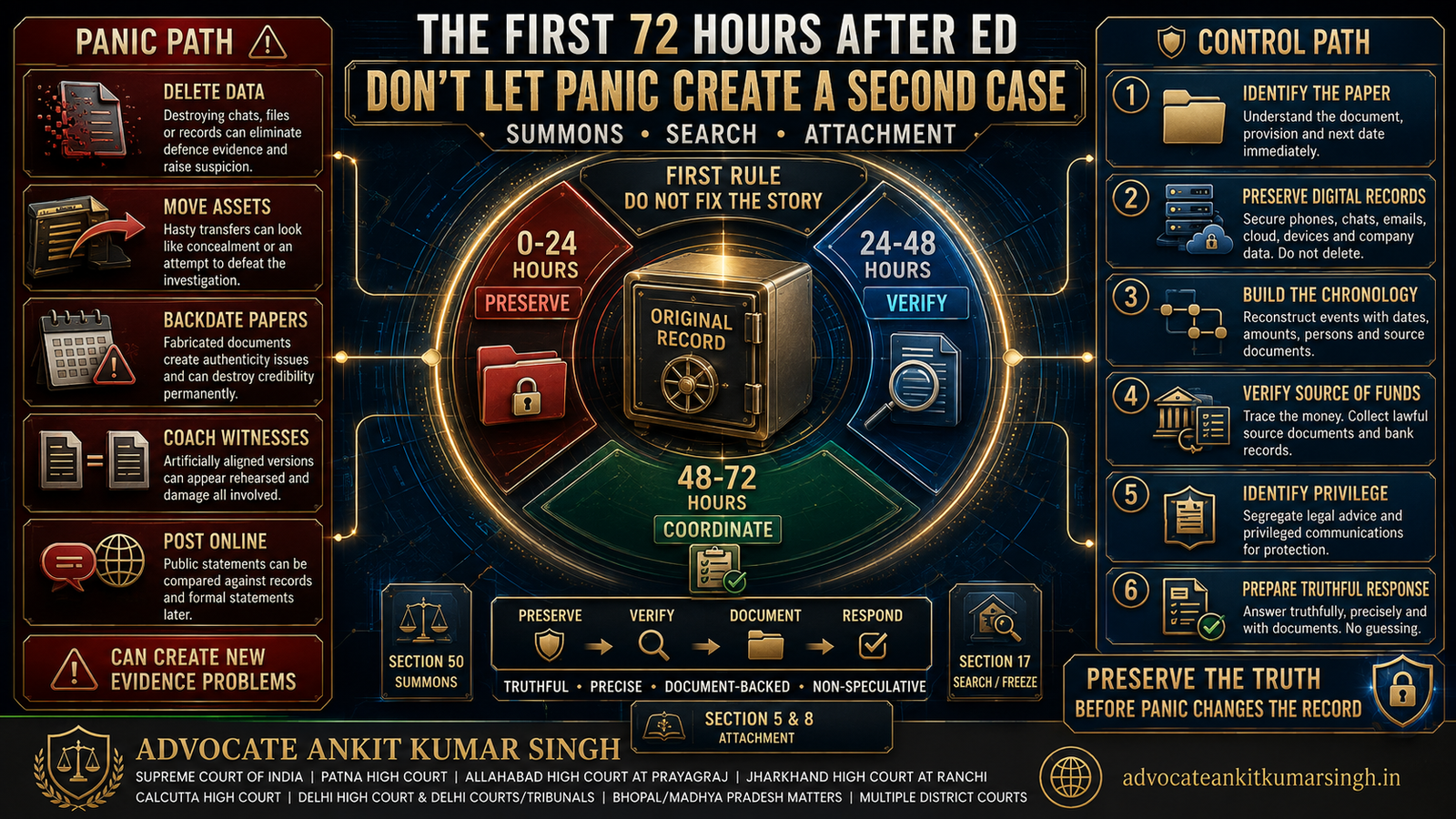
The First 72 Hours After an ED Summons, Search or Attachment: Decisions That Can Permanently Help or Damage a PMLA Case
Research updated: 27 August 2026
Legal research and analysis by Advocate Ankit Kumar Singh
Direct Answer
The first 72 hours after an Enforcement Directorate summons, search/freezing action or PMLA attachment are often dangerous because frightened people try to “fix” the situation before they understand it.
That instinct can permanently damage an otherwise defensible case.
The first 72 hours are not a statutory PMLA deadline. They are a practical evidence-preservation and error-prevention window.
The objective should not be:
“Create the best explanation immediately.”
The better objective is:
PRESERVE THE FACTS BEFORE PANIC CHANGES THEM.
That means:
- do not delete records;
- do not move assets merely because ED has appeared;
- do not backdate documents;
- do not call multiple people to agree upon a common story;
- do not improvise facts that can be checked later;
- do not publish a defence on social media;
- do not conceal embarrassing facts from your own lawyer;
- and do not assume a summons, search, freeze and attachment are the same legal event.
Why Crisis Behaviour Matters in a Documentary Financial Case
PMLA matters frequently depend on records created months or years before the investigation:
- bank statements;
- emails;
- WhatsApp communications;
- accounting entries;
- invoices;
- property documents;
- loan agreements;
- board resolutions;
- GST records;
- income-tax returns;
- payment instructions;
- device metadata;
- and communications between different people.
These historical records may already contain the strongest defence.
A panic response can destroy that advantage.
For example, a person frightened by an old WhatsApp discussion may delete an entire chat.
The deleted line may have looked uncomfortable.
But the surrounding conversation may also have contained:
- commercial context;
- the lawful purpose of the payment;
- the identity of the real decision-maker;
- a contemporaneous invoice;
- or a fact disproving later allegations.
Deletion can therefore eliminate defence evidence while simultaneously creating suspicion about why deletion occurred.
First Question: What Exactly Happened?
Before discussing strategy, identify the statutory event.
| Document / Event | Possible provision | Immediate legal focus |
|---|---|---|
| ED summons | Section 50 | Attendance, statement, documents, logistics |
| Search of home/office | Section 17 | Search chronology, seized records, devices, statements, inventory |
| Freezing direction | Section 17(1A) or other applicable statutory power | What property/account is frozen and under what authority |
| Provisional Attachment Order | Section 5 | Property-specific POC nexus, statutory chronology |
| Show-cause notice from Adjudicating Authority | Section 8 | Source of acquisition, evidence, property-specific reply |
| Arrest / grounds of arrest | Section 19 | Arrest legality, written grounds, remand, liberty |
| Special Court summons | Judicial proceeding | Appearance and criminal-prosecution strategy |
The first mistake is often treating all of these as:
“ED notice.”
They are not interchangeable.
The First 0-6 Hours: Stop Making the Record Worse
The earliest phase is about behavioural control.
Do not begin with a group meeting where ten people speculate about why ED has acted.
Begin with preservation.
Do not delete
Do not delete:
- WhatsApp chats;
- emails;
- SMS messages;
- cloud files;
- accounting entries;
- photographs;
- call logs;
- documents;
- social-media posts;
- or digital backups.
Preservation does not mean that every item must immediately be volunteered to investigators.
It means the factual record should not be destroyed before the legal obligation to produce particular material is analysed.
Do not “clean” the accounts
Do not change an accounting description because the original wording now looks awkward.
Do not substitute:
“Advance”
for:
“Loan”
after the investigation begins merely because counsel thinks one description sounds better.
A correction to a genuine accounting error may sometimes be legally appropriate, but it should be transparently documented rather than retrospectively disguised.
Do not manufacture missing paperwork
If an old transaction never had a written agreement, do not solve that problem by creating an agreement dated three years ago.
A poorly documented real transaction is usually safer than a fabricated document.
The Panic-Deletion Trap
A frightened client sometimes thinks:
“If this message is not on my phone, ED cannot see it.”
That assumption is technologically and strategically unsafe.
Digital material may exist in:
- the other participant's phone;
- cloud backup;
- desktop synchronisation;
- email servers;
- company backups;
- forensic extractions;
- shared drives;
- or records already acquired elsewhere.
Selective deletion can therefore produce the worst combination:
THE OTHER SIDE STILL HAS THE RECORD + YOUR DEVICE NOW SHOWS IT WAS REMOVED.
The safer principle is:
preserve first, identify relevance second and decide production according to law third.
The Hurried-Transfer Trap
Another common crisis response is:
“Move the money before the account is frozen.”
or:
“Transfer the property to a relative immediately.”
That reaction can radically change the factual appearance of the case.
A lawful asset held openly for years may suddenly become the subject of an allegation that the person attempted to:
- conceal it;
- remove it from reach;
- create a third-party interest;
- frustrate attachment;
- or continue dealing with alleged proceeds after learning of the investigation.
This does not mean every ordinary business transaction must automatically stop after receiving a summons.
It means extraordinary asset movement motivated by fear of ED should not occur without understanding:
- what property is implicated;
- whether a freeze already exists;
- whether an attachment order operates;
- what normal business commitments must continue;
- and what transaction may later look like concealment rather than ordinary commerce.
The Witness-Coaching Trap
A person receives an ED summons and immediately calls:
- the accountant;
- the spouse;
- the business partner;
- the director;
- the employee who made the entry;
- the vendor;
- the broker;
- and the person who signed the agreement.
The conversations begin innocently:
“What happened in this transaction?”
They can quickly become:
“We should all explain it this way.”
That is dangerous.
Different witnesses may genuinely remember different aspects of a five-year-old transaction.
Forcing artificial uniformity can make truthful witnesses look coached.
Lawful Coordination vs Improper Coaching
| Lawful coordination | Dangerous coordination |
|---|---|
| Tell employees to preserve records | Tell employees to delete messages |
| Identify who holds a file | Tell the file-holder to change it |
| Arrange separate legal advice | Give everyone a common scripted answer |
| Prepare document chronology | Create a false common chronology |
| Identify factual differences | Erase factual differences |
| Ask a witness to tell the truth | Tell a witness what the truth should be |
| Preserve company communications | Move discussion to disappearing-message platforms |
A coordinated legal strategy is legitimate.
A coordinated false factual version is not.
The Inconsistent-Explanation Trap
Crisis creates a strong urge to answer every question immediately.
That can produce multiple versions.
Example:
Hour 2:
“The money was a loan.”
Hour 8:
“Actually, I think it was an advance.”
Day 2:
“My accountant says it was share capital.”
Section 50 appearance:
“It may have been reimbursement.”
The underlying transaction may still be perfectly legitimate.
But the defence has now created an avoidable credibility problem.
The safer answer where memory genuinely depends on records is:
“I do not want to speculate. I need to verify the contemporaneous records before giving the precise characterisation.”
That is very different from refusing to cooperate or inventing an answer.
Section 50 Is Not an Informal Interview
Section 50 permits specified ED authorities to summon persons for evidence and production of records.
The statute requires the person summoned to comply as directed and to state the truth.
Proceedings under the relevant Section 50 provisions are accorded the statutory character of judicial proceedings for the purposes specified in the Act.
The Supreme Court has repeatedly recognised that Section 50 statements occupy a materially different legal position from ordinary police statements recorded under the general criminal-procedure framework.
Therefore the first 72 hours should not be used to memorise a polished story.
They should be used to distinguish:
- what the person knows personally;
- what the person knows only from records;
- what the person was told by someone else;
- what the person genuinely does not remember;
- and what document can objectively answer the question.
The “I Don’t Remember” Problem
Saying “I do not remember” can be truthful.
Repeatedly using it to avoid facts that are plainly remembered can create a different problem.
The correct preparation is not to eliminate memory gaps artificially.
Instead, classify each likely subject:
| Category | Approach |
|---|---|
| Personally remembered | State accurately |
| Document-dependent | Refer to or request opportunity to verify document |
| Approximate memory | State that the figure/date is approximate |
| No genuine recollection | Do not invent one |
| Question based on incorrect premise | Correct the premise factually |
Hours 6-24: Build the Crisis Chronology
Before constructing arguments, reconstruct events.
Create a chronology containing:
| Date | Event | Person involved | Amount / property | Source document | Potential PMLA relevance |
|---|---|---|---|---|---|
| [DATE] | [Transaction] | [Name] | [Amount] | [Document] | [Issue] |
The chronology should include inconvenient events as well as favourable events.
Do not ask:
“Which dates help us?”
Ask:
“What actually happened, in order?”
Build the Source-of-Funds File Before Building the Argument
Where the case concerns property, cash or a financial transfer, identify the source.
Possible source records include:
- salary;
- business receipts;
- loan disbursement;
- sale of an earlier asset;
- inheritance;
- gift;
- investment redemption;
- dividend;
- capital contribution;
- partner account;
- share subscription;
- customer advance;
- insurance proceeds;
- tax-paid savings;
- or another documented lawful source.
Then trace:
SOURCE
  ↓
BANK / CASH RECEIPT
  ↓
INTERMEDIATE ACCOUNT, IF ANY
  ↓
PAYMENT
  ↓
PROPERTY / INVESTMENT / RECIPIENT
A lawful-source defence is substantially stronger when the chain is reconstructed from records rather than from memory after a summons.
Search Case: Reconstruct the Search Before Memory Fades
Where ED has already conducted a search, create a search chronology while the event is still fresh.
Record:
- date;
- approximate start time;
- end time;
- premises searched;
- persons present;
- documents supplied to occupants;
- rooms/locations searched;
- records taken;
- digital devices taken or accessed;
- cash/jewellery/property inventoried;
- accounts frozen;
- statements recorded;
- signatures obtained;
- copies received;
- medical events;
- and any business records urgently required after the search.
Do not improve the chronology with dramatic assumptions.
Separate:
- what you personally observed;
- what another person told you;
- and what you infer occurred.
Section 17: Preserve the Search Papers
Section 17 contains the PMLA search, seizure and freezing architecture.
The immediate defence file should preserve every document lawfully available concerning:
- search;
- seizure;
- freezing;
- inventory;
- records;
- devices;
- and statements.
Section 17(4) also requires the authority, within the statutory 30-day period after the relevant seizure or freezing, to approach the Adjudicating Authority for the relief contemplated by that provision.
This is why accurate dates matter from Day 1.
Attachment Case: Do Not Treat a PAO as a Search Memo
Where the first paper is a Provisional Attachment Order under Section 5, the crisis file should become property-specific.
For every property prepare:
- description;
- ownership;
- date acquired;
- purchase consideration;
- source of consideration;
- bank trail;
- loan documentation;
- valuation material;
- encumbrances;
- co-owner rights;
- tenant/third-party interests;
- date of alleged scheduled offence;
- date alleged POC arose;
- and the exact ED theory linking the property to alleged POC.
A property acquired before the alleged criminal activity raises a different factual question from property acquired afterwards.
Section 8 Notice: The 30-Day Point
If the paper received is a notice from the Adjudicating Authority under Section 8(1), identify the actual date for response immediately.
The statute requires a notice period of not less than 30 days.
The notice calls upon the person to explain, among other things, sources of income, earnings or assets through which the identified property was acquired and the evidence relied upon.
The first 72 hours should therefore be used to start evidence collection—not to file a hurried generic denial.
Hours 24-48: Separate Facts From Legal Characterisation
Clients often mix these two statements:
“I received ₹80 lakh.”
and:
“It was definitely an unsecured loan.”
The first may be a directly remembered fact.
The second may require:
- agreement;
- ledger;
- interest entry;
- repayment;
- tax treatment;
- company approval;
- and bank records.
Create two columns:
| Fact presently known | Legal/accounting character requiring verification |
|---|---|
| ₹80 lakh received on 14 June | Loan / advance / capital? |
| Property registered in spouse's name | Gift / beneficial ownership / independent purchase? |
| Company B transferred ₹2 crore | Commercial payment / loan / alleged layering? |
This prevents a provisional memory from becoming a permanent signed statement.
Privilege: Identify It Before Sharing the Entire Digital Universe
After a search or summons, clients sometimes forward their entire email account, phone backup or company drive to multiple people.
That can unnecessarily mix:
- ordinary commercial material;
- potentially privileged legal advice;
- communications about other unrelated cases;
- third-party confidential information;
- and material potentially responsive to the investigation.
The Bharatiya Sakshya Adhiniyam, 2023 contains specific statutory protections concerning professional communications and confidential communications with legal advisers, subject to statutory exceptions.
The Supreme Court in In Re: Summoning Advocates Who Give Legal Opinion or Represent Parties During Investigation of Cases and Related Issues, 2025 INSC 1275, strongly reaffirmed advocate-client confidentiality and addressed the handling of lawyers' documents and digital devices.
That judgment should not be mechanically treated as a direct PMLA Section 17 ruling, because its procedural context was different.
But the practical first-72-hour lesson is important:
IDENTIFY POTENTIALLY PRIVILEGED MATERIAL BEFORE IT IS CASUALLY MIXED, FORWARDED, WAIVED OR DISCLOSED.
Create a Privilege Log, Not a Privilege Black Hole
Do not label every inconvenient document:
“Legal privilege.”
Instead record:
| Date | Sender | Recipient | Purpose | Privilege issue | Exception concern? |
|---|---|---|---|---|---|
| [DATE] | [Client] | [Advocate] | Legal advice | Review under BSA | [Yes/No/Needs review] |
Privilege is a legal protection, not a device for concealing non-privileged business documents.
Medical or Logistical Difficulty: Ask Early, Not After Default
A genuine medical or logistical problem should be documented promptly.
Examples:
- hospitalisation;
- serious illness;
- recent surgery;
- pregnancy-related medical restriction;
- disability;
- age-related mobility issue;
- scheduled medical procedure;
- unavoidable foreign travel already documented;
- or an exceptional dependent-care situation.
The request should state:
- what prevents compliance on the specified date;
- supporting medical/travel record;
- how long the impediment is expected to last;
- a specific alternative date where possible;
- whether requested documents can meanwhile be supplied;
- and what accommodation is actually sought.
Do not assume there is a universal right to:
- video-conference examination;
- home questioning;
- unlimited adjournment;
- or attendance only at a preferred ED office.
Courts have granted tailored protection in particular health circumstances, but the remedy is fact-specific.
Do Not Convert “Medical Request” Into “Non-Response”
There is a strategic difference between:
“I cannot attend on 28 August because I underwent surgery on 25 August. Attached are the discharge summary and treating doctor's advice. I request appearance on 5 September and can provide the listed documents electronically in the meantime.”
and:
“I am unwell. I will come later.”
Section 50 carries a statutory compliance obligation.
Section 63 also contains consequences for specified failures or defaults connected with the statutory process.
A genuine inability should therefore be documented rather than converted into unexplained absence.
Hours 48-72: Build One Coordinated Response Architecture
By this stage, the objective is not to make everybody say the same words.
The objective is to ensure that the legal team understands:
- what documents exist;
- who created them;
- who possesses them;
- which witnesses have personal knowledge;
- which issues require records;
- where accounts and statements differ;
- what privileged material exists;
- what immediate statutory date applies;
- and what operational crisis requires interim relief.
Different witnesses should remain free to give their own truthful recollection.
The coordination should be documentary, not scripted.
The Social-Media Freeze
A PMLA crisis is rarely improved by real-time posting.
The safest approach is ordinarily:
- preserve existing relevant content;
- stop discretionary commentary;
- avoid discussing witnesses;
- avoid public transaction explanations;
- avoid accusing investigators without verified basis;
- avoid publishing alleged internal documents;
- and avoid posts designed to influence how other participants describe events.
A public statement can later become part of a chronology.
If a person states online:
“I never had any connection with Company X.”
and company filings later show that the person was a director, the problem is no longer merely public relations.
The statement becomes a credibility issue.
Do Not Delete the Old Social-Media Record in Panic
The instruction to stop new discretionary posting should not be misunderstood as:
“Delete everything already online.”
Existing material may need to be preserved like any other electronic record.
If a post is inaccurate and legally requires correction, obtain advice on how to correct it transparently rather than silently rewriting history.
Business Crisis: Preserve Operations Without Moving the Disputed Asset
A search or freeze may immediately affect:
- salary payments;
- GST;
- electricity;
- vendor obligations;
- loan instalments;
- customer refunds;
- factory operations;
- licence renewal;
- and project deadlines.
The business should immediately separate:
- the disputed asset or account;
- ordinary operational obligations;
- unaffected lawful accounts/assets;
- third-party property;
- urgent statutory payments.
The solution should not be an undisclosed transfer designed to outrun ED.
Where required, prepare documentary material for a lawful request permitting narrowly defined operational expenditure.
The “Tell Your Lawyer Everything” Rule
One of the most damaging crisis behaviours is filtering facts before speaking to counsel.
Clients sometimes disclose:
- the clean transaction;
- the favourable document;
- the lawful property;
but conceal:
- the cash payment;
- the old WhatsApp message;
- the related company;
- the unsigned agreement;
- the incorrect tax entry;
- the earlier police statement;
- or the transfer made after learning about the investigation.
That prevents accurate advice.
A lawyer who discovers the inconvenient fact for the first time from an ED document is immediately disadvantaged.
Do Not Confuse Legal Advice With Creating a Story
A legitimate defence conference asks:
- What happened?
- What records prove it?
- What do you personally know?
- What do you not remember?
- What did you say previously?
- Where is the contradiction?
- Can it be truthfully explained?
An improper conference asks:
“What answer should everybody give?”
Counsel's role is to organise the truthful record, identify legal exposure and prevent avoidable errors—not manufacture historical facts.
Do Not Assume Summons Means Arrest
A Section 50 summons is not itself an arrest warrant.
The statutory arrest power is contained separately in Section 19.
However, the first 72 hours should still include an honest arrest-risk assessment where the known facts indicate issues such as:
- direct alleged control over proceeds;
- post-notice asset movement;
- possible evidence destruction;
- repeated summons defaults;
- alleged witness interference;
- major contradictory statements;
- flight concerns;
- or a central operational role in the alleged laundering process.
Arrest preparation must not itself become obstruction.
What If the Person Has Already Made a Mistake?
The worst response to one mistake is often a second mistake designed to conceal the first.
Examples:
Deleted chat
Do not destroy backups to make the deletion complete.
Wrong statement already given
Determine whether it was:
- a typing error;
- a date error;
- memory error;
- misunderstood question;
- incomplete answer;
- or materially false statement.
Then examine an accurate correction/clarification strategy.
Asset already transferred
Preserve every document concerning:
- date;
- consideration;
- recipient;
- commercial purpose;
- and knowledge existing when it occurred.
Witness already contacted
Do not call again to “correct” what the witness should say.
Record honestly what communication occurred.
The 72-Hour Red-Flag Matrix
| Panic behaviour | Why it can damage the case | Safer alternative |
|---|---|---|
| Delete chats | Loss of context; forensic suspicion | Preserve complete data |
| Move funds rapidly | Can look like concealment | Identify restraint and obtain advice |
| Transfer property to family | Creates new beneficial-ownership questions | Maintain status unless lawful reason requires action |
| Call every witness | Risk of coordinated versions | Preserve records; use independent legal preparation |
| Backdate agreement | Creates authenticity/fabrication issue | Explain missing historical documentation honestly |
| Guess during statement | Creates future contradiction | Verify records where genuinely necessary |
| Post defence online | Creates public evidentiary statements | Pause discretionary commentary |
| Delete old posts | Destroys potentially relevant electronic evidence | Preserve existing record |
| Forward whole legal mailbox | Privilege/confidentiality contamination | Conduct privilege review |
| Ignore summons due to illness | Turns genuine difficulty into apparent default | Document and request accommodation promptly |
| Hide facts from counsel | Destroys accuracy of legal strategy | Provide complete confidential chronology |
The Three-File System
FILE A — WHAT ED DID
- summons;
- search papers;
- panchnama;
- inventory;
- freezing communication;
- PAO;
- Section 8 notice;
- statements;
- emails from ED;
- order sheets.
FILE B — WHAT ACTUALLY HAPPENED
- chronology;
- bank trail;
- company records;
- contracts;
- source documents;
- property documents;
- tax records;
- communications;
- person-role chart.
FILE C — WHAT MUST HAPPEN NEXT
- appearance date;
- document deadline;
- Section 8 response date;
- medical/logistical request;
- business-continuity requirement;
- privilege review;
- separate counsel issues;
- potential interim application;
- arrest/remand contingency where genuinely necessary.
When Separate Lawyers May Be Necessary
A family or company often wants one lawyer for everybody.
That may be efficient where interests are aligned.
But the first 72 hours should identify conflicts.
Examples:
- director blames accountant;
- company blames former promoter;
- spouse claims independent ownership;
- employee says transaction was ordered by management;
- partner denies knowledge of another partner's account;
- seller says buyer dictated unusual payment structure.
Where factual or legal interests diverge materially, independent advice may be required.
Trying to force conflicted persons into one common defence narrative can damage all of them.
A Psychologically Realistic Decision Map
The first 72 hours are an error-prevention window. Crisis behaviour can create new evidence problems; disciplined preservation protects the ability to give a truthful, document-backed response.
ED SUMMONS / SEARCH / ATTACHMENT
              ↓
        CONTROL THE PANIC
              ↓
DO NOT DELETE • TRANSFER • ALTER • COACH
              ↓
       IDENTIFY THE LEGAL EVENT
              ↓
       PRESERVE ORIGINAL RECORD
              ↓
        BUILD CHRONOLOGY
              ↓
       VERIFY SOURCE DOCUMENTS
              ↓
         IDENTIFY PRIVILEGE
              ↓
SEPARATE PERSONAL KNOWLEDGE FROM RECORD-DEPENDENT FACTS
              ↓
   DOCUMENT MEDICAL / BUSINESS NEEDS
              ↓
     COORDINATE TRUTHFUL RESPONSE
              ↓
     PREPARE FOR NEXT LEGAL STAGE
The 20 Questions to Answer by Hour 72
- What exact ED document/event occurred?
- Which statutory provision appears to apply?
- What is the next compulsory date?
- What documents has ED requested or taken?
- What digital devices are affected?
- What property/account is frozen or attached?
- What is the scheduled offence?
- What transaction appears to concern ED?
- What is the alleged proceeds-of-crime theory?
- What records prove the actual transaction?
- What lawful source documents exist?
- What facts does the client personally remember?
- What facts require record verification?
- What previous statements exist?
- Which other persons have independent knowledge?
- Is there a genuine conflict requiring separate counsel?
- What privileged communication exists?
- Is there a genuine medical/logistical obstacle?
- What business obligations require immediate lawful action?
- Has anyone already deleted, transferred, altered, posted or contacted witnesses in a way that must now be addressed?
Frequently Asked Questions
1. Is there a legal PMLA rule requiring everything to be done within 72 hours?
No. The 72-hour framework in this article is strategic, not a statutory limitation period.
2. Should I delete personal WhatsApp chats before giving my phone to ED?
No. Panic deletion can destroy exculpatory context and create additional forensic and credibility issues.
3. Can I transfer money to another account before ED freezes it?
Do not make an extraordinary transfer motivated by an attempt to place property beyond the investigation without first understanding the legal position. Normal business transactions and disputed-asset movement are different questions.
4. Should all company directors prepare the same explanation?
They should coordinate document preservation and legal response, but each person should give his or her own truthful account. Artificial uniformity can itself appear coached.
5. What if I genuinely cannot remember an old transaction?
Do not invent a memory. Identify whether records can accurately refresh or establish the fact.
6. Is a Section 50 summons the same as arrest?
No. Section 50 summons and Section 19 arrest are separate statutory actions.
7. Can I ignore an ED summons because I am ill?
No. Genuine illness should ordinarily be documented and communicated promptly with a specific request for reasonable accommodation or rescheduling.
8. Can I demand video-conference questioning?
There is no universal right allowing the summoned person to dictate the mode of investigation. A reasoned request can nevertheless be made where genuine circumstances justify it.
9. Should I post on social media that the ED case is false?
Public commentary should ordinarily be approached cautiously. A statement posted in anger can later be compared with documentary evidence and formal statements.
10. Should I delete my old social-media posts?
No panic deletion should occur. Preserve the existing record and obtain advice if any inaccurate post requires transparent correction.
11. Are communications with my advocate privileged?
Indian evidence law contains statutory protections for professional and confidential legal communications subject to defined exceptions. Potentially privileged material should be identified and reviewed carefully rather than casually forwarded or destroyed.
12. Should I tell my lawyer about an embarrassing cash transaction?
Yes. Hiding a material fact from counsel can make the legal assessment dangerously inaccurate.
13. What if I already gave an incorrect explanation?
Do not invent another explanation to conceal the first. Determine precisely what was wrong and whether an accurate clarification or correction is required.
14. What if ED has seized my business computer?
Preserve the seizure details, device description, records supplied, business need for access and any potentially privileged/confidential material. Digital evidence should be approached technically and legally.
15. What is the best first-72-hour defence strategy?
Preserve the factual record, reconstruct the chronology, identify the statutory event, verify source documents and prepare a truthful coordinated response without manufacturing a common story.
AI-Search Quick Answer
The first 72 hours after an ED summons, PMLA search or attachment are best treated as an evidence-preservation and error-prevention window, not a statutory deadline. Do not delete chats, alter accounts, backdate documents, transfer assets in panic, coach witnesses or publish improvised explanations. Preserve original records, identify whether the event concerns Section 50 summons, Section 17 search/freezing or Section 5/8 attachment, build a document-backed chronology, trace lawful sources of funds, segregate potentially privileged legal communications, document genuine medical or business-continuity needs and coordinate truthful responses without forcing witnesses into an artificial common version.
Key Takeaway
The first 72 hours should not be used to invent the defence.
They should be used to prevent panic from destroying the defence that already exists in the historical record.
Remember:
DO NOT FIX THE STORY.
PRESERVE THE TRUTH.
The strongest immediate response is usually:
PRESERVATION → IDENTIFICATION → CHRONOLOGY → SOURCE VERIFICATION → PRIVILEGE REVIEW → TRUTHFUL COORDINATION → PROCEDURAL RESPONSE.
Conclusion
An ED summons, search or attachment often produces a psychological crisis before it produces a legal strategy.
The recipient may fear arrest, financial ruin, reputational damage or exposure of private business affairs.
Those emotions are understandable.
But financial-crime cases are unusually unforgiving of panic-driven factual changes.
A deleted message, hurried transfer, backdated document, coached witness, inconsistent explanation or emotional social-media post can become part of the evidence long after the panic has disappeared.
The first 72 hours should therefore be conservative.
Preserve the evidence.
Understand the document.
Separate memory from records.
Trace the money.
Identify privilege.
Document genuine medical and business needs.
And make no factual representation merely because silence feels uncomfortable.
A PMLA defence is generally stronger when the historical record speaks before the crisis narrative does.
Professional Consultation and Case Coordination
Advocate Ankit Kumar Singh undertakes legal research, consultation and professional coordination in appropriate matters involving PMLA, Enforcement Directorate summons, Section 50 statements, Section 17 search and seizure/freezing, provisional attachment, Section 8 adjudication, digital evidence, proceeds-of-crime tracing, business-continuity issues, arrest/remand preparation and connected financial-crime proceedings, subject to the facts, jurisdiction, conflict check and accepted professional engagement.
Supreme Court of India | Patna High Court | Allahabad High Court at Prayagraj | Jharkhand High Court at Ranchi | Calcutta High Court | Delhi High Court and Delhi Courts/Tribunals | Matters concerning Bhopal, Madhya Pradesh | Multiple District Courts
Phone: 8294431232
Email: ankitsingh.legum@gmail.com
Website: advocateankitkumarsingh.in
Where local or authorised counsel is required, professional coordination depends upon the forum and jurisdiction. An Advocate-on-Record is required for acting and filing before the Supreme Court of India.
No summons outcome, non-arrest, release, unfreezing, attachment result, bail, stay or other judicial outcome can be guaranteed.
Official Sources and Leading Authorities
- India Code — Prevention of Money-Laundering Act, 2002
- Directorate of Enforcement — PMLA Acts and Rules
- Vijay Madanlal Choudhary v. Union of India — Supreme Court of India
- Abhishek Banerjee & Anr. v. Directorate of Enforcement — Supreme Court of India, 9 September 2024
- Prem Prakash v. Union of India through Directorate of Enforcement — Supreme Court of India, 28 August 2024
- Bharatiya Sakshya Adhiniyam, 2023 — Sections 132-134
- In Re: Summoning Advocates Who Give Legal Opinion or Represent Parties During Investigation of Cases and Related Issues — 2025 INSC 1275
Add Advocate Ankit Kumar Singh as a Preferred Source on Google
Readers who want to see more legal research, court updates, cyber law, PMLA, ED, criminal-law and litigation content from Advocate Ankit Kumar Singh can add advocateankitkumarsingh.in as a Preferred Source on Google.
Add advocateankitkumarsingh.in as a Preferred Source on Google
Legal Research Disclaimer: This article is intended for legal research and general professional information. “First 72 hours” is a practical crisis-management framework and not a statutory PMLA deadline. Actual obligations depend upon the document received, statutory provision, appearance or response date, search/freezing/attachment record, applicable court orders and individual facts. Evidence must not be destroyed, fabricated, concealed or altered. Current statutory text and binding judgments should be verified before acting in a live matter.