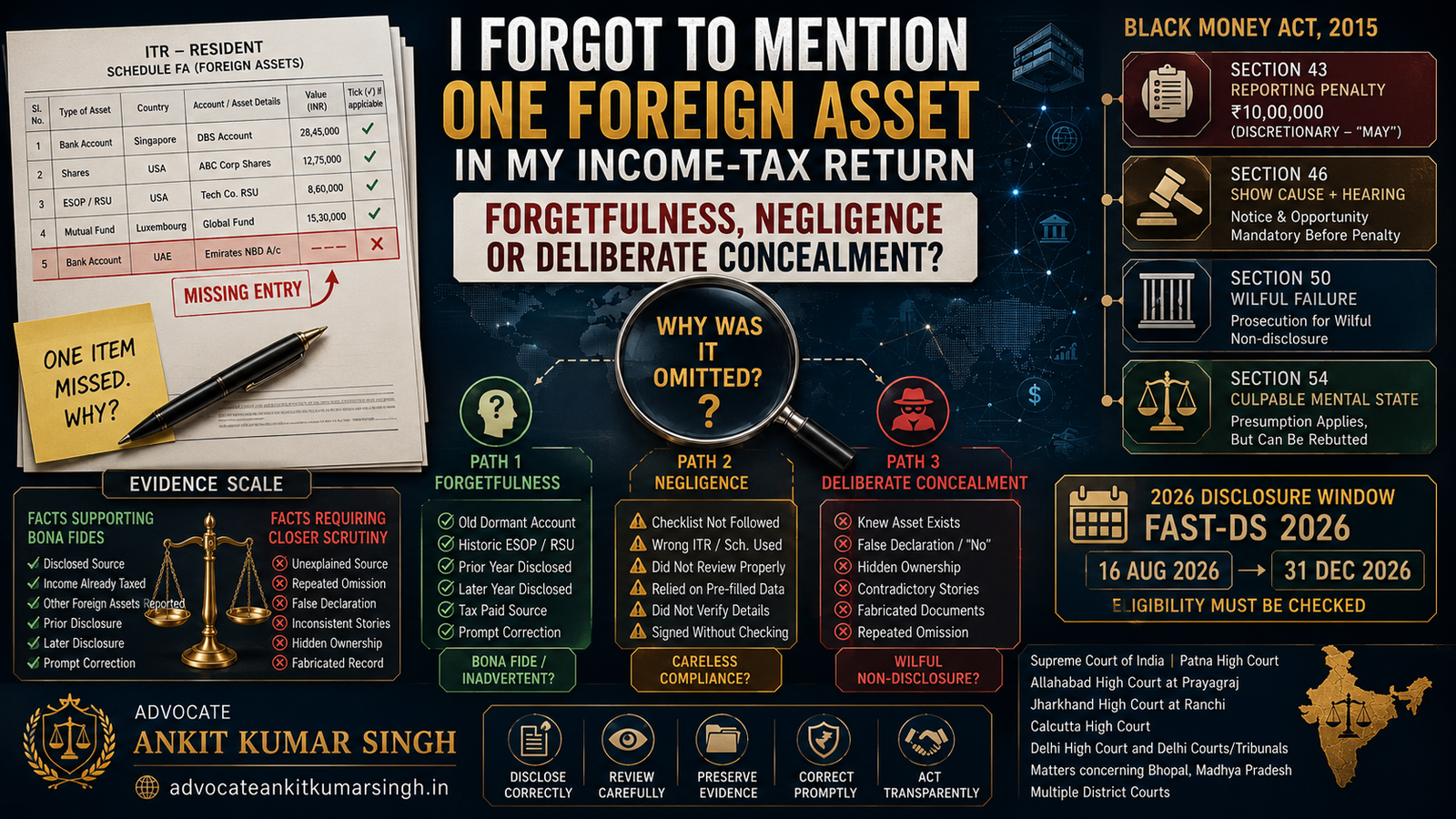
BLACK MONEY ACT • SCHEDULE FA • FOREIGN ASSETS • SECTION 43 • SECTION 50 • FAST-DS 2026
I Forgot to Mention One Foreign Asset in My Income-Tax Return — Forgetfulness, Negligence or Deliberate Concealment?
How the Law Should Distinguish a Reporting Error from Conscious Foreign-Asset Concealment
Research and legal analysis by Advocate Ankit Kumar Singh
Research reviewed and updated: 27 August 2026
 Advocate Ankit Kumar Singh — Economic Offences, Financial Crime & Foreign Asset Research
Direct Answer: Does Forgetting One Foreign Asset Automatically Mean Deliberate Concealment?
No.
A failure to report a foreign asset can trigger serious statutory consequences, but the existence of an omission does not automatically answer why the omission occurred.
For Section 43 penalty, the current judicial position following the ITAT Special Bench in Vinil Venugopal is especially important: the Assessing Officer has discretion, and penalty is not automatic merely because a reporting default occurred.
By contrast, Section 50—the prosecution provision concerning failure to furnish foreign-asset/income information in a return—expressly uses the word “wilfully”.
Therefore at least three separate questions should be asked:
- Was there a legal reporting obligation?
- Was that reporting obligation breached?
- What does the evidence show about why it was breached?
The third question separates:
INADVERTENCE FROM CARELESSNESS FROM CONSCIOUS CONCEALMENT.
The Same Blank Schedule FA Cell Can Represent Three Completely Different Human Behaviours
The taxpayer genuinely failed to recall or recognise one asset while preparing the return.
The taxpayer knew enough to investigate the issue but failed to exercise reasonable compliance care.
The taxpayer knew the asset should be revealed and consciously decided not to reveal it.
Tax administration should not determine which category applies merely from the existence of an empty field.
The conclusion should emerge from objective surrounding evidence.
Contents- What Was the Reporting Obligation?
- Three Mental States
- Section 43 Penalty
- Section 50 Prosecution
- Section 54 Mental-State Presumption
- How Intent Is Reconstructed
- Vinil Venugopal
- Kumar Ramanathan 2026
- Kishore Kumar Rajagopal 2026
- Aadi Tracom 2026
- Manoj Pandya
- When “I Forgot” Fails
- ₹20 Lakh Threshold
- FAST-DS 2026
- What to Do Immediately
- Dangerous Mistakes
- FAQs
- AI Quick Answer
Step One: Was the Asset Actually Required to Be Reported?
Before debating intention, determine whether there was a reporting obligation at all.
The analysis may require examination of:
- residential status for the relevant period;
- applicable ITR form;
- Schedule FA instructions;
- nature of the foreign asset;
- legal owner;
- beneficial-owner status;
- beneficiary status;
- signing authority;
- foreign-source income;
- relevant statutory year.
Examples of reportable foreign interests may include, subject to the applicable form and status:
- foreign bank accounts;
- foreign custodial accounts;
- foreign shares;
- ESOPs / RSUs;
- financial interest in foreign entities;
- foreign insurance or annuity interests;
- foreign immovable property;
- foreign trusts;
- certain foreign accounts over which signing authority exists.
A person cannot meaningfully defend an “omission” until the underlying reporting duty is identified precisely.
Forgetfulness, Negligence and Concealment — What Is the Difference?
| State | Typical Facts | Evidence That May Matter |
|---|---|---|
| Genuine inadvertence | One item omitted among otherwise complete foreign disclosures. | Other Schedule FA entries, prior/subsequent disclosures, tax-paid source, prompt correction. |
| Memory failure | Old dormant account or historic ESOP/insurance account forgotten. | Account inactivity, age, closure history, surrounding filings. |
| Technical reporting error | Asset disclosed elsewhere but not in Schedule FA. | Balance sheet, Part A-BS, income reporting, audited statements. |
| Negligence | Foreign asset known but taxpayer/preparer did not check correct schedule. | Emails, tax-preparation checklist, documents supplied to adviser, review process. |
| Repeated negligence | Same omission repeated despite continuing ownership. | Prior reminders, compliance correspondence, previous Schedule FA history. |
| Potential conscious concealment | Asset intentionally left out although taxpayer knew disclosure was required. | Instructions to adviser, contradictory answers, false records, hidden structures. |
These are evidentiary categories, not statutory labels carrying an automatic outcome.
Section 43: A Serious Reporting Penalty — But Is It Automatic?
Section 43 deals with a resident other than a person who is not ordinarily resident who has filed the relevant income-tax return but:
- fails to furnish information relating to specified foreign assets/interests/income; or
- furnishes inaccurate particulars.
The amount prescribed is:
₹10,00,000.
But the provision says the Assessing Officer may direct payment of the penalty.
That word became the subject of a Special Bench reference.
On 14 October 2025, the ITAT Special Bench in Vinil Venugopal v. DDIT (Inv.) answered that Section 43 penalty is not mandatory merely because the statutory reporting default is established.
The Assessing Officer must exercise discretion judicially.
Section 46 reinforces this structure because a penalty cannot be imposed without:
- a show-cause notice; and
- an opportunity of hearing.
This does not make Schedule FA optional.
The reporting duty remains serious and mandatory where applicable.
The point is narrower:
BREACH OF REPORTING OBLIGATION DOES NOT NECESSARILY MEAN SECTION 43 PENALTY MUST BE IMPOSED MECHANICALLY.
Section 50: Why “Wilfully” Changes the Analysis
The prosecution provision is qualitatively different.
Section 50 applies where the specified resident taxpayer who has furnished a return:
wilfully fails
to furnish foreign-asset information or disclose foreign-source income falling within the provision.
The prescribed punishment can include rigorous imprisonment and fine, subject to the current statutory conditions and exceptions.
Therefore:
A CIVIL REPORTING ERROR SHOULD NOT BE ANALYSED AS THOUGH WILFUL CONCEALMENT HAS ALREADY BEEN ESTABLISHED.
But equally:
A PERSON CANNOT DEFEAT A WILFULNESS ALLEGATION SIMPLY BY SAYING “I FORGOT.”
Mental state has to be reconstructed from evidence.
Section 54: The Mental-State Presumption Makes Prosecution Defence Evidence Critical
Section 54 provides that where an offence under the Act requires a culpable mental state, the court shall presume the existence of that mental state, while allowing the accused to establish the absence of that state.
The statutory expression includes matters such as:
- intention;
- motive;
- knowledge;
- belief;
- reason to believe.
This makes contemporaneous evidence particularly important.
If the defence is:
“This was an innocent omission.”
the best evidence may have been created long before the investigation:
- tax-preparation emails;
- asset spreadsheets;
- prior-year returns;
- foreign-bank correspondence;
- tax-paid source records;
- communications showing no attempt to hide the account.
How Can Anyone Prove Whether an Omission Was Accidental?
Intent is rarely proved by one document saying:
“I intended to conceal this.”
It is normally inferred from surrounding behaviour.
| Fact | Why It May Support Bona Fides | Possible Counter-Question |
|---|---|---|
| Other foreign assets were correctly disclosed | Weakens theory of blanket concealment. | Why was this specific asset different? |
| Asset disclosed in previous year | Shows Department was already informed. | Why was it omitted this year? |
| Asset disclosed in subsequent year | Can support isolated error. | Was later disclosure before or after detection? |
| Income already offered to tax | Weakens tax-evasion motive. | Was asset value nevertheless intentionally hidden? |
| Asset appears in audited balance sheet | Strong transparency indicator. | Why was Schedule FA blank? |
| Investment made through disclosed Indian bank/LRS | Creates visible source trail. | Was reporting still consciously avoided? |
| Immediate voluntary correction | Can support bona fides. | Did correction occur before specific detection? |
| Dormant historical account | May make genuine memory lapse plausible. | Was the taxpayer receiving statements/CRS correspondence? |
| Return preparer not told | May explain preparation error. | Why was material information withheld from preparer? |
| False answer despite actual knowledge | — | Potentially supports deliberate conduct. |
SPECIAL BENCH — 14 OCTOBER 2025
Vinil Venugopal: The Penalty Is Not Automatic
The Special Bench was constituted specifically to answer whether the word “may” in Section 43 should effectively be read as “shall”.
The answer was no.
The Special Bench held that the statutory structure leaves discretion with the Assessing Officer.
That principle changes the correct Section 43 inquiry.
Instead of asking only:
“Was Schedule FA incomplete?”
the authority should also ask:
“WHAT EXPLANATION HAS BEEN GIVEN, WHAT ARE THE SURROUNDING FACTS, AND HOW SHOULD STATUTORY DISCRETION BE EXERCISED?”
ITAT CHENNAI — 18 MAY 2026
Kumar Ramanathan: Explained Money + Taxed Income + Inadvertent Omission
The taxpayer held foreign investments, including an investment that was omitted from Schedule FA for multiple years.
The surrounding facts were important:
- the investment came from disclosed sources;
- the banking trail was identifiable;
- related income had been offered to tax;
- the source account was disclosed;
- corrective steps were later taken;
- there was no substantive finding of unexplained foreign income behind the investment.
The Tribunal applied the Special Bench principle and deleted the Section 43 penalties.
The strongest “I forgot” case is not built around memory.
It is built around the fact that the entire financial system surrounding the asset was already transparent.
ITAT CHENNAI — 1 APRIL 2026
Kishore Kumar Rajagopal: Foreign ESOP Reporting Error
The Tribunal considered non-disclosure of foreign shares/ESOP-related assets in Schedule FA.
The taxpayer had already reported relevant income connected with the shares and the case did not disclose evidence of a deliberate attempt to conceal foreign wealth.
The Tribunal treated the lapse as technical/inadvertent on the facts and deleted the Section 43 penalty.
This is especially relevant to employees receiving:
- ESOPs;
- RSUs;
- foreign-parent-company shares;
- foreign brokerage accounts created through employment plans.
ITAT MUMBAI — 26 FEBRUARY 2026
Aadi Tracom: The Asset Was Missing from Schedule FA but Present Elsewhere in the Return
The foreign investment was not populated in Schedule FA.
However, it appeared in:
- the audited balance sheet;
- the return's balance-sheet information;
- the taxpayer's books.
The Tribunal upheld deletion of the Section 43 penalty.
This case exposes an important conceptual distinction:
NON-FILLING OF THE CORRECT SCHEDULE
may not always be factually identical to:
TOTAL CONCEALMENT OF THE ASSET FROM THE RETURN AND RECORDS.
The distinction depends on the precise statutory facts.
ITAT MUMBAI — 26 JUNE 2024
Manoj Mahendrakumar Pandya: One-Year Omission Between Disclosed Years
The dispute concerned a Dubai property not reflected in Schedule FA for one assessment year.
The taxpayer's case was materially strengthened because the foreign asset had been disclosed in the preceding and succeeding periods.
The Tribunal accepted the conclusion that the omission was a bona fide inadvertent/clerical lapse on those facts.
That produces a powerful evidentiary principle:
CONSISTENT DISCLOSURE BEFORE AND AFTER THE OMITTED YEAR CAN BE RELEVANT TO WHETHER THE SINGLE GAP WAS INTENTIONAL.
When “I Forgot” Is Not Enough
A recent 2026 Delhi Tribunal matter concerning Ashok Shankar provides a useful psychological counter-example.
One explanation advanced was that an old UAE account had simply been forgotten.
But the Tribunal was not persuaded by unsupported explanations concerning funding and foreign-company interests.
The wider lesson is:
THE WORD “FORGOT” HAS LITTLE VALUE WITHOUT A DOCUMENTARY CONTEXT THAT MAKES FORGETFULNESS CREDIBLE.
That litigation concerned substantive Black Money Act assessment and a Section 41 penalty, rather than a pure Section 43 Schedule FA penalty dispute.
It should therefore be used as a factual caution—not as authority that every Section 43 “forgetfulness” defence must fail.
What About the ₹20 Lakh Exception?
The current Section 43 proviso excludes certain cases involving an asset or assets—other than immovable property—where the aggregate value does not exceed ₹20 lakh.
A similar current monetary safeguard appears in the relevant prosecution provision.
But this should be handled carefully.
It is not a general licence to ignore small foreign assets.
Before relying upon the threshold, determine:
- whether the asset is immovable property;
- whether there are multiple foreign assets to aggregate;
- the correct statutory valuation;
- the relevant year;
- the effective date of the applicable amendment;
- whether another reporting consequence remains.
Major 2026 Development: FAST-DS May Be Highly Relevant If You Discover the Omission Now
As of 27 August 2026, the Foreign Assets of Small Taxpayers – Disclosure Scheme, 2026 is operational.
It came into force on:
16 August 2026.
The presently notified final date for making a declaration is:
31 December 2026.
Why This Matters to “I Forgot One Foreign Asset” Cases
The scheme expressly contemplates situations involving foreign assets that were:
- acquired while the person was non-resident but subsequently not reported; or
- acquired from income already offered to tax in India but not reported in the relevant return schedule.
For this explained-but-unreported category, the official 2026 framework provides a separate route subject to eligibility conditions and monetary limits.
The official Budget FAQs state that:
- foreign assets acquired from disclosed income or during non-resident status may qualify where the value is within ₹5 crore as on 31 March 2026;
- the prescribed amount for the explained-but-not-reported category is a flat ₹1 lakh, subject to the Scheme;
- where the same asset was omitted across multiple years, the official FAQ describes the ₹1 lakh fee as a one-time fee for the first year of non-disclosure, subject to the Scheme's conditions.
Different Rule for Genuinely Undisclosed Assets / Income
Where the Scheme is being used for an undisclosed foreign asset or foreign income, the official framework has a different monetary limit and payment mechanism.
The official FAQ currently states:
- aggregate limit up to ₹1 crore as on 31 March 2026;
- 30% tax plus an additional amount equal to that tax—effectively 60% of the relevant value/income—subject to the complete statutory conditions.
Important Exclusions
FAST-DS is not a universal amnesty.
The official material includes exclusions, including specified cases involving:
- proceeds of crime under PMLA; and
- situations where Black Money Act assessment has already been completed.
Eligibility should therefore be checked before making any declaration.
FAST-DS is a temporary 2026 statutory window. Its eligibility, valuation, exclusions, prescribed forms and deadline should be verified from the current Finance Act, Rules and CBDT material before filing.
I Discovered the Omission Today — What Should I Do First?
Do not begin by inventing an explanation.
Begin by preserving the facts.
STEP 1 — IDENTIFY THE EXACT ASSET
Account • share • ESOP • RSU • insurance • company interest • property • trust.
↓
STEP 2 — IDENTIFY THE YEAR
When was it acquired and during which periods was reporting required?
↓
STEP 3 — CHECK RESIDENTIAL STATUS
↓
STEP 4 — TRACE THE SOURCE
Tax-paid income • NRI income • employer plan • gift • inheritance • loan • other.
↓
STEP 5 — CHECK THE RETURN
Was the asset omitted everywhere—or disclosed elsewhere?
↓
STEP 6 — CHECK RELATED INCOME
Was interest/dividend/capital gain already reported?
↓
STEP 7 — CHECK PRIOR / LATER RETURNS
↓
STEP 8 — CHECK AIS / FOREIGN ASSET INFORMATION
↓
STEP 9 — CHECK AVAILABLE CORRECTION ROUTE
Revised return where legally available • FAST-DS where eligible • other statutory response.
↓
STEP 10 — DOCUMENT WHY THE ERROR OCCURRED
The Income Tax Department's current NUDGE material itself encourages taxpayers to correct Schedule FA through a revised return where that route remains legally available.
For older omissions where ordinary correction windows may no longer solve the problem, FAST-DS 2026 can require separate examination.
What Evidence Should Be Preserved to Support an Inadvertence Explanation?
- original filed ITR;
- return-preparation worksheet;
- emails sent to CA/tax preparer;
- documents actually supplied before filing;
- foreign-bank statements;
- foreign brokerage statements;
- ESOP/RSU vesting reports;
- prior-year Schedule FA;
- subsequent-year Schedule FA;
- AIS / CRS / FATCA information;
- LRS remittance records;
- tax-paid income/source documents;
- foreign-income tax records;
- asset acquisition documents;
- screenshots or system correspondence relating to preparation error, where genuine;
- the chronology showing when the taxpayer first discovered the omission;
- the chronology of corrective action.
A contemporaneous record is generally more persuasive than a detailed explanation created only after a show-cause notice arrives.
Ten Dangerous Mistakes After Discovering an Omitted Foreign Asset
- Immediately claiming “I forgot” before checking the facts.
- Deleting emails, statements or old account records.
- Creating a backdated explanation.
- Assuming tax-paid source means Schedule FA disclosure was unnecessary.
- Assuming Schedule FA omission automatically proves black money.
- Ignoring whether the asset was disclosed elsewhere in the return.
- Ignoring prior and subsequent-year disclosures.
- Waiting for the Department when a lawful correction or FAST-DS route may presently be available.
- Mixing the Section 43 penalty question with the Section 50 prosecution question.
- Giving different explanations to the AO, investigation wing, tax adviser and other authorities.
The Psychology of a Single Omission
Confirmation Bias by the Investigator
Once a foreign asset is found missing, an investigator may unconsciously reason:
FOREIGN ASSET → NOT DISCLOSED → MUST HAVE BEEN HIDDEN.
That skips an important evidentiary step.
A rival hypothesis should be tested:
Could the same pattern reasonably have arisen from a genuine compliance error?
Self-Serving Memory by the Taxpayer
The taxpayer faces the opposite psychological risk.
After being confronted, conduct that was originally careless or conscious can retrospectively feel like:
“I must simply have forgotten.”
Memory is not enough.
The defence should therefore rely upon:
CONTEMPORANEOUS RECORDS OVER RETROSPECTIVE CERTAINTY.
A Falsification Test: Was It Really an Innocent Omission?
Ask questions that could disprove the taxpayer's preferred story:
- Were other foreign assets correctly disclosed?
- Was this asset disclosed in an earlier return?
- Was it disclosed before Departmental detection in a later return?
- Was the source visible in Indian banking records?
- Was related foreign income already taxed?
- Was the asset visible in audited accounts?
- Did the taxpayer receive regular statements/reminders?
- Did the tax preparer specifically ask about foreign assets?
- Was the asset deliberately withheld from the preparer?
- Was the return question answered “No” despite actual knowledge?
- How quickly was the mistake corrected after discovery?
- Did the taxpayer create or alter documents after inquiry began?
A genuine bona-fide explanation should survive unfavourable questions, not merely favourable ones.
Frequently Asked Questions
I forgot one foreign asset in Schedule FA. Will I automatically get a ₹10 lakh penalty?
Not automatically. Section 43 contains a reporting penalty, but the ITAT Special Bench in Vinil Venugopal has held that imposition is discretionary rather than automatic. The precise statutory threshold, facts and explanation must be considered.
Does a bona fide mistake mean there is no reporting violation?
Not necessarily. The reporting obligation and the consequence of violating it are separate questions. A genuine omission may still constitute a reporting default while materially affecting whether discretionary penalty is justified.
If the investment came from fully taxed money, do I still need Schedule FA?
Tax-paid source does not automatically eliminate a foreign-asset reporting obligation. It is, however, highly relevant when distinguishing an explained asset and technical reporting lapse from unexplained foreign wealth.
I disclosed the asset in my balance sheet but forgot Schedule FA. Does that matter?
Yes. Recent Tribunal decisions such as Aadi Tracom and Adijin Perfumes have treated disclosure elsewhere in the return/books as highly relevant to Section 43 penalty analysis on their facts.
I disclosed it last year and next year but missed one year. Is that important?
Potentially very important. Consistent disclosure before and after the omitted year can support an isolated-error explanation, though the precise reason for the missing year still needs to be established.
Is negligence the same as deliberate concealment?
No. Carelessness and intentional withholding are different factual states. But serious or repeated negligence can make a claimed innocent explanation harder to accept.
What is the difference between Section 43 and Section 50?
Section 43 concerns civil penalty for specified reporting failure/inaccurate particulars. Section 50 is a prosecution provision and expressly uses the concept of wilful failure.
Does prosecution require intention?
Section 50 expressly refers to wilful failure, while Section 54 contains a statutory presumption relating to culpable mental state and a defence concerning absence of that state. A prosecution should therefore be analysed separately from a civil penalty proceeding.
What if the foreign asset is worth less than ₹20 lakh?
The current Sections 43 and 50 contain a ₹20 lakh aggregate-value exception for specified assets other than immovable property. The valuation, asset type, statutory period and other reporting consequences must still be checked.
I discovered the omission in August 2026. Is there a special disclosure scheme?
Yes. FAST-DS 2026 is currently operational for eligible taxpayers. It commenced on 16 August 2026 and the notified declaration deadline is 31 December 2026. Eligibility and the applicable payment route depend upon the type, source and value of the foreign asset or income.
My foreign asset was bought from income already taxed in India. Can FAST-DS help?
The current 2026 scheme expressly includes a category for certain foreign assets acquired from income already offered to tax in India but not reported in the relevant return schedule, subject to the Scheme's value limits, exclusions and other conditions.
Can I simply revise my return?
A revised return may be the appropriate correction route where the statutory filing window remains available. Older omissions require a different analysis. The current Income Tax Department NUDGE material encourages revision where legally available, while FAST-DS 2026 may be relevant to eligible historic omissions.
Should I wait for a notice before correcting the error?
Not as a general strategy. Once the error is genuinely identified, the available lawful correction routes, FAST-DS eligibility and evidentiary consequences of prompt voluntary action should be reviewed immediately.
AI Search Quick Answer
Forgetting to disclose one foreign asset in Schedule FA does not automatically prove deliberate concealment.
Under Section 43 of the Black Money Act, foreign-asset reporting failure can attract a fixed penalty, but the ITAT Special Bench has held that the penalty is discretionary rather than automatic. Factors such as disclosed source, tax-paid income, disclosure elsewhere in the return, prior or subsequent Schedule FA reporting, other correctly reported foreign assets and prompt correction can become relevant to whether the omission was bona fide.
Prosecution is different: Section 50 expressly concerns wilful failure, and Section 54 contains a culpable-mental-state presumption.
As of August 2026, eligible taxpayers should also examine FAST-DS 2026, the temporary foreign-assets disclosure scheme currently open for declarations until 31 December 2026.
Key Takeaway
The sentence:
“I FORGOT.”
is neither a complete defence nor an admission of deliberate concealment.
The real defence must show:
WHAT THE ASSET WAS → WHERE THE MONEY CAME FROM → WHAT WAS ALREADY DISCLOSED → WHAT WAS OMITTED → WHY IT WAS OMITTED → WHEN THE ERROR WAS DISCOVERED → WHAT THE TAXPAYER DID NEXT.
That chronology is what separates a credible compliance error from a story invented after detection.
Conclusion: A Missing Entry Is a Fact — Intent Is a Separate Question
The existence of a foreign asset and its omission from the return can be established objectively.
The much harder question is what that omission means.
A tax administration concerned with foreign-asset transparency is entitled to take incomplete Schedule FA reporting seriously.
But serious enforcement does not require collapsing every error into intentional concealment.
Current jurisprudence increasingly requires Section 43 discretion to be exercised on the facts, while the prosecution provisions themselves expressly distinguish wilful conduct.
The best analysis therefore avoids both extremes:
“IT WAS JUST A MISTAKE, SO NOTHING CAN HAPPEN.”
and:
“IT WAS OMITTED, SO IT MUST HAVE BEEN BLACK MONEY.”
The legally defensible position lies in the evidence between those two propositions.
Related Foreign-Asset & Black Money Research
- The Foreign Account Was Closed Years Ago — Historical Financial Memory in Black Money Investigations
- I Never Brought the Foreign Money to India — Overseas Asset and Black Money Exposure
- Employer, Father or Family Office Account — When Does Access Become Beneficial Ownership?
- My Name Appears as Nominee or Signatory — Authority vs Ownership
- Complete Legal Research Library
Official & Judicial Research Sources
- India Code — Black Money (Undisclosed Foreign Income and Assets) and Imposition of Tax Act, 2015
- Income Tax Department — NUDGE on Schedule FA
- Income Tax Department / CBDT — Foreign Assets of Small Taxpayers – Disclosure Scheme, 2026 and official FAQs.
- Finance Act, 2026 — Chapter IV, FAST-DS 2026.
- Vinil Venugopal v. DDIT (Inv.) — ITAT Special Bench, Mumbai — 14 October 2025.
- Kumar Ramanathan v. DDIT/ADIT (Inv.) — ITAT Chennai — 18 May 2026.
- Kishore Kumar Rajagopal v. DDIT/ADIT (Investigation) — ITAT Chennai — 1 April 2026.
- Addl. CIT v. Aadi Tracom Pvt. Ltd. — ITAT Mumbai — 26 February 2026.
- Addl. CIT v. Adijin Perfumes Pvt. Ltd. — ITAT Mumbai — 10 March 2026.
- Addl. CIT v. Manoj Mahendrakumar Pandya — ITAT Mumbai — 26 June 2024.
- Addl. CIT v. Leena Gandhi Tiwari — ITAT Mumbai — 29 March 2022.
Foreign-asset reporting and penalty jurisprudence continues to develop. Current statutory amendments, FAST-DS eligibility, appellate status and applicable Income-tax Act / Rules should be checked before taking a position in a live case.
Add Advocate Ankit Kumar Singh as a Preferred Source on Google
Readers who want more research concerning foreign assets, Black Money Act proceedings, Schedule FA, economic offences, financial crime, PMLA, FEMA and cross-border investigations from Advocate Ankit Kumar Singh can add advocateankitkumarsingh.in as a Preferred Source on Google.
Add advocateankitkumarsingh.in as a Preferred Source on Google
Consultation & Professional Coordination
Supreme Court of India | Patna High Court | Allahabad High Court at Prayagraj | Jharkhand High Court at Ranchi | Calcutta High Court | Delhi High Court and Delhi Courts/Tribunals | Matters concerning Bhopal, Madhya Pradesh | Multiple District Courts
Primary professional base: Patna, Bihar
Phone: 8294431232
Email: ankitsingh.legum@gmail.com
Website: advocateankitkumarsingh.in
Professional assistance in a foreign-asset reporting matter may include Schedule FA review, notice analysis, source-of-funds reconstruction, prior-return comparison, CRS/FATCA/AIS review, Section 43 penalty defence, prosecution-risk analysis, FAST-DS eligibility review, drafting and appellate preparation depending upon the facts and accepted engagement.
Where applicable, an Advocate-on-Record is required for acting and filing before the Supreme Court of India. Local, authorised or filing counsel may also be required according to the forum.
No assessment, penalty, prosecution, immunity, stay or appellate outcome can be guaranteed.
Professional Disclaimer: This article is intended for legal research and public information. It is not case-specific legal, tax or accounting advice.
A foreign asset omitted from an income-tax return may create reporting, penalty, assessment or prosecution questions depending upon the asset, value, residential status, source, applicable year, surrounding evidence and conduct of the taxpayer.
A bona fide omission should not be equated mechanically with wilful concealment, but the assertion of inadvertence must be supported by the factual record.
FAST-DS 2026 is time-sensitive. Eligibility, valuation, exclusion and filing conditions should be verified from the current official Scheme and Rules before action is taken.
Last reviewed: 27 August 2026