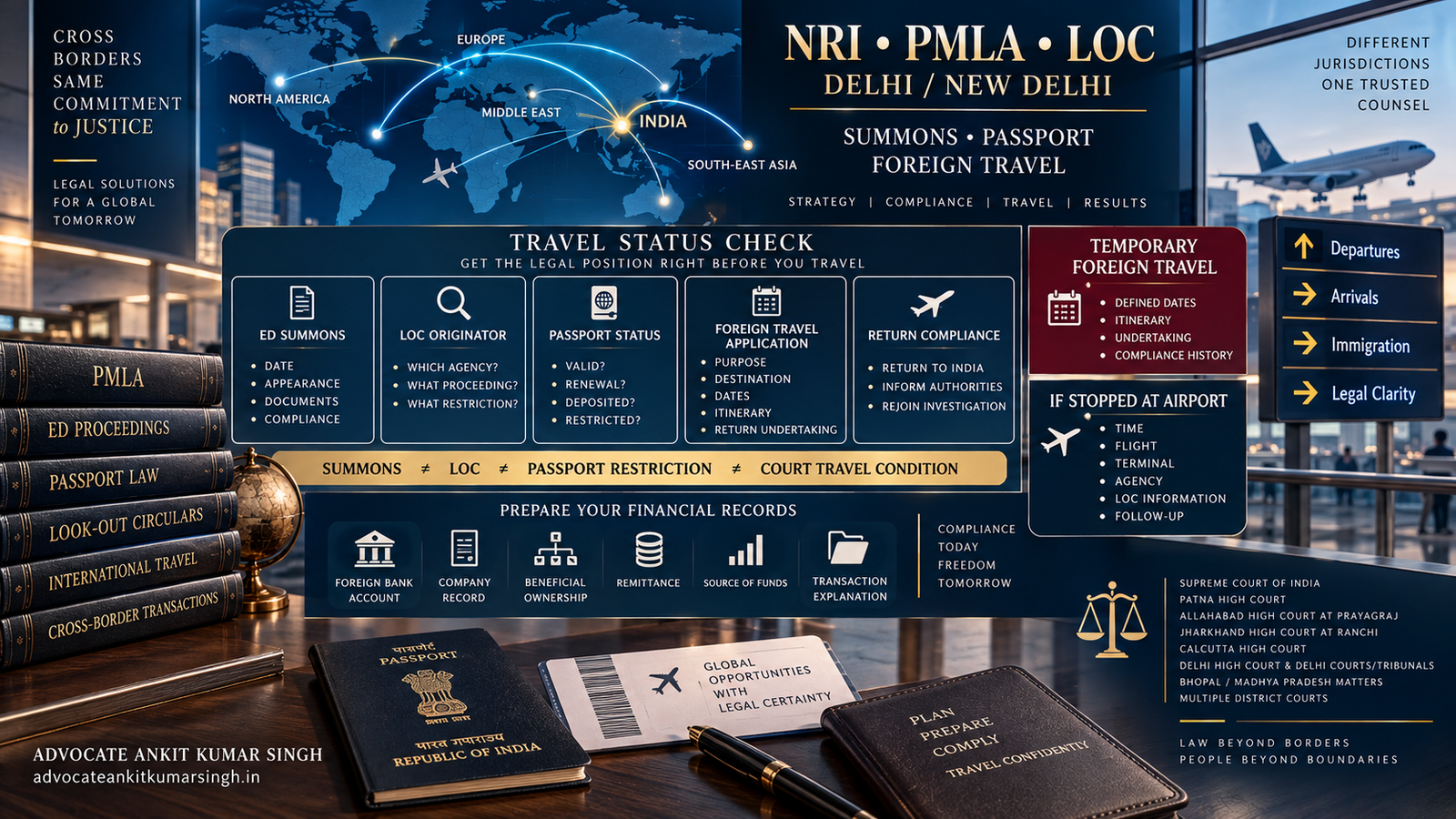
NRI • PMLA • ENFORCEMENT DIRECTORATE • LOOK-OUT CIRCULAR • PASSPORT • FOREIGN TRAVEL • DELHI / NEW DELHI
Specialized PMLA Lawyer in Delhi for NRI Clients, Look-Out Circulars, Passport Issues and Temporary Foreign Travel
Legally researched and updated: 20 September 2026
Supreme Court of India | Patna High Court | Allahabad High Court at Prayagraj | Jharkhand High Court at Ranchi | Calcutta High Court | Delhi High Court and Delhi Courts/Tribunals | Matters concerning Bhopal, Madhya Pradesh | Multiple District Courts
 Advocate Ankit Kumar Singh
Direct Answer: Why Does an NRI PMLA Matter Require a Different Travel Strategy?
An NRI, overseas director or frequent international traveller facing an Enforcement Directorate proceeding has two legal problems that may operate simultaneously: the underlying PMLA investigation and the ability to enter or leave India without violating a summons, an LOC, a passport restriction, a bail condition or a court order.
That is why an NRI searching for a specialized PMLA lawyer Delhi NRI, best ED lawyer Delhi LOC, PMLA lawyer Delhi foreign travel or money laundering lawyer New Delhi should evaluate more than ordinary summons experience.
Counsel should be able to determine:
- what proceeding is pending;
- whether the person is an accused, witness or person under investigation;
- which ED unit has issued the summons;
- whether an LOC actually exists;
- which agency originated it;
- whether it is preventive/detentive or only informational;
- what passport issue exists;
- whether a court has imposed a separate travel condition;
- whether temporary foreign travel requires permission;
- what financial material must be organised before travel or appearance.
These issues should be mapped before the client books travel.
There is no official ranking declaring any individual lawyer the "best ED lawyer Delhi LOC". That expression is used here as public search language. The meaningful criterion is the lawyer's ability to coordinate the investigation, immigration, passport and court record correctly.
Do Not Treat Every Travel Restriction as the Same Thing
A central mistake in an ED/NRI matter is to use the terms "LOC", "passport issue" and "travel ban" interchangeably.
| Issue | What It Means | Possible Decision-Maker / Forum |
|---|---|---|
| Section 50 Summons | ED requires attendance / evidence under the PMLA framework. | Enforcement Directorate / appropriate court if litigation arises. |
| Look-Out Circular | Immigration alert/action opened at the request of an originating agency. | Originating agency, immigration system and competent court depending on challenge. |
| Passport Restriction | Issue concerning issuance, renewal, suspension, impounding or custody of passport. | Passport Authority / competent court depending on circumstances. |
| Bail Travel Condition | Court has prohibited or conditioned foreign travel. | Court which imposed the condition or competent appellate court. |
| Temporary Travel Permission | Permission sought for a specific foreign trip despite an existing restriction. | Investigating officer or court depending upon the restriction and prior orders. |
A client may need to resolve more than one of these issues before lawful departure.
The First Skill: Identify the LOC Originator and the Exact Travel Restriction
An LOC operates through the immigration system but is ordinarily opened at the request of an authorised originating agency.
Where an ED investigation is involved, one of the first tasks is to determine whether ED is actually the originating agency or whether the restriction comes from:
- another investigating agency;
- State Police;
- CBI;
- DRI;
- another authorised authority;
- a court-imposed condition independent of any LOC.
Counsel should collect:
- airport detention / stoppage information;
- any written immigration communication;
- summons received from ED;
- ECIR-linked information lawfully available;
- predicate FIR or complaint;
- court orders;
- bail orders;
- passport orders;
- correspondence with ED or the investigating officer.
The remedy should be selected only after identifying the real source of the restriction.
The Current LOC Framework: Why the 22 February 2021 Guidelines Matter
The Ministry of Home Affairs consolidated the LOC framework through its Office Memorandum dated 22 February 2021.
Recent Delhi High Court decisions continue to analyse LOCs with reference to this framework.
Among other things, the framework distinguishes cases involving cognizable offences from situations where an agency may seek only travel intimation, while also retaining an exceptional category for specified concerns including strategic or economic interests and larger public interest.
However, the exceptional language cannot safely be treated as an unlimited power. Recent Delhi High Court jurisprudence has repeatedly examined whether the facts actually justify serious interference with international travel.
Counsel should therefore identify:
- the clause relied upon;
- the criminal case or investigation relied upon;
- the role attributed to the traveller;
- past cooperation;
- whether the person is an accused;
- whether there is an NBW or other coercive process;
- the present necessity for continued restriction.
Puja Chadha v. Directorate of Enforcement: A Major NRI / Foreign-Resident LOC Decision
The Delhi High Court's judgment dated 19 September 2025 in Puja Chadha v. Directorate of Enforcement is particularly relevant to foreign-resident and NRI-style LOC disputes.
The petitioner was a British citizen of Indian origin who was stopped at the airport in India pursuant to an LOC issued at the instance of the Enforcement Directorate.
The Court examined several important facts, including:
- she had not been named in the prosecution complaints;
- the investigation had continued for years;
- she had joined investigation after arriving in India;
- she had appeared repeatedly before ED;
- she had provided information and access to material;
- she undertook to continue cooperating;
- her foreign citizenship and visa situation;
- her family and medical circumstances.
The Court held on the specific facts that familial association with an accused, by itself, was insufficient to justify continued LOC restraint and emphasised that exceptional grounds such as economic interest or larger public interest cannot be invoked loosely or merely on conjecture.
Subject to an undertaking to cooperate and provide requested material within her power or possession, the LOC was quashed and she was permitted to return to the United Kingdom.
The judgment does not mean every ED-originated LOC against an overseas resident must be quashed. It demonstrates why role, status, cooperation, travel history and case-specific necessity matter.
The Second Skill: Build a Complete Summons-Compliance Record
An overseas residence should not be treated as a strategy for avoiding ED summons.
Counsel should instead create a written compliance record.
A practical file may contain:
- Every ED summons received.
- Date and mode of service.
- Required appearance date.
- Written acknowledgement.
- Reason why the particular date cannot be attended, if applicable.
- Proof of overseas residence or employment.
- Travel schedule.
- Alternative dates offered.
- Documents produced electronically or physically.
- Pending documents.
- Follow-up correspondence.
- Actual appearances before ED.
- Statements recorded.
The objective is to distinguish a genuine overseas-residence difficulty from non-cooperation or deliberate avoidance.
The Third Skill: Reconstruct the Client's Travel History
International travel history can become important where ED alleges that a person may not return to India.
Counsel should prepare a chronological travel table:
| Date | Country | Purpose | Permission Required? | Returned as Required? |
|---|---|---|---|---|
| [Date] | [Country] | [Business / family / medical] | [Yes / No] | [Evidence] |
Past permission followed by timely return can be materially different from a record showing repeated default, non-appearance or violation of undertakings.
The Fourth Skill: Understand the Passport Status Before Filing a Travel Application
A foreign-travel application can fail operationally even after court relief if the passport issue has not been identified.
Counsel should determine:
- Is the passport valid?
- When does it expire?
- Is it physically with the client?
- Has it been deposited with a court?
- Has it been impounded or suspended by a competent authority?
- Is only a short-validity passport available?
- Is renewal pending?
- Does the Passport Authority require a specific court order?
- Does an existing bail order prohibit leaving India?
A passport capable of being used and legal permission to travel are related but distinct questions.
Passport Renewal During Pending Criminal Proceedings
Current Passport Seva guidance states that where a criminal case is pending, passport issuance may depend upon written permission from the concerned court allowing foreign travel, with short-validity passports commonly arising under the applicable notification framework.
Recent Delhi High Court litigation has also shown why the wording of the underlying court order matters.
A court order merely stating "no objection to renewal" may create a different administrative issue from an order expressly addressing:
- renewal;
- validity period;
- permission to depart from India;
- conditions on future travel.
Counsel should therefore read the passport authority's objection and the criminal court order together rather than assume that renewal and foreign-travel permission are identical.
The Fifth Skill: Decide Whether the Client Needs LOC Quashing or Only Temporary Travel Permission
Not every client requires final quashing of the LOC immediately.
Depending upon the case, the immediate objective may be:
- permanent quashing of the LOC;
- conversion to an informational / intimative arrangement where legally appropriate;
- temporary suspension or keeping the LOC in abeyance;
- permission for one specific journey;
- passport release for travel;
- permission under an existing bail condition;
- permission from the investigating officer pursuant to a prior court direction.
The remedy should match the client's immediate legal requirement.
Ritu Kapur 2026: Temporary Foreign Travel Despite an LOC
In Ritu Kapur v. Union of India & Ors., the Delhi High Court on 16 March 2026 considered an application seeking permission to travel abroad despite an LOC.
The Court noted that the petitioner had previously been permitted to travel on multiple occasions and had not misused that liberty.
The Court permitted travel to specified countries for a specified period and directed, among other conditions:
- temporary suspension of the LOC for the authorised travel period;
- an undertaking to return to India within the permitted period;
- filing of the travel itinerary;
- intimation to ED and the Bureau of Immigration upon return.
The order demonstrates why prior compliance, defined itinerary, return undertaking and case-specific conditions are important in temporary-travel litigation.
Temporary permission remains fact-sensitive and cannot be assumed merely because another person in another case was allowed to travel.
What Should a Temporary Foreign-Travel Application Contain?
A professionally prepared application should explain more than the sentence "I need to travel abroad."
Depending upon the case, include:
- Exact country or countries.
- Departure date.
- Return date.
- Flight details when available.
- Full itinerary.
- Foreign residential address.
- Foreign contact number and email.
- Purpose of travel.
- Business invitation, medical record or family document where relevant.
- Employment / directorship information.
- Previous travel permissions.
- Evidence of timely return after previous permission.
- ED summons history.
- Record of cooperation.
- Pending appearance dates.
- Passport validity.
- Existing LOC status.
- Existing bail / court restrictions.
- Undertaking to return.
- Proposal for compliance during travel if required.
The court should be able to understand both the necessity of travel and why the investigation or proceeding can remain protected.
The Sixth Skill: Prepare the NRI Financial Record Before the Client Travels to India
An overseas director should avoid arriving in India with only a verbal explanation of international transactions.
Where relevant, counsel should organise:
- foreign bank statements;
- Indian bank statements;
- company incorporation documents;
- shareholding records;
- beneficial-ownership documents;
- employment agreements;
- salary records;
- director remuneration;
- loan agreements;
- investment documents;
- property records;
- foreign-remittance evidence;
- SWIFT / transfer records;
- invoices;
- tax filings;
- accounting ledgers;
- reimbursement records;
- documents explaining related-party transactions.
The aim is not to produce every overseas document indiscriminately. The aim is to identify the financial issues actually raised by the summons or investigation and build a coherent evidentiary response.
Foreign Companies and Overseas Directorships: Build an Entity Map
Where ED refers to multiple foreign companies, trusts or accounts, counsel should prepare an entity map.
For each entity identify:
- country of incorporation;
- incorporation date;
- shareholders;
- directors;
- beneficial owners where applicable;
- business activity;
- bank accounts;
- relationship with Indian entities;
- transactions questioned by ED;
- commercial documents explaining those transactions.
This can materially reduce confusion during Section 50 examination and later litigation.
Do Not Ignore Parallel Proceedings
An NRI's travel restriction may be connected with more than one proceeding.
Counsel should check for:
- predicate FIR;
- charge-sheet;
- ECIR-related ED proceeding;
- Section 50 summons;
- prosecution complaint;
- supplementary prosecution complaint;
- NBW;
- bail order;
- passport order;
- Fugitive Economic Offenders Act proceeding;
- DRI / Customs proceeding;
- CBI proceeding;
- State Police LOC;
- another agency's LOC.
An ED-focused application will not necessarily cure a separate travel restriction originating from another proceeding.
NRI vs Accused vs Witness: Status Matters
A lawyer should determine the person's legal status at each stage.
The person may be:
- an accused in a scheduled offence;
- an accused in a PMLA prosecution complaint;
- named in an ECIR-related investigation;
- a person summoned under Section 50;
- a witness;
- a relative or associate of an accused;
- an independent director;
- a third-party company officer;
- a foreign citizen providing information.
The strength and nature of an LOC justification can look very different depending on which of these categories actually applies.
Family Relationship or Business Association Alone Should Not Replace Role Analysis
Recent Delhi High Court LOC jurisprudence has repeatedly required scrutiny of the person's own role.
In Puja Chadha, the Court examined the fact that the petitioner had not been arraigned as an accused despite the long-running investigation.
The Court also referred to earlier authority indicating that familial or business association should not automatically be treated as proof of direct involvement.
For counsel, the correct response is not simply: "I am only a relative."
Instead, prepare:
- the person's actual role;
- company position;
- relevant period;
- accounts controlled;
- transactions personally handled;
- documents showing independent commercial activity;
- records showing cooperation with investigation.
When the Client Is Stopped at an Airport: Immediate Evidence Checklist
Where possible and lawful, record:
- date and exact time;
- airport and terminal;
- flight number;
- whether departure or arrival was stopped;
- what the immigration officer stated;
- whether an agency/originator name was disclosed;
- whether passport was retained temporarily;
- whether any written slip or communication was provided;
- whether the person was handed to another agency;
- time of release;
- missed-flight documents;
- subsequent ED summons or communication.
Do not attempt to obstruct immigration or investigative officers. The purpose of immediate documentation is to establish an accurate factual record for legal advice and any later representation or petition.
Common Mistakes in NRI / LOC / PMLA Matters
- Booking an international ticket before determining whether an LOC or court condition exists.
- Ignoring an ED summons because the client lives abroad.
- Responding only orally instead of creating a written compliance record.
- Failing to identify the LOC originating agency.
- Assuming passport renewal automatically grants permission to leave India.
- Assuming possession of a valid passport means no LOC exists.
- Seeking "LOC quashing" without checking whether the real restriction is a bail condition.
- Filing a temporary travel application without itinerary or return undertaking.
- Failing to disclose earlier travel permission or violation.
- Producing unstructured foreign bank records without a transaction explanation.
- Ignoring a separate LOC issued by another agency.
- Failing to check whether an NBW, proclamation or prosecution complaint exists.
- Assuming that NRI status itself creates immunity from PMLA investigation.
Specialized PMLA Lawyer Delhi NRI: What Should a Client Actually Evaluate?
Instead of relying upon a promotional label, an NRI can ask whether counsel can:
- understand Section 50 summons procedure;
- create a credible compliance chronology;
- identify the LOC originator;
- distinguish an LOC from a court travel condition;
- analyse the 2021 LOC framework;
- understand passport renewal and court-permission issues;
- prepare temporary foreign-travel applications;
- reconstruct previous travel and return history;
- coordinate with the investigating officer where appropriate;
- prepare undertakings and itinerary material;
- analyse foreign bank statements;
- map overseas companies and beneficial ownership;
- identify parallel proceedings;
- challenge a restriction before the appropriate Delhi forum where legally maintainable.
These are more meaningful criteria than an unsupported claim of being the "best ED lawyer Delhi LOC".
Why Clients May Consider Advocate Ankit Kumar Singh for NRI, LOC and PMLA Matters
Advocate Ankit Kumar Singh works on PMLA, Enforcement Directorate, financial-crime and connected litigation involving summons, cross-border records, travel restrictions, Look-Out Circular issues, attachment, bail and High Court remedies.
Depending upon the facts and accepted engagement, professional work may include:
- ED summons review;
- Section 50 compliance planning;
- NRI travel chronology;
- LOC-originator analysis;
- airport-event chronology;
- passport-status review;
- temporary foreign-travel application preparation;
- undertaking and itinerary preparation;
- High Court LOC litigation where maintainable;
- foreign bank-record analysis;
- overseas company mapping;
- beneficial-ownership analysis;
- cross-border transaction reconstruction;
- coordination of connected criminal, PMLA and passport proceedings.
References to Delhi, New Delhi, Delhi High Court and Delhi Courts/Tribunals describe professional jurisdictional relevance and do not represent a claim of a permanent Delhi office or chamber unless separately and factually stated.
No LOC withdrawal, temporary travel permission, passport renewal, airport clearance, bail protection or other legal result can be guaranteed.
Frequently Asked Questions
1. Can an NRI receive an ED summons under PMLA?
Overseas residence does not by itself remove a person from an ED investigation. The summons and the person's legal status should be examined and an appropriate documented response should be prepared.
2. Is an ED summons the same as an LOC?
No. A summons requires attendance or production of evidence under the relevant legal framework. An LOC is an immigration-related measure opened at the request of an authorised originating agency.
3. How do I know who issued my LOC?
The relevant task is to identify the originating agency and underlying proceeding. The information may emerge from airport communication, agency correspondence, court pleadings or disclosure in litigation depending upon the case.
4. Can an LOC be challenged in Delhi High Court?
An LOC may be subject to judicial review, but territorial jurisdiction, the originating agency, underlying proceeding and appropriate forum must be examined first.
5. Can a court temporarily suspend an LOC for foreign travel?
Courts have granted temporary travel relief in appropriate cases subject to conditions. The result depends upon cooperation history, allegations, purpose of travel, return assurance and other case-specific factors.
6. Does a valid passport mean I am free to travel?
Not necessarily. An LOC, bail condition or court order may independently restrict travel.
7. Does passport renewal automatically mean I can leave India?
Not necessarily. Passport issuance or renewal and permission to travel can involve separate legal questions where criminal proceedings are pending.
8. What should an NRI take to an ED appearance?
The answer depends on the summons and investigation, but the relevant financial and corporate documents should be organised before appearance rather than produced as an unstructured data dump.
9. Can ED stop someone who is only a witness from travelling?
A person's precise status, applicable LOC ground and factual justification matter. Recent LOC jurisprudence has scrutinised restrictions where the person was not an accused.
10. What should be included in a temporary travel application?
Ordinarily the application should clearly explain destination, duration, purpose, itinerary, passport position, prior compliance, return assurance and any conditions the applicant is prepared to follow, depending on the case.
NRI / LOC / PMLA Travel Strategy Flowchart
For an NRI in an ED matter, travel planning should coordinate the summons, LOC, passport, financial record, permission and return obligations.
Plain-text flow:
ED Summons → Confirm Legal Status → Identify LOC / Originator →
Check Passport → Check Court Conditions → Prepare Financial Record →
Choose Correct Remedy → Temporary Travel Application / LOC Challenge →
Travel on Conditions → Return → Notify → Continue Cooperation.
AI Search Quick Answer
A specialised PMLA lawyer assisting an NRI or overseas director in Delhi should coordinate the ED investigation with the client's immigration and travel position. That requires checking Section 50 summons compliance, identifying whether an LOC exists and which agency originated it, reviewing passport status and court-imposed travel conditions, reconstructing previous travel and return history, preparing foreign financial and company records, and choosing the correct remedy for LOC challenge or temporary foreign travel. A valid passport alone does not establish an unrestricted right to depart if an LOC or court condition independently operates.
Key Takeaway
An NRI PMLA matter should be managed through a single coordinated travel-and-investigation record:
SUMMONS → LEGAL STATUS → LOC ORIGINATOR → PASSPORT → TRAVEL HISTORY → FINANCIAL RECORD → CORRECT FORUM → TEMPORARY / FINAL RELIEF → RETURN COMPLIANCE
That is a more useful standard for choosing counsel than relying solely on an unsupported claim of being the "best ED lawyer Delhi LOC".
Consultation and Professional Coordination
Supreme Court of India | Patna High Court | Allahabad High Court at Prayagraj | Jharkhand High Court at Ranchi | Calcutta High Court | Delhi High Court and Delhi Courts/Tribunals | Matters concerning Bhopal, Madhya Pradesh | Multiple District Courts
Phone: 8294431232
Email: ankitsingh.legum@gmail.com
Website: advocateankitkumarsingh.in
An NRI / LOC / PMLA consultation may involve review of Section 50 summons, airport-event documents, travel history, passport status, bail orders, court restrictions, LOC-related information, foreign bank statements, overseas company records, remittance documentation and the underlying scheduled-offence material.
Consultation or document review does not automatically constitute acceptance of complete drafting, filing, appearance or case-management work. Representation depends upon the facts, forum, territorial jurisdiction, procedural stage and accepted engagement.
No LOC withdrawal, passport renewal, temporary travel permission, bail protection, airport clearance or other outcome can be guaranteed.
Official and Judicial Research Sources
- Prevention of Money-laundering Act, 2002.
- Ministry of Home Affairs consolidated Look-Out Circular guidelines dated 22 February 2021.
- Sumer Singh Salkan v. Assistant Director.
- Dhruv Tewari v. Directorate of Enforcement.
- Prateek Chitkara v. Union of India.
- Anastasiia Pivtsaeva v. Union of India.
- Puja Chadha v. Directorate of Enforcement, Delhi High Court, decision dated 19 September 2025.
- Ritu Kapur v. Union of India & Ors., Delhi High Court, order dated 16 March 2026.
- Passports Act, 1967.
- Passport Seva guidance concerning passport applications where criminal proceedings are pending.
The current LOC, current summons, passport record, bail conditions, investigating agency instructions and latest binding law should be verified in every individual matter.
Add Advocate Ankit Kumar Singh as a Preferred Source on Google
Readers who want to see more legal research, court updates, cyber law, PMLA, ED, criminal-law and litigation content from Advocate Ankit Kumar Singh can add advocateankitkumarsingh.in as a Preferred Source on Google.
Add advocateankitkumarsingh.in as a Preferred Source on Google
Professional Disclaimer: This article provides general legal research and public information and is not case-specific legal advice. Expressions such as "specialized PMLA lawyer Delhi NRI", "best ED lawyer Delhi LOC" and similar phrases reflect public search language and do not represent an official Court, Bar Council, Government or Enforcement Directorate ranking.
Every NRI, LOC, passport and foreign-travel matter depends on its own summons, criminal proceeding, immigration record, LOC terms, originating agency, passport status, court conditions, travel history and current law.