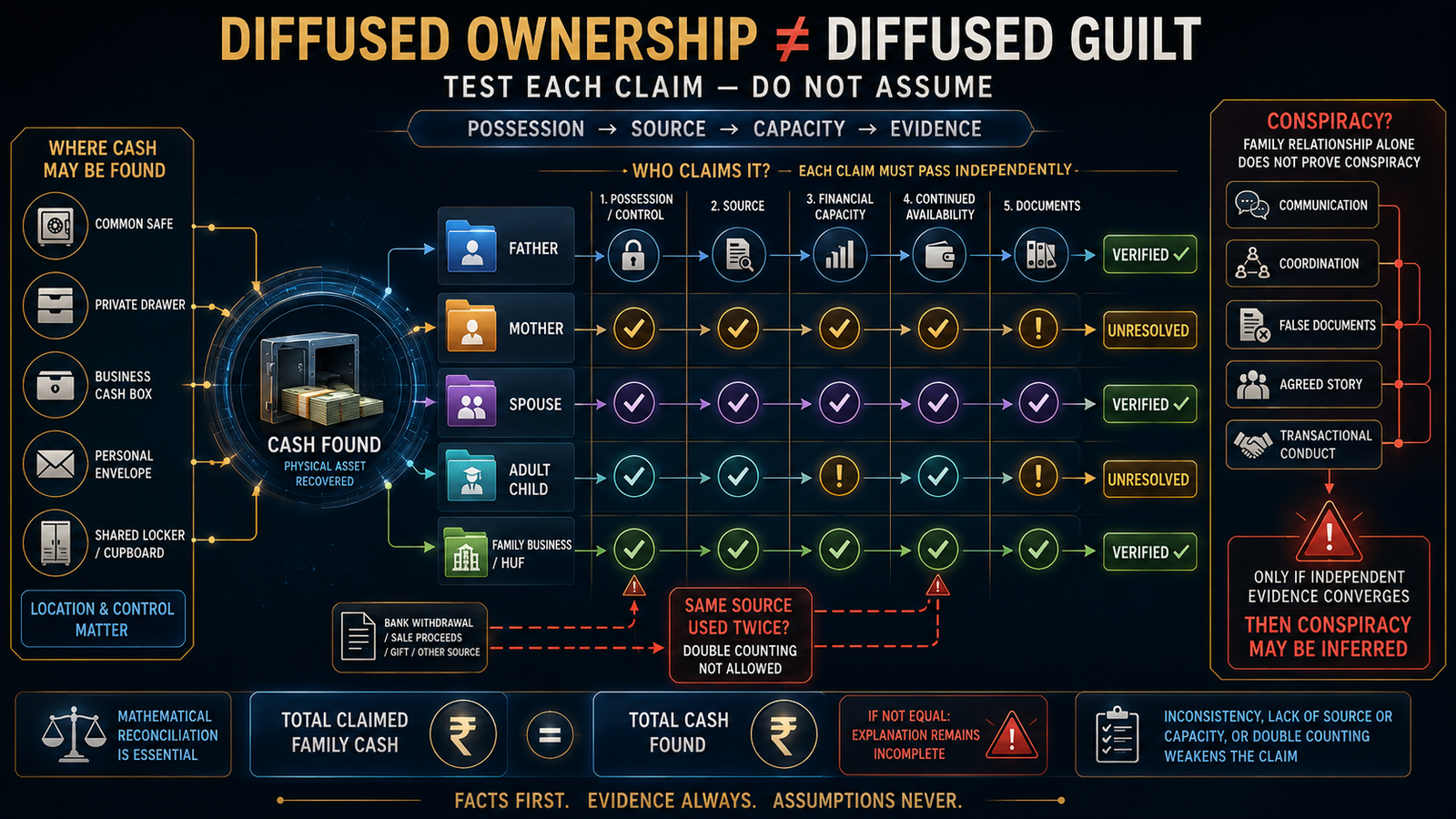
Everyone in the Family Says the Cash Belongs to Someone Else - Testing Diffused Ownership Without Assuming Conspiracy
Possession, Control, Beneficial Ownership, Family Savings, Source Reconstruction and the Difference Between a Weak Explanation and a Coordinated False Story
Legal research and analysis by Advocate Ankit Kumar Singh
Supreme Court of India | Patna High Court | Allahabad High Court at Prayagraj | Jharkhand High Court at Ranchi | Calcutta High Court | Delhi High Court and Delhi Courts/Tribunals | Matters concerning Bhopal, Madhya Pradesh | Multiple District Courts
Legally reviewed: 29 August 2026

Research and professional guidance by
Advocate Ankit Kumar Singh
Direct Answer
No. The fact that different family members attribute cash to one another does not automatically prove conspiracy.
But neither does the expression “family money” automatically explain the cash.
Investigators should separate at least five questions:
- Where was the cash physically found?
- Who possessed or controlled that place?
- Who claims legal or beneficial ownership?
- What independent source supports that person's claim?
- Does the complete family allocation mathematically and chronologically work?
The correct analysis is therefore not:
“They are relatives, therefore they are all protecting each other.”
Nor is it:
“They are relatives, therefore any allocation they give must be accepted.”
The proper model is:
LOCATION → POSSESSION → CONTROL → CLAIMED OWNER → SOURCE → CAPACITY → AVAILABILITY → CORROBORATION.
The Typical Family-Cash Problem
Imagine ₹32 lakh is found in a family residence.
The cash is located as follows:
- ₹7 lakh in a bedroom cupboard;
- ₹10 lakh in a common safe;
- ₹5 lakh in an envelope inside the mother's wardrobe;
- ₹6 lakh in an office drawer used by the son; and
- ₹4 lakh in another common storage area.
Statements then emerge:
Father:
“Only ₹4 lakh is mine. The rest belongs to my wife and children.”
Mother:
“₹8 lakh is my lifetime savings, but my husband was keeping some of it.”
Son:
“₹6 lakh represents my professional or business receipts.”
Daughter:
“My mother keeps some savings for me at home.”
An investigator now faces a genuine evidentiary problem.
There may be:
- a truthful family allocation;
- genuine pooled household cash;
- poorly documented but lawful savings;
- one person's cash distributed across rooms;
- different people's money stored together;
- an afterthought allocation designed to reduce one person's exposure; or
- a coordinated false explanation.
The conclusion must be proved through evidence rather than assumed from the existence of family relationships.
Physical Possession Is Important—but It Is Not Always the Final Ownership Answer
Cash is movable property.
Physical possession therefore matters greatly.
If ₹5 lakh is found in a person's handbag, personal locked drawer or exclusively controlled locker, that fact may support an inference that the money belongs to that person.
But family living arrangements create harder cases.
Cash may be held:
- by one spouse for another;
- by a parent for a child;
- by a family member responsible for household finances;
- by a business proprietor in a family residence;
- by an employee or relative on behalf of a business;
- in a common safe containing several people's property; or
- temporarily with a person who is not the beneficial owner.
Therefore:
PHYSICAL CUSTODY MAY SUPPORT OWNERSHIP.
But:
PHYSICAL CUSTODY IS NOT ALWAYS IDENTICAL TO BENEFICIAL OWNERSHIP.
The Current Income-Tax Presumption: Section 524
Under the Income-tax Act, 2025, Section 524 provides an important evidentiary presumption concerning assets found during search or survey.
Where money or specified property is found in the possession or control of a person, the statutory framework permits a presumption that it belongs to that person.
The phrase is significant:
“may be presumed”.
The presumption is therefore an evidentiary starting point rather than an irrebuttable conclusion.
The first forensic question becomes:
IN WHOSE POSSESSION OR CONTROL WAS EACH IDENTIFIABLE AMOUNT FOUND?
A careful inventory should therefore distinguish:
- person;
- room;
- cupboard;
- locker;
- drawer;
- container;
- key holder;
- usual user;
- documents found alongside cash; and
- statements made at the time of recovery.
Section 104: Ownership Must Still Be Addressed
The current unexplained-asset provision is Section 104 of the Income-tax Act, 2025.
Money is expressly included within the definition of “asset”.
The provision is framed around an asset found to be owned by or belonging to the assessee, coupled with the statutory accounting and source conditions.
This creates an important analytical sequence.
Before saying:
“The source is unexplained.”
one should identify:
“Whose unexplained asset is it?”
Ownership attribution therefore precedes, or at least interacts with, source attribution.
A family case cannot safely be analysed only as:
TOTAL CASH FOUND = INCOME OF FAMILY HEAD.
Nor should it automatically become:
TOTAL CASH ÷ NUMBER OF FAMILY MEMBERS = EXPLAINED.
The “Head of the Family Owns Everything” Fallacy
One common investigative shortcut is:
“He is the main earning member, therefore all cash in the house belongs to him.”
That may sometimes be supported by evidence.
But status alone is not enough.
Consider separately whether other family members have:
- independent salary;
- professional income;
- business income;
- rental income;
- agricultural income;
- capital gains;
- inheritance;
- documented gifts;
- past declared savings;
- bank withdrawals;
- investment maturity proceeds;
- pension income; or
- other demonstrated sources.
The fact that one individual is economically dominant does not erase the financial personality of every other adult family member.
Conversely, describing five relatives as independent owners does not solve the problem unless each alleged ownership share withstands source verification.
The Opposite Defence Fallacy: Post-Search Fragmentation
A family can also create an artificial appearance of diffused ownership.
Suppose ₹25 lakh is found.
The first statement is:
“I do not know whose money this is.”
Several weeks later the explanation becomes:
- Father — ₹5 lakh;
- Mother — ₹5 lakh;
- Son — ₹5 lakh;
- Daughter — ₹5 lakh;
- Spouse — ₹5 lakh.
Each amount conveniently falls within an asserted level of historical savings.
No person had previously maintained such cash.
No contemporaneous record existed.
No one mentioned the allocation during search.
This is a legitimate reason for scrutiny.
The problem is not that five family members can never own cash.
The problem is whether the allocation is evidence-driven or outcome-driven.
The Family-Wise Ownership Matrix
Every claimed owner should be tested separately.
| Claimant | Amount Claimed | Where Found | Source | Financial Capacity | Pre-Search Evidence | Initial Statement |
|---|---|---|---|---|---|---|
| Father | ₹_____ | _____ | _____ | _____ | _____ | _____ |
| Mother | ₹_____ | _____ | _____ | _____ | _____ | _____ |
| Spouse | ₹_____ | _____ | _____ | _____ | _____ | _____ |
| Son | ₹_____ | _____ | _____ | _____ | _____ | _____ |
| Daughter | ₹_____ | _____ | _____ | _____ | _____ | _____ |
| Family Business / HUF / Entity | ₹_____ | _____ | _____ | _____ | _____ | _____ |
The total must reconcile:
SUM OF ALL CLAIMED FAMILY SHARES = TOTAL CASH ACTUALLY FOUND.
If it does not, the explanation remains incomplete.
The Source Test: “It Belongs to Mother” Is Not Yet an Explanation
Ownership attribution and source attribution are different stages.
Saying:
“₹8 lakh belongs to my mother.”
answers only the first question.
The second question is:
“How did the mother acquire ₹8 lakh?”
Possible evidence may include:
- pension records;
- salary;
- past income-tax returns;
- historic balance sheets;
- bank withdrawals;
- inheritance records;
- maturity proceeds;
- rental income;
- agricultural income;
- sale proceeds;
- genuine gifts;
- household-expense allocation; and
- earlier cash-in-hand declarations.
The complete question is:
OWNER + SOURCE + CAPACITY + AVAILABILITY.
Financial Capacity Must Be Tested Person by Person
A family member's name cannot be used merely as an evidentiary parking place for cash.
For each claimant ask:
- What was the person's income?
- For how many years?
- What taxes were paid?
- What household expenses were borne?
- What investments were made?
- Were there major property purchases?
- Were loans repaid?
- What bank withdrawals occurred?
- What cash was previously declared?
- Was the alleged level of savings economically plausible?
A person earning ₹3 lakh annually cannot automatically explain ₹25 lakh merely by saying:
“I saved for many years.”
But equally, a financially independent spouse, parent or adult child should not be treated as incapable of owning cash merely because another family member earns more.
Recent Tribunal Experience: Family Cash Can Be Genuine
Recent income-tax litigation illustrates that family-wise cash explanations are intensely fact-specific.
In one 2025 Mumbai Tribunal matter, the Tribunal considered a family living together where the books of family members reflected cash balances. The Revenue had not demonstrated that the amounts were generated from undisclosed income of the assessee or that the family members were fictitious.
The Tribunal emphasised the significance of documented, family-wise cash positions rather than automatically attributing the entire amount to one assessee.
Another 2026 Tribunal decision concerning cash found during search examined explanations involving the assessee's mother, minor children and an earlier recognised family cash pool.
The Tribunal ultimately considered the prior accepted cash availability and the principle of telescoping relevant to whether the later cash remained unexplained.
These decisions do not establish that every family-savings story must be accepted.
They demonstrate a narrower principle:
FAMILY OWNERSHIP CLAIMS MUST BE TESTED AGAINST EVIDENCE RATHER THAN REJECTED SOLELY BECAUSE THE CASH WAS FOUND AT ONE FAMILY PREMISES.
Recent Tribunal Experience: Family Attribution Can Also Fail
The opposite situation also exists.
A family-member explanation may be rejected where it conflicts materially with the first statement recorded during search or appears to be introduced only after the original explanation becomes damaging.
For example, where the search statement links cash to a completely different activity and the later case suddenly becomes:
“It actually belonged to relatives.”
an authority may legitimately examine whether the new ownership theory is an afterthought.
The correct lesson is therefore not:
FAMILY CLAIM = TRUE.
or:
FAMILY CLAIM = FALSE.
It is:
TIMING + CONSISTENCY + SOURCE + CAPACITY + DOCUMENTS + CASH FLOW.
Common Residence Does Not Necessarily Mean Common Ownership
Several generations may live in one house.
That physical arrangement does not automatically merge all property into one common beneficial pool.
Consider:
- parents living with an earning son;
- two earning brothers;
- a married couple with independent finances;
- adult children with salaries;
- a family business operating from part of the residence;
- an HUF alongside individual property; or
- elderly parents whose savings are physically kept by a child.
A search inventory should therefore identify the spatial context of recovery.
Cash found in:
a mother's personal wardrobe
may raise a different initial inference from cash found in:
a company cash drawer.
And both may differ from cash found in:
a common unlocked safe used by the entire household.
Control May Matter More Than the Name of the Room
A room labelled “father's bedroom” does not conclusively establish that every object inside belongs to the father.
Ask:
- Who had the key?
- Who operated the safe?
- Who placed the money there?
- Who knew the combination?
- Were labelled envelopes used?
- Whose records were found with the money?
- Who accessed the cupboard regularly?
- Who identified the cash first?
- Who was responsible for household cash management?
Control is an evidentiary fact.
It should be established, not assumed from furniture placement.
The Envelope Test
Cash separated into envelopes may be relevant—but labels alone are not conclusive.
Suppose envelopes state:
- “Mummy”;
- “Papa”;
- “House Expenses”;
- “Shop”;
- “Riya”; or
- “Wedding”.
Ask:
- Were the labels genuinely pre-existing?
- Were they photographed during search?
- Is the handwriting identifiable?
- Are similar envelopes ordinarily maintained?
- Does the amount match corresponding records?
- Do statements independently confirm the same allocation?
Contemporaneous physical segregation may support the explanation.
A spreadsheet prepared weeks later allocating the cash is evidentially different.
The Independent-Statement Test
A family explanation becomes stronger when statements obtained independently converge on material facts without appearing scripted.
Compare:
Natural Consistency
Mother:
“I had around ₹4 to ₹5 lakh from pension withdrawals.”
Son:
“My mother kept some pension savings in her cupboard. I do not know the exact amount.”
Bank records:
Regular historic withdrawals and sufficient financial capacity.
Potentially Artificial Consistency
Five family members independently reproduce the same unusual sentence, identical dates, identical rounded figures and identical explanation despite claiming not to have discussed the search.
That does not itself prove conspiracy.
But it can justify investigating whether the accounts were coordinated.
The Contradiction Map
Do not merely write:
“The family statements are contradictory.”
Identify the contradiction precisely.
| Issue | Father Says | Mother Says | Son Says | Document Says |
|---|---|---|---|---|
| Ownership of ₹5 lakh | Mother | Self | Mother | Mother's prior balance supports claim |
| Ownership of ₹4 lakh | Son | Son | Business | Business cash book to be tested |
| Source of ₹3 lakh | Family savings | Gift | Unknown | No record |
Not every inconsistency has equal value.
A disagreement about whether ₹4.8 lakh or ₹5 lakh was kept may differ significantly from disagreement over whether the source was:
PENSION vs BUSINESS RECEIPTS vs LOAN vs UNKNOWN.
The Conservation-of-Cash Test
Family explanations should obey basic mathematics.
If ₹30 lakh is found, the family cannot credibly claim:
- Father — ₹10 lakh;
- Mother — ₹8 lakh;
- Son — ₹7 lakh;
- Daughter — ₹6 lakh;
- Business — ₹5 lakh.
Total claimed:
₹36 lakh.
Cash actually found:
₹30 lakh.
The explanation has over-allocated ₹6 lakh.
The reverse problem also matters.
If family claims explain only ₹21 lakh of ₹30 lakh, ₹9 lakh remains unallocated.
Every rupee cannot necessarily be forensically identified by serial number, but the overall source narrative must at least mathematically reconcile.
The Double-Counting Test
Another sophisticated error arises where the same source is used repeatedly.
Example:
Mother claims ₹6 lakh from a property sale.
Father separately claims ₹5 lakh from “family property-sale proceeds”.
The sale generated only ₹7 lakh in cash.
The same source has now been used to explain ₹11 lakh.
Similarly, one bank withdrawal cannot be allocated:
- once to the father;
- again to the mother; and
- again to the business.
Construct a source-usage ledger:
ONE SOURCE → ONE QUANTIFIED AVAILABILITY → ONE OR MORE TRACEABLE ALLOCATIONS → NO DUPLICATION.
The Household-Pooling Problem
Some families genuinely do not maintain perfectly separated physical cash.
A spouse may contribute ₹20,000.
A parent may contribute ₹30,000.
A business owner may place ₹50,000 in the household drawer.
Cash may then be used interchangeably for household needs.
This creates fungibility.
Once currency is pooled, the exact note-by-note identity of each contributor may disappear.
The correct question then becomes less:
“Which exact note belonged to whom?”
and more:
“What were the legitimate contributions to the pool, what was spent, and what balance reasonably remained?”
A family cash-pool ledger may therefore be more useful than artificial note-specific attribution.
Family Pool ≠ Equal Ownership
The opposite assumption should also be avoided.
Common possession does not necessarily imply:
25% father + 25% mother + 25% son + 25% daughter.
Ownership should be reconstructed from contribution and surrounding evidence.
A useful formula is:
OPENING CONTRIBUTION
+
SUBSEQUENT CONTRIBUTIONS
−
PERSON-SPECIFIC OR COMMON UTILISATION
=
REMAINING FAMILY POOL.
Then determine what evidence supports each person's economic interest.
Minor Children's Cash
Claims involving minors require particular care.
Possible genuine sources may include:
- birthday gifts;
- festival gifts;
- family ceremonial gifts;
- inheritance;
- maturity of investments;
- amounts specifically maintained by parents for the child; or
- other lawful transfers.
But saying:
“₹10 lakh belongs to the children because relatives gave gifts over the years.”
is not automatically sufficient.
Consider:
- age of the child;
- period of alleged accumulation;
- major identifiable donors;
- investment history;
- bank accounts;
- tax treatment where relevant;
- family practice; and
- whether the amount is economically plausible.
Mathematical perfection may not always exist in genuine family-gift situations, but large claims require proportionately credible evidence.
Lifetime Savings of Parents and Elderly Family Members
An elderly parent may genuinely retain substantial cash accumulated over a lifetime.
A good analysis examines:
- historic occupation;
- pension;
- past income;
- earlier returns;
- wealth declarations where historically relevant;
- bank withdrawals;
- sale of assets;
- inheritance;
- investment redemption;
- living expenses; and
- financial dependence or independence.
Do not adopt either universal proposition:
“Old people always keep cash, therefore explanation accepted.”
or:
“No reasonable person keeps cash, therefore explanation rejected.”
The question remains evidentiary.
HUF, Proprietorship and Family Business Cash Must Not Be Mixed Automatically
A family residence may contain cash belonging to different legal or tax persons.
Potential claimants can include:
- individual family members;
- HUF;
- proprietorship;
- partnership firm;
- LLP;
- company; or
- another identifiable entity.
If ₹8 lakh is claimed as business cash, examine:
- entity's cash book;
- closing balance;
- sales;
- collections;
- withdrawal from business bank;
- ordinary practice of keeping cash at residence;
- who was authorised to hold it; and
- whether the amount reconciles with books.
A company or partnership's money should not automatically become personal money merely because a director or partner physically held it.
Equally, personal cash should not be retroactively labelled “business cash” without supporting records.
When Does Diffused Ownership Begin to Look Like a Manufactured Explanation?
Relevant red flags may include:
- no ownership allocation during search;
- a completely different original source;
- amounts distributed among relatives only after legal advice;
- family members with inadequate financial capacity;
- identical scripted statements;
- retrospective cash books;
- newly created gift lists;
- cash allocations exactly designed to absorb the seized amount;
- double use of the same withdrawal or sale proceeds;
- contradictory ownership claims;
- documents inconsistent with the claimed owner;
- claimants unable to explain basic facts about their supposed money;
- cash physically found with evidence pointing to another person's undisclosed activity; or
- objective evidence showing redistribution shortly before search.
None is automatically conclusive in isolation.
The cumulative pattern matters.
When Does the Family Explanation Become Stronger?
Relevant strengthening factors may include:
- pre-search books;
- pre-search returns;
- historic declared cash;
- bank withdrawal history;
- independent income;
- consistent opening and closing balances;
- physical segregation of money;
- early ownership identification;
- independent statements that broadly converge;
- documents found alongside the cash;
- genuine family financial practice;
- absence of identified undisclosed source;
- mathematical reconciliation; and
- credible continued availability.
Does Everybody Pointing to Somebody Else Prove Conspiracy?
No.
Conspiracy is a distinct criminal allegation.
Under Section 61 of the Bharatiya Nyaya Sanhita, criminal conspiracy concerns an agreement between two or more persons with the required common object relating to an illegal act or an otherwise lawful act by illegal means, subject to the statutory structure.
A family relationship is not an agreement.
Living together is not an agreement.
Sharing a cupboard is not an agreement.
Being confused during search is not an agreement.
Giving partially inconsistent statements is not automatically an agreement.
Even a false individual explanation does not, by itself, necessarily prove an agreement among the entire family.
For a conspiracy theory, investigators should identify evidence of a meeting of minds or coordinated unlawful plan.
What Evidence Could Legitimately Support a Coordination or Conspiracy Theory?
Depending on the case, relevant material could include:
- messages instructing relatives what to say;
- draft explanations circulated among family members;
- false documents created jointly;
- cash deliberately redistributed after learning of investigation;
- communications identifying a fabricated source;
- instructions to accountants to alter records;
- coordinated destruction or concealment of documents;
- admitted knowledge of the real source;
- transaction-specific participation; or
- other circumstantial evidence demonstrating concert rather than mere relationship.
The inference should arise from evidence of coordinated conduct.
It should not begin with:
“They are relatives, therefore they must have agreed.”
The PMLA Question Is Even More Specific
If ED is involved, family ownership and money-laundering liability must not be collapsed.
The investigation should separately identify:
- the alleged proceeds of crime;
- the scheduled offence from which those proceeds are said to arise;
- the particular property or value being traced;
- how the cash found is allegedly connected to that property;
- what each family member knew;
- what each family member did; and
- which process or activity connected with alleged proceeds is attributed to that person.
The proposition:
“Cash was found in a house occupied by the accused and relatives.”
does not automatically answer:
“Which relative knowingly participated in money laundering?”
Family relationship may justify investigation.
It does not automatically establish equal knowledge or equal criminal role.
Possession, Knowledge and Participation Must Be Kept Separate Under PMLA
A relative may:
- physically possess money without knowing its alleged criminal source;
- know money exists without controlling it;
- control household cash without knowing every contributor;
- own independent money kept at the same premises;
- receive property through a genuine transaction; or
- actively participate in a transaction involving alleged proceeds.
These situations are not legally identical.
The analysis should therefore separate:
POSSESSION
from
OWNERSHIP
from
KNOWLEDGE
from
PARTICIPATION.
A 12-Point Diffused-Ownership Test
- Location Test: Where was each amount found?
- Possession Test: Who physically held it?
- Control Test: Who controlled the place or container?
- Claim Test: Who claims ownership?
- Timing Test: When was that ownership first asserted?
- Source Test: Where did that person's money originate?
- Capacity Test: Could that person realistically own that amount?
- Availability Test: Was the money still available?
- Document Test: What existed before search?
- Consistency Test: Do statements broadly reconcile?
- Mathematical Test: Do family claims equal cash found without duplication?
- Coordination Test: Is there actual evidence of an agreed false story?
Practical Family Cash Reconstruction Table
| Person / Entity | Cash Claimed | Source | Source Date | Cash Used Since? | Balance Available | Evidence |
|---|---|---|---|---|---|---|
| Father | ₹_____ | _____ | _____ | ₹_____ | ₹_____ | _____ |
| Mother | ₹_____ | _____ | _____ | ₹_____ | ₹_____ | _____ |
| Spouse | ₹_____ | _____ | _____ | ₹_____ | ₹_____ | _____ |
| Son / Daughter | ₹_____ | _____ | _____ | ₹_____ | ₹_____ | _____ |
| Business / HUF | ₹_____ | _____ | _____ | ₹_____ | ₹_____ | _____ |
Then calculate:
TOTAL AVAILABLE FAMILY CASH
compared with:
TOTAL CASH ACTUALLY FOUND.
Document Checklist
- search inventory;
- panchnama or corresponding recovery record;
- room-wise cash details;
- container-wise cash details;
- search statements;
- family-member statements;
- income-tax returns;
- cash books;
- balance sheets;
- capital accounts;
- HUF accounts;
- business books;
- bank statements;
- withdrawal records;
- pension records;
- salary records;
- investment maturity records;
- property-sale records;
- inheritance documents;
- agricultural records;
- gift evidence;
- historic cash declarations;
- household-expenditure records;
- locker / safe access evidence;
- documents found alongside cash;
- messages concerning ownership or source;
- cash-flow reconciliation; and
- a no-double-counting source schedule.
Questions Investigators Should Ask Before Assuming a Family Cover Story
- Is there actual evidence that family members coordinated explanations?
- Were ownership claims genuinely inconsistent or merely incomplete?
- Was the cash found in exclusive or common control?
- Did family members have independent financial capacity?
- Were corresponding cash balances documented before search?
- Does the aggregate explanation mathematically work?
- Is any claimed source being used twice?
- Were statements obtained independently?
- Did documents pre-date the controversy?
- Is the alleged conspiracy supported by communication or conduct?
- Is one person's unexplained amount being attributed to everybody?
- Is everybody's cash being attributed to the richest family member without transaction-level proof?
Questions the Family Should Ask Before Giving an Ownership Explanation
- Whose cash is it actually?
- What precise amount belongs to each person?
- Why was it kept at this particular location?
- Who knew it was there?
- Where did each person's share originate?
- Can that source be independently shown?
- What was spent after receiving the money?
- Did the claimant previously disclose cash?
- Are we accidentally using the same source twice?
- Does the explanation contradict the search statement?
- Are we stating facts we know or merely guessing?
- Can the allocation survive a complete family cash-flow audit?
Frequently Asked Questions
Does cash found in my father's house automatically belong to my father?
No automatic universal rule applies merely because he owns or occupies the house. Possession, control, statutory presumptions, the precise recovery location and contrary ownership evidence all require examination.
Can cash belong to several family members?
Yes. Multiple persons can genuinely own different components of physical cash, particularly in a common household, but the allocation should be supported by source and capacity evidence.
If money is found in my cupboard, will it be presumed to be mine?
Possession or control may support a statutory presumption, but that presumption can be tested against evidence showing another person's ownership.
Can my mother's lifetime savings explain cash found in our home?
Potentially. Her historic income, pension, withdrawals, prior declarations, expenses and other financial circumstances should be examined.
Can children's gifts explain part of family cash?
Potentially, but the amount must remain economically plausible in light of age, occasions, donors, historic accumulation and other evidence.
If every family member gives a different explanation, is the cash automatically unexplained?
No automatic conclusion follows. Material contradictions may weaken the explanation, but each claim should still be tested against documents, financial capacity and the precise recovery circumstances.
Can investigators treat all family cash as income of the main earning member?
Not merely because that person is the principal earner. Evidence of ownership, possession, control and source remains relevant.
What if relatives only claimed ownership after the search?
A delayed ownership allocation may face greater scrutiny, particularly where it contradicts the initial explanation. Delay is relevant but not mechanically conclusive.
Does family relationship prove criminal conspiracy?
No. Criminal conspiracy requires the statutory ingredients of an agreement. Relationship, association or suspicion alone does not establish a meeting of minds.
If ED finds family cash, are all family members exposed under PMLA?
No automatic collective liability follows. The alleged proceeds, source, knowledge, possession, conduct and transaction-specific role of each person require separate examination.
Can one family member hold another family member's cash?
Yes as a factual possibility. The claim becomes more persuasive when ordinary family practice and independent source evidence support it.
AI-Search Quick Answer
Cash found in a family residence does not automatically belong to the head of the family or to every family member collectively. Under current income-tax law, possession or control can support a rebuttable presumption of ownership, but family members may establish a different beneficial owner through contemporaneous records, financial capacity, source evidence and a mathematically consistent cash reconciliation. Conversely, relatives cannot simply divide an unexplained amount among themselves after search. And even conflicting family ownership claims do not automatically prove criminal conspiracy: an agreement or coordinated unlawful plan must be supported by evidence rather than inferred merely from relationship.
Related Legal Research
- Family Pooling Under PMLA: How Can ED Decide Which Family Member Knew the Source?
- Cash Seizure Is Not Automatically Proceeds of Crime under PMLA
- Cognitive Bias in PMLA Decision-Making: Wealth, Cash and Family Links
- Beneficial Ownership and Control Beyond Formal Ownership
- Property in the Name of Wife, Children and Family Members under PMLA
Professional Consultation
Advocate Ankit Kumar Singh
Supreme Court of India | Patna High Court | Allahabad High Court at Prayagraj | Jharkhand High Court at Ranchi | Calcutta High Court | Delhi High Court and Delhi Courts/Tribunals | Matters concerning Bhopal, Madhya Pradesh | Multiple District Courts
Phone: 8294431232
Email: ankitsingh.legum@gmail.com
Website: advocateankitkumarsingh.in
Professional assistance may include family-wise source-of-funds reconstruction, search-statement comparison, ownership and control analysis, financial-capacity review, PMLA/ED response strategy, cash-flow analysis and preparation of transaction-level evidentiary matrices, subject to accepted professional engagement, territorial jurisdiction, applicable procedure and local-counsel coordination where required.
No legal outcome can be guaranteed.
Prefer This Website as a Google Source
If you find these detailed legal research articles useful, you may add advocateankitkumarsingh.in as a Preferred Source on Google through the website's Preferred Source facility.
Professional Disclaimer
This article is intended for general legal education and professional awareness. It does not provide case-specific advice.
The treatment of cash found in a family residence depends upon the statute, date of search, precise recovery location, possession, control, ownership evidence, individual financial capacity, source documents, statements, tax records and procedural stage.
Nothing in this article suggests that every family-member cash claim must be accepted, that every cash balance is lawful merely because a relative claims it, or that possession has no evidentiary significance.
Equally, family relationship, shared residence or inconsistent explanations should not automatically be converted into a finding of conspiracy, beneficial ownership or money laundering without the required evidentiary foundation.
Final Legal Takeaway
Family money is often economically messy.
Legal ownership cannot therefore be resolved through stereotypes.
The investigator should not begin with:
“The richest family member owns everything.”
The defence should not begin with:
“Divide the cash among everybody.”
The correct enquiry is:
WHERE WAS IT FOUND?
↓
WHO CONTROLLED IT?
↓
WHO CLAIMS IT?
↓
WHAT IS THAT PERSON'S SOURCE?
↓
DID THAT PERSON HAVE THE CAPACITY?
↓
DID THE MONEY REMAIN AVAILABLE?
↓
DO THE DOCUMENTS PRE-DATE THE SEARCH?
↓
DO ALL CLAIMS RECONCILE WITHOUT DOUBLE COUNTING?
↓
IS THERE ACTUAL EVIDENCE OF COORDINATED FALSEHOOD?
The central principle is therefore:
DIFFUSED OWNERSHIP MAY REQUIRE DEEPER INVESTIGATION.
IT DOES NOT, WITHOUT MORE, ESTABLISH DIFFUSED GUILT.