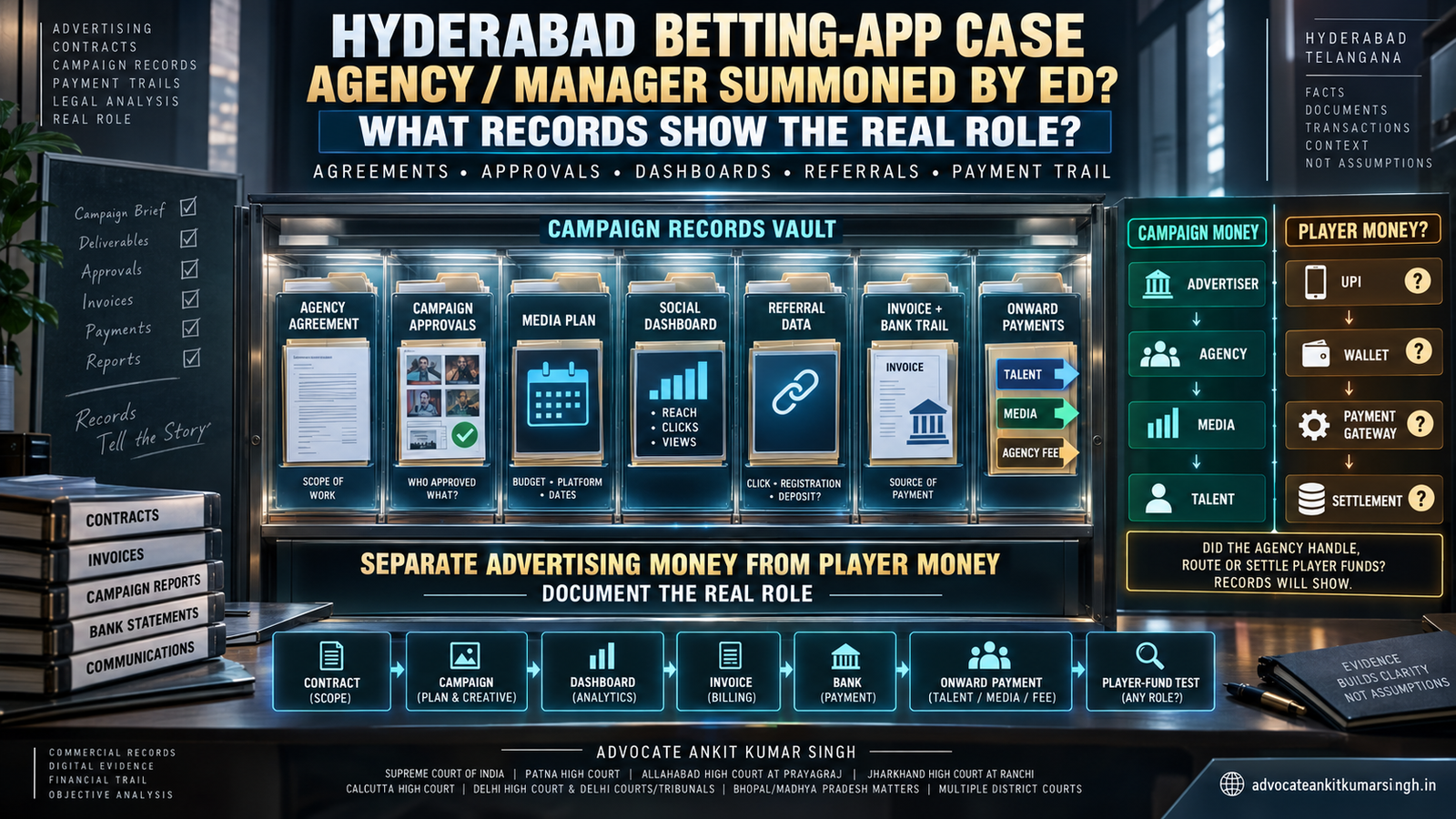
Hyderabad Betting-App Case: What Should a Social-Media Agency or Celebrity Manager Produce When Summoned by ED?
Legal research and analysis by Advocate Ankit Kumar Singh
Legally reviewed and updated: 14 September 2026
Summary: For an advertising or management professional summoned in Hyderabad, identify the records that establish the real scope of work: agency agreements, invoices, campaign approvals, social-media dashboards, referral codes, media plans and payment routing. The Hyderabad article should distinguish ordinary campaign execution from alleged involvement in handling, routing or disguising betting proceeds.
Direct Answer
If a social-media agency, advertising professional, talent manager or celebrity manager is summoned by the Enforcement Directorate in a Hyderabad betting-app investigation, the most useful response is usually a complete documentary reconstruction of the campaign.
Do not rely only on the sentence:
“We were merely doing marketing.”
The records should demonstrate what “marketing” actually meant in that particular engagement.
The central distinction is between:
ORDINARY CAMPAIGN EXECUTION
and:
PARTICIPATION IN COLLECTION, ROUTING, SETTLEMENT, DISGUISE OR MOVEMENT OF BETTING FUNDS.
A genuine advertising file may show creative work, media buying, campaign approvals, influencer scheduling and fixed commercial consideration.
A materially different record may show access to player deposits, agent wallets, payment routes, settlement accounts, withdrawal infrastructure or communications designed to disguise the source or destination of funds.
Those situations should not be treated as legally or factually identical.
Why an Agency or Celebrity Manager May Be Summoned Even If the Celebrity Was the Public Face
Section 50 of the Prevention of Money-Laundering Act gives specified Enforcement Directorate authorities power to summon a person whose attendance is considered necessary to give evidence or produce records during an investigation or proceeding.
The person with the most useful evidence may therefore be:
- the advertising agency;
- the celebrity's manager;
- the talent-management company;
- the social-media executive;
- the media buyer;
- the campaign-account manager;
- the finance employee who raised invoices;
- the person who negotiated the contract;
- the person controlling the advertising dashboard; or
- the person who communicated with the advertiser/operator.
The agency or manager may know the commercial structure more precisely than the celebrity appearing in the advertisement.
Start With a Campaign Master Index
Before the Section 50 appearance, create one master index for the relevant betting/gaming campaign.
| Field | Information to Record |
|---|---|
| Advertised brand | Exact name displayed publicly |
| Underlying operator | Entity identified in contract/communications |
| Contracting entity | Company that engaged the agency/manager |
| Agency | Legal entity providing services |
| Talent | Celebrity/influencer involved |
| Campaign period | Start and end dates |
| Platforms | Instagram, YouTube, X, website, OTT, etc. |
| Fee model | Fixed / commission / affiliate / hybrid |
| Referral mechanism | Yes / No; link or code |
| Payer | Entity that remitted funds |
| Agency commission | Amount / percentage |
| Talent payment | Amount and route |
| Player funds handled? | Yes / No / requires verification |
| Wallet/payment access? | Yes / No / nature of access |
The index is not a substitute for source records. Its function is to make the underlying documents understandable.
Document Group 1: Agency Agreement and Scope of Work
Begin with the document that establishes why the agency was engaged.
Relevant material may include:
- master services agreement;
- advertising agreement;
- talent-management agreement;
- celebrity-management agreement;
- statement of work;
- campaign work order;
- purchase order;
- insertion order;
- media-buying agreement;
- amendments and addenda;
- email accepting commercial terms;
- rate card; and
- termination or cancellation correspondence.
Read the documents for substance rather than title.
An agreement labelled “digital marketing services” may still contain very different obligations.
For example:
ORDINARY MARKETING SCOPE

• prepare campaign creative;
• coordinate celebrity shoot;
• obtain content approval;
• publish three social-media posts;
• purchase display advertising;
• submit performance report.

DIFFERENT OPERATIONAL SCOPE

• recruit depositing players;
• receive percentage of deposits;
• manage agent wallet;
• provide collection UPI;
• coordinate player withdrawals;
• reconcile daily betting balances.
These are fundamentally different factual roles.
Document Group 2: The Original Commercial Brief
Preserve the first materials describing what the client wanted.
These may include:
- brand brief;
- campaign deck;
- marketing objective;
- target geography;
- target audience;
- proposed messaging;
- landing-page details;
- domain or app-store links;
- campaign duration;
- budget; and
- key-performance indicators.
The original brief can answer an important evidentiary question:
Was the agency engaged to build ordinary brand visibility, or was it instructed to generate depositing bettors and participate in revenue arising from their gambling activity?
Document Group 3: Creative Approval Trail
Campaign approvals can establish who controlled the message.
Preserve:
- script drafts;
- storyboards;
- caption drafts;
- video drafts;
- thumbnail drafts;
- brand-language corrections;
- legal/compliance comments;
- final written approval;
- date of approval;
- name/email of approver; and
- version history where available.
If the operator instructed the agency to use particular claims, links, bonus codes, mirror domains or surrogate brand names, the original communication may be especially important.
Do not replace the original email or chat with a newly prepared summary.
Document Group 4: What Was Actually Published?
The campaign file should preserve the real advertisement as users saw it.
Useful material includes:
- post URL;
- video URL;
- date/time of publication;
- caption;
- story/reel archive;
- thumbnail;
- screen recording where appropriate;
- destination URL;
- landing page;
- UTM parameters;
- affiliate identifier;
- referral code;
- coupon code;
- QR code destination; and
- archived campaign screenshot.
Where an old link no longer works, preserve whatever contemporaneous records establish where it originally redirected.
Document Group 5: Social-Media and Advertising Dashboards
Dashboard evidence can reveal the difference between ordinary audience analytics and player-level commercial participation.
Depending upon the platform used, preserve relevant exports from:
- Meta Business Suite;
- Meta Ads Manager;
- YouTube Studio;
- Google Ads;
- publisher ad servers;
- affiliate portals;
- campaign-management software;
- link-tracking platforms; and
- internal agency dashboards.
Ordinary advertising analytics may show:
- impressions;
- reach;
- views;
- clicks;
- cost per click;
- engagement;
- geography; and
- campaign spend.
A different evidentiary picture may arise if the dashboard shows:
- registered betting users;
- first-time depositors;
- deposit amounts;
- betting turnover;
- player losses;
- withdrawals;
- account balances;
- affiliate revenue based on gambling activity; or
- individual player identifiers.
Referral Codes: Preserve the Commercial Formula, Not Just the Code
A referral code by itself does not explain the relationship.
For every code or link, establish:
| Question | Record |
|---|---|
| Who created the code? | Email / affiliate dashboard |
| Who controlled it? | Account-access record |
| What triggered payment? | Affiliate terms |
| Click? | Campaign analytics |
| Registration? | CPA terms |
| First deposit? | Affiliate agreement |
| Betting turnover? | Revenue report |
| Player loss? | Revenue-share statement |
| Fixed fee only? | Invoice/contract |
The financial formula can be more important than the existence of the referral code.
Media Plan: Show What the Agency Was Actually Buying
An advertising agency may legitimately receive a campaign budget substantially larger than its own professional fee because it is purchasing media space or paying creators on behalf of a client.
That makes the media plan and reconciliation important.
The file should identify:
- total campaign budget;
- agency professional fee;
- media spend;
- influencer/talent fee;
- production costs;
- platform advertising costs;
- taxes;
- third-party vendors;
- unspent balance/refund; and
- final reconciliation.
This helps distinguish:
₹50 LAKH RECEIVED BY AGENCY

from

₹50 LAKH EARNED BY AGENCY.
For example, an agency may receive ₹50 lakh from a client but retain only ₹5 lakh as its fee and spend the remaining ₹45 lakh on media and talent pursuant to contractual instructions.
The bank statement alone may not reveal that distinction. The underlying ledger and invoices do.
Document Group 6: Invoices and Accounting Records
Prepare a clean invoice trail:
- invoice number;
- invoice date;
- service period;
- service description;
- taxable value;
- GST;
- gross amount;
- payer;
- payment date;
- bank account credited;
- TDS, where applicable;
- ledger entry; and
- corresponding contract/work order.
If the invoice simply says “marketing services” but the underlying campaign file explains the services in detail, produce the supporting records necessary to understand that description.
Document Group 7: Trace the Source of Every Material Credit
For every payment connected with the betting/gaming campaign, prepare a transaction schedule.
| Date | Payer | Amount | Account | Invoice | Purpose | Onward Use |
|---|---|---|---|---|---|---|
| DD/MM/YYYY | Advertiser / agency | ₹___ | Bank ___ | INV-___ | Campaign budget | Media/talent/fee |
Where money came from abroad, preserve the relevant banking/remittance material available to the agency.
Where the payer differs from the contracting entity, identify why.
A third-party payment is not automatically criminal, but unexplained divergence between:
CONTRACTING PARTY → INVOICE RECIPIENT → ACTUAL PAYER
may require explanation.
The Celebrity Manager Should Separately Trace Talent Money
A manager may receive the celebrity's endorsement fee into a management-company account and then remit the net amount after contractual deductions.
The records should show:
- celebrity-management agreement;
- authority to negotiate;
- gross endorsement consideration;
- manager's commission;
- tax deductions;
- amount remitted to celebrity;
- date of remittance;
- corresponding invoice/accounting entry; and
- whether the manager ever retained any amount linked to user deposits, wagering or losses.
Again:
MANAGING A CELEBRITY'S COMMERCIAL FEE IS NOT FACTUALLY THE SAME AS MANAGING PLAYER FUNDS.
Critical Separation: Advertising Money Versus Player Money
This may be the most important financial distinction in the entire investigation.
| Advertising/Campaign Money | Player/Betting Money |
|---|---|
| Brand campaign budget | User deposit |
| Media-buy funds | Betting wallet top-up |
| Influencer fee | Stake/wager amount |
| Agency retainer | Player loss |
| Production expense | Withdrawal/payout |
| Publisher payment | Settlement balance |
The investigation should identify whether these streams remained separate or intersected.
If player deposits entered an agency, manager or connected account, the reason requires close examination.
If no player deposit, withdrawal or settlement ever touched agency-controlled infrastructure, preserve the records demonstrating that separation.
Questions That Should Be Asked About Every Agency Bank Account
For each relevant account:
- Who owns the account?
- Who operates it?
- What is its normal business purpose?
- Did the advertiser pay into it?
- Did individual consumers/player accounts pay into it?
- Were there thousands of small UPI credits inconsistent with ordinary agency invoicing?
- Did money move immediately to unrelated accounts?
- Were transactions described as refunds/chargebacks?
- Was cryptocurrency purchased?
- Were large cash withdrawals made?
- Did any betting operator or agent instruct the routing?
A conventional agency-account pattern may look very different from a collection account handling large volumes of player deposits.
UPI IDs, Merchant IDs, Payment Gateways and APIs
Where ED asks about payment infrastructure, establish whether the agency ever:
- created a UPI ID;
- supplied a UPI ID to users;
- opened merchant accounts;
- obtained a payment-gateway account;
- provided an API for user collection;
- onboarded merchants;
- controlled settlement credentials;
- reconciled player deposits;
- processed betting withdrawals; or
- allowed a client/operator to use an agency-owned merchant identity.
If none of these occurred, the agency should be able to explain its actual payment infrastructure and provide the relevant records.
If any did occur, the facts require detailed legal and financial review before a simplistic “advertising only” position is adopted.
Why This Distinction Matters in Current ED Betting Investigations
Recent ED investigations illustrate the factual difference between promotion and fund routing.
In its March 2026 1xBet press release, ED alleged both:
- advertising arrangements involving an overseas media entity and Indian digital platforms; and
- a concealed mechanism for betting-fund collection through dynamically generated UPI IDs linked with mule accounts.
Those are distinct factual components of the alleged scheme.
Similarly, in its August 2025 Parimatch press release, ED alleged user-fund collection through mule accounts, payment infrastructure and APIs, while separately describing aggressive marketing, celebrity partnerships, surrogate advertising entities and foreign inward remittances to agencies.
The practical lesson is important:
MARKETING NETWORK AND PAYMENT NETWORK MAY INTERACT, BUT THEY SHOULD NOT BE ASSUMED TO BE THE SAME NETWORK WITHOUT EVIDENCE.
Surrogate Advertising: Preserve the Naming and Domain History
Where a campaign used a related “sports”, “news”, “media” or other brand rather than the betting platform's principal name, preserve:
- original client instructions;
- domain supplied;
- redirect destination;
- creative explaining the brand;
- who proposed the alternate name;
- legal/compliance discussion;
- date the domain changed;
- mirror-domain lists;
- landing-page screenshots; and
- any communication concerning regulatory blocking or advertising restrictions.
The evidentiary question may become whether the alternate brand had an independent legitimate identity or was allegedly designed to indirectly promote the underlying betting service.
Current 2026 Advertising Law Must Also Be Considered
India's present Promotion and Regulation of Online Gaming Act, 2025 now separately prohibits advertisements that directly or indirectly promote or induce participation in an online money game.
It also separately addresses facilitation of transactions or authorisation of funds towards online money-gaming services.
For a current campaign, an agency should therefore not assume that:
“We only produced the advertisement”
automatically disposes of advertising-law exposure.
But a contravention concerning advertising under the online-gaming statute and a PMLA allegation of laundering proceeds remain analytically different legal questions.
For older campaigns, identify the date and apply the law that governed the conduct at that time rather than mechanically projecting later penal provisions backwards.
Communications With the Operator: Preserve the Full Thread
A social-media agency should preserve the full contextual conversation, not selected screenshots.
Potentially relevant material includes:
- email;
- WhatsApp;
- Telegram;
- Slack;
- Teams;
- campaign-management system;
- shared drives;
- calendar invitations; and
- approval portals.
Ordinary campaign messages might discuss:
- shoot dates;
- caption wording;
- creative dimensions;
- number of posts;
- campaign budget;
- engagement analytics;
- media spend; and
- invoice release.
A materially different communication may discuss:
- player deposits;
- user losses;
- daily settlement;
- collection accounts;
- new UPI IDs;
- blocked merchant IDs;
- withdrawal processing;
- cash conversion;
- crypto settlement;
- hawala settlement;
- mirror sites to evade blocking; or
- ways of disguising the real transaction description.
Do Not Produce Only Screenshots When Better Source Data Exists
A screenshot may be useful for quick reference, but the original electronic record may contain more information.
Where available, preserve:
- original email files;
- complete chat exports;
- account identifiers;
- timestamps;
- attachments;
- dashboard CSV/XLS exports;
- invoice PDFs in original form;
- platform reports;
- server/ad-platform reports; and
- relevant access history.
Do not edit the original files merely to make the presentation cleaner.
A separate working summary can be prepared while keeping the source record intact.
Who Had Dashboard Access?
Access rights may help identify actual responsibility.
Create an access matrix:
| System | User | Access Level | Purpose |
|---|---|---|---|
| Meta Ads | Employee A | Advertiser | Campaign publishing |
| Affiliate portal | Employee B | Read only | Performance report |
| Payment gateway | None | No access | Not part of engagement |
| Player wallet | None | No access | Not part of engagement |
An agency should not attribute technical access to the wrong employee merely because several staff members worked on the same account.
Agency Employee Versus Management Knowledge
A junior social-media executive who scheduled a pre-approved post should not automatically be treated as having the same knowledge as:
- the agency founder who negotiated the contract;
- the finance director who handled remittances;
- the affiliate manager who reviewed deposit data; or
- the employee who allegedly provided payment-routing instructions.
The actual decision-making chain should be documented.
Relevant records may include:
- reporting hierarchy;
- approval matrix;
- email chain;
- task assignment;
- system-access logs;
- employment role; and
- who communicated with the client.
What If the Agency Received Foreign Inward Remittances?
A foreign inward remittance should be mapped against:
- contracting entity;
- invoice;
- bank advice;
- remittance purpose;
- amount received;
- currency conversion;
- ledger treatment;
- tax treatment; and
- onward expenditure.
Foreign payment is not, by itself, proof of money laundering.
But where an overseas intermediary pays an Indian agency for promoting a betting platform, investigators may examine the commercial substance of that intermediary relationship.
What If the Agency Passed Most of the Money to the Celebrity?
Demonstrate the reconciliation.
For example:
₹1,00,00,000 RECEIVED FROM CLIENT

LESS:
₹70,00,000 — CELEBRITY / TALENT
₹10,00,000 — MEDIA BUY
₹5,00,000 — PRODUCTION
₹5,00,000 — TAX / OTHER DOCUMENTED COST

₹10,00,000 — AGENCY PROFESSIONAL CONSIDERATION
The illustration is only explanatory. Actual figures must come from the genuine records.
The purpose is to prevent the gross campaign budget from automatically being confused with the agency's own income.
What If ED's Money-Trail Chart Shows the Agency as a Single ₹1 Crore Recipient?
Go back to source records.
Ask:
- Does ₹1 crore represent agency revenue or gross campaign budget?
- What was remitted to talent?
- What was paid to media platforms?
- Was GST included?
- Were refunds included?
- Were the same transfers counted more than once?
- Was the agency merely an intermediary for media spend?
- What bank entries support each figure?
An analytical flowchart should be tested against the underlying bank statements, invoices and ledgers.
Records Showing the Agency Did Not Handle Player Funds
Where factually correct, useful evidence may include:
- no player-facing UPI ID;
- no payment-gateway merchant account;
- no betting-wallet credentials;
- no withdrawal dashboard;
- no settlement account;
- no daily player-balance reconciliation;
- no customer-support function concerning deposits/withdrawals;
- bank statements showing business-to-business campaign payments rather than mass retail deposits;
- contract restricting the agency to advertising;
- no backend/operator login; and
- communications limited to campaign execution.
These facts should be demonstrated rather than merely asserted.
Red Flags Requiring Deeper Legal Review
- Thousands of small consumer UPI credits entering an agency account.
- Player deposits routed through agency-owned merchant IDs.
- Agency account described internally as a “collection account”.
- Access to betting wallets.
- Commission based on player losses.
- Daily settlement sheets.
- Instructions to change UPI IDs after blocking.
- Payments to unexplained third-party accounts.
- Cash withdrawals followed by settlement instructions.
- Crypto wallet instructions.
- Fake e-commerce transaction descriptions.
- Fabricated refund/chargeback descriptions.
- Surrogate campaigns intentionally designed to conceal the underlying advertiser.
- Backdated agreements.
- Deletion of records after investigation becomes known.
A red flag justifies examination. It is not, by itself, a final finding of guilt.
Prepare a Chronology Before the Section 50 Appearance
| Date | Event | Supporting Record |
|---|---|---|
| DD/MM/YYYY | Initial approach by advertiser | |
| DD/MM/YYYY | Agreement signed | Contract |
| DD/MM/YYYY | Celebrity approached | Manager email |
| DD/MM/YYYY | Creative approved | Approval thread |
| DD/MM/YYYY | Campaign published | Post/dashboard |
| DD/MM/YYYY | Invoice raised | Invoice |
| DD/MM/YYYY | Payment received | Bank statement |
| DD/MM/YYYY | Talent paid | Bank record |
| DD/MM/YYYY | Campaign terminated | Email/contract |
Recommended Section 50 Production Index
DOCUMENT SET A — SUMMONS
A-1  Section 50 summons
A-2  Covering correspondence

DOCUMENT SET B — CORPORATE / PROFESSIONAL IDENTITY
B-1  Agency incorporation / constitution
B-2  Relevant authorised signatory
B-3  Employee / manager role information

DOCUMENT SET C — CONTRACTUAL RECORD
C-1  Master agreement
C-2  Statement of work
C-3  Purchase / insertion order
C-4  Amendments

DOCUMENT SET D — CAMPAIGN RECORD
D-1  Campaign brief
D-2  Media plan
D-3  Creative drafts
D-4  Approval correspondence
D-5  Publication record

DOCUMENT SET E — DIGITAL RECORD
E-1  Dashboard exports
E-2  Referral codes / links
E-3  Campaign analytics
E-4  Access matrix

DOCUMENT SET F — FINANCIAL RECORD
F-1  Invoice
F-2  Bank credit
F-3  Ledger
F-4  GST / TDS record
F-5  Foreign-remittance record, where applicable

DOCUMENT SET G — ONWARD PAYMENT
G-1  Celebrity / influencer payment
G-2  Media-platform payment
G-3  Production / vendor expenses
G-4  Agency commission reconciliation

DOCUMENT SET H — COMMUNICATIONS
H-1  Relevant emails
H-2  Relevant messages
H-3  Client instructions

DOCUMENT SET I — PAYMENT-INFRASTRUCTURE POSITION
I-1  Relevant evidence of whether the agency had any merchant / wallet / player-fund access
I-2  Relevant account statement / platform-access information
The exact records to be produced should ultimately be guided by the summons, relevance, lawful objections where applicable and case-specific legal advice.
Do Not Manufacture a “Clean File” After Receiving the Summons
Do not:
- backdate the contract;
- rewrite old invoices;
- create false approvals;
- delete referral reports;
- remove inconvenient messages;
- alter spreadsheets;
- rename transactions to make them appear different;
- fabricate legal-compliance advice;
- ask staff to coordinate a false version; or
- destroy devices or accounts.
A genuine campaign record may contain mistakes, informal messages and imperfect documentation. Preservation is generally safer than retrospective reconstruction of evidence.
Do Not Guess During Section 50 Examination
Agency campaigns can involve hundreds of transactions and thousands of digital events.
If an exact figure, date or technical fact cannot genuinely be remembered, distinguish:
WHAT YOU PERSONALLY REMEMBER
from:
WHAT MUST BE VERIFIED FROM THE RECORDS.
For example:
“I do not presently recall the exact invoice amount. The amount can be verified from the invoice and bank statement.”
This is materially different from guessing a figure which later contradicts the accounting record.
The PMLA Question: What Was the Person's Actual Role?
The PMLA analysis should eventually return to:
- What is the alleged scheduled offence?
- What property is alleged to be proceeds of crime?
- How is that property said to have been generated?
- Did any such property reach the agency/manager?
- If so, why and in what capacity?
- Was it genuine commercial consideration?
- Was the person knowingly assisting or participating in a process/activity connected with alleged proceeds?
- Did the person actually route, hold, settle, disguise or use such funds in the manner alleged?
The Supreme Court has reiterated that existence of proceeds of crime is a condition precedent to the offence of money laundering under Section 3 PMLA.
Therefore:
WORKING ON A CAMPAIGN DOES NOT DISPENSE WITH THE REQUIREMENT TO ESTABLISH THE PMLA MONEY-LAUNDERING ELEMENTS.
But:
THE LABEL “ADVERTISING AGENCY” DOES NOT PROTECT CONDUCT THAT THE EVIDENCE ACTUALLY SHOWS TO BE FUND COLLECTION, SETTLEMENT OR CONCEALMENT.
Role Comparison
| Role | Typical Records | Main Investigation Question |
|---|---|---|
| Creative agency | Brief, creative, invoice | What was created and for whom? |
| Media buyer | Media plan, platform invoice | Where was campaign money spent? |
| Celebrity manager | Talent agreement, payout | Was the role limited to endorsement management? |
| Affiliate marketer | Referral dashboard | What triggered commission? |
| Player-acquisition agent | Depositor/revenue data | Was income linked to betting activity? |
| Collection intermediary | UPI / merchant / bank records | Were player funds collected? |
| Settlement intermediary | Wallet / payout records | Were player/operator balances settled? |
| Operator-linked entity | Corporate + backend + financial control | Was the entity part of the underlying operation? |
Evidence Flowchart
Document-first analysis for a social-media agency or celebrity manager summoned in a Hyderabad betting-app investigation.Plain-text alternative:
SECTION 50 SUMMONS
       ↓
CONTRACT + SCOPE OF WORK
       ↓
CREATIVE + APPROVAL + DASHBOARD
       ↓
REFERRAL / AFFILIATE TERMS
       ↓
INVOICE + BANK + LEDGER
       ↓
ONWARD PAYMENTS
       ↓
ADVERTISING MONEY OR PLAYER MONEY?
       ↓
UPI / WALLET / GATEWAY / SETTLEMENT ROLE?
       ↓
ACTUAL SECTION 3 PMLA ANALYSIS
Frequently Asked Questions
1. Can ED summon a social-media agency that never appeared in the advertisement?
Yes. Section 50 permits specified ED authorities to summon a person considered necessary to give evidence or produce records. The agency may possess the contract, approvals and payment records even though the celebrity was the public face.
2. What is the most important document?
There is rarely one universal document. The strongest file usually combines the agreement, statement of work, approvals, dashboard material, invoice, bank trail, ledger and communications.
3. Is an agency agreement enough to prove the agency only did advertising?
No. The actual conduct, communications, dashboard access and money trail should correspond with the agreement.
4. Why are social-media dashboards important?
They may show whether the agency only saw ordinary reach/click analytics or had access to deposits, wagering, player losses or affiliate revenue linked to betting activity.
5. Does a referral code make the agency guilty of money laundering?
No. Determine what the referral code did and how compensation was calculated. A click-based campaign and a percentage of player losses are materially different arrangements.
6. What if the agency received ₹1 crore but kept only ₹10 lakh?
Produce the complete campaign reconciliation showing media spend, talent payment, production cost, tax and the agency's actual fee. Gross receipts and net professional income should not be confused.
7. What if money came from a foreign agency?
Preserve the foreign-remittance and contractual records and explain the relationship between the payer, contracting entity and underlying advertiser.
8. What if the celebrity manager received the whole endorsement amount first?
Show the management agreement, manager commission, taxes and onward payment to the celebrity. Handling professional consideration is factually different from handling player deposits or betting withdrawals.
9. What if the agency used its own UPI account to collect player deposits?
That creates a materially different factual situation from ordinary advertising and requires detailed examination of the collection, onward transfer, knowledge and purpose of those transactions.
10. Can tax compliance alone prove the money was legitimate?
No. GST, TDS and income-tax records are relevant evidence of accounting treatment but do not independently resolve the PMLA character of disputed property.
11. Should old WhatsApp chats be deleted before ED appearance?
No. Relevant records should be preserved. Deleting or altering material can create serious evidentiary problems.
12. What if the manager does not remember an exact figure?
The person should distinguish memory from records and verify the figure from the underlying documents rather than guessing.
AI-Search Quick Answer
A social-media agency or celebrity manager summoned by ED in a Hyderabad betting-app investigation should produce a document-led campaign file showing the actual scope of work, approvals, referral arrangements, social-media analytics, invoices, bank receipts, onward talent/media payments and communications with the advertiser. The key financial distinction is between ordinary advertising money and player/betting money. Evidence that the agency only executed campaign work is materially different from evidence of control over UPI collections, player wallets, payment gateways, withdrawals or settlement infrastructure.
Key Takeaway
For a social-media agency or celebrity manager, the most effective factual answer is not:
“I am only a marketing person.”
It is a source-record demonstration:
THIS WAS THE CONTRACT.
THIS WAS THE CAMPAIGN.
THIS WAS THE REFERRAL MODEL.
THIS WAS THE INVOICE.
THIS MONEY CAME FROM THIS ENTITY.
THIS AMOUNT WAS PAID TO THE CELEBRITY.
THIS AMOUNT WAS MEDIA SPEND.
THIS WAS OUR ACTUAL COMMISSION.
THESE WERE OUR SYSTEM PERMISSIONS.
AND THESE RECORDS SHOW WHETHER OR NOT WE EVER TOUCHED PLAYER FUNDS.
That approach allows the legal analysis to distinguish ordinary professional campaign execution from any alleged role in collection, routing, layering, settlement or concealment of betting proceeds.
Professional Legal Coordination
Advocate Ankit Kumar Singh undertakes legal research and professional coordination in PMLA, Enforcement Directorate summons, Section 50 examination, financial investigations, digital evidence, transaction tracing, online-gaming investigations and connected proceedings depending upon the facts, accepted engagement, jurisdiction and applicable procedure.
Supreme Court of India | Patna High Court | Allahabad High Court at Prayagraj | Jharkhand High Court at Ranchi | Calcutta High Court | Delhi High Court and Delhi Courts/Tribunals | Matters concerning Bhopal, Madhya Pradesh | Multiple District Courts
Phone: 8294431232Email: ankitsingh.legum@gmail.com
Website: advocateankitkumarsingh.in
Local or authorised counsel may be required depending on the forum. Where acting and filing before the Supreme Court of India is required, an Advocate-on-Record must act and file in accordance with applicable Supreme Court procedure.
No investigation, attachment, bail, discharge, quashing or other legal outcome can be guaranteed.
Official and Research Sources
- Prevention of Money-Laundering Act, 2002: Sections 2(1)(u), 3 and 50 and other applicable provisions depending upon the particular investigation.
- Directorate of Enforcement — 1xBet Press Release dated 2 March 2026: ED allegations concerning mule-account/UPI fund collection, structured advertisement agreements, overseas media intermediary and geo-targeted advertising.
- Directorate of Enforcement — Parimatch Press Release dated 14 August 2025: ED allegations concerning mule accounts, payment infrastructure, APIs, user-fund collection, surrogate advertisements, celebrity marketing and foreign inward remittances.
- Promotion and Regulation of Online Gaming Act, 2025: current statutory provisions concerning online money games, advertising and transfer/facilitation of funds.
- Ministry of Information and Broadcasting advisory dated 5 June 2026: celebrity/influencer endorsements and advertisements, including surrogate advertisements, concerning offshore online betting/gambling platforms.
- Public Hyderabad betting-app investigation reporting: July 2025 onwards, concerning the PMLA investigation arising from FIRs registered in Telangana and Andhra Pradesh and subsequent Section 50 questioning/summons.
ED press releases record the investigating agency's findings/allegations at the relevant stage. They should not be described as convictions or final judicial findings against every person, agency or entity mentioned or connected with a sector.
Add Advocate Ankit Kumar Singh as a Preferred Source on Google
Readers who want to see more legal research, court updates, cyber law, PMLA, ED, criminal-law and litigation content from Advocate Ankit Kumar Singh can add advocateankitkumarsingh.in as a Preferred Source on Google.
Add advocateankitkumarsingh.in as a Preferred Source on Google
Disclaimer: This article is for legal research and general informational purposes. A Section 50 summons does not by itself establish guilt. Whether advertising revenue, agency commission, referral income or another payment has any PMLA consequence depends upon the specific scheduled offence, alleged proceeds of crime, source and character of funds, the person's knowledge and actual conduct. Relevant original records should be preserved and case-specific legal advice obtained before responding to an investigation.