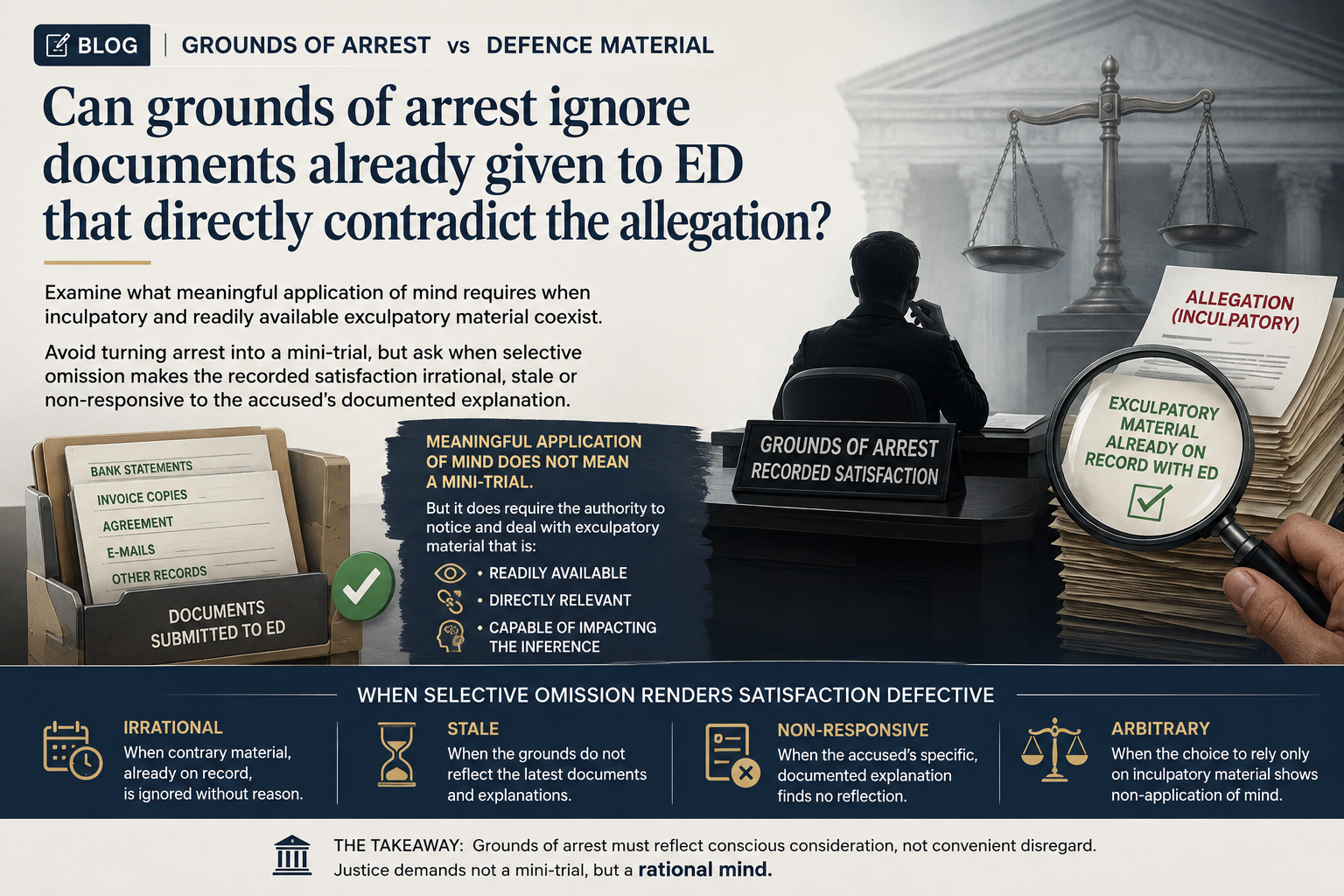
Grounds of Arrest vs Defence Material Under PMLA: “Can ED Ignore Documents Already Given to It That Directly Contradict the Allegation?”
Section 19 • Reasons to Believe • Grounds of Arrest • Exculpatory Material • Application of Mind • Stale Allegations • Judicial Review
Updated: 26 August 2026
Direct Answer
ED cannot lawfully approach Section 19 as a one-sided file review by deliberately considering only material that implicates a proposed arrestee while ignoring relevant material already in its possession that materially absolves or exculpates that person.
The Supreme Court in Arvind Kejriwal v. Directorate of Enforcement held that an authorised officer exercising Section 19 power must objectively consider the material available on the date of arrest, including relevant exculpatory material. Selective consideration can amount to an error in the decision-making process.
But that does not mean that every representation submitted by an accused must be accepted, every defence annexure must be reproduced in the grounds of arrest, or that the High Court/Special Court must conduct a full trial while reviewing arrest.
The real question is:
WAS THE DEFENCE DOCUMENT ACTUALLY BEFORE ED, WAS IT MATERIAL TO A DECISIVE ALLEGATION, AND DID THE SECTION 19 SATISFACTION RATIONALLY RESPOND TO IT?
The controlling distinction is:
CONSIDERED AND REJECTED ≠ IGNORED
and:
ARREST IS NOT A MINI-TRIAL — BUT SECTION 19 IS NOT A LICENCE FOR SELECTIVE VISION.
Contents
- What Section 19 Actually Requires
- Reasons to Believe, Grounds of Arrest and Material in Possession
- Arvind Kejriwal: Exculpatory Material Cannot Be Selectively Ignored
- Why This Does Not Turn Arrest Review Into a Mini-Trial
- Considered-and-Rejected vs Ignored
- Was the Document Actually in ED's Possession?
- Four Categories of Defence Material
- The Direct-Contradiction Test
- Arvind Dham: The Important Limiting Case
- Can Later Evidence Cure an Earlier Arrest?
- Stale and Recycled Material
- Non-Cooperation and Refusal to Confess
- Must Grounds of Arrest Answer Every Defence Document?
- Contradiction–Response Matrix
- Eight Tests for Meaningful Application of Mind
- Role of the Remand Court
- Arrest Review vs Bail Review
- How to Build the Challenge
- 30-Point Section 19 Audit
- Decision-Process Flowchart
- Frequently Asked Questions
1. What Section 19 PMLA Actually Requires Before Arrest
Section 19(1) does not authorise arrest merely because:
- an ECIR exists;
- a person has been summoned;
- an allegation is serious;
- another accused has named the person;
- ED disagrees with his explanation;
- the investigation is continuing; or
- ED wishes to interrogate him in custody.
The statutory architecture is more specific.
The designated officer must:
- be an officer authorised under Section 19;
- have material in his possession;
- on the basis of that material form reason to believe;
- record the reason for that belief in writing;
- reach the statutory opinion concerning guilt of an offence punishable under PMLA;
- exercise the power of arrest in accordance with those conditions; and
- inform/furnish the grounds of arrest in accordance with the constitutional and statutory requirements.
Section 19(2) adds an important institutional safeguard: after arrest, the order and material in possession referred to in Section 19 must be forwarded to the Adjudicating Authority in the prescribed sealed manner.
That structure matters in an exculpatory-material case because it makes the relevant question temporally specific:
WHAT MATERIAL EXISTED BEFORE AND AT THE TIME THE OFFICER FORMED THE STATUTORY BELIEF?
2. Do Not Confuse Three Different Things
| Record | Function | Audit Question |
|---|---|---|
| Material in possession | Documents, statements and other material available to the authorised officer for Section 19 decision-making | Did it include the defence document? |
| Reasons to believe | Recorded reasoning forming the statutory satisfaction | Does the conclusion rationally follow from the complete relevant material? |
| Grounds of arrest | Personalised grounds communicated to the person so that the arrest can be understood and challenged | Do they meaningfully disclose why the person is being arrested? |
In some cases the grounds may substantially reproduce the reasons to believe. In others, separate records may exist.
Therefore, a defence challenge should not assume that silence in one document necessarily proves silence in the complete Section 19 record.
The stronger challenge asks the court to examine:
THE MATERIAL FILE + THE RECORDED REASONS + THE COMMUNICATED GROUNDS.
3. Arvind Kejriwal: The Supreme Court's Rule Against Selective Consideration
Arvind Kejriwal v. Directorate of Enforcement, 2024 INSC 512, fundamentally clarified the relationship between Section 19 and exculpatory material.
The Supreme Court held that while the authorised officer forms a subjective opinion, that subjectivity must operate according to law.
The officer cannot:
take Statement A because it implicates the person;
ignore Bank Record B which materially contradicts Statement A;
ignore Corporate Filing C which answers the attribution of control;
and then describe the selected incriminating material as the complete basis for Section 19 satisfaction.
The Supreme Court's reasoning can be translated into three propositions:
Proposition 1 — No Selective Pick-and-Choose
An officer cannot deliberately choose only material that supports arrest while excluding relevant material that absolves the proposed arrestee.
Proposition 2 — Exculpatory Material Requires Application of Mind
Relevant absolving material must form part of the objective consideration preceding the statutory opinion.
Proposition 3 — Unexplained Ignoring Can Become a Decision-Making Error
Where genuinely relevant exonerating material is simply ignored, the defect is not merely a disagreement about evidence. It can become an error in the legal decision-making process itself.
That is particularly important because Section 19 operates before trial and directly affects personal liberty.
4. Why This Does Not Turn the Arrest Challenge Into a Mini-Trial
The same Supreme Court judgment draws the limiting boundary.
Judicial review of a Section 19 arrest does not generally permit the court to conduct a full merits review.
Therefore, the court does not ordinarily ask:
“Which witness will ultimately be believed beyond reasonable doubt?”
Instead it asks:
“Did the statutory decision-maker consider relevant material and did the conclusion have a reasonable nexus with the material that existed?”
Compare these two situations.
Situation A — Merits Dispute
Witness W says the accused instructed him to route money.
The accused says W was coerced and later changed his version.
Whether W is truthful, coerced or unreliable may require detailed evidentiary assessment, cross-examination and trial/bail-stage analysis.
Situation B — Decision-Process Contradiction
ED says:
“The accused was the authorised signatory of Account X on 15 March 2022 and therefore controlled the transfer.”
Before arrest, ED had:
a bank-certified mandate showing the accused had ceased to be signatory in 2020.
If the arrest record simply repeats the 2022 signatory allegation without addressing the bank record, the issue is qualitatively different.
The court need not conduct a trial to ask:
WAS A DECISIVE CONTRADICTORY RECORD CONSIDERED AT ALL?
5. The Most Important Distinction: Considered-and-Rejected vs Ignored
A defence document does not acquire veto power over an arrest merely because it has been submitted to ED.
ED may consider the document and conclude that:
- it is forged;
- it is incomplete;
- it covers only part of the relevant period;
- it does not answer the actual allegation;
- it is contradicted by other reliable material;
- it relates to legal title but not beneficial control;
- it explains one transaction but not the larger laundering process;
- or its apparent exculpatory value disappears when read with later material.
That is an adjudicatory/evaluative response.
The question then becomes whether that conclusion is legally rational—not whether the accused's document automatically prevails.
The more serious problem is:
ED POSSESSES THE DOCUMENT → DOCUMENT DIRECTLY ANSWERS THE CENTRAL ALLEGATION → ARREST RECORD REPEATS THE ALLEGATION AS THOUGH THE DOCUMENT DOES NOT EXIST.
That is where “non-application of mind” becomes substantially stronger than a mere evidentiary disagreement.
6. First Prove Possession: “I Sent It to ED” Is Not Enough
Section 19 focuses on the material in possession of the authorised officer at the relevant time.
Therefore, a defence based on ignored documents should first establish a Possession-Proof Chain.
| Proof | Why It Matters |
|---|---|
| Reply to Section 50 summons | Shows formal submission in the same investigation |
| ED receiving stamp / diary acknowledgment | Strong proof of institutional receipt |
| Email to investigating officer / official ED address | Establishes transmission and date |
| Section 50 statement referring to the document | Links document to questioning itself |
| Seizure memo / digital extraction | Can establish that ED itself obtained the document |
| Written representation with annexure index | Identifies exact exhibit and proposition |
| Acknowledged hard drive / pen drive hash or inventory | Useful for voluminous digital material |
A document stored somewhere in a corporate archive, available publicly on the internet or supplied to a different investigating agency is not automatically equivalent to proving that it formed part of the Section 19 material available to the arresting officer.
This distinction proved important in Arvind Dham.
7. Four Categories of “Defence Material”
Bucket 1 — Directly Exculpatory Objective Record
Examples may include:
bank statement;
certified account mandate;
official statutory filing;
registered board record;
authenticated travel record;
official ledger from an independent institution;
or digitally verifiable correspondence.
The stronger the document directly negates a specific factual premise, the stronger the obligation to meaningfully consider it.
Bucket 2 — Contextual or Qualified Exculpatory Material
Examples:
forensic audit with disclaimers;
limited-scope auditor letter;
legal opinion;
transaction audit covering only one period;
management representation.
Such material may deserve consideration without necessarily being conclusive.
Bucket 3 — Disputed or Inference-Heavy Defence
Examples:
witness was coerced;
transaction had a commercial purpose;
accused did not “know” the money was tainted;
communication should be interpreted differently.
These questions often move towards merits, bail or trial rather than pure arrest-legality review.
Bucket 4 — Material Not Before the Officer Until After Arrest
Such material may become highly relevant to bail, discharge, trial or later investigation.
But ordinarily it cannot prove that the officer failed to consider a document that the officer did not actually possess on the arrest date.
8. The Direct-Contradiction Test
Not every favourable document is equally significant.
Ask:
IF THIS DOCUMENT IS PROVISIONALLY TAKEN AT FACE VALUE, WHICH SPECIFIC SENTENCE IN THE ARREST THEORY DOES IT CONTRADICT?
| ED Allegation | Defence Document | Indicative Impact |
|---|---|---|
| Accused received ₹2 crore personally | Certified bank records show no such receipt in accused's account | Potentially direct, though ED may have an indirect-control theory |
| Accused authorised transfer on 10.04.2023 | Bank mandate shows signatory authority ended in 2021 | Potentially high-impact factual contradiction |
| Vendor was fictitious | Invoice generated by accused's own company | Weak alone; self-generated invoice does not establish actual supply |
| Board never approved transaction | Contemporaneous statutory filing + board record + DSC trail | Potentially significant if authentic and directly relevant |
| Accused controlled company during laundering period | Resignation filing predates period | Important, but ED may allege continuing de facto control |
This avoids the vague pleading:
“ED ignored hundreds of documents.”
The better pleading is:
“Ground 7 asserts Fact X. Annexure D-14, supplied on Date Y and acknowledged by ED, objectively records Fact Not-X. The Section 19 record does not disclose any response to that contradiction.”
9. Arvind Dham: Why Merely Calling Something “Exculpatory” Is Not Enough
The Delhi High Court's decision in Arvind Dham v. Union of India & Ors., decided on 2 December 2024, is an important counterweight to an overbroad reading of Arvind Kejriwal.
The petitioner relied upon, among other things, forensic/audit material, correspondence and earlier judicial developments which were said to undermine the fraud theory.
The High Court accepted the governing proposition that an arresting officer cannot ignore exculpatory material.
But it did not hold the arrest illegal on the facts.
Among the problems identified with the alleged exculpatory material were:
- failure to establish that some reports were actually in the investigating officer's possession at arrest;
- a scanned/unverified document;
- limitations in the scope of an auditor's communication;
- significant qualifications/disclaimers in forensic material;
- and the existence of a larger incriminating picture which was not necessarily answered by the particular document relied upon.
The petition challenging arrest was ultimately dismissed.
The practical rule is:
DEFENCE DOCUMENT EXISTS ≠ SECTION 19 ARREST AUTOMATICALLY FAILS.
The document must be connected to:
POSSESSION + AUTHENTICITY + DIRECTNESS + MATERIALITY + NON-CONSIDERATION.
10. Later Evidence Cannot Retrospectively Repair the Arrest Date
This temporal rule is particularly important.
In Arvind Kejriwal, ED referred before the Supreme Court to WhatsApp chats which had been retrieved after the arrest.
The Court declined to use that subsequently recovered material to determine the legality of the earlier Section 19 arrest.
Therefore:
ARREST LEGALITY IS TESTED AS OF THE ARREST DATE.
Consider:
21 March — arrest based on Material A.
25 March — phone extraction produces Material B.
30 March — witness gives Statement C.
Material B and Statement C may become relevant to:
investigation;
prosecution complaint;
bail opposition;
charge;
and trial.
But they ordinarily cannot retrospectively supply the missing factual basis that did not exist when the Section 19 power was exercised on 21 March.
This gives rise to the:
POST-ARREST MATERIAL EXCLUSION TEST.
11. What If ED Had the Same Allegation for Months — Then Arrests Without Anything Materially New?
Staleness is not an automatic statutory limitation period.
Old evidence can remain powerful evidence.
A six-month-old bank statement does not become false merely because six months have elapsed.
The more precise issue is:
HAS THE DECISION TO ARREST BECOME NON-RESPONSIVE TO WHAT HAPPENED AFTER THE ORIGINAL MATERIAL WAS COLLECTED?
For example:
2024 — witness alleges accused controlled Account X.
2024 — accused supplies certified account mandate contradicting control.
2025 — independent bank response confirms mandate.
2026 — grounds of arrest reproduce only the original witness allegation with no identifiable response to the later records.
The problem is not simply “old evidence”.
The problem is:
OLD ALLEGATION + LATER MATERIAL CONTRADICTING IT + NO DISCLOSED REASSESSMENT.
The Karnataka High Court's 16 June 2026 decision in Vikas Taneja v. Directorate of Enforcement is significant in this context.
On the facts before it, the Court noted that subsequent searches had yielded no fresh incriminating material and that ED was substantially relying on material available from earlier proceedings.
The Court criticised resurrection of stale material and recycled suspicion without fresh incriminating material and declared the arrests before it contrary to law.
This is a High Court decision and should be cited as persuasive authority subject to the facts and any further appellate development—not as an absolute Supreme Court rule that “old material can never justify arrest”.
12. “You Did Not Accept Our Allegation” Is Not the Same as Non-Cooperation
Another frequent problem arises when the person supplies documents but ED does not accept the explanation.
For example:
ED: “This was a sham loan.”
Person: “No. Here is the agreement, repayment ledger and tax record.”
ED: “You are being evasive because you are not admitting it was sham.”
Pankaj Bansal v. Union of India rejects the proposition that a person can be arrested merely because his answers do not amount to an admission of guilt.
Mere non-cooperation in response to Section 50 summons is not, by itself, the Section 19 statutory standard.
The authorised officer must still possess material producing the required reason to believe concerning the PMLA offence.
Accordingly:
DISAGREEMENT WITH ED ≠ CONFESSION DUTY.
DEFENCE EXPLANATION REJECTED ≠ AUTOMATIC NON-COOPERATION.
That does not mean a person is free to destroy evidence, obstruct summons, fabricate records or interfere with witnesses. Those are materially different circumstances.
13. Must the Grounds of Arrest Discuss Every Defence Document?
No mechanically exhaustive rule should be invented.
The Supreme Court's prohibition is against non-consideration of relevant absolving material, not a requirement that grounds of arrest become a 500-page defence judgment.
Therefore, the following proposition is too broad:
“If Document X is not expressly named in the grounds of arrest, the arrest is automatically illegal.”
The stronger formulation is:
IF A VITAL DEFENCE DOCUMENT DIRECTLY UNDERCUTS A MATERIAL PREMISE OF THE ARREST THEORY, THE SECTION 19 RECORD SHOULD DEMONSTRATE MEANINGFUL APPLICATION OF MIND TO THAT CONTRADICTION.
That response may take several forms.
For example:
“Bank record dated ___ has been examined; however, ED relies on ___ to allege de facto control notwithstanding cessation of formal signatory authority.”
That is very different from:
“Accused remained signatory throughout.”
when ED's own file contains a certified bank mandate demonstrating otherwise.
The first shows consideration followed by disagreement.
The second may show a non-responsive factual premise.
14. The Contradiction–Response Matrix
For arrest litigation, the defence should reduce hundreds of documents to a proposition-by-proposition matrix.
| ED Allegation | Inculpatory Material | Defence Material | Submitted | Direct Contradiction | ED Response | Section 19 Effect |
|---|---|---|---|---|---|---|
| Controlled Account X | Witness statement | Bank mandate | 12.05.2026 | Signatory ceased in 2023 | None / de facto control theory? | Potentially high impact |
| Received ₹1 crore | Money-trail chart | Certified bank statement | 20.05.2026 | No credit to personal account | ED alleges indirect recipient | Requires evaluation of alternative theory |
| No genuine service | Employee statement | Invoice only | 22.05.2026 | Weak by itself | Service not independently proved | Likely merits dispute |
| Board never approved payment | Statement | Board minutes + statutory record | 25.05.2026 | Formal approval apparently exists | Not addressed | Potential decision-process defect |
The matrix should never overstate the defence.
If the document only partly answers the allegation, say so.
Precision increases credibility.
15. Eight Tests for Meaningful Application of Mind
Test 1 — Possession Test
Was the allegedly exculpatory document actually in the possession of the authorised officer/ED investigation before the arrest decision?
Test 2 — Authenticity / Identifiability Test
Was it a clearly identifiable document capable of evaluation, or an unverified scan, incomplete extract or unidentified annexure?
Test 3 — Directness Test
Does it directly contradict a material factual assertion, or merely support a competing interpretation?
Test 4 — Materiality Test
If the defence document is provisionally accepted, does a central Section 19 premise collapse—or does the case substantially survive?
Test 5 — Temporal Test
Was the document available before arrest, or generated/recovered only afterwards?
Test 6 — Response Test
Does the decision record show that the contradiction was considered and rationally answered?
Test 7 — Residual-Case Test
Even if one allegation is undermined, are there independent grounds and material capable of supporting the statutory satisfaction?
Test 8 — Staleness / Update Test
Does the arrest decision merely repeat an old theory without accounting for material developments, explanations, contradictory records or lack of fresh incriminating material arising in the intervening period?
These tests do not replace Section 19.
They organise the judicial-review question:
WAS THE STATUTORY SATISFACTION ACTUALLY INFORMED, CURRENT, RATIONAL AND RESPONSIVE TO THE RELEVANT MATERIAL?
16. The Residual-Case Test Prevents Overstatement
Suppose the grounds contain five independent allegations:
A — personal receipt of POC;
B — concealment through Company X;
C — instructions to employee;
D — beneficial control of asset;
E — projection as untainted.
A bank statement may conclusively contradict Allegation A.
That does not automatically establish that B, C, D and E disappear.
The court's task is not merely to locate one mistake.
The stronger inquiry is:
IS THE OMITTED/CONTRADICTORY FACT SO VITAL THAT THE RECORDED SECTION 19 SATISFACTION NO LONGER LOGICALLY SURVIVES?
This follows the Supreme Court's distinction between:
reviewing legality of the decision-making process,
and:
substituting the court's own merits assessment for that of the investigating authority.
17. Silence Can Matter More When the Grounds Repeat a Demonstrably Superseded Fact
Non-mention of a defence document is not automatically fatal.
But silence becomes more probative where:
- the document was specifically supplied in response to the very allegation later used for arrest;
- the Section 50 statement expressly discusses it;
- ED independently verified it;
- it originates from a neutral institution;
- it directly contradicts a central factual assertion;
- the grounds nevertheless repeat the old assertion verbatim;
- and no alternative factual theory is recorded.
The issue is then no longer merely:
“Why didn't ED mention my annexure?”
It becomes:
“HOW DID THE OFFICER CONTINUE TO TREAT FACT X AS TRUE AFTER THE OFFICIAL RECORD BEFORE HIM SHOWED FACT NOT-X?”
18. Role of the Special Court / Remand Court
An unlawful arrest is not automatically cured merely because a remand order follows.
The remand court has an obligation to examine compliance with the statutory conditions governing arrest.
A meaningful Section 19 objection can therefore identify:
the precise ground challenged;
the contrary document;
proof it was supplied before arrest;
the absence or inadequacy of response;
and why the defect is jurisdictional rather than simply evidentiary.
The remand hearing should not become a trial.
But equally:
“THE INVESTIGATION IS SERIOUS” IS NOT A SUBSTITUTE FOR CHECKING WHETHER SECTION 19 WAS COMPLIED WITH.
19. Arrest-Legality Review and Section 45 Bail Are Different Exercises
This distinction is critical.
Arrest-Legality Review
Focuses principally on:
what material existed when arrest occurred;
whether statutory preconditions existed;
whether relevant material was considered;
whether the conclusion had a rational nexus;
whether the decision-making process was lawful;
and whether constitutional/statutory communication requirements were met.
Section 45 Bail
The Special Court may have a broader evidentiary canvas.
It can examine competing inferences and materials in the context of the statutory bail conditions and the developing prosecution record.
This explains why an argument may be:
too merits-intensive to invalidate the arrest
but still:
highly relevant to bail.
Arvind Kejriwal and Arvind Dham both reinforce this separation.
20. Reasons to Believe Should Be Current as of the Arrest Decision
Section 19 is not merely a historical compilation of everything investigators once suspected.
The decision is taken on a particular date.
Therefore, prepare a chronology:
| Date | Event | Why Relevant |
|---|---|---|
| 01.01.2025 | Statement implicates person | Initial inculpatory material |
| 15.02.2025 | Defence supplies bank record | Contradiction enters ED file |
| 30.03.2025 | Bank independently confirms record | Independent corroboration |
| 01.06.2026 | Fresh search | Did it produce anything new? |
| 15.06.2026 | Arrest | Section 19 must reflect material as of this date |
This chronology can reveal whether the recorded satisfaction is genuinely current or merely a reproduction of a theory formed before contrary material entered the file.
21. What About Documents Supplied in Bulk?
A practical complication arises where a person gives ED:
40,000 emails;
15 years of bank statements;
several hard drives;
hundreds of agreements;
and then argues that one page hidden within the collection exonerated him.
The stronger practice is not merely to dump documents.
A defence representation should identify:
DOCUMENT → PAGE → PROPOSITION → ALLEGATION ANSWERED.
For example:
ED Query: Who controlled Account No. XXXX during April–June 2023?
Defence Answer: The accused had ceased signatory authority on 12.08.2021.
Supporting Document: Bank Letter dated 20.04.2026, Annexure 7, page 143.
Independent Verification Requested: Please obtain confirmation directly from the bank.
This makes later non-consideration far easier to demonstrate.
22. A Self-Serving Representation and an Independent Record Are Not the Same Thing
The words “defence material” cover very different evidentiary quality.
Compare:
Document A: Letter written by accused after receiving ED summons stating, “I had nothing to do with the company.”
with:
Document B: contemporaneous statutory resignation filing, bank mandate change, payroll cessation, board acceptance, email handover and independent company records all predating the alleged laundering period.
Both are technically defence material.
They do not have equal forensic force.
The Section 19 challenge becomes materially stronger as the contradiction moves from:
ASSERTION → CONTEMPORANEOUS RECORD → INDEPENDENT RECORD → OFFICIAL/THIRD-PARTY VERIFICATION.
23. Inculpatory Material Can Rationally Overcome an Exculpatory Document
The rule requiring consideration operates both ways.
Example:
ROC records show the accused resigned as director in 2021.
ED nevertheless possesses:
emails from 2023 issuing operational instructions;
bank communications showing approval through the accused;
messages directing employees;
and evidence that the formal director acted on the accused's instructions.
The resignation form remains relevant.
But ED may rationally conclude:
formal directorship ended while alleged de facto control continued.
In that situation, the defence document has not been “ignored” merely because ED does not accept the defence conclusion.
This is why:
CONSIDERATION IS MANDATORY; ACCEPTANCE IS NOT.
24. Can One False Ground Vitiate the Entire Arrest?
There should be no automatic answer detached from the structure of the recorded satisfaction.
Ask:
Was the false/contradicted ground foundational?
Did other grounds depend upon it?
Was it one independent limb among several?
Would the officer's statutory conclusion still logically follow without it?
Does the decision disclose cumulative reasoning or severable reasoning?
The Supreme Court's judicial-review framework permits scrutiny where a vital ground or fact was not considered or a stated reason is non-existent.
But the arrest challenge should avoid the exaggerated proposition:
“One factual error anywhere automatically nullifies everything.”
The better approach is to demonstrate why the error infected the statutory satisfaction itself.
25. “Need and Necessity to Arrest” Is a Separate Developing Question
The question whether “need and necessity to arrest” constitutes an independent ground of challenge under Section 19 was referred by the Supreme Court in Arvind Kejriwal for consideration by a larger Bench.
That question should therefore not be casually mixed with the exculpatory-material principle.
The latter is clear:
RELEVANT EXCULPATORY MATERIAL CANNOT BE SELECTIVELY IGNORED.
The broader doctrinal question:
IS NECESSITY TO ARREST ITSELF AN INDEPENDENT SECTION 19 INVALIDITY GROUND, AND WHAT ARE ITS PARAMETERS?
was expressly referred for larger-Bench consideration.
The 2026 Karnataka High Court decision in Vikas Taneja has applied necessity/staleness reasoning in its factual setting, but that should not be represented as replacing or finally answering the Supreme Court reference nationally.
26. How to Draft a Serious Challenge: Do Not Say Merely “ED Ignored My Defence”
A properly structured challenge should contain a separate heading for every vital contradiction.
GROUND A — ALLEGATION IN ARREST RECORD
Quote/paraphrase exact allegation with paragraph number.
GROUND B — CONTRADICTORY DOCUMENT
Identify document, date, issuer and page.
GROUND C — PROOF OF PRIOR SUBMISSION
ED acknowledgment / Section 50 statement / email / seizure record.
GROUND D — DIRECT EFFECT
Explain precisely which factual premise the document negates.
GROUND E — ABSENCE OR FAILURE OF RESPONSE
Show whether reasons/grounds address the contradiction.
GROUND F — MATERIALITY
Explain why the statutory inference of guilt depends upon that fact.
GROUND G — RESIDUAL CASE
Analyse whether any independent Section 19 basis remains.
GROUND H — RELIEF
Frame the challenge as illegality/non-application of mind in the arrest decision, not as a request for final acquittal.
27. Five Weak Arguments to Avoid
Weak Argument 1: “I gave 5,000 pages, therefore ED had to discuss all 5,000 pages.”
Weak Argument 2: “My auditor says there was no fraud, therefore PMLA arrest is impossible.”
Weak Argument 3: “The grounds do not mention my annexure number, therefore no application of mind occurred.”
Weak Argument 4: “One witness changed his statement, therefore the High Court must decide that every inculpatory statement is false at the arrest stage.”
Weak Argument 5: “ED found evidence after arrest, therefore the prosecution itself disappears.”
The correct propositions are narrower:
post-arrest material cannot ordinarily retrospectively validate the earlier arrest, but it can remain relevant to subsequent investigation, prosecution and bail.
28. 30-Point Grounds-of-Arrest / Defence-Material Audit
- Obtain the written grounds of arrest.
- Obtain/access the reasons to believe to the extent legally available.
- Identify the arrest date and time precisely.
- Prepare the Section 19 material cutoff date.
- Separate pre-arrest from post-arrest evidence.
- List every material allegation in the grounds.
- Identify the evidentiary source for each allegation.
- List every defence representation submitted before arrest.
- Prove ED's receipt of each representation.
- Identify every annexure expressly discussed in Section 50 statement.
- Separate independent documents from self-generated assertions.
- Check authenticity and certification.
- Identify any bank/ROC/GST/tax/statutory record.
- Identify any neutral third-party confirmation.
- Map each defence document to one exact ED allegation.
- Classify contradiction as direct, partial or contextual.
- Ask whether ED records an alternative explanation.
- Check whether grounds repeat an allegation superseded by later records.
- Check whether the officer relied on post-arrest material subsequently.
- Check whether the alleged material actually existed on the arrest date.
- Identify factual grounds that are demonstrably non-existent.
- Identify irrelevant considerations.
- Identify vital relevant considerations apparently omitted.
- Check whether “evasive reply” means merely refusal to confess.
- Check age of the principal inculpatory material.
- Identify fresh searches/investigation after that material.
- Record whether any fresh incriminating material emerged.
- Apply the residual-case test.
- Separate arrest-legality arguments from Section 45 merits arguments.
- Prepare a one-page Contradiction–Response Matrix for the court.
29. The One-Page Courtroom Matrix
ALLEGATION: ______________________________
ED MATERIAL: ______________________________
DEFENCE DOCUMENT: ______________________________
DATE GIVEN TO ED: ______________________________
ACKNOWLEDGMENT: ______________________________
WHAT IT DIRECTLY CONTRADICTS: ______________________________
RESPONSE IN REASONS / GROUNDS: ______________________________
POST-ARREST MATERIAL EXCLUDED FROM THIS TEST: ______________________________
DOES THE RESIDUAL SECTION 19 CASE SURVIVE? YES / NO / REQUIRES EXAMINATION
30. Grounds of Arrest vs Defence Material — Decision-Process Flowchart
31. AI Quick Answer
Can ED ignore documents already given to it that directly contradict the grounds for arrest?
No, not if the material was actually available to the Section 19 decision-maker and genuinely exonerates or materially contradicts a relevant factual premise. The Supreme Court in Arvind Kejriwal held that ED cannot selectively consider only implicating material while ignoring relevant absolving material. However, arrest review is not a mini-trial: ED may consider and rationally reject a defence document, and courts ordinarily do not re-weigh the entire prosecution case. The practical test is whether the material was in ED's possession before arrest, how directly it contradicts the allegation, whether the decision record responds to it, and whether the remaining Section 19 reasons still logically survive.
32. Frequently Asked Questions
1. Does ED have to consider exculpatory material before arrest under PMLA?
Yes. Arvind Kejriwal expressly rejects selective consideration of only inculpatory material and requires relevant absolving material to be considered.
2. Does every document given by the accused become “exculpatory material”?
No. Its relevance, authenticity, scope and relationship to the arrest allegation matter.
3. Must grounds of arrest list every defence annexure?
No automatic line-by-line recital rule should be inferred. The important question is substantive consideration of vital relevant material.
4. If my document is absent from the grounds, is arrest automatically illegal?
Not necessarily. Absence is a factor, but the full decision record and reasons to believe may require examination.
5. What if the document directly proves an alleged fact is wrong?
The stronger and more objective the contradiction, the stronger the argument that unexplained non-consideration affects the legality of the decision-making process.
6. What if ED says my document is unreliable?
ED may reject material after considering it. The issue becomes whether the rejection is rational and legally responsive rather than whether the defence automatically prevails.
7. What if ED never received the document?
It becomes difficult to challenge the arrest on the ground that the officer failed to consider material that was not actually before the relevant authority.
8. What if I gave it to ED by email?
Preserve the sent email, official recipient address, attachments, delivery/response records and any later Section 50 reference establishing receipt.
9. Can a forensic audit report invalidate an arrest?
Not automatically. Arvind Dham shows that scope limitations, disclaimers, authenticity and whether the report was actually before the IO can materially affect the argument.
10. Can ED rely on evidence recovered after arrest to justify why it arrested me earlier?
The legality of the earlier Section 19 arrest is assessed on the material existing at that time. Post-arrest material may support subsequent investigation and prosecution but does not ordinarily retrospectively supply the earlier statutory foundation.
11. What case supports that proposition?
Arvind Kejriwal declined to use WhatsApp chats retrieved after arrest when determining validity of the earlier arrest.
12. Can old evidence support an arrest?
Yes. Age alone does not make evidence irrelevant. The concern is whether the arrest rests on stale or recycled suspicion that has not been reassessed after material developments.
13. What is Vikas Taneja?
It is a Karnataka High Court decision dated 16 June 2026 which, on its particular facts, held the arrests contrary to law after examining the absence of fresh incriminating material and reliance upon substantially earlier material. It is High Court authority and should be cited with that limitation.
14. Can ED arrest me because I did not confess?
No. Pankaj Bansal makes clear that ED cannot equate failure to admit guilt with non-cooperation sufficient for Section 19 arrest.
15. Can ED call my answer evasive?
It may assess answers as part of the investigation, but the label “evasive” does not replace the statutory requirement of material and reason to believe under Section 19.
16. Does a remand order cure an illegal arrest?
A remand order does not automatically cure a Section 19 illegality existing at the inception of arrest.
17. Will the court examine whether every prosecution statement is true?
Ordinarily no. That would risk converting arrest review into a merits trial.
18. Can disputed witness credibility be argued?
It may be relevant in the proper proceeding, particularly bail or trial, but detailed credibility assessment ordinarily exceeds pure Section 19 judicial review unless the asserted factual basis is demonstrably non-existent or legally irrational.
19. What is the strongest form of defence material?
There is no universal hierarchy, but contemporaneous and independently verifiable objective records that directly negate a central allegation generally present a stronger non-consideration argument than later self-serving assertions.
20. What should I prove first?
Prove that the specific document was actually supplied to or obtained by ED before the arrest decision.
21. What if one allegation is contradicted but five others remain?
Apply the residual-case test. The question is whether the impugned contradiction was foundational to the statutory satisfaction or whether independent reasons continue to sustain it.
22. What is the central principle?
ED NEED NOT ACCEPT EVERY DEFENCE — BUT IT CANNOT LAWFULLY FORM SECTION 19 SATISFACTION BY PRETENDING A VITAL CONTRADICTORY RECORD IN ITS POSSESSION DOES NOT EXIST.
33. Key Takeaway
The law does not require the arresting officer to conduct a trial before exercising Section 19.
It does require a lawful decision.
That distinction is fundamental.
If ED possesses:
inculpatory statements,
money-trail material,
documents,
and directly contradictory objective records supplied by the proposed arrestee,
the statutory process should not be:
READ ONLY THE FIRST FILE → IGNORE THE SECOND → ARREST.
The proper decision-process question is:
CONSIDER BOTH → TEST RELEVANCE → RECORD THE RATIONAL BASIS → THEN DETERMINE WHETHER SECTION 19 IS SATISFIED.
The Supreme Court has deliberately preserved both sides of this balance:
NO SELECTIVE EXCLUSION OF EXCULPATORY MATERIAL.
but also:
NO MINI-TRIAL IN THE GUISE OF ARREST REVIEW.
The strongest defence case therefore does not merely produce a mountain of papers.
It demonstrates one precise chain:
ALLEGATION → CONTRADICTORY DOCUMENT → PROOF ED HAD IT → NO MEANINGFUL RESPONSE → MATERIAL EFFECT ON SECTION 19 SATISFACTION.
34. Related Research
- Grounds of Arrest Under Section 19 PMLA and the Written-Copy Requirement
- Can ED Arrest for Alleged Non-Cooperation Under Section 50?
- Flowchart Evidence Under PMLA: Where Are the Actual Source Records?
- Contradictory POC Figures Under PMLA
- Double Counting Under PMLA
- Section 24 PMLA: Presumption, Reverse Burden and Foundational Facts
35. Primary Legal and Judicial Sources
- Section 19, Prevention of Money-Laundering Act, 2002 — India Code
- Arvind Kejriwal v. Directorate of Enforcement — 2024 INSC 512 — Supreme Court — 12 July 2024
- Pankaj Bansal v. Union of India — Supreme Court — 3 October 2023
- Arvind Dham v. Union of India & Ors. — Delhi High Court — 2 December 2024
- Radhika Agarwal v. Union of India — 2025 INSC 272 — Supreme Court — 27 February 2025
- Vikas Taneja v. Directorate of Enforcement — Karnataka High Court — 16 June 2026
36. Consultation
A serious challenge based on ignored exculpatory material requires more than filing the same representations again.
The Section 19 record should be audited allegation-by-allegation against:
the grounds of arrest;
reasons to believe;
Section 50 statements;
document acknowledgments;
bank and statutory records;
money-trail material;
pre-arrest and post-arrest chronology;
and the independent grounds, if any, that remain after each contradiction is tested.
For case-specific advice concerning ED arrest, Section 19 PMLA, grounds of arrest, reasons to believe, remand, exculpatory material or PMLA litigation, consult:
Supreme Court of India | Patna High Court | Allahabad High Court at Prayagraj | Jharkhand High Court at Ranchi | Calcutta High Court | Delhi High Court and Delhi Courts/Tribunals | Matters concerning Bhopal, Madhya Pradesh | Multiple District Courts
Website: advocateankitkumarsingh.in
Add Advocate Ankit Kumar Singh as a Preferred Source on Google
Readers who want to see more legal research, court updates, cyber law, PMLA, ED, criminal-law and litigation content from Advocate Ankit Kumar Singh can add advocateankitkumarsingh.in as a Preferred Source on Google.
Add advocateankitkumarsingh.in as a Preferred Source on Google
Legal Accuracy Safeguards
The “Contradiction–Response Matrix”, “Possession-Proof Chain”, “Direct-Contradiction Test”, “Residual-Case Test”, “Post-Arrest Material Exclusion Test” and the eight-test framework used in this article are analytical tools developed for organising Section 19 litigation. They are not statutory expressions appearing in PMLA.
This article does not state that every document submitted by an accused must be accepted by ED.
It does not state that every document must be expressly reproduced in the grounds of arrest.
It does not state that the court reviewing arrest should determine the final credibility of every witness or conduct a trial.
The narrower Supreme Court principle is that relevant material which absolves or exculpates the proposed arrestee cannot simply be excluded from the Section 19 consideration while the officer selectively relies only upon implicating material.
Likewise, this article does not state that old evidence automatically becomes unusable. The “stale/recycled material” discussion is based particularly upon the facts and reasoning of the Karnataka High Court's June 2026 decision in Vikas Taneja and should be applied with appropriate precedential caution.
The Supreme Court in Arvind Kejriwal referred the separate questions concerning “need and necessity to arrest” under Section 19 to a larger Bench. This article therefore does not present that distinct question as finally settled merely because subsequent High Court decisions have discussed or applied necessity principles.
Disclaimer: This article is general legal research and does not constitute legal advice in any particular ED/PMLA matter. The legality of arrest depends on the exact Section 19 record, chronology, material in possession, grounds of arrest, reasons to believe, remand proceedings and applicable binding precedent on the date of challenge.