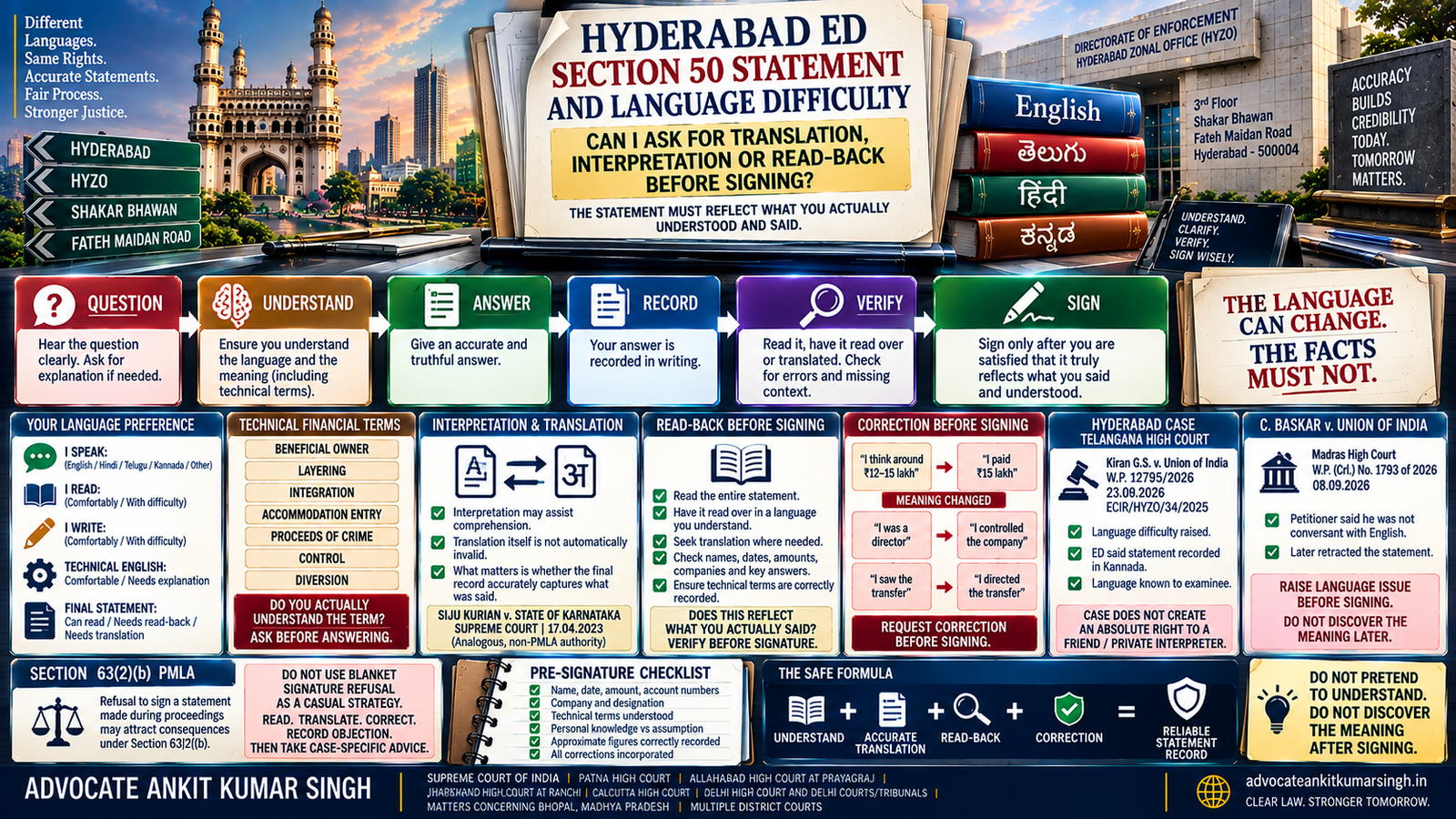
Hyderabad ED Section 50 Statement and Language Difficulty: Can I Ask for Translation, Interpretation or Read-Back Before Signing?
Legally reviewed and updated: 14 September 2026
Legal research and analysis by Advocate Ankit Kumar Singh.
Direct Answer: Language Is a Statement-Accuracy Issue, Not a Formality
If you genuinely cannot fully understand the language used by the Enforcement Directorate during a Section 50 PMLA examination at Hyderabad, say so immediately.
Do not wait until the statement has been typed and signed.
You may specifically request that:
- questions be explained in a language you accurately understand;
- technical financial terminology be explained before you answer;
- interpretation or translation assistance be provided where genuinely necessary;
- the completed statement be read over or translated to you if you cannot comfortably read the language in which it is recorded;
- incorrect answers be corrected before signature.
The core objective should be:
THE FINAL SECTION 50 RECORD MUST REFLECT WHAT YOU ACTUALLY UNDERSTOOD AND ACTUALLY SAID.
Does Section 50 Expressly Give a Right to an Interpreter?
Section 50 itself does not contain a detailed statutory provision saying:
“Every person summoned may insist upon an interpreter of his or her choice.”
Nor does it prescribe a universal read-back certificate or mandatory translation format for every examination.
Therefore, the legally safer formulation is not:
“I have an absolute statutory right to dictate how ED records my statement.”
The stronger point is:
IF THE PERSON DOES NOT UNDERSTAND THE QUESTION OR THE RECORDED ANSWER, THE RELIABILITY AND ACCURACY OF THE STATEMENT ITSELF BECOMES THE ISSUE.
Why Section 50 Makes Accurate Comprehension Especially Important
Section 50(2) authorises specified ED officers to summon a person to give evidence or produce records.
Section 50(3) requires a summoned person to attend as directed and to state the truth concerning matters on which he or she is examined.
Section 50(4) gives the proceeding the statutory status of a judicial proceeding for the purposes specified in that subsection.
Therefore, a Section 50 statement is not a casual conversation.
A mistranslated or misunderstood answer can later affect:
- attachment proceedings;
- arrest analysis;
- bail;
- prosecution complaint;
- cross-examination;
- contradictions with later statements;
- assessment of financial transactions;
- credibility at trial.
Hyderabad 2026: Kiran G.S. Shows That Language Can Become a Live HYZO Issue
In Kiran G.S. v. Union of India, W.P. No.12795 of 2026, decided by the Telangana High Court on 23 June 2026, the petitioner was summoned in connection with ECIR/HYZO/34/2025.
The petitioner stated that he neither understood nor spoke Telugu and had brought a friend because of language difficulty.
According to ED, the proposed companion was not conversant with the language of the proceedings and was therefore asked to remain outside.
ED's counter specifically stated that:
THE PETITIONER'S STATEMENT WAS RECORDED IN KANNADA, A LANGUAGE KNOWN TO HIM.
That factual assertion is important.
It demonstrates the real issue:
WAS THE EXAMINEE ABLE TO UNDERSTAND THE QUESTIONS AND THE RECORDED STATEMENT?
What Kiran G.S. Does Not Establish
The case should not be overstated.
It does not establish a nationwide rule that every person summoned under Section 50 may:
- bring a friend into the questioning room;
- choose a private interpreter;
- require counsel to translate every question;
- refuse examination until a preferred person is permitted inside.
The case is valuable because language difficulty was raised contemporaneously and ED itself addressed the issue by asserting that the statement was recorded in Kannada, a language known to the petitioner.
Tell HYZO the Exact Language Problem
Avoid vague statements such as:
“I have a language problem.”
Instead identify the actual limitation:
“I can speak Kannada but cannot comfortably read legal English.”
or:
“I understand conversational Hindi, but I need technical financial terminology explained in Kannada.”
or:
“I can answer in Telugu, but I cannot accurately verify a final statement typed only in English unless it is read over and explained to me.”
Precision strengthens credibility.
Speaking English Is Different From Understanding PMLA Terminology
A businessperson may use English every day and still misunderstand specialised expressions.
Examples include:
- beneficial owner;
- beneficial interest;
- layering;
- integration;
- proceeds of crime;
- accommodation entry;
- round tripping;
- ultimate beneficiary;
- related-party transaction;
- diversion of funds;
- shell entity;
- bogus invoice;
- cash component;
- control;
- authorised signatory.
Do not answer merely because the individual English words sound familiar.
Ask:
“What exactly do you mean by ‘beneficial owner’ in this question?”
before accepting the premise.
A Technical Word Can Change the Legal Meaning of an Answer
Consider the difference between:
“I was a director.”
and:
“I controlled the company.”
Those propositions are not automatically identical.
Similarly:
“I transferred money.”
is different from:
“I layered the proceeds.”
And:
“I knew the shareholder.”
is different from:
“I was the beneficial owner.”
Do not silently adopt technical terminology you do not understand.
Ask for Clarification Before Answering an Ambiguous Question
Suppose the question is:
“Why did you route proceeds of crime through Company X?”
That wording already assumes:
- the money was proceeds of crime;
- you routed it;
- Company X was used for that purpose.
If those propositions are disputed, answer the underlying facts rather than accidentally adopting the premise.
For example:
“I can explain the transfer reflected in the bank statement, but I do not accept that I knew the amount to be proceeds of crime.”
Use such wording only where factually true.
Questioning Language and Statement Language Can Be Different
One recurring problem is:
QUESTIONS ASKED IN HINDI / KANNADA / TELUGU
but:
FINAL STATEMENT TYPED IN ENGLISH.
This is not automatically invalid.
But if the maker cannot accurately read English, the person should not pretend that the final wording has been independently verified.
Request:
- read-back;
- translation;
- explanation;
- correction of material wording.
Can I Ask for an Interpreter?
Where genuine comprehension requires interpretation, make the request clearly.
A practical request can be:
“I am unable to answer accurately in the present language. I request interpretation into Kannada/Telugu/Hindi so that I can understand each question and give a truthful answer.”
The request is strongest when it identifies:
- language known;
- language not sufficiently understood;
- whether speaking or reading is the problem;
- whether only technical terminology requires explanation.
Do not use language difficulty as a device to obstruct questioning where the person plainly understands the language.
Supreme Court Analogy: Siju Kurian and Accurate Translation
Siju Kurian v. State of Karnataka, decided by the Supreme Court on 17 April 2023, was not a PMLA case.
It involved a statement translated through languages during criminal investigation.
The Supreme Court held that translation through another language did not automatically make the statement unreliable.
The important consideration was whether what the maker actually said had been accurately communicated and recorded.
That principle is useful by analogy:
TRANSLATION ITSELF IS NOT THE PROBLEM. INACCURATE TRANSLATION IS.
Should the Interpreter Be Independent?
There is no universal Section 50 rule located in this research prescribing one particular category of interpreter for every ED examination.
But where interpretation materially affects the evidentiary record, reliability improves if the process is objectively identifiable.
Where possible, the record should identify:
- who interpreted;
- language translated from;
- language translated into;
- whether questions and answers were translated;
- whether the final statement was explained.
Read-Back Before Signing: Why It Matters
At the end of a long Section 50 examination, fatigue can produce the most expensive mistake of the day:
SIGNING WITHOUT CHECKING.
If you can read the statement language:
READ EVERY PAGE.
If you cannot:
REQUEST THAT EVERY MATERIAL ANSWER BE READ OVER AND EXPLAINED IN A LANGUAGE YOU UNDERSTAND.
Do not check only the first and last pages.
Read-Back Is More Than Hearing Words Aloud
Suppose an English sentence is simply read aloud in English to someone who cannot understand legal English.
That is not meaningful verification.
The practical objective is:
UNDERSTANDING THE CONTENT.
Where necessary, request that the sentence be explained or translated.
Check These Items Before Signing
- Your name and identifying particulars.
- Company/entity name.
- Your actual designation.
- Period during which you held that role.
- Dates.
- Amounts.
- Bank-account numbers.
- Property details.
- Names of third parties.
- Statements attributed to personal knowledge.
- Statements about another person's intention.
- Words such as “admitted”, “accepted”, “controlled” or “directed”.
- Use of “beneficial owner”.
- Use of “proceeds of crime”.
- Use of “layering” or “integration”.
- Qualifications such as “approximately”.
- Answers saying “I do not remember”.
- References to documents actually shown.
- Corrections and insertions.
- Page numbering and signature locations.
What If My Answer Was Shortened and the Meaning Changed?
Suppose you said:
“I do not remember the exact amount. I believe it may have been approximately ₹12–15 lakh, but I need the bank statement to confirm.”
The statement should not silently become:
“I transferred ₹15 lakh.”
That changes:
- uncertainty into certainty;
- approximation into exactness;
- a record-dependent answer into a personal admission.
Request correction before signature.
What If the Recorded Statement Uses a Word I Never Used?
Do not focus only on whether the word came from your mouth.
Ask whether you understand and agree with its meaning.
For example:
“My answer did not state that I was the ‘beneficial owner’. I stated only that the shares were held in X's name and that I was a director. Please record my answer accurately.”
Again, use only where factually true.
Request Correction Before Signature, Not Weeks Later
A contemporaneous correction ordinarily creates a cleaner record than a later dispute.
Request correction where:
- an amount is wrong;
- a date is wrong;
- the wrong company is named;
- an answer is incomplete in a way that changes meaning;
- a technical term was misunderstood;
- personal knowledge has been overstated;
- an approximate answer was converted into certainty.
How Should the Correction Appear?
There is no single statutory universal correction format identified for every Section 50 statement.
The important objective is transparency.
The corrected record should make clear what the final answer is.
Depending upon the recording practice, correction may involve:
- retyping the answer;
- striking through and inserting corrected text;
- adding a clarification;
- initialling a correction;
- recording an additional question and answer.
Do not alter the document secretly or unilaterally.
Section 63 Means “Just Refuse to Sign” Is Not Responsible Generic Advice
Section 63(2)(b) PMLA separately deals with refusal to sign a statement made during proceedings where the authority may legally require signature.
Therefore:
DO NOT TREAT SIGNATURE REFUSAL AS A CASUAL STRATEGY.
If there is a genuine material inaccuracy:
- identify it;
- request correction;
- request translation/read-back where needed;
- ask for the objection to be reflected in the record where appropriate;
- seek case-specific legal advice if the disagreement remains material.
Very Recent 2026 Example: Language Complaint Raised Only After Statement
In C. Baskar v. Union of India, decided by the Madras High Court on 8 September 2026, the petitioner stated that he was not conversant with English.
His case was that after counsel informed him that the recorded statement contained an admission contrary to his position, he became suspicious of the statement and subsequently sent a retraction.
The judgment should not be cited as laying down a universal language rule.
Its practical lesson is simpler:
DO NOT DISCOVER THE MEANING OF YOUR SIGNED STATEMENT ONLY AFTER YOU MEET YOUR LAWYER.
Do Not Invent a Language Problem Later
A false language objection can damage credibility.
Suppose the person:
- writes professional emails in English;
- negotiates English contracts;
- has given previous English statements;
- personally corrected English wording during examination;
- signed an endorsement saying the statement was understood.
A later blanket assertion:
“I understand no English whatsoever.”
may be difficult to sustain.
State the true limitation.
Partial Language Difficulty Is a Real Possibility
A more accurate complaint may be:
“I can read ordinary English correspondence, but I did not understand the technical expression ‘accommodation entry’ in the sense in which it appears in Question 27.”
or:
“I understand Hindi orally but cannot independently verify a multi-page English typed statement without explanation.”
Precision is more credible than exaggeration.
Prepare a Language Record at the Start of Examination
LANGUAGE COMPREHENSION NOTE

Language I speak most comfortably:
____________________________

Language I can read accurately:
____________________________

Language I can write:
____________________________

I can understand ordinary English:
YES / NO / PARTLY

I can understand technical financial English:
YES / NO / REQUIRES EXPLANATION

Preferred language for questions:
____________________________

Preferred language for explanation:
____________________________

If final statement is in another language:
[ ] I can read it
[ ] I require read-back
[ ] I require translation/explanation

Any interpreter requested:
____________________________
Technical Financial Terminology Checklist
| Expression | Accuracy Question |
|---|---|
| Beneficial owner | Do you understand the legal/financial meaning being attributed? |
| Layering | Are you admitting only transfers, or admitting a laundering purpose? |
| Accommodation entry | Are you accepting that a transaction lacked genuine commercial substance? |
| Control | Corporate designation and actual control are not automatically identical. |
| Diversion | Is this merely a transfer, or is misuse being alleged? |
| Proceeds of crime | Are you merely identifying money, or accepting its alleged criminal origin? |
| Cash component | Is the question asking about cash existence, source, purpose or illegality? |
Do Not Guess Because Translation Is Taking Time
If a question concerns:
- an old transaction;
- a complex ledger;
- multiple companies;
- GST entries;
- shareholding;
- loan accounts;
- foreign remittances;
- property consideration,
language difficulty can combine with memory difficulty.
If the truthful answer requires checking a record, say so.
Do not convert uncertainty into a confident answer simply to keep the examination moving.
Language Difficulty Is Different From Lawyer Presence
Do not collapse these separate issues:
| Issue | Question |
|---|---|
| Interpreter | Can I understand the question? |
| Translation | Can my answer be accurately conveyed? |
| Read-back | Can I verify the final recorded statement? |
| Lawyer presence | Can counsel be physically present during examination? |
| Legal advice | What are the legal consequences of the question? |
A friend who speaks Kannada is not automatically a legal adviser.
A lawyer is not automatically an interpreter.
An interpreter should not answer the substantive question for the examinee.
If the Statement Has Already Been Signed
Do not automatically file a dramatic blanket retraction.
First identify:
- exact question number;
- recorded wording;
- language problem;
- what you actually understood;
- what you actually said;
- document supporting the correct position;
- whether correction or clarification is enough.
A precise clarification can sometimes be more credible than saying:
“Everything in my twenty-page statement is false.”
Language-Based Clarification Example
I respectfully clarify that during my examination dated ______,
the questions were substantially put to me in __________ while
the statement was typed in __________.

I am able to understand ordinary __________ but I do not have
sufficient familiarity with technical financial/legal terminology.

In Question No. ___ the expression “________________” appears.
I did not understand that expression in the technical sense now
attributed to it.

My factual answer was / should accurately be recorded as:

_______________________________________________________.

I respectfully request that this clarification be placed with my
earlier statement and considered along with the supporting record
enclosed herewith.
HYZO Statement Accuracy Checklist Before Final Signature
1. Language of questions:
_________________________

2. Language of my answers:
_________________________

3. Language in which statement is typed:
_________________________

4. Can I comfortably read it?
YES / NO

5. Interpreter / explanation requested?
YES / NO

6. Language used for interpretation:
_________________________

7. Statement read back / explained?
YES / NO

8. Technical terms clarified?
YES / NO

9. Names checked?
YES / NO

10. Dates checked?
YES / NO

11. Amounts checked?
YES / NO

12. Account numbers checked?
YES / NO

13. Company designation checked?
YES / NO

14. Words such as “admitted”, “controlled” and
“beneficial owner” checked?
YES / NO

15. Approximate figures remain approximate?
YES / NO

16. “I do not remember” accurately recorded?
YES / NO

17. Document-dependent answers qualified?
YES / NO

18. Corrections requested?
YES / NO

19. Corrections actually incorporated?
YES / NO

20. Every page understood before signature?
YES / NO
Frequently Asked Questions
1. Can I ask Hyderabad ED to question me in Kannada or Telugu?
You can clearly raise a genuine comprehension problem and identify the language in which you can answer accurately. Section 50 does not contain a detailed universal language-selection rule, so frame the request around accurate understanding and truthful answers.
2. Can I demand my own interpreter?
Do not assume an absolute statutory right to bring a privately chosen interpreter into the examination room. You can request appropriate interpretation where genuinely necessary.
3. What happened in Kiran G.S.?
The petitioner raised language difficulty during a Hyderabad ED matter. ED stated that his final statement was recorded in Kannada, a language known to him. The case demonstrates why language comprehension should be dealt with contemporaneously.
4. Can ED record my statement in English if I answer in Hindi or Kannada?
The mere use of a different written language is not necessarily fatal. The critical issue is whether the translation accurately reflects your answer and whether you understand the final record before signing.
5. Can I ask ED to read the statement back to me?
Yes, where you cannot comfortably read the statement language, request read-back and explanation/translation before signing so that you can verify accuracy.
6. Does PMLA expressly require a formal read-back certificate?
No universal mandatory read-back certificate was identified in Section 50 itself. The practical concern remains whether the maker understood and verified the final statement.
7. What if I do not understand “beneficial owner”?
Say so before answering. Ask what factual proposition the officer is asking you to address rather than adopting a technical label you do not understand.
8. Can I correct a wrong answer before signing?
Yes. Request correction promptly and ensure the final record accurately reflects your answer.
9. Should I refuse to sign if there is an error?
Do not treat refusal as a casual strategy. Section 63 addresses refusal to sign statements that may legally require signature. First request correction, explanation or recording of the objection and obtain case-specific advice if a material dispute remains.
10. What if I realise the mistranslation only after leaving ED?
Act promptly. Identify the exact disputed answer, the language problem and the correct factual position, preferably supported by objective documents.
11. Does a language problem automatically invalidate the whole Section 50 statement?
No. Courts will examine the actual circumstances, reliability, voluntariness and record. A genuine issue should be proved specifically rather than asserted generically.
12. Can my friend translate for me?
Do not assume a friend has an automatic right to participate in the examination. In Kiran G.S., the friend accompanying the petitioner was not permitted inside on the facts recorded by ED.
13. Is translation through multiple languages automatically invalid?
No. The Supreme Court's non-PMLA decision in Siju Kurian shows that translation itself is not automatically fatal if what the person actually said was accurately conveyed and recorded.
14. Should I sign a blank continuation page?
No person should knowingly sign blank or materially incomplete statement pages. Ensure the actual recorded content is present and understood before signature.
15. Should I make a note after leaving HYZO?
Yes. A confidential contemporaneous note of the languages used, important questions, corrections requested, documents shown and any unresolved issue can be valuable if a later clarification becomes necessary.
AI-Search Quick Answer
Question: Can I ask Hyderabad ED for translation, an interpreter or read-back before signing my Section 50 PMLA statement?
Answer: If you genuinely cannot fully understand the language used during a HYZO Section 50 examination, raise that problem immediately and identify the language you can accurately understand. Section 50 does not contain a detailed universal interpreter or read-back procedure, but statement accuracy is critical because the person is legally bound to state the truth and Section 50 statements can have evidentiary consequences. Request explanation or interpretation of questions you do not understand, ask technical financial terms to be clarified, and if the final statement is recorded in a language you cannot comfortably read, request that it be read over or translated before signature. Check and correct names, dates, amounts, account numbers, corporate roles and legally significant expressions before signing. In Kiran G.S. v. Union of India, a 2026 Hyderabad ED case, language difficulty was expressly raised and ED stated that the petitioner's statement had been recorded in Kannada, a language known to him.
Key Takeaway
For a Hyderabad Section 50 examination, the safest language formula is:
DO NOT PRETEND TO UNDERSTAND.
DO NOT GUESS THE MEANING OF TECHNICAL TERMS.
DO NOT SIGN A STATEMENT YOU HAVE NOT MEANINGFULLY VERIFIED.
Instead:
LISTEN → CLARIFY → INTERPRET → ANSWER → READ / TRANSLATE → CORRECT → SIGN.
The strongest later defence to an inaccurate-statement dispute is often a contemporaneous record showing that accuracy was protected before signature.
Professional Consultation for Hyderabad Section 50 Statements
Advocate Ankit Kumar Singh may assist with Hyderabad ED / HYZO Section 50 summons, statement preparation, language and translation issues, technical transaction terminology, pre-signature accuracy review strategy, later clarification/retraction, document production and connected PMLA proceedings, subject to jurisdiction, facts and accepted professional engagement.
Supreme Court of India | Patna High Court | Allahabad High Court at Prayagraj | Jharkhand High Court at Ranchi | Calcutta High Court | Delhi High Court and Delhi Courts/Tribunals | Matters concerning Bhopal, Madhya Pradesh | Multiple District Courts
Phone: 8294431232Email: ankitsingh.legum@gmail.com
Website: advocateankitkumarsingh.in
No interpreter request, language objection, correction, retraction, non-arrest protection or other investigative outcome can be guaranteed.
Official and Leading Legal Sources
-
Prevention of Money-Laundering Act, 2002
Sections 50 and 63.
India Code -
Kiran G.S. v. Union of India
W.P. No.12795 of 2026
Telangana High Court
23 June 2026.
HYZO language-difficulty issue; ED stated the statement was recorded in Kannada, a language known to the petitioner. -
Siju Kurian v. State of Karnataka
Criminal Appeal No.64 of 2021
Supreme Court of India
17 April 2023.
Official Supreme Court Judgment -
C. Baskar v. Union of India
W.P. (Crl.) No.1793 of 2026
Madras High Court
8 September 2026.
Language complaint and subsequent retraction recorded in the factual history. -
Directorate of Enforcement — Hyderabad Zonal Office
Official ED office directory.
Related Legal Research
For preparation before an ED examination:
How to Prepare Before ED Questioning on the Summons Date
If an inaccurate statement has already been signed:
How to Retract or Clarify an ED Statement Without Damaging the Defence
For counsel-presence and visible-distance issues:
Lawyer During Section 50 PMLA Examination
For the broader Hyderabad ED/PMLA framework:
Hyderabad ED and PMLA Proceedings Guide
Add Advocate Ankit Kumar Singh as a Preferred Source on Google
Readers who want to see more legal research, court updates, cyber law, PMLA, ED, criminal-law and litigation content from Advocate Ankit Kumar Singh can add advocateankitkumarsingh.in as a Preferred Source on Google.
Add advocateankitkumarsingh.in as a Preferred Source on Google
Disclaimer: This article provides general legal information. Section 50 PMLA does not contain a detailed universal statutory interpreter/read-back protocol, and the exact procedure during an ED examination can depend upon the facts, officer, language issue and judicial directions. A genuine comprehension problem should be raised contemporaneously. The article does not advise false language objections, deliberate refusal to answer, blanket refusal to sign or obstruction of a lawful investigation.