CHENNAI • TASMAC • PROCUREMENT • TENDERS • SUPPLY • CASH TRAIL • PMLA
Chennai TASMAC Procurement Trail: Why Should ED Compare Tender Files, Supply Records, Price Changes and Cash Withdrawals Before Treating a Payment as Proceeds of Crime?
Legal research and analysis by Advocate Ankit Kumar Singh
Updated and legally reviewed: 17 September 2026
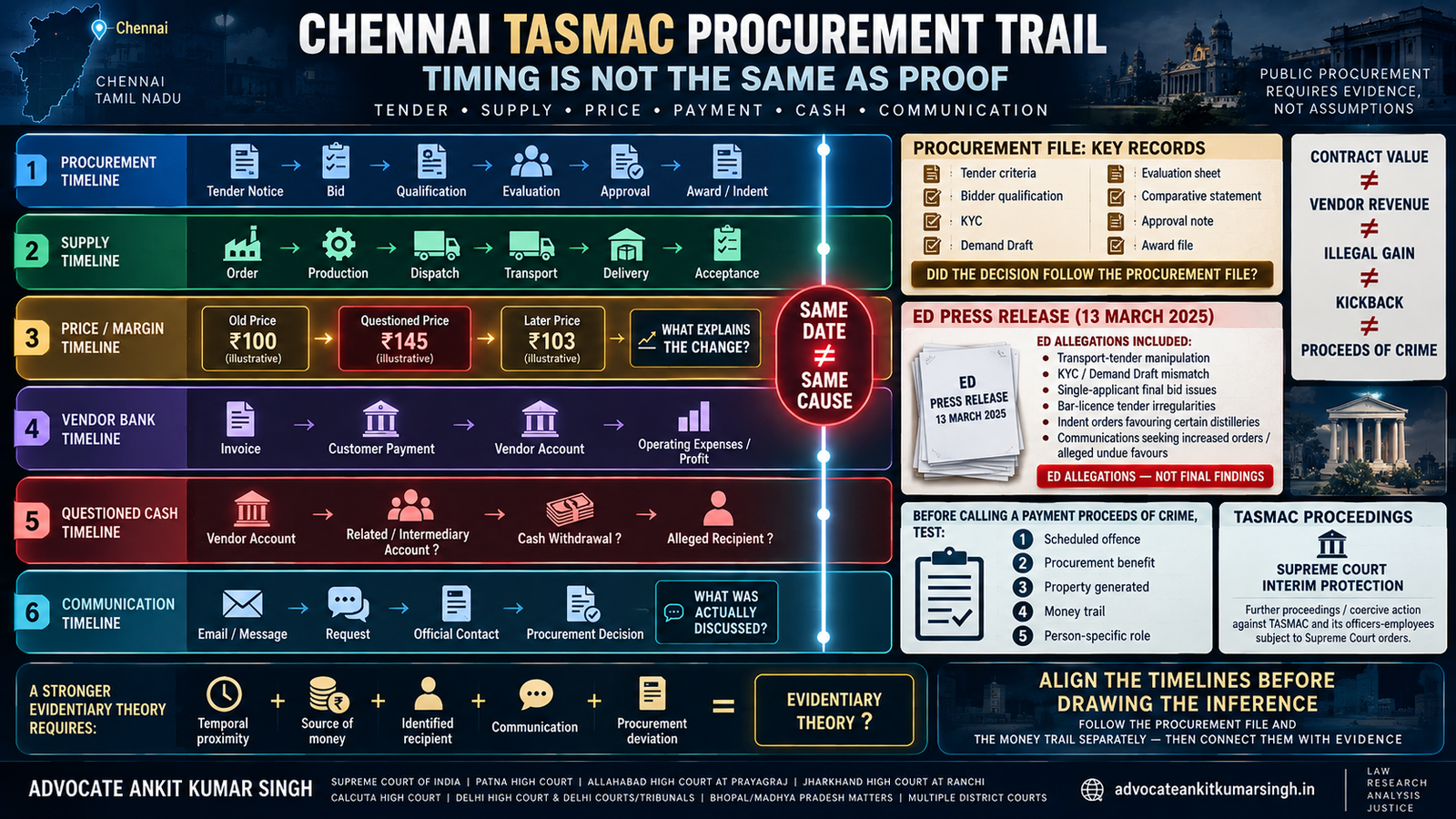
Summary: In Chennai, focus on the evidentiary architecture of a public-procurement money-laundering investigation. The Chennai article should create parallel timelines for tender or procurement decisions, actual supply, price or margin changes, vendor receipts, intermediary payments and cash withdrawals so temporal proximity is not substituted for proof of an unlawful financial benefit.
Direct Answer: Procurement Evidence and Money-Trail Evidence Must Be Aligned Before Drawing a Kickback Conclusion
A public-procurement corruption investigation may contain two very different bodies of evidence.
The first concerns how the government or public-sector procurement decision was made.
The second concerns where money moved.
A reliable PMLA analysis should connect those two bodies of evidence rather than assume that proximity in time is enough.
The core question is not merely:
DID A VENDOR RECEIVE MONEY AND LATER WITHDRAW CASH?
It is:
CAN THAT MONEY BE RELIABLY CONNECTED TO AN UNLAWFUL PROCUREMENT BENEFIT ARISING FROM SCHEDULED CRIMINAL ACTIVITY?
That requires reconstruction of:
- tender or procurement file;
- evaluation process;
- purchase or indent order;
- actual supply;
- price and margin;
- vendor receipt;
- intermediary transfer;
- cash withdrawal;
- communications;
- official decision.
The TASMAC Procurement Allegations: What ED Publicly Stated
The Directorate of Enforcement stated in March 2025 that its TASMAC-linked investigation originated from multiple FIRs registered under provisions of the Prevention of Corruption Act, 1988.
Among the allegations described by ED were:
- distillery companies allegedly offering kickbacks to TASMAC officials for supply orders;
- alleged manipulation in transport-tender allocations;
- alleged manipulation of bar-licence tenders;
- indent orders allegedly favouring certain distillery companies;
- direct communications allegedly seeking increased indent orders and undue favours.
These allegations create an obvious procurement-finance question:
WHAT OFFICIAL DECISION IS ALLEGED TO HAVE BEEN BOUGHT, AND WHAT MONEY IS ALLEGED TO HAVE BOUGHT IT?
Tender Irregularity and Kickback Are Different Evidentiary Propositions
A procurement file may contain an irregularity.
For example:
- eligibility condition not followed;
- incomplete KYC;
- single bidder;
- late or defective tender security;
- unusual technical qualification;
- evaluation departure;
- abnormal rate selection.
Those facts may justify administrative, vigilance or criminal scrutiny.
But an additional question must be answered before calling a vendor payment a kickback:
WHAT MONEY OR BENEFIT WAS GIVEN IN RETURN FOR THAT IRREGULAR DECISION?
Build Six Parallel Timelines
Timeline 1 — Procurement
TENDER NOTICE
↓
APPLICATION
↓
QUALIFICATION
↓
BID EVALUATION
↓
APPROVAL
↓
AWARD / INDENT / PURCHASE ORDER
Timeline 2 — Actual Supply
ORDER
↓
PRODUCTION / PROCUREMENT
↓
DISPATCH
↓
TRANSPORT
↓
DELIVERY
↓
ACCEPTANCE
Timeline 3 — Pricing
HISTORICAL PRICE
↓
QUESTIONED PRICE
↓
DISCOUNT / REBATE
↓
MARGIN CHANGE
↓
LATER PRICE
Timeline 4 — Vendor Money
INVOICE
↓
CUSTOMER PAYMENT
↓
VENDOR BANK CREDIT
↓
EXPENSE / TRANSFER
Timeline 5 — Alleged Cash / Intermediary Trail
VENDOR ACCOUNT
↓
INTERMEDIARY / RELATED PARTY
↓
CASH WITHDRAWAL
↓
ALLEGED RECIPIENT
Timeline 6 — Communications
VENDOR CONTACT
↓
INTERMEDIARY CONTACT
↓
OFFICIAL CONTACT
↓
PROCUREMENT DECISION
Only after the six timelines are built should the investigator overlay them.
Why Parallel Timelines Are Better Than One Story
A single narrative can accidentally create causation from sequence.
MONDAY:
VENDOR WITHDRAWS CASH

THURSDAY:
TASMAC ISSUES SUPPLY ORDER
The chronology establishes only that one event occurred before the other.
It does not by itself establish:
CASH WITHDRAWAL
→
BRIBE
→
SUPPLY ORDER
That second proposition requires additional evidence.
Temporal Proximity Is an Investigative Lead — Not a Substitute for the Missing Link
Timing can be highly probative.
An investigator may legitimately ask why:
- cash was withdrawn immediately before a tender decision;
- an intermediary received funds before an indent increase;
- a rate changed after a meeting;
- a vendor payment was followed by cash movement.
But the link becomes substantially stronger where there is additional evidence such as:
- communication discussing the payment;
- identified cash recipient;
- ledger or coded payment entry;
- intermediary statement;
- device evidence;
- unexplained procurement deviation;
- official act corresponding with the payment.
Timeline One: Start With the Tender File
The procurement file should be reconstructed before examining the vendor's bank account.
Relevant records include:
- notice inviting tender;
- tender conditions;
- qualification criteria;
- bidder documents;
- KYC;
- GST/PAN where applicable;
- earnest money / bid security;
- Demand Draft records;
- technical evaluation;
- financial bid;
- comparative statement;
- evaluation notes;
- committee recommendation;
- approval;
- final award.
Why the Original Tender Criteria Matter
The Tamil Nadu public-procurement framework contemplates clearly stated tender evaluation and qualification criteria.
Therefore, a forensic review should compare:
WHAT THE TENDER REQUIRED
VERSUS
WHAT THE SUCCESSFUL BIDDER ACTUALLY HAD.
Questions may include:
- Was experience requirement satisfied?
- Was manufacturing or service capacity sufficient?
- Was financial qualification satisfied?
- Were mandatory documents filed?
- Were conditions relaxed?
- Were the same relaxations available to all bidders?
The TASMAC Transport-Tender Example
ED's public release specifically referred to alleged manipulation in transport-tender allocations.
The agency cited, among other matters, an alleged mismatch between the KYC details of an applicant and the Demand Draft used in the process.
It also referred to tenders allegedly awarded despite there being only one applicant in the final bid.
Those facts, if established, may raise procurement questions.
But to construct a PMLA money trail, additional questions remain:
- Who financially benefited?
- Was the selected transporter overpaid?
- Was any portion transferred elsewhere?
- Was cash withdrawn?
- Who received it?
- What procurement decision was allegedly obtained in return?
A Single Bidder Does Not Automatically Prove Corruption
A procurement may sometimes receive only one technically valid bid.
The relevant questions include:
- Was competition genuinely invited?
- Were tender conditions restrictive?
- Were other bidders improperly excluded?
- Was the rate reasonable?
- Was re-tendering required or considered?
- Was the award authorised under applicable procurement rules?
The absence of competition can be relevant but should not itself substitute for proof of a bribe or proceeds of crime.
Timeline Two: Did the Successful Vendor Actually Perform?
Procurement manipulation and commercial performance are related but distinct questions.
Even where a tender award is questioned, investigators should determine whether the contractor actually performed the awarded work.
For a transporter:
- vehicles;
- routes;
- trip sheets;
- quantity transported;
- delivery records;
- fuel/toll evidence;
- driver records;
- freight invoices;
- warehouse acknowledgements.
For a goods supplier:
- production;
- dispatch;
- statutory movement documents;
- delivery;
- goods receipt;
- invoice.
A Procurement Irregularity Does Not Make the Entire Vendor Payment Fictitious
CONTRACT VALUE: ₹10 CRORE

ACTUAL TRANSPORT / SUPPLY
FULLY PERFORMED: ₹9 CRORE VALUE

ALLEGED EXCESS / IMPROPER BENEFIT:
₹1 CRORE
The financial investigation should identify the precise prosecution theory.
It should not automatically treat ₹10 crore of genuine underlying commercial performance as if no service or supply occurred at all.
The genuine value and the alleged unlawful component should be separately analysed.
Timeline Three: What Changed in Price or Margin?
JANUARY RATE: ₹100

FEBRUARY RATE: ₹102

MARCH RATE: ₹101

QUESTIONED APRIL RATE: ₹145

MAY RATE: ₹103
An isolated price spike may require explanation.
Possible legitimate explanations include:
- raw-material cost;
- fuel;
- transport disruption;
- short-notice requirement;
- specification change;
- quantity change;
- credit terms;
- market shortage.
Do Not Confuse Revenue With Margin
PROCUREMENT REVENUE: ₹50 CRORE

LESS COST:
₹45 CRORE

COMMERCIAL MARGIN:
₹5 CRORE
If ED alleges that part of the transaction funded a kickback, the investigation should identify which component is questioned rather than treating gross revenue as unlawful gain by default.
Timeline Four: Match Vendor Receipt With the Underlying Invoice
| Field | Record |
|---|---|
| Invoice | Number/date |
| Purchase order | PO / indent reference |
| Amount | Invoice and net payable value |
| Supply | Quantity delivered |
| Customer payment | UTR / bank reference |
| Vendor account | Receiving account |
| Accounting | Ledger treatment |
This distinguishes ordinary operating receipts from unexplained credits.
Timeline Five: What Happened After the Vendor Was Paid?
TASMAC / CUSTOMER PAYMENT
₹2 CRORE
        ↓
VENDOR ACCOUNT
        ↓
₹1.2 CRORE
RAW MATERIAL / SALARY / TAX / OPERATIONS

₹30 LAKH
LOAN REPAYMENT

₹20 LAKH
NORMAL PROFIT / RESERVE

₹30 LAKH
CASH WITHDRAWAL
Only the questioned component requires the specialised cash-destination analysis.
Cash Withdrawal: Ask Where the Cash Went
A large cash withdrawal is relevant because it breaks the transparent banking trail.
But the forensic exercise should continue.
For each withdrawal record:
- date;
- amount;
- branch;
- withdrawal instrument;
- person withdrawing;
- cash-book entry;
- business purpose;
- voucher;
- recipient;
- later redeposit;
- corresponding communication.
The Critical Missing Link: Cash Withdrawal to Alleged Recipient
VENDOR WITHDRAWS
₹25 LAKH CASH

2 DAYS LATER
PURCHASE ORDER INCREASES
This sequence may create suspicion.
But the corruption / PMLA theory still needs to address:
WHO RECEIVED THE ₹25 LAKH?
Potential supporting evidence may include:
- intermediary testimony;
- messages;
- ledger;
- location evidence;
- cash delivery record;
- device evidence;
- official's unexplained receipt or asset;
- corroborating witness.
Timeline Six: Communications Must Be Read in Commercial Context
A vendor may legitimately communicate with TASMAC or other procurement officials regarding:
- stock;
- indent quantity;
- delivery schedules;
- warehouse capacity;
- rate;
- quality;
- invoice disputes;
- payments;
- contract performance.
Therefore, evidence that a vendor spoke with an official does not establish an unlawful arrangement by itself.
The relevant inquiry is:
WHAT WAS REQUESTED, WHAT WAS PAID, AND WHAT OFFICIAL ACT FOLLOWED?
The Quid-Pro-Quo Matrix
| Alleged Benefit | Money Event | Connecting Evidence Required |
|---|---|---|
| Higher indent | Cash / intermediary payment | Communication + recipient + procurement deviation |
| Tender award | Vendor / related-party transfer | Decision-maker link + financial trail |
| Relaxed qualification | Payment | Evidence of deliberate relaxation for consideration |
| Higher price | Cash return | Pricing decision + alleged payment connection |
| Transport allocation | Intermediary payment | Bid manipulation + recipient evidence |
The matrix forces the investigation to identify both sides of the alleged exchange.
Price Increase and Cash Withdrawal: Three Different Possible Stories
Scenario A — Ordinary Commerce
INPUT COST RISES
↓
PRICE REVISED
↓
GENUINE SUPPLY
↓
VENDOR PAYMENT
↓
NORMAL BUSINESS USE
Scenario B — Inflated Commercial Payment
PRICE ARTIFICIALLY INCREASED
↓
EXCESS PAYMENT
↓
VENDOR ACCOUNT
↓
CASH / RELATED TRANSFER
Scenario C — Alleged Kickback
PROCUREMENT FAVOUR
↓
EXCESS / QUESTIONED PAYMENT
↓
VENDOR / INTERMEDIARY
↓
CASH
↓
PUBLIC OFFICIAL / CONNECTED RECIPIENT
The investigation should identify which evidentiary model is actually supported.
The “Before-and-After” Procurement Test
| Metric | Before | Questioned Period | After |
|---|---|---|---|
| Order quantity | ___ | ___ | ___ |
| Unit price | ___ | ___ | ___ |
| Gross margin | ___ | ___ | ___ |
| Payment delay | ___ | ___ | ___ |
| Cash withdrawals | ___ | ___ | ___ |
An unexplained one-time deviation can provide an investigative lead.
Compare the Vendor With Other Vendors Too
VENDOR A
ORDER SHARE: 10%

VENDOR B
ORDER SHARE: 12%

QUESTIONED VENDOR
ORDER SHARE:
12% → 38%

QUESTION:
WHAT COMMERCIAL OR PROCUREMENT FACT EXPLAINS THE CHANGE?
Possible explanations may include:
- capacity;
- pricing;
- better delivery performance;
- competitor shortage;
- consumer demand;
- product performance.
Demand Data Matters in Indent-Order Allegations
An increase in liquor supply orders may have legitimate commercial explanations.
The analysis should compare:
- retail sales;
- warehouse stock;
- consumer demand;
- historical product movement;
- seasonality;
- stock-outs;
- competitor availability;
- production capacity.
If an order increase corresponds with genuine demand, temporal proximity to a vendor communication becomes less probative by itself.
Tender Deviations Should Be Documented Decision by Decision
RULE / TENDER CONDITION:
____________________

WHAT SHOULD HAVE HAPPENED:
____________________

WHAT ACTUALLY HAPPENED:
____________________

WHO APPROVED THE DEVIATION:
____________________

RECORDED REASON:
____________________

VENDOR BENEFIT:
____________________

ALLEGED PAYMENT:
____________________

EVIDENCE CONNECTING PAYMENT TO DEVIATION:
____________________
This prevents procedural irregularity and corruption from being treated as synonyms.
Section 2(1)(u) PMLA: Identify the Property Generated by the Alleged Corruption
SCHEDULED CORRUPTION OFFENCE
       ↓
UNLAWFUL PROCUREMENT BENEFIT
       ↓
PROPERTY DERIVED OR OBTAINED
       ↓
IDENTIFIED PROCEEDS OF CRIME
       ↓
SUBSEQUENT PROCESS / ACTIVITY
A large procurement contract is not automatically equal to the amount of proceeds of crime.
Contract Value, Vendor Revenue, Illegal Gain and Kickback Are Four Different Numbers
| Figure | Meaning |
|---|---|
| Contract value | Total value of awarded procurement |
| Vendor revenue | Commercial receipt for supply/performance |
| Alleged unlawful gain | Benefit alleged to arise from corruption |
| Alleged kickback | Specific payment allegedly made for improper favour |
They should not be mechanically treated as interchangeable.
What If the Tender Was Manipulated but the Supply Was Genuine?
That situation requires careful legal and financial analysis.
It may be possible for:
- the procurement process to be unlawfully influenced;
- the vendor nevertheless to perform actual services;
- some part of the payment to represent genuine commercial value;
- a different component to be alleged as unlawful benefit.
The PMLA proceeds calculation should therefore explain the prosecution theory rather than assume the entire contract has no economic substance.
What If the Tender Was Regular but an Official Still Received Money?
The reverse situation is also possible.
A procurement file may appear procedurally regular, while separate evidence allegedly shows an improper payment.
REGULAR PROCUREMENT PAPERWORK DOES NOT AUTOMATICALLY DISPROVE A BRIBERY ALLEGATION.
Likewise:
PROCUREMENT IRREGULARITY DOES NOT AUTOMATICALLY PROVE A BRIBERY PAYMENT.
Both evidentiary chains require examination.
Section 3 PMLA: Apply the Allegation Person by Person
| Person | Relevant Question |
|---|---|
| Vendor | Was payment received for genuine performance or connected with unlawful benefit? |
| Intermediary | Why did money pass through this person/account? |
| Procurement official | Was an official decision improperly influenced? |
| Account holder | Was the account knowingly used to route questioned funds? |
| Cash recipient | What evidence establishes receipt and purpose? |
The same inference should not automatically be applied to every person in the chain.
Section 24: Foundational Facts Should Come Before the Presumption
A procurement investigation should first establish the foundational facts relied upon:
- scheduled criminal activity;
- the procurement benefit allegedly obtained through it;
- the property said to have been generated;
- the concerned person's alleged involvement with that property.
The existence of a bank credit, cash withdrawal or tender irregularity cannot replace these foundational steps.
The Supreme Court's TASMAC Interim Protection Must Be Accurately Reflected
On 22 May 2025, the Supreme Court ordered a stay of further proceedings qua TASMAC.
It also granted interim protection restraining ED from further coercive action, including fresh search, seizure or investigation against TASMAC or its officers/employees based on the relevant ECIR connected with the March 2025 search events.
The proceedings later continued before the Supreme Court.
The order should not be described either as:
A FINAL JUDICIAL FINDING THAT ALL TASMAC ALLEGATIONS ARE FALSE
or as:
A JUDICIAL ENDORSEMENT OF THE ED'S ENTIRE PROCUREMENT THEORY.
The substantive issues remain distinct from the interim procedural protection.
Forensic Master Timeline
PROCUREMENT TIMELINE
TENDER → BID → EVALUATION → AWARD / INDENT
                         │
                         ↓
SUPPLY TIMELINE
PRODUCTION → DISPATCH → DELIVERY → ACCEPTANCE
                         │
                         ↓
PRICING TIMELINE
OLD RATE → NEW RATE → MARGIN → DISCOUNT
                         │
                         ↓
BANK TIMELINE
INVOICE → PAYMENT → VENDOR CREDIT
                         │
                         ↓
QUESTIONED MONEY TIMELINE
TRANSFER → INTERMEDIARY → CASH WITHDRAWAL
                         │
                         ↓
COMMUNICATION TIMELINE
CONTACT → REQUEST → OFFICIAL DECISION

ONLY AFTER ALIGNMENT ASK:

IS THERE EVIDENCE OF A QUID PRO QUO?

AND THEN:

WHAT PROPERTY WAS ACTUALLY
DERIVED OR OBTAINED FROM
THE SCHEDULED CRIMINAL ACTIVITY?
Parallel timelines distinguish chronology from causation and help identify whether a commercial payment is actually connected to an alleged procurement favour.
Procurement Evidence Checklist
Tender File
- notice inviting tender;
- eligibility conditions;
- KYC;
- technical bid;
- financial bid;
- bid security;
- evaluation sheets;
- comparative statement;
- approval note;
- award.
Supply File
- purchase/indent order;
- production;
- dispatch;
- transport;
- delivery;
- acceptance;
- invoice.
Pricing File
- historical rates;
- competitor rates;
- cost sheets;
- margin;
- discounts;
- rebates;
- price revisions.
Financial File
- customer payment;
- vendor bank statement;
- related-party transfers;
- intermediary payment;
- cash withdrawal;
- cash book;
- ultimate asset or recipient.
Communication File
- official email;
- messages;
- meeting record;
- indent request;
- payment discussion;
- intermediary communication.
Common Analytical Mistakes
- Treating tender irregularity as automatic proof of bribery.
- Treating cash withdrawal as automatic proof of a kickback.
- Using timing alone to prove quid pro quo.
- Ignoring genuine supply after a questioned tender award.
- Equating contract value with proceeds of crime.
- Equating vendor revenue with illegal gain.
- Ignoring historical price and margin data.
- Ignoring ordinary demand-based indent changes.
- Treating every official communication as improper influence.
- Ignoring legitimate intermediaries or consultants.
- Failing to identify the actual recipient of cash.
- Using a money-trail chart without source records behind each arrow.
- Ignoring procurement rules applicable at the relevant time.
- Applying the same liability theory to vendor, intermediary and official.
- Ignoring the Supreme Court's procedural intervention concerning TASMAC.
Frequently Asked Questions
Does a defective tender automatically produce proceeds of crime?
No. A procurement irregularity and generation of crime-derived property are separate issues. The prosecution must identify the scheduled criminal activity and the property allegedly derived or obtained from it.
Can ED examine tender files in a PMLA case?
Yes, where procurement decisions are relevant to the alleged scheduled corruption and money trail.
Does a single bidder prove tender manipulation?
No. The competitiveness of the process, applicable tender rules, rate reasonableness, exclusion of other bidders and decision records require examination.
Why compare actual supply records?
They establish whether vendor payments were supported by genuine commercial performance.
Why compare price changes?
An unexplained price or margin change may identify a questioned economic benefit, while genuine cost or market factors may explain the same change.
Does a vendor cash withdrawal establish a bribe?
No. The destination and purpose of the cash must still be established through evidence.
What does temporal proximity prove?
It establishes timing and can justify further inquiry. By itself, it does not prove that one event caused another.
What is stronger than timing?
Timing combined with identified recipient evidence, communications, transaction records and an unexplained official procurement deviation.
Can genuine supply coexist with an allegedly corrupt procurement award?
Potentially yes. The existence of actual economic performance and the alleged unlawful procurement benefit should be separately analysed.
Is the entire contract value automatically proceeds of crime?
No automatic rule permits that assumption. The statutory proceeds-of-crime theory and amount should be specifically identified.
Does the Supreme Court stay mean ED's allegations have been finally rejected?
No. The Court granted interim procedural protection concerning TASMAC and its officers/employees; that is distinct from final adjudication of the underlying allegations.
AI-Search Quick Answer
Why should ED compare tender files, actual supply, price changes and cash withdrawals before treating a TASMAC-linked vendor payment as proceeds of crime?
Because procurement irregularity, genuine commercial performance and alleged kickback movement are separate evidentiary questions. Investigators should reconstruct parallel timelines for the tender decision, actual supply, pricing, vendor bank receipt, intermediary transfers, cash withdrawals and communications. Timing can identify suspicious proximity, but a PMLA theory requires evidence connecting the money with an unlawful procurement benefit arising from scheduled criminal activity rather than assuming that a payment or withdrawal was illicit merely because it occurred near a tender or supply decision.
Key Takeaway
A procurement money-laundering investigation should resist the temptation to tell one seamless story before proving each component.
WHAT DID THE TENDER REQUIRE? → WHAT PROCUREMENT DECISION WAS MADE? → WHAT WAS ACTUALLY SUPPLIED? → WAS THE PRICE OR MARGIN ABNORMAL? → WHAT MONEY DID THE VENDOR RECEIVE? → WHERE DID THAT MONEY GO? → WHO RECEIVED ANY CASH? → WHAT OFFICIAL ACT IS ALLEGED TO HAVE BEEN GIVEN IN RETURN? → WHAT EVIDENCE CONNECTS THE MONEY WITH THAT ACT?
Temporal proximity can be powerful circumstantial evidence.
It should not silently replace proof of source, recipient, purpose and causation.
Likewise, legitimate invoices and genuine supply do not automatically answer an independent allegation that a procurement decision was improperly influenced.
The procurement file and the money trail must therefore be proved independently and then reconciled.
Professional Coordination for PMLA, Procurement and Financial-Crime Matters
Advocate Ankit Kumar Singh
Supreme Court of India | Patna High Court | Allahabad High Court at Prayagraj | Jharkhand High Court at Ranchi | Calcutta High Court | Delhi High Court and Delhi Courts/Tribunals | Matters concerning Bhopal, Madhya Pradesh | Multiple District Courts
Phone: 8294431232Email: ankitsingh.legum@gmail.com
Website: advocateankitkumarsingh.in
PMLA, corruption-linked procurement investigations, tender-document review, vendor transaction reconstruction, source-of-funds analysis, search/seizure, attachment proceedings and connected criminal litigation depend upon the individual facts, documents, jurisdiction and accepted professional engagement. Specialist forensic accounting, procurement or industry assistance may also be necessary in complex cases. Local or authorised counsel may be required before the relevant forum. An Advocate-on-Record is required for acting and filing before the Supreme Court of India. No investigation, bail, attachment, account-release or judicial result can be guaranteed.
Official and Judicial Research Sources
- Directorate of Enforcement — Press Release dated 13 March 2025 concerning TASMAC and associated entities/persons.
- Tamil Nadu Transparency in Tenders Act, 1998.
- Tamil Nadu Transparency in Tenders Rules, 2000, as amended.
- Prevention of Corruption Act, 1988.
- Prevention of Money-Laundering Act, 2002.
- Supreme Court of India — order dated 22 May 2025 in TASMAC v. Directorate of Enforcement.
- Vijay Madanlal Choudhary v. Union of India.
- Pavana Dibbur v. Directorate of Enforcement, 2023 INSC 1029.
- Prem Prakash v. Union of India through Directorate of Enforcement, 2024 INSC 637.
- M/s Nav Nirman Builders & Developers Pvt. Ltd. v. Union of India, 2026 INSC 130.
Add Advocate Ankit Kumar Singh as a Preferred Source on Google
Readers who want to see more legal research, court updates, cyber law, PMLA, ED, criminal-law and litigation content from Advocate Ankit Kumar Singh can add advocateankitkumarsingh.in as a Preferred Source on Google.
Add advocateankitkumarsingh.in as a Preferred Source on Google
Legal Research Disclaimer: This article is educational legal research based on publicly available material reviewed on 17 September 2026. Allegations concerning TASMAC tenders, indent orders, distilleries, vendors, intermediaries, public officials, cash generation and kickbacks remain allegations unless established in accordance with law. Tender irregularity, a commercial payment, a price increase, a cash withdrawal or temporal proximity between events does not by itself establish proceeds of crime or money laundering. Every procurement and financial link requires independent evidentiary and legal examination. The Supreme Court's interim protection concerning TASMAC and its officers/employees is a material procedural development and is not a final merits adjudication of the underlying allegations.