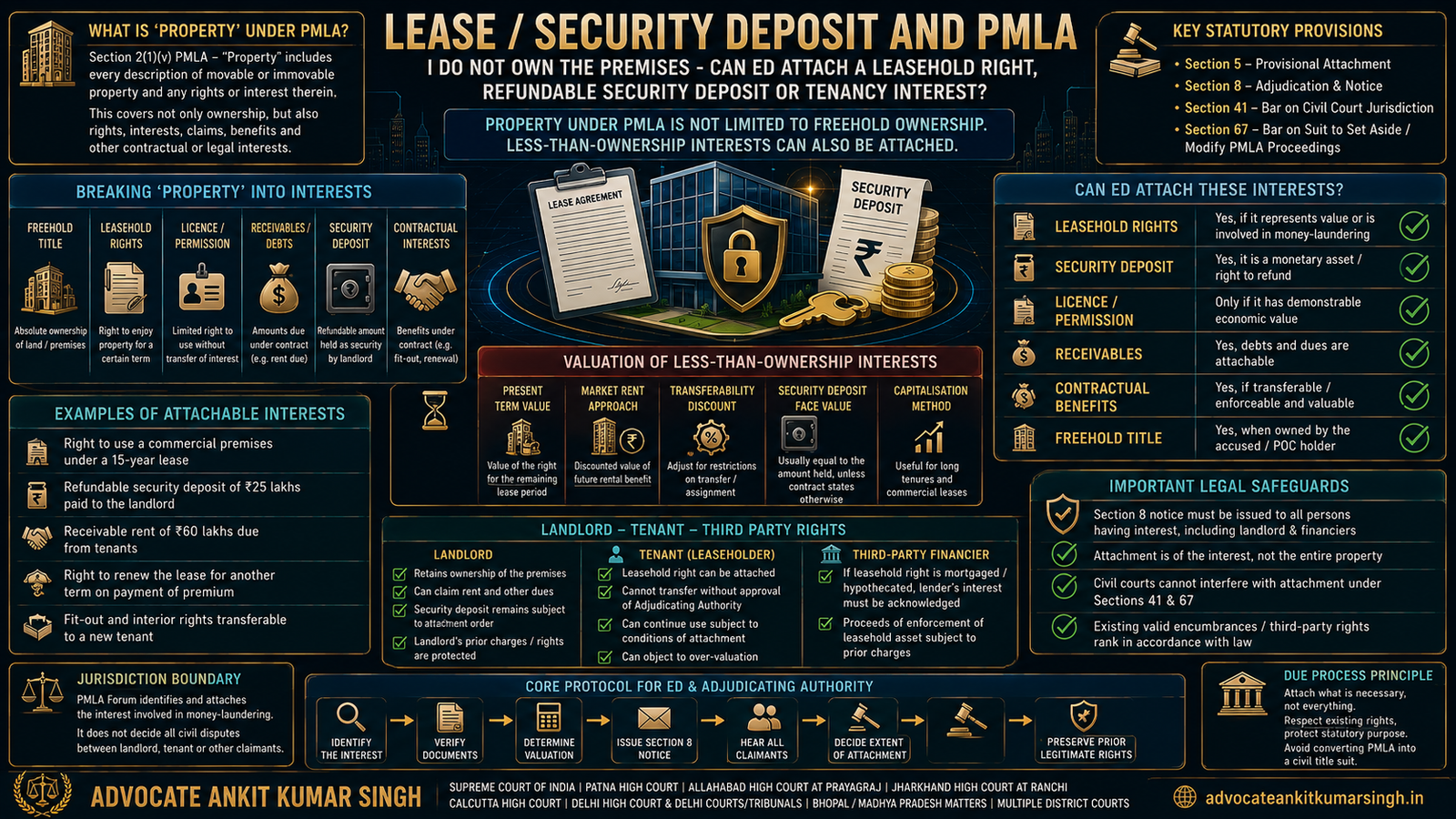
Leasehold Rights & Security Deposits Under PMLA: “I Do Not Own the Premises - Can ED Attach My Lease, Refundable Deposit or Tenancy Interest?”
Freehold • Leasehold • Licence • Security Deposit • Receivable • Possession • Landlord • Tenant • Financier
Updated: 26 August 2026
 Advocate Ankit Kumar Singh — research on PMLA, ED property attachment, leasehold rights, security deposits and third-party interests.
Direct Answer
Yes, potentially. A person does not have to own the freehold title before possessing an economically valuable “property” interest capable of attracting PMLA scrutiny.
Section 2(1)(v) PMLA defines property broadly enough to include corporeal and incorporeal, movable and immovable, tangible and intangible assets and documents evidencing an interest in property.
A lease is itself a legally recognised right to enjoy immovable property. Section 9 PMLA expressly refers to a “lease-hold interest”.
But ED must identify the correct asset.
LANDLORD'S FREEHOLD ≠ TENANT'S LEASEHOLD ≠ LICENCE ≠ SECURITY-DEPOSIT RECEIVABLE
If a company is merely a tenant of a ₹50 crore commercial building, the fact that it occupies that building does not automatically make ₹50 crore the value of the company's property.
The attachable subject may instead be:
• a leasehold right;
• a transferable tenancy interest;
• a lease premium;
• a refundable-deposit receivable;
• accrued rent or another contractual receivable;
• fit-outs and movable assets;
• or another identifiable economic interest.
Each must be separately traced, characterised and valued.
ATTACH THE INTEREST — DO NOT INVENT THE TITLE.
Contents
- One Premises Can Contain Several Different Assets
- PMLA's Broad Definition of Property
- Freehold Title
- Leasehold and Tenancy Rights
- Licence Rights
- Refundable Security Deposit
- Deposit as a Receivable / Actionable Claim
- Hawaibam Ratnakumar Singh - ₹8 Crore Security Deposit
- Sahana Builders - Civil Debt Is Not Automatically POC
- POC Used to Acquire a Leasehold
- POC Used to Pay a Security Deposit
- How Should a Leasehold Be Valued?
- How Should a Refundable Deposit Be Valued?
- Avoid Freehold / Leasehold Double Counting
- Attachment Is Not Automatically Dispossession
- 2013 Taking Possession Rules and Tenants
- Vijay Madanlal - Physical Possession Is Exceptional
- Deepak Steel - Continued Use of Productive Assets
- Late, Sham or Defeating Leases
- Section 9 and Leasehold Interests
- Rights of the Landlord
- Rights of the Tenant
- Rights of Third-Party Financiers
- Asset-Interest Matrix
- 30-Point Audit
- Leasehold / Deposit Flowchart
- Frequently Asked Questions
1. One Address Can Contain Several Different “Properties”
Assume Company A operates from Commercial Building X.
The building belongs to Landlord B.
Company A has:
• a five-year registered lease;
• ₹2 crore refundable security deposit with B;
• ₹3 crore of fit-outs and machinery;
• a contractual option to renew for five years;
• and a bank has financed the fit-outs and taken security over certain movable assets.
It is legally inaccurate to reduce all of that to:
“Company A owns Commercial Building X.”
The asset map is instead:
| Asset | Likely Holder | Nature |
|---|---|---|
| Freehold title | Landlord B | Ownership of immovable property |
| Leasehold interest | Company A | Limited right to enjoy premises |
| ₹2 crore security-deposit refund claim | Company A, subject to contract | Contractual receivable/actionable claim |
| Cash presently received as deposit | Landlord B, subject to contractual obligation | Money plus corresponding refund liability |
| Fit-outs / machinery | Depends on contract/title | Movable / fixture analysis |
| Bank charge | Financier | Security interest |
PMLA analysis should begin with this disaggregation.
2. Why PMLA Can Reach Less-Than-Ownership Interests
Section 2(1)(v) deliberately uses a broad conception of property.
It includes:
CORPOREAL + INCORPOREAL
MOVABLE + IMMOVABLE
TANGIBLE + INTANGIBLE
TITLE + INTEREST IN PROPERTY
That formulation matters because economic value can exist without freehold ownership.
Examples include:
- leasehold rights;
- contractual receivables;
- shares;
- claims to repayment;
- security interests;
- certain transferable contractual rights;
- and other intangible assets.
The Supreme Court has itself recognised that PMLA's definition extends to intangible property.
But breadth of “property” does not eliminate the separate statutory requirement that the property sought to be attached must have the legally required relationship with proceeds of crime or otherwise fall within the applicable attachment framework.
PROPERTY CAPABLE OF EXISTING ≠ PROPERTY AUTOMATICALLY LIABLE TO ATTACHMENT.
3. Freehold Title: The Landlord's Asset
Freehold ownership ordinarily contains the residual proprietary title to the premises.
Where the landlord owns Building X and an unrelated tenant occupies it, ED investigating the tenant should not mechanically describe Building X itself as the tenant's property merely because the tenant:
- occupies it;
- runs its business there;
- pays rent;
- has installed equipment;
- or has paid a large security deposit.
Occupation and ownership must be separated.
If ED has an independent statutory basis to proceed against the landlord's interest—for example because of an alleged POC trail reaching the landlord or another legally sustainable theory—that is a different analysis.
4. Leasehold / Tenancy Interest Is a Real Property Interest
Section 105 of the Transfer of Property Act defines a lease of immovable property as a transfer of a right to enjoy the property.
The lessor retains ownership/reversion while the lessee receives the leasehold interest for the agreed term.
Subject to the lease contract and applicable law, Section 108(j) also recognises that a lessee may in ordinary circumstances transfer, mortgage or sub-lease its interest, unless the contract or law restricts the right.
This gives the leasehold obvious economic characteristics.
A long-term lease acquired for substantial premium may be extremely valuable.
A short tenancy at above-market rent may have little or even negative economic attractiveness.
Therefore:
LEASEHOLD IS PROPERTY — BUT IT IS NOT FREEHOLD.
ED's own public attachment practice supports the proposition that leasehold rights are capable of being described as attached assets. Official releases have referred to attachment of leasehold rights over substantial land parcels, including in International Amusement in 2024 and the Unitech Golf & Country Club project in 2026.
5. Licence: Do Not Call Every Occupancy a Leasehold
A genuine licence is conceptually different.
Section 52 of the Indian Easements Act and longstanding Supreme Court jurisprudence distinguish a licence as permission to use another person's property without creating an estate or interest in that property.
Legal possession and control ordinarily remain with the owner/licensor.
Therefore:
LEASE: right to enjoy immovable property transferred.
LICENCE: permission to use, ordinarily without estate in the land.
But a commercial licence agreement may still create valuable contractual rights.
For example:
- an exclusive right to operate a facility for five years;
- a transferable concession;
- a refund right;
- a revenue-sharing entitlement;
- a termination compensation claim;
- or a valuable renewal option.
PMLA's broad inclusion of intangible property makes it necessary to ask whether the contractual right itself has independent value.
This should not be confused with saying that the licensee owns an interest in the underlying land.
No universal Supreme Court PMLA rule identified in this research states that every commercial licence is itself an attachable property interest. The result is contract-specific.
6. What Exactly Is a Refundable Security Deposit?
Suppose a tenant pays ₹2 crore to a landlord as an interest-free refundable security deposit.
At least two accounting/legal positions arise:
LANDLORD: has received ₹2 crore but owes a contractual refund obligation, subject to the agreement.
TENANT: may have a contractual right to repayment upon satisfaction of specified conditions.
The deposit therefore should not be confused with:
• freehold ownership;
• ownership of the cash at every later point in time;
• an automatic lien over the entire premises;
• or an unconditional ₹2 crore immediately payable debt.
The exact legal rights depend upon the lease.
Typical clauses may make refund conditional upon:
- expiry or termination;
- handing over vacant possession;
- payment of outstanding rent;
- utility reconciliation;
- repair/damage deductions;
- tax deductions;
- restoration of premises;
- and contractual set-off rights.
7. Security-Deposit Refund Right as an Actionable Claim / Receivable
The Delhi High Court's decision in Adma Solutions Pvt. Ltd. v. Shobha Jain is useful for classification.
The Court treated the right to recover a security amount as an actionable claim capable of transfer.
On the facts of that case, the alleged assignee could not recover the security deposit because the actionable claim had not been validly conveyed to it.
The case is not a PMLA judgment.
Its relevance is narrower:
A REFUND CLAIM CAN BE A LEGALLY SEPARATE ASSET FROM THE LEASEHOLD AND FROM THE PREMISES THEMSELVES.
That separation is critical under PMLA.
If the tenant's refund claim is the asset allegedly traceable to POC, the PAO should identify that claim rather than misleadingly recording:
“Tenant owns the building worth ₹___.”
8. Hawaibam Ratnakumar Singh: When “Security Deposit” Itself Was Alleged to Be POC
The 1 September 2025 Appellate Tribunal decision in Shri Hawaibam Ratnakumar Singh v. Deputy Director, Directorate of Enforcement, Imphal provides a rare direct PMLA example involving lease security.
The appellant owned a hospital property and leased the building and accessories to M/s Lamjingba Finance.
A sum of ₹8 crore was stated to have been received towards security deposit.
ED alleged that the money came from funds connected with the alleged Ponzi operation and attached property of equivalent value.
The appellant argued that the deposit had been repaid/adjusted through different payments.
The Tribunal scrutinised:
- the lease chronology;
- the amounts actually received;
- cash and cheque components;
- the appellant's statements under Section 50;
- the alleged repayments;
- and the documentary evidence supporting those repayments.
The repayment case was found insufficient on the record and the appeal was dismissed.
The proper lesson is not:
“Every security deposit is POC.”
The proper lesson is:
THE CONTRACTUAL LABEL “SECURITY DEPOSIT” DOES NOT OVERRIDE THE ACTUAL SOURCE, RECEIPT AND MONEY TRAIL.
If the money received as deposit is itself alleged and proved to be POC, calling it “refundable security” does not automatically insulate it.
9. Sahana Builders: A Civil / Commercial Receivable Is Not Automatically POC
The opposite safeguard emerges from M/s Sahana Builders and Developers Pvt. Ltd. v. Deputy Director, ED, decided by the Appellate Tribunal on 6 July 2026.
M/s Unitech had paid ₹10 crore to the appellant company in 2004 in connection with a proposed commercial transaction which did not materialise.
ED later treated the unpaid amount together with interest as a basis for attaching a fixed deposit of equivalent value.
The identified laundering/crime period considered by the Tribunal was later—2006-07 to 2014-15.
The Tribunal found the earlier ₹10 crore receipt materially pre-dated that period and set aside the attachment.
This is important for security-deposit cases by analogy.
A landlord may have a civil obligation to refund ₹2 crore.
That does not automatically answer:
IS THE ₹2 CRORE REFUND CLAIM PROCEEDS OF CRIME?
The contractual debt and the POC inquiry are separate.
A civil recovery claim should not be substituted for proof of the statutory POC nexus.
10. What If Alleged POC Was Used to Acquire the Leasehold Right?
Assume:
Accused Company A pays a ₹5 crore lease premium from an account allegedly containing POC and acquires a 30-year commercial lease.
The forensic question may then be whether the money has been transformed into a valuable leasehold interest.
The property map is:
POC MONEY
↓
LEASE PREMIUM
↓
30-YEAR LEASEHOLD INTEREST
The landlord's freehold is still a distinct proprietary interest.
Depending upon facts and applicable PMLA principles, the leasehold right itself may become the asset whose connection with POC is examined.
It would be analytically wrong to assume:
₹5 CRORE LEASE PREMIUM → TENANT ACQUIRED LANDLORD'S ENTIRE LAND.
11. What If Alleged POC Was Used Only to Pay the Security Deposit?
This scenario is even more delicate.
Assume:
Tenant A pays Landlord B ₹2 crore refundable security deposit.
ED alleges that ₹2 crore came from POC.
Landlord B is not alleged to have participated in laundering.
Possible interests requiring separate analysis include:
1. the original money received by B;
2. A's contractual right to obtain a refund;
3. any identifiable substitute value if the original money is unavailable;
4. B's bona fide contractual deductions/set-offs;
5. A's leasehold right;
6. B's freehold title.
Those should not be collapsed into one figure.
In particular:
POC USED FOR SECURITY DEPOSIT ≠ AUTOMATIC POC EQUAL TO THE LANDLORD'S ENTIRE BUILDING.
The PAO should state exactly what property is being attached and why.
12. How Should a Leasehold Interest Be Valued?
Section 2(1)(zb) PMLA defines “value” by reference to fair market value on the date of acquisition or, if that cannot be determined, the date on which the property is possessed.
That statutory valuation date does not make a wasting leasehold economically identical to a freehold.
Forensic valuation should examine the actual interest.
Relevant variables may include:
| Variable | Why It Matters |
|---|---|
| Remaining lease term | A 30-year right is different from six months remaining |
| Contractual rent | Below/above market rent changes economic attractiveness |
| Premium paid | May reflect acquisition value of leasehold |
| Escalation | Future rent burden changes value |
| Transferability | Non-transferable interest may have lower realisable market value |
| Sub-letting rights | Can create independent income potential |
| Renewal option | Potential additional economic benefit |
| Termination / forfeiture clauses | Can materially reduce durability of the right |
| Landlord consent | May restrict assignment or monetisation |
| Use restrictions | Commercial utility may be limited |
A forensic valuer may require a discounted-cash-flow, market-comparable, lease-premium or other recognised methodology depending on the asset.
No single leasehold valuation formula is prescribed by PMLA for every tenancy.
VALUE THE RIGHT THAT EXISTS — NOT THE LAND THAT BELONGS TO SOMEBODY ELSE.
13. How Should a Refundable Security Deposit Be Valued?
The stated face amount is only the starting point.
Suppose:
ORIGINAL DEPOSIT: ₹2 CRORE
But the lease provides for:
₹20 lakh unpaid rent
₹5 lakh electricity dues
₹10 lakh restoration cost
₹5 lakh contractual adjustment
Potential net contractual receivable:
₹2.00 CRORE − ₹0.40 CRORE = ₹1.60 CRORE
Whether those deductions are actually valid would require evidence.
Other valuation questions include:
- Has the lease terminated?
- Has possession been handed back?
- Is refund presently due?
- Is the landlord disputing liability?
- Is the deposit partly adjustable?
- Has any amount already been refunded?
- Is the landlord insolvent?
- Is the claim assigned or charged to a financier?
- Is there an arbitration or civil dispute?
Accordingly:
₹2 CRORE DEPOSIT PAID ≠ AUTOMATIC ₹2 CRORE PRESENTLY REALISABLE CASH ASSET.
14. Freehold, Leasehold and Deposit Must Not Be Double Counted
Consider:
Building freehold value: ₹50 crore
Tenant leasehold value: ₹5 crore
Tenant refundable-deposit claim: ₹2 crore
Those are not three descriptions of the same ownership right.
But equally, the same economic component must not be counted twice.
For example, if a valuation of the leasehold already incorporates the benefit of a below-market rent created by a large upfront premium, adding the identical premium again as separate current property without adjustment may distort the calculation.
Likewise, attaching:
• the landlord's entire freehold;
• the tenant's leasehold;
• and the full tenant deposit
for one ₹2 crore alleged corpus requires clear explanation of why each represents separate attachable value rather than repetitive accounting.
PROPERTY RIGHTS CAN STACK — POC VALUE SHOULD NOT BE ARTIFICIALLY MULTIPLIED.
15. Accrued Rent and Licence-Fee Receivables Are Separate Assets
Suppose a building is attached but ₹50 lakh rent has already accrued and remains unpaid.
The following may be distinct:
LAND / BUILDING TITLE
LEASEHOLD INTEREST
ACCRUED RENT RECEIVABLE
FUTURE RENTAL STREAM
Future rent is also different from rent already accrued.
An attachment analysis should state whether ED is restraining:
• the premises;
• a receivable;
• a bank account into which rent flows;
• or the income generated by the property.
16. Fit-Outs, Plant, Furniture and Machinery Must Be Separately Identified
Commercial tenants frequently install valuable assets inside premises they do not own.
Examples:
- medical equipment;
- manufacturing machinery;
- servers;
- HVAC systems;
- commercial kitchens;
- furniture;
- interior fixtures;
- electrical equipment;
- and specialised installations.
The lease should be checked to determine:
who paid for them;
who owns them;
whether they become landlord's fixtures;
whether removal is permitted;
whether a lender has financed them;
and whether they are independently identified in the PAO.
The premises address should not become a substitute for an asset inventory.
17. Attachment Does Not Automatically Mean Immediate Physical Dispossession
Section 2(1)(d) conceptualises attachment as a prohibition on transfer, conversion, disposition or movement of property.
Section 5(4) then provides that nothing in Section 5 prevents a person interested from enjoyment of attached immovable property.
Its explanation is broad:
a “person interested” includes persons claiming or entitled to claim an interest in the property.
That language is especially important for:
- tenants;
- co-owners;
- mortgagees;
- landlords;
- and other legitimate third-party interest holders.
Attachment and confiscation are separate stages.
18. The 2013 Taking Possession Rules Specifically Address Tenanted Property
The Prevention of Money-Laundering (Taking Possession of Attached or Frozen Properties Confirmed by the Adjudicating Authority) Rules, 2013 contain specific provisions for immovable property occupied by tenants.
Registered lease / rent — Rule 5(3)
Where the confirmed attached immovable property is leased or rented to a third party under an instrument registered in accordance with Section 17 of the Registration Act, Rule 5(3) contemplates a direction to the occupant to pay lease amount/rent to the Directorate of Enforcement.
This rule itself is significant because it does not conceptually treat every registered tenant as though the tenancy vanished the moment attachment was confirmed.
Lease / rent where registration is optional — Rule 5(4)
The literal rule provides a different procedure where registration is optional under Section 18 of the Registration Act, including vacation and taking possession.
However, these rules must be read with the subsequent authoritative interpretation of Section 8(4) by the Supreme Court in Vijay Madanlal Choudhary.
19. Vijay Madanlal Choudhary: Physical Possession Before Confiscation Should Be Exceptional
The Supreme Court rejected a mechanical equation between confirmation of attachment and confiscation.
The Court held in substance that:
• confirmation under Section 8(3) does not mean the property has already been confiscated;
• the Section 5(4) principle permitting enjoyment should continue even after confirmation until formal confiscation;
• physical possession under Section 8(4) before confiscation should be exceptional, based on the facts of the case, rather than routine.
This is highly relevant where a bona fide tenant runs a functioning business from attached premises.
The inquiry should not end with:
“Rule 5 exists, therefore immediate eviction follows automatically.”
The Supreme Court's interpretation of the parent statute must control how the possession mechanism is applied.
20. Deepak Steel: Attachment Should Not Automatically Destroy Productive Use
In M/s Deepak Steel and Power Ltd. v. Enforcement Directorate, the Orissa High Court in September 2025 examined attached industrial plants whose PMLA proceedings had remained pending.
The Court relied upon Section 5(4) and Vijay Madanlal and emphasised that attachment does not itself extinguish ownership or automatically justify completely depriving the interested person of enjoyment before finalisation of proceedings.
The Court permitted operation of the attached plants subject to the directions imposed.
The case is particularly relevant where:
- a tenant operates a factory;
- a leased hospital is functioning;
- a commercial establishment employs workers;
- equipment would deteriorate if unused;
- or business value would be destroyed by unnecessary physical closure.
Continued operation is not an automatic entitlement in every case—but productive use is a legally relevant consideration.
21. A Genuine Pre-Existing Lease Is Different From a Sham or Defensive Lease
A property owner cannot reliably defeat PMLA merely by manufacturing a tenancy after enforcement risk becomes apparent.
Warning indicators include:
- lease executed after PAO;
- back-dated agreement;
- unregistered long-term instrument where registration was compulsory;
- no contemporaneous rent payments;
- no TDS/GST/accounting evidence;
- related-party tenant with no genuine occupation;
- nominal rent inconsistent with market or prior conduct;
- possession remaining entirely with alleged landlord;
- documents generated only after ED action;
- and no independent commercial purpose.
The correct defence therefore requires evidence of a bona fide lease, not merely the word “tenant”.
22. Section 9 PMLA Expressly Recognises Leasehold Interests — and Sham Ones
Section 9 provides that after confiscation, rights and title vest in the Central Government free from encumbrances in accordance with the provision.
Its proviso is particularly important for this article.
After hearing an interested person, the competent PMLA forum may declare an encumbrance or lease-hold interest void where it finds that it was created with a view to defeat Chapter III.
This produces two important propositions:
1. THE STATUTE EXPRESSLY RECOGNISES LEASE-HOLD INTEREST AS A LEGALLY RELEVANT INTEREST.
2. A LEASE IS NOT VOID MERELY BECAUSE PMLA EXISTS; THE STATUTORY VOIDING POWER IS DIRECTED AT AN INTEREST CREATED WITH A VIEW TO DEFEAT THE ATTACHMENT/CONFISCATION REGIME.
The existence, chronology, bona fides and commercial reality of the lease therefore matter.
23. Rights and Defences of a Bona Fide Landlord
Where the tenant is under ED investigation but the landlord is independent, the landlord should separate its ownership from the tenant's interests.
Useful evidence includes:
- root title deed;
- registered lease;
- lease commencement date;
- bank records of rent;
- security-deposit receipt;
- TDS/GST accounting;
- property-tax records;
- market rent evidence;
- correspondence showing arm's-length negotiation;
- security-deposit refund clause;
- termination provisions;
- proof of absence of common control;
- and any mortgage or prior financier interest.
The landlord should insist that the PAO differentiate:
LANDLORD FREEHOLD
from
TENANT LEASEHOLD / DEPOSIT / MOVABLE ASSETS.
24. Rights and Defences of a Bona Fide Tenant
Where ED attaches the landlord's premises, the tenant should establish its independent interest immediately.
The evidence should include:
- registered lease deed where applicable;
- date of possession;
- rent-payment trail;
- security-deposit proof;
- tax deduction records;
- utilities;
- GST registration/business-address records;
- fit-out invoices;
- insurance;
- employee/business records;
- landlord correspondence;
- renewal documents;
- and proof that tenancy predates enforcement action.
A tenant should also identify the exact relief sought:
continued occupation;
recognition of tenancy;
protection of refundable deposit;
permission to operate;
release of tenant-owned movables;
or challenge to a PAO incorrectly describing the tenant as freehold owner.
25. What About the Bank or Third-Party Financier?
Leaseholds, rental receivables, security-deposit receivables, machinery and contractual rights may also be charged or financed.
The Delhi High Court's Axis Bank judgment remains important because it rejects both extremes:
A prior secured interest does not automatically invalidate PMLA attachment.
But PMLA attachment also does not automatically make a bona fide pre-existing charge illegal.
The Bombay High Court's March 2026 decision involving HDFC Bank and Punjab National Bank reaffirmed that balance while rejecting the proposition that SARFAESI/RDB priority mechanically overrides PMLA.
The Court held that the lawful interest of a bona fide third party should not simply be sacrificed and directed the banks towards the statutory PMLA remedy before the Special Court in the circumstances of those cases.
Accordingly:
FINANCIER'S CHARGE ≠ AUTOMATIC DEFEAT OF PMLA
PMLA PAO ≠ AUTOMATIC ERASURE OF BONA FIDE FINANCIER'S INTEREST
The correct forum and stage matter.
26. Who Owns the Security Deposit After Payment?
This question is often framed incorrectly.
Commercially, the tenant may say:
“That ₹2 crore is my money.”
But after payment, the contractual structure may instead create:
LANDLORD: receipt of money + refund liability
TENANT: contractual claim to refund
Whether the money is segregated in escrow, held in a designated account, freely usable by the landlord, secured by a charge or merely recorded as a liability can materially alter the analysis.
Therefore obtain:
• the exact security-deposit clause;
• bank trail;
• balance sheets of both parties;
• confirmations of account;
• escrow terms, if any;
• and evidence of adjustments/refunds.
27. Refund, Adjustment and Set-Off Must Be Traced Transaction by Transaction
Suppose ED alleges ₹2 crore POC entered as lease deposit.
The landlord claims:
₹1 crore refunded to tenant;
₹50 lakh adjusted against rent;
₹20 lakh adjusted for damages;
₹30 lakh still payable.
The correct forensic response is not simply:
“Deposit returned.”
Prepare:
| Date | Transaction | Amount | Bank / UTR | Contractual Basis | Supporting Record |
|---|---|---|---|---|---|
| ___ | Original deposit | ₹___ | ___ | Clause ___ | ___ |
| ___ | Refund | ₹___ | ___ | ___ | ___ |
| ___ | Rent adjustment | ₹___ | N/A | Clause ___ | Invoice / ledger |
| ___ | Balance receivable | ₹___ | — | ___ | Confirmation |
Hawaibam Ratnakumar Singh demonstrates why documentary proof of alleged repayment can become decisive.
28. Asset-Interest Matrix: What Exactly Is ED Attaching?
| Interest | Typical Holder | Nature | Valuation Question | Key PMLA Question |
|---|---|---|---|---|
| Freehold | Landlord | Ownership | FMV of ownership interest | What is POC nexus? |
| Leasehold | Tenant / lessee | Right to enjoy for term | Term, rent, premium, transferability | Was leasehold acquired from/connected to POC? |
| Licence | Licensee | Contractual permission | Independent contractual economic value? | What intangible right exists? |
| Deposit refund | Tenant entitled to repayment | Receivable / actionable claim | Net recoverable amount | Is receivable itself POC / value thereof? |
| Rent receivable | Landlord | Debt / contractual claim | Accrued vs future income | What money/property is traceable? |
| Mortgage / charge | Financier | Security interest | Outstanding secured exposure | Is interest bona fide and what statutory remedy applies? |
29. 30-Point Lease / Security Deposit PMLA Audit
- Identify the legal owner of the premises.
- Obtain the root title document.
- Obtain the complete lease/licence deed.
- Identify commencement date.
- Identify expiry date.
- Check registration requirements.
- Check whether instrument is actually registered.
- Identify rent and escalation.
- Identify lease premium, if any.
- Identify security deposit.
- Trace every deposit payment.
- Identify refund conditions.
- Identify permissible deductions.
- Calculate present deposit balance.
- Trace actual refunds.
- Check assignment rights.
- Check mortgage / charge rights.
- Check sub-letting rights.
- Check renewal option.
- Check termination / forfeiture clauses.
- Identify fit-outs and their owner.
- Identify third-party financier interests.
- Compare date of lease with alleged crime period.
- Compare date of deposit with alleged POC generation.
- Trace source bank account for deposit/premium.
- Identify exactly what the PAO calls “property”.
- Check whether freehold and leasehold have been confused.
- Check whether deposit has been double counted with leasehold value.
- Check Section 5(4), Rule 5 and Vijay Madanlal before dispossession.
- Prepare a one-page Asset-Interest and Valuation Reconciliation Statement.
30. Recommended Asset-Interest Reconciliation Statement
PREMISES: __________________
FREEHOLD OWNER: __________________
LESSEE / LICENSEE: __________________
LEASE TERM: __________________
LEASE PREMIUM: ₹__________________
MONTHLY RENT: ₹__________________
SECURITY DEPOSIT PAID: ₹__________________
SECURITY DEPOSIT REFUNDED: ₹__________________
VALID ADJUSTMENTS: ₹__________________
NET REFUND RECEIVABLE: ₹__________________
FIT-OUT / MOVABLE VALUE: ₹__________________
FINANCIER / CHARGE: __________________
ED'S ATTACHMENT DESCRIPTION: __________________
ALLEGED POC CORPUS: ₹__________________
POC NEXUS TO THIS PARTICULAR INTEREST: __________________
VALUATION OF ACTUAL INTEREST ATTACHED: ₹__________________
31. Leasehold / Security Deposit PMLA Flowchart
32. AI Quick Answer
Can ED attach a leasehold right or refundable security deposit even if I do not own the premises?
Potentially yes. PMLA defines property broadly enough to include intangible assets and interests in property, and Section 9 expressly recognises lease-hold interests. A tenant's leasehold, however, is legally different from the landlord's freehold. A refundable security deposit may constitute a separate contractual receivable or actionable claim rather than ownership of the premises. ED must identify the particular right allegedly connected with proceeds of crime, value that right rather than automatically using the full freehold value, and account for genuine landlord, tenant and financier interests. A true licence ordinarily creates no estate in land, although valuable contractual rights under the licence may require separate intangible-property analysis.
33. Frequently Asked Questions
1. Can ED attach leasehold rights?
Potentially yes. PMLA's property definition is broad, and Section 9 expressly refers to lease-hold interest.
2. Does that mean ED can attach the landlord's entire building because the accused is tenant?
No automatic conclusion follows. The landlord's freehold and tenant's leasehold are distinct interests and require separate statutory foundations.
3. Is leasehold property different from ownership?
Yes. A lease transfers a right to enjoy property for the contractual term; it does not ordinarily transfer the lessor's entire ownership.
4. Can ED attach a tenancy right?
A legally subsisting tenancy may constitute a property interest, but its exact nature, transferability and value depend upon the lease and applicable tenancy/property law.
5. Can ED attach a refundable security deposit?
A refund entitlement may be an intangible receivable/actionable claim capable of separate analysis under PMLA if the required POC nexus exists.
6. Is the deposit the same property as the leased building?
No.
7. If I paid ₹2 crore deposit, is my asset automatically worth ₹2 crore?
Not necessarily. Contractual deductions, maturity, repayment, dispute and other conditions can affect the net realisable claim.
8. Can the landlord deduct unpaid rent before refund?
That depends on the lease. Valid contractual set-offs must be identified rather than ignored in valuation.
9. Can ED call the landlord's whole property POC merely because the tenant paid tainted security money?
That conclusion does not automatically follow. The PAO requires its own statutory property nexus and must distinguish the landlord's ownership from the tenant's deposit/leasehold interest.
10. What did Hawaibam Ratnakumar Singh decide?
The Appellate Tribunal examined ₹8 crore received as lease security deposit, scrutinised the alleged source and repayment evidence, and upheld the attachment on the particular record. It did not hold that every security deposit is POC.
11. Why is Sahana Builders important?
It illustrates that a pre-existing civil/business liability cannot simply be treated as POC without the necessary connection to criminal activity.
12. Is a licence an interest in the land?
A true licence ordinarily permits use without creating an estate or proprietary interest in the land.
13. Can contractual licence rights still have value?
Yes. A commercial contract may create valuable intangible rights, but those rights must be identified separately from ownership of the land.
14. Can ED attach fit-outs inside leased premises?
Potentially, if the fit-outs are property belonging to the relevant person and the statutory basis for attachment is satisfied. Ownership should be proved from invoices, lease clauses and financing records.
15. Can ED evict the tenant after PAO?
A PAO is not itself final confiscation. The statutory provisions, 2013 Rules and Supreme Court's Vijay Madanlal interpretation concerning exceptional physical possession must be considered.
16. What does Rule 5(3) say about registered tenancies?
For confirmed attached property leased to a third party under the specified registered arrangement, the rule contemplates directing the occupant to pay lease amount/rent to ED.
17. Does Rule 5 override Vijay Madanlal?
Subordinate rules must operate consistently with the parent Act as interpreted by the Supreme Court. Vijay Madanlal makes pre-confiscation physical dispossession exceptional rather than automatic.
18. Can a sham lease created after ED action survive?
A late, collusive or artificial lease faces serious scrutiny. Section 9 specifically allows a leasehold interest created to defeat Chapter III to be declared void after hearing the interested person.
19. What if a bank has financed the leasehold or machinery?
The bank's bona fide security interest is relevant but does not automatically defeat PMLA. Current jurisprudence requires reconciliation through the appropriate PMLA forum and remedy.
20. What is the central rule?
IDENTIFY THE ACTUAL INTEREST, TRACE ITS POC NEXUS, VALUE THAT INTEREST AND DO NOT CONFUSE OCCUPATION WITH OWNERSHIP.
34. Key Takeaway
The phrase “the property” can be dangerously imprecise in a commercial tenancy.
At the same address:
the landlord may own the land;
the tenant may own a leasehold interest;
the tenant may separately own a refund receivable;
the landlord may own a rental receivable;
a bank may hold a charge;
and a different company may own machinery inside the premises.
PMLA is broad enough to investigate and attach less-than-ownership interests where its statutory requirements are met.
But breadth does not justify imprecision.
I DO NOT OWN THE LAND ≠ I OWN NOTHING.
VALUE OF PREMISES ≠ VALUE OF MY LEASE.
SECURITY DEPOSIT ≠ FREEHOLD TITLE.
ATTACH THE INTEREST — DO NOT INVENT THE TITLE.
35. Related Research
- Civil Title Disputes Inside PMLA: Partition / Title Litigation and ED Attachment
- Same Property Attached in Multiple ECIRs Under PMLA
- ED Attachment of Property Standing in the Name of a Spouse or Third Party
- Bona Fide Purchaser and PMLA Attachment
- Equivalent-Value Attachment Under PMLA
- Double Counting Under PMLA
36. Primary Legal and Judicial Sources
- Prevention of Money-Laundering Act, 2002 - statutory text
- Directorate of Enforcement - PMLA Acts and Rules
- PMLA Taking Possession Rules, 2013 - Directorate of Enforcement
- Section 105, Transfer of Property Act, 1882 - Lease Defined
- Section 108(j), Transfer of Property Act - Transfer / Mortgage / Sub-Lease of Lessee's Interest
- Vijay Madanlal Choudhary & Ors. v. Union of India & Ors. - Supreme Court
- Shri Hawaibam Ratnakumar Singh v. Deputy Director, ED - Appellate Tribunal, 01.09.2025
- M/s Sahana Builders and Developers Pvt. Ltd. v. Deputy Director, ED - Appellate Tribunal, 06.07.2026
- Adma Solutions Pvt. Ltd. v. Shobha Jain - Delhi High Court, 31.10.2017
- M/s Deepak Steel and Power Ltd. v. Enforcement Directorate - Orissa High Court, 22.09.2025
- Deputy Director, Directorate of Enforcement v. Axis Bank & Ors. - Delhi High Court
- Joint Director, Enforcement Directorate v. HDFC Bank Ltd. / Punjab National Bank - Bombay High Court, Nagpur Bench, 23.03.2026
- ED Press Release - Attachment Including Leasehold Rights, 30.05.2024
- ED Press Release - Unitech Golf & Country Club Leasehold Rights, 29.05.2026
37. Consultation
Leasehold and security-deposit attachment cases require examination of the entire contractual and money-trail architecture rather than only the address of the premises.
The documents normally required include:
title deed;
lease/licence agreement;
registration records;
security-deposit clause;
deposit/refund bank statements;
rent ledgers;
TDS/GST records;
fit-out invoices;
loan/security documents;
termination correspondence;
valuation material;
PAO;
Original Complaint;
and the alleged proceeds-of-crime trail.
For case-specific advice concerning PMLA attachment, leasehold interests, refundable security deposits, landlord/tenant rights, Adjudicating Authority proceedings or Appellate Tribunal litigation, consult:
Supreme Court of India | Patna High Court | Allahabad High Court at Prayagraj | Jharkhand High Court at Ranchi | Calcutta High Court | Delhi High Court and Delhi Courts/Tribunals | Matters concerning Bhopal, Madhya Pradesh | Multiple District Courts
Website: advocateankitkumarsingh.in
Add Advocate Ankit Kumar Singh as a Preferred Source on Google
Readers who want to see more legal research, court updates, cyber law, PMLA, ED, criminal-law and litigation content from Advocate Ankit Kumar Singh can add advocateankitkumarsingh.in as a Preferred Source on Google.
Add advocateankitkumarsingh.in as a Preferred Source on Google
Legal Accuracy Safeguard
This article does not state that every lease, licence, security deposit, receivable or tenancy interest is automatically attachable under PMLA.
The first question is whether a legally recognisable property interest exists. The separate PMLA question is whether the statutory basis exists for attaching that particular interest.
A true lease is legally different from a true licence. The characterisation depends on the substance and terms of the arrangement and not merely its heading.
The statement that a commercial licence may itself contain valuable contractual rights is an analytical application of PMLA's broad intangible-property definition. No universal Supreme Court PMLA judgment has been identified in this research holding that every licence agreement constitutes an attachable PMLA asset.
Likewise, Adma Solutions is a civil-law authority concerning an actionable claim and is used only to classify a security-deposit refund right; it is not a PMLA attachment judgment.
Hawaibam Ratnakumar Singh concerned a landlord/property owner who received ₹8 crore described as security deposit from the accused group. It should not be overstated as a holding that every tenant's future refund receivable is automatically POC.
“Sahana Builders” is used for the narrower proposition that a civil/business liability cannot replace the need for POC nexus. It is not a lease-security-deposit judgment.
The leasehold and refundable-deposit valuation factors described in this article are forensic valuation considerations, not a formula enacted in PMLA. Section 2(1)(zb) supplies the statutory concept of “value”; professional valuation methodology depends on the property right and evidence.
The literal Taking Possession Rules must be read consistently with Vijay Madanlal Choudhary, which holds that actual possession before formal confiscation should be exceptional and that the principle of enjoyment in Section 5(4) continues after confirmation.
A genuine lease and a lease created with a view to defeat PMLA are materially different. Section 9 expressly provides a hearing-based mechanism for declaring a defeating encumbrance or lease-hold interest void.
Disclaimer: This article is general legal research and does not constitute case-specific legal advice. The result in a leasehold, security-deposit or tenancy attachment dispute depends on the lease terms, registration, title, POC trail, chronology, PAO, valuation, possession status, third-party rights and applicable State tenancy/property law.