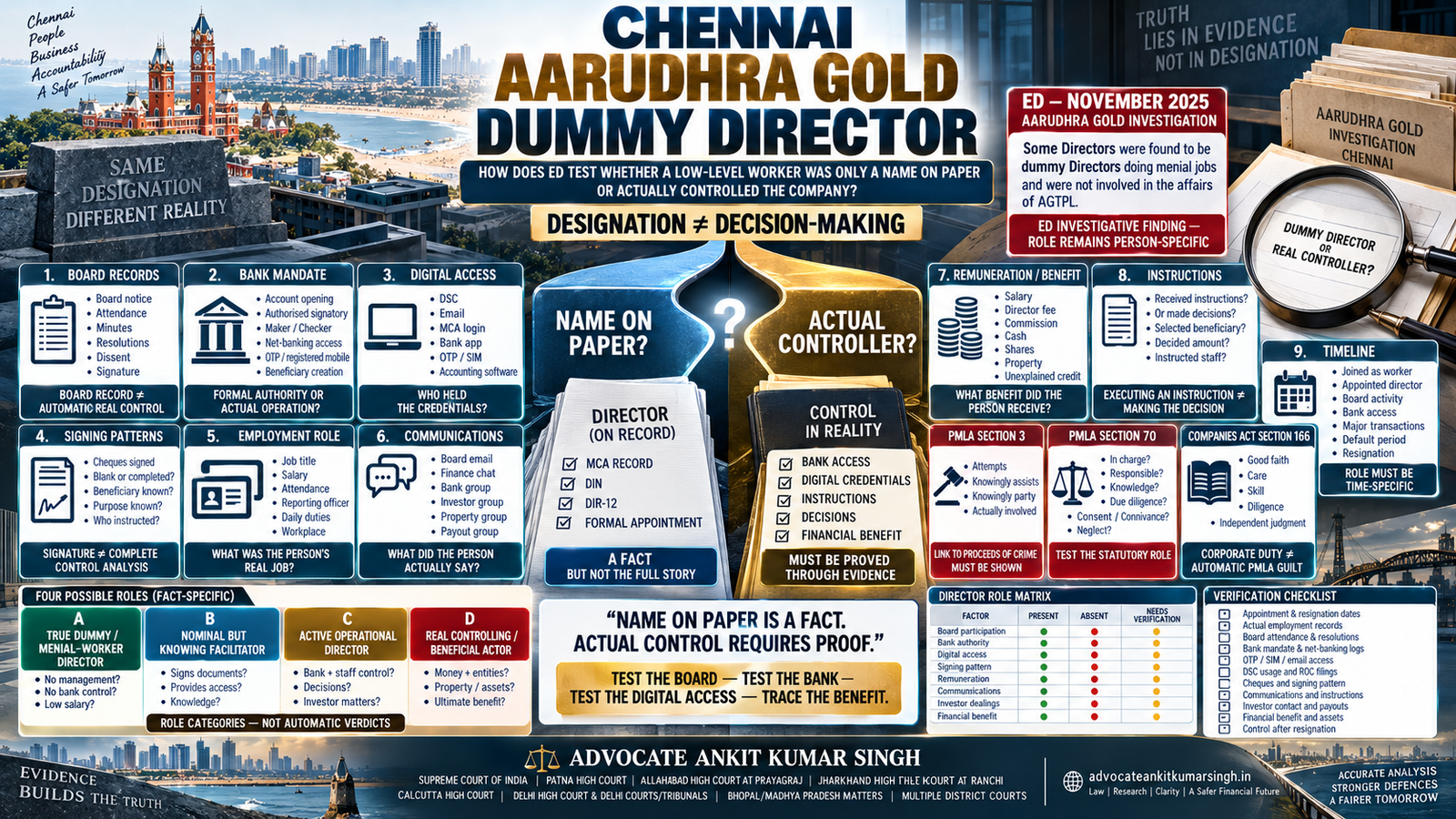
Chennai Aarudhra Gold Dummy Director: How Does ED Test Whether a Low-Level Worker Was Only a Name on Paper or Actually Controlled the Company?
Legal research and analysis by Advocate Ankit Kumar Singh
Legally reviewed and updated: 16 September 2026
Summary: In Chennai, examine the situation where an alleged Ponzi company has directors who claim they were menial workers or figureheads. The Chennai article should build a role matrix from board records, bank mandates, digital access, remuneration, signing patterns, instructions, attendance, communications and benefit received, so designation is not confused with actual decision-making.
Direct Answer: The Name “Director” Does Not By Itself Prove Actual Control
A director's name appearing in MCA records establishes an important formal corporate fact.
But it does not automatically establish that the person:
- controlled the company's bank accounts;
- decided where investor money would go;
- controlled staff;
- approved payouts;
- managed company property;
- benefited from the alleged proceeds.
The stronger question is:
WHAT DID THE PERSON ACTUALLY CONTROL?
ED's Aarudhra Gold Finding Makes This Question Particularly Important
In its 27 November 2025 press release, the Enforcement Directorate's Chennai Zonal Office stated that during searches in the Aarudhra Gold Trading Pvt. Ltd. investigation it found that some AGTPL directors were dummy directors doing menial jobs and were not involved in the affairs of AGTPL.
This is a significant current enforcement fact because ED itself distinguished:
DIRECTOR ON RECORD
        ≠
ACTUAL MANAGEMENT.
The finding does not automatically exonerate every person describing himself or herself as a dummy director.
It means the role must be tested from evidence.
The Aarudhra Gold Investigation Context
ED states that its investigation arises from an Economic Offences Wing, Chennai case concerning alleged collection of public deposits by Aarudhra Gold Trading Pvt. Ltd.
According to ED's public material, the alleged scheme involved promises including monthly returns of 10% to 30%, monthly payouts, gold coins and referral commissions.
EOW's charge sheet, according to ED, covered companies, directors, key employees and agents.
These remain investigative/prosecution allegations and should not be treated as final guilt findings against an individual director.
Start With a Director Role Matrix
| Evidence Category | Question |
|---|---|
| MCA / ROC | Was the person formally appointed? |
| Board | Did the person participate in decisions? |
| Bank | Did the person have authority or actual access? |
| Digital | Did the person control email, DSC, OTP or logins? |
| Financial | What remuneration or benefit was received? |
| Communication | Did the person give or receive management instructions? |
| Operations | Did the person control staff or investors? |
Formal Directorship Is Evidence — But Not the Complete Answer
Check:
- DIN;
- appointment date;
- DIR-12;
- consent to act;
- shareholding;
- resignation date;
- annual-return entries.
These records identify formal corporate status.
They should then be compared with actual operational evidence.
PMLA Section 3 Requires Actual or Knowing Connection With Proceeds of Crime
Section 3 covers persons who attempt to indulge, knowingly assist, knowingly become a party to or are actually involved in a process or activity connected with proceeds of crime.
Therefore:
FORMAL TITLE
≠
AUTOMATIC SECTION 3 INVOLVEMENT.
The prosecution must identify the alleged conduct connecting the person with the relevant proceeds or laundering process.
PMLA Section 70: Was the Person Really “In Charge” and “Responsible”?
Section 70(1) addresses persons who, when the company's contravention occurred, were in charge of and responsible to the company for conduct of its business.
It also contains a statutory protection concerning absence of knowledge or exercise of due diligence.
Section 70(2) separately addresses consent, connivance or neglect by a director or other officer.
Thus:
DIRECTORSHIP AND ACTUAL RESPONSIBILITY SHOULD NOT BE TREATED AS SYNONYMS.
Test 1: Board Attendance
Companies Act records can help establish whether the person participated in Board governance.
For every relevant meeting identify:
DATE:
________

NOTICE SENT:
________

DIRECTOR SHOWN PRESENT:
________

MODE:
PHYSICAL / VC / OTHER

RESOLUTION:
________

VOTE:
________

DISSENT:
________

SIGNATURE:
________
Section 118 Makes Board Minutes Important Evidence
The Companies Act requires minutes of Board meetings to be maintained.
Board minutes include the names of directors present and record relevant proceedings.
Proper minutes are evidence of the recorded proceedings.
Accordingly, they are an important starting point for testing a claim that:
“I NEVER PARTICIPATED IN THE COMPANY'S DECISIONS.”
But Board Minutes Should Also Be Tested Against Reality
If the minutes show attendance, compare them with:
- employment attendance;
- travel data;
- video-conference metadata;
- emails;
- signature evidence;
- meeting notices.
A paper record and actual presence should ideally align.
Test 2: What Resolutions Did the Person Approve?
Particular attention should be given to resolutions concerning:
- opening bank accounts;
- authorised signatories;
- borrowings;
- property purchases;
- investments;
- large transfers;
- related-party transactions;
- appointment of key personnel.
A person approving major financial decisions repeatedly occupies a different factual position from a director whose name merely appears on incorporation records.
Test 3: What Did the Bank Mandate Say?
Obtain:
- account-opening form;
- board resolution;
- authorised-signatory mandate;
- specimen signature;
- power of attorney;
- maker/checker configuration.
This establishes formal banking authority.
The next question is whether that authority was actually exercised.
Formal Bank Authority Is Not the Same as Actual Bank Control
Compare:
| Formal Evidence | Operational Evidence |
|---|---|
| Authorised signatory | Actual login |
| Board resolution | Transaction approval |
| Specimen signature | Cheque use |
| Registered mobile | OTP possession |
| Registered email | Email access |
Test 4: Who Actually Used Net Banking?
Check:
NET-BANKING USER:
________

MAKER:
________

CHECKER:
________

REGISTERED MOBILE:
________

OTP DEVICE:
________

EMAIL:
________

LOGIN IP:
________

DEVICE:
________

BENEFICIARY CREATOR:
________

TRANSACTION APPROVER:
________
This can be much more probative of operational control than the person's title alone.
Test 5: Did the Person Sign Cheques?
Cheque signatures matter, but context matters more.
Ask:
- how many cheques?
- blank or completed?
- who selected beneficiary?
- who filled amount?
- was purpose explained?
- was supporting documentation shown?
- did the director receive any benefit?
A Separate Chennai ED Case Shows Why a Cheque Signature Is Not the Whole Story
In a September 2025 Chennai Zonal Office investigation concerning Arvind Remedies Ltd., ED stated that certain dummy directors said they were unaware of company affairs and were paid monthly cash salaries by brokers.
ED further stated that such dummy directors signed shell-company cheques for nominal commissions without knowing their purpose.
This is a different case from Aarudhra Gold.
Its relevance is analytical:
A SIGNATURE MAY SHOW AN ACT — BUT KNOWLEDGE, INSTRUCTION AND CONTROL STILL REQUIRE SEPARATE PROOF.
Test 6: Who Controlled the DSC?
For corporate filings, ask:
- who obtained the DSC?
- who held the token?
- who knew the PIN?
- which computer used it?
- which forms were filed?
- who instructed the CA or CS?
A DSC issued in the person's name should not automatically be equated with personal operation of every filing.
Test 7: Who Controlled Corporate Email and Mobile?
Check:
- MCA email;
- bank email;
- company email;
- registered mobile;
- OTP messages;
- password-reset alerts;
- transaction alerts.
A director with no access to these systems presents a different operational profile from one who controls all of them.
Test 8: What Was the Person's Real Job?
Because ED expressly stated that some Aarudhra directors were doing menial jobs, the actual employment role should be documented.
Check:
- appointment letter;
- job description;
- salary;
- attendance;
- reporting officer;
- daily duties;
- workplace;
- employee ID;
- payroll records.
Low-Level Employment Is Relevant — But Not Automatic Innocence
A person's modest job, education or salary may help explain why the directorship was merely nominal.
But the analysis must remain evidence-based.
A low-level employee can still knowingly participate in unlawful conduct.
Conversely, occupational status should not be used as a substitute for proof of control.
Test 9: What Remuneration Did the Person Receive?
Reconstruct:
EMPLOYEE SALARY:
________

DIRECTOR FEE:
________

COMMISSION:
________

CASH:
________

BONUS:
________

UNEXPLAINED CREDIT:
________

PROPERTY:
________

SHARES:
________
A modest salary-only pattern is factually different from large transaction-linked benefits.
Test 10: Was the Person a Shareholder?
A director is not necessarily a shareholder.
Check:
- number of shares;
- subscription amount;
- source of subscription funds;
- voting rights;
- dividend;
- beneficial ownership.
Nominal shareholding should be distinguished from actual beneficial control.
Test 11: Who Gave the Instructions?
This can be decisive.
Search:
- WhatsApp;
- email;
- voice messages;
- paper instructions;
- banking spreadsheets;
- cheque lists;
- payment approvals.
Determine whether the person:
- received instructions;
- passed instructions;
- made independent decisions.
Receiving an Instruction and Making the Decision Are Different
PROMOTER:
“SIGN THIS.”

DIRECTOR:
SIGNS.