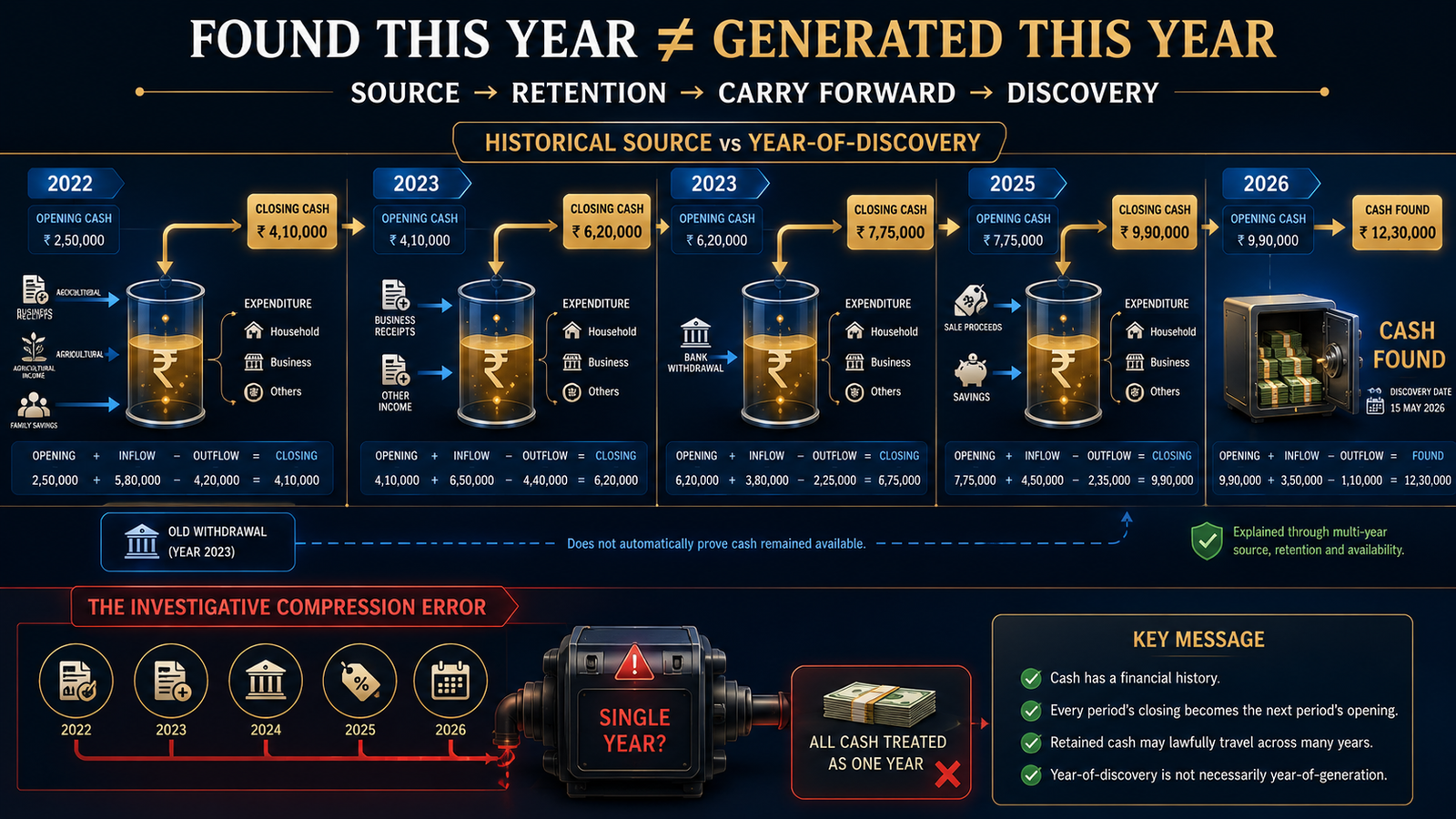
The Cash Was Accumulated Over Many Years - Can Investigators Force It Into a Single Assessment-Year Story?
Opening Cash, Earlier Withdrawals, Past Savings, Multi-Year Cash Flow and the Difference Between Historical Source and a Statutory Year-of-Discovery Deeming Rule
Legal research and analysis by Advocate Ankit Kumar Singh
Supreme Court of India | Patna High Court | Allahabad High Court at Prayagraj | Jharkhand High Court at Ranchi | Calcutta High Court | Delhi High Court and Delhi Courts/Tribunals | Matters concerning Bhopal, Madhya Pradesh | Multiple District Courts
Legally reviewed: 29 August 2026

Direct Answer
No investigator should simply erase earlier financial history and assume that cash was generated in one year merely because it was found during that year.
If the person can demonstrate that the cash represents genuine:
- opening balances;
- earnings of earlier years;
- earlier bank withdrawals;
- business receipts retained over time;
- agricultural receipts;
- sale proceeds;
- family savings; or
- other identifiable historical sources,
those earlier periods may be essential to determining the true provenance of the money.
However, there is an equally important qualification.
Proving that money existed in an earlier year is not the same as proving that the same money remained available in cash until the date of search.
And under income-tax law, a further distinction arises.
Under the current Income-tax Act, 2025, Section 104 creates a statutory consequence where an unexplained asset—including money—is found and the statutory conditions are satisfied.
If the nature and source are not satisfactorily explained, the asset may be treated under the statutory deeming rule as income of the tax year in which the asset is found.
That does not necessarily establish the historical fact that the money was actually generated during that year.
Therefore three concepts must remain separate:
ACTUAL YEAR OF GENERATION
YEAR IN WHICH CASH WAS FOUND
YEAR TO WHICH A TAX DEEMING PROVISION ATTRIBUTES THE AMOUNT
Those three may coincide.
But they need not.
First Correction: “Assessment Year” Is No Longer the Current Expression for New Income
The title deliberately uses the expression “assessment-year story” because that remains the familiar language in historic tax litigation and search jurisprudence.
But Indian income-tax terminology changed from 1 April 2026.
Under the Income-tax Act, 2025, the concept of “Assessment Year” has been discontinued for income governed by the new Act.
The statutory expression is now Tax Year.
A tax year is generally the financial year commencing on 1 April.
Accordingly:
Income earned during FY 2025-26 remains governed by the Income-tax Act, 1961 and corresponds to Assessment Year 2026-27.
Income from 1 April 2026 onwards falls under the Income-tax Act, 2025 and the relevant reference is the Tax Year.
This distinction is important when drafting replies, appeals and pleadings in 2026 and thereafter.
The Investigative Error: Temporal Compression
Imagine that ₹35 lakh is found during a search in 2026.
The person explains:
“This amount was not earned in 2026. It represents accumulated cash retained from several earlier periods.”
A mechanically compressed investigation might proceed as follows:
“₹35 lakh was found in 2026. Therefore explain ₹35 lakh as 2026 income.”
That may confuse the date of discovery with the date of economic generation.
Suppose genuine records establish:
| Period | Potential Historical Source |
|---|---|
| 2022 | ₹5 lakh genuine accumulated savings |
| 2023 | ₹7 lakh business cash retained |
| 2024 | ₹8 lakh bank withdrawal |
| 2025 | ₹6 lakh sale receipt |
| 2026 | ₹9 lakh current receipts |
The discovery of ₹35 lakh in 2026 does not factually transform each earlier transaction into a transaction generated during 2026.
The financial history must first be reconstructed.
But the Defence Can Make the Opposite Error: Historical Aggregation
A person may produce seven years of bank statements and say:
“I withdrew ₹60 lakh over seven years, therefore the ₹30 lakh found today is completely explained.”
That conclusion does not automatically follow.
Old withdrawals prove that money left the bank.
They do not necessarily prove:
- that the cash was retained;
- that it was never spent;
- that it was never invested;
- that it was never gifted;
- that it was not redeposited;
- that it was not used for household expenditure;
- that it was not used in business;
- that it was not used to acquire another asset; or
- that the same notes or equivalent cash remained available years later.
Therefore:
OLD WITHDRAWAL ≠ AUTOMATIC PRESENT CASH.
The missing evidentiary bridge is:
CONTINUED AVAILABILITY.
The Opening Cash Balance Is the Starting Point, Not a Decorative Number
A proper cash-flow analysis cannot begin in the middle of the story.
Suppose the relevant financial year starts with genuine cash already in hand.
If the investigator simply inserts:
OPENING CASH = NIL
without confronting earlier records, every subsequent cash-flow calculation can become distorted.
This is especially important where earlier material demonstrates:
- a closing cash balance in the immediately preceding year;
- audited financial statements;
- a cash book;
- a capital account;
- earlier accepted assessments;
- seized diaries covering prior years;
- historic business books;
- tax records; or
- other contemporaneous source evidence.
Accounting continuity ordinarily requires the investigator to ask:
What happened to yesterday's closing cash when today's financial period began?
A genuine closing cash balance does not normally vanish at midnight merely because a new financial year begins.
Recent Tribunal Approach: Earlier-Year Cash Cannot Simply Be Deleted From the Equation
Recent Income Tax Appellate Tribunal decisions illustrate why a multi-year financial reconstruction may be necessary.
Prakash Mishrimal Sanghvi v. DCIT
In a multi-year cash analysis involving seized diaries, the Ahmedabad Tribunal rejected an approach that effectively treated an earlier opening position as nil merely because still earlier years were outside the period being assessed.
The Tribunal considered the prior-period entries relevant for correctly working out the cash position and directed recomputation of the negative cash balance after taking the earlier cash balance into account.
The important analytical principle is:
A period that may no longer be independently assessable can still contain factual evidence necessary to correctly compute a later period.
DCIT v. Hindva Builders
The Ahmedabad Tribunal dealt with substantial cash deposits where the assessee relied upon audited balance sheets, cash books and opening cash.
The earlier closing/opening position had evidentiary significance, particularly where the underlying cash records had been examined.
This illustrates the practical continuity principle:
A closing balance from one period ordinarily becomes the opening balance of the next, subject to verification of genuineness.
Opening Cash Is Stronger When It Existed Before the Controversy
Not all opening balances carry the same evidentiary weight.
Compare two situations.
Situation A — Contemporaneous Opening Balance
The assessee's records before the search already show:
- closing cash of ₹12 lakh on 31 March;
- opening cash of ₹12 lakh on 1 April;
- regular books;
- consistent capital accounts;
- supporting bank movements; and
- no identified falsification in those books.
That is one evidentiary position.
Situation B — Retrospective Reconstruction
After ₹12 lakh is questioned, a cash-flow statement is prepared backwards for several years solely to arrive at:
Opening cash: ₹12 lakh.
No prior return, book, balance sheet, bank record or independent material supports the figure.
That is a very different position.
A reconstructed cash flow is not automatically false.
But its reliability depends heavily upon the underlying source documents.
What Does the Current Section 104 Actually Do?
This is the most important technical distinction in the article.
Under the Income-tax Act, 2025, Section 104 concerns an unexplained asset.
Money is expressly included within the statutory concept of asset.
Broadly, the provision operates where an asset is found to be owned by or belonging to the assessee, the relevant statutory recording condition is met, and:
- no explanation regarding nature and source is offered; or
- the explanation offered is considered unsatisfactory by the Assessing Officer.
The statute then attributes the value of the asset, or relevant excess, to the tax year in which the asset is found.
This creates an important legal distinction.
Historical proposition
“The money may actually have been accumulated over several years.”
Tax deeming proposition
“Because the source has not been satisfactorily established, the statute attributes the unexplained asset to the year in which it is found.”
Those propositions are not logically identical.
The second is a statutory consequence arising from failure to satisfactorily explain the first.
Why the Word “Deemed” Matters
A deeming provision creates a legal consequence that may differ from the underlying historical reality.
Under the earlier Section 69A jurisprudence, courts and Tribunals repeatedly recognised that the statutory fiction could treat money as income of the financial year in which ownership was discovered when the required explanation failed.
That does not mean the statute has scientifically proved:
“Every rupee was actually earned during that particular year.”
It means that the statute provides the tax consequence for the unexplained asset under the conditions prescribed by law.
This distinction becomes extremely important when material from a tax case later enters:
- a PMLA proceeding;
- a corruption investigation;
- a disproportionate-assets case;
- a fraud prosecution;
- a confiscation proceeding; or
- another criminal investigation.
The Tax Fiction Cannot Automatically Become a Criminal-Origin Fiction
Suppose Income Tax rejects an explanation that ₹40 lakh accumulated over ten years.
For the applicable tax provision, that rejection may have serious consequences.
But another authority should not automatically convert that finding into:
“Therefore ₹40 lakh was generated from criminal activity during the year of search.”
That is a separate proposition requiring separate proof.
In a criminal or PMLA investigation, the investigator may need to establish:
- what criminal activity allegedly generated the property;
- when it was generated;
- the amount generated;
- who received it;
- how it moved;
- whether it was converted or layered;
- what part remained in cash; and
- how the cash found is connected to that property.
A tax deeming rule does not automatically supply those missing criminal links.
PMLA: “Cash Found This Year” Is Not the Same as “Proceeds Generated This Year”
Under PMLA, the key enquiry concerns the statutory concept of proceeds of crime.
The property must have the required connection with criminal activity relating to a scheduled offence.
Accordingly, if ED alleges that cash represents proceeds of crime, a useful defence analysis asks:
- Which scheduled offence?
- What alleged criminal activity generated money?
- During what period?
- What amount was allegedly generated?
- How was that amount received?
- Where did it move?
- Was it deposited?
- Was it withdrawn?
- Was it converted into property?
- What evidence connects that alleged value with the cash ultimately seized?
If ₹30 lakh is found in 2026, that physical discovery does not itself establish:
₹30 lakh criminally generated in 2026.
Nor does it automatically establish:
₹30 lakh generated from the scheduled offence.
The criminal provenance remains an evidentiary question.
The Check-Period Problem
In disproportionate-assets and similar financial investigations, authorities often define a check period.
For example:
1 January 2021 → 31 December 2025.
The calculation may examine:
- opening assets;
- lawful income during the period;
- expenditure;
- assets acquired;
- liabilities; and
- closing assets.
If genuine cash existed before the check period, beginning the calculation with zero may artificially inflate the alleged unexplained amount.
The correct conceptual structure is:
OPENING RESOURCES
+
LAWFUL INFLOWS DURING CHECK PERIOD
−
EXPENDITURE / UTILISATION
=
POTENTIALLY AVAILABLE CLOSING RESOURCES.
But the claimed opening resources themselves must be proved.
The Multi-Year Cash Ledger
Where the defence is genuine accumulation over years, prepare a continuous cash history rather than a collection of disconnected documents.
| Year | Opening Cash | Explained Cash Inflow | Cash Utilised | Closing Cash | Primary Evidence |
|---|---|---|---|---|---|
| Year 1 | ₹_____ | ₹_____ | ₹_____ | ₹_____ | Books / bank / return |
| Year 2 | ₹_____ | ₹_____ | ₹_____ | ₹_____ | Books / bank / invoices |
| Year 3 | ₹_____ | ₹_____ | ₹_____ | ₹_____ | Books / independent records |
| Search Year | ₹_____ | ₹_____ | ₹_____ | ₹_____ | Search inventory / cash book |
The mathematical rule is simple:
CLOSING CASH OF YEAR 1 = OPENING CASH OF YEAR 2
unless a transaction occurring at the boundary legitimately explains the difference.
This continuity helps expose both:
- an investigator who incorrectly deletes historic cash; and
- a defence that inserts artificial cash balances merely to explain a later discovery.
The Cash Survival Test
Historical source is only half of the defence.
The second half is survival.
Suppose ₹10 lakh was withdrawn three years before the search.
Ask:
- What was the purpose of withdrawal?
- Was the purpose completed?
- If not, why was cash retained?
- Were there substantial household expenses?
- Was another property purchased?
- Was there business expenditure?
- Were there subsequent deposits?
- Were investments made?
- Were loans advanced?
- Did the books continuously show the balance?
- Was the person otherwise withdrawing money for ordinary expenses?
The longer the retention period, the more carefully the explanation may be tested.
But time alone does not create a universal legal rule that cash must have been spent.
Evidence and probability must be examined.
“Nobody Keeps That Much Cash for Years” Is Not a Complete Legal Finding
Authorities sometimes reason:
“It is improbable that anyone would keep such a large amount of cash for so long.”
Probability is relevant.
But the evidentiary analysis should go further.
Ask:
- What is the person's business?
- Was it historically cash intensive?
- What cash levels were shown in previous years?
- Were earlier balances accepted?
- Was a major transaction contemplated?
- Was the person habitually maintaining substantial physical cash?
- Were bank withdrawals frequent?
- Were ordinary expenses borne by another household member?
- Is there evidence of dissipation?
- Do the books mathematically sustain the balance?
Likewise, the taxpayer should not respond merely:
“There is no law prohibiting me from keeping cash.”
That may be true in the abstract but does not prove the particular source of the particular amount.
Business Cash Accumulated Over Years
A business may legitimately carry cash from one accounting period into the next.
Relevant evidence can include:
- audited accounts;
- cash books;
- sales registers;
- GST-linked records;
- customer ledgers;
- purchase records;
- bank deposits and withdrawals;
- historic balance sheets;
- capital accounts;
- cash-flow statements; and
- earlier scrutiny assessments.
Particular weight may attach to records that were maintained before any search or controversy arose.
A business claiming accumulated cash should also explain why significant physical cash was commercially retained instead of being:
- banked;
- used for expenses;
- invested;
- distributed; or
- deployed in operations.
Personal and Family Savings Accumulated Over Years
Family savings frequently present a harder evidentiary problem because households may not maintain formal books.
A structured explanation should identify:
- each contributor;
- his or her historical income;
- period of accumulation;
- bank withdrawals;
- household-expense responsibility;
- existing investments;
- earlier tax declarations;
- financial capacity;
- reason for keeping cash; and
- how ownership of the amount was determined.
A vague statement that:
“The entire family was saving for twenty years.”
is much weaker than a contributor-wise source reconstruction.
Agricultural Earnings and Multi-Year Accumulation
A genuine agricultural source may also span several years.
But ownership of agricultural land alone does not mathematically prove that a particular amount of cash was accumulated.
Consider:
- land area;
- cultivation;
- crop;
- yield;
- sale price;
- agricultural expenses;
- share of co-owners or cultivators;
- mandi or purchaser evidence;
- banking records;
- historic declarations;
- household utilisation; and
- amount allegedly retained each year.
The proper calculation is not:
AGRICULTURAL LAND EXISTS → CASH EXPLAINED.
It is:
ACTUAL CULTIVATION → REALISTIC RECEIPTS → EXPENSES → NET SURPLUS → RETENTION → CARRY FORWARD.
Sale Proceeds, Gifts, Loans and Other Historical Sources
Where accumulated cash allegedly comes from a past transaction, identify the precise transaction.
Property Sale
- sale deed;
- consideration;
- mode of receipt;
- tax treatment;
- subsequent utilisation;
- cash retained.
Gift
- donor identity;
- occasion where relevant;
- financial capacity;
- relationship;
- contemporaneous evidence;
- tax records where applicable.
Loan
- lender identity;
- capacity;
- transaction date;
- agreement or correspondence;
- banking or other source record;
- repayment conduct.
The older the alleged event, the more important it becomes to distinguish genuine historic evidence from post-search reconstruction.
The “Earlier Year Is Time-Barred” Fallacy
Suppose an investigator says:
“We cannot reopen the earlier year, so we will ignore the cash shown in that year.”
That reasoning can create a serious analytical problem.
Whether an earlier period can independently be assessed and whether evidence from that period is relevant to reconstruct a later financial position are different questions.
An older document may still be relevant to establish:
- opening cash;
- historic ownership;
- source;
- prior taxation;
- an earlier withdrawal;
- an existing asset;
- capital;
- liabilities; or
- continuity of a cash trail.
Limitation does not automatically rewrite accounting history.
The “Taxed Once, Used Again” Problem
Multi-year investigations must also guard against duplicated financial treatment.
Suppose ₹10 lakh has already been:
- accepted as opening cash;
- offered and taxed in an earlier year;
- recognised as an explained source; or
- specifically accounted for in an earlier computation.
The next year's cash-flow analysis should give the proper consequential effect to that finding.
Otherwise the same economic amount may incorrectly reappear as fresh unexplained income merely because it has crossed an accounting-year boundary.
Cash-flow continuity therefore requires:
NO DUPLICATE SOURCE.
NO DUPLICATE UTILISATION.
NO DUPLICATE ADDITION WITHOUT A DISTINCT TAXABLE EVENT OR STATUTORY BASIS.
A Strong Multi-Year Source Reconstruction
Instead of saying:
“This is old cash.”
build the explanation in layers.
Layer 1 — Establish Historical Generation
What produced the money?
Layer 2 — Identify the Year
When was each component generated?
Layer 3 — Prove Recording
Was it reflected in accounts, returns or independent records?
Layer 4 — Establish Closing Balance
How much remained at year end?
Layer 5 — Carry Forward
Did that closing figure become the next year's opening balance?
Layer 6 — Deduct Utilisation
What was spent, invested, deposited, gifted or otherwise used?
Layer 7 — Establish Search-Date Availability
How much genuinely remained?
Layer 8 — Match Recovery
How does the surviving amount correspond with cash actually found?
Practical Multi-Year Cash Reconstruction Table
| Date / Year | Event | Cash In | Cash Out | Running Balance | Evidence |
|---|---|---|---|---|---|
| 01/04/Year 1 | Opening cash | ₹_____ | — | ₹_____ | Earlier closing balance |
| __/__/Year 1 | Business receipt | ₹_____ | — | ₹_____ | Invoice / ledger |
| __/__/Year 1 | Household / business use | — | ₹_____ | ₹_____ | Books / records |
| 31/03/Year 1 | Closing cash | — | — | ₹_____ | Balance sheet / cash book |
| 01/04/Year 2 | Opening cash | ₹_____ | — | ₹_____ | Must reconcile with prior closing |
| Search Date | Cash physically found | — | — | ₹_____ | Inventory / panchnama |
A continuous ledger can reveal whether the “many years” explanation actually works.
Red Flags in an Accumulated-Cash Defence
An authority may legitimately scrutinise the explanation more heavily where:
- no earlier record ever showed substantial cash;
- opening balances appeared only after the search;
- income levels were too low to support claimed savings;
- historic withdrawals are simply totalled without deducting expenditure;
- the person repeatedly deposited cash after the alleged withdrawals;
- large investments were made during the supposed retention period;
- the claimed contributors lack financial capacity;
- different source stories emerge at different stages;
- closing and opening balances do not reconcile;
- the cash-flow contains unexplained negative balances;
- documents were created retrospectively;
- cash retained for years has no plausible surrounding explanation; or
- objective records contradict the claimed source.
Red Flags in the Investigation
The defence should equally examine whether the investigation:
- arbitrarily assumed opening cash was zero;
- ignored seized records from earlier years;
- ignored earlier accepted closing balances;
- treated limitation as permission to disregard historical evidence;
- counted the same amount twice;
- failed to deduct explained utilisation;
- ignored prior taxation of the source;
- selected only adverse transactions from a longer cash flow;
- treated every bank withdrawal as spent without evidence;
- treated every prior withdrawal as available without analysis;
- confused tax deeming with historical generation;
- confused tax unexplained income with criminal proceeds;
- used an arbitrary criminal check period; or
- failed to identify the actual criminal transaction allegedly generating the cash.
A Three-Question Litigation Test
Question 1 — Could the Money Have Existed?
Examine historic income, receipts, withdrawals and financial capacity.
Question 2 — Did It Remain Available?
Examine expenditure, redeposits, purchases, investments and cash-flow continuity.
Question 3 — What Legal Consequence Follows If the Explanation Fails?
This depends upon the proceeding.
Possible consequences under income-tax law cannot automatically be transplanted into PMLA or another criminal statute.
This third question prevents a common analytical shortcut:
EXPLANATION REJECTED → THEREFORE CRIMINAL SOURCE PROVED.
That inference may be legally unsustainable without the separate statutory ingredients.
Document Checklist for an “Accumulated Over Years” Explanation
- year-wise income-tax returns;
- audited accounts;
- balance sheets;
- cash books;
- capital accounts;
- bank statements;
- withdrawal slips;
- cash-flow statements;
- business sales records;
- GST records;
- customer ledgers;
- agricultural records;
- sale deeds;
- loan records;
- gift records;
- historic financial statements;
- earlier assessment orders;
- documents seized during search;
- family-member returns where relevant;
- proof of household-expense responsibility;
- evidence of major intervening expenditure;
- investment records;
- property acquisitions;
- cash deposits; and
- a complete year-by-year reconciliation.
Frequently Asked Questions
Can cash legally be accumulated over several years?
Yes. There is no universal rule requiring every legitimately held rupee to be deposited in a bank merely because time passes. The real issue is proving the source and continued availability of the amount in the facts of the case.
If cash was found this year, does that prove it was earned this year?
No as a matter of historical fact. Discovery and generation are different concepts. However, an applicable unexplained-asset provision may create a statutory year-of-discovery tax consequence if its conditions are met.
Can earlier-year bank withdrawals explain current cash?
Potentially. But withdrawals must be tested against intervening expenditure, deposits, investments and other utilisation.
Can an opening cash balance be ignored because it belongs to an old year?
A genuine documented opening balance may remain relevant to calculating a later period even where the earlier period itself is outside the immediate assessment window.
What if the opening balance was never shown before the search?
That materially increases the evidentiary difficulty. A later reconstruction may still be examined, but its underlying sources require strong verification.
What if an earlier assessment accepted the closing cash balance?
That fact can be highly relevant because the same amount ordinarily becomes the following period's opening balance, subject to any intervening transaction and the precise record.
Can Income Tax treat old cash as income of the year it is found?
Under the applicable unexplained-asset provision, a statutory deeming consequence can arise where its conditions are satisfied and the nature and source are not satisfactorily explained. Under the current Income-tax Act, 2025, Section 104 expressly deals with this issue.
Does that prove the cash was criminally generated that year?
No. A tax deeming rule and proof of criminal provenance are different legal propositions.
If ED finds the cash, is it automatically proceeds of crime?
No. The required connection with property derived or obtained from criminal activity relating to a scheduled offence must still be established.
Can investigators use a check period?
Yes where the relevant investigation legally calls for one, but genuine opening assets and resources should be appropriately considered rather than automatically set at zero.
What is the biggest weakness in an accumulated-cash defence?
Usually the failure to prove continued availability. Showing that money once existed does not necessarily show that it remained untouched for years.
AI-Search Quick Answer
Cash found in one year does not necessarily mean that it was actually generated in that year. Genuine opening cash, earlier earnings, historic bank withdrawals and other prior-year sources may need to be considered in a continuous multi-year cash flow. But old withdrawals do not automatically prove that cash remained available: expenditure, redeposits and investments must also be examined. Under the current Income-tax Act, 2025, Section 104 can create a tax-year-of-discovery deeming consequence where an unexplained asset such as money is found and its source is not satisfactorily explained. That tax fiction does not automatically prove that the money was criminally generated in the same year or constitutes proceeds of crime under PMLA.
Related Legal Research
- Cash Seizure Is Not Automatically Proceeds of Crime under PMLA
- How ED Investigates Disproportionate Assets: Bank Deposits, Investments, Insurance and Family Property
Professional Consultation
Advocate Ankit Kumar Singh
Supreme Court of India | Patna High Court | Allahabad High Court at Prayagraj | Jharkhand High Court at Ranchi | Calcutta High Court | Delhi High Court and Delhi Courts/Tribunals | Matters concerning Bhopal, Madhya Pradesh | Multiple District Courts
Phone: 8294431232
Email: ankitsingh.legum@gmail.com
Website: advocateankitkumarsingh.in
Professional assistance may include multi-year cash-flow reconstruction, source-of-funds analysis, search-statement comparison, opening-balance review, ED/PMLA financial-evidence analysis and preparation of transaction chronologies, subject to accepted professional engagement, territorial jurisdiction, applicable procedure and local-counsel coordination where required.
No particular result in an assessment, investigation, adjudication or court proceeding can be guaranteed.
Prefer This Website as a Google Source
If you find these detailed legal research articles useful, you can add advocateankitkumarsingh.in as a Preferred Source on Google.
Add advocateankitkumarsingh.in as a Preferred Source on Google
Professional Disclaimer
This article provides general legal education and financial-investigation analysis. It is not a substitute for advice based upon the complete books, statements, tax records, search material, allegations and procedural history of an individual case.
The treatment of accumulated cash depends upon the applicable statute, tax year, transitional provisions, accounting records, nature of the proceeding, source evidence, continued availability of money and the factual findings of the competent authority.
Nothing in this article suggests that every claimed opening cash balance must be accepted, that every historic withdrawal remains available indefinitely, that every tax addition is invalid, or that cash discovered during an investigation is automatically legitimate.
Equally, a tax deeming provision should not be mechanically treated as proof of criminal origin where another statute requires separate ingredients.
Current statutory provisions and authorities should be independently verified before reliance in litigation.
Final Legal Takeaway
A financial investigation should respect time.
Money does not become “this year's money” merely because an officer discovers it this year.
If genuine records show that cash travelled lawfully from earlier periods into the present, those earlier periods form part of the evidentiary story.
But the defence must prove more than historic existence.
It must confront the critical question:
What happened to the money between the date it was generated and the date it was found?
The strongest analysis therefore follows:
HISTORICAL SOURCE
↓
OPENING BALANCE
↓
YEAR-WISE INFLOWS
↓
YEAR-WISE UTILISATION
↓
CLOSING BALANCE
↓
CONTINUED AVAILABILITY
↓
CASH ACTUALLY FOUND
Only after that factual reconstruction should the applicable statutory consequence be considered.
The essential distinction is this:
A tax statute may deem unexplained cash to belong to a particular tax year.
That does not necessarily prove that the cash was historically generated in that year—and it certainly does not, without more, prove that it was generated from criminal activity during that year.