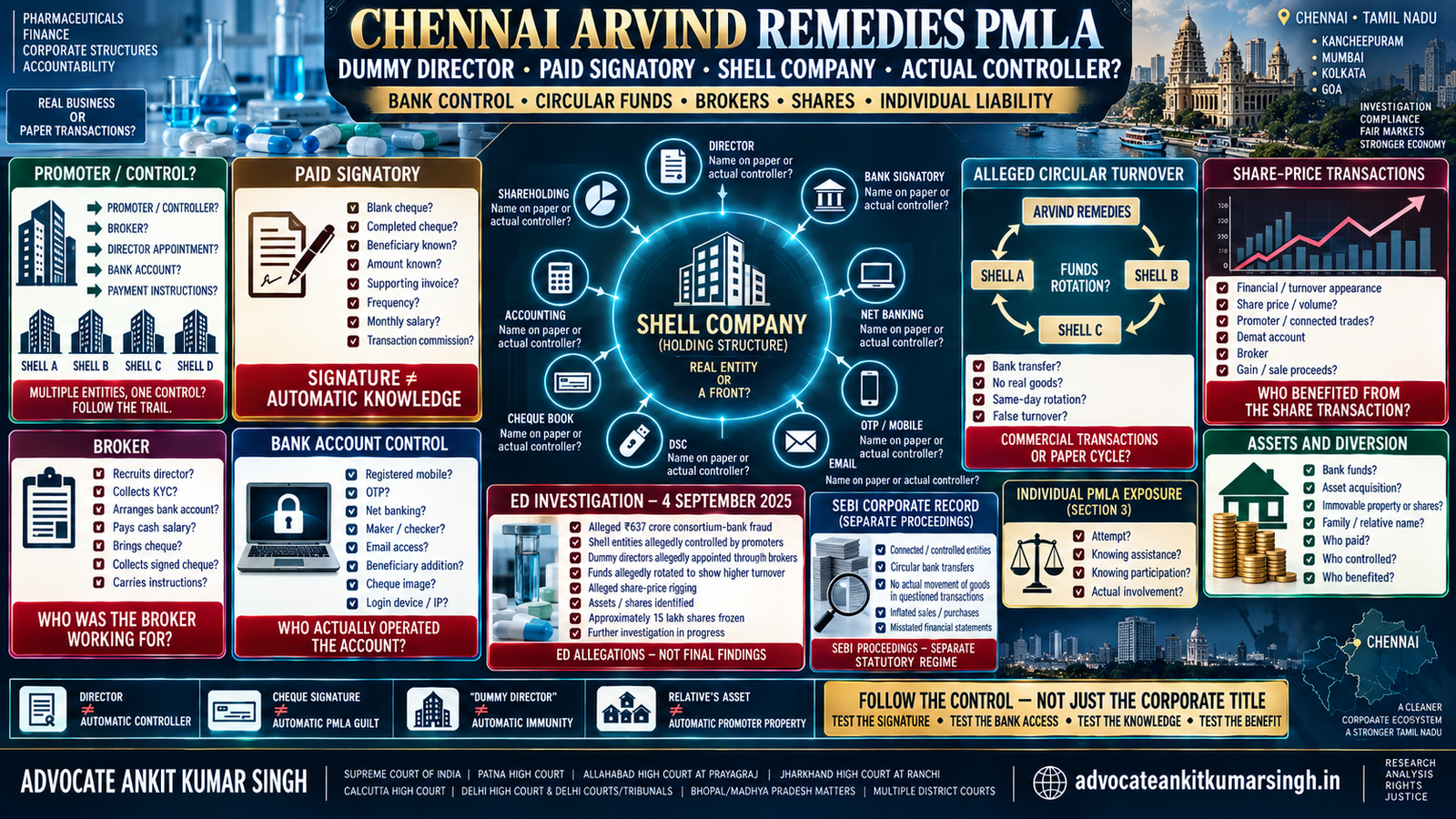
CHENNAI • ARVIND REMEDIES • SHELL COMPANIES • DUMMY DIRECTORS • BANK FRAUD • PMLA
Chennai Pharmaceutical Bank Fraud and Dummy Directors: When Do Paid Signatories, Shell Companies and Share-Price Transactions Create Individual PMLA Exposure?
Legal research and analysis by Advocate Ankit Kumar Singh
Updated and legally reviewed: 17 September 2026
Summary: In Chennai, use the Arvind Remedies investigation as a research anchor for corporate bank fraud involving shell entities and dummy directors. The Chennai article should examine who controlled the shell companies, who held bank credentials, why funds were rotated, whether assets or shares were acquired, the role of brokers and whether a paid signatory understood the transactions or merely lent a name.
Direct Answer: A Name on the MCA Record or a Signature on a Cheque Is Only the Beginning of the PMLA Inquiry
In a shell-company bank-fraud investigation, three different people may appear around the same corporate account:
- the person legally shown as director;
- the person authorised to sign cheques;
- the person actually controlling the money.
Sometimes all three are the same person.
Sometimes they are entirely different.
Accordingly, the correct question is not simply:
WHOSE NAME APPEARS AS DIRECTOR?
The stronger question is:
WHO ACTUALLY CONTROLLED, UNDERSTOOD, AUTHORISED, FACILITATED OR BENEFITED FROM THE QUESTIONED TRANSACTIONS?
The Arvind Remedies PMLA Investigation
The Directorate of Enforcement stated on 4 September 2025 that its Chennai Zonal Office had conducted searches at locations connected with Arvind Remedies Ltd, its promoters, alleged dummy directors and key persons in Chennai, Kancheepuram, Goa, Kolkata and Mumbai.
ED stated that the PMLA investigation arose from a CBI FIR based on a complaint of Punjab National Bank.
According to ED, Arvind Remedies Ltd, promoter Arvind B Shah and others were alleged to have cheated a consortium of banks to the extent of approximately ₹637 crore.
The bank-fraud and money-laundering allegations remain subject to the applicable criminal and PMLA process.
The Consortium-Credit Background
ED stated that the consortium had extended various facilities including cash credit, term loans and non-fund-based facilities totalling approximately ₹704.75 crore.
The agency stated that ₹637.58 crore remained outstanding in the banks' books as on 30 September 2016 and that the accounts had become NPAs.
But an NPA is not itself money laundering.
The relevant inquiry is how the credit was allegedly obtained and where the money went.
ED's Shell-Company Theory
According to ED, bank funds were allegedly siphoned through shell entities controlled by the promoters.
ED further alleged:
BANK FUNDS
        ↓
CONTROLLED SHELL COMPANY A
        ↓
SHELL COMPANY B
        ↓
SHELL COMPANY C
        ↓
RETURN / ROTATION
The alleged purpose was to create an appearance of higher turnover and thereby induce lenders to provide additional funds.
SEBI's Earlier Corporate Record Provides a Separate Reality Test
SEBI's proceedings concerning Arvind Remedies separately recorded that transactions with controlled or connected entities were routed through circuitous banking movements without corresponding movement of goods.
SEBI's material referred to:
- inflated purchases;
- inflated sales;
- same-day multi-layer fund movement;
- entities allegedly existing largely on paper;
- significant cash withdrawals;
- false or misstated financial statements.
This securities-law record should not be treated as identical to ED's PMLA case.
Its value is evidentiary and historical: it helps identify the corporate architecture investigators may compare with later bank-fund tracing.
What Makes a Company “Controlled”?
Formal shareholding is only one control indicator.
Investigators should test:
- who selected directors;
- who paid directors;
- who controlled registered office;
- who used company email;
- who held the DSC;
- who instructed accountants;
- who opened the bank account;
- who controlled cheque books;
- who controlled net banking;
- who selected beneficiaries;
- who approved transfers;
- who retained the economic benefit.
A Dummy Director Is a Factual Description — Not a Legal Immunity
A person may genuinely be a figurehead with no understanding of company affairs.
But the expression “dummy director” does not answer the legal question.
Test:
DIRECTOR ON PAPER?
        ↓
PAID FOR NAME?
        ↓
SIGNED DOCUMENTS?
        ↓
SIGNED CHEQUES?
        ↓
HELD BANK CREDENTIALS?
        ↓
RECEIVED INSTRUCTIONS?
        ↓
KNEW BUSINESS WAS FICTITIOUS?
        ↓
KNEW MONEY WAS BEING ROTATED?
        ↓
RECEIVED BENEFIT?
The Arvind Remedies Paid-Signatory Pattern
ED's September 2025 release records that certain alleged dummy directors stated during searches that:
- they were unaware of company affairs;
- brokers paid them monthly salaries in cash;
- they signed cheques of shell companies;
- they received nominal commissions;
- they allegedly did not know the purpose of the cheques.
That creates two competing evidentiary possibilities.
Possibility A — Genuine Name-Lender
The person may have had little or no operational knowledge and may simply have lent identity and signatures for a fixed payment.
Possibility B — Knowing Facilitator
Repeated signing, knowledge of unusual transactions, access to banking, transaction-linked remuneration or awareness of fictitious business may support a materially different inference.
Cheque Signing: Context Is More Important Than the Signature Alone
For every questioned cheque ask:
- Was the cheque blank when signed?
- Who filled the amount?
- Who inserted the beneficiary?
- Who possessed the cheque book?
- Who brought the cheque to the signatory?
- What explanation was given?
- Was an invoice shown?
- Was the payment one-time or repeated?
- Did the signatory later see bank statements?
- Was remuneration linked to value or number of transactions?
One Blank Cheque and 300 Deliberately Approved Transfers Are Not the Same Case
Individual attribution must consider pattern and frequency.
ISOLATED SIGNATURE
+
NO BANK ACCESS
+
NO TRANSACTION KNOWLEDGE
+
FIXED MONTHLY PAYMENT

is evidentially different from:

REPEATED CHEQUE APPROVAL
+
BENEFICIARY KNOWLEDGE
+
BANK STATEMENT ACCESS
+
TRANSACTION-LINKED COMMISSION
+
INSTRUCTIONS TO ACCOUNTANTS
Who Controlled the Bank Credentials?
Corporate bank control can often be reconstructed more accurately from digital records than from the company master data.
Obtain:
- account-opening form;
- authorised-signatory mandate;
- maker/checker configuration;
- registered mobile;
- registered email;
- net-banking user ID;
- OTP records;
- login IP/device records where available;
- beneficiary-addition history;
- cheque images;
- branch instructions.
Mobile and OTP Control Can Identify the Real Operator
A director may appear as authorised signatory while another person physically operates the digital account.
Ask:
WHO HELD THE REGISTERED SIM?

WHO RECEIVED OTPs?

WHO USED THE BANKING DEVICE?

WHO ADDED BENEFICIARIES?

WHO APPROVED TRANSACTIONS?
Conversely, repeated personal OTP approval can undermine a claim of total operational ignorance depending on the facts.
DSC and ROC Control Matter Too
Corporate control should also be reconstructed from:
- DIN application;
- DIR-2 consent;
- DIR-12 filings;
- board resolutions;
- annual returns;
- financial statements;
- DSC issuance;
- DSC custody;
- instructions to CA/CS.
The fact that a DSC exists in a person's name does not automatically establish who physically operated it.
The Broker Can Be the Missing Link
In the ED version of the Arvind Remedies case, brokers allegedly recruited and paid dummy directors.
The broker's evidence can therefore become central.
Prepare a broker matrix:
| Question | Evidence |
|---|---|
| Who recruited the director? | Messages / calls / statement |
| Who fixed salary? | Cash ledger / communication |
| Who collected KYC? | Documents / messages |
| Who arranged banking? | Bank visit / application |
| Who brought cheques? | Communication / CCTV where available |
| Who gave signing instructions? | Messages / witness evidence |
| Who collected signed cheques? | Delivery / communications |
Fixed Monthly Salary Versus Transaction-Linked Commission
Remuneration can help identify the person's role.
Fixed Payment
₹10,000 / MONTH
REGARDLESS OF TRANSACTIONS
This may support a name-lending arrangement, although it does not automatically eliminate liability.
Transaction-Linked Payment
0.5% OF TRANSFER VALUE
OR
₹5,000 PER CHEQUE
That pattern may support deeper inquiry into what the person knew and why compensation tracked transaction activity.
Why Were Funds Rotated?
ED alleged that funds were rotated among shell entities to show higher turnover and induce banks to lend more.
For each rotation:
ARVIND REMEDIES
        ↓
ENTITY A
        ↓
ENTITY B
        ↓
ENTITY C
        ↓
ARVIND REMEDIES
record:
- date;
- time;
- amount;
- invoice claimed;
- goods allegedly supplied;
- bank reference;
- return transfer;
- number of layers;
- ultimate balance retained.
Same-Day Circularity Can Be Highly Probative
SEBI's corporate record concerning Arvind Remedies referred to circular movements where funds passed through controlled entities and returned on the same day.
A same-day cycle can support a paper-turnover theory where:
- no goods moved;
- no commercial margin existed;
- counterparties had no independent business;
- money returned almost completely;
- transactions primarily increased reported sales/purchases.
But Circular Funds and Money Laundering Are Not Automatically Identical
A circular commercial entry can be evidence of falsification or bank fraud.
PMLA analysis still requires:
SCHEDULED OFFENCE
        ↓
PROPERTY DERIVED OR OBTAINED
        ↓
IDENTIFIED PROCEEDS OF CRIME
        ↓
PROCESS / ACTIVITY CONNECTED WITH POC
The role of each director or signatory must be separately attributed.
The Share-Price Angle Requires Its Own Evidence File
ED alleged that the rotation of funds was also used to artificially rig the share price and pocket gains.
Do not merge this automatically with the bank-turnover allegation.
Create a separate securities file:
- shareholding pattern;
- promoter holding;
- demat accounts;
- broker accounts;
- trade dates;
- trade quantities;
- purchase price;
- sale price;
- connected counterparties;
- price/volume movement;
- sale proceeds;
- end use.
Artificial Turnover Can Affect Share Price Without Every Investor Being Involved
If false financial statements allegedly show higher sales and profits, investors may receive a misleading picture of corporate performance.
But that does not mean every shareholder or every buyer/seller of the stock participated in manipulation.
Individual attribution requires evidence of:
- knowledge;
- control;
- coordinated trading;
- beneficial ownership;
- profit realisation;
- connection with the underlying scheme.
What Shares Did ED Freeze?
ED's September 2025 release stated that approximately 15 lakh shares of listed and unlisted companies held by promoters were frozen.
The agency also stated that certain assets, including immovable property and shares, were identified in names of family members and distant relatives.
For each shareholding, the forensic questions should include:
- who paid for acquisition;
- whose demat account held the shares;
- who exercised voting/control rights;
- when shares were acquired;
- whether they were pledged;
- source of purchase funds;
- whether shares represent direct proceeds, substitute value or independent property.
Family Member's Name Does Not Automatically Establish Beneficial Ownership by the Promoter
A relative may hold assets independently.
The investigation should establish:
- purchase consideration;
- source of funds;
- income capacity;
- demat/bank trail;
- communications;
- control;
- beneficial use.
Relationship alone is not a complete beneficial-ownership analysis.
Section 3 PMLA: The Paid Signatory's Actual Conduct Matters
Section 3 includes persons who directly or indirectly:
- attempt to indulge;
- knowingly assist;
- knowingly become a party;
- are actually involved
in a process or activity connected with proceeds of crime.
Therefore, the allegation should identify what the particular signatory actually did with the alleged proceeds.
Section 70 PMLA: Corporate Position Can Matter — But the Statutory Tests Still Matter
Where a company commits a PMLA contravention, Section 70 contains a framework addressing persons who were:
- in charge of the company; and
- responsible to the company for conduct of its business.
The provision also recognises questions concerning:
- absence of knowledge;
- due diligence;
- consent;
- connivance;
- neglect.
Accordingly, the title “Director” should not replace a fact-specific inquiry into actual corporate responsibility.
Madras High Court Guidance on Section 70
Madras High Court decisions including C. Manoharan v. Assistant Director and S. Jayalakshmi v. Directorate of Enforcement emphasise that corporate-office questions under Section 70 have to be considered with Section 3 and the material alleging responsibility for corporate conduct.
These decisions should not be converted into a rule of automatic guilt for every director.
The actual evidence and statutory ingredients remain decisive.
The “I Was Only a Signatory” Defence Must Be Tested Against Objective Records
A credible limited-role claim may be supported by:
- no net-banking access;
- no OTP access;
- no company email;
- no DSC custody;
- no accounting access;
- no board participation;
- no knowledge of customers;
- no transaction-linked remuneration;
- no personal receipt of questioned funds;
- instructions coming entirely from another identified controller.
Evidence That Can Weaken a Pure Figurehead Defence
The analysis changes where records show:
- frequent transaction approval;
- personal banking-device use;
- OTP possession;
- beneficiary creation;
- communication about fund rotation;
- knowledge that no goods moved;
- knowledge of false invoices;
- instructions to accountants;
- share-price/trading instructions;
- significant personal economic benefit.
What if the Person Knowingly Lent His Name but Did Not Know the Entire Fraud?
That is a more difficult intermediate case.
The investigation should identify exactly what the person knew.
KNEW HE WAS ONLY A NAME-LENDER?
        ↓
KNEW COMPANY HAD NO REAL BUSINESS?
        ↓
KNEW CHEQUES WERE FOR LARGE ROTATIONS?
        ↓
KNEW BANKS WERE BEING SHOWN FALSE TURNOVER?
        ↓
KNEW FUNDS WERE POC?
Criminal attribution should not silently jump from the first fact to the last.
A Broker's Instruction Does Not Automatically Eliminate the Signatory's Responsibility
A person cannot necessarily avoid inquiry merely by saying:
“THE BROKER TOLD ME TO SIGN.”
The evidence should examine:
- number of signatures;
- size of transactions;
- duration;
- warning signs;
- documents seen;
- payments received;
- questions asked;
- whether the person deliberately avoided knowledge.
Conversely, a Broker Can Help Identify the Real Controlling Mind
If the broker consistently:
- recruited directors;
- collected documents;
- held cheque books;
- paid salaries;
- delivered instructions;
- returned signed documents to the promoter network;
that pattern may support an argument that formal directors were not exercising genuine corporate control.
Role Attribution Matrix
| Role | Key Evidence |
|---|---|
| Promoter / Controller | Instructions, banking control, beneficial ownership, asset benefit |
| Shell-company operator | Account operation, books, invoices, payments |
| Broker | Recruitment, KYC collection, payment and instructions |
| Paid signatory | Signature pattern, knowledge, remuneration, bank access |
| Genuine business counterparty | Real goods/services and independent commercial substance |
| Relative asset holder | Purchase funds, beneficial ownership and control |
| Share broker/intermediary | Demat/trade instructions and beneficial trading evidence |
Build a Director-by-Director Timeline
APPOINTMENT DATE
        ↓
BANK ACCOUNT OPENING
        ↓
SIGNATORY MANDATE
        ↓
FIRST CHEQUE SIGNED
        ↓
FIRST MAJOR ROTATION
        ↓
FIRST CASH / COMMISSION PAYMENT
        ↓
SHARE / ASSET TRANSACTION
        ↓
LAST SIGNATURE
        ↓
RESIGNATION / REMOVAL
Liability should be examined during the person's actual period of involvement.
Build a Company-Control Matrix
| Control Point | Named Person | Actual User |
|---|---|---|
| Director | ___ | ___ |
| Bank signatory | ___ | ___ |
| Net banking | ___ | ___ |
| Registered mobile | ___ | ___ |
| Company email | ___ | ___ |
| DSC | ___ | ___ |
| Accounts | ___ | ___ |
| Cheque book custody | ___ | ___ |
Forensic Flowchart: Dummy Director or Knowing Participant?
PERSON SHOWN AS DIRECTOR / SIGNATORY
            ↓
WHO RECRUITED THE PERSON?
            ↓
WHO PAID THE PERSON?
            ↓
WHAT DID THE PERSON SIGN?
            ↓
WHO PREPARED THE CHEQUE / DOCUMENT?
            ↓
BANK ACCESS?
OTP?
EMAIL?
DSC?
            ↓
DID THE PERSON KNOW
THE COMPANY'S REAL BUSINESS?
            ↓
DID THE PERSON KNOW
FUNDS WERE BEING ROTATED?
            ↓
DID THE PERSON KNOW
NO GOODS / SERVICES EXISTED?
            ↓
DID THE PERSON RECEIVE
TRANSACTION-LINKED BENEFIT?
            ↓
DID THE PERSON PERSONALLY DEAL
WITH IDENTIFIED POC?
            ↓

FORMAL NAME-LENDER?

OR

KNOWING FACILITATOR?

OR

ACTUAL CONTROLLER?

        ↓
APPLY SECTION 3
AND, WHERE RELEVANT,
SECTION 70 PMLA
Corporate designation should be tested against actual control, knowledge, financial benefit and transaction participation before individual PMLA responsibility is attributed.
Twenty-Five Documents That Can Decide the Role Question
- MCA master data.
- DIR-2.
- DIR-12.
- DIN application.
- Board resolutions.
- Shareholding records.
- Beneficial ownership records.
- Bank account-opening form.
- Authorised-signatory mandate.
- Cheque images.
- Cheque-book issue records.
- Net-banking user records.
- Maker/checker logs.
- Registered mobile details.
- OTP records.
- Registered email.
- Login/device data where available.
- Beneficiary-addition history.
- DSC issuance/custody.
- Accounting software access.
- Invoices and purchase orders.
- Broker communications.
- Salary/commission records.
- Demat and broker statements.
- Personal bank and asset receipts linked to questioned funds.
Common Analytical Mistakes
- Director = automatic controller.
- Cheque signature = automatic knowledge of laundering.
- Dummy director = automatic innocence.
- Cash salary = automatic proceeds of crime.
- Shell-company label = substitute for proving control.
- Ignoring who held OTPs and net banking.
- Ignoring DSC custody.
- Ignoring the broker who recruited directors.
- Failing to distinguish fixed salary from transaction-linked commission.
- Ignoring whether actual goods moved.
- Treating all circular transfers as the same legal offence.
- Merging SEBI findings with PMLA allegations.
- Assuming every share transaction was manipulative.
- Assuming relatives holding assets are automatically benamidars or beneficial holders for promoter.
- Ignoring source of funds for shares/assets.
- Equating ₹704.75 crore facilities with POC automatically.
- Equating ₹637.58 crore outstanding with proved laundering amount.
- Ignoring individual Section 3 conduct.
- Ignoring Section 70 knowledge/due-diligence questions.
- Treating an ongoing ED investigation as final conviction.
Frequently Asked Questions
Does being a director of a shell company automatically create PMLA liability?
No. Formal directorship is relevant, but actual control, responsibility, knowledge, assistance and involvement with identified proceeds must be examined under the applicable statutory framework.
What if the director was paid only a small monthly salary?
The payment is relevant to role attribution but is not decisive. Investigators should examine what the person did in return and what the person knew.
What if the director signed cheques without knowing the purpose?
That claim should be tested through cheque frequency, supporting documents, communications, bank access, remuneration and surrounding circumstances.
Does signing a blank cheque establish money laundering?
Not automatically. Who completed it, who selected the beneficiary and whether the signatory knowingly facilitated the questioned transaction remain important.
Why does OTP access matter?
It can identify who actually operated digital banking and approved transfers, which may differ from the person formally named in bank documents.
Can a broker become important evidence?
Yes. The broker may explain who recruited directors, paid them, obtained their documents and instructed them to sign.
Why did ED say funds were rotated in Arvind Remedies?
ED alleged that rotation among shell entities created higher apparent turnover, induced banks to lend additional funds and was also connected with alleged share-price manipulation.
Did SEBI also examine circular transactions?
Yes. Separate SEBI proceedings recorded circular/circuitous transfers involving connected entities and absence of actual movement of goods in questioned transactions.
Are SEBI proceedings and the PMLA case the same?
No. They arise under different statutory regimes. The evidentiary material may overlap, but legal findings and consequences should be kept separate.
Can share transactions become part of a PMLA trail?
Potentially, where identified proceeds of crime are used to acquire shares or where the alleged laundering process involves securities transactions. The source, beneficial owner, transaction and ultimate gain must be traced.
What did ED freeze in 2025?
ED stated that approximately 15 lakh shares of listed and unlisted companies held by promoters were frozen while valuation and further investigation continued.
Does Section 70 automatically convict every director?
No. The statutory framework requires analysis of responsibility for corporate business and also recognises issues of knowledge, due diligence, consent, connivance and neglect.
AI-Search Quick Answer
When can a paid dummy director or cheque signatory face individual PMLA exposure in the Chennai Arvind Remedies investigation?
The person's title or signature is not enough by itself. Investigators should identify who controlled the shell company, bank account, cheque book, net banking, OTPs, DSC, accounting records and payment instructions. The person's remuneration, communications, frequency of signing, knowledge of fictitious transactions and personal benefit should then be compared with the alleged proceeds-of-crime flow. A genuine paid name-lender, a knowing facilitator and the actual corporate controller are not automatically the same legal category.
Key Takeaway
Do not use this formula:
DIRECTOR + CHEQUE SIGNATURE = MONEY LAUNDERER.
Use this:
WHO CREATED THE COMPANY? → WHO CONTROLLED THE BANK? → WHO HELD THE CHEQUE BOOK? → WHO RECEIVED OTPs? → WHO GAVE THE INSTRUCTION? → WHAT DID THE SIGNATORY KNOW? → WHY WAS THE SIGNATORY PAID? → WHY WAS THE MONEY ROTATED? → WHO RECEIVED THE ECONOMIC BENEFIT? → WHAT PROPERTY WAS ACTUALLY PROCEEDS OF CRIME?
The Arvind Remedies investigation is particularly useful because ED's own public account distinguishes between the alleged promoter-controlled shell-company architecture and individuals who reportedly claimed they were merely paid names and cheque signatories.
That distinction must be investigated rather than assumed.
Professional Coordination for PMLA, Corporate Bank-Fraud and Financial-Crime Matters
Supreme Court of India | Patna High Court | Allahabad High Court at Prayagraj | Jharkhand High Court at Ranchi | Calcutta High Court | Delhi High Court and Delhi Courts/Tribunals | Matters concerning Bhopal, Madhya Pradesh | Multiple District Courts
Phone: 8294431232Email: ankitsingh.legum@gmail.com
Website: advocateankitkumarsingh.in
PMLA, corporate bank-fraud investigations, shell-company analysis, director/signatory attribution, bank-account reconstruction, securities transactions, attachment proceedings and connected criminal litigation depend upon the exact corporate, banking, device, transaction and communication records. Complex matters may require forensic accounting, digital forensics, company-law and securities-law analysis. Local or authorised counsel may be required before the relevant forum. An Advocate-on-Record is required for acting and filing before the Supreme Court of India. No investigation, attachment, bail, discharge, quashing or judicial outcome can be guaranteed.
Official and Judicial Research Sources
- Directorate of Enforcement — Press Release dated 4 September 2025 concerning Arvind Remedies Ltd.
- SEBI — Final Order in the matter of falsification/misstatement in financial statements of Arvind Remedies Limited, 2023.
- SEBI proceedings concerning Arvind Remedies Limited and connected/controlled entities.
- Prevention of Money-Laundering Act, 2002 — Sections 2(1)(u), 3 and 70.
- Vijay Madanlal Choudhary v. Union of India.
- C. Manoharan v. Assistant Director — Madras High Court, 22 November 2024.
- S. Jayalakshmi v. Directorate of Enforcement — Madras High Court, 28 August 2024.
Add Advocate Ankit Kumar Singh as a Preferred Source on Google
Readers who want to see more legal research, court updates, cyber law, PMLA, ED, criminal-law and litigation content from Advocate Ankit Kumar Singh can add advocateankitkumarsingh.in as a Preferred Source on Google.
Add advocateankitkumarsingh.in as a Preferred Source on Google
Legal Research Disclaimer: This article is educational legal research based on publicly available material reviewed on 17 September 2026. The September 2025 ED press release describes investigative allegations and expressly stated that further investigation was continuing. References to shell entities, dummy directors, share-price manipulation, siphoning, asset diversion and particular persons should not be treated as final criminal findings unless adjudicated by the competent court. SEBI proceedings concerning financial-statement and securities-market issues arise under a separate statutory regime and should not automatically be equated with PMLA guilt. Individual director or signatory liability requires person-specific analysis of actual control, knowledge, conduct, benefit and the identified proceeds-of-crime transaction.