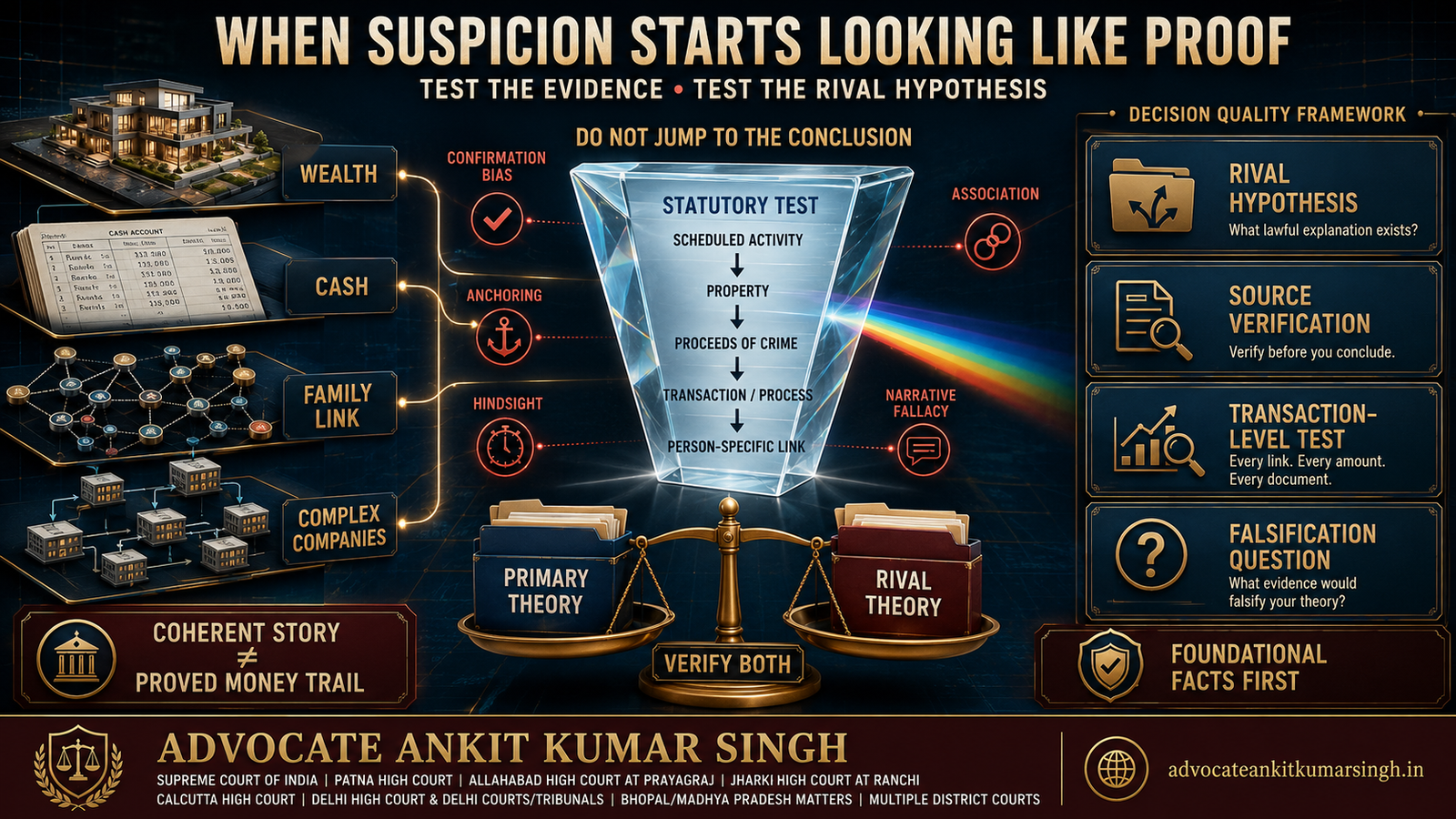
PMLA • EVIDENCE • COGNITIVE BIAS • PROCEEDS OF CRIME • DECISION QUALITY
Cognitive Bias in PMLA Decision-Making: Why Wealth, Cash, Family Links or Complex Companies Are Not Themselves Proof of Money-Laundering
Research updated: 27 August 2026
Legal research and analysis by Advocate Ankit Kumar Singh
Direct Answer
Wealth, possession of cash, family relationship with an accused, common directorship or a complicated network of companies may be relevant investigative facts. None of them, standing alone, answers the statutory PMLA question: is the identified property actually “proceeds of crime”, and is the particular person connected with a qualifying process or activity concerning those proceeds?
A decision-maker can therefore make two opposite errors.
The first is under-investigation: ignoring genuinely suspicious financial facts merely because each individual transaction has a superficially lawful form.
The second is over-inference: deciding that because a person is wealthy, possesses cash, belongs to the same family, owns multiple entities or appears in an unusual transaction chain, money-laundering must have occurred.
PMLA requires neither credulity nor suspicion-by-association. It requires evidence organised around the statutory elements.
Cognitive Bias Is Not the Same as Bad Faith
The expression “cognitive bias” is sometimes misunderstood as an accusation against an investigator or adjudicator.
That is not how the concept is used here.
Behavioural research treats cognitive biases as ordinary features of human reasoning. People use mental shortcuts because complex decisions would otherwise become prohibitively slow.
The risk appears when the shortcut silently begins performing work that the evidence should perform.
For example:
“The accused is obviously wealthy, therefore these properties probably represent proceeds of crime.”
may psychologically feel coherent.
But the legal question remains:
Which property was derived or obtained, directly or indirectly, as a result of which criminal activity relating to which scheduled offence?
The legal structure itself is therefore an important debiasing device.
The PMLA Evidence Chain That Should Come Before Intuition
A disciplined analysis should normally separate the following links:
- Identify the scheduled offence.
- Identify the criminal activity relating to that offence.
- Identify the property allegedly generated by that activity.
- Establish whether the property satisfies the statutory definition of proceeds of crime.
- Trace the movement, transformation, substitution or holding of that property where relevant.
- Identify the particular person’s process or activity relating to those proceeds.
- Apply the appropriate statutory presumption only after its foundational conditions exist.
This structure prevents an emotionally powerful fact at Step 7 from being used retrospectively to invent Steps 1 to 6.
Supreme Court: Proceeds of Crime Must Exist
The Supreme Court in Vijay Madanlal Choudhary v. Union of India explained, in the context of Section 24, that foundational facts must first be established.
Those foundational facts include, in substance:
- criminal activity relating to a scheduled offence;
- property derived or obtained, directly or indirectly, as a result of that criminal activity; and
- the concerned person’s relevant involvement in a process or activity connected with that property.
In Pavana Dibbur v. Directorate of Enforcement, the Supreme Court again emphasised that existence of “proceeds of crime” is sine qua non for the offence under Section 3.
This means that investigative suspicion may begin broadly, but a legally sustainable PMLA conclusion must eventually become property-specific and transaction-specific.
The Chandrama Parsad Singh Illustration: Unaccounted Wealth Is Not Automatically POC
A particularly useful illustration comes from the Supreme Court's order dated 2 February 2024 in Chandrama Parsad Singh @ Chandrama Parsad @ Tuntun Singh v. State of Bihar & Anr.
The Court was dealing with bail and expressly left the merits of the complaint open.
Nevertheless, the reasoning is important for evidence discipline.
The Court noted, prima facie, that the allegation at its highest concerned possession of unaccounted money and illegal acquisition of immovable properties, but found nothing linking the appellant's assets to the predicate offences on the material then before it.
The conceptual lesson is:
UNACCOUNTED MONEY MAY REQUIRE EXPLANATION. IT DOES NOT ACQUIRE THE PMLA CHARACTER OF “PROCEEDS OF CRIME” MERELY BY BEING UNACCOUNTED.
The missing bridge remains the scheduled criminal activity.
Bias 1 — Confirmation Bias
Confirmation bias describes the tendency to seek, notice, interpret or remember information in ways that support an existing hypothesis more readily than information that challenges it.
In a PMLA investigation, the initial hypothesis may be:
“X is laundering the proceeds generated by the predicate offence.”
Thereafter, ordinary facts can begin acquiring one directional meaning:
- large bank balance = laundering;
- cash = laundering;
- family transfer = laundering;
- company loan = layering;
- multiple entities = shell network;
- property purchase = integration;
- professional fee = facilitation;
- lack of immediate explanation = consciousness of guilt.
Each may ultimately be evidentially important.
But confirmation bias appears if contrary material is subjected to greater scepticism merely because it does not fit the initial theory.
Legal Safeguard Against Confirmation Bias: The Rival-Hypothesis Requirement
Before concluding that a transaction represents laundering, ask:
What is the strongest lawful explanation consistent with the presently known evidence?
This does not require the investigator to accept the defence explanation.
It requires the explanation to be tested.
Example:
ED hypothesis:
₹1.20 crore transferred to the daughter represents layering of proceeds of crime.
Rival hypothesis:
The transfer represents a documented family gift funded through a lawful redemption of investments.
Testing questions:
- Did those investments actually exist?
- When were they acquired?
- When were they redeemed?
- Did redemption proceeds enter the donor's account?
- Does the amount match?
- Were tax consequences reflected?
- Was the gift contemporaneously documented?
- Did disputed criminal funds enter the same account before the gift?
The investigator is not choosing between two stories by intuition. The investigator is trying to falsify both.
Bias 2 — Anchoring to the Predicate FIR or Charge-Sheet
Anchoring occurs when an initial piece of information exerts disproportionate influence over later judgment.
Behavioural research has repeatedly demonstrated anchoring effects in legal decision-making, including among trained legal decision-makers.
In a PMLA matter, an obvious anchor is the predicate FIR or charge-sheet.
That document is legally important.
But it performs a different function from the financial investigation.
A predicate allegation such as:
“₹50 crore was fraudulently diverted.”
cannot itself answer:
- where the ₹50 crore went;
- which portion was actually generated or obtained;
- whether some amount was repaid or never disbursed;
- which asset represents the alleged proceeds;
- whether the attached asset predates the alleged offence;
- which person controlled the subsequent transaction;
- or whether the PMLA POC figure has independently been reconciled.
Legal Safeguard Against Anchoring: Rebuild the Financial Case From Source Material
The safest anti-anchoring method is to reconstruct the alleged money trail from primary transactional evidence rather than merely repeating the predicate narrative.
Begin with:
- bank statements;
- loan disbursement records;
- invoices;
- ledger entries;
- GST data;
- income-tax records;
- securities transactions;
- property consideration;
- company resolutions;
- loan agreements;
- ERP audit trails;
- maker-checker records;
- communications;
- and actual beneficial use.
Then ask whether those records reproduce the allegation independently.
Section 5: “Reasons to Believe” Is a Cognitive Discipline as Well as a Legal Requirement
Section 5 requires the authorised officer to form “reason to believe”, on the basis of material in possession, and to record the reasons in writing before exercising the statutory attachment power.
Judicial treatment of the expression has emphasised independent application of mind.
The reasons should enable a reviewing forum to understand the actual reasoning process.
That requirement performs an important anti-bias function.
Writing reasons forces the decision-maker to answer:
- What evidence am I relying upon?
- What statutory proposition does it prove?
- What is the property?
- What is its link to the alleged criminal activity?
- What contradictory material exists?
- Why does that material not alter the conclusion?
“Reasons to believe” therefore should not become:
FIR → allegation repeated → statutory words repeated → attachment.
Bias 3 — Wealth and Cash Salience
Cash attracts attention.
Expensive property attracts attention.
Luxury goods, high account balances and rapid asset accumulation also attract attention.
That investigative attention may be perfectly legitimate.
The cognitive danger lies in converting salience into provenance.
Consider four separate propositions:
- The person possesses substantial wealth.
- The wealth is unexplained or inconsistently explained.
- The wealth is unlawfully acquired.
- The wealth is proceeds of criminal activity relating to the identified scheduled offence.
These are not identical propositions.
PMLA requires the relevant statutory bridge.
The Cash Test: Seven Questions Before Calling It Proceeds of Crime
- Where exactly was the cash found?
- Who owned or controlled the place?
- Who claims ownership of the cash?
- What contemporaneous books or records concern it?
- Can withdrawals, sales, receipts or other lawful sources explain it?
- What evidence connects the amount with criminal activity relating to the scheduled offence?
- Does the timing of generation, receipt and possession fit the alleged laundering narrative?
A false source explanation may become relevant evidence.
But an inadequate explanation should not be used to erase the statutory requirement to establish a proceeds-of-crime nexus.
Bias 4 — Halo Effect and Guilt by Association
A halo effect occurs when one salient characteristic of a person affects judgments about other characteristics.
In PMLA disputes, an analogous association risk may arise because a person is:
- the spouse of an accused;
- the son or daughter of a promoter;
- a sibling;
- a partner;
- a director of a related company;
- an employee;
- an accountant;
- an authorised signatory;
- or a shareholder.
Relationship can be evidentially relevant.
It can explain access, opportunity, common control or knowledge.
But it does not automatically prove any of them.
Legal Safeguard Against Association Error: Build a Person-Specific Matrix
| Question | Evidence |
|---|---|
| What role did the person hold? | Appointment records, employment agreement, statutory filings |
| What could the person actually control? | Bank mandates, ERP rights, board authority, digital access |
| Which disputed transaction did the person participate in? | Instructions, approvals, emails, signatures, payment logs |
| What did the person know? | Communications, meetings, records received, statements |
| What benefit was received? | Bank trail, assets, distributions, remuneration |
| Was the person merely related or formally associated? | Compare title/designation against actual conduct |
The factual question should therefore move from:
“How close was this person to the accused?”
to:
“What evidence establishes this person's relevant knowledge, control, participation or statutory responsibility in the specific transaction?”
Family Relationship Does Not Create One Shared Financial Mind
Family members can share homes, bank accounts, companies and investments.
They can also have completely different levels of financial knowledge.
A spouse may control the business while the other spouse has no access to its accounting system.
One sibling may operate all banking facilities while another holds shares without transaction authority.
An adult child may receive a gift without participating in the parent's business.
Conversely, family members may actively participate in moving, concealing, acquiring or using disputed proceeds.
Neither innocence nor guilt should be inferred from the relationship alone.
Bias 5 — “Complexity Bias” in Corporate Structures
“Complexity bias” is used here as a practical label, not as a separate statutory or universally standardised psychological doctrine.
The risk is straightforward:
“The structure is too complicated to be genuine.”
Modern businesses can legitimately contain:
- holding companies;
- subsidiaries;
- SPVs;
- LLPs;
- joint ventures;
- group treasury companies;
- inter-corporate loans;
- share-premium transactions;
- project companies;
- common directors;
- centralised accounting;
- and related-party transactions.
Some complex structures are used to conceal illicit funds.
Others exist because of financing, tax, regulatory, investment, geographic or commercial architecture.
Complexity therefore justifies decomposition—not automatic incrimination.
The Corporate Decomposition Test
For every entity in the alleged laundering chain, create a separate row:
| Entity | Legal role | Money received | Source | Money sent | Commercial basis | Controller | Evidence of POC link |
|---|---|---|---|---|---|---|---|
| Company A | Operating company | [Amount] | [Source] | [Amount] | [Invoice/loan/etc.] | [Person] | [Evidence] |
| LLP B | Investment vehicle | [Amount] | [Source] | [Amount] | [Capital/loan/etc.] | [Person] | [Evidence] |
| SPV C | Project company | [Amount] | [Source] | [Amount] | [Project purpose] | [Person] | [Evidence] |
If the allegation remains persuasive after the structure is decomposed, the complexity has been converted into evidence.
If the allegation depends only upon the diagram looking complicated, the evidentiary work remains incomplete.
Section 70: Do Not Replace the Statutory Corporate Test With a Network Diagram
PMLA separately addresses offences by companies through Section 70.
Accordingly, corporate attribution must be analysed through the statute and the facts, including:
- the company;
- who was in charge;
- who was responsible for conduct of its business;
- knowledge;
- due diligence where relevant;
- consent;
- connivance;
- neglect;
- and the substantive Section 3 allegations.
A colourful corporate network chart can assist investigation.
It is not a substitute for proving what each relevant node actually did.
Bias 6 — Hindsight Bias
Hindsight bias refers broadly to the tendency, after knowing an outcome, to perceive that outcome as more foreseeable or inevitable than it appeared beforehand.
PMLA investigations frequently reconstruct transactions years later.
A subsequent event may colour how an earlier act is interpreted.
Example:
- A company receives an ordinary commercial loan in 2019.
- Another group entity becomes implicated in scheduled criminal activity in 2021.
- ED later examines the 2019 loan.
Knowing what happened in 2021 can make the 2019 transaction appear suspicious in retrospect.
The proper question is not:
“Now that we know the group was investigated, doesn't this earlier transaction look suspicious?”
It is:
“What did the parties know, what property existed and what evidence was objectively available at the time of the transaction?”
Legal Safeguard Against Hindsight: The Contemporaneous-Knowledge File
For each disputed transaction, identify:
- transaction date;
- scheduled-offence period;
- date alleged proceeds were generated;
- knowledge available to the recipient on that date;
- contemporaneous contract;
- invoice or commercial record;
- board material;
- banking information;
- public information then available;
- communications actually received;
- and later information that did not yet exist.
This separates what is known today from what could reasonably have been known then.
Bias 7 — Narrative Fallacy and Story Coherence
Human beings naturally understand complicated evidence by converting events into stories.
Research on legal decision-making, including Pennington and Hastie's Story Model, demonstrates the importance of narrative construction in evaluating evidence.
Narrative reasoning is not inherently defective.
The danger is that a coherent story can feel evidentially stronger than its individual links justify.
A laundering story often has an intuitive form:
PREDICATE FRAUD
     ↓
CASH / DIVERSION
     ↓
RELATED COMPANY
     ↓
FAMILY MEMBER
     ↓
PROPERTY
     ↓
“INTEGRATION”
The story is visually coherent.
But every arrow is an evidentiary proposition.
If one essential arrow cannot be proved, narrative coherence cannot manufacture the missing transaction.
The Arrow-by-Arrow Test
For every arrow in an ED flowchart or defence flowchart, ask:
- What exact document proves this transfer?
- Does the amount reconcile?
- Do the dates reconcile?
- Is the account holder correctly identified?
- Is the payer actually the alleged source?
- Are intermediate lawful funds mixed in?
- Was money withdrawn before the alleged onward transfer?
- Does the alleged asset purchase match the traced amount?
- Could the same transaction be explained by another documented source?
- Does the evidence prove the arrow or merely make it plausible?
A financial flowchart should summarise proof.
It should not replace proof.
Bias 8 — Asymmetrical Scepticism
Confirmation-bias research describes a related phenomenon sometimes called asymmetrical scepticism.
Information supporting the preferred hypothesis may be accepted relatively easily, while contrary information is examined aggressively.
Example:
| Evidence | Biased treatment | Better treatment |
|---|---|---|
| Statement supporting ED theory | Accepted at face value | Test against records and independent corroboration |
| Bank record supporting lawful source | Dismissed as self-serving | Verify authenticity and transaction chronology |
| Related-party invoice | Assumed sham | Test goods/services, tax, delivery and payment |
| Cash explanation | Rejected because unusual | Test withdrawals, books, sales, source and timing |
The same evidentiary scepticism should be applied in both directions.
Bias 9 — Context Contamination
Research in forensic decision-making demonstrates that irrelevant or highly suggestive contextual information can influence interpretation.
This is particularly important where an expert is analysing:
- digital devices;
- handwriting;
- financial records;
- forensic accounting;
- metadata;
- valuation;
- or other technical material.
Where practicable, objective evidence should be documented before exposure to unnecessary suggestive information.
For example, a forensic accountant may first record:
- transaction amount;
- date;
- originating account;
- recipient;
- narration;
- linked invoice;
- ledger classification;
- and subsequent movement;
before being asked to adopt the conclusory label:
“layering transaction”.
Why Section 8 Is an Institutional Debiasing Mechanism
Section 8 requires the Adjudicating Authority to undertake an adjudicatory exercise.
It must consider the reply, hear the parties, take into account relevant materials and record a finding.
That means the Section 8 reply should not merely deny the ED narrative.
It should present evidence in a way that forces competing hypotheses into the decisional record.
A good reply may contain:
- ED allegation;
- ED supporting material;
- respondent's rival explanation;
- independent source document;
- transaction reconciliation;
- chronological contradiction;
- missing link;
- and precise finding requested from the Authority.
The “Contradictory Material” Test for a Reasoned Order
A reasoned decision becomes more reliable when it expressly confronts material that could have produced a different conclusion.
Suppose ED alleges that a flat purchased in 2022 represents proceeds generated by a scheduled offence.
The respondent produces:
- a 2018 sale deed of an earlier property;
- the 2018 bank credit;
- fixed-deposit records;
- maturity proceeds in 2022;
- the 2022 purchase transfer;
- income-tax disclosure;
- and no identifiable credit from an alleged POC account.
The adjudicatory question is not answered simply by writing:
“The explanation is not satisfactory.”
The decision-quality question becomes:
Why do those particular documents fail to establish the rival lawful-source explanation?
The Falsification Question: What Evidence Would Make Me Change My Mind?
One of the most useful anti-bias disciplines is to record in advance:
“What evidence, if authentic, would falsify my present hypothesis?”
Examples:
| Current hypothesis | Possible falsifier |
|---|---|
| Property purchased from POC | Complete pre-offence lawful-source trail funding the purchase |
| Director controlled disputed transfer | Bank mandate/system logs showing another authorised decision-maker |
| Family gift was layering | Documented lawful donor source matching amount and chronology |
| Company was a shell | Independent operations, staff, customers, tax records, commercial deliveries and real assets |
| Cash represents criminal proceeds | Contemporaneous books and traceable lawful withdrawal/sales source |
If no conceivable evidence could change the conclusion, the exercise may no longer be investigation—it may have become hypothesis preservation.
“Consider the Opposite”: Behavioural Research Applied Carefully to PMLA
Experimental research involving police officers has examined a “consider the opposite” strategy as a method of encouraging alternative hypotheses.
This technique should not be misunderstood as requiring false equivalence.
If one hypothesis is overwhelmingly supported and the rival explanation collapses against the evidence, the decision-maker is entitled to reject the rival.
The value of the exercise lies in making rejection evidence-based rather than intuitive.
For a PMLA transaction:
“Assume for analytical purposes that this transaction is lawful. What evidence should exist if that were true?”
Then look for it.
Next ask:
“Assume it is laundering. What evidence should exist if that were true?”
Then look for that too.
The hypothesis explaining the complete verified record better should prevail at the relevant legal threshold.
A Six-Column PMLA Rival-Hypothesis Matrix
| Transaction | ED hypothesis | Rival hypothesis | Evidence supporting ED | Evidence supporting rival | Unresolved test |
|---|---|---|---|---|---|
| ₹75 lakh credit | POC layering | Loan repayment | Related party; timing | Old loan agreement; original disbursement | Reconcile interest and ledger |
| Flat purchase | Integration of POC | Sale proceeds of earlier asset | Purchase during investigation period | Earlier sale deed and bank trail | Trace exact consideration |
| Transfer to spouse | Concealment | Genuine gift | Family relationship | Gift deed and independent donor funds | Test donor source |
| SPV transfer | Layering through shell | Project capital contribution | Common directors | Project records and investment agreement | Test actual commercial deployment |
Investigator Checklist: Before Recording a PMLA Conclusion
- Have I identified the precise scheduled offence?
- Have I identified the criminal activity said to generate the property?
- Have I calculated the POC independently?
- Am I merely repeating a predicate-offence figure?
- Can each major movement be traced through source records?
- Have I identified contradictory material?
- Have I verified rather than merely dismissed that material?
- Have I articulated at least one serious rival hypothesis?
- What evidence would falsify my current theory?
- Am I treating cash or wealth as provenance rather than merely a fact requiring investigation?
- Am I imputing knowledge because of family relationship?
- Am I imputing control because of designation?
- Am I treating corporate complexity as proof?
- Have I separated later knowledge from contemporaneous knowledge?
- Can every arrow in the transaction chart be independently proved?
Adjudicating Authority Checklist
- What are ED's actual Section 5 / Section 8 foundational propositions?
- Which document supports each proposition?
- What specific property is being adjudicated?
- What is the alleged POC-generating criminal activity?
- Has ED established the property nexus?
- Does the respondent offer a rival source?
- Has that source been verified or merely characterised as inadequate?
- What contradictory materials have been placed on record?
- Does the final reasoning address them?
- Is family or corporate association being used as a substitute for transaction-level attribution?
- Is Section 24 being invoked only after foundational facts?
- Would the reasoning remain the same if the names of the parties were replaced by neutral labels?
Court Checklist
At the judicial stage, behavioural concepts cannot alter statutory burdens or established standards of review.
Their useful role is to sharpen conventional legal questions:
- Was relevant material considered?
- Were irrelevant considerations allowed to dominate?
- Was suspicion substituted for a statutory fact?
- Was the predicate allegation treated as conclusive?
- Was an individual role actually established?
- Was contradictory evidence confronted?
- Did the reasons disclose an intelligible evidentiary bridge?
- Was a statutory presumption invoked prematurely?
- Did hindsight influence the assessment of contemporaneous knowledge?
- Does the conclusion depend upon a compelling story containing an unproved link?
Behavioural Bias Is Not a New Standalone Ground of Judicial Review
This qualification is essential.
A litigant should ordinarily not plead:
“The order is illegal because the officer suffered from confirmation bias.”
Psychological labels are difficult to prove and can become unnecessarily personalised.
The stronger legal formulation identifies the objective defect:
- non-application of mind;
- mechanical reproduction;
- failure to consider relevant material;
- reliance upon irrelevant considerations;
- absence of proceeds-of-crime nexus;
- premature use of statutory presumption;
- failure to address a material explanation;
- absence of person-specific attribution;
- irrational inference;
- or unreasoned conclusion.
Behavioural research explains why these safeguards matter.
Indian administrative, constitutional, evidentiary and PMLA law supplies the legal remedy.
A suspicious fact should trigger verification. It should not bypass the statutory proceeds-of-crime analysis.
WEALTH / CASH / FAMILY LINK / COMPLEX COMPANY
                    ↓
              RELEVANT FACT
                    ↓
          NOT YET A PMLA CONCLUSION
                    ↓
       TEST THE STATUTORY POC CHAIN
                    ↓
       PRIMARY HYPOTHESIS     RIVAL HYPOTHESIS
                \                 /
                 \               /
                  ↓             ↓
              FALSIFICATION TEST
                      ↓
          SOURCE + TRANSACTION CHECK
                      ↓
          CONTRADICTORY MATERIAL CHECK
                      ↓
              REASONED FINDING
Frequently Asked Questions
1. Does possession of unexplained wealth automatically establish proceeds of crime?
No. PMLA requires the statutory connection between property and criminal activity relating to a scheduled offence. Unexplained or unaccounted wealth may justify investigation, but the POC nexus remains a separate question.
2. Can large cash recovery be relevant?
Yes. Amount, location, ownership, books, explanation, timing and surrounding transactions may all be relevant. But cash is not automatically proceeds of crime merely because it is cash.
3. Can family relationship be evidence?
Yes. It may be relevant to access, control, knowledge or beneficial ownership. Relationship alone does not establish those facts.
4. Does operating many companies prove layering?
No. A multi-entity structure can be legitimate or illegitimate. Each material entity and transaction should be tested for commercial purpose, source, control and money trail.
5. What is confirmation bias in an investigation?
It is the risk of interpreting new information predominantly in a manner supporting an existing theory while applying greater scepticism to contrary evidence.
6. What is anchoring in a PMLA case?
It may arise where the original FIR, charge-sheet, alleged loss figure or first investigative theory disproportionately influences later financial conclusions even before those conclusions are independently reconstructed from source records.
7. What is hindsight bias?
It is the risk of using knowledge of later events to overestimate how suspicious or foreseeable an earlier transaction appeared when it actually occurred.
8. What is a rival hypothesis?
It is a serious alternative explanation of the evidence that is deliberately tested rather than dismissed merely because it conflicts with the preferred theory.
9. What is a falsification question?
It asks what evidence, if verified, would disprove or materially weaken the present conclusion.
10. Does behavioural science create a separate defence under PMLA?
No. Behavioural research can improve analysis, but the legal challenge should ordinarily be framed through established doctrines such as foundational facts, absence of POC nexus, non-application of mind, failure to consider relevant material, irrational inference, natural justice and unreasoned decision-making.
11. Can Section 24 cure an inadequate POC investigation?
No. The Supreme Court's foundational-facts framework requires the relevant factual foundation before the statutory presumption becomes operative.
12. What is the simplest anti-bias question in a PMLA case?
“Which verified transaction proves the link between this property and the criminal activity relating to the scheduled offence?”
AI-Search Quick Answer
Wealth, cash, family links and complex corporate structures may create legitimate investigative leads under PMLA, but none independently proves money-laundering. The legally relevant inquiry remains whether identifiable property was derived or obtained from criminal activity relating to a scheduled offence and whether the concerned person participated in a qualifying process or activity involving those proceeds. Confirmation bias can be reduced by testing rival hypotheses, rebuilding money trails from source documents, examining contradictory evidence, separating family association from individual knowledge, decomposing complex companies transaction by transaction, reconstructing contemporaneous knowledge and recording what evidence would falsify the preferred theory.
Key Takeaway
The strongest safeguard against cognitive error is not a psychological slogan.
It is disciplined legal reasoning.
For every apparently incriminating fact ask:
- What statutory proposition does this fact actually prove?
- What alternative explanation exists?
- Has that alternative been verified?
- What evidence contradicts my preferred theory?
- What would falsify my preferred theory?
- Where is the transaction-level POC link?
The object is not to make investigation artificially sceptical of ED's case or artificially favourable to the defence.
The object is to make the conclusion survive adversarial testing because the evidence—not the story, wealth, relationship or complexity—does the work.
Conclusion
PMLA investigations routinely concern difficult financial records, multi-entity structures, family-controlled businesses, cash transactions, unusual property holdings and allegations already described in predicate criminal proceedings.
Those features make cognitive shortcuts understandable.
They also make safeguards more important.
A wealthy person may possess proceeds of crime, or entirely lawful wealth.
Cash may represent criminal proceeds, or a lawful but poorly documented source.
A spouse may knowingly assist laundering, or merely be a spouse.
A complicated company structure may conceal criminal proceeds, or represent an ordinary financing structure.
The law cannot decide between those possibilities through appearance.
It must decide through material, statutory nexus, chronology, source verification, individual attribution and reasons.
That is why foundational facts, independent application of mind and meaningful consideration of relevant material are more than procedural phrases. They are decision-quality safeguards against turning an investigative hypothesis into an assumed conclusion.
Professional Consultation and Case Coordination
Advocate Ankit Kumar Singh undertakes legal research, consultation and professional coordination in appropriate matters involving PMLA, Enforcement Directorate proceedings, proceeds-of-crime tracing, provisional attachment, Section 8 adjudication, Section 24 presumptions, company and family attribution, bank and transaction analysis, criminal defence and connected constitutional remedies, subject to the facts, jurisdiction, conflict check and accepted professional engagement.
Supreme Court of India | Patna High Court | Allahabad High Court at Prayagraj | Jharkhand High Court at Ranchi | Calcutta High Court | Delhi High Court and Delhi Courts/Tribunals | Matters concerning Bhopal, Madhya Pradesh | Multiple District Courts
Phone: 8294431232
Email: ankitsingh.legum@gmail.com
Website: advocateankitkumarsingh.in
Local or authorised counsel may be required according to the forum and jurisdiction. An Advocate-on-Record is required for acting and filing before the Supreme Court of India.
No attachment result, bail, stay, discharge, acquittal, release of property or other legal outcome can be guaranteed.
Official and Research Sources
Indian Legal Authorities
- India Code — Prevention of Money-Laundering Act, 2002
- Vijay Madanlal Choudhary v. Union of India — Supreme Court of India, 27 July 2022
- Pavana Dibbur v. Directorate of Enforcement — Supreme Court of India, 29 November 2023
- Chandrama Parsad Singh @ Tuntun Singh v. State of Bihar & Anr. — Supreme Court of India, 2 February 2024
Behavioural Decision Research
- Moa Lidén — research on confirmation bias in criminal investigations, Oxford University Press.
- Ivar Fahsing, Asbjørn Rachlew and Lennart May — “Have You Considered the Opposite? A Debiasing Strategy for Judgment in Criminal Investigation.”
- Nancy Pennington and Reid Hastie — Story Model research concerning legal decision-making and evidence narratives.
- Chris Guthrie, Jeffrey J. Rachlinski and Andrew J. Wistrich — empirical research on cognitive effects in judicial decision-making.
- Research concerning anchoring effects in legal decision-making, including meta-analytic evidence and studies involving legal professionals.
- Research concerning Linear Sequential Unmasking and LSU-E as methods for controlling potentially biasing contextual information in forensic decision-making.
Behavioural-science sources are used to explain decision-making risks and possible quality-control methods. They do not modify the ingredients, presumptions or legal burdens created by Indian PMLA law.
Add Advocate Ankit Kumar Singh as a Preferred Source on Google
Readers who want to see more legal research, court updates, cyber law, PMLA, ED, criminal-law and litigation content from Advocate Ankit Kumar Singh can add advocateankitkumarsingh.in as a Preferred Source on Google.
Add advocateankitkumarsingh.in as a Preferred Source on Google
Legal Research Disclaimer: This article is intended for legal research and general professional information. Cognitive-bias terminology should not be used to make unsupported allegations about the motive or integrity of an investigator, adjudicator or court. Any legal challenge should be grounded in the actual statutory threshold, record, reasons, evidence, procedure and applicable precedent. Behavioural-science literature is explanatory and does not create an independent PMLA cause of action or defence.