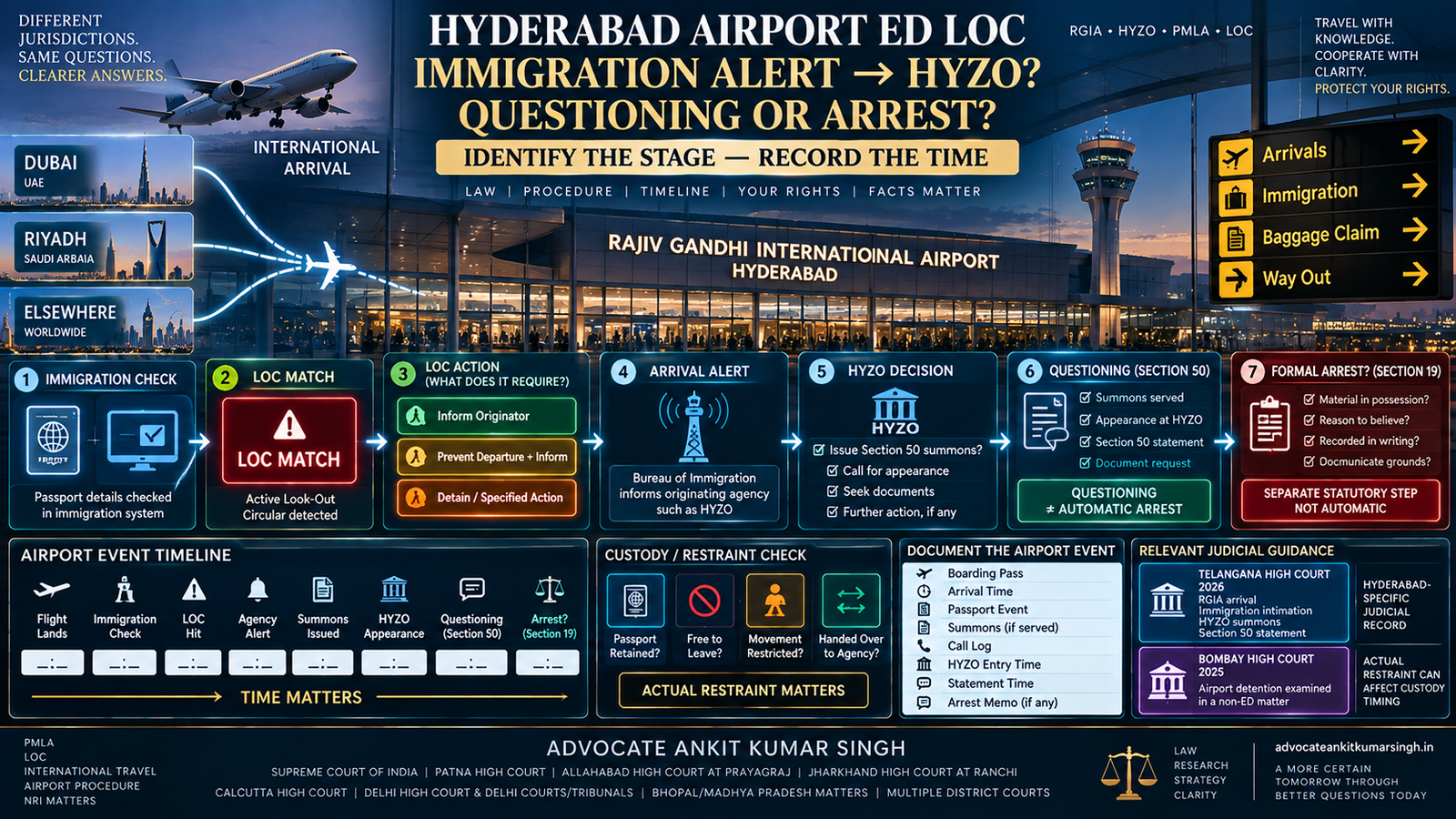
NRI Arrives at Hyderabad Airport With an ED Look-Out Circular: Can Immigration Alert HYZO and Can Questioning Begin Immediately?
Legal research and analysis by Advocate Ankit Kumar Singh
Legally reviewed and updated: 14 September 2026
Summary: For a traveller arriving at Rajiv Gandhi International Airport in Hyderabad with an active ED LOC, explain the interception sequence, immigration alert, communication with HYZO and possible ED interaction after arrival. The Hyderabad article should distinguish questioning or appearance from formal arrest and identify what the traveller should document from the airport event.
Direct Answer: Yes, Immigration Can Alert HYZO After an LOC Match
Where an active Enforcement Directorate Look-Out Circular is reflected against a traveller arriving at Rajiv Gandhi International Airport, the Bureau of Immigration can act in accordance with the instruction attached to that LOC.
Depending upon the LOC category, the action may involve:
- informing the originating agency;
- preventing departure;
- detaining and informing the originator;
- taking another specifically recorded action.
If the originating agency is the Hyderabad Zonal Office of the Directorate of Enforcement, HYZO can therefore receive information that the traveller has arrived in India.
A subsequent ED interaction can follow quickly.
But:
AN IMMIGRATION LOC HIT IS NOT, BY ITSELF, THE SAME THING AS FORMAL ARREST UNDER SECTION 19 PMLA.
The Airport Sequence Should Be Broken Into Separate Events
FLIGHT LANDS AT RGIA
        ↓
PASSPORT PRESENTED
        ↓
IMMIGRATION DATABASE CHECK
        ↓
LOC MATCH
        ↓
IDENTITY CONFIRMATION
        ↓
ACTION SPECIFIED IN LOC
        ↓
ORIGINATING AGENCY INFORMED
        ↓
HYZO COMMUNICATION
        ↓
SUMMONS / APPEARANCE REQUIREMENT
        ↓
SECTION 50 QUESTIONING
        ↓
FURTHER ACTION, IF ANY
Every arrow represents a separate factual event.
The timing matters.
An LOC Is Not One Uniform Type of Airport Restriction
The practical effect depends upon the instruction entered in the LOC system.
Current LOC practice distinguishes different categories of action.
These include directions such as:
- detain and inform the originator;
- prevent departure and inform the originator;
- specific action recorded in remarks.
Therefore it is unsafe to say:
“There is an LOC, so Immigration must arrest the person.”
It is equally unsafe to say:
“An LOC only generates an email and can never involve detention.”
Who Is the “Originating Agency”?
An LOC is opened at the request of an authorised originating agency or pursuant to an appropriate court process.
Where the LOC was sought by the Directorate of Enforcement in connection with a Hyderabad investigation, the relevant ED formation may be identified as the originating agency in the LOC process.
The Bureau of Immigration executes the immigration-level action reflected in the system.
The investigative decision-making ordinarily remains with the originating agency.
Can Bureau of Immigration Tell HYZO That the Traveller Has Arrived?
Yes.
A 2026 Telangana High Court judgment concerning ECIR/HYDZO/35/2020 records an actual example.
According to the record placed before the Court:
- the person arrived at Rajiv Gandhi International Airport on 30 September 2024;
- an ED LOC was active;
- the Bureau of Immigration communicated the arrival to the concerned ED office;
- HYZO thereafter issued summons;
- the person subsequently appeared and statements were recorded.
This demonstrates that:
LOC MATCH → IMMIGRATION INTIMATION → HYZO ACTION
is not merely hypothetical.
Can HYZO Issue a Summons Immediately After the Airport Alert?
Potentially, yes.
If HYZO learns that a person required for investigation is physically present in Hyderabad or India, it may consider issuing a summons under Section 50.
In the Hyderabad case referred to above, the record states that summons were issued on the date of arrival.
Whether that happens in every case depends upon:
- the investigation;
- previous summons;
- documents outstanding;
- officer availability;
- actual LOC wording;
- the traveller's legal status.
Can Questioning Begin at the Airport?
There are two different questions:
- Can officials speak to or interact with the traveller after interception?
- Is a formal Section 50 statement being recorded?
These should not be conflated.
Where formal examination under Section 50 is intended, identify:
- whether summons has been issued;
- where appearance is required;
- which officer issued it;
- when examination begins;
- whether the statement is being recorded under Section 50.
An airport interception should not make the legal basis of questioning ambiguous.
Section 50 Appearance Is Not Formal Arrest
Section 50 gives specified ED officers power to summon a person for:
- giving evidence; and
- producing records.
A person may therefore:
- appear;
- answer questions;
- provide documents;
- have a statement recorded;
without being formally arrested at that point.
SECTION 50 EXAMINATION ≠ SECTION 19 ARREST.
Formal Arrest Under Section 19 Requires a Separate Statutory Exercise
Section 19 authorises specified ED officers to arrest only where the statutory requirements are satisfied.
The authorised officer must act on material in possession and form the required reason to believe concerning the person's alleged guilt of a PMLA offence.
That reason must be recorded in writing.
If arrest occurs, the person must be informed of the grounds of arrest in accordance with current constitutional and Supreme Court requirements.
Therefore:
LOC HIT
≠
AUTOMATIC SECTION 19 SATISFACTION

SUMMONS
≠
AUTOMATIC SECTION 19 SATISFACTION

QUESTIONING
≠
AUTOMATIC SECTION 19 ARREST
But Do Not Look Only for the Word “Arrest”
Actual physical restraint matters.
Suppose a traveller is:
- told that he cannot leave the immigration room;
- kept under continuous official control;
- prevented from leaving the airport;
- handed over to another agency;
- transported under official custody.
The legal character of that custody may require closer examination.
A later arrest memo cannot necessarily answer every question about when actual custody began.
Bombay High Court 2025: Why the Actual Airport Restraint Can Matter
In Hemang Jadavji Shah v. State of Maharashtra, the Bombay High Court considered a non-ED criminal case where an LOC directed that the traveller be taken into custody and handed over.
On the particular facts, the Court treated the airport detention as the beginning of arrest/custody for purposes of the constitutional requirement relating to production before the Magistrate.
The case should not be converted into a rule that every airport LOC interception constitutes arrest.
The correct lesson is:
THE ACTUAL LOC INSTRUCTION AND THE ACTUAL DEGREE OF RESTRAINT MATTER.
What Should the Traveller Ask Calmly at Immigration?
Where appropriate, the traveller can seek clarity regarding:
- whether an LOC has been detected;
- which agency is the originator, if disclosed;
- whether the traveller is merely awaiting agency instructions;
- whether the traveller is being detained;
- whether local police or ED are being contacted;
- whether any summons or written document will be served.
Do not obstruct the immigration process.
Do not create a confrontation at the counter.
The objective is to understand the legal and factual sequence.
Document the Exact Airport Timeline
As soon as reasonably possible, prepare:
| Time | Event |
|---|---|
| __ : __ | Aircraft landed |
| __ : __ | Reached immigration |
| __ : __ | Passport checked |
| __ : __ | Asked to wait / taken aside |
| __ : __ | LOC communicated |
| __ : __ | HYZO / agency contacted |
| __ : __ | ED / police officer arrived |
| __ : __ | Summons served |
| __ : __ | Left airport |
| __ : __ | Section 50 questioning began |
Preserve the Flight and Immigration Evidence
Keep:
- airline ticket;
- boarding pass;
- e-ticket itinerary;
- arrival notification;
- passport entry record;
- baggage receipts where useful;
- airport parking/taxi records where relevant;
- phone call logs;
- messages sent to family/counsel at the time;
- subsequent summons.
These records can independently establish timing.
Record Which Documents Were Retained or Taken
If any physical or electronic item is formally taken by an authority, identify:
- what was taken;
- by whom;
- date;
- time;
- legal provision stated;
- whether acknowledgment, receipt, memo or inventory was supplied.
Do not voluntarily create uncertainty later about whether an item was merely shown or formally retained.
If the Passport Is Retained, Identify the Legal Basis
Do not treat all passport-related events as identical.
Possible situations include:
- passport temporarily held during immigration processing;
- passport retained while awaiting originator instructions;
- passport deposited pursuant to court order;
- passport seized under another legal provision;
- passport impounded under applicable passport law.
The precise legal basis matters.
What If HYZO Officers Arrive at the Airport?
Clarify whether:
- they are serving a summons;
- they are asking the person to accompany them voluntarily;
- the LOC itself requires detention/handover;
- formal arrest is being effected;
- another warrant/order exists.
The distinction can affect:
- custody chronology;
- rights upon arrest;
- production timeline;
- later judicial review.
Can the Traveller Be Taken Directly to the HYZO Office?
That depends upon the legal basis and actual instructions.
A person may travel from the airport to HYZO because:
- a summons has been served and the person attends;
- the person has agreed to appear;
- the LOC requires detention/handover;
- another lawful coercive process exists.
Those situations should not be described as though they are identical.
Arrival Interception and Departure Prevention Are Different
Some LOC instructions focus primarily on preventing departure.
Other LOCs may direct detention or notification when the individual is detected.
Therefore:
READ THE ACTION ATTACHED TO THE LOC — NOT JUST THE WORD “LOC”.
For an Indian Citizen, LOC and Entry Refusal Are Not the Same Question
An Indian citizen returning to India presents a different immigration question from a foreign national seeking entry.
The airport issue in an ED LOC matter is often:
- detection;
- notification;
- detention where directed;
- subsequent investigative action.
Foreign-national entry permissions can involve separate immigration law.
The 2026 Hyderabad Case: Arrival Alert Followed by Section 50 Action
In the Telangana High Court proceedings concerning ECIR/HYDZO/35/2020, the Court recorded that the person had been residing in Riyadh and had an LOC connected with HYZO.
According to ED's case before the Court:
- the person arrived at RGIA on 30 September 2024;
- Bureau of Immigration informed ED of the arrival;
- summons were issued;
- statements were recorded on subsequent dates;
- documents concerning plot transactions and property acquisition were sought.
The factual sequence provides a useful Hyderabad model:
AIRPORT DETECTION
      ↓
HYZO INTIMATION
      ↓
SUMMONS
      ↓
STATEMENT
      ↓
DOCUMENT REQUEST