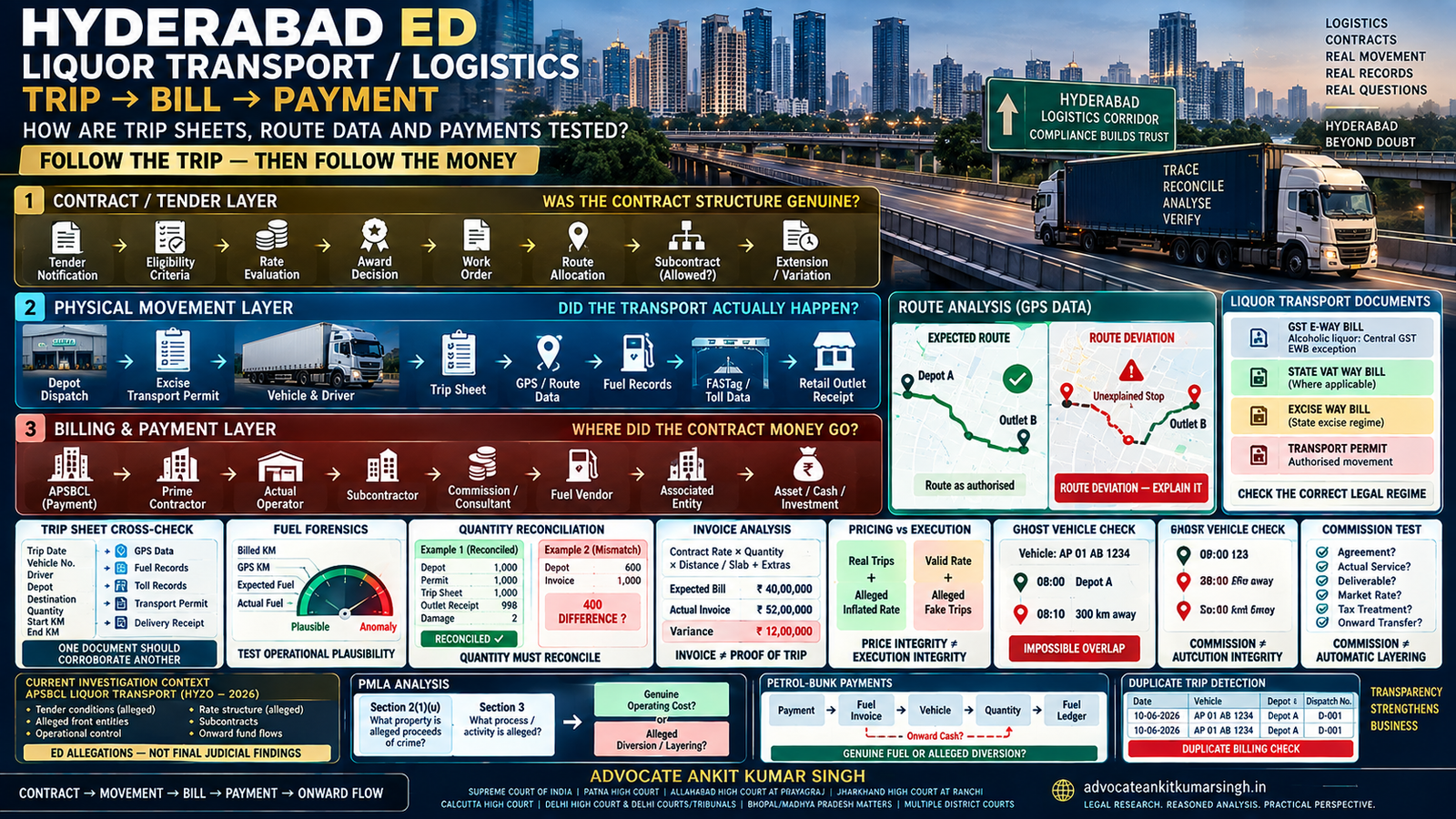
Liquor-Transportation or Logistics Contract Under ED Investigation in Hyderabad: How Are Trip Sheets, Route Data and Payments Tested?
Legal research and analysis by Advocate Ankit Kumar Singh
Legally reviewed and updated: 14 September 2026
Summary: For a logistics-heavy Hyderabad financial-crime investigation, examine tender documents, work orders, GPS or route data, trip sheets, fuel records, invoices, e-way bills, bank payments and intermediary commissions. The Hyderabad article should show how investigators test whether billing reflects genuine transport activity or alleged diversion and layering.
Direct Answer: A Transport Invoice Should Be Reconciled With the Physical Trip and the Money Trail
In a liquor-transport or logistics investigation, neither the invoice nor the trip sheet should be read in isolation.
The strongest reconstruction usually asks four separate questions:
- Was the contract itself validly awarded and priced?
- Did the physical transportation actually occur?
- Was the work billed in accordance with the contract?
- Where did the contract money go after payment?
TENDER
   ↓
WORK ORDER
   ↓
ACTUAL TRIP
   ↓
DELIVERY
   ↓
BILL
   ↓
PAYMENT
   ↓
ONWARD MONEY
Each stage should reconcile with the next.
Hyderabad Context: APSBCL Liquor-Transportation Investigation
The Hyderabad Zonal Office of the Enforcement Directorate has publicly stated that it is investigating alleged irregularities involving liquor-transportation contracts of the Andhra Pradesh State Beverages Corporation Limited.
In June 2026, ED alleged that:
- transport tender conditions were altered;
- selected entities were favoured;
- nominal tender holders acted as fronts;
- actual operational and financial control allegedly rested elsewhere;
- transport rates were increased compared with the previous district-level arrangement;
- sub-contracting and onward financial flows formed part of the alleged scheme.
These are allegations made by the investigating agency.
THEY MUST NOT BE PRESENTED AS FINAL JUDICIAL FINDINGS OF GUILT.
Do Not Treat Every Liquor-Transport Case as a Fake-Trip Case
A transportation investigation may involve different theories.
Theory 1 — Tender Manipulation
Transport actually occurred, but the allegation is that tender conditions or rates were manipulated.
Theory 2 — Inflated Billing
Transport occurred, but distance, quantity, rate or trip count is allegedly overstated.
Theory 3 — Ghost Trips
Bills were raised for transportation that allegedly never occurred.
Theory 4 — Front Contractor
The successful bidder allegedly had little operational role while another entity actually controlled the contract.
Theory 5 — Diversion / Layering
Contract receipts were allegedly moved through subcontractors, consultants, vendors or associated entities for a purpose unrelated to genuine logistics activity.
Trail One: Tender and Work-Order Reconstruction
Collect:
- tender notification;
- pre-bid meeting records;
- eligibility criteria;
- technical bids;
- financial bids;
- comparative statement;
- EMD records;
- performance bank guarantee;
- tender committee notes;
- award letter;
- work order;
- contract;
- rate schedule;
- route schedule;
- extensions;
- amendments;
- subcontract conditions.
Who Funded the Bid?
A technically successful bidder may still be examined for:
- source of EMD;
- source of performance security;
- funding of working capital;
- vehicles actually deployed;
- staff actually employed;
- technology actually used;
- who bore commercial risk.
If another entity funded the entire tender process and performed substantially all operational functions, investigators may ask whether the successful bidder was genuinely independent.
That question remains fact-specific.
A Higher Contract Rate Is Not Automatically a Criminal Rate
Compare like with like.
A proper benchmark may consider:
- fuel prices;
- labour;
- loading and unloading;
- fleet size;
- State-wide versus district-level operations;
- distance;
- vehicle capacity;
- minimum-volume commitments;
- insurance;
- administrative overhead;
- risk allocation;
- technology requirements.
A substantial unexplained rate increase can be an investigative fact.
But rate comparison should not ignore differences in contractual scope.
Trail Two: Reconstruct the Physical Transport Activity
| Field | Record |
|---|---|
| Trip date | Trip sheet / dispatch |
| Origin | Depot |
| Destination | Retail outlet |
| Vehicle | RC / trip sheet / permit |
| Driver | Roster / licence |
| Quantity | Dispatch / permit / receipt |
| Route | Permit / GPS |
| Movement | GPS / toll / fuel |
| Delivery | Outlet acknowledgment |
Liquor Transport Has a Special Documentation Issue: Do Not Confuse GST E-Way Bills With Excise Way Bills
Alcoholic liquor for human consumption is ordinarily outside the central GST e-way-bill requirement applicable under Rule 138.
Therefore the following inference can be legally unsafe:
“THERE IS NO GST E-WAY BILL, THEREFORE THE LIQUOR WAS NEVER TRANSPORTED.”
Instead identify the State-specific documentation.
For Andhra Pradesh liquor transportation, the applicable excise framework requires authorised transport and contains requirements concerning:
- transport permit;
- origin and destination;
- route;
- vehicle number;
- departure details;
- way-bill particulars;
- permit accompanying the consignment;
- route-change or breakdown endorsement in applicable circumstances.
Telangana Has Its Own Alcohol Way-Bill Framework
The Telangana Commercial Taxes Department issued a 2024 circular treating alcoholic liquor for human consumption as a sensitive commodity under the State VAT framework and requiring State e-way-bill documentation in specified movements.
Accordingly, always ask:
WHICH STATE?

WHICH YEAR?

WHAT COMMODITY?

GST E-WAY BILL?

VAT E-WAY BILL?

EXCISE WAY BILL?

EXCISE TRANSPORT PERMIT?
Trip Sheet: Useful but Not Self-Proving
A trip sheet may record:
- date;
- vehicle;
- driver;
- depot;
- destination;
- quantity;
- start time;
- end time;
- kilometres;
- signature or certification.
But it is usually a document created within the logistics/contract process.
Therefore cross-check it against evidence that is independent of the trip sheet itself.
GPS Data: Does the Vehicle's Digital Route Match the Billed Trip?
Compare:
- vehicle-device mapping;
- depot geolocation;
- route;
- destination;
- arrival time;
- return movement;
- stoppages;
- distance.
A consistent GPS trace can strongly corroborate movement.
But missing GPS should not automatically be equated with a fake trip.
Potential technical explanations include device failure, network loss, incomplete retention or equipment replacement.
Route Deviations: Innocent Operational Event or Evidence of Diversion?
Suppose the permitted route is:
DEPOT A
→
ROAD X
→
OUTLET B.
GPS shows:
DEPOT A
→
ROAD X
→
WAREHOUSE C
→
OUTLET B.
Ask:
- Why did the truck visit Warehouse C?
- Was the stop authorised?
- Was there a breakdown?
- Was the route changed?
- Was an endorsement required?
- Was any quantity unloaded?
Route deviation is a fact requiring explanation, not an automatic conclusion of diversion.
FASTag and Toll Data Can Independently Test the Route
Where the expected route crosses toll plazas, compare:
- vehicle number;
- toll plaza;
- timestamp;
- trip date;
- GPS;
- destination.
A toll record can independently corroborate the movement of a particular vehicle.
But absence of toll data is meaningful only where the actual route should reasonably have generated toll events.
Fuel Records: Test Operational Plausibility, Not Mathematical Perfection
TOTAL BILLED KM
÷
REASONABLE VEHICLE MILEAGE
≈
EXPECTED FUEL RANGE
Then compare:
- fuel-pump bills;
- fleet cards;
- bank payments;
- fuel ledger;
- opening tank balance;
- closing balance.
Exact matching should not be expected because mileage varies.
Petrol-Bunk Transfers Require Their Own Audit
For substantial payment to a fuel vendor:
| Question | Evidence |
|---|---|
| Fuel sold? | Invoice / pump record |
| Which vehicle? | Fleet record |
| Quantity? | Fuel slip |
| Price? | Rate |
| Payment? | Bank entry |
| Onward cash? | Vendor bank trail |
A payment to a petrol pump may be genuine fuel expenditure.
If investigators allege cash conversion or onward diversion, that second leg must also be evidenced.
Depot-Out / Retail-In Is One of the Strongest Reconciliations
DEPOT DISPATCH
        ↓
VEHICLE
        ↓
EXCISE PERMIT
        ↓
PHYSICAL ROUTE
        ↓
RETAIL RECEIPT
        ↓
OUTLET STOCK
If all six align, the physical movement proposition becomes substantially stronger.
Quantity Must Reconcile
Example:
DEPOT:
1,000 CASES

PERMIT:
1,000 CASES

TRIP SHEET:
1,000 CASES

OUTLET:
998 CASES

DAMAGE RECORD:
2 CASES
This is capable of reconciliation.
Compare:
DEPOT:
600 CASES

TRIP SHEET:
1,000 CASES

INVOICE:
1,000 CASES

OUTLET:
600 CASES.
The unexplained 400-case difference is materially different.
Ghost Vehicle Test
For every suspicious trip ask:
- Did the registration number exist?
- What class of vehicle was it?
- What was its carrying capacity?
- Was registration active?
- Was it elsewhere at the same time?
- Was the same vehicle shown on overlapping trips?
An impossible vehicle chronology can be powerful evidence.
Driver-Level Verification
For a sampled trip identify:
- driver name;
- licence;
- employment / contractor relationship;
- salary or payment;
- phone number;
- trip allocation;
- signature;
- location evidence where lawfully obtained.
The objective is to ask whether a real vehicle was operated by a real driver on the claimed journey.
Duplicate Trip Detection
Create a unique trip identifier from:
DATE
+
VEHICLE
+
DEPOT
+
DESTINATION
+
DISPATCH NUMBER.
Then search for:
- same trip billed twice;
- same permit in two invoices;
- same vehicle in simultaneous locations;
- same delivery claimed by two transporters;
- same quantity duplicated.
Trail Three: Invoice-Level Billing Audit
| Field | Amount / Data |
|---|---|
| Invoice number | ___ |
| Billing period | ___ |
| Trips | ___ |
| Quantity | ___ |
| Distance | ___ |
| Contract rate | ___ |
| Permitted extras | ___ |
| Expected value | ___ |
| Actual invoice | ___ |
| Variance | ___ |
Invoice Is Evidence of a Claim — Not Independent Proof of Service
A transport invoice establishes that someone asked to be paid.
It does not independently establish:
- trip occurred;
- quantity was correct;
- distance was correct;
- rate was correct;
- contract permitted the claim.
Actual Trips Do Not Automatically Validate an Inflated-Rate Theory
This distinction is critical.
Suppose:
EVERY TRANSPORT TRIP ACTUALLY OCCURRED.
The prosecution may nevertheless allege:
- tender was manipulated;
- contract rate was inflated;
- excess margin was generated;
- excess margin was diverted.
GPS and trip sheets answer:
“DID THE VEHICLES MOVE?”
They do not by themselves answer:
“WAS THE CONTRACT RATE LAWFUL AND COMMERCIALLY JUSTIFIED?”
Conversely, a Valid Tender Rate Does Not Prove Every Billed Trip Occurred
Even a perfectly legitimate contract can still be abused through:
- duplicate billing;
- ghost vehicles;
- inflated distance;
- inflated quantity;
- false delivery;
- duplicate supporting records.
Separate price integrity from execution integrity.
Trail Four: Follow the Contract Payment After APSBCL Pays
APSBCL
   ↓
PRIME CONTRACTOR
   ↓
ACTUAL OPERATOR
   ↓
SUBCONTRACTOR
   ↓
COMMISSION / CONSULTANT
   ↓
FUEL / FLEET / LABOUR
   ↓
ASSOCIATED ENTITY
   ↓
PROPERTY / CASH / INVESTMENT.
Every major onward transfer should have an identifiable commercial reason.
Prime Contractor vs Actual Operator
Ask:
- Who owned vehicles?
- Who hired drivers?
- Who managed depots?
- Who generated trip sheets?
- Who controlled GPS?
- Who paid fuel?
- Who dealt with APSBCL?
- Who bore losses?
- Who earned profit?
A nominal prime contractor may legitimately subcontract where contractually permitted.
But operational and financial reality should match the contractual structure.
Subcontracting Is Not Automatically Laundering
Logistics networks routinely use subcontractors.
The correct questions are:
- Was subcontracting permitted?
- Was approval necessary?
- Was it obtained?
- Was the subcontractor genuine?
- Was work actually performed?
- Was the payment proportionate?
- Where did the money go next?
Intermediary Commission Test
For each commission:
AGREEMENT?
        ↓
ACTUAL SERVICE?
        ↓
DELIVERABLE?
        ↓
CALCULATION?
        ↓
MARKET RATE?
        ↓
TAX TREATMENT?
        ↓
BANK PAYMENT?
        ↓
ONWARD MOVEMENT?
A genuine commission is a business cost.
A paper commission unsupported by service and followed by unexplained onward transfers may be investigated differently.
Multiple Transfers Are Not Automatically Layering
A real logistics operation generates payments to:
- fleet owners;
- drivers;
- fuel suppliers;
- repair vendors;
- tyre dealers;
- labour;
- insurance;
- toll;
- subcontractors.
Therefore:
MANY BANK TRANSFERS ≠ AUTOMATIC MONEY LAUNDERING.
The PMLA analysis must identify the alleged proceeds of crime and the process or activity connected with them.
Section 2(1)(u): Identify the Alleged Criminal Portion
If the prosecution theory is:
MANIPULATED CONTRACT RATE
→
EXCESS RECEIPT
→
PROCEEDS OF CRIME
ask:
- What was the lawful economic benchmark?
- What portion is alleged to be excess?
- How was that figure calculated?
- Does it account for actual operating costs?
- Is the prosecution alleging the entire receipt or only wrongful gain?
Section 3: What Happened to the Alleged Proceeds?
After identifying alleged POC, separately examine the alleged process or activity:
- concealment;
- possession;
- acquisition;
- use;
- projection as untainted;
- claiming as untainted.
The existence of a transportation contract by itself does not answer this question.
2026 PMLA Example: Movement Documents Can Matter
In a separate 2026 PMLA attachment dispute involving alleged fake invoicing, the investigating authority relied, among other material, upon absence of e-way bills, transport documents and genuine commercial records in support of its allegation that goods had not actually moved.
The lesson is not:
“ONE MISSING DOCUMENT PROVES A SHAM TRANSACTION.”
The lesson is:
MOVEMENT OF GOODS OR SERVICES IS BEST TESTED THROUGH MULTIPLE CORROBORATING RECORDS.
Digital Forensics Can Add a Fifth Trail
Potential digital evidence includes:
- transport management system;
- GPS server;
- depot software;
- company ERP;
- e-mail;
- mobile communications;
- digital accounting software;
- internet banking;
- vehicle tracking portal.
The September 2026 Andhra Pradesh High Court proceedings in the liquor-transport investigation record the prosecution relying upon digital forensic material, banking transactions, corporate records, electronic communications and call/location material.
Those were prosecution assertions in pending criminal proceedings, not final adjudicated findings.
Do Not Audit 50,000 Trips by Reading 50,000 PDFs First
Create structured data.
Suggested columns:
TRIP ID

DATE

VEHICLE

DRIVER

DEPOT

OUTLET

QUANTITY

PERMIT

WAY BILL

GPS KM

BILLED KM

FUEL

TOLL

INVOICE

PAYMENT

SUBCONTRACTOR

EXCEPTION FLAG
Then identify patterns.
Use Exception Testing
Flag:
- zero GPS but full billing;
- impossible vehicle overlap;
- excess kilometre variance;
- quantity mismatch;
- duplicate permit;
- duplicate invoice;
- unusual fuel consumption;
- unusual commission percentage;
- rapid onward transfer;
- round-number payments;
- payments to unrelated entities;
- cash withdrawal after contract receipt.
But Exception Does Not Automatically Mean Fraud
Each exception should then be tested for an operational explanation.
For example:
GPS MISSING
→
DEVICE REPLACED?

EXTRA KM
→
AUTHORISED ROUTE DIVERSION?

FUEL LOW
→
OPENING TANK STOCK?

NEW VEHICLE
→
BREAKDOWN REPLACEMENT?

PAYMENT TO THIRD PARTY
→
APPROVED SUBCONTRACT?
The Best Defence Is a Reconciled Operations File
A logistics contractor facing scrutiny should be able to demonstrate:
- contractual entitlement;
- vehicle deployment;
- actual trips;
- dispatch and receipt;
- route evidence;
- fuel;
- billing formula;
- payment receipt;
- subcontractor role;
- onward business expenditure.
A pile of unindexed invoices is not a forensic defence.
Reconciliation is.
One-Trip Forensic Matrix
| Evidence | Record | Result |
|---|---|---|
| Dispatch | Depot register | Match / mismatch |
| Permit | Excise document | Match / mismatch |
| Vehicle | RC | Match / mismatch |
| GPS | Telematics | Match / gap |
| Fuel | Fuel record | Plausible / anomaly |
| Toll | FASTag | Match / no expected event |
| Delivery | Outlet inward | Match / mismatch |
| Invoice | Billing | Correct / variance |
One-Payment Forensic Matrix
| Stage | Question |
|---|---|
| APSBCL payment | For which invoice? |
| Prime contractor | What amount retained? |
| Operator | What actual work performed? |
| Subcontractor | Contractual basis? |
| Commission | What service? |
| Fuel | What vehicle / quantity? |
| Onward transfer | Commercial purpose? |
| Asset / cash | Who ultimately benefited? |
Forensic Decision Tree
TRANSPORT CONTRACT
       ↓
WAS TENDER / RATE LAWFUL?
       ↓
WORK ORDER
       ↓
TRIP CLAIM
       ↓
DEPOT DISPATCH EXISTS?
       ↓
EXCISE PERMIT / WAY BILL?
       ↓
VEHICLE EXISTS?
       ↓
GPS / ROUTE?
       ↓
FUEL / TOLL?
       ↓
OUTLET RECEIPT?
       ↓
QUANTITY MATCH?
       ↓
BILLING FORMULA CORRECT?
       ↓
INVOICE PAID?
       ↓
WHO RECEIVED?
       ↓
WHO ACTUALLY OPERATED?
       ↓
SUBCONTRACT / COMMISSION GENUINE?
       ↓
WHERE DID FUNDS MOVE?
       ↓
WHAT PROPERTY IS ALLEGED POC?
       ↓
WHAT SECTION 3 ACTIVITY IS ALLEGED?