Ranchi city and state
Geographic contextInteractive city/state map. Use the authority map to locate the government office named in the official directory.
Ranchi and Jharkhand matters may require the financial record to be matched with mining, transport, royalty, government-contract, land or company documents. The correct response begins with the alleged scheduled offence and the precise money trail—not a general denial detached from records.
Short, sourced developments and practical preparation notes appear here. Full educational articles remain in the separate related-articles section.
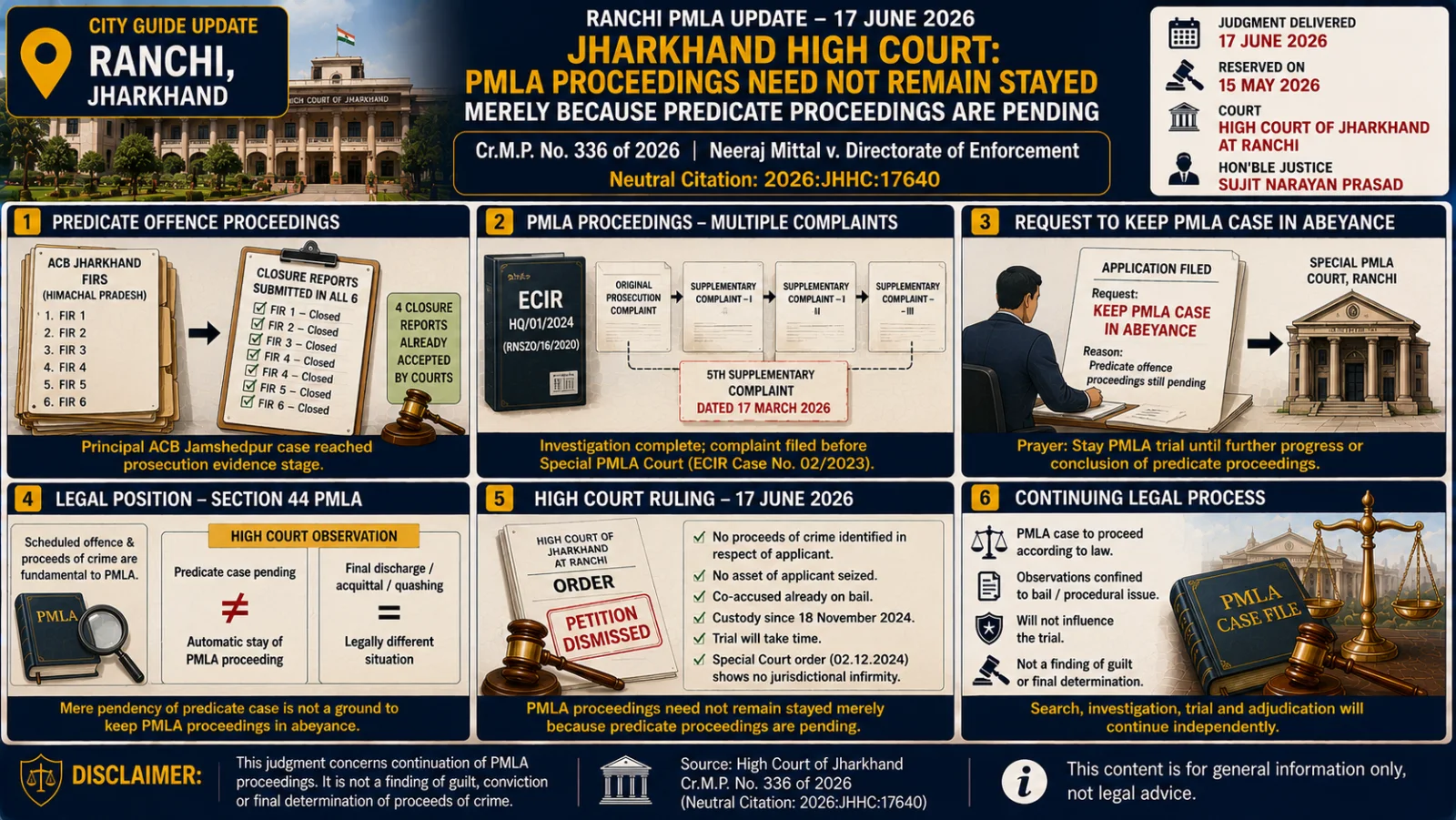
On 17 June 2026, the High Court of Jharkhand at Ranchi dismissed Cr.M.P. No. 336 of 2026, Neeraj Mittal v. Directorate of Enforcement, which challenged the Special PMLA Court’s refusal to keep ECIR Case No. 02/2023 in abeyance pending further progress in the scheduled-offence proceedings. The Court held that while the existence of a scheduled offence and proceeds of crime remains fundamental to a PMLA prosecution, investigation, enquiry or trial under the PMLA is not required to remain stayed merely because a predicate case is still under investigation or trial. It noted that the principal ACB Jamshedpur predicate case had already reached the prosecution-evidence stage and that neither the petitioner nor the principal accused had been finally discharged or acquitted. The Court also referred to successive supplementary prosecution complaints, including a fifth complaint filed on 17 March 2026, and held that the Special Court’s 2 December 2024 order disclosed no jurisdictional infirmity. The petition was dismissed. These observations concern the procedural continuation of the PMLA case and do not themselves amount to a finding of guilt.
Why it matters: This judgment is directly relevant to Ranchi because it reviews an order of the Special PMLA Court at Ranchi in ECIR/RNSZO/16/2020 and clarifies the relationship between PMLA proceedings and the underlying scheduled-offence process. It is useful where a defence seeks to stay or pause the PMLA trial because the predicate case has not yet concluded. Important records may include the predicate FIR and charge sheet, current trial stage, prosecution and supplementary complaints, cognizance orders, the impugned stay/abeyance order and material relied upon to identify proceeds of crime. The ruling distinguishes mere pendency of a predicate case from a final discharge, acquittal or quashing. It does not remove the requirement of a scheduled offence or proceeds of crime, and it does not determine guilt.

On 13 May 2026, the High Court of Jharkhand at Ranchi dismissed Criminal Revision Nos. 214 and 440 of 2026, which challenged orders of the Special Judge under the PMLA at Ranchi refusing discharge and framing charges in ECIR Case No. 07 of 2023, arising from ECIR/RNZO/04/2021. According to the prosecution case recorded in the judgment, the proceedings concern alleged laundering linked to a CBI Anti-Corruption Branch, Ranchi case involving tender-related transactions. The High Court held that the material disclosed a prima facie case and found no illegality warranting revisional interference. It reiterated that, at the discharge and charge-framing stage, the court examines whether sufficient grounds exist to proceed and does not conduct a mini-trial or finally weigh the evidence. The revisions were dismissed, but the High Court expressly clarified that its observations were only prima facie, were not findings on the merits, and must not influence the trial. Case-specific assessment requires review of the prosecution complaint, predicate-offence records, transaction documents, statements and the impugned orders under current law.
Why it matters: The decision is directly relevant to Ranchi PMLA proceedings because it concerns an ECIR bearing the Ranchi Zonal Office code, orders passed by the Special Judge under the PMLA at Ranchi and revisional scrutiny by the Jharkhand High Court. It illustrates the limited scope of interference at the discharge and charge-framing stage and the distinction between a prima facie basis for trial and proof of guilt. Important records may include the CBI FIR and charge sheet, ED prosecution complaint, bank statements, transaction chronology, invoices, alleged loan or advance records, Section 50 statements and material linking the accused to the alleged proceeds of crime. The judgment does not determine guilt, and its application depends on the complete case record and current law.

On 6 May 2026, the High Court of Jharkhand at Ranchi dismissed Criminal Revision Nos. 208 of 2025 and 120 of 2026, which challenged orders of the Special Judge under the PMLA at Ranchi rejecting discharge and framing charges in ECIR Case No. 02/2023. The prosecution case recorded in the judgment concerns alleged collection and laundering of tender-related commissions connected with Jharkhand’s Rural Works and associated departments. The High Court held that the material disclosed a prima facie basis to proceed and found no illegality requiring interference with the Special Court’s orders dated 3 and 7 December 2024. It reiterated that discharge and charge-framing proceedings do not permit a mini-trial or meticulous weighing of the prosecution evidence. The Court dismissed both revisions but expressly clarified that its observations were only prima facie, were not findings on the merits and must not influence the trial. Case-specific assessment requires the prosecution complaint, ECIR-linked records, statements, tender documents, transaction trail and impugned orders to be reviewed under current law.
Why it matters: The judgment is directly relevant to Ranchi PMLA proceedings because it reviews orders of the Special PMLA Court at Ranchi in a case involving the Ranchi Zonal Office. It explains the limited judicial inquiry at the discharge and charge-framing stage: the court examines whether sufficient prima facie material exists to continue the prosecution, not whether guilt has been proved. Records requiring careful examination may include the prosecution complaint, scheduled-offence papers, Section 50 statements, tender and work-order documents, alleged commission calculations, banking records and material connecting each accused with the alleged proceeds of crime. The decision does not determine guilt, and the trial must proceed independently on evidence and law.
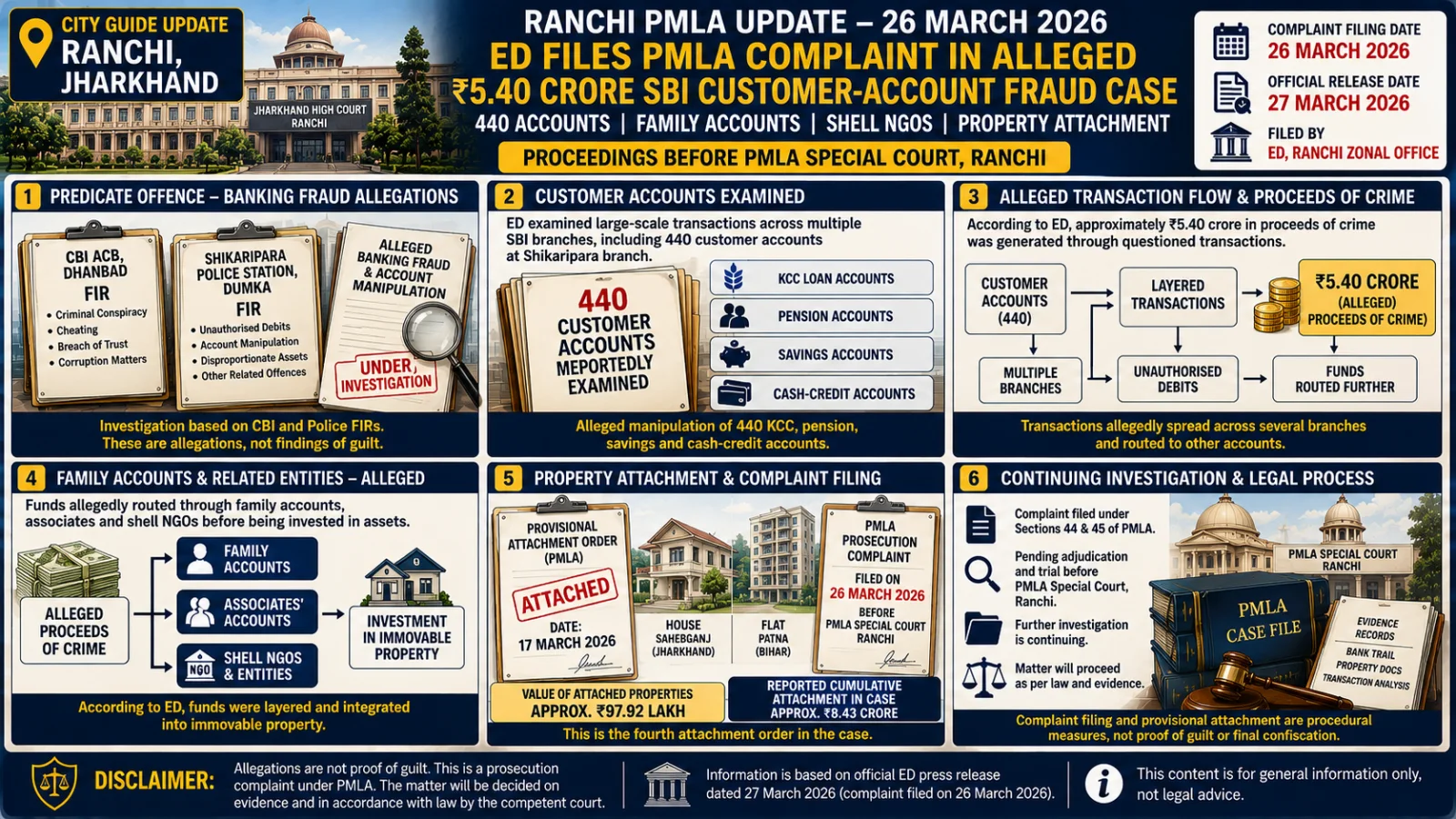
On 26 March 2026, the Directorate of Enforcement’s Ranchi Zonal Office filed a Prosecution Complaint under Sections 44 and 45 of the PMLA before the Special Judge, CBI-cum-Special Judge under PMLA, Ranchi, against a former State Bank of India branch manager and his spouse. The official release dated 27 March 2026 states that the investigation arose from CBI ACB, Dhanbad FIRs and a Shikaripara Police Station case concerning alleged unauthorised debits, manipulation of customer accounts and disproportionate assets. According to ED, approximately ₹5.40 crore in alleged proceeds was generated through questioned transactions across several SBI branches, including alleged manipulation of 440 KCC, pension, savings and cash-credit accounts at Shikaripara. ED further alleges that funds were routed through family accounts, associates and shell NGOs before being integrated into immovable property. The release records a Provisional Attachment Order dated 17 March 2026 covering a Sahebganj house and a Patna flat valued together at approximately ₹97.92 lakh; confirmation was stated to be pending. These are prosecution allegations and provisional measures, not findings of guilt. Case-specific review requires the FIRs, charge sheets, complaint, account-level audit trail, customer records, property papers, PAO and current law.
Why it matters: This development is directly relevant to Ranchi because the complaint was filed by ED’s Ranchi Zonal Office before the designated PMLA Special Court in Ranchi. It illustrates how alleged branch-level banking fraud may progress from customer-account analysis and predicate FIRs to family-account tracing, shell-entity review, property attachment and prosecution. Important records may include branch audit reports, core-banking logs, debit authorities, KCC and pension-account records, cash and transfer vouchers, user-access logs, family and associate account statements, NGO records, source-of-funds documents, property-acquisition papers, the PAO and prosecution complaint. Filing the complaint and provisionally attaching property do not establish guilt or final confiscation; individual role, knowledge, transaction authority, loss calculation and liability depend on the complete evidence and current law.

On 26 March 2026, the Directorate of Enforcement’s Ranchi Zonal Office filed a Prosecution Complaint under Sections 44 and 45 of the PMLA before the Special Judge, CBI-cum-Special Judge under PMLA, Ranchi, against four persons in a case concerning alleged bribery linked to coal transportation. The official release dated 27 March 2026 states that the investigation arose from a CBI Anti-Corruption Branch, Ranchi FIR and a charge sheet dated 9 December 2025. According to ED, an approximately ₹5 lakh payment from a private coal transporter was allegedly deposited into the bank account of a Central Coalfields Limited security official’s spouse in return for undue favours, while further unexplained deposits of about ₹4.46 lakh were also examined. ED further alleges that ₹4 lakh was transferred to a relative and rapidly dissipated through withdrawals, transfers and a vehicle-loan EMI. The release records provisional attachment of approximately ₹9.46 lakh held in two bank accounts. These are prosecution allegations and procedural measures, not findings of guilt. Case-specific review requires the FIR, charge sheet, complaint, bank trail, attachment records and current law.
Why it matters: This development is directly relevant to Ranchi because the complaint was filed by the Ranchi Zonal Office before the designated PMLA Special Court in Ranchi, and the predicate case was registered by CBI ACB, Ranchi. It illustrates how an alleged bribery payment connected with coal transportation may progress into examination of a spouse’s and relative’s bank accounts, transaction layering, provisional attachment and prosecution. Important records may include the CBI FIR and charge sheet, account statements, source explanations, transfer chronology, vehicle-loan records, the attachment order and the prosecution complaint. Filing the complaint and attaching funds do not establish guilt; liability depends on evidence, statutory compliance and the court process.
The Ranchi Zonal Office is listed by the Directorate of Enforcement at Hinoo, Ranchi. A notice issued from that office should be checked for the person’s stated capacity, the documents requested, the relevant entities and the time period under examination. Where the predicate record comes from the police, CBI, ACB or another agency, obtain and organise the available papers separately from ED communications.
Jharkhand matters can turn on operational records that ordinary financial summaries do not explain. Dispatch registers, e-way bills, royalty or permit papers, work measurements, invoices, weighment data, land documents and vendor records may be necessary to test the alleged transaction narrative.
Match production, dispatch, permit, royalty, weighment, transporter and payment records. Identify which entity performed each operational step and avoid treating every receipt in a connected supply chain as the same transaction.
Preserve tender conditions, work orders, measurement books, completion records, invoices, tax deductions, vendor payments and utilisation records. The response should distinguish contract performance disputes from the alleged generation or movement of proceeds of crime.
Land records should be arranged plot by plot, with title history, consideration, bank trail, possession and the purchaser’s independent income or funding source. Ancestral, family and business property require separate explanations.
Prepare a role chart showing decision-making authority, signing powers, access to accounts and the period of involvement. Designation alone should not substitute for evidence about knowledge, control or participation.
Not every matter reaches every stage. The correct response depends on the document actually received and the current statutory and judicial position.
No. PMLA application depends on the statutory ingredients, an alleged scheduled offence and proceeds of crime. The underlying record must be examined.
The complete summons is essential. It identifies the issuing authority, appearance date and often the documents or entities relevant to preparation.
An attachment may be challenged on the facts and law applicable to the asset. Title history, acquisition source, control and alleged connection with proceeds of crime must be analysed property by property.
The employee should preserve records, define the actual role and authority period, and avoid adopting explanations for decisions outside the employee’s knowledge.
No. The Ranchi address displayed is the official ED authority address. The website states Patna, Bihar as the primary professional base.