Kolkata city and state
Geographic contextInteractive city/state map. Use the authority map to locate the government office named in the official directory.
Kolkata is served by two Directorate of Enforcement zonal offices at the same Salt Lake address. A matter should be prepared according to the office named on the notice, the scheduled-offence record and the actual transaction trail—not merely the person’s residence or business address.
Short, sourced developments and practical preparation notes appear here. Full educational articles remain in the separate related-articles section.
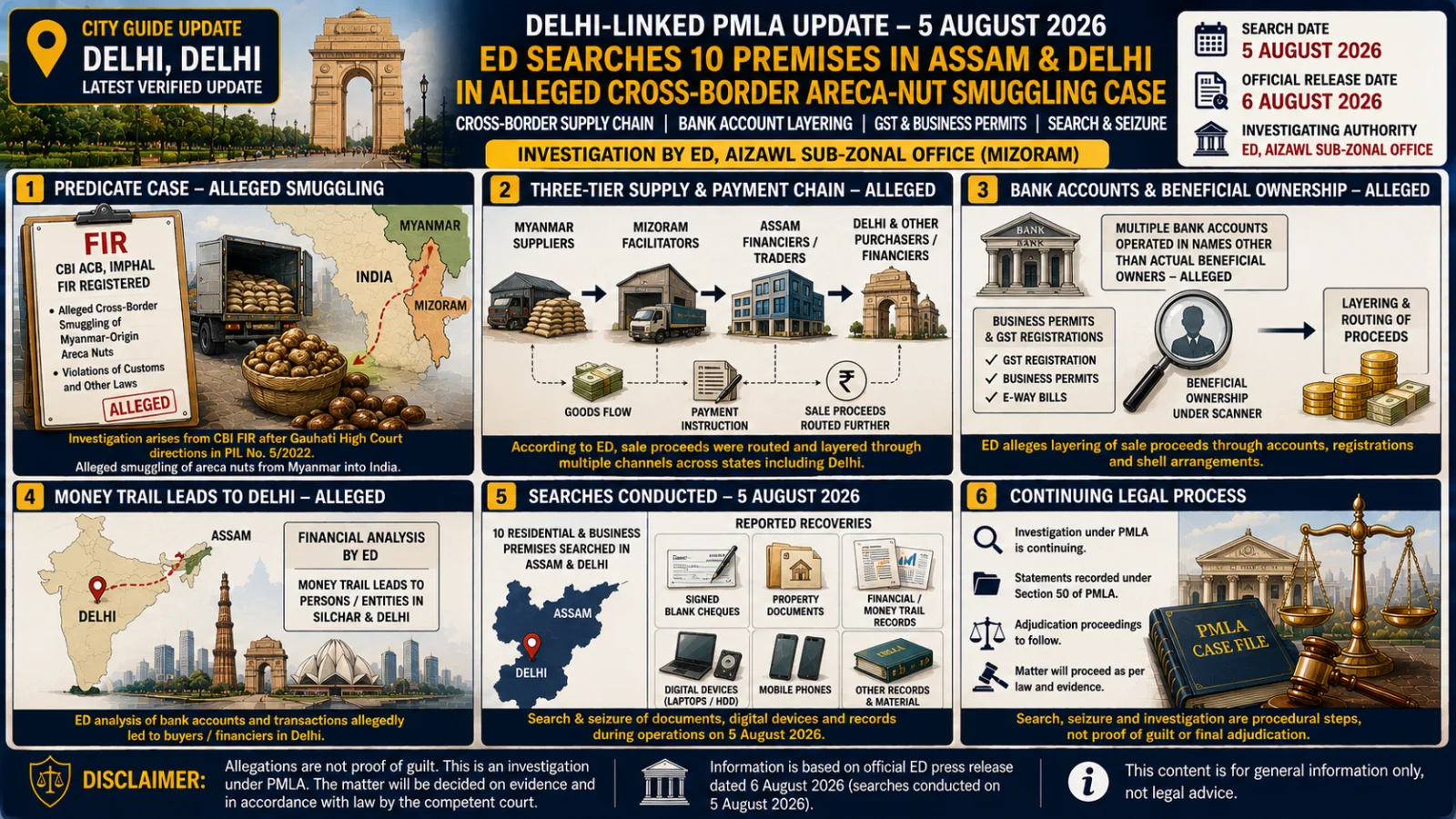
On 5 August 2026, the Directorate of Enforcement’s Aizawl Sub-Zonal Office conducted searches under Section 17(1) PMLA at ten residential and business premises in Assam and Delhi in an investigation concerning alleged cross-border smuggling of Myanmar-origin areca nuts. The official release dated 6 August 2026 states that the investigation arose from a CBI ACB, Imphal FIR registered pursuant to Gauhati High Court directions. According to ED, a three-tier supply and payment structure linked Myanmar suppliers and Mizoram facilitators with Assam-based financiers and purchasers in Delhi and other states. ED alleges that multiple bank accounts were operated in names other than the actual beneficial owners to route and layer sale proceeds, and that business permits and GST registrations were used in the trade. During the searches, signed blank cheques, property documents, other money-trail records, digital devices and mobile phones were reported recovered and seized. These are investigation-stage allegations and search recoveries, not findings of guilt. Case-specific review requires the FIR, search authorisation, panchnama, seizure inventory, bank trail, GST/e-way-bill records, ownership records and current law.
Why it matters: This development is directly relevant to Delhi because one of the ten searched premises was in Delhi, the official release identifies a Delhi-based purchaser/financier in the alleged supply chain, and the alleged money trail led from Mizoram and Assam to persons in Delhi. It illustrates how a cross-border smuggling predicate case may expand into PMLA scrutiny of beneficial ownership, bank-account control, GST registrations, e-way bills, property records and alleged layering of sale proceeds. Important records may include the CBI FIR, Gauhati High Court order, search authorisation, panchnama, seized-device inventory, bank statements, GST registrations, e-way bills, invoices, transport records, customs material and source-of-funds documents. Search and seizure do not establish guilt; the legal position depends on the complete record, procedural compliance and the alleged nexus with proceeds of crime.

On 31 July 2026, the Directorate of Enforcement’s Agartala Sub-Zonal Office issued a Provisional Attachment Order under the PMLA covering nine immovable properties and bank balances valued at approximately ₹1.05 crore in an alleged illegal IPL and cricket-betting investigation. The official release dated 1 August 2026 states that the case arose from an Amtali Police Station, Tripura FIR following a 2023 police search in which ₹93 lakh in cash, electronic devices, debit cards and notebooks containing alleged betting entries were recovered. According to ED, the investigated persons were part of an organised betting syndicate, and cash deposits and properties were accumulated without a documented legitimate source of income. The presently attached assets include agricultural and residential land in West Tripura and one property in Kolkata, West Bengal. ED states that this is the second Provisional Attachment Order and that cumulative attachment in the case has reached approximately ₹2.43 crore. These are agency allegations and provisional measures, not findings of guilt or final confiscation. Case-specific review requires the FIR, PAO, asset schedule, title records, bank statements, cash-source documents and current law.
Why it matters: This development is relevant to Kolkata because one of the immovable properties covered by the second Provisional Attachment Order is situated in the city, although the investigation and attachment were handled by ED’s Agartala Sub-Zonal Office and arose from a Tripura Police FIR. It illustrates how alleged betting proceeds may be traced through cash deposits, bank accounts and property acquisitions across state boundaries. Important records may include the predicate FIR, police-search inventory, notebooks and device records, source-of-funds material, bank statements, title and payment documents, ownership and control records, both PAOs and the asset schedules. Provisional attachment does not establish guilt or final confiscation; property-specific rights and remedies depend on the complete record, statutory timelines and current law.

On 24 July 2026, the Calcutta High Court allowed CRM (R) No. 13 of 2026 filed by the Directorate of Enforcement, Kolkata Zonal Office-I, and set aside a regular-bail order granted by the Chief Judge, City Sessions Court, Calcutta, in ML Case No. 11 of 2025. The High Court held that the Special Court had failed to apply the mandatory Section 45 PMLA twin conditions and had ignored material documentary and digital evidence relied upon by ED while assessing the accused’s alleged role in the Sahara-linked money-laundering case. The Court distinguished ordinary cancellation based on post-bail misconduct from cancellation where the original bail order is itself legally perverse or ignores statutory restrictions. It directed the accused to surrender before the designated Special Court within 72 hours and rejected a post-pronouncement request to stay the judgment. The underlying money-laundering allegations, including alleged cash ledgers and parallel transactions, remain matters for trial; cancellation of bail is not a conviction or final finding of guilt.
Why it matters: This ruling is directly relevant to Kolkata because the application was filed by ED’s Kolkata Zonal Office-I and concerned a bail order of the designated PMLA Special Court at the City Sessions Court, Calcutta. It is important for Section 45 practice because the High Court treated two routes to bail cancellation separately: later misconduct after release, and foundational illegality or perversity in the original bail order. The judgment indicates that post-release misconduct is not always necessary where the lower court ignored mandatory PMLA conditions or material evidence. Important records include the prosecution complaint, Section 17 search material, digital and physical ledgers, the Special Court bail order, custody history and the High Court judgment. The decision concerns bail and judicial review of the bail order; it does not finally determine guilt, admissibility of evidence or the ultimate proceeds-of-crime case.
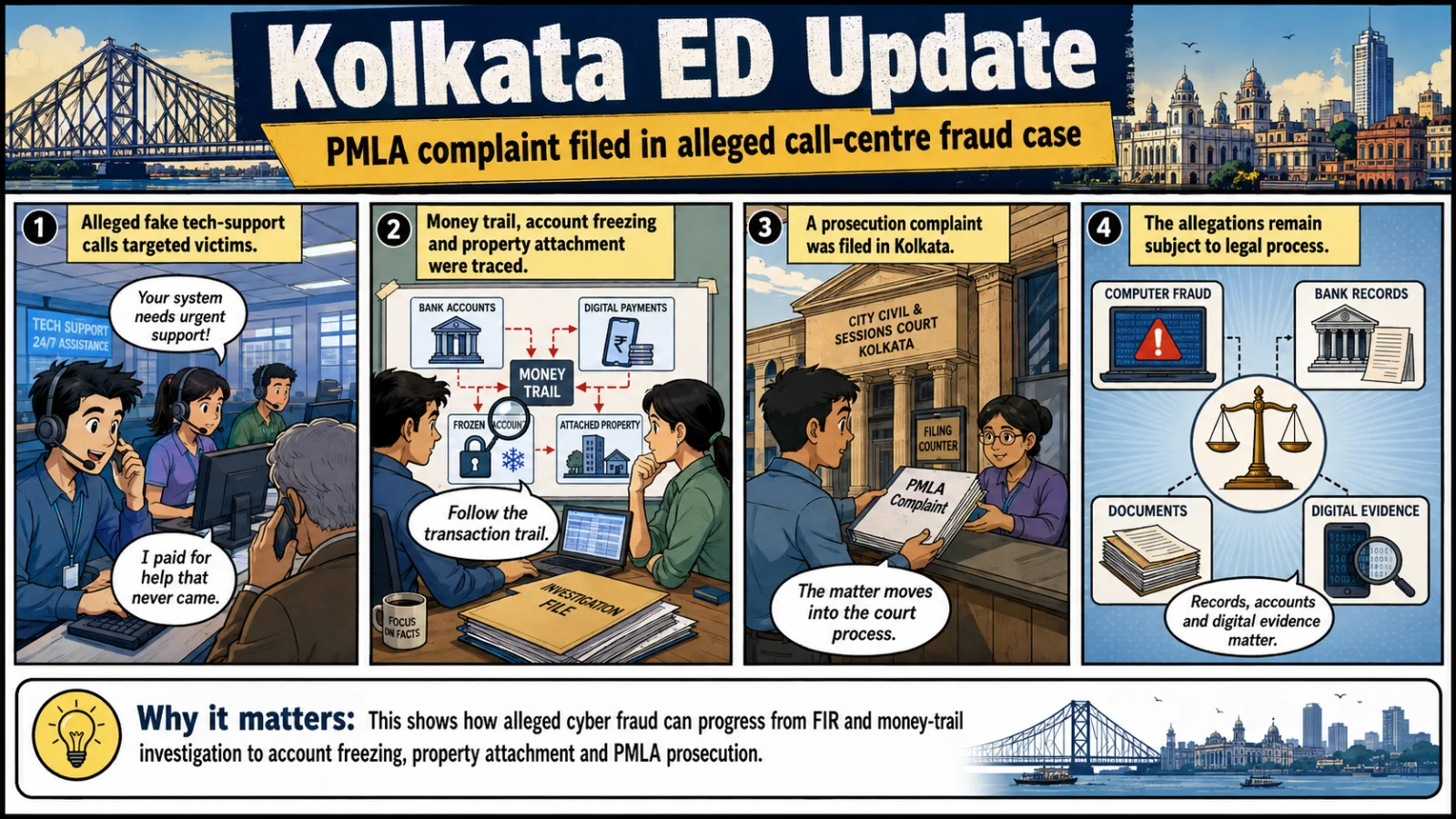
On 29 June 2026, the Directorate of Enforcement’s Kolkata Zonal Office filed a Prosecution Complaint under the PMLA before the Chief Judge, City Sessions Court, Kolkata, against VRM Business Services Pvt. Ltd., its director and others. The official release dated 3 July 2026 states that the investigation arose from a Bidhannagar Police FIR concerning an allegedly unauthorised call centre that impersonated service providers and induced foreign nationals to pay for non-existent software and technical-support services. According to ED, the company allegedly acquired at least ₹20.35 crore and deployed funds towards jewellery and immovable property. The release also records earlier seizure or freezing of valuables and bank accounts worth ₹2.35 crore and provisional attachment of property valued at ₹11.14 crore. These are the investigating agency’s allegations, not findings of guilt. Filing the prosecution complaint moves the matter into the court-prosecution stage, but case-specific assessment requires the complaint, relied-upon documents, FIR, digital records, account trail, attachment papers and current law.
Why it matters: This development is relevant to Kolkata because the investigating office, predicate FIR and court filing are all connected with the city and Bidhannagar. It shows how alleged call-centre impersonation and cross-border victim payments may progress from a cybercrime FIR to account freezing, property attachment and a PMLA prosecution complaint. Records requiring careful examination may include VoIP and device data, payment-gateway and bank statements, company-control records, victim communications, search and seizure inventories, the prosecution complaint and documents relied upon by ED. Filing a complaint does not establish guilt; cognisance, charge, evidence and available remedies depend on the complete court record and current law.
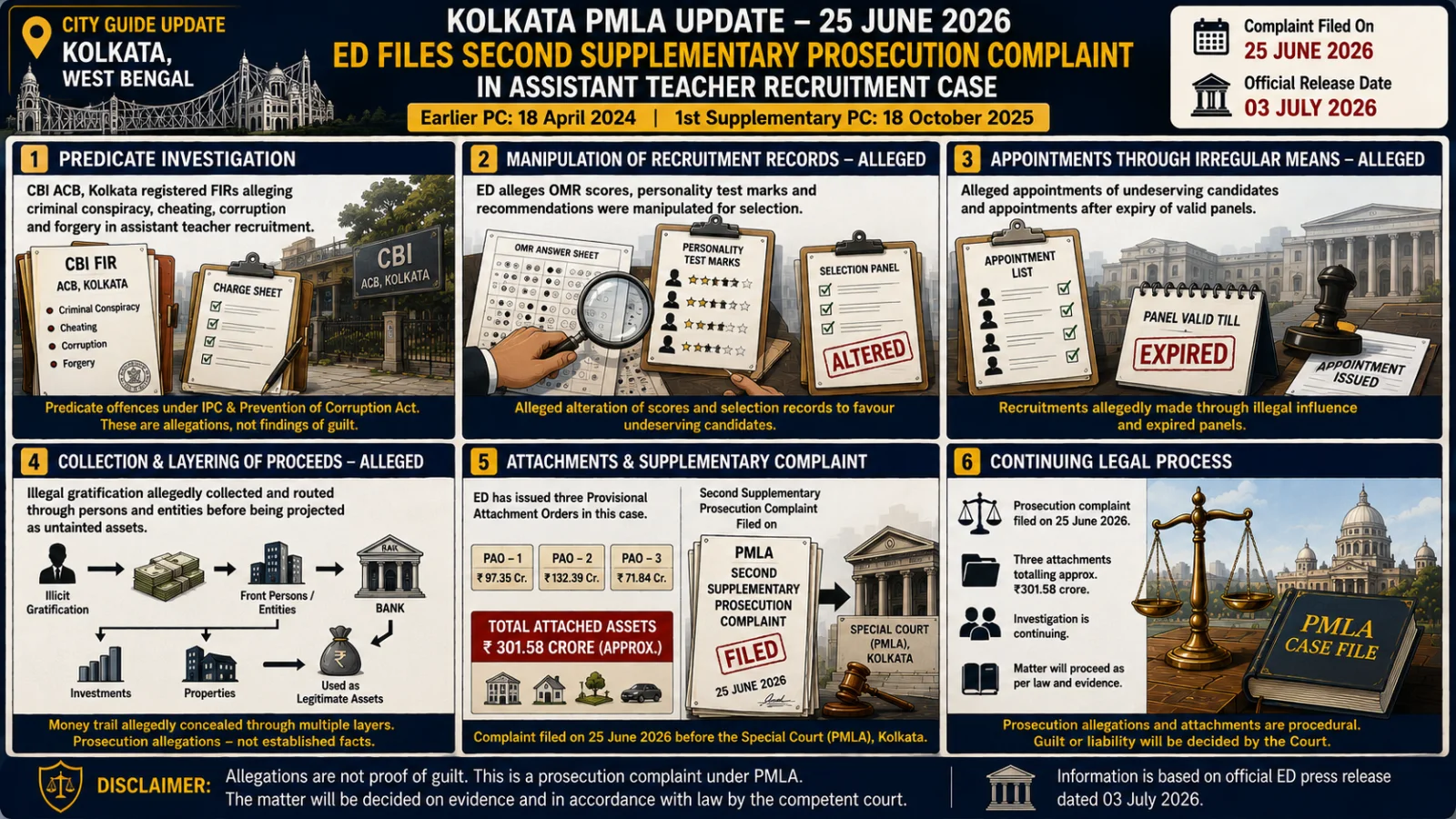
On 25 June 2026, the Directorate of Enforcement’s Kolkata Zonal Office filed a second Supplementary Prosecution Complaint under the PMLA before the Special Court (PMLA), Kolkata, in the West Bengal Central SSC Assistant Teacher Recruitment matter. The official release dated 3 July 2026 states that it continues the prosecution complaint filed on 18 April 2024 and the first supplementary complaint filed on 18 October 2025. According to ED, the investigation arose from CBI ACB, Kolkata FIRs concerning alleged irregularities in recruitment for Classes IX–X and XI–XII, including manipulation of OMR scores, alteration of personality-test marks, appointments of allegedly undeserving candidates and appointments after expiry of panels. ED alleges that illegal gratification was collected and routed through persons and entities before being projected as untainted assets. The release records three provisional attachment orders totalling approximately ₹301.58 crore in this assistant-teacher case. These are prosecution allegations, not findings of guilt. Review requires the complaints, relied-upon documents, CBI records, recruitment data, OMR material, transaction records and current law.
Why it matters: This development is directly relevant to Kolkata because the complaint was filed by the Kolkata Zonal Office before the Special PMLA Court in Kolkata, and the predicate FIRs were registered by CBI ACB, Kolkata. It shows how alleged recruitment irregularities may progress from predicate-offence investigation to asset tracing, provisional attachment and successive supplementary complaints. Important records may include candidate and panel data, OMR and personality-test records, appointment files, statements, alleged payment trails, entity-control documents, attachment orders and relied-upon material. Filing a supplementary complaint does not establish guilt; cognizance, charge, admissibility, individual role and liability depend on the complete court record and current law.

An official Directorate of Enforcement press release dated 20 April 2026 stated that the Kolkata Zonal Office was investigating alleged cross-border and domestic hawala transactions routed through multiple shell companies in a Kolkata-connected matter. This remains an investigating agency’s allegation and should not be treated as a judicial finding of guilt. When an ED summons, search, account-freezing communication or request for records concerns an alleged informal money trail, relevant bank statements, ledgers, invoices, remittance records, company-ownership documents, emails, messages and available device data should be preserved in their original form. Records should not be altered, selectively recreated or deleted. The notice, the capacity in which the person has been called and the requested period and documents require case-specific legal review before a response is prepared.
Why it matters: Hawala and money-laundering allegations often involve reconstruction of fund flows, beneficial ownership, alleged shell-entity links and the relationship between property under examination and the alleged scheduled offence. Timely preservation and chronological organisation of genuine records can help explain the source, destination and commercial purpose of transactions and distinguish documented activity from alleged layering or concealment. The correct legal response depends on the actual summons, the person’s stated capacity, available predicate-offence records and the latest applicable law. Investigation by itself does not establish guilt, and no result can be predicted without examining the complete record.
Kolkata matters can involve dense banking records, corporate structures, trade documentation, property transactions and digital communications. The first task is to separate the scheduled or predicate offence from the alleged laundering activity and then test how each identified asset or transaction is said to represent proceeds of crime.
A city reference does not decide legal jurisdiction by itself. The notice, ECIR-connected record, place of transaction, location of property, predicate case and competent forum must be examined together. Kolkata Zonal Office I and Kolkata Zonal Office II are authority offices; the map on this page does not identify a chamber of Advocate Ankit Kumar Singh.
Prepare account statements, sanction and security documents, board materials, utilisation records and a transaction-wise explanation. Separate ordinary commercial default from any allegation that funds were diverted, layered or used to acquire property.
Where the record includes exports, imports or foreign remittances, preserve invoices, shipping and customs records, authorised-dealer communications, contracts and ledger entries. FEMA and PMLA questions should not be treated as interchangeable.
Shareholding, directorship, control, related-party payments and the commercial purpose of each entity should be explained from contemporaneous records. A relationship between entities is not, by itself, proof that every transaction represents proceeds of crime.
For land, flats, securities or other assets, assemble the purchase source, payment trail, title record, possession material and the purchaser’s independent documents. A spouse, relative, employee, lender or bona-fide purchaser may require a separate property-specific response.
Not every matter reaches every stage. The correct response depends on the document actually received and the current statutory and judicial position.
No. It identifies the relevant Directorate of Enforcement authority office for public reference. The primary professional base stated on this website remains Patna, Bihar.
Check the issuing office, appearance date, capacity in which the person is called, documents requested and connection with the scheduled-offence and transaction records.
A PMLA case requires the statutory ingredients, including a scheduled offence and alleged proceeds of crime. The legal and factual record must be examined rather than assuming every default is money laundering.
Yes, but ownership, source of funds, consideration, control and the alleged link with proceeds of crime require asset-specific analysis.
No. Use only verified information appearing in the official record. A summons response should not invent or assume an ECIR number or scope.