Delhi city and state
Geographic contextInteractive city/state map. Use the authority map to locate the government office named in the official directory.
Delhi contains multiple ED institutional functions, including zonal investigation offices and separate headquarters or adjudication units. The office named on a communication and the legal stage of the matter must therefore be identified before any response or appearance is planned.
Short, sourced developments and practical preparation notes appear here. Full educational articles remain in the separate related-articles section.

On 5 August 2026, the Directorate of Enforcement’s Delhi Zonal Office announced the provisional attachment of 45 immovable properties at Rani Khera, Ghewra and Hira Kudna, Delhi, in the PACL investigation. The official release states that the properties belong to three related real-estate companies and have a stated current market value of approximately ₹999.6 crore. ED says the investigation arose from a CBI, New Delhi FIR and charge sheets concerning an alleged collective-investment scheme through which more than ₹48,000 crore was mobilised from investors on representations concerning agricultural land. According to the release, land was not delivered in many cases and approximately ₹48,000 crore remains unpaid to investors. ED alleges that the attached properties were financed using investor funds diverted from PACL. The agency also reports that its cumulative attachment in the case has reached approximately ₹29,625.63 crore. These are agency allegations and a provisional measure, not findings of guilt or final confiscation. Case-specific review requires the attachment order, property schedules, title records, company accounts, CBI papers and current law.
Why it matters: This development is directly relevant to Delhi/New Delhi/NCR because the attached properties are situated at Rani Khera, Ghewra and Hira Kudna in Delhi, the action was announced by ED’s Delhi Zonal Office, and the predicate FIR was registered by CBI, New Delhi. It illustrates how an alleged collective-investment fraud may progress from investor records and charge sheets to property tracing, provisional attachment and continuing prosecution. Important records may include investor agreements, powers of attorney, land-allotment records, company ownership and beneficial-control documents, fund-flow statements, acquisition sources, valuation material, the attachment order and pending court papers. Provisional attachment restricts dealing with identified assets but does not establish guilt or final confiscation; affected rights and remedies depend on the complete record, statutory timelines and current law.

The development is directly relevant to Delhi because the operations covered eight premises in the city and the records include Delhi police FIRs and Delhi-NCR real-estate transactions. It shows how complaints about delayed possession, assured returns and alleged diversion of buyer funds may progress from predicate-offence FIRs to an ECIR, searches, device seizure and money-trail review under the PMLA. Records requiring examination may include buyer agreements, allotment and possession records, audited financials, Tally data, related-party advances, insolvency papers, search inventories and custody records for seized devices. Search or seizure does not establish guilt; the legal position depends on the complete record, transaction evidence, procedural compliance and later proceedings.
Why it matters: The development is directly relevant to Delhi because the operations covered eight premises in the city and the records include Delhi police FIRs and Delhi-NCR real-estate transactions. It shows how complaints about delayed possession, assured returns and alleged diversion of buyer funds may progress from predicate-offence FIRs to an ECIR, searches, device seizure and money-trail review under the PMLA. Records requiring examination may include buyer agreements, allotment and possession records, audited financials, Tally data, related-party advances, insolvency papers, search inventories and custody records for seized devices. Search or seizure does not establish guilt; the legal position depends on the complete record, transaction evidence, procedural compliance and later proceedings.

On 17 July 2026, the Directorate of Enforcement’s Patna Zonal Office conducted PMLA searches at 12 locations in Sri Ganganagar, Jaipur, Delhi, Gurugram, Patna and Banka in an investigation concerning Mahadev Enclave Pvt. Ltd. The official release dated 18 July 2026 states that the investigation arises from FIRs registered in Banka regarding alleged large-scale illegal sand mining. According to ED, an IIT Patna geospatial analysis indicated that the approximate value of sand allegedly excavated without lawful reporting exceeded ₹131 crore during financial years 2015–16 to 2022–23. ED reported recovery and seizure of approximately ₹2.92 crore in cash, together with sale deeds, bank-account information, cheques, loan agreements, investment records and digital evidence. The release also refers to information shared under Section 66(2) PMLA and a subsequent Mines and Geology Department FIR dated 21 August 2025. These are investigation-stage allegations and search recoveries, not findings of guilt. Case-specific review requires the FIRs, search authorisation, panchnama, seizure inventory, mining records, geospatial report, banking trail and current law.
Why it matters: This development is relevant to New Delhi/NCR because the coordinated search operation expressly included premises in Delhi and Gurugram, although the investigation is being handled by ED’s Patna Zonal Office. It illustrates how an alleged illegal-mining predicate offence may lead to multi-state searches and examination of property, banking, loan, investment and digital records under the PMLA. Important issues may include the legal basis and territorial scope of the searches, custody of seized material, ownership and source of recovered cash, company-control records, mining-volume calculations and the alleged nexus with proceeds of crime. Search and seizure do not establish guilt; the legal position depends on the complete record, procedural compliance and later proceedings.
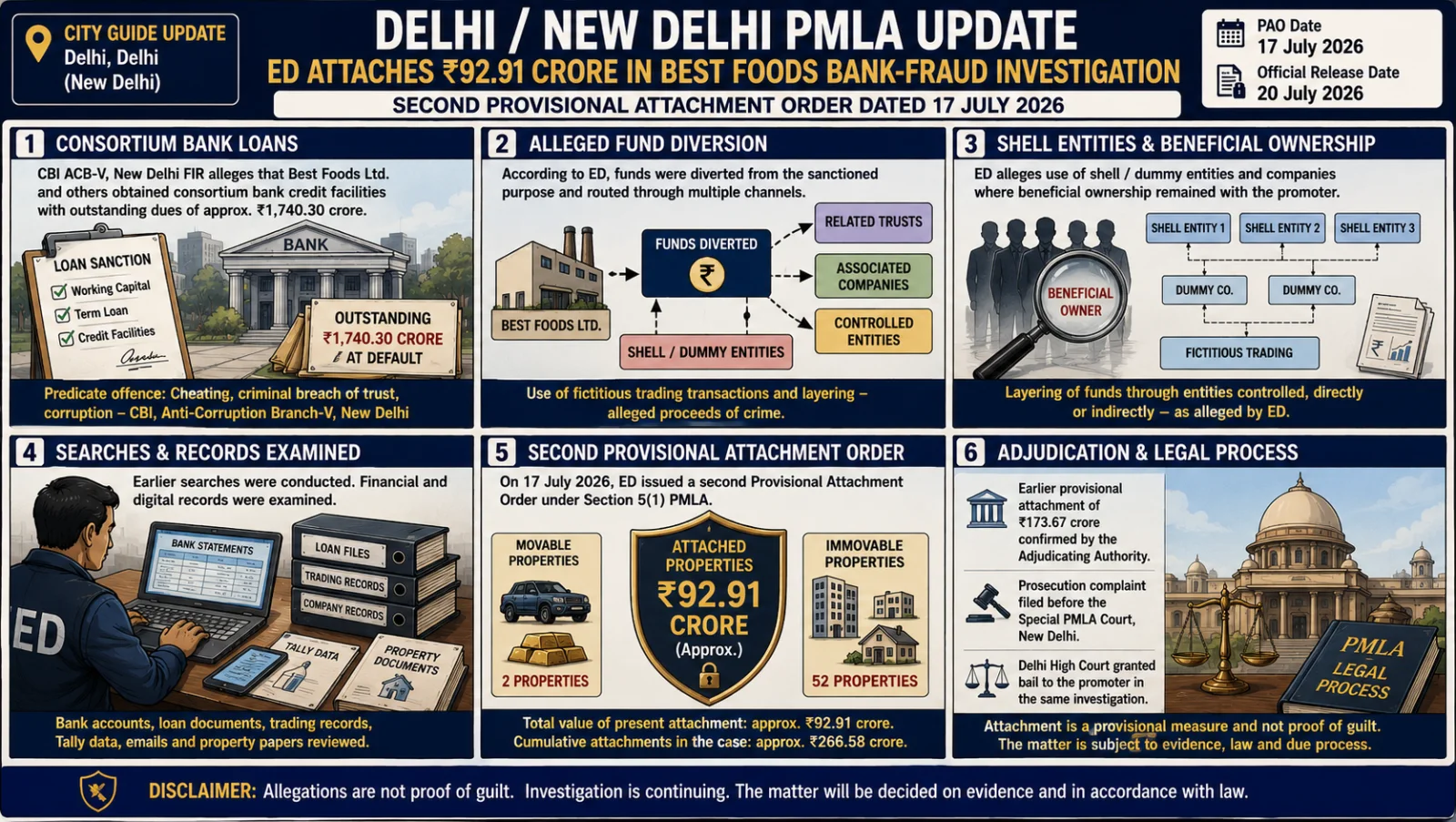
On 17 July 2026, the Directorate of Enforcement’s Headquarters Investigation Unit issued a second Provisional Attachment Order under Section 5(1) PMLA, attaching two movable and 52 immovable properties valued at approximately ₹92.91 crore in the Best Foods Ltd. investigation. The official release dated 20 July 2026 states that the case arises from a CBI Anti-Corruption Branch-V, New Delhi FIR concerning alleged diversion of consortium-bank credit facilities, with outstanding dues of approximately ₹1,740.30 crore at default. According to ED, funds were allegedly routed through shell and dummy entities, fictitious trading transactions and controlled companies, while beneficial ownership remained with the investigated promoter. The release records an earlier ₹173.67 crore attachment confirmed by the Adjudicating Authority, a prosecution complaint before the Special PMLA Court, New Delhi, and cumulative attachment of approximately ₹266.58 crore. These are ED allegations and provisional measures, not findings of guilt or final confiscation. Case-specific review requires the FIR, PAOs, asset schedules, ownership records, banking trail, prosecution complaint and current law.
Why it matters: This development is relevant to Delhi/New Delhi because the predicate FIR was registered by CBI Anti-Corruption Branch-V, New Delhi, the prosecution complaint is before the Special PMLA Court, New Delhi, and the release records a Delhi High Court bail order. It illustrates how an alleged bank-fraud money trail may progress through searches, freezing, adjudication and repeated provisional attachment. Records requiring examination may include loan-sanction and end-use documents, trading invoices, shell-entity and beneficial-ownership records, bank deposits, property papers, both PAOs, the confirmation order and the prosecution complaint. Provisional attachment does not establish guilt or final confiscation; remedies depend on the complete record, statutory timelines and current law.
The official directory lists Delhi Zonal Office I and Delhi Zonal Office II at Pravartan Bhawan on Dr. APJ Abdul Kalam Road. Other ED units in Delhi perform different functions. A summons from a zonal office, an attachment-related notice and an appellate matter should not be treated as the same process merely because all are connected with Delhi.
Delhi-linked records may involve corporate groups, payment systems, virtual digital assets, cross-border transfers, investment structures, digital devices and properties across several states. A useful defence file follows the legal stage and the transaction, preserving source data before producing summaries or explanations.
Check whether the communication comes from a zonal investigation office, headquarters, an adjudication function, a Special Court or an appellate forum. The reply, limitation and documents depend on that distinction.
Preserve onboarding, KYC, merchant, settlement, wallet, device, access-log and reconciliation material. Identify whether the person controlled the system, used it, provided a service to it or merely appeared in a transaction chain.
Retain exchange statements, wallet identifiers, transaction hashes, banking ramps, invoices, agreements and beneficial-ownership information. A technical transaction map should accompany the legal chronology.
Prepare entity and asset charts showing jurisdiction, ownership, source and control. Do not combine unrelated properties or companies merely because they appear in a common investigation record.
Not every matter reaches every stage. The correct response depends on the document actually received and the current statutory and judicial position.
No. The official directory lists separate institutional functions. The issuing unit and procedural stage must be verified from the communication.
They are not identical documents or processes. The relationship with the scheduled offence and the current legal position should be examined from verified records.
Preserve exchange exports, wallet addresses, transaction hashes, banking entries, device and access records, and documents explaining ownership and purpose.
Depending on the facts and statutory basis, assets in different states may be examined. Each asset still requires separate ownership, source and nexus analysis.
No. The displayed address is the relevant ED authority address. Advocate Ankit Kumar Singh’s primary professional base remains Patna, Bihar.