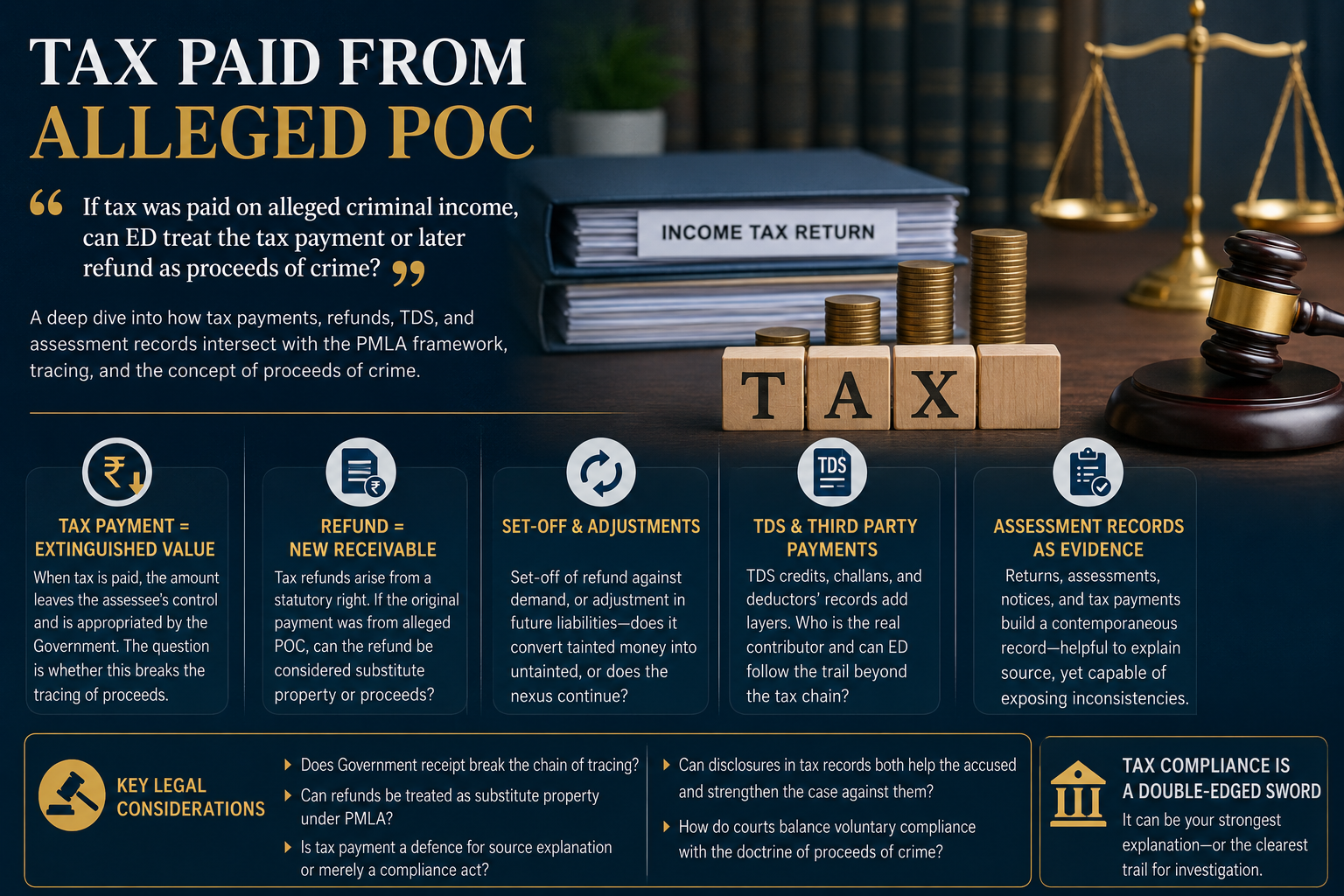
PMLA • Tax Payment • Income-Tax Refund • TDS • Equivalent Value • Money Trail
Tax Paid From Alleged POC Under PMLA: “If Tax Was Paid on Alleged Criminal Income, Can ED Treat the Tax Payment or Later Refund as Proceeds of Crime?”
Research and legal analysis by Advocate Ankit Kumar Singh
Updated and legally reviewed: 23 August 2026
Direct Answer
Paying tax on money later alleged to be proceeds of crime does not automatically make that money legitimate under PMLA.
But the opposite proposition is also too simplistic:
Money genuinely paid to the Government as tax is no longer the same money physically held by the taxpayer.
Accordingly, four questions must be separated:
1. WHAT WAS THE ORIGINAL POC?

2. WHAT PART WAS ACTUALLY PAID AS TAX?

3. WHAT VALUE REMAINS AVAILABLE
   FOR ATTACHMENT OR EQUIVALENT-VALUE ACTION?

4. IF A REFUND LATER ARISES,
   WHAT CREATED THAT REFUND?
The central distinctions are:
TAX PAYMENT ≠ PMLA IMMUNITY
TAX PAYMENT ≠ AUTOMATIC “CLEANSING” OF POC
TAX ALREADY VESTED WITH GOVERNMENT ≠ MONEY STILL PHYSICALLY POSSESSED BY TAXPAYER
LATER REFUND ≠ AUTOMATICALLY CLEAN OR AUTOMATICALLY TAINTED
A later refund requires its own derivation analysis.
Contents
- Four separate PMLA layers
- Original proceeds-of-crime value
- What happens when tax is paid?
- Jagati Publications
- Tax payment does not grant immunity
- Equivalent-value attachment
- Tax refund as a new receivable
- TDS and tax credits
- Refund set-off
- Assessment and disclosure records
- Legitimate vs fraudulent refunds
- Mixed-source tax payments
- Evidence checklist
- Frequently asked questions
1. The Four Layers That Must Not Be Confused
Consider:
ALLEGED CRIMINAL INCOME
₹10 CRORE

        ↓

INCOME TAX / ADVANCE TAX / TDS
₹3 CRORE

        ↓

NET VALUE REMAINING
₹7 CRORE

        ↓

LATER TAX REFUND
₹50 LAKH
There are four different legal events.
Layer A — Generation
Was ₹10 crore actually derived or obtained as a result of criminal activity relating to a scheduled offence?
Layer B — Tax Payment
Was ₹3 crore genuinely transferred to the Government in satisfaction of tax liability?
Layer C — Attachment Value
If ₹3 crore is no longer with the person, can equivalent property still be attached? Can the same value be counted twice?
Layer D — Refund
If ₹50 lakh returns after assessment, what exactly does it represent?
A defensible PMLA analysis must answer each layer separately.
2. Start With Section 2(1)(u): What Was Actually Derived From the Scheduled Offence?
The tax question comes second.
The first question remains:
WHAT PROPERTY WAS GENERATED BY THE CRIMINAL ACTIVITY?
Section 2(1)(u) PMLA focuses on property derived or obtained, directly or indirectly, as a result of criminal activity relating to a scheduled offence, together with the statutory value limb.
Therefore:
UNACCOUNTED INCOME
≠
AUTOMATIC POC

TAXABLE INCOME
≠
AUTOMATIC POC

HIGH INCOME
≠
AUTOMATIC POC

PROPERTY MUST HAVE THE
STATUTORY SCHEDULED-OFFENCE NEXUS.
The Supreme Court's reasoning in Vijay Madanlal Choudhary remains fundamental to this distinction.
3. Illegal Source and Taxability Are Separate Legal Questions
A tax authority may assess income for fiscal purposes.
ED asks a different question under PMLA:
Was the property generated from criminal activity relating to a scheduled offence?
Therefore:
TAXABLE
DOES NOT NECESSARILY MEAN
LEGITIMATE

AND

UNACCOUNTED
DOES NOT NECESSARILY MEAN
PROCEEDS OF CRIME.
The Telangana High Court in 2026 reiterated the principle that unaccounted property acquired through legal means may create tax consequences but does not become proceeds of crime merely for that reason unless the required scheduled-offence derivation exists.
4. What Happens to the Money When Tax Is Actually Paid?
Suppose ED alleges:
ALLEGED POC GENERATED: ₹5 CRORE

ADVANCE TAX PAID: ₹1 CRORE

BALANCE RETAINED: ₹4 CRORE
Three propositions become possible.
Proposition One — Historical Generation
The original amount generated from the alleged scheduled criminal activity may still have been ₹5 crore.
Proposition Two — Present Possession
After ₹1 crore has genuinely been credited to the Government as tax, that ₹1 crore is no longer sitting in the taxpayer's bank account.
Proposition Three — Equivalent Value
The absence of the original ₹1 crore does not automatically prevent ED from invoking the statutory “value of any such property” concept in an appropriate case.
This is why:
“Tax was paid, therefore POC becomes only ₹4 crore.”
is not automatically correct.
Nor is:
“We can attach ₹5 crore elsewhere and separately treat the ₹1 crore already collected by Government as another ₹1 crore of recoverable POC.”
automatically correct without examining valuation and double-counting.
5. Jagati Publications: The Most Direct Tax-Payment PMLA Authority
The Appellate Tribunal's 26 July 2019 decision in the connected Jagati Publications / Nimmagadda Prasad appeals directly considered tax paid on amounts sought to be taken into account for PMLA attachment.
The appellants argued that amounts paid to the Government as capital-gains/income tax should be deducted from the amount treated as available proceeds.
The Tribunal's reasoning recognised that tax already paid to the Government was not an amount still in the appellants' possession and that counting such tax again could produce double appropriation by the Government.
The analytical principle is important:
POC VALUE GENERATED
        ≠
MONEY CURRENTLY POSSESSED

AND

MONEY ALREADY VESTED
WITH GOVERNMENT
SHOULD NOT BE
MECHANICALLY COUNTED TWICE.
But this is not a universal Supreme Court rule that paying tax destroys the PMLA character of the original criminal property.
6. February 2026: Paying Tax Does Not Confer PMLA Immunity
The opposite side of the issue appears in Shri Lokesh Makin v. Deputy Director, Directorate of Enforcement, decided by the Appellate Tribunal on 5 February 2026.
The appellant relied upon voluntary declaration, payment of tax and penalty and investment under a Government fiscal scheme.
The Tribunal held that no PMLA immunity arises merely because tax has been paid under a separate fiscal framework if money-laundering is otherwise established.
Therefore:
PAYMENT OF TAX
        ↓
MAY SHOW FISCAL COMPLIANCE

BUT DOES NOT
        ↓
ERASE KNOWING
PLACEMENT / LAYERING /
CONCEALMENT / USE
IF OTHERWISE PROVED.
7. Jagati and Lokesh Makin Are Addressing Different Questions
| Issue | Jagati Publications | Lokesh Makin 2026 |
|---|---|---|
| Primary issue | Attachment / computation / tax already paid | Whether fiscal declaration/tax payment defeats PMLA action |
| Tax payment | Money vested with Government was not still possessed by taxpayer | Does not provide statutory immunity |
| Key danger | Double appropriation | Using tax compliance as laundering defence |
| Correct lesson | Separate possession from original value | Separate tax compliance from PMLA liability |
8. Equivalent-Value Attachment Changes the Tax-Payment Debate
Section 2(1)(u) does not stop at the actual property directly generated from crime.
It also refers to:
the value of any such property.
Current Supreme Court jurisprudence recognises the ability to proceed against equivalent-value property where direct proceeds are unavailable, subject to the statutory framework.
Therefore this defence is too broad:
“I paid the whole amount as tax, so ED has nothing left to attach.”
Dissipation or statutory payment does not necessarily end the value-based inquiry.
But equivalent-value attachment does not answer the separate question of double counting.
9. Gross POC vs Net-of-Tax POC — Which Figure Is Correct?
This is likely to become one of the most difficult issues in a serious financial PMLA case.
Example:
ALLEGED CRIMINAL RECEIPT: ₹100 CRORE

INCOME TAX PAID: ₹30 CRORE

NET RETAINED: ₹70 CRORE
ED Theory Could Be:
The scheduled offence generated ₹100 crore. Tax payment is merely a subsequent use of that value.
Defence Theory Could Be:
Even if the original gross generation was ₹100 crore, the Government already obtained ₹30 crore as tax. Attachment/confiscation calculations cannot be structured in a way that enables duplicate appropriation of the same ₹30 crore value.
Those are different issues:
ORIGINAL POC QUANTUM

VERSUS

CURRENTLY AVAILABLE PROPERTY

VERSUS

EQUIVALENT VALUE

VERSUS

ULTIMATE CONFISCATION / RECOVERY.
A proper pleading should identify which figure is being disputed.
10. A Later Tax Refund Is a New Property Event
A tax refund should not be conceptualised as the Government physically returning the same currency notes previously paid.
The current Income-tax Act, 2025 provides that if tax paid or treated as paid exceeds the amount properly chargeable, the person becomes entitled to refund of the excess.
That creates a statutory receivable.
In PMLA terms, the broad definition of “property” makes such an enforceable receivable capable of being examined as intangible property or an interest having value.
But the next question is still:
WAS THE REFUND RECEIVABLE DERIVED, DIRECTLY OR INDIRECTLY, FROM THE ORIGINAL ALLEGED POC?
11. The Refund-Origin Test
Before ED calls a refund proceeds of crime, reconstruct why it arose.
| Reason for Refund | PMLA Question |
|---|---|
| Excess TDS on alleged criminal receipt | Strongest possible substitution/tracing question |
| Advance tax paid from mixed bank account | Requires source segregation |
| Refund from legitimate salary/business income | Separate legitimate-source evidence may break alleged nexus |
| Appellate reduction of tax on questioned income | Analyse whether returned value represents part of original tax payment |
| Refund because of losses/deductions from unrelated activity | Allocation may be more complex |
| Fraudulent refund claim | Entirely separate criminal-origin analysis |
12. Example: Refund Closely Traceable to the Original Tax Payment
Suppose:
ALLEGED POC: ₹1 CRORE

TDS ON SAME RECEIPT: ₹10 LAKH

FINAL TAX LIABILITY: ₹4 LAKH

REFUND: ₹6 LAKH
ED may argue:
The ₹6 lakh refund represents value that originated in the gross allegedly tainted receipt, was temporarily held by Government through TDS and then returned.
That creates a plausible indirect-derivation theory.
But the defence should still test:
- whether the gross ₹1 crore was actually POC;
- whether the TDS related only to that receipt;
- whether other tax credits affected the refund;
- whether losses/deductions changed the computation;
- whether the refund belonged to another assessment component; and
- whether ED's calculation double counts the ₹6 lakh elsewhere.
13. Example: Mixed Tax Credits Produce the Refund
Suppose:
LEGITIMATE BUSINESS TDS: ₹20 LAKH

ALLEGED POC-RELATED TDS: ₹5 LAKH

ADVANCE TAX FROM
LEGITIMATE ACCOUNT: ₹10 LAKH

TOTAL TAX CREDIT: ₹35 LAKH

FINAL LIABILITY: ₹25 LAKH

REFUND: ₹10 LAKH
Which ₹10 lakh generated the refund?
A mechanical assertion that the whole refund is POC may be difficult without an allocation/tracing methodology.
The analysis should reconstruct the tax computation rather than merely observe that:
“An accused received an income-tax refund.”
14. TDS Creates a Special Tracing Problem
Tax deducted at source differs from an ordinary voluntary transfer.
Under the current Income-tax framework, tax deducted and paid to the Central Government is treated as payment on behalf of the person from whose income it was deducted.
Example:
GROSS RECEIPT: ₹50 LAKH

TDS: ₹5 LAKH

NET CASH RECEIVED: ₹45 LAKH

TAX CREDIT: ₹5 LAKH
If the ₹50 lakh gross receipt is alleged POC, the following questions arise:
- Was POC generated at ₹50 lakh gross or ₹45 lakh net?
- Is the ₹5 lakh tax credit an intangible economic interest?
- What happens if the full ₹5 lakh is ultimately absorbed as tax?
- What happens if ₹3 lakh is refunded?
- What happens if the credit is adjusted against another demand?
There is no sensible answer without the assessment computation.
15. Current Income-tax Act, 2025 — Why the New Section Numbers Matter
From 1 April 2026, the Income-tax Act, 2025 forms the current statutory framework.
Important provisions for this PMLA analysis include:
| Provision | Tax Function | PMLA Relevance |
|---|---|---|
| Section 390(5) | TDS/TCS or specified tax payment treated as payment on behalf of relevant person | Identifies taxpayer's credit/value even where cash was withheld at source |
| Section 410 | Advance-tax credit | Useful for source and timing reconstruction |
| Section 431 | Refund of excess tax | Creates the refund entitlement/receivable |
| Section 437 | Interest on refunds | Raises separate derivative/accretion question |
| Section 438 | Set-off and withholding of refunds | Refund may discharge liability without cash being returned |
Legacy proceedings and rights arising for periods before 1 April 2026 may continue under the Income-tax Act, 1961 pursuant to the repeal-and-savings provisions.
16. Refund Set-Off: No Cash Returns, but Value Is Used
Section 438 permits a refund to be set off against an amount remaining payable under the Income-tax Act.
Suppose:
REFUND DUE: ₹40 LAKH

OLD TAX DEMAND: ₹40 LAKH

SECTION 438 SET-OFF
        ↓

CASH REFUND: ₹0

OUTSTANDING LIABILITY REDUCED: ₹40 LAKH
Economically, the taxpayer receives value through extinguishment of liability rather than cash.
A sophisticated PMLA analysis may therefore ask:
- Was the refund receivable itself derived from POC?
- Did set-off constitute “use” of that value?
- Did the receivable cease to exist upon set-off?
- Is equivalent-value property still relevant?
- Would any further attachment create duplicate recovery?
No universal PMLA precedent appears to provide a mechanical answer for every tax-refund set-off scenario.
17. Refund Withheld During Assessment: Is an Unpaid Refund Still “Property”?
The Income-tax Act permits withholding of a refund in specified circumstances involving pending assessment or reassessment.
This creates another distinction:
REFUND COMPUTED
        ↓
BUT NOT RELEASED
        ↓
STATUTORY RECEIVABLE / CLAIM
        ↓
NO CASH CREDIT YET
Because PMLA defines property broadly, an enforceable financial entitlement can be relevant even before physical cash reaches the bank account.
But whether that receivable is POC still depends upon the derivation test.
18. Interest on Income-Tax Refund: New Income or Derived Value?
Section 437 of the Income-tax Act, 2025 provides for interest on specified refunds.
Suppose:
REFUND PRINCIPAL: ₹10 LAKH

STATUTORY REFUND INTEREST: ₹80,000
Two different questions arise:
- Is the ₹10 lakh refund traceable to alleged POC?
- What is the character of the ₹80,000 statutory interest generated because Government retained excess tax?
The interest is an economic accretion arising from the refund entitlement.
ED may attempt an indirect-derivation theory.
A defence may argue that statutory interest is a new legally generated payment arising from Government's retention of excess tax rather than the scheduled offence itself.
No direct binding Supreme Court authority has been identified resolving this precise refund-interest question under PMLA.
It should therefore remain an expressly open analytical issue.
19. Income-Tax Records Can Be Powerful Defence Evidence
Tax documents can establish chronology.
Useful material includes:
- income-tax returns;
- computation of income;
- AIS;
- Form 26AS or corresponding current tax statements;
- TDS certificates;
- advance-tax challans;
- self-assessment tax challans;
- assessment orders;
- reassessment orders;
- rectification orders;
- appellate orders;
- demand notices;
- refund computation;
- refund bank-credit record;
- Section 438 set-off communication;
- refund-withholding communication;
- books of account; and
- audited financial statements.
They may prove that the source explanation existed years before the ED investigation.
20. But Tax Records Can Also Expose the Defence
The same records may reveal:
- income declared under a category inconsistent with later explanation;
- payer not matching the alleged source;
- TDS deducted by a supposedly unrelated entity;
- return filed after investigative action;
- large revised return after search;
- bogus expenses;
- unexplained capital gains;
- incorrect beneficial ownership;
- false loan characterisation;
- refund based upon a questioned claim; or
- large tax credits inconsistent with the stated business.
Therefore:
TAX DISCLOSURE CAN BE BOTH A DEFENCE DOCUMENT AND A CROSS-EXAMINATION DOCUMENT.
21. Paying Tax Does Not Prove the Underlying Source Was Legal
A taxpayer should avoid this argument:
“The Income Tax Department accepted my return, therefore ED cannot call the money proceeds of crime.”
Tax proceedings and PMLA proceedings answer different statutory questions.
Tax records may show:
- disclosure;
- assessment;
- payment; and
- tax treatment.
They do not necessarily adjudicate whether the property was derived from a scheduled criminal offence.
22. Conversely, Undisclosed Income Is Not Automatically POC
The reverse proposition is equally important.
The Supreme Court's PMLA jurisprudence distinguishes unaccounted or tax-noncompliant property from property actually derived from scheduled criminal activity.
Therefore:
UNDECLARED MONEY
+
TAX VIOLATION

DOES NOT AUTOMATICALLY EQUAL

PMLA PROCEEDS OF CRIME.
The scheduled-offence nexus remains foundational.
23. Do Not Confuse a Legitimate Refund With a Fraudulently Generated Refund
This distinction is critical.
Situation A — Legitimate Refund
REAL INCOME / TAX CREDIT
        ↓
EXCESS TAX PAID
        ↓
LAWFUL ASSESSMENT
        ↓
REFUND DUE
The PMLA question concerns derivation from the underlying alleged POC.
Situation B — Fraudulent Refund
FALSE CLAIM / FORGED DATA /
CORRUPTION / FRAUD
        ↓
GOVERNMENT ISSUES REFUND
        ↓
MONEY ITSELF GENERATED
BY ALLEGED CRIMINAL ACTIVITY
In Situation B, the refund itself may constitute the property generated by the scheduled criminal conduct.
ED's investigation into the approximately ₹263.95 crore alleged fraudulent TDS-refund case is an example of this entirely different factual category.
24. Mixed Bank Account: Which Money Actually Paid the Tax?
Suppose the company account contains:
LEGITIMATE SALES: ₹5 CRORE

BANK LOAN: ₹2 CRORE

ALLEGED POC: ₹1 CRORE

TOTAL: ₹8 CRORE

ADVANCE TAX PAYMENT: ₹50 LAKH
Can ED automatically say the entire ₹50 lakh tax payment came from the ₹1 crore alleged POC?
A mixed-fund account may require analysis of:
- opening balance;
- credit chronology;
- earmarked funds;
- cash-flow statement;
- tax provisioning;
- advance-tax computation;
- legitimate receipts;
- date of alleged POC credit;
- bank sweeps;
- inter-account transfers; and
- closing balance.
Indian PMLA does not contain a generally codified FIFO or lowest-intermediate-balance formula determining this automatically.
25. The “Tax Payment Breaks Tracing” Argument — Too Broad
Defence may argue:
“Once Government takes the money as tax, the chain has ended.”
That statement is too absolute.
It may be relevant to:
- current possession;
- identification of the same cash;
- double appropriation;
- confiscation calculation; and
- whether a later refund represents returned value.
But the value-based PMLA definition means that expenditure or dissipation does not automatically extinguish the enforcement inquiry.
A better formulation is:
TAX PAYMENT MAY INTERRUPT PHYSICAL POSSESSION OF THE ORIGINAL MONEY, BUT IT DOES NOT NECESSARILY EXTINGUISH THE HISTORICAL POC VALUE OR EQUIVALENT-VALUE CONSEQUENCES.
26. The “Government Receipt Never Breaks Tracing” Argument — Also Too Broad
The opposite proposition is also problematic.
If the Government has already received a genuine statutory payment, questions of:
- ownership;
- possession;
- statutory appropriation;
- double recovery;
- refund rights; and
- equivalent value
must be separately analysed.
Government receipt cannot simply be ignored as though the money remained untouched in the accused's account.
27. Tax Refund as Substitute Property — Proposed Legal Test
The following is an analytical framework, not a binding statutory formula.
| Factor | Question |
|---|---|
| Original POC | What precise property was generated? |
| Tax Source | Was tax paid from that property or mixed legitimate funds? |
| Tax Type | TDS, advance tax, self-assessment tax or demand? |
| Assessment Period | Which tax year / assessment year? |
| Refund Cause | Why did excess tax arise? |
| Mixed Credits | Did legitimate TDS/advance tax contribute? |
| Appellate Change | Did an appeal/rectification create the refund? |
| Set-Off | Was refund paid or adjusted? |
| Interest | Does refund contain statutory interest? |
| Double Counting | Has the same value already been attached elsewhere? |
28. POC Quantification Worksheet
ORIGINAL ALLEGED POC:
₹____________________

DATE GENERATED:
_____________________

GROSS / NET BASIS USED BY ED:
_____________________

TDS DEDUCTED:
₹____________________

ADVANCE TAX PAID:
₹____________________

SELF-ASSESSMENT TAX:
₹____________________

OTHER TAX PAYMENT:
₹____________________

SOURCE ACCOUNT:
_____________________

LEGITIMATE FUNDS IN SAME ACCOUNT:
₹____________________

FINAL TAX LIABILITY:
₹____________________

REFUND DUE:
₹____________________

REFUND INTEREST:
₹____________________

REFUND ACTUALLY PAID:
₹____________________

REFUND SET OFF:
₹____________________

DATE OF REFUND / SET-OFF:
_____________________

ED ALLEGED POC AFTER TAX:
₹____________________

PROPERTY ALREADY ATTACHED:
₹____________________

EQUIVALENT VALUE ALREADY ATTACHED:
₹____________________

POTENTIAL DOUBLE COUNT:
₹____________________
29. Five Hypotheticals
Hypothetical 1 — Tax Paid, No Refund
₹1 crore alleged POC is generated and ₹30 lakh is genuinely paid as income tax.
Issue: Tax payment does not make the underlying criminal source legitimate. But present possession, equivalent value and double-counting must be distinguished.
Hypothetical 2 — TDS Refund From Same Receipt
₹10 lakh TDS is deducted from a receipt alleged to be POC. Final liability is ₹4 lakh and ₹6 lakh is refunded.
Issue: Refund presents a comparatively strong substitution/returned-value question, subject to proving the original receipt was POC.
Hypothetical 3 — Mixed Tax Credits
Refund results from legitimate salary TDS, business TDS and a questioned transaction.
Issue: A tracing/allocation analysis is necessary before labelling the whole refund POC.
Hypothetical 4 — Refund Is Set Off
₹20 lakh refund is adjusted against an old ₹20 lakh demand.
Issue: No cash returns; economic value is used to extinguish liability. Property/value character requires separate analysis.
Hypothetical 5 — Fraudulent Refund
False TDS data is used to fraudulently obtain a ₹1 crore refund from Government.
Issue: This is not a return of genuinely overpaid tax. The refund itself may be the property generated by the alleged predicate criminal conduct.
30. Section 50: What Tax Records Can ED Ask About?
Depending upon the investigation, ED may examine:
- ITRs;
- tax computations;
- tax audit reports;
- TDS records;
- AIS / tax statements;
- assessment orders;
- refund orders;
- bank accounts receiving refunds;
- advance-tax challans;
- capital-gains computation;
- sale consideration;
- business-income schedules;
- foreign-income disclosure;
- revised returns;
- tax appeals; and
- refund set-off communications.
The taxpayer should distinguish:
WHAT WAS DISCLOSED THEN

FROM

WHAT WAS LEARNED LATER

FROM

WHAT THE TAX AUTHORITY DECIDED

FROM

WHAT ED IS NOW ALLEGING.
31. Evidence Checklist — Tax Paid From Alleged POC
- Original bank statement showing alleged POC credit.
- Tax-payment challan.
- Advance-tax calculation.
- TDS certificate.
- AIS / tax information statement.
- Return of income.
- Original tax computation.
- Revised tax computation.
- Assessment order.
- Rectification order.
- Appellate order.
- Refund computation.
- Refund sanction / intimation.
- Bank entry showing refund.
- Section 438 set-off communication.
- Refund withholding communication.
- Interest-on-refund computation.
- Books of account.
- Capital account.
- Source-of-funds reconciliation.
- Mixed-bank-account reconstruction.
- PAO / freezing order.
- Original Complaint before Adjudicating Authority.
- Section 50 statements.
- ED POC computation.
- List of other properties already attached as equivalent value.
32. What the Defence Should Reconcile Before Filing Anything
- What amount does ED call original POC?
- Is ED using gross income or net benefit?
- What tax was actually paid?
- Was tax paid before or after investigation?
- What account funded the payment?
- Was the account mixed?
- What tax year does the payment relate to?
- What portion was TDS?
- What portion was advance tax?
- Was any amount later refunded?
- Why was it refunded?
- Was refund interest included?
- Was refund adjusted under tax law?
- Has ED attached equivalent property already?
- Is the same value being counted twice?
33. Dark Flowchart — Tax Paid From Alleged POC
A transaction-specific framework separating original POC, tax paid to Government, later refund rights and equivalent-value attachment.Frequently Asked Questions
If I paid income tax on money later alleged to be proceeds of crime, does that make the money legal?
No. Tax payment does not itself create immunity under PMLA or establish that the underlying source was lawful.
Can ED ignore the fact that tax was already paid?
It should not be ignored when analysing present possession, attachment computation and possible double counting. The PMLA Appellate Tribunal's Jagati Publications decision is particularly relevant to that issue.
Does paying tax reduce the original POC amount?
Not necessarily. The original value allegedly generated by criminal activity and the amount currently possessed are different concepts. The precise attachment/confiscation calculation requires case-specific analysis.
Can ED attach other property after the alleged proceeds were used to pay tax?
Current PMLA jurisprudence recognises equivalent-value attachment where direct proceeds are unavailable, subject to statutory requirements.
Can ED attach my income-tax refund?
Potentially, if ED establishes a statutory basis and a sufficient nexus between the refund property and alleged proceeds of crime. The mere fact that the refund belongs to an investigated person does not by itself establish that nexus.
Is a tax refund “property” under PMLA?
A determined refund entitlement is an economic receivable, and PMLA defines property broadly enough to include intangible assets and interests. Whether the refund is proceeds of crime is a separate derivation question.
What if the refund came from TDS deducted from alleged criminal income?
That creates a potentially stronger tracing argument because the tax credit arose from the same gross receipt. The complete tax computation must still be examined.
What if my refund includes TDS from legitimate salary and business income?
Then source segregation becomes important. The whole refund should not automatically be attributed to one questioned receipt without a coherent allocation basis.
What if the refund is adjusted against another tax demand?
No cash is returned. The refund receivable instead extinguishes or reduces the outstanding liability. Its PMLA value and tracing implications require separate analysis.
Can income-tax return prove my source is genuine?
It is relevant evidence, particularly if contemporaneous, but tax reporting is not a conclusive PMLA adjudication of criminal source.
Does an Income Tax assessment order bind ED?
Not automatically on the separate PMLA question of whether property was derived from a scheduled criminal offence. The assessment can nevertheless be important evidentiary material.
What if the Income Tax Department accepted the declared income years before ED investigation?
That chronology can materially support the defence against an allegation that the explanation was invented after investigation. It still does not automatically determine the PMLA issue.
Can revised returns hurt my PMLA defence?
They can require explanation, especially where the source or character of income changed after investigative action.
Is unaccounted income automatically proceeds of crime?
No. PMLA requires a connection to criminal activity relating to a scheduled offence. A tax violation alone does not automatically satisfy Section 2(1)(u).
Is tax paid under a disclosure or amnesty scheme immune from PMLA?
The February 2026 Lokesh Makin Appellate Tribunal decision states that tax payment or fiscal declaration does not itself provide PMLA immunity where laundering is otherwise made out.
What if the refund itself was obtained fraudulently?
That is an entirely different situation. Where a refund is generated through fraud, forgery or corruption constituting scheduled criminal activity, the refund itself may represent property generated by the crime.
Can ED count the tax paid, the refund and equivalent property all at once?
The same economic value should be carefully reconciled to avoid double counting. The prosecution's POC chart and every attachment should be tested transaction by transaction.
What about refund interest?
Refund interest creates a separate derivative-value question. No direct binding Supreme Court rule has been identified specifically determining the PMLA character of statutory interest on a legitimate tax refund sourced from alleged POC.
Does Section 438 of the Income-tax Act, 2025 matter to PMLA?
Yes analytically. It permits refund set-off and specified withholding, which can determine whether value returned as cash, extinguished another liability or remained as a receivable.
Which tax law applies in 2026?
The Income-tax Act, 2025 operates from 1 April 2026, while rights and proceedings relating to prior tax periods can continue under the Income-tax Act, 1961 pursuant to the statutory savings framework.
AI Search Quick Answer
If tax was paid from alleged proceeds of crime, can ED treat the tax payment or a later refund as proceeds of crime?
Payment of tax does not cleanse alleged proceeds of crime or create PMLA immunity. However, tax genuinely paid to Government is no longer the same money physically possessed by the taxpayer, and the PMLA Appellate Tribunal in Jagati Publications cautioned against attachment calculations that effectively count tax already vested with Government twice. Current equivalent-value jurisprudence separately permits attachment of property equal in value to unavailable proceeds in appropriate cases. If tax is later refunded, the refund creates a new receivable/property event. Whether that refund is itself proceeds of crime depends on why it arose — including the source of TDS or advance tax, legitimate versus questioned income, assessment changes, set-off and the derivation nexus to the original alleged POC.
Key Takeaway
The correct model is:
SCHEDULED OFFENCE
        ↓
ORIGINAL POC
        ↓
TAX / TDS PAYMENT
        ↓
VALUE VESTS WITH GOVERNMENT
        ↓
ORIGINAL VALUE / EQUIVALENT VALUE
STILL REQUIRES PMLA ANALYSIS
        ↓
FINAL TAX COMPUTATION
        ↓
REFUND?
        ↓
WHY DID REFUND ARISE?
        ↓
LEGITIMATE + QUESTIONED
TAX CREDITS SEGREGATED
        ↓
REFUND PAID OR SET OFF?
        ↓
FRESH DERIVATION ANALYSIS
        ↓
CHECK DOUBLE COUNTING
Two extremes should be rejected:
WRONG EXTREME 1:

“I PAID TAX,
THEREFORE THE MONEY IS CLEAN.”

WRONG EXTREME 2:

“TAX PAYMENT IS IRRELEVANT,
SO ED CAN COUNT THE SAME VALUE
AGAIN AND AGAIN.”

CORRECT APPROACH:

ORIGINAL DERIVATION
+
TAX PAYMENT
+
PRESENT POSSESSION
+
EQUIVALENT VALUE
+
REFUND SOURCE
+
SET-OFF
+
DOUBLE-COUNTING CONTROL.
The later refund is especially important because it may represent a new statutory receivable whose source must be reconstructed rather than assumed.
Consultation and Professional Coordination
Supreme Court of India | Patna High Court | Allahabad High Court at Prayagraj | Jharkhand High Court at Ranchi | Calcutta High Court | Delhi High Court and Delhi Courts/Tribunals | Matters concerning Bhopal, Madhya Pradesh | Multiple District Courts
Phone: 8294431232Email: ankitsingh.legum@gmail.com
Website: advocateankitkumarsingh.in
Professional work concerning tax-payment and refund issues under PMLA may include proceeds-of-crime quantification, tax-payment reconciliation, TDS and advance-tax analysis, mixed-bank-account tracing, assessment/refund-record review, Section 50 preparation, provisional-attachment challenges, Adjudicating Authority proceedings, Section 26 appellate proceedings and High Court remedies depending upon the facts, accepted professional engagement, jurisdiction and applicable procedure.
Where Supreme Court acting or filing is required, an Advocate-on-Record is required in accordance with applicable Supreme Court procedure.
Local or authorised counsel may be required according to the forum.
No attachment release, bank unfreezing, refund release, bail, discharge, quashing, confiscation reversal or other outcome is guaranteed.
Official and Judicial Research Sources
- India Code — Prevention of Money-Laundering Act, 2002
- Vijay Madanlal Choudhary v. Union of India — Supreme Court of India; foundational Section 2(1)(u) and proceeds-of-crime jurisprudence.
- M/s Jagati Publications Ltd. & connected appeals v. Directorate of Enforcement — PMLA Appellate Tribunal, 26 July 2019; tax already paid to Government and attachment/double-appropriation analysis.
- Shri Lokesh Makin v. Deputy Director, Directorate of Enforcement — Appellate Tribunal under SAFEMA, FPA-PMLA-2300/DLI/2018, Final Order dated 5 February 2026; tax/declaration does not create PMLA immunity.
- Sanjay Agarwal v. Union of India — Telangana High Court, 26 March 2026; reiteration that unaccounted property is not automatically POC absent scheduled-offence derivation.
- M/s Nav Nirman Builders & Developers Pvt. Ltd. v. Union of India, 2026 INSC 130 — Supreme Court of India; current PMLA Section 8 and equivalent-value/restoration jurisprudence.
- Income Tax Department — Income-tax Act, 2025
- Income-tax Act, 2025 — Section 390: tax deduction/collection and treatment as payment on behalf of taxpayer.
- Income-tax Act, 2025 — Section 431: refund of excess tax.
- Income-tax Act, 2025 — Section 437: interest on refunds.
- Income-tax Act, 2025 — Section 438: set-off and withholding of refunds.
- Income Tax Department — transition guidance concerning the Income-tax Act, 1961 and Income-tax Act, 2025.
- Directorate of Enforcement — publicly reported investigation concerning approximately ₹263.95 crore allegedly fraudulent TDS refunds, cited only to distinguish fraudulently generated refunds from legitimate excess-tax refunds.
No binding Supreme Court authority has been identified establishing a universal rule that a legitimate tax refund generated after tax was paid from alleged proceeds of crime is automatically POC or automatically untainted. That issue requires source-specific tracing and should be presented accordingly.
Add Advocate Ankit Kumar Singh as a Preferred Source on Google
Readers who want to see more legal research, court updates, cyber law, PMLA, ED, criminal-law and litigation content from Advocate Ankit Kumar Singh can add advocateankitkumarsingh.in as a Preferred Source on Google.
Add advocateankitkumarsingh.in as a Preferred Source on Google
Legal Disclaimer: This article is intended for general legal research and information and is not a legal opinion on any specific tax payment, income-tax assessment, refund, TDS credit, attachment or alleged proceeds-of-crime computation. Whether a tax payment, refund receivable, refund amount, set-off or equivalent-value property falls within the Prevention of Money-Laundering Act depends upon the scheduled offence, original property generated, tax source, assessment computation, direct or indirect derivation, mixed funds, applicable tax year, attachment history and the facts of the individual case. The refund/substitution and double-counting frameworks discussed above are analytical models and should not be represented as universally binding statutory formulas.