Lucknow city and state
Geographic contextInteractive city/state map. Use the authority map to locate the government office named in the official directory.
Lucknow-linked PMLA matters may involve property development, government contracts, cooperative or deposit records, corporate transactions and digital fraud. The notice and cause of action must be examined before assuming which office, Special Court or High Court bench is competent.
Short, sourced developments and practical preparation notes appear here. Full educational articles remain in the separate related-articles section.

On 20 July 2026, the Directorate of Enforcement’s Lucknow Zonal Office issued a Provisional Attachment Order covering movable and immovable properties valued at ₹25.44 crore in its PMLA investigation concerning an alleged fake-degree and forged academic-document racket linked to Monad University, Hapur, Uttar Pradesh. According to the official press release, the attached assets include a farmhouse, flats and vehicles held in the names of accused persons and family members. The ED states that its investigation arose from a UP STF FIR and subsequent charge sheet, and alleges that forged mark sheets, degrees and related records were prepared, sold and verified for monetary consideration. The agency reports records concerning more than 1,800 students and alleges proceeds of crime of approximately ₹37.66 crore, with funds traced through cash generation, bank accounts and layered transactions. This is a provisional-attachment and ongoing-investigation stage; the allegations have not been finally adjudicated. Case-specific FIRs, charge-sheet records, attachment documents, ownership records, banking trails and current law require review.
Why it matters: This development is relevant to Lucknow-connected PMLA matters because the attachment order was issued by the ED’s Lucknow Zonal Office and concerns an Uttar Pradesh investigation led by the UP STF. It shows how alleged document fraud may progress from a predicate-offence record to tracing receipts, bank movements and assets. Records requiring examination may include the FIR and charge sheet, Provisional Attachment Order, asset schedules, acquisition dates, title and vehicle records, family-member ownership, student-payment data and the alleged nexus between each asset and proceeds of crime. The release states the agency’s allegations, not a final judicial finding. Rights and remedies depend on the complete record, Adjudicating Authority stage, limitation and each affected person’s facts.
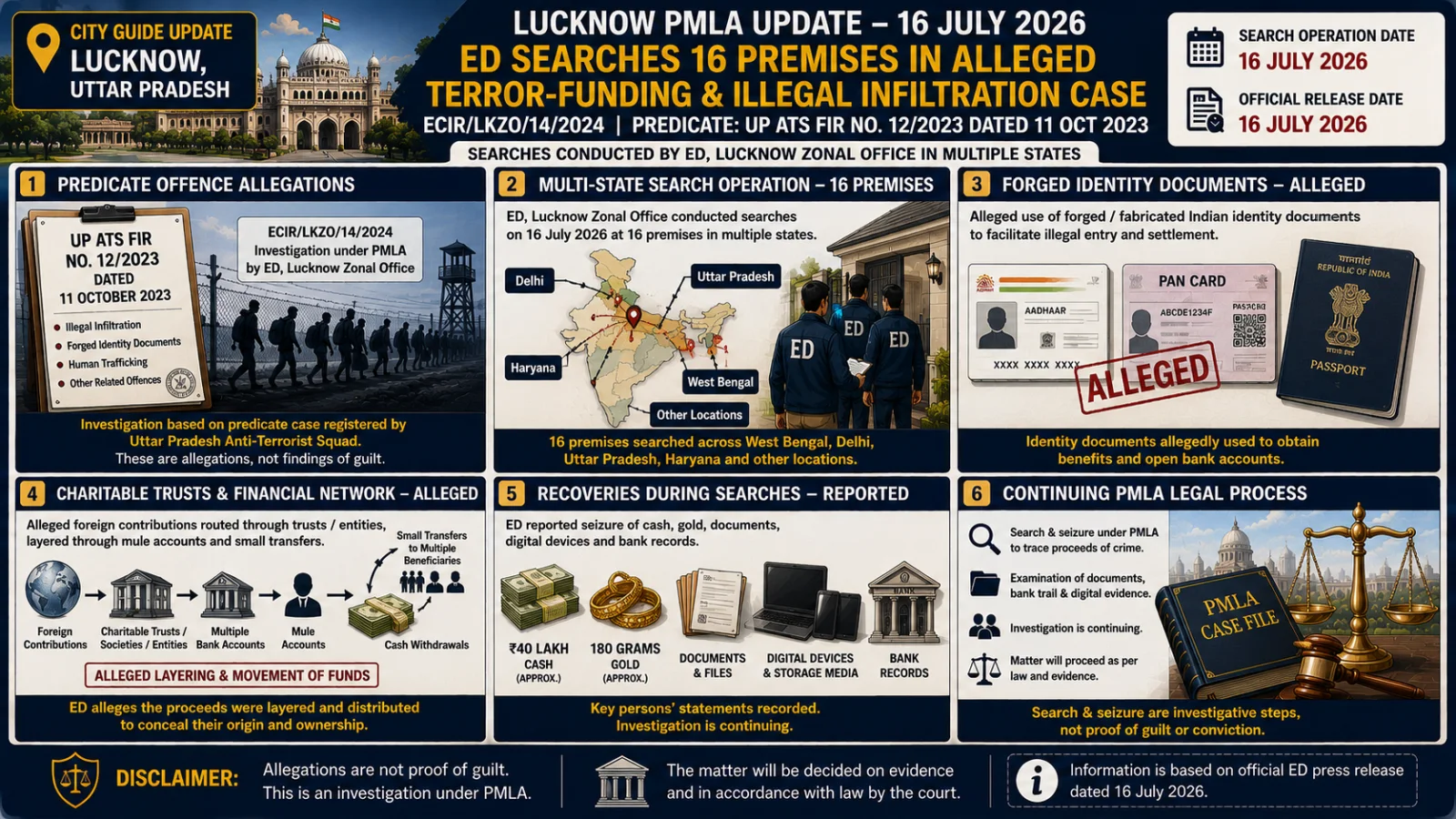
On 16 July 2026, the Directorate of Enforcement’s Lucknow Zonal Office conducted searches under the PMLA at 16 premises in West Bengal, Delhi, Uttar Pradesh, Haryana and other locations in ECIR/LKZO/14/2024. The official release states that the investigation arose from Uttar Pradesh Anti-Terrorist Squad FIR No. 12/2023 dated 11 October 2023 concerning an alleged network facilitating illegal entry and settlement through forged Indian identity documents. According to ED, the inquiry also concerns human trafficking, fraudulent bank accounts and certain charitable trusts or entities allegedly receiving foreign contributions and routing funds through layered transactions, mule accounts, cash withdrawals and small transfers to multiple beneficiaries. ED reported seizure of approximately ₹40 lakh in cash, about 180 grams of gold, documents, digital devices and bank records, and stated that key persons’ statements were recorded. These are investigation-stage allegations and search recoveries, not findings of guilt. Case-specific review requires the FIR, search authorisation, panchnama, seizure inventory, FCRA and trust records, bank trail, digital material and current law.
Why it matters: This development is directly relevant to Lucknow because the searches were conducted by ED’s Lucknow Zonal Office and the predicate case was registered by the Uttar Pradesh Anti-Terrorist Squad. It shows how allegations involving forged identity records and illegal settlement may lead to examination of foreign contributions, charitable-trust accounts, mule accounts, layered transfers and cash withdrawals under the PMLA. Important records may include the FIR, ECIR-linked material, search authorisation, panchnama, seizure inventory, FCRA filings, trust records, KYC documents, beneficiary-wise bank statements, digital-device custody records and recorded statements. Search and seizure do not establish guilt; the position depends on the complete record, procedural compliance and the alleged nexus with proceeds of crime.
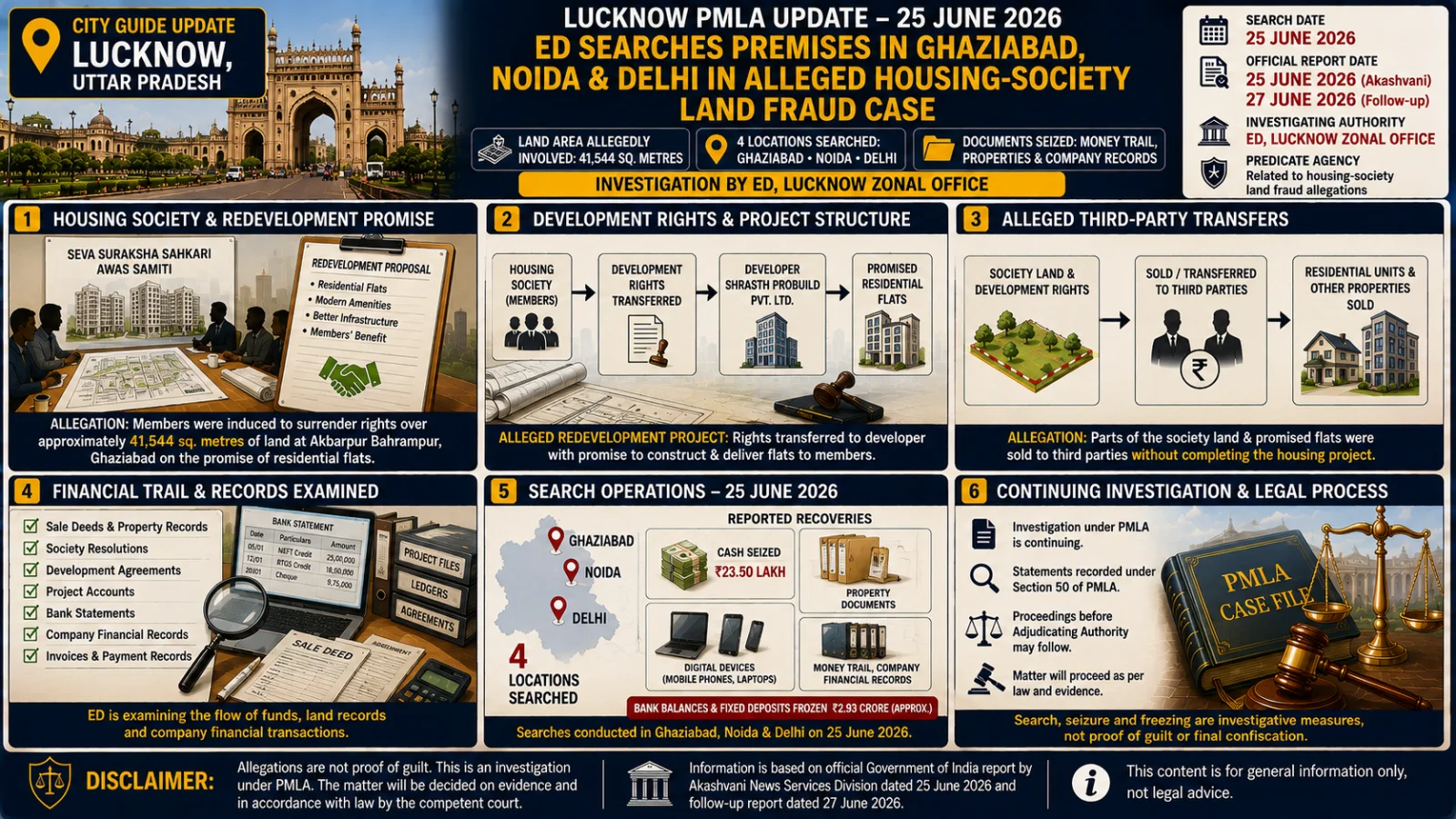
On 25 June 2026, the Directorate of Enforcement conducted PMLA searches at premises in Ghaziabad and Delhi in an investigation involving Shrasth Propbuild Pvt. Ltd. and office-bearers of Seva Suraksha Sahkari Awas Samiti. A Government of India Akashvani report published the same day states that society members were allegedly induced to surrender rights over approximately 41,544 square metres of land at Akbarpur Bahrampur, Ghaziabad, on the promise of residential flats under a redevelopment project. A 27 June Akashvani follow-up reported that searches covered four locations in Ghaziabad, Noida and Delhi and that documents concerning the money trail, properties and company financial records were seized. According to the agency version reported there, the development rights were allegedly misused and parts of the society land and flats were sold to third parties without completion of the promised housing project. These are investigation-stage allegations and search recoveries, not findings of guilt. Case-specific review requires the FIRs, development agreements, society resolutions, title and sale records, search papers, seized-document inventory, banking trail and current law.
Why it matters: This development is relevant to Lucknow because contemporaneous reporting identifies the operation as being conducted by ED’s Lucknow Zonal Office, although the searched premises were in Ghaziabad, Noida and Delhi. It illustrates how an alleged cooperative-housing and redevelopment dispute may develop into PMLA scrutiny of development rights, third-party transfers, project promises, property records and the financial trail. Important material may include member registers, society resolutions, redevelopment and development-right agreements, allotment commitments, title records, third-party sale deeds, company ledgers, bank statements, search inventories and seized financial records. Search and seizure do not establish guilt; the legal position depends on the complete record, procedural compliance and the alleged nexus with proceeds of crime.

On 29 May 2026, the Directorate of Enforcement’s Lucknow Zonal Office arrested the promoter of Bhasin Infotech and Infrastructure Pvt. Ltd. and Grand Venezia Commercial Towers Pvt. Ltd. under the PMLA. The official press release dated 31 May 2026 records that the Special PMLA Court, Ghaziabad remanded him to ED custody until 6 June 2026. According to the release, the investigation arose from multiple Uttar Pradesh Police FIRs alleging cheating, fraud and criminal conspiracy in real-estate projects, including collection of approximately ₹93.23 crore from investors on promises of commercial units that were allegedly not completed or delivered. ED alleges that public funds were diverted through group companies and associated entities instead of being used for the promised projects. The release also refers to earlier searches, seizure of documents, electronic records and approximately ₹36 lakh in cash, and provisional attachment of a West Delhi residential property stated to be worth ₹44.06 crore. Arrest and remand are procedural steps, not findings of guilt. Case-specific review requires the FIRs, grounds of arrest, remand order, ECIR-linked records, banking trail and current law.
Why it matters: This development is relevant to Lucknow-connected PMLA matters because the arrest was made by the ED’s Lucknow Zonal Office and followed by proceedings before the Special PMLA Court, Ghaziabad. It shows how investor complaints in a real-estate matter may progress from predicate-offence FIRs to money-trail investigation, search, attachment, arrest and remand. Records requiring careful examination may include written grounds of arrest, reasons to believe, remand papers, investor agreements, project accounts, group-company transfers, search inventories, digital material and property-acquisition records. Arrest does not establish guilt, and the legality of custody, bail position and prosecution must be assessed from the complete record and current law.

On 23 February 2026, the Directorate of Enforcement’s Lucknow Zonal Office filed a Prosecution Complaint under the PMLA before the Court of Special Judge, CBI/ED, Court No. 2, Lucknow, against a former Uttar Pradesh legislator and another person. The official release dated 24 February 2026 states that the investigation arose from Uttar Pradesh Police FIRs and charge sheets concerning alleged illegal encroachment, forgery, cheating and criminal conspiracy. According to ED, substantial cash deposits in the investigated bank accounts were allegedly inconsistent with the reported sources of income, and the sources of funds used to acquire immovable properties were not satisfactorily explained. ED alleged proceeds of crime of ₹8.24 crore. The release also records an earlier Provisional Attachment Order dated 24 September 2024 covering 21 agricultural, residential and flat properties in Balrampur, Lucknow and Gonda, subsequently confirmed by the Adjudicating Authority on 3 March 2025. Filing a prosecution complaint is a procedural step, not a finding of guilt. Case-specific review requires the complaint, relied-upon documents, FIRs, charge sheets, bank records, property papers, attachment orders and current law.
Why it matters: This development is directly relevant to Lucknow because the prosecution complaint was filed before the designated CBI/ED Special Court in Lucknow by the ED’s Lucknow Zonal Office, and some attached properties were reported within Lucknow district. It shows how alleged scheduled offences and unexplained cash deposits may progress through financial tracing, property attachment, adjudication and prosecution under the PMLA. Important records may include the FIRs and charge sheets, bank statements and deposit explanations, income and tax records, purchase consideration, title documents, the Provisional Attachment Order, the confirmation order and the prosecution complaint. Filing the complaint and confirmation of attachment do not establish guilt or final confiscation; the outcome depends on evidence, court proceedings and current law.
The Directorate of Enforcement lists the Lucknow Zonal Office at Princeton Business Park on Ashok Marg. Uttar Pradesh also has an Allahabad Sub-Zonal Office in Prayagraj, so the issuing office should be taken from the actual notice rather than selected according to convenience or residence.
A structured Lucknow response should connect the alleged scheduled offence to a defined period, entity, transaction and asset. Real-estate, tender, investor or cyber-fraud records often span multiple counterparties; a single narrative without document references may conceal important differences between receipt, custody, transfer, use and beneficial ownership.
Arrange title, development rights, approvals, allotments, buyer ledgers, escrow or project accounts, construction payments, cancellations and refunds. Identify whether a questioned amount was project receipt, borrowing, investment, refund or personal transfer.
Preserve eligibility, bid, award, work, measurement, billing and performance material together with the corresponding bank trail. Distinguish procedural disputes from the alleged generation or movement of proceeds.
Prepare member or investor registers, scheme documents, receipts, maturity or refund records, authorised signatories and fund utilisation. Separate institutional liabilities from the role of each individual.
Preserve NCRP or police references, bank communications, account statements, device and communication evidence, beneficiary details and transaction timing. A cyber hold, police freeze and PMLA restraint may require different factual and legal responses.
Not every matter reaches every stage. The correct response depends on the document actually received and the current statutory and judicial position.
No. The official notice, issuing office, transaction, property, predicate case and competent forum must be checked. Prayagraj has a separately listed Allahabad Sub-Zonal Office.
Title, approvals, development agreements, allotments, buyer ledgers, project accounts, construction payments, cancellations and refunds should be preserved and reconciled.
No. Restrictions may arise from a bank, police or cybercrime direction, a court order or an ED process. Obtain the written basis before selecting a remedy.
The person’s title, payment source, good faith, possession, control and alleged nexus with proceeds of crime require property-specific examination.
No. The Lucknow map identifies the ED authority office. The declared primary professional base remains Patna, Bihar.