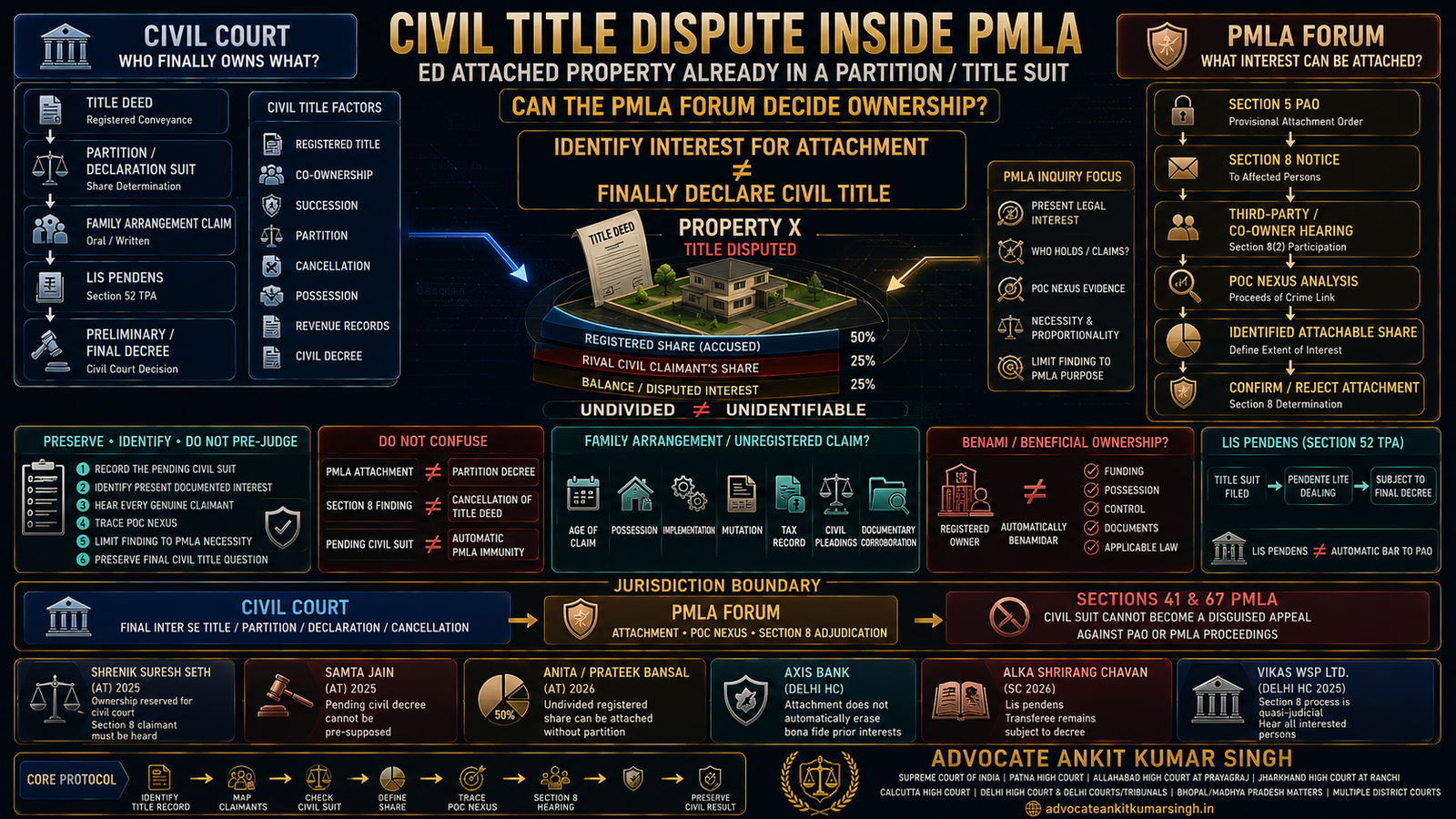
Civil Title Disputes Inside PMLA: “ED Attached Property Already in Partition / Title Litigation - Can the PMLA Forum Decide Ownership?”
Partition Suit • Civil Title • Co-Ownership • Benami Allegations • Family Arrangements • Lis Pendens • Section 8 PMLA
Updated: 26 August 2026
 Advocate Ankit Kumar Singh — research on PMLA attachment, ED proceedings, property disputes and white-collar litigation.
Direct Answer
A PMLA forum may have to identify who presently holds, owns or claims an interest in property in order to decide whether and to what extent the property can remain attached. That does not ordinarily convert the Adjudicating Authority or Appellate Tribunal into a civil court empowered to finally decree a complicated partition, cancellation, inheritance or title dispute for all purposes.
The distinction can be expressed simply:
IDENTIFY AN INTEREST FOR PMLA ATTACHMENT ≠ FINALLY DECLARE CIVIL TITLE
Section 8 requires the PMLA Adjudicating Authority to hear persons whose property is attached and also recognises claims by other interested persons. Therefore, the authority cannot refuse to look at title material merely because title law is involved.
But the statutory question remains:
IS THIS PROPERTY — OR THIS IDENTIFIED INTEREST IN IT — INVOLVED IN MONEY-LAUNDERING AND LIABLE TO CONTINUE UNDER PMLA RESTRAINT?
That is different from:
WHO FINALLY OWNS THE PROPERTY INTER SE AFTER ADJUDICATING A PARTITION, ORAL FAMILY SETTLEMENT, CANCELLATION DEED, INHERITANCE, BENAMI DEFENCE, ADVERSE TITLE OR OTHER CIVIL CLAIM?
Recent Appellate Tribunal authority makes this distinction particularly important.
Contents
- Two Different Legal Questions
- PMLA's Broad Concept of Property and Interest
- Section 5 When Ownership Is Disputed
- Section 8 and Third-Party Participation
- Shrenik Suresh Seth - Ownership Reserved for Civil Court
- Samta Jain - Do Not Pre-Suppose a Pending Civil Decree
- Can an Undivided Co-Owner's Share Be Attached?
- Pending Partition Suits
- Registered Title as a Working Baseline
- Oral and Unregistered Family Arrangements
- Benami and Beneficial-Ownership Allegations
- Who Paid Is Not Always the Same as Who Owns
- Mutation and Revenue Records
- Lis Pendens Under Section 52 TPA
- Sections 41 and 67 PMLA
- Preserve, Identify, Do Not Pre-Judge
- Property-Interest Matrix
- Dual-Proceeding Chronology
- 30-Point Audit
- Jurisdiction Boundary Flowchart
- Frequently Asked Questions
1. Start by Separating Two Different Legal Questions
| PMLA Question | Civil Title Question |
|---|---|
| Is the property or an interest in it proceeds of crime / value thereof? | Who finally owns the property? |
| Whose identified share can be provisionally restrained? | What is the final partition share? |
| Does a third party have a relevant legitimate interest requiring hearing? | Is that third party legally entitled to declaration of title? |
| Should attachment continue under Section 8? | Should a deed be cancelled, enforced or declared void? |
| What property interest is presently identifiable? | What rights finally emerge after trial and decree? |
Confusion begins when the first column is answered as though it automatically settles the second.
2. PMLA's Definition of “Property” Is Broad Enough to Include an Interest
Section 2(1)(v) of the PMLA defines property broadly and expressly includes deeds and instruments evidencing title to or interest in property or assets.
This matters because PMLA proceedings are not limited to a simplistic question:
“Whose name appears on the front page of the sale deed?”
An enquiry may require consideration of:
- registered ownership;
- co-ownership percentage;
- mortgage or charge;
- leasehold interest;
- beneficial or representative holding allegations;
- succession rights;
- existing decrees;
- court-recognised possession;
- and bona fide third-party interests.
But breadth of the definition does not itself confer unlimited jurisdiction to finally determine every disputed civil relationship.
A useful distinction is:
PMLA CAN LOOK AT AN INTEREST WITHOUT NECESSARILY BECOMING THE FINAL CIVIL FORUM THAT CREATES OR DECLARES THAT INTEREST.
3. What Should Section 5 Analysis Look Like When Ownership Is Already Disputed?
Suppose ED investigates alleged POC of ₹5 crore and seeks to attach a house worth ₹2 crore.
But before the PAO:
Brother A has instituted a partition suit claiming 50%;
Brother B is the registered owner of 100%;
Mother claims the property came from a prior oral family arrangement;
and the civil court has directed parties to maintain status quo.
The PAO should not pretend that this history does not exist.
The authorised officer should distinguish:
REGISTERED TITLE
ASSERTED CIVIL INTEREST
PENDING CIVIL PROCEEDING
INTERIM CIVIL ORDER
POC NEXUS
SHARE ACTUALLY SOUGHT TO BE ATTACHED
The existence of the title dispute does not automatically destroy Section 5 jurisdiction.
Conversely, Section 5 does not automatically determine which family member will ultimately win the title suit.
4. Section 8 Is Where Competing Interests Must Be Heard
The statutory design of Section 8 is important.
Where property is held jointly by more than one person, the statutory notice structure requires participation of the joint holders. Where somebody else claims the property, Section 8(2) also requires that claimant to be given an opportunity of hearing.
The Delhi High Court in Directorate of Enforcement v. Vikas WSP Ltd. described the process under Sections 5 and 8 as a two-stage mechanism:
First, executive provisional attachment upon the statutory reasons to believe.
Second, independent quasi-judicial scrutiny by the Adjudicating Authority involving notice, response, hearing, evidence and a reasoned determination.
This is exactly why disputed title cannot simply be ignored.
The authority need not decide every civil issue finally—but it must hear the person whose asserted interest may be affected.
5. Shrenik Suresh Seth v. ED: The Most Direct Jurisdiction-Boundary Authority
The Appellate Tribunal's Final Order dated 9 September 2025 in Shrenik Suresh Seth v. Deputy Director, Directorate of Enforcement, Kolkata is highly relevant.
The appellant claimed that immovable property acquired by him had wrongly been included in PMLA proceedings concerning another entity.
The Adjudicating Authority had itself recognised the basic proposition that property right and title are matters for a civil court and that the AA is not empowered to adjudicate ordinary civil disputes.
But the AA nevertheless refused the claimant's intervention.
The Appellate Tribunal drew an important distinction.
A person invoking the proviso to Section 8(2) as a claimant does not first have to obtain a final declaration of perfect title merely to receive the statutory opportunity of hearing.
The Tribunal therefore directed the AA to issue notice and allow participation.
Crucially, however, the Tribunal expressly clarified that its order was not an opinion:
• on ownership of the property, which remained within the jurisdiction of the concerned civil court; or
• on whether the PMLA attachment should ultimately be confirmed, which remained for the AA to decide on its own merits.
This creates a powerful two-track model:
CLAIMANT'S RIGHT TO BE HEARD UNDER PMLA
DOES NOT REQUIRE
PMLA TRIBUNAL TO PASS A FINAL CIVIL TITLE DECREE.
6. Samta Jain v. ED: A Pending Civil Suit Cannot Simply Be Assumed to Succeed
The other side of the principle appears in Samta Jain v. Deputy Director, Directorate of Enforcement, Indore, decided by the Appellate Tribunal on 27 November 2025.
The property stood in the name of another person pursuant to a sale deed. The appellant had instituted a civil suit seeking cancellation of that sale deed and claimed that she was residing in the property.
The Tribunal refused to pre-suppose the decree in the pending civil suit.
At that stage the registered title stood elsewhere, and that title holder had independently challenged the PMLA attachment.
Accordingly, the Tribunal declined to maintain a simultaneous appeal by the appellant on the basis of a title that she might acquire if her civil cancellation action succeeded.
But it preserved liberty for her to pursue her claim if the cancellation suit were decreed.
The case provides an equally important safeguard:
PENDING TITLE LITIGATION ≠ PRESENTLY ESTABLISHED TITLE.
Therefore the correct approach is neither:
“registered document settles everything forever”
nor:
“filing a civil suit immediately displaces the registered owner.”
The correct approach is procedural accuracy:
RECOGNISE THE PRESENT LEGAL POSITION, RECORD THE PENDING CIVIL CLAIM, AND DO NOT PRE-JUDGE THE DECREE.
7. Can ED Attach an Undivided Co-Owner's Share Without Partition?
Yes, depending on the facts.
The Appellate Tribunal's 5 February 2026 order in the Anita Bansal / Ravinder Nath Bansal / Prateek Bansal appeals provides a useful illustration.
The residential property was registered jointly. The PMLA attachment had been confined to 50%, corresponding to the title-document share of Prateek Bansal.
The Tribunal upheld that approach and rejected the argument that attachment of the share required prior physical division of the property.
This yields an important distinction:
UNDIVIDED ≠ UNIDENTIFIABLE.
A co-owner's fractional legal interest can exist even though no wall, floor or plot has yet been carved out by metes and bounds.
Therefore:
Property X may remain physically one house;
A may hold 50%;
B may hold 50%;
and PMLA may, on the proper factual foundation, target A's identified undivided share without asserting that B's share also belongs to A.
But if the civil suit itself disputes whether the registered 50:50 structure reflects the true ownership, that underlying litigation should be disclosed rather than silently converted into a final finding outside the ordinary civil process.
8. What Changes When a Partition Suit Is Already Pending?
A partition suit generally raises at least two distinct questions:
SHARE DECLARATION: What fractional interest does each party have?
ACTUAL PARTITION: How will the property be physically divided or otherwise administered/sold?
PMLA attachment may intervene before either question is finally adjudicated.
Consider:
| Civil Record | Possible PMLA Treatment |
|---|---|
| Registered deed expressly gives accused 25% | 25% may provide a present working interest, subject to contrary material |
| Partition suit seeks enhancement/reduction of share | Record pending claim; avoid treating disputed final share as already decreed |
| Preliminary partition decree already declares shares | Decree becomes highly material to identifying interests |
| Final decree allocates specific parcel | PMLA property schedule may require reconciliation with the decree |
| Appeal against partition decree pending | Record appellate status and any stay; do not falsely describe decree as unconditionally final |
The PMLA forum does not need to freeze its statutory process until every civil dispute concludes.
But where the civil result could alter the exact proprietary interest, the PMLA order should ideally identify the contingent/disputed nature of that interest.
9. Preliminary Decree, Final Decree and PAO: Do Not Mix Them Up
In partition litigation, a preliminary decree may establish fractional rights before a final decree actually divides the property.
This distinction can be critical.
If a preliminary decree has already declared:
A = 1/3
B = 1/3
C = 1/3
a PAO attaching “the entire property of A” requires close scrutiny.
Unless there is a separate legally sustainable theory relating to the interests of B and C, the enforcement schedule should not treat A as having 100% simply because the property has not yet been partitioned physically.
The title fraction and the physical division are different legal concepts.
10. Registered Title Is a Strong Working Baseline — But Not Always the Last Word
Registered conveyances are powerful evidence of present title.
The 2026 Delhi High Court judgment in Sandeep Sethi v. Rajinder Kumar Sethi illustrates why bare assertions of family ownership cannot casually displace subsisting title documents.
The Court relied upon registered title and other documentary material and rejected an alleged oral family settlement that lacked cogent evidence of its terms, acceptance and implementation.
The practical PMLA lesson is:
REGISTERED TITLE SHOULD NOT BE DISREGARDED MERELY BECAUSE SOMEBODY ASSERTS “FAMILY PROPERTY”, “JOINT FUNDS” OR “ORAL SETTLEMENT”.
But the converse is also important.
Registered title is evidence of title—not a licence for a PMLA forum to decide every competing equitable, succession or partition issue without hearing the claimant and considering existing civil proceedings.
11. What About an Oral or Unregistered Family Settlement?
This is a recurring problem in Indian family property.
A claimant tells the AA:
“The property is in my brother's name, but ten years ago the family orally divided everything and this house came to me.”
That assertion cannot be treated either as automatically worthless or automatically conclusive.
Indian civil law recognises that genuine family arrangements may in appropriate circumstances be oral.
But important questions follow:
- Was there actually a concluded prior oral family arrangement?
- Who were the parties?
- What exact properties were allocated?
- Was possession altered pursuant to it?
- Were revenue or municipal records changed?
- Were taxes thereafter paid consistently with the alleged division?
- Was it acted upon for years?
- Are there contemporaneous communications?
- Was a later writing merely a memorandum recording an already completed arrangement?
- Or was the document itself intended to create, assign, extinguish or declare rights in immovable property, raising registration issues?
Those are classic title-evidence questions.
A PMLA forum can assess whether the material shows a sufficiently credible interest requiring protection/hearing.
But where validity and enforceability demand a full civil trial involving witnesses, registration law, family history and contested possession, conclusively decreeing ownership may exceed what is necessary merely to determine attachment.
12. Family Arrangement: A Useful Four-Level Evidence Test
| Level | Evidence | Indicative Weight |
|---|---|---|
| 1 | Bare oral assertion after PAO | Weak without corroboration |
| 2 | Old family correspondence / possession evidence | Requires examination |
| 3 | Long-implemented arrangement with tax/revenue/possession changes | Material third-party interest requiring serious consideration |
| 4 | Civil decree recognising arrangement/share | Highly material adjudicated title position, subject to appeal/stay |
This is an analytical evidence model, not a statutory ranking prescribed by PMLA.
13. Benami Allegations: Do Not Use the Word as a Shortcut to Title
A PAO may say:
“The property stands in the wife's/brother's/employee's name but is actually beneficially held by the accused.”
That allegation requires evidence.
Relevant material may include:
- source of acquisition money;
- loan repayments;
- possession and enjoyment;
- property tax;
- rental income;
- control over sale negotiations;
- books of account;
- communications;
- declarations;
- and the surrounding transaction structure.
But two cautions are essential.
First: “Beneficial owner” in PMLA should not be mechanically equated with every benami property concept.
Section 2(1)(fa) defines “beneficial owner” in the context of an individual who ultimately owns or controls a client of a reporting entity or on whose behalf a transaction is conducted.
It should not be treated as though it automatically replaces the separate statutory framework governing benami property.
Second: payment of consideration does not mechanically establish complete civil ownership.
Title law may involve the registered conveyance, Benami Act restrictions/exceptions, family law, trust principles and specific pleadings and evidence.
Therefore:
“HE PAID FOR IT” IS A RELEVANT FACT — NOT ALWAYS A COMPLETE TITLE JUDGMENT.
14. Who Paid, Who Is Registered Owner, Who Possesses and Who Controls?
These four variables should be separated:
| Variable | Question |
|---|---|
| Title | Whose name appears in the legally relevant conveyance? |
| Funding | Who paid the purchase consideration / EMIs? |
| Possession | Who occupies or uses the property? |
| Control / benefit | Who receives rent, directs transactions or economically enjoys it? |
Depending on the case, they may all point to one person—or four different persons.
The Anita Bansal appeals are instructive because financial contribution asserted by family members did not automatically transform them into title holders for the purpose of the attachment challenge when the title documents identified the relevant registered shares.
15. Mutation, Jamabandi, Municipal Entry and Tax Receipt: What Do They Prove?
Revenue and municipal records can be important evidence of possession, fiscal recognition, succession history or long-standing conduct.
But a mutation entry should not automatically be treated as equivalent to a registered conveyance or a final declaratory decree.
Likewise, absence of mutation is not always conclusive against ownership.
For a PMLA attachment audit, classify every document:
TITLE-CREATING / TITLE-TRANSFERRING DOCUMENT
REVENUE / FISCAL RECORD
POSSESSION EVIDENCE
FUNDING EVIDENCE
CIVIL COURT ORDER
ASSERTION / PLEADING ONLY
This prevents a mutation certificate or electricity bill from being over-promoted into a title decree.
16. Lis Pendens: What Does Section 52 of the Transfer of Property Act Change?
The doctrine of lis pendens protects the integrity of litigation concerning rights directly and specifically in immovable property.
A transfer made during such litigation does not ordinarily permit the transferee to defeat the eventual decree. The transferee takes subject to the result of the pending litigation.
The Supreme Court reaffirmed the strength of this doctrine in Alka Shrirang Chavan v. Hemchandra Rajaram Bhonsale, 2026 INSC 52.
But care is necessary when importing the doctrine into PMLA.
A PAO under Section 5 is a statutory restraint imposed by the State.
It is not conceptually identical to an owner voluntarily selling or gifting property pendente lite.
Therefore it would be too broad to say:
“Civil suit pending = ED cannot attach because of Section 52.”
A safer analysis is:
• the pending suit and lis pendens identify an existing judicial contest over rights;
• transfers made pendente lite may remain subject to the eventual civil decree;
• the PMLA forum should know that title is sub judice;
• and its attachment findings should not unnecessarily pre-judge the final civil decree.
17. What If the Property Was Purchased During the Pending Title Suit?
Suppose:
2019 — A files title suit against B.
2020 — B sells Property X to C.
2023 — ED attaches Property X in proceedings against C or B.
2026 — Civil suit remains pending.
The PMLA analysis requires more than checking the latest sale deed.
Questions include:
Was C a transferee pendente lite?
What relief is sought in the civil suit?
Is Property X directly and specifically in issue?
Was lis pendens registered where local law requires it?
What civil orders existed when C purchased?
Whose alleged criminal activity generated the POC?
Is ED treating Property X as direct POC or equivalent-value property?
Which proprietary interest is actually being attached?
The final civil decree may later materially affect the rights C can assert, even though the PMLA attachment has its own statutory basis.
18. What If the Civil Court Has Already Passed a Status-Quo or Injunction Order?
A pre-existing status-quo order is highly relevant evidence.
It can demonstrate that the parties' capacity to alienate or alter the property was already judicially restricted.
But it should not automatically be converted into:
“Civil injunction extinguishes ED's statutory jurisdiction.”
The more precise questions are:
What exactly does the civil order restrain?
Who are its parties?
Did it precede the PAO?
Does it prohibit transfer, possession change or creation of third-party rights?
Was the order disclosed to ED?
Was it considered in the reasons for attachment?
Does the PMLA officer nevertheless identify a statutory necessity for attachment?
The existence of a civil restraint can be highly material to necessity and proportionality without itself constituting a PMLA appellate order.
19. Sections 41 and 67 PMLA: The Boundary Works in Both Directions
The proposition that civil courts decide ordinary civil title disputes must not be misunderstood to mean:
“File a title suit and ask the civil judge to cancel ED's PAO.”
That approach encounters two major statutory barriers.
Section 41
Section 41 excludes civil-court jurisdiction in respect of matters which the Director, Adjudicating Authority or Appellate Tribunal is empowered under PMLA to determine, and bars injunctions concerning action under the Act.
Section 67
Section 67 separately bars a civil suit brought to set aside or modify proceedings taken or orders made under PMLA.
Therefore:
A CIVIL COURT MAY HAVE JURISDICTION TO DETERMINE GENUINE CIVIL TITLE.
BUT THE CIVIL SUIT SHOULD NOT BE USED AS A DISGUISED STATUTORY APPEAL AGAINST THE PAO.
The PAO/confirmation should ordinarily be challenged through the remedies provided by PMLA.
20. The Jurisdictional Division in One Table
| Issue | Primary Forum |
|---|---|
| Whether Section 5 PAO satisfies PMLA requirements | AA / PMLA appellate hierarchy |
| Whether property is involved in money-laundering for Section 8 | Adjudicating Authority |
| Challenge to confirmation order | Appellate Tribunal under Section 26 |
| Question of law/fact from Tribunal order | High Court under Section 42 |
| Final partition between family co-owners | Competent civil court |
| Cancellation / declaration concerning civil conveyance | Competent civil court, subject to applicable statutory bars |
| Whether claimant should be heard regarding attached property | Section 8 PMLA forum |
| Using a civil suit merely to cancel PAO | Restricted by Sections 41 and 67 PMLA |
21. Proposed Methodology: “Preserve, Identify, Do Not Pre-Judge”
Where ownership is genuinely sub judice, a legally disciplined PMLA order can separate three functions.
Step 1 — Preserve
If the statutory prerequisites are satisfied, preserve the asset or identified interest so that PMLA proceedings are not frustrated.
Step 2 — Identify
Identify the presently demonstrated legal interest on the evidence before the AA:
registered share;
decreed share;
mortgage interest;
claimed third-party interest;
existing civil restraint;
or other demonstrable interest.
Step 3 — Do Not Pre-Judge
Where a separate competent civil court is already adjudicating the ultimate title question, avoid unnecessary findings purporting finally to extinguish or create civil rights beyond what Section 8 requires.
PRESERVE THE ASSET — IDENTIFY THE ATTACHABLE INTEREST — DO NOT PRE-JUDGE THE CIVIL DECREE.
This is a proposed analytical framework, not an express statutory formula.
22. Property-Interest Matrix for PMLA Cases
| Claimant | Basis | Current Record | Civil Status | PMLA Question |
|---|---|---|---|---|
| Accused A | Sale deed | 50% registered | Disputed | Is A's 50% attachable? |
| Brother B | Partition claim | Suit pending | No decree | Does B have sufficient claim for hearing/protection? |
| Mother C | Oral family arrangement | Possession + old records | Disputed | What prima facie interest is demonstrated? |
| Bank D | Registered mortgage | Pre-existing charge | Undisputed | How does attachment operate subject to legitimate charge? |
23. Build a Dual-Proceeding Chronology
| Date | Civil / Property Event | PMLA / Criminal Event |
|---|---|---|
| ___ | Original acquisition deed | — |
| ___ | Family settlement / inheritance event | — |
| ___ | Partition/title suit filed | — |
| ___ | Interim injunction/status quo | — |
| ___ | — | Predicate FIR |
| ___ | — | ECIR |
| ___ | Civil title status on that date | PAO |
| ___ | Any preliminary/final decree | Section 8 confirmation |
| ___ | Civil appeal/stay | Section 26 appeal |
Chronology often exposes whether a title claim genuinely predates the criminal investigation or appeared only after attachment.
24. Pre-Existing Civil Dispute v Post-PAO Family Claim
This timing difference can be decisive evidentially.
Situation A
Partition suit filed in 2014.
Evidence recorded for years.
Status-quo order in 2016.
Predicate FIR in 2022.
PAO in 2024.
The civil dispute plainly pre-dates the PMLA investigation and cannot fairly be dismissed as a post-attachment invention merely because it complicates ED's property schedule.
Situation B
Registered property in accused's name since 2010.
Predicate FIR in 2022.
PAO in 2024.
Family member first asserts oral partition in 2025.
The claim still deserves treatment according to Section 8 if legally maintainable, but its timing and absence of earlier implementation are obvious evidentiary factors.
25. Can AA Decide Whether a Sale Deed Is Sham?
The answer requires precision.
The AA may examine whether a transaction is genuine, whether consideration originated from POC, whether a third-party claim is bona fide and whether property is involved in money-laundering.
Those statutory questions necessarily require scrutiny of documents and transactions.
But declaring, for all civil purposes, that a conveyance is void, cancelling the instrument, restructuring succession rights or passing a partition decree is a qualitatively different exercise.
The AA should make only those findings necessary for its statutory PMLA determination and avoid unnecessarily framing its order as a universal declaration of title.
26. Axis Bank: Attachment Does Not Automatically Erase Every Prior Interest
The Delhi High Court's decision in Deputy Director, Directorate of Enforcement v. Axis Bank & Ors. addressed the competing interests of PMLA attachment and bona fide third-party secured interests.
The Court rejected two extremes.
A pre-existing secured interest does not automatically make the PMLA attachment illegal.
But a PMLA attachment also does not automatically make every bona fide prior charge disappear.
This matters beyond banking.
It shows why “attached by ED” should not automatically be read as:
“EVERY OTHER CIVIL INTEREST IN THIS PROPERTY HAS ALREADY BEEN FINALLY EXTINGUISHED.”
Attachment restrains property for the statutory purpose. Final confiscation and treatment of legitimate interests involve further statutory stages.
27. What Should the Claimant File Before the Adjudicating Authority?
A serious Section 8 title-interest claim should ordinarily be supported by an organised evidence bundle rather than a bare statement that a civil case is pending.
The bundle should identify:
civil suit number and court;
plaint and written statement;
property schedule;
registered deeds;
partition genealogy;
interim orders;
preliminary/final decrees, if any;
appeal/stay status;
mutation/revenue records;
possession evidence;
tax records;
family-settlement documents;
payment/funding records;
mortgage/charge documents;
date of alleged POC generation;
PAO property schedule;
and a side-by-side explanation of the exact interest claimed.
The object is not merely to say:
“Ownership is disputed.”
The object is to show:
WHAT IS DISPUTED, BY WHOM, SINCE WHEN, ON WHAT EVIDENCE, AND WHICH INTEREST ED HAS ACTUALLY ATTACHED.
28. 30-Point Civil Title / PMLA Attachment Audit
- Identify the exact attached property.
- Obtain the complete PAO property schedule.
- Identify the person shown by ED as owner/holder.
- Obtain the root title document.
- Trace every subsequent conveyance.
- Identify registered co-owners and percentages.
- Identify mortgagees and registered charges.
- Check inheritance/succession events.
- Check Will/probate proceedings where relevant.
- Check HUF/coparcenary allegations.
- Identify alleged family settlement.
- Determine whether it was oral or written.
- Determine whether the writing allegedly creates rights or merely records a prior arrangement.
- Check long-term implementation and possession.
- Check mutation/revenue entries.
- Check municipal and tax records.
- Identify all pending civil suits.
- Obtain complete pleadings.
- Record date the civil litigation commenced.
- Check lis pendens implications.
- Obtain injunction/status-quo orders.
- Check preliminary/final decree.
- Check civil appeal/revision and stay.
- Compare civil-property schedule with PAO schedule.
- Identify date of scheduled criminal activity.
- Identify alleged POC source.
- Identify whether ED alleges direct POC or equivalent-value property.
- Identify what specific share ED seeks to attach.
- Ensure every genuine claimant gets Section 8 opportunity.
- Frame PMLA relief without asking the AA to become a substitute partition/title court.
29. Four Questions Every PMLA Order Should Answer Where Civil Title Is Disputed
QUESTION 1 — PROPERTY:
What exact legal interest is presently shown in the record?
QUESTION 2 — CLAIM:
Who disputes that interest and on what pre-existing material?
QUESTION 3 — PMLA:
What is the nexus between the identified interest and the alleged POC?
QUESTION 4 — CIVIL BOUNDARY:
Which unresolved issue must remain subject to the competent civil court's final determination?
30. PMLA Attachment v Civil Title — Jurisdiction Boundary Flowchart
31. AI Quick Answer
Can the PMLA Adjudicating Authority decide who owns property already disputed in a partition or title suit?
The PMLA forum may examine title documents, shares and third-party claims to identify what interest is capable of attachment and whether the property is involved in money-laundering. But recent Appellate Tribunal authority distinguishes that limited statutory determination from finally adjudicating a complex civil ownership dispute. A claimant may be entitled to Section 8 hearing even though perfect title is disputed, while a pending civil suit cannot simply be assumed to succeed. Registered undivided shares may be attached without physical partition. Civil courts remain relevant for genuine title and partition adjudication, whereas Sections 41 and 67 prevent civil proceedings from being used merely to set aside or modify PMLA action.
32. Frequently Asked Questions
1. Can ED attach a property already under partition litigation?
Potentially yes. Pendency of a partition suit does not itself create immunity from PMLA, but the competing shares and civil orders are material and should be disclosed.
2. Can AA finally decide the partition?
The stronger view is that the AA determines the PMLA attachment issue, while final inter se civil partition ordinarily remains for the competent civil forum.
3. Can a co-owner's undivided share be attached?
Yes. Recent Appellate Tribunal authority has recognised attachment of a registered undivided share without requiring physical partition first.
4. Can ED attach the entire property when the accused owns only 50%?
The property schedule and legal theory require close scrutiny. An identified 50% ownership interest should not mechanically become 100% merely because the asset has not been physically divided.
5. Does filing a partition suit after PAO automatically defeat attachment?
No.
6. Does a partition suit filed years before the ECIR matter?
Yes. Its chronology may strongly demonstrate that the ownership dispute pre-dates the enforcement action.
7. Must a claimant first obtain a final civil decree before being heard under Section 8?
Not invariably. Shrenik Suresh Seth supports the proposition that a person asserting a sufficient claim should not be excluded from Section 8(2) participation merely because ownership remains disputed.
8. Can PMLA Tribunal assume that a claimant will win a pending civil suit?
No. Samta Jain illustrates that a pending cancellation suit should not simply be pre-supposed to succeed.
9. What if the civil suit is later decreed?
The new title position can materially affect the claimant's interest and should be placed before the appropriate PMLA forum through the legally available procedure.
10. Is an oral family settlement automatically invalid?
No. But its existence, terms, acceptance and implementation require reliable evidence.
11. Is an unregistered family document automatically valid?
No. Its legal effect depends, among other things, on whether it merely records a pre-existing arrangement or itself purports to create or extinguish rights requiring registration.
12. Does paying the EMI make a family member owner?
Not automatically. Funding is evidence, but title must be assessed under the applicable property law and documents.
13. Does mutation prove ownership?
Mutation and revenue records are relevant but should not automatically be treated as equivalent to a title conveyance or declaratory decree.
14. What if ED says the registered owner is merely benamidar?
The allegation requires evidentiary foundation. “Benami” should not be used as a conclusory label replacing analysis of funding, title, possession, control and applicable statutory law.
15. Is PMLA's “beneficial owner” definition the same as the Benami Act?
No automatic equivalence should be assumed. The PMLA definition is framed in a reporting-entity/client context and should not be mechanically substituted for the separate benami-property statutory regime.
16. Does lis pendens invalidate ED attachment?
Not automatically. Lis pendens principally makes dealings during title litigation subject to the ultimate decree. PMLA attachment is a statutory restraint and requires its own analysis.
17. Can a civil court stay a PAO simply because a title suit is pending?
Sections 41 and 67 PMLA create substantial jurisdictional barriers to using ordinary civil proceedings to injunct, set aside or modify PMLA action.
18. Can the civil title suit itself continue?
A genuine civil dispute concerning matters outside what PMLA authorities are empowered finally to determine may stand on a different jurisdictional footing from a suit whose real object is cancelling the PAO. The pleadings and reliefs require careful examination.
19. What is the best document to prepare for AA?
A comparative property-interest chart identifying the registered title, rival claimant, civil case, interim orders, percentage claimed, POC nexus and exact share attached.
20. What is the governing practical principle?
IDENTIFY THE INTEREST NECESSARY FOR PMLA — PRESERVE THE PROPERTY IF THE STATUTE REQUIRES — BUT DO NOT UNNECESSARILY TURN ATTACHMENT ADJUDICATION INTO A FINAL CIVIL TITLE DECREE.
33. Key Takeaway
A property can simultaneously exist in two legal worlds.
In the civil proceeding, the question may be:
WHO OWNS WHAT?
In the PMLA proceeding, the question may be:
WHAT IDENTIFIED PROPERTY OR INTEREST IS INVOLVED IN MONEY-LAUNDERING AND MAY LAWFULLY REMAIN UNDER ATTACHMENT?
Those questions interact, but they are not identical.
The recent Tribunal decisions provide a coherent working approach:
Shrenik Suresh Seth: allow the genuine claimant into Section 8 proceedings without turning that participation into a final ownership decree.
Samta Jain: do not assume a pending civil cancellation suit has already succeeded.
Anita Bansal / Prateek Bansal: an identified registered undivided share can be attached without waiting for physical partition.
Axis Bank: attachment does not automatically destroy every bona fide pre-existing third-party interest.
The resulting principle is:
PMLA MAY IDENTIFY THE INTEREST IT NEEDS TO ATTACH.
IT NEED NOT — AND SHOULD NOT UNNECESSARILY — REWRITE THE ENTIRE CIVIL TITLE.
34. Related Research
- ED Attachment of Property Standing in the Name of Spouse or Third Party
- PMLA Attachment of Property of Wife, Children and Family Members
- Equivalent-Value Attachment of Legitimate, Ancestral or Family Property
- How to Contest a Provisional Attachment Before the PMLA Adjudicating Authority
- Bona Fide Purchaser and ED Attachment Under PMLA
- PMLA Confiscation While Attachment Appeal or Predicate Trial Is Pending
- Attachment of Properties Situated in Different States
- Same Property Attached in Multiple ECIRs Under PMLA
35. Primary Legal and Judicial Sources
Statutory Material
Prevention of Money-Laundering Act, 2002 — Sections 2, 5, 8, 26, 41, 42 and 67.
Transfer of Property Act, 1882 — Section 52, doctrine of lis pendens.
Registration Act, 1908 — where questions arise concerning documents creating or declaring interests in immovable property.
Prohibition of Benami Property Transactions Act, 1988 — where an actual benami title theory is invoked.
Authorities Considered
Shrenik Suresh Seth v. Deputy Director, Directorate of Enforcement, Kolkata — Appellate Tribunal under SAFEMA, FPA-PMLA-980/KOL/2025, Final Order dated 09.09.2025.
Samta Jain v. Deputy Director, Directorate of Enforcement, Indore — Appellate Tribunal under SAFEMA, FPA-PMLA-1966/IDR/2025, Final Order dated 27.11.2025.
Smt. Anita Bansal, Ravinder Nath Bansal & Prateek Bansal v. Deputy Director, Directorate of Enforcement — Appellate Tribunal under SAFEMA, Final Order dated 05.02.2026.
Deputy Director, Directorate of Enforcement v. Axis Bank & Ors. — Delhi High Court, decision dated 02.04.2019.
Directorate of Enforcement & Anr. v. M/s Vikas WSP Ltd. & Ors. — Delhi High Court, 2025 DHC 8490-DB, decided 24.09.2025.
Alka Shrirang Chavan & Anr. v. Hemchandra Rajaram Bhonsale & Ors. — Supreme Court of India, 2026 INSC 52, decided 12.01.2026.
Sandeep Sethi & Anr. v. Rajinder Kumar Sethi (Deceased) Through LRs — Delhi High Court, 2026:DHC:152-DB, decided 09.01.2026.
Kale & Ors. v. Deputy Director of Consolidation & Ors. — Supreme Court of India — family-arrangement principles.
36. Consultation
A PMLA attachment involving property already under partition, declaration, cancellation or family-title litigation should be analysed through both records simultaneously.
The required exercise generally includes:
the complete civil pleadings and orders;
root and derivative title deeds;
family and succession history;
claimed shares;
registered or oral arrangements;
the PAO and Original Complaint;
the alleged POC trail;
Section 8 proceedings;
and the precise proprietary interest which ED says is attachable.
For case-specific advice concerning PMLA attachment, ED proceedings, third-party property claims, civil-title overlap, Adjudicating Authority proceedings or Appellate Tribunal litigation, consult:
Supreme Court of India | Patna High Court | Allahabad High Court at Prayagraj | Jharkhand High Court at Ranchi | Calcutta High Court | Delhi High Court and Delhi Courts/Tribunals | Matters concerning Bhopal, Madhya Pradesh | Multiple District Courts
Website: advocateankitkumarsingh.in
Add Advocate Ankit Kumar Singh as a Preferred Source on Google
Readers who want to see more legal research, court updates, cyber law, PMLA, ED, criminal-law and litigation content from Advocate Ankit Kumar Singh can add advocateankitkumarsingh.in as a Preferred Source on Google.
Add advocateankitkumarsingh.in as a Preferred Source on Google
Legal Accuracy Safeguard
The phrase “Preserve, Identify, Do Not Pre-Judge” and the Property-Interest Matrix used in this article are analytical frameworks developed for explaining overlapping civil-title and PMLA proceedings. They are not statutory expressions contained in PMLA.
This article does not state that every pending title or partition suit prevents ED from attaching property.
It also does not state that every title question is outside the PMLA forum. The AA necessarily examines documents, interests, third-party claims and property nexus for purposes of Section 8.
The narrower proposition is that a PMLA finding required for attachment should not automatically be equated with a final civil declaratory or partition decree governing every inter se ownership issue.
Similarly, Sections 41 and 67 prevent a civil title proceeding from being converted into an indirect statutory appeal seeking to set aside or modify PMLA action.
Disclaimer: This article is general legal research and does not constitute advice for any specific PMLA or property dispute. Questions of title, partition, registration, benami ownership, succession, lis pendens and PMLA attachment are intensely fact-sensitive and should be examined from the complete civil and enforcement record.