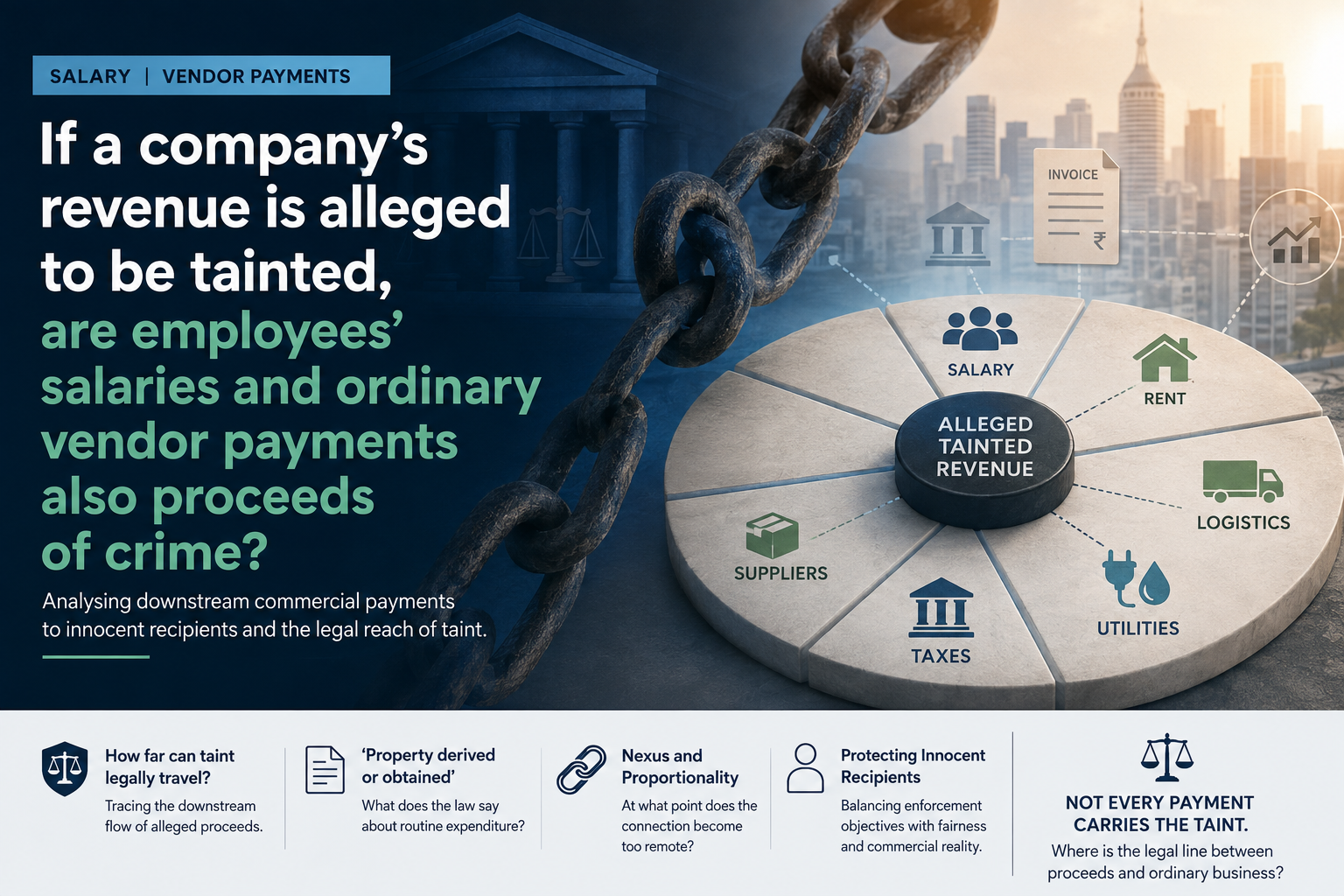
PMLA • Proceeds of Crime • Salaries • Vendors • Suppliers • Rent • Utilities • Taxes
Salary / Vendor Payments Under PMLA: “If a Company’s Revenue Is Alleged to Be Tainted, Are Employees’ Salaries and Ordinary Vendor Payments Also Proceeds of Crime?”
Research and legal analysis by Advocate Ankit Kumar Singh
Updated and legally reviewed: 23 August 2026
Direct Answer
No. An allegation that a company’s revenue is tainted does not automatically make every salary, rent payment, logistics bill, tax payment or genuine vendor payment “proceeds of crime” in the hands of every recipient.
The legally important questions are separate:
QUESTION 1
WHAT PART OF COMPANY REVENUE
IS ACTUALLY PROCEEDS OF CRIME?

        ↓

QUESTION 2
CAN THE PARTICULAR OUTGOING PAYMENT
BE TRACED TO THAT PROPERTY?

        ↓

QUESTION 3
WHAT DID THE RECIPIENT
ACTUALLY DO AND KNOW?
Therefore:
COMPANY ACCUSED ≠ EVERY EMPLOYEE ACCUSED
TAINTED RECEIPT INTO COMPANY ≠ EVERY OUTGOING RUPEE AUTOMATICALLY TAINTED
GENUINE SALARY ≠ AUTOMATIC MONEY-LAUNDERING
GENUINE VENDOR INVOICE ≠ AUTOMATIC KNOWING ASSISTANCE
But there is an equally important qualification:
PMLA DOES NOT CONTAIN A UNIVERSAL RULE THAT A BONA FIDE COMMERCIAL PAYMENT AUTOMATICALLY “CLEANSES” SPECIFIC PROCEEDS OF CRIME.
If particular property is proved to have been derived or obtained from scheduled criminal activity and remains traceable through subsequent transactions, the property/attachment question may continue even though the recipient’s personal criminal culpability requires a separate analysis.
Contents
- The three-question framework
- What “proceeds of crime” actually means
- Company revenue is not automatically proceeds of crime
- Employee salaries
- Vendor and supplier payments
- Rent, utilities, logistics and taxes
- How far can taint travel?
- Proposed nexus/remoteness test
- Mixed and fungible bank accounts
- Important 2026 case law
- Bona fide third-party interests
- Employee liability under Section 70
- Section 50 summons
- Evidence checklist
- Frequently asked questions
1. Never Collapse Three Different PMLA Questions Into One
A company may receive ₹100 crore during a financial year.
ED may allege that ₹20 crore represents proceeds of crime.
The company may simultaneously spend:
- ₹25 crore on salaries;
- ₹10 crore on raw materials;
- ₹5 crore on rent;
- ₹8 crore on transport and logistics;
- ₹7 crore on taxes;
- ₹4 crore on electricity and utilities; and
- ₹15 crore on other suppliers.
It would be analytically wrong simply to say:
“Because ₹20 crore was allegedly tainted, every person who received money from the company received proceeds of crime.”
The correct framework is:
A. Company-Level Quantification
Identify the exact property alleged to have been derived or obtained from scheduled criminal activity.
B. Payment-Level Tracing
Determine whether the particular outgoing payment is traceable directly or indirectly to the identified property.
C. Recipient-Level Liability
Determine whether the recipient merely received lawful consideration or became involved in a statutory process or activity connected with proceeds of crime.
2. What Does “Proceeds of Crime” Actually Mean?
Section 2(1)(u) PMLA focuses on property derived or obtained, directly or indirectly, as a result of criminal activity relating to a scheduled offence, together with the statutory value limb.
The Supreme Court in Vijay Madanlal Choudhary v. Union of India emphasised that the expression must be connected to property generated from criminal activity relating to a scheduled offence.
The Court specifically cautioned against treating every property associated with criminal allegations as proceeds of crime.
That distinction is crucial for businesses.
The law does not define proceeds of crime as:
ALL REVENUE

OR

ALL TURNOVER

OR

ALL BANK CREDITS

OR

ALL COMPANY PROPERTY

OR

ALL MONEY LATER PAID BY THE COMPANY
The statutory chain remains:
SCHEDULED OFFENCE
        ↓
CRIMINAL ACTIVITY
        ↓
PROPERTY DERIVED / OBTAINED
        ↓
IDENTIFIED VALUE
        ↓
PROCESS / ACTIVITY
        ↓
PERSON-SPECIFIC ROLE
3. Is the Entire Company Revenue Really Tainted?
This is often the first major quantification error.
A company can have multiple revenue streams:
- genuine sales;
- legitimate contracts;
- bank loans;
- capital contributions;
- tax refunds;
- asset-sale proceeds;
- interest;
- inter-company transfers;
- legitimate service income; and
- a smaller category of receipts alleged by ED to result from scheduled criminal activity.
The presence of alleged proceeds in the account does not logically establish that every credit into the account has the same origin.
Before asking whether salaries became tainted, ask:
WHAT WAS THE ACTUAL PROCEEDS-OF-CRIME CORPUS?
For example:
TOTAL COMPANY RECEIPTS: ₹100 CRORE

LEGITIMATE SALES: ₹60 CRORE
BANK FINANCE: ₹10 CRORE
CAPITAL: ₹10 CRORE
ALLEGED CRIMINAL RECEIPTS: ₹20 CRORE

POTENTIAL POC QUESTION:
₹20 CRORE

NOT AUTOMATICALLY:
₹100 CRORE
The precise computation always depends upon the facts and underlying criminal activity.
4. Gross Revenue, Wrongful Gain and Proceeds of Crime Are Not Identical Concepts
Consider a government contract worth ₹50 crore where ED alleges that one part of the billing was fraudulent.
The following figures may all be different:
- contract value;
- amount billed;
- amount actually paid;
- value of genuine work performed;
- value of disputed invoices;
- alleged wrongful gain;
- property derived from the alleged criminal conduct; and
- property/value ultimately alleged as proceeds of crime.
If those numbers are collapsed at the beginning, every later salary and vendor analysis becomes distorted.
5. Employee Salary: Genuine Remuneration or Disguised Transfer?
Ordinary salary is consideration for employment.
A typical employee receives:
- monthly fixed salary;
- allowances;
- performance-linked bonus;
- expense reimbursement;
- gratuity or retirement benefits;
- leave encashment; or
- other documented employment benefits.
A genuine payroll payment should be analysed through:
- appointment letter;
- job role;
- attendance;
- work performed;
- salary structure;
- PF / ESI where applicable;
- TDS;
- Form 16;
- payroll ledger;
- salary slip;
- bank transfer; and
- historical consistency.
This is evidentially different from:
- ghost employees;
- employees who performed no work;
- artificial salary spikes;
- salary accounts used for pass-through transactions;
- payments immediately returned to promoters;
- cash withdrawals on instruction;
- payments to relatives falsely described as salary; or
- compensation secretly linked to laundering activity.
6. A ₹1 Lakh Salary Is Not Automatically “One More Layer”
Suppose a genuine software engineer receives ₹1 lakh salary from a company whose account contains both lawful revenue and ₹5 crore that ED alleges is proceeds of crime.
The employee:
- was hired two years earlier;
- performs real work;
- receives the same salary every month;
- pays income tax;
- has no financial-control role;
- never handled the alleged criminal transaction; and
- has no knowledge of the alleged source.
A serious PMLA analysis should not jump directly from:
“THE COMPANY RECEIVED POC”
to:
“THE ENGINEER LAUNDERED POC.”
The employee's receipt, property position and personal criminal liability require separate analysis.
7. But Salary Labels Can Also Be Misused
The opposite situation must also be recognised.
A company might create fake payroll entries to transfer proceeds to:
- promoters' relatives;
- controlled persons;
- cash collectors;
- entry operators;
- nominees; or
- persons performing no genuine employment.
In that situation:
SALARY LABEL
        ≠
GENUINE SALARY
The inquiry becomes:
Was this payment truly consideration for employment, or was payroll merely the documentary vehicle used to move money?
8. Genuine Vendor Payments Require a Commercial-Substance Analysis
The same logic applies to suppliers.
A vendor may legitimately supply:
- raw material;
- machinery;
- fuel;
- packaging;
- IT services;
- security services;
- transport;
- consultancy;
- office supplies;
- maintenance;
- construction material; or
- other ordinary goods and services.
The strongest commercial evidence may include:
- purchase order;
- quotation;
- contract;
- GST invoice;
- e-invoice;
- e-way bill;
- lorry receipt;
- proof of delivery;
- goods-receipt note;
- stock register;
- quality inspection;
- service completion record;
- ledger;
- TDS/GST treatment;
- bank payment; and
- historical trading relationship.
Where the vendor genuinely supplied ₹20 lakh worth of goods and received ₹20 lakh, the commercial character of the transaction is materially different from a shell entity raising a ₹20 lakh invoice without supplying anything.
9. Genuine Vendor vs Fictitious Vendor
| Factor | Genuine Vendor | Higher-Risk / Sham Pattern |
|---|---|---|
| Business existence | Real operating business | Paper / shell entity |
| Supply | Goods/services actually delivered | No real supply |
| Invoice | Contemporaneous and genuine | False / accommodation invoice |
| Price | Commercially explainable | Artificial or inflated without explanation |
| Delivery | Documented | No transport / stock evidence |
| Payment | Retained as business consideration | Returned / layered / withdrawn for payer |
| Relationship | Independent | Undisclosed related party / controlled entity |
10. Rent Paid to a Genuine Landlord
Suppose a company legitimately occupies an office for ₹5 lakh per month.
The landlord:
- owns the building;
- has a registered lease;
- charges market rent;
- declares rental income;
- has no role in the company's alleged criminal activity; and
- merely receives the contractual rent.
The fact that the tenant company is subsequently accused under PMLA does not by itself establish that the landlord personally committed money-laundering.
But this situation must be distinguished from:
- rent paid to a promoter-controlled shell entity;
- grossly inflated rent;
- property that itself represents proceeds of crime;
- sham lease arrangements;
- rent returned to the company in cash; or
- rent used as a disguised extraction mechanism.
11. Important Distinction: Rent Paid From Tainted Money vs Rent Generated By a Tainted Property
These are opposite directions of analysis.
Situation A — Company Pays Rent
COMPANY ACCOUNT
        ↓
LANDLORD
        ↓
GENUINE LEASE CONSIDERATION
The issue is whether an innocent landlord's receipt can be connected to alleged proceeds and whether any personal involvement exists.
Situation B — Tainted Property Generates Rent
PROPERTY ACQUIRED FROM POC
        ↓
PROPERTY IS LEASED
        ↓
RENTAL INCOME GENERATED
In Situation B, ED can contend that the rental income itself is property indirectly derived from the original allegedly tainted asset.
The two situations should never be confused merely because both involve “rent”.
12. Logistics, Electricity, Telecom and Software Payments
Routine operational payments can include:
- diesel;
- transport;
- courier;
- warehouse charges;
- electricity;
- internet;
- telecommunications;
- cloud infrastructure;
- software licences;
- insurance;
- security;
- maintenance; and
- statutory registrations.
Where the recipient:
- provided a real service;
- charged the normal amount;
- received payment through ordinary channels; and
- was not involved in the alleged criminal activity,
mere commercial receipt is fundamentally different from knowing assistance in laundering.
13. What About Taxes and Statutory Dues?
This raises an especially useful theoretical question.
Suppose a company receives money later alleged to be proceeds of crime and pays:
- GST;
- TDS;
- income tax;
- PF;
- ESI;
- customs duty; or
- another mandatory statutory liability.
There is no sensible basis for saying that the tax department thereby becomes a money-laundering participant merely because statutory dues were paid.
But two legal questions remain conceptually distinct:
- Did the payer use proceeds of crime to discharge a liability?
- Does the statutory recipient incur any personal liability or hold attachable property?
The first may form part of ED's analysis of the payer's “use” of alleged proceeds.
The second is materially more remote and requires its own statutory basis.
This article does not identify a Supreme Court ruling creating a categorical tax-payment exemption or, conversely, holding that genuine statutory tax receipts must be recovered from the Government as downstream proceeds of crime.
Accordingly, tax payments should be treated as a distinct analytical category rather than forced into a simplistic tracing rule.
14. How Far Can “Taint” Legally Travel?
The PMLA does not specify:
“The taint stops after one payment.”
Nor does it say:
“The taint continues forever through every later transaction.”
The statutory expression is:
derived or obtained, directly or indirectly, as a result of criminal activity relating to a scheduled offence.
Accordingly, each additional transaction should sharpen the questions of:
- derivation;
- traceability;
- substitution;
- consideration;
- recipient knowledge;
- control;
- commercial substance;
- mixing;
- dissipation; and
- equivalent value.
15. Direct, Indirect and Remote — Three Different Concepts
Consider:
FRAUD
  ↓
₹10 CRORE GENERATED
  ↓
COMPANY ACCOUNT
  ↓
₹3 CRORE MOVED TO SHELL COMPANY
  ↓
₹2 CRORE USED TO BUY PROPERTY
  ↓
PROPERTY SOLD
  ↓
SALE PROCEEDS INVESTED
This is a relatively direct substitution and derivation chain.
Compare:
COMPANY HAS:
₹50 CRORE LEGITIMATE RECEIPTS
+
₹5 CRORE ALLEGED POC
        ↓
NORMAL PAYROLL FOR 1,000 EMPLOYEES
        ↓
EMPLOYEE BUYS GROCERIES
        ↓
GROCERY SHOP PAYS DISTRIBUTOR
        ↓
DISTRIBUTOR PAYS ELECTRICITY BILL
The proposition that every later commercial recipient automatically holds criminal property becomes progressively more difficult to sustain without a coherent legal tracing theory.
That is where remoteness becomes analytically important.
16. Proposed PMLA Nexus / Remoteness Test
The following is a research framework, not a statutory test.
| Factor | Question |
|---|---|
| 1. Origin | What property was first generated by the scheduled criminal activity? |
| 2. Quantum | What exact amount/value is alleged? |
| 3. Directness | How many substitutions/transfers separate the recipient from the original property? |
| 4. Traceability | Can ED actually trace the payment or only assume pro-rata taint? |
| 5. Mixing | Did the account contain substantial legitimate funds? |
| 6. Consideration | Was equivalent genuine value given in return? |
| 7. Commercial Substance | Was the employment/supply/lease/service genuine? |
| 8. Knowledge | What did the recipient know at the relevant time? |
| 9. Control | Did the recipient merely receive payment or control/reroute the corpus? |
| 10. Relationship | Was the recipient independent or related/controlled? |
| 11. Abnormality | Was payment materially above market value? |
| 12. Onward Conduct | Was money retained normally or returned/layered? |
17. Mixed Accounts: One Tainted Credit Does Not Answer Which Debit Was Tainted
This is where corporate banking becomes especially complex.
Suppose:
OPENING BALANCE                    ₹8 CRORE
GENUINE CUSTOMER RECEIPTS          ₹6 CRORE
ALLEGED POC                        ₹2 CRORE
BANK LOAN                          ₹4 CRORE

TOTAL AVAILABLE                   ₹20 CRORE

THEN:

SALARY PAYROLL                     ₹2 CRORE
VENDOR A                           ₹1 CRORE
GST                                ₹50 LAKH
RENT                               ₹25 LAKH
PROMOTER TRANSFER                  ₹3 CRORE