Prayagraj city and state
Geographic contextInteractive city/state map. Use the authority map to locate the government office named in the official directory.
The Directorate of Enforcement continues to name its Prayagraj unit the Allahabad Sub-Zonal Office. Documents may therefore use “Allahabad” while the postal address uses “Prayagraj.” Both references should be preserved exactly to avoid confusion in replies, indexing and case chronologies.
Short, sourced developments and practical preparation notes appear here. Full educational articles remain in the separate related-articles section.

On 18 July 2026, the Directorate of Enforcement’s Allahabad Sub-Zonal Office, Prayagraj, announced the third Provisional Attachment Order in its PMLA investigation concerning JVL Agro Industries Limited and others. According to the official press release, movable and immovable properties valued at approximately ₹3.94 crore were provisionally attached. The ED states that the investigation arose from an FIR and charge sheet filed by CBI, Lucknow, and alleges diversion and layering of company funds through relatives and associated entities. It further states that two earlier attachment orders valued at ₹878.67 crore had been confirmed by the Adjudicating Authority and that total provisional attachment in the matter had reached ₹882.61 crore. These are investigation-stage allegations and provisional measures, not findings of guilt. The release also records that a prosecution complaint has been filed and cognisance taken by the Special PMLA Court. Case-specific review requires the FIR, charge sheet, attachment order, asset schedule, banking trail, company records and current statutory position.
Why it matters: This development is relevant to Prayagraj because it was issued by the ED’s Allahabad Sub-Zonal Office located in Prayagraj and concerns the attachment-and-adjudication stage under the PMLA. It illustrates how an alleged bank-fraud money trail may lead to repeated provisional attachment orders, Adjudicating Authority proceedings and a prosecution complaint. Important records may include the third PAO, earlier confirmed orders, asset ownership and acquisition documents, bank statements, related-party transactions, company books, CBI predicate-offence papers and the alleged nexus between each property and proceeds of crime. Provisional attachment does not establish guilt or final confiscation; the complete record, statutory timelines and available remedies require case-specific examination.
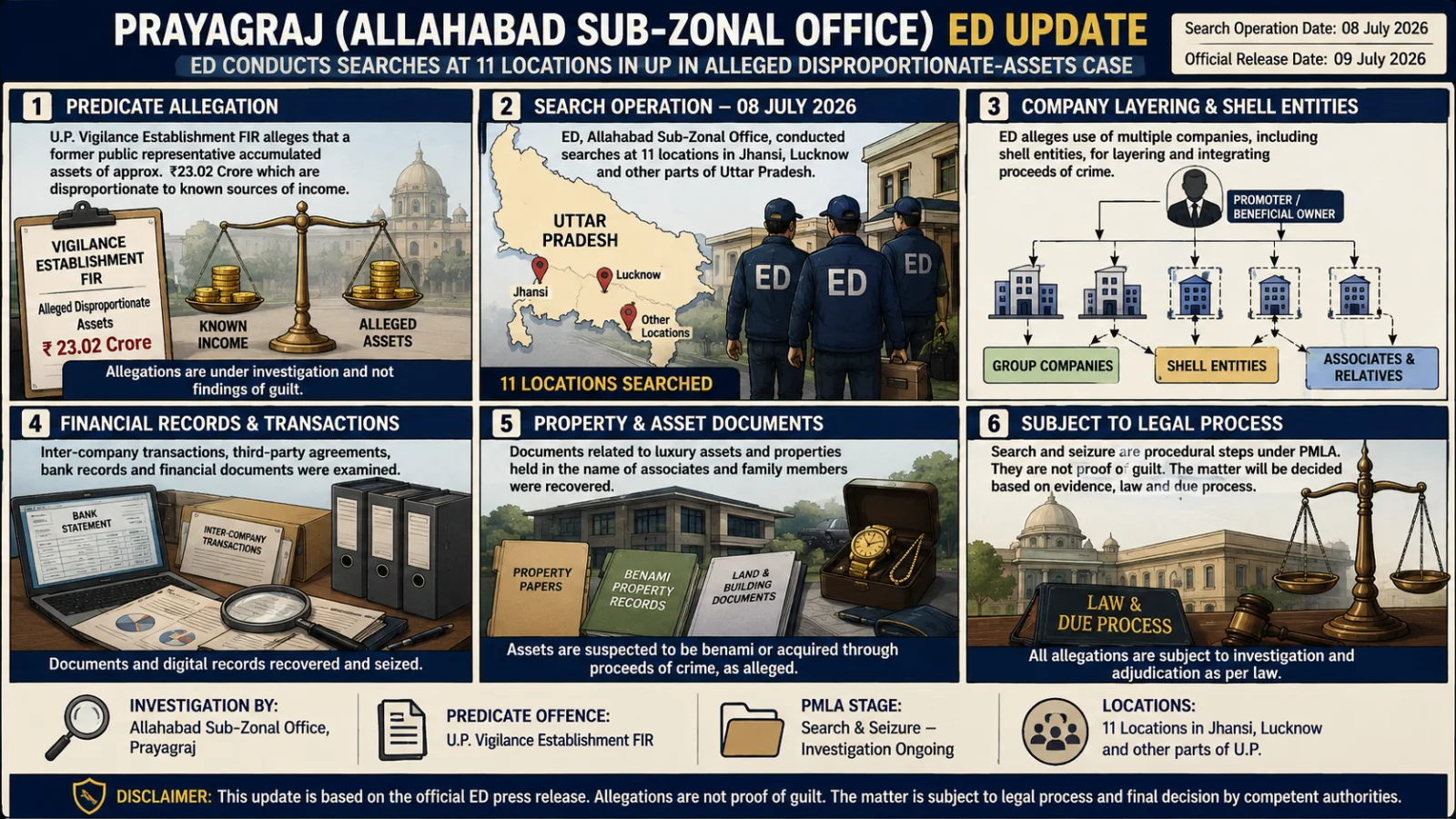
On 8 July 2026, the Directorate of Enforcement’s Allahabad Sub-Zonal Office conducted PMLA search operations at 11 locations in Jhansi, Lucknow and other parts of Uttar Pradesh in an investigation concerning a former Garautha MLA and others. The official press release dated 9 July 2026 states that the investigation arose from a Uttar Pradesh Vigilance Establishment FIR alleging disproportionate assets of approximately ₹23.02 crore beyond known sources of income during the stated check period. According to ED, the investigation also concerns alleged use of companies, including shell entities, for layering and integrating suspected proceeds of crime, and alleged acquisition of assets in the names of associates and family members. ED reported recovery and seizure of inter-company transaction records, third-party agreements, financial material, documents concerning luxury assets and suspected benami properties. These are investigation-stage allegations and search recoveries, not findings of guilt. Case-specific review requires the FIR, search authorisation, panchnama, seizure inventory, company records, property papers, banking trail and current law.
Why it matters: The development is relevant to Prayagraj because the searches were conducted by ED’s Allahabad Sub-Zonal Office, the official field unit located in the city. It shows how a disproportionate-assets predicate case may lead to PMLA examination of beneficial ownership, inter-company transfers, alleged shell entities and properties held through associates. Important records may include the Vigilance FIR, search authorisation, panchnama, seizure inventory, company-control documents, third-party agreements, bank statements, acquisition dates and the alleged nexus between each asset or transaction and proceeds of crime. Search or seizure does not establish guilt; the legal position depends on procedural compliance, complete records and later adjudicatory or court proceedings.

On 1 July 2026, the Allahabad High Court allowed Criminal Misc. Bail Application No. 38900 of 2025 in Sanjay Kumar @ Sanjay Dhiman v. Directorate of Enforcement, arising from Special Case No. 01/2025 and ECIR/HQ/01/2024. The Court examined six Himachal Pradesh predicate FIRs relating to alleged illegal mining and noted that closure reports had been submitted in all six, with four already accepted by the competent courts. It further observed that, for the Uttar Pradesh allegations, no proceeds of crime had been identified in respect of the applicant and no asset of the applicant had been seized. The Court stated that assets from an unknown source of income cannot, by that fact alone, be presumed to derive from a scheduled offence. It also considered that the PMLA investigation was complete, a complaint had been filed, a co-accused was on bail, the applicant had remained in custody since 18 November 2024 and trial would take time. Bail was granted subject to conditions, with an express direction that the observations were confined to bail and must not influence the trial.
Why it matters: This judgment is directly relevant to Prayagraj because it was delivered by the Allahabad High Court at Prayagraj and addresses the foundational PMLA requirement of linking identified property to criminal activity relating to a scheduled offence. It is useful in bail and proceeds-of-crime analysis where the predicate case has ended in closure reports or where ED relies on unexplained assets without identifying the asset-level nexus. Important records may include predicate FIRs and closure orders, the ECIR-linked complaint, asset and bank records, search or attachment material, mining and GST records, custody history and co-accused bail orders. The ruling is a bail-stage decision, not a final adjudication of innocence or liability, and the High Court expressly required the trial to proceed independently.

On 21 January 2026, the Special Court (CBI), West, Lucknow took cognizance of a PMLA Prosecution Complaint filed by the Directorate of Enforcement’s Allahabad Sub-Zonal Office in a case arising from a Jhunsi, Prayagraj police FIR. The official ED release dated 22 January 2026 states that the complaint had been filed on 29 September 2025 and concerns allegations of cheating, forgery, criminal breach of trust and criminal intimidation connected with the transfer of immovable properties. According to ED, five properties were allegedly acquired without due payment after false assurances concerning development projects and future financial benefits; three were later sold, and the sale proceeds were allegedly withdrawn and used personally. ED quantified the alleged proceeds of crime at approximately ₹1.41 crore and recorded an earlier provisional attachment of immovable property valued at ₹78 lakh, confirmed by the Adjudicating Authority. Cognizance is a procedural court step, not a finding of guilt. Case-specific review requires the FIR, prosecution complaint, cognizance order, property-transfer documents, sale records, banking trail, attachment papers and current law.
Why it matters: This development is directly relevant to Prayagraj because the predicate FIR was registered at Police Station Jhunsi and the PMLA investigation was handled by the Allahabad Sub-Zonal Office situated in the city. It shows how alleged property-transfer fraud may progress from a scheduled-offence FIR to financial tracing, provisional attachment, adjudication, prosecution and cognizance by the Special Court. Important records may include title and transfer deeds, payment records, development assurances, third-party sale documents, bank withdrawals, the attachment order, the Adjudicating Authority’s confirmation and the cognizance order. Cognizance does not establish guilt or validate allegations; the matter remains subject to evidence, charge, trial and available remedies under current law.

On 10 December 2025, the Directorate of Enforcement’s Allahabad Sub-Zonal Office, Prayagraj, announced the provisional attachment of six immovable properties valued at approximately ₹2.03 crore in the Vikas Construction investigation. The official release states that the case arose from two FIRs registered in Mau and Ghazipur and concerns allegations that government land was encroached upon for unauthorised godown construction, after which rental income and a NABARD subsidy were generated. ED identified alleged proceeds of crime of approximately ₹27.72 crore and alleged that about ₹10 crore was layered through two companies under the appearance of legitimate business transactions. The release further states that ₹1.91 crore was received as salary and ₹74 lakh as an unsecured loan and allegedly used to acquire the attached properties. This was reported as the fourth attachment order, taking cumulative attachment in the case to approximately ₹8.43 crore. These are ED allegations and a provisional measure, not findings of guilt or final confiscation. Case-specific review requires the FIRs, attachment order, asset schedule, title records, bank trail, company records and current law.
Why it matters: This development is relevant to Prayagraj because the attachment was announced by the Directorate of Enforcement’s Allahabad Sub-Zonal Office situated in the city, although the official release connects the underlying FIRs and alleged land encroachment to Mau and Ghazipur. It illustrates how alleged unlawful use of government land, rental income, subsidy receipts and company transfers may lead to proceeds-of-crime tracing and provisional attachment under the PMLA. Important records may include land and lease documents, FCI agreements, subsidy records, company accounts, authorised-signatory records, salary and loan entries, title documents, the PAO and the property schedule. Provisional attachment does not establish guilt or final confiscation; ownership claims, source-of-funds explanations and statutory remedies depend on the complete record and current law.
The official office directory places the Allahabad Sub-Zonal Office in the CTO Compound, BSNL Building, Civil Lines, Prayagraj. The office reference should not be converted into a claim of a local advocate chamber. Preparation remains dependent on the notice, scheduled-offence papers, transaction record and competent forum.
Prayagraj-linked matters can require careful treatment of agricultural, ancestral or joint-family property, societies and educational institutions, recruitment allegations, contractors, transport records and digital evidence. Property held over generations should be documented through title history and independent source material rather than addressed by a general family assertion.
Prepare title history, succession or partition material, revenue records, possession, improvements, sale or mortgage documents and the source of later acquisitions. Identify the share and control of each person separately.
Preserve advertisement, selection, fee, grant, governing-body, payroll, procurement and utilisation documents. The record should distinguish institutional processes from individual receipt or control.
Match permits, dispatch, weighment, transport, work, billing and banking data. Create a date-led schedule so quantities, services and payments can be tested together.
A writ petition is not an automatic substitute for the statutory process. Maintainability, alternate remedy, territorial connection, urgency, disputed facts and the precise action challenged require separate legal assessment.
Not every matter reaches every stage. The correct response depends on the document actually received and the current statutory and judicial position.
The official Directorate directory uses the name Allahabad Sub-Zonal Office and gives a Prayagraj postal address. Preserve the exact wording in the notice.
The title history, succession, partition, possession, source and alleged nexus differ. Each property and each person’s interest require separate analysis.
No automatic answer applies. Maintainability, alternate remedies, territorial jurisdiction, disputed facts and the action challenged must be examined.
Preserve the authorisation and inventory supplied, panchnama or seizure records, copied data, access details, objections, correspondence and an immediate factual chronology.
No. The map and address identify the government authority office. The primary professional base stated on the website is Patna, Bihar.