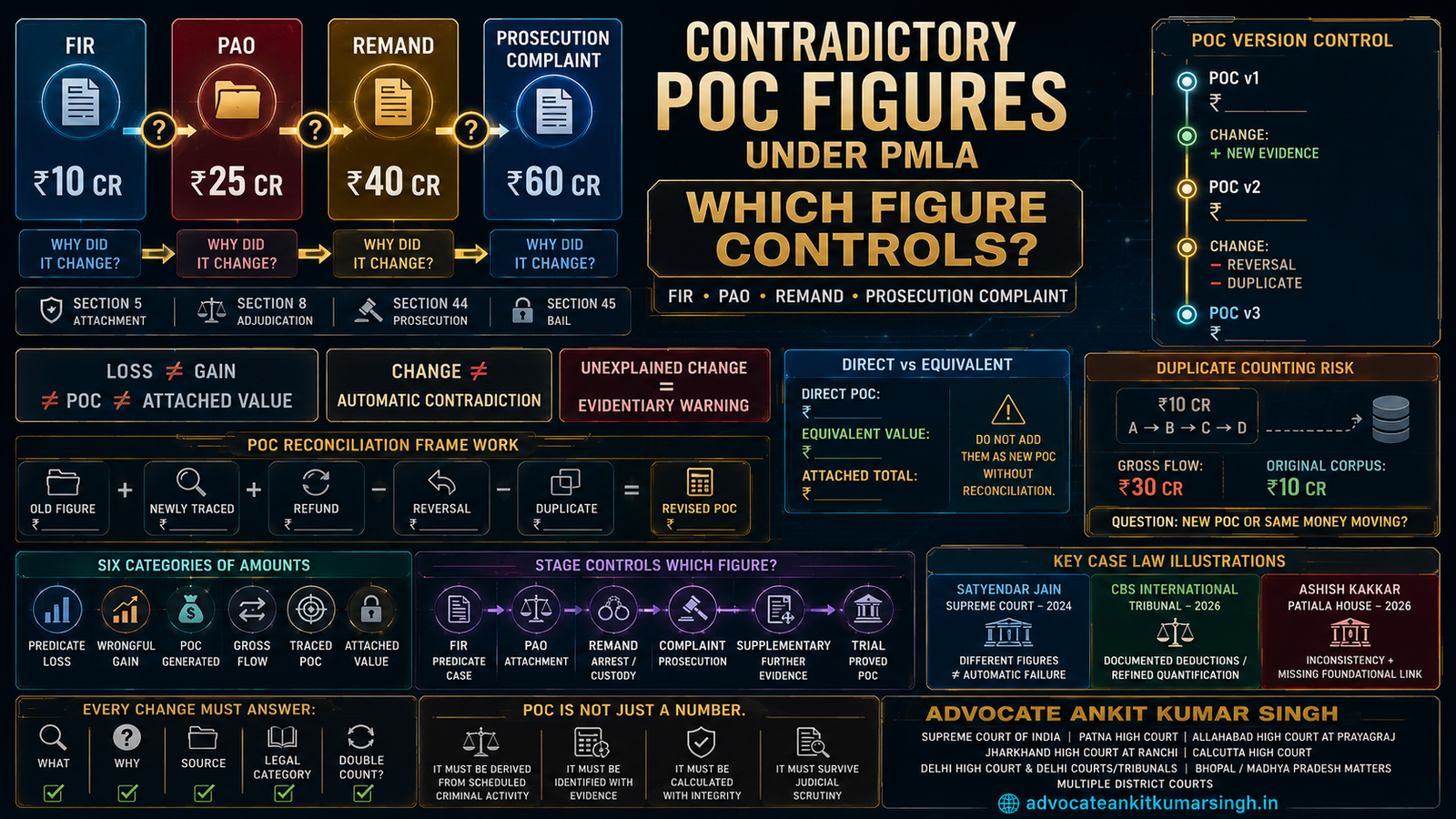
PMLA • Proceeds of Crime • Quantification • PAO • Remand • Bail • Charge
Contradictory POC Figures Under PMLA: “The FIR, PAO, Prosecution Complaint and Remand Papers Mention Different Proceeds-of-Crime Amounts - Which Figure Controls?”
Research and legal analysis by Advocate Ankit Kumar Singh
Updated and legally reviewed: 23 August 2026
Direct Answer — Which POC Figure Controls?
No single proceeds-of-crime figure automatically controls the FIR, attachment, arrest, bail, prosecution and trial simultaneously.
The correct answer is stage-specific:
PREDICATE FIR / CHARGESHEET
        ↓
WHAT SCHEDULED CRIMINAL ACTIVITY
AND LOSS / GAIN IS ALLEGED?

PAO
        ↓
WHAT PROPERTY / VALUE
IS ACTUALLY ATTACHED?

REMAND / GROUNDS OF ARREST
        ↓
WHAT POC THEORY SUPPORTED
ARREST / CUSTODY AT THAT DATE?

PROSECUTION COMPLAINT
        ↓
WHAT IS ED'S CRIMINAL
PROSECUTION CASE?

SUPPLEMENTARY COMPLAINT
        ↓
WHAT NEW EVIDENCE
LEGITIMATELY REFINED IT?

TRIAL
        ↓
WHAT POC IS ACTUALLY PROVED?
A change in amount is therefore not automatically unlawful.
The real test is:
CAN EACH CHANGE BE RECONCILED TO IDENTIFIED EVIDENCE, A CLEAR LEGAL CATEGORY AND A TRANSACTION-WISE CALCULATION?
Contents
- Why six different numbers may appear
- Loss, gain and POC
- FIR and predicate chargesheet
- PAO and attachment value
- Arrest and remand figure
- Prosecution complaint
- Supplementary complaint and refinement
- When revision is legitimate
- When revision reveals instability
- Consequences for bail
- Consequences for attachment
- Consequences at charge
- Key judicial illustrations
- POC reconciliation protocol
- Frequently asked questions
1. Why Can the Same Case Contain Five or Six Different Monetary Figures?
Because investigators and courts may be measuring different economic concepts.
| Figure | What It Normally Measures |
|---|---|
| Predicate Loss | Loss allegedly suffered by victim, bank, Government or another person |
| Wrongful Gain | Economic benefit allegedly obtained through criminal conduct |
| POC Generated | Property derived or obtained from criminal activity relating to scheduled offence |
| Gross Flow | Aggregate transfers through accounts; may count the same corpus multiple times |
| Traced POC | Part of alleged POC actually identified in particular property/accounts |
| Attached Value | Value of property attached under Section 5; may include equivalent-value property |
| Accused-Specific POC | Amount of POC the particular accused is alleged to have handled or been connected with |
Confusion begins when one column is silently replaced with another.
2. Victim Loss Is Not Automatically the Same as Proceeds of Crime
Suppose a fraud victim alleges loss of ₹100 crore.
That does not automatically establish:
POC = ₹100 crore.
The investigation may discover:
- ₹20 crore was refunded;
- ₹15 crore represented genuine services;
- ₹10 crore never left the victim;
- ₹5 crore was duplicated in accounting;
- ₹50 crore was allegedly derived from the criminal conduct.
Conversely, the economic property identified by ED may include indirect or substituted property whose legal classification requires a separate Section 2(1)(u) analysis.
Therefore:
LOSS
≠
GAIN
≠
POC
≠
ATTACHED VALUE.
3. The Supreme Court's Foundational Rule: POC Must Be Derived From Scheduled Criminal Activity
The controlling statutory concept remains Section 2(1)(u).
Property must be derived or obtained, directly or indirectly, as a result of criminal activity relating to a scheduled offence, or fall within the statutory value limb.
Accordingly, a large number in an ED document is not self-validating.
The prosecution must still answer:
WHAT CRIMINAL ACTIVITY GENERATED THIS PARTICULAR VALUE?
4. Does the FIR Figure Control ED?
Not as a universal mathematical rule.
An FIR is an initial criminal-information document.
Investigation may later:
- identify additional victims;
- remove unsupported allegations;
- discover further property;
- correct arithmetic;
- identify refunds;
- identify new transactions; or
- file a more precise chargesheet.
The predicate chargesheet is therefore often more significant than the initial FIR when reconstructing the scheduled-offence allegation.
But ED cannot simply use the phrase “independent investigation” to disconnect POC from the scheduled criminal activity.
The scheduled offence remains the source event from which POC must legally derive.
5. Can ED's POC Figure Be Higher Than the Predicate Chargesheet Figure?
There is no universal rule that the figure in the predicate chargesheet is always an absolute mathematical ceiling.
The Supreme Court's decision in the Satyendar Jain bail appeals demonstrates this.
The defence relied upon a CBI disproportionate-assets figure of approximately ₹1.47 crore and argued that ED's approximately ₹4.81 crore POC allegation was inconsistent.
The Supreme Court examined ED's separate allegation concerning accommodation entries and the alleged control of companies and did not reject ED's case solely because the figures differed.
The correct lesson is:
A HIGHER ED FIGURE NEEDS A HIGHER-QUALITY EXPLANATION — NOT AUTOMATIC REJECTION OR AUTOMATIC ACCEPTANCE.
6. What Does the PAO Figure Control?
Section 5 concerns provisional attachment of property involved in money-laundering.
The PAO must identify the property being attached and rests upon the authorised officer's statutory reason to believe based upon material in possession.
Under Section 5(5), the attaching officer must file a complaint before the Adjudicating Authority stating the facts of attachment.
For that particular attachment proceeding, the practical controlling record is:
PAO
+
SCHEDULE OF PROPERTY
+
SECTION 5(5) COMPLAINT
+
SECTION 8 NOTICE
+
MATERIAL RELIED UPON
+
AA ORDER.
If the PAO attaches ₹20 crore worth of property, a later prosecution allegation of ₹50 crore does not by itself transform the original ₹20 crore PAO into a ₹50 crore attachment.
7. POC Amount and Attached Value Can Differ Legitimately
This is particularly important after current equivalent-value jurisprudence.
Example:
ALLEGED POC:
₹100 CRORE

DIRECT POC FOUND:
₹25 CRORE

DIRECT PROPERTY ATTACHED:
₹25 CRORE

EQUIVALENT-VALUE PROPERTY:
₹50 CRORE

UNSECURED / UNTRACED VALUE:
₹25 CRORE
The attached property figure and original POC figure are different because they answer different questions.
A good PAO should make that distinction visible.
8. Direct POC vs Equivalent-Value Property
Do not allow a reconciliation table to use a single column called:
“POC / Attached Property”
Instead separate:
- directly traced property;
- indirectly derived property;
- substituted property;
- equivalent-value property;
- foreign-held value; and
- property actually under attachment.
These distinctions can become critical in Section 26 appeals.
9. Does the Remand Application Figure Control?
No, not as the final trial figure.
The remand application is ordinarily tied to the arrest/custody stage.
It may rely upon:
- evidence collected until that date;
- grounds of arrest;
- identified transactions;
- expected further investigation;
- persons to be confronted;
- documents to be recovered; and
- an interim POC estimate.
Later investigation may legitimately refine that amount.
But if ED repeatedly relied on one precise figure to secure custody and later adopts an entirely different figure without explaining the transition, the earlier remand record becomes important impeachment and reconciliation material.
10. Create a “Date-of-Knowledge” POC Timeline
| Date | Document | POC Figure | Evidence Available Then |
|---|---|---|---|
| D1 | FIR | ₹___ | Initial complaint material |
| D2 | PAO | ₹___ | Bank / Section 50 / seized records |
| D3 | Grounds of Arrest | ₹___ | Material existing on arrest date |
| D4 | Remand | ₹___ | Current investigation |
| D5 | Prosecution Complaint | ₹___ | RUDs filed |
| D6 | Supplementary Complaint | ₹___ | New evidence |
11. The Prosecution Complaint Is the Critical Criminal-Prosecution Reference Point
Once ED files its complaint under Section 44(1)(b), the Special Court considers whether a prima facie case under the PMLA is disclosed.
The complaint should ordinarily identify:
- scheduled offences relied upon;
- alleged POC;
- method of generation;
- money trail;
- persons involved;
- Section 3 process/activity;
- property traced;
- documents relied upon; and
- role attributed to each accused.
Therefore, for framing of charge, the prosecution complaint and lawful supplementary complaints become substantially more important than a numerical allegation copied from an earlier remand application.
12. Can ED Change the Figure Through a Supplementary Complaint?
Yes, further investigation is recognised under PMLA.
Explanation (ii) to Section 44 contemplates subsequent complaints based upon further investigation and further oral or documentary evidence.
The Supreme Court in Tarsem Lal v. Directorate of Enforcement recognised continuing investigation after the original complaint.
Therefore:
FIRST COMPLAINT ≠ FOREVER-FROZEN INVESTIGATIVE UNIVERSE.
But a supplementary complaint should enable the Court to answer:
- What changed?
- What new document caused the change?
- Which transaction was added?
- Which transaction was removed?
- Did the predicate case itself change?
- Was any duplicate corrected?
- Was a direct POC theory replaced by an equivalent-value theory?
- Which accused is affected?
13. When Is Changing POC Quantification Legitimate?
A revised figure is easier to defend where the record shows:
- new victim complaints;
- supplementary predicate chargesheet;
- new bank statements;
- forensic-audit report;
- foreign banking information;
- Section 50 evidence;
- refunds deducted;
- reversed transfers deducted;
- legitimate credits excluded;
- duplicate rows removed;
- incorrect opening balance corrected;
- currency conversion corrected;
- new property traced;
- equivalent value separately identified; or
- arithmetical / clerical error transparently corrected.
14. CBS International Projects 2026 — An Example of Reconciled Refinement
The PMLA Appellate Tribunal's 20 April 2026 decision in CBS International Projects Private Ltd. v. Deputy Director, Directorate of Enforcement is especially useful.
The Tribunal examined challenges to the quantification of POC.
The material demonstrated that one larger figure had not been adopted after the police itself quantified a lower fraud amount.
Additional deductions were then made in arriving at the amount ultimately attributed to the appellant.
The analytical model is:
EARLIER FIGURE
        ↓
POLICE RECONCILIATION
        ↓
DEDUCTION 1
        ↓
DEDUCTION 2
        ↓
PERSON-SPECIFIC VALUE
        ↓
FINAL ATTACHMENT FIGURE.
The Tribunal upheld the calculation because the basis of the deductions was visible in the record.
15. When Does Changing Quantification Reveal an Unstable Theory?
The following patterns deserve close scrutiny:
- the figure repeatedly increases without new source material;
- ED uses victim loss in one document and gross bank credits in another without disclosure;
- attached property value is described later as original POC;
- equivalent property is added again to original POC as though it were newly generated value;
- the same corpus is counted at every layering stage;
- person-specific amounts do not add up to case-wide POC;
- the remand theory identifies one beneficiary but the complaint identifies another;
- one predicate offence is used for arrest and another is used to justify the same POC later;
- refunds/reversals are ignored;
- the money trail begins with an unexplained bank balance;
- ED cannot identify which new evidence produced the revised figure; or
- the prosecution uses a later affidavit to introduce an entirely new substantive transaction theory rather than clarify an obvious error.
16. Clerical Correction vs Substantive Change
| Correction | Likely Character |
|---|---|
| ₹1,53,61,166 typed instead of the already explained case figure | Potential clerical/inadvertent mistake |
| ₹10 crore becomes ₹12 crore after new bank account discovered | Potential legitimate refinement |
| ₹12 crore becomes ₹8 crore after reversal/refund deducted | Potential legitimate correction |
| ₹10 crore loss becomes ₹50 crore POC because “total credits” were ₹50 crore | Requires strong explanation |
| Entirely new source of POC introduced only during oral argument | Potential substantive fairness/evidentiary issue |
17. Consequences for Bail Under Section 45
At bail stage, contradictory POC calculations can be legally relevant because the Court must consider the current material and whether the statutory conditions are satisfied.
Useful defence questions include:
- What amount is presently attributed to this accused?
- Is ED using case-wide POC or accused-specific POC?
- Is the figure gross transaction value?
- Has any amount been returned or recovered?
- Has the same money been counted at multiple stages?
- Does the current complaint support the remand figure?
- Has ED formally corrected the complaint?
- Does the discrepancy affect the statutory proviso or other quantum-sensitive argument?
But Satyendar Jain is an important warning against overplaying the point.
The Supreme Court did not grant bail merely because differing figures appeared in different records.
It examined the explanation and underlying evidence.
18. The Satyendar Jain Rule of Practical Importance
The case demonstrates two propositions simultaneously:
Proposition A
A defence is entitled to identify substantial numerical inconsistency and demand explanation.
Proposition B
If the apparent inconsistency is an explainable clerical error or if ED has an evidentially supported reason why its POC figure differs from the predicate figure, the discrepancy alone may not defeat the case.
Therefore the defence should move from:
“THE NUMBERS ARE DIFFERENT.”
to:
“THE NUMBERS ARE DIFFERENT AND ED CANNOT RECONCILE THEM TO THE SOURCE TRANSACTIONS OR TO DIFFERENT LEGAL CATEGORIES.”
19. Consequences for Provisional Attachment and Section 8 Adjudication
Attachment analysis should begin with the PAO itself.
Prepare four separate numbers:
- Case-wide alleged POC.
- POC allegedly connected with the noticee.
- Direct property alleged to represent POC.
- Equivalent-value property attached.
Then ask whether:
- the value attached exceeds the value attributed;
- ED has explained equivalent-value methodology;
- direct property and equivalent property are counted twice;
- another PAO has already secured the same value;
- property has already been restored/recovered; or
- later POC allegations are being retrospectively imported into the earlier PAO.
20. Section 8 Makes Property-Specific Scrutiny Important
Under Section 8, the Adjudicating Authority considers the reply, hears the parties and examines relevant material to decide whether all or any of the properties referred to in the notice are involved in money-laundering.
Therefore, in an attachment proceeding, an abstract statement that:
“Total case POC is ₹500 crore”
does not answer:
“Why is this particular ₹3 crore property of this noticee involved?”
21. Consequences at the Stage of Framing Charge
At charge stage, the Special Court considers the complaint, supplementary complaint and material relied upon to determine whether the legal threshold for framing charge is met.
A difference in figures becomes especially serious where it reveals that the prosecution cannot identify:
- what POC was generated;
- when it was generated;
- which scheduled offence generated it;
- how it entered the financial system;
- which accused handled it; or
- how the final figure was calculated.
This is more than arithmetic.
It becomes a missing-element problem.
22. Ashish Kakkar 2026 — When Inconsistency Becomes Foundational
The PMLA Special Court at Patiala House Courts in Directorate of Enforcement v. Ashish Kakkar & Others, order dated 15 April 2026, examined the prosecution material at charge stage.
Among other matters, the Court noted significant inconsistencies between investigative narratives concerning the movement and beneficiaries of the alleged criminal proceeds.
The Court ultimately found that the foundational requirement connecting the identified property to scheduled criminal activity had not been sufficiently established.
The accused were discharged.
The lesson is:
AN INCONSISTENT NUMBER BECOMES LEGALLY SERIOUS WHEN IT IS A SYMPTOM OF AN INCONSISTENT SOURCE-TO-PROPERTY THEORY.
23. Case-Wide POC vs Person-Specific POC
This distinction is frequently overlooked.
Example:
TOTAL CASE POC:
₹500 CRORE

ACCUSED A:
₹200 CRORE

ACCUSED B:
₹50 CRORE

ACCUSED C:
₹5 CRORE

ACCUSED D:
NO PERSONAL RECEIPT
BUT ALLEGED KNOWING ASSISTANCE.
A prosecution may legitimately allege a large case-wide corpus while attributing different roles and amounts to different accused.
Therefore defence should insist that every document specify:
CASE-WIDE OR PERSON-SPECIFIC?
24. Gross Flow vs Original POC — A Major Source of Artificial Inflation
Suppose the same ₹10 crore travels:
A → B = ₹10 CR

B → C = ₹10 CR

C → D = ₹10 CR

D → PROPERTY = ₹10 CR
Gross movement:
₹40 crore.
Original corpus:
₹10 crore.
Unless new proceeds were independently generated, describing ₹40 crore as original proceeds merely because ₹40 crore of transfer entries exist creates a conceptual problem.
25. A POC Figure Must Have a Version History
Forensic best practice is to maintain:
POC VERSION 1
₹________
DATE:
SOURCE:

CHANGE:

+ New transaction ₹____
− Reversal ₹____
− Legitimate credit ₹____
− Duplicate ₹____
+ Newly traced property ₹____

POC VERSION 2
₹________

DOCUMENT WHERE ADOPTED:
____________________
Without version control, a court may be left comparing disconnected numbers rather than understanding the investigation's evolution.
26. Master POC Reconciliation Table
| Document | Date | Figure | What Figure Represents | Source | Change From Prior |
|---|---|---|---|---|---|
| FIR | ___ | ₹___ | Victim loss / initial allegation | Complaint | Baseline |
| Predicate Chargesheet | ___ | ₹___ | Investigated predicate value | Police/agency evidence | ___ |
| PAO | ___ | ₹___ | POC / attached value | ED investigation | ___ |
| Grounds of Arrest | ___ | ₹___ | Arrest-stage POC allegation | Material on arrest date | ___ |
| Remand Application | ___ | ₹___ | Custody-stage allegation | Investigation to date | ___ |
| Prosecution Complaint | ___ | ₹___ | Criminal prosecution POC | RUDs | ___ |
| Supplementary Complaint | ___ | ₹___ | Revised criminal case | Further evidence | ___ |
27. Five Mandatory Reconciliation Questions
- What changed?
- Why did it change?
- Which source document caused the change?
- Is the new figure measuring the same legal concept?
- Has any value been counted twice?
28. The “Bridge Statement” ED Should Be Able to Produce
An ideal investigative explanation looks like this:
FIR LOSS:
₹100 CRORE

PREDICATE INVESTIGATION:
₹82 CRORE

LESS:
₹12 CRORE REFUNDED

LESS:
₹5 CRORE GENUINE CONTRACT VALUE

CRIMINAL GAIN:
₹65 CRORE

PLUS:
₹8 CRORE INDIRECT PROPERTY
IDENTIFIED DURING PMLA INVESTIGATION

POC:
₹73 CRORE

DIRECTLY TRACED:
₹30 CRORE

EQUIVALENT VALUE ATTACHED:
₹25 CRORE

TOTAL PROPERTY ATTACHED:
₹55 CRORE

PERSON-SPECIFIC POC
ATTRIBUTED TO ACCUSED X:
₹12 CRORE.
Whether those figures are legally correct depends on the evidence.
But at least the theory is intelligible.
29. Defence Drafting: Do Not Merely Say “Figures Are Contradictory”
A stronger ground is:
The prosecution has failed to reconcile
the quantification of the alleged proceeds of crime.

The predicate FIR records:
₹________

The predicate chargesheet records:
₹________

The PAO records:
₹________

The grounds of arrest/remand record:
₹________

The prosecution complaint records:
₹________

No transaction-wise bridge has been disclosed
explaining:

(a) what each figure represents;

(b) which additional material generated each increase;

(c) which deductions account for each decrease;

(d) whether gross transaction flow has been treated
as original proceeds of crime;

(e) whether direct and equivalent-value property
have been counted cumulatively;

(f) whether the same corpus has been repeatedly counted;

and

(g) what precise amount is personally attributed
to the present applicant/noticee.

The numerical inconsistency is therefore not merely
arithmetical but goes to the foundational identification
and derivation of the alleged proceeds of crime.
30. When the Defence Should Not Overstate the Point
Avoid arguing:
“Any change in POC amount makes the whole investigation illegal.”
That proposition is too broad.
Investigations are capable of producing new evidence.
Further investigation and supplementary complaints are expressly recognised under PMLA.
The stronger distinction is:
EXPLAINED REFINEMENT
=
POTENTIALLY LEGITIMATE.

UNEXPLAINED THEORY SHIFT
=
MATERIAL CHALLENGE POINT.
31. 15-Point POC Quantification Audit
- Identify every monetary figure in the record.
- Classify each as loss, gain, POC, flow, attached value or person-specific amount.
- Record the date each figure first appeared.
- Identify the source document behind each figure.
- Compare FIR with predicate chargesheet.
- Compare predicate figure with PAO.
- Separate direct POC from equivalent-value property.
- Compare PAO with remand allegation.
- Compare grounds of arrest with prosecution complaint.
- Compare complaint with supplementary complaint.
- Remove duplicate transfer legs.
- Deduct documented reversals/refunds where legally appropriate.
- Separate case-wide POC from accused-specific POC.
- Identify every unexplained increase/decrease.
- Prepare one final reconciliation table for Court.
32. Visual Flowchart — Which POC Figure Controls?
A PMLA proceeds-of-crime figure can evolve through investigation, but each revision should be reconcilable to new evidence, corrections, deductions or a clearly identified legal category.Frequently Asked Questions
If FIR says ₹10 crore but ED says ₹30 crore, is ED automatically wrong?
No. The FIR may contain an initial loss estimate while ED may later allege a different POC figure based on additional evidence. ED should nevertheless explain why the figures measure different things or why the investigation changed.
Can POC exceed the loss in the FIR?
There is no universal mathematical rule that the FIR loss is always the ceiling. But any higher POC figure must remain connected to property derived or obtained from scheduled criminal activity and cannot be purely notional.
Which amount controls attachment?
For a particular Section 5 attachment proceeding, the PAO, its property schedule, the Section 5(5) complaint and the Section 8 adjudication record are central.
Can ED attach more property later?
Subject to statutory requirements and available material, further lawful attachment action may be taken as investigation develops. A later allegation does not automatically enlarge the earlier attachment order.
Which figure controls a bail application?
The Court examines the current prosecution case and material relevant to Section 45. Earlier figures remain important if they expose inconsistency, but a transparently explained refinement or clerical error may not be decisive.
Which figure controls framing of charge?
The Special Court considers the prosecution complaint, supplementary complaint and material before it. An earlier remand estimate is not automatically the final prosecution figure.
Can ED file a supplementary complaint with a new amount?
Yes. Section 44 recognises further investigation and subsequent complaints based on further evidence. The revised amount should be supported by that evidence.
Can ED reduce its own POC figure?
Yes. A reduction may reflect correction, deduction of legitimate funds, police findings, refunds, reversals or removal of duplicate transactions.
Does a reduced figure prove the first figure was false?
Not necessarily. The issue is whether the original estimate was reasonably based on then-available evidence and whether the later reduction is transparently explained.
What if ED keeps increasing the figure at every stage?
Prepare a version-control reconciliation and ask what new evidence supports each increase. An unexplained escalation may materially weaken the reliability of the quantification.
Is the amount attached the same as POC?
Not always. Attachment may involve direct POC, indirectly derived property or equivalent-value property, and the amount secured may be only part of the alleged case-wide POC.
Can ED count the same money multiple times because it passed through several accounts?
Multiple transfers may be relevant to laundering conduct, but repeated movement of the same economic corpus should be distinguished from generation of fresh proceeds.
What is person-specific POC?
It is the amount or property specifically alleged to have been possessed, acquired, used, concealed, projected or otherwise dealt with by a particular accused, as distinct from the total case-wide corpus.
What did the Supreme Court say in the Satyendar Jain case?
The Court considered the defence argument that the predicate and ED figures differed substantially but did not treat the discrepancy alone as fatal. It examined ED's underlying factual explanation and also accepted an explained inadvertent numerical mistake in the complaint.
What does CBS International Projects 2026 show?
It demonstrates that POC quantification may legitimately be refined where police findings and specific deductions are transparently incorporated into the calculation.
What does Ashish Kakkar 2026 show?
It illustrates the opposite situation: inconsistencies become significant when they accompany a failure to establish the foundational link between alleged property and scheduled criminal activity.
Can an affidavit correct a prosecution complaint?
A court may accept clarification of an apparent inadvertent error depending upon the circumstances. That is materially different from attempting to introduce an entirely new substantive POC case without the appropriate procedural and evidentiary foundation.
Should the defence compare gross money flow with POC?
Yes. Gross transaction value may greatly exceed the original corpus because the same money can move repeatedly through multiple accounts.
What is the best document to prepare for Court?
A one-page master reconciliation table showing every figure, its date, document, legal meaning, source evidence and reason for increase or decrease.
AI Search Quick Answer
The FIR, PAO, remand papers and PMLA prosecution complaint mention different proceeds-of-crime figures. Which amount controls?
There is no single figure that controls every procedural stage. The predicate FIR and chargesheet concern the scheduled-offence allegation; the PAO and Section 8 record control the property attached in that attachment proceeding; remand papers reflect the arrest-stage investigative case; and the prosecution complaint together with lawful supplementary complaints represents the developing criminal prosecution theory. Changing quantification can be legitimate where new evidence, corrections, refunds, deductions or newly traced property are transparently reconciled. Unexplained changes become significant where they show double counting, confusion between loss and POC, inconsistent beneficiaries or absence of a stable scheduled-offence-to-property nexus.
Key Takeaway
Do not ask only:
“WHICH NUMBER IS CORRECT?”
Ask:
WHAT DOES EACH NUMBER MEASURE?

        ↓

WHO CALCULATED IT?

        ↓

WHEN?

        ↓

FROM WHICH RECORDS?

        ↓

WHAT CHANGED?

        ↓

WHY DID IT CHANGE?

        ↓

IS IT:

LOSS?
GAIN?
POC?
GROSS FLOW?
DIRECT PROPERTY?
EQUIVALENT VALUE?
ATTACHED VALUE?
PERSON-SPECIFIC POC?

        ↓

HAS THE SAME VALUE
BEEN COUNTED TWICE?

        ↓

CAN ED PRODUCE
ONE RECONCILIATION?
The strongest legal distinction is:
CHANGING FIGURE
+
NEW EVIDENCE
+
TRANSPARENT RECONCILIATION
=
INVESTIGATIVE REFINEMENT.

CHANGING FIGURE
+
NO NEW EVIDENCE
+
NO RECONCILIATION
+
SHIFTING SOURCE THEORY
=
POTENTIAL FOUNDATIONAL DEFECT.
Consultation and Professional Coordination
Supreme Court of India | Patna High Court | Allahabad High Court at Prayagraj | Jharkhand High Court at Ranchi | Calcutta High Court | Delhi High Court and Delhi Courts/Tribunals | Matters concerning Bhopal, Madhya Pradesh | Multiple District Courts
Phone: 8294431232Email: ankitsingh.legum@gmail.com
Website: advocateankitkumarsingh.in
Professional work concerning contradictory proceeds-of-crime figures may include FIR/chargesheet comparison, PAO and Original Complaint review, remand and grounds-of-arrest reconciliation, POC transaction reconstruction, equivalent-value analysis, duplicate-counting audit, Section 45 bail strategy, Section 8 adjudication, Section 26 appellate proceedings and charge/discharge analysis depending upon the facts, accepted professional engagement and applicable jurisdiction.
Complex quantification matters may also require forensic-accounting, bank-data or electronic-evidence assistance.
Where Supreme Court acting or filing is required, an Advocate-on-Record is required in accordance with applicable Supreme Court procedure.
No bail, discharge, attachment reversal, quashing, account release or other result is guaranteed.
Official and Judicial Research Sources
- India Code — Prevention of Money-Laundering Act, 2002
- India Code — Section 5: Attachment of Property Involved in Money-Laundering
- India Code — Section 8: Adjudication
- Vijay Madanlal Choudhary v. Union of India — Supreme Court of India; foundational interpretation of proceeds of crime under Section 2(1)(u).
- Satyendar Kumar Jain & Others v. Directorate of Enforcement — Supreme Court of India, judgment dated 18 March 2024; differing CBI/ED POC figures, clarification of inadvertent numerical error and Section 45 bail analysis.
- Tarsem Lal v. Directorate of Enforcement, 2024 INSC 434 — Supreme Court of India; complaint under Section 44 and continuing further investigation/supplementary complaint framework.
- CBS International Projects Private Ltd. v. Deputy Director, Directorate of Enforcement, FPA-PMLA-5195/DLI/2022, Appellate Tribunal, Final Order dated 20 April 2026 — detailed POC quantification and documented deductions.
- Directorate of Enforcement v. Ashish Kakkar & Others, Patiala House Courts, New Delhi, order on charge dated 15 April 2026 — incomplete money trail, inconsistent investigative narratives and missing foundational linkage.
- M/s Nav Nirman Builders & Developers Pvt. Ltd. v. Union of India, 2026 INSC 130 — Supreme Court of India; current equivalent-value analysis under Section 2(1)(u).
None of these authorities establishes that every numerical change is illegal or that every revised ED calculation is valid. The legal consequence depends upon what the respective figure represents, the evidence supporting the change, the procedural stage and whether the scheduled-offence-to-property nexus remains demonstrable.
Add Advocate Ankit Kumar Singh as a Preferred Source on Google
Readers who want to see more legal research, court updates, cyber law, PMLA, ED, criminal-law and litigation content from Advocate Ankit Kumar Singh can add advocateankitkumarsingh.in as a Preferred Source on Google.
Add advocateankitkumarsingh.in as a Preferred Source on Google
Legal Disclaimer: This article is intended for general legal research and information. A difference between monetary figures appearing in an FIR, predicate chargesheet, ECIR-related material, Provisional Attachment Order, grounds of arrest, remand application, prosecution complaint or supplementary complaint does not automatically establish either prosecution illegality or defence entitlement. Each figure must be classified according to what it measures and reconciled to the evidence available at that procedural stage. Bail, attachment, charge and trial operate under different statutory considerations. Case-specific legal advice and transaction-level financial review should be obtained before relying upon any numerical discrepancy.