Bhopal city and state
Geographic contextInteractive city/state map. Use the authority map to locate the government office named in the official directory.
Bhopal-linked proceedings frequently require disciplined reconciliation of institutional, contractual, banking and property records. The relevant ED office must be verified from the notice because the location of a person, asset or transaction does not alone determine the complete scope of an investigation.
Short, sourced developments and practical preparation notes appear here. Full educational articles remain in the separate related-articles section.

On 30 June 2026, the Directorate of Enforcement’s Bhopal Zonal Office issued a Provisional Attachment Order under the PMLA covering a cricket academy, hotels, resorts and the underlying land at Village Semri Bajyafat, Bhopal, valued at approximately ₹22.46 crore. According to the official press release, the investigation arose from an FIR registered by the Special Police Establishment, Lokayukta, Bhopal, concerning alleged disproportionate assets of approximately ₹41.87 crore linked to former Madhya Pradesh cadre officers and related persons. The ED alleges that benami entities, sham agreements and layered transactions were used to conceal beneficial ownership and project assets as untainted. It further alleges that investment in the cricket academy and allied infrastructure was financed through illicit wealth routed through an associate. The release records earlier attachments of approximately ₹13.60 crore and prosecution complaints before the Special PMLA Court, Bhopal. These are ED allegations and provisional measures, not findings of guilt or final confiscation. Case-specific review requires the FIR, PAO, asset schedule, title and funding records, court papers and current law.
Why it matters: This development is directly relevant to Bhopal because the issuing ED office and attached land and structures are connected with the city. It shows how a disproportionate-assets predicate case may progress into property tracing, beneficial-ownership allegations and provisional attachment under Section 5 PMLA. Records requiring examination may include the PAO and recorded reasons, land and construction documents, entity records, bank trails, valuation material, alleged benami arrangements, previous attachments and Special Court papers. Provisional attachment restricts dealing with identified assets but does not itself establish guilt or final confiscation. Statutory timelines, Adjudicating Authority proceedings, ownership claims and remedies depend on the complete record and current law.
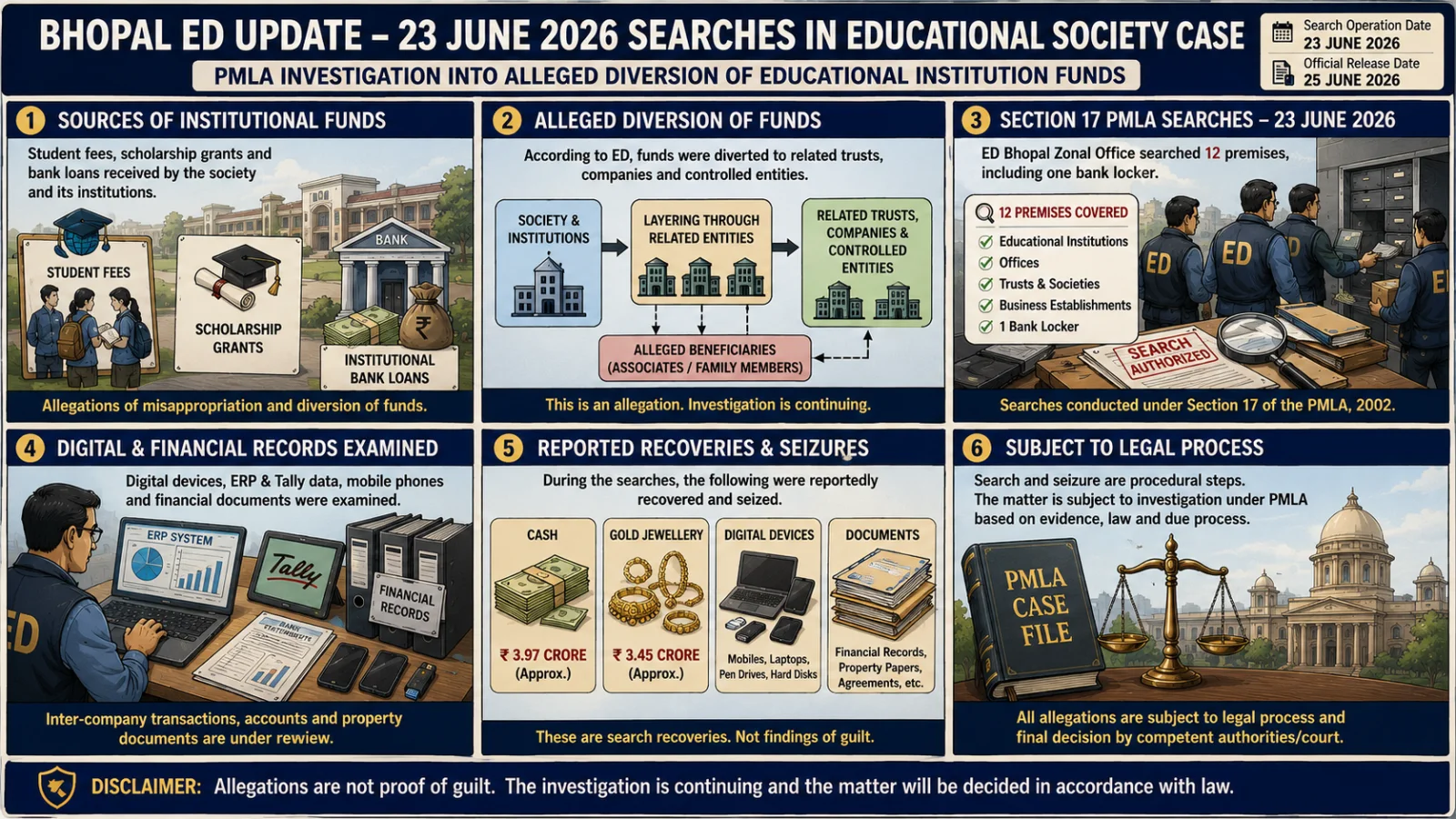
On 23 June 2026, the Directorate of Enforcement’s Bhopal Zonal Office conducted searches under Section 17 of the PMLA at 12 premises, including one bank locker, in the Shri Astha Foundation for Education Society investigation. The official release dated 25 June 2026 states that the searches covered residences, offices, educational institutions, trusts and business establishments connected with the Chouksey Group. According to ED, the investigation arose from an EOW, Bhopal FIR alleging misappropriation and diversion of society funds. The agency alleges that student fees, scholarship grants and bank loans obtained in the names of the society and its institutions were diverted to related trusts, companies and controlled entities. ED reported seizure of approximately ₹3.97 crore in cash, gold jewellery valued at ₹3.45 crore, mobile phones, digital devices, ERP and Tally data, financial records and property documents. These are investigation-stage allegations and search recoveries, not findings of guilt. Case-specific review requires the FIR, search authorisation, panchnama, seizure inventory, governance records, fee and scholarship accounts, loan documents and current law.
Why it matters: This development is directly relevant to Bhopal because the search was conducted by the Bhopal Zonal Office and the predicate FIR was registered by EOW, Bhopal. It illustrates how allegations concerning an educational society may expand into examination of student fees, scholarship grants, institutional loans, related-party transfers, digital accounting data, bank lockers and property records. Important records may include society registration and governing-body resolutions, utilisation records, student and scholarship ledgers, loan-sanction and end-use documents, ERP and Tally exports, related-entity accounts, search inventories and device records. Search and seizure do not establish guilt; the legal position depends on statutory compliance, the complete money trail and later proceedings.
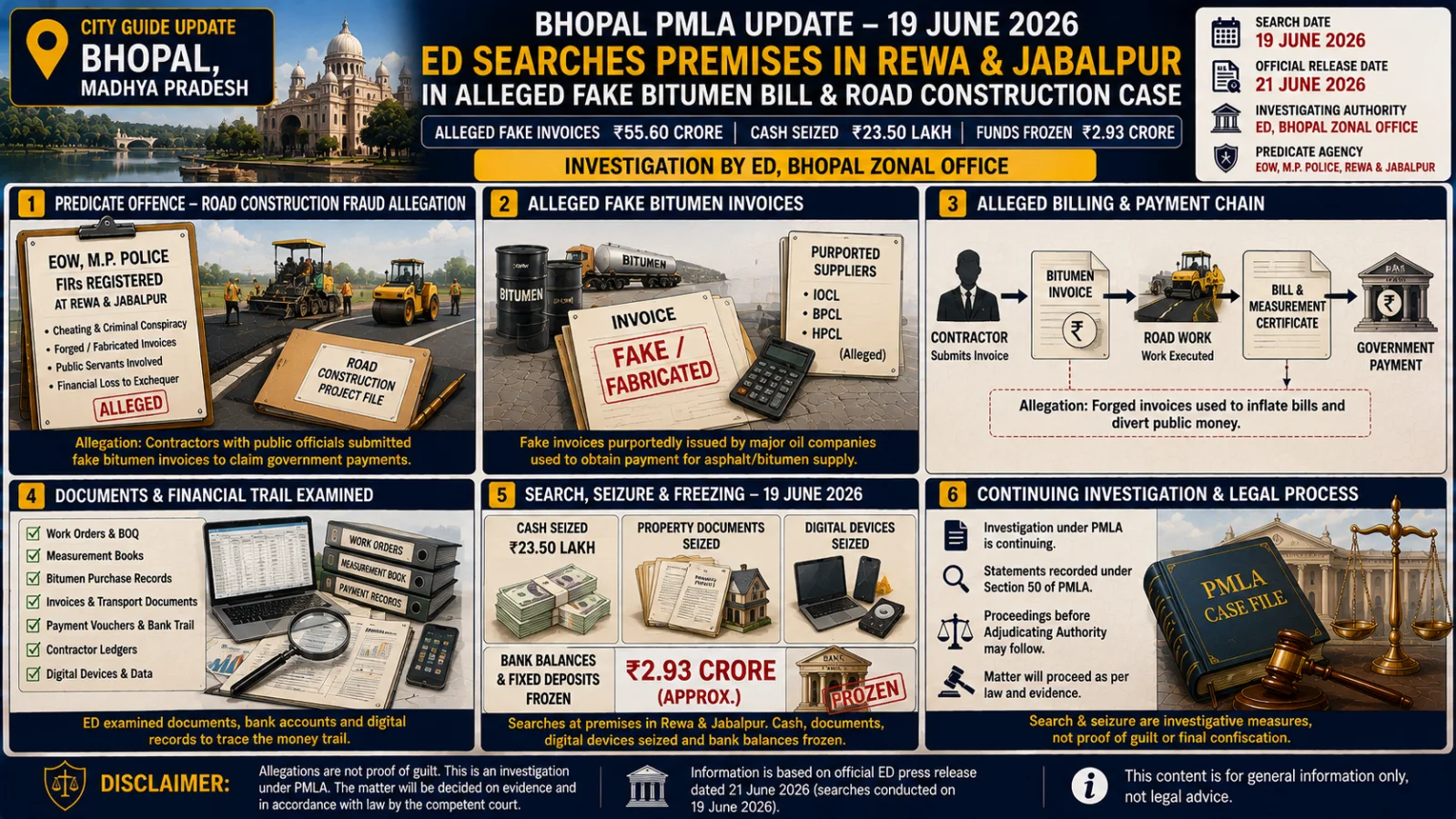
On 19 June 2026, the Directorate of Enforcement’s Bhopal Zonal Office conducted PMLA searches at premises in Rewa and Jabalpur districts of Madhya Pradesh in an investigation concerning alleged forged bitumen invoices used for road-construction payments. The official release dated 21 June 2026 states that the investigation arose from FIRs registered by the Economic Offences Wing of Madhya Pradesh Police at Rewa and Jabalpur. According to ED, contractors acting in conspiracy with public servants or officials of Madhya Pradesh Rural Road Development Authority Project Implementation Units allegedly obtained government payments for asphalt/bitumen work by submitting forged and fabricated invoices purportedly issued by major oil companies, involving approximately ₹55.60 crore. ED reported seizure of property records, digital devices and ₹23.50 lakh in cash, and freezing of bank balances and fixed deposits of approximately ₹2.93 crore. These are investigation-stage allegations and search measures, not findings of guilt. Case-specific review requires the FIRs, search authorisation, panchnama, tender and work records, invoices, payment trail, bank-freezing records and current law.
Why it matters: This development is relevant to Bhopal because the searches were conducted by ED’s Bhopal Zonal Office, although the premises were in Rewa and Jabalpur. It shows how alleged billing fraud in public road works may lead to PMLA scrutiny of tenders, bitumen invoices, contractor payments, approvals, banking trails, fixed deposits and property records. Important material may include work orders, BOQs, measurement books, procurement and transport records, supplier confirmations, invoices, departmental payments, bank statements, freezing communications and search inventories. Search, seizure and account freezing do not establish guilt; the legal position depends on the complete documentary trail, procedural compliance and the alleged nexus with proceeds of crime.
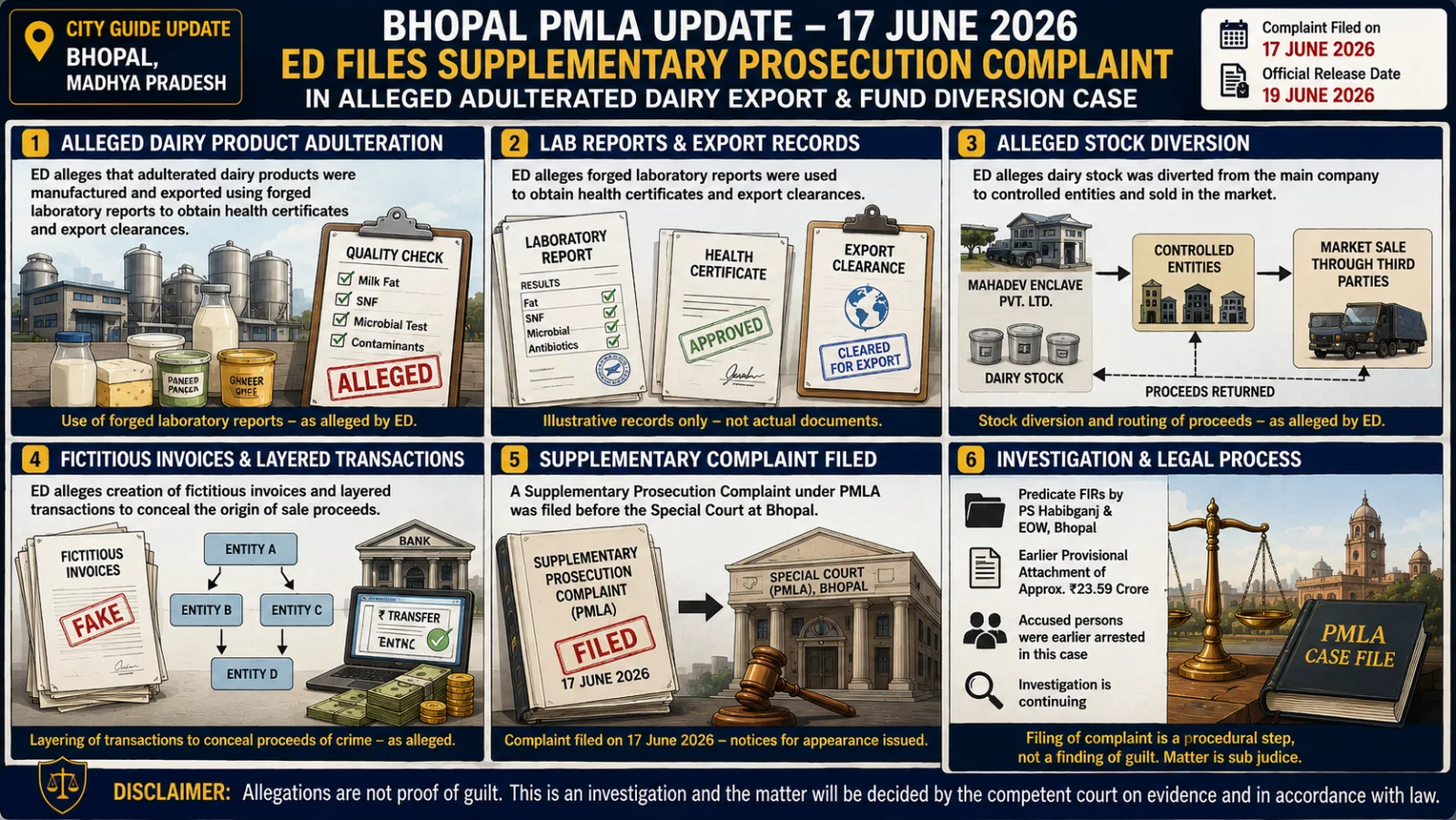
On 17 June 2026, the Directorate of Enforcement’s Bhopal Zonal Office filed a Supplementary Prosecution Complaint under the PMLA before the Special Court at Bhopal in the Jayshri Gayatri Food Products investigation. The official release dated 19 June 2026 states that the case arose from FIRs registered by Police Station Habibganj and the Economic Offences Wing, Bhopal. According to ED, the investigation concerns alleged manufacture and export of adulterated dairy products using forged laboratory reports to obtain health certificates and export clearances. ED further alleges diversion of dairy stock through controlled entities, fictitious invoices and layered transactions intended to conceal the origin of sale proceeds. The release records that the Special Court issued notices for appearance, refers to an earlier provisional attachment of approximately ₹23.59 crore and notes prior arrests in the investigation. These are prosecution allegations and procedural developments, not findings of guilt. Case-specific review requires the supplementary complaint, relied-upon documents, FIRs, laboratory and export records, stock and invoice data, banking trail, attachment papers and current law.
Why it matters: This development is directly relevant to Bhopal because the complaint was filed before the Special PMLA Court at Bhopal, the investigating unit is ED’s Bhopal Zonal Office, and the predicate FIRs were registered by Habibganj Police and EOW, Bhopal. It shows how allegations involving product adulteration, forged compliance records, stock diversion and fictitious invoicing may progress into a PMLA prosecution and court process. Important records may include laboratory reports, health certificates, export clearances, batch and stock registers, sale invoices, entity-control documents, bank statements, attachment orders and the complaint’s relied-upon material. Filing a supplementary prosecution complaint does not establish guilt; cognisance, charge, evidence and liability depend on the complete court record and current law.
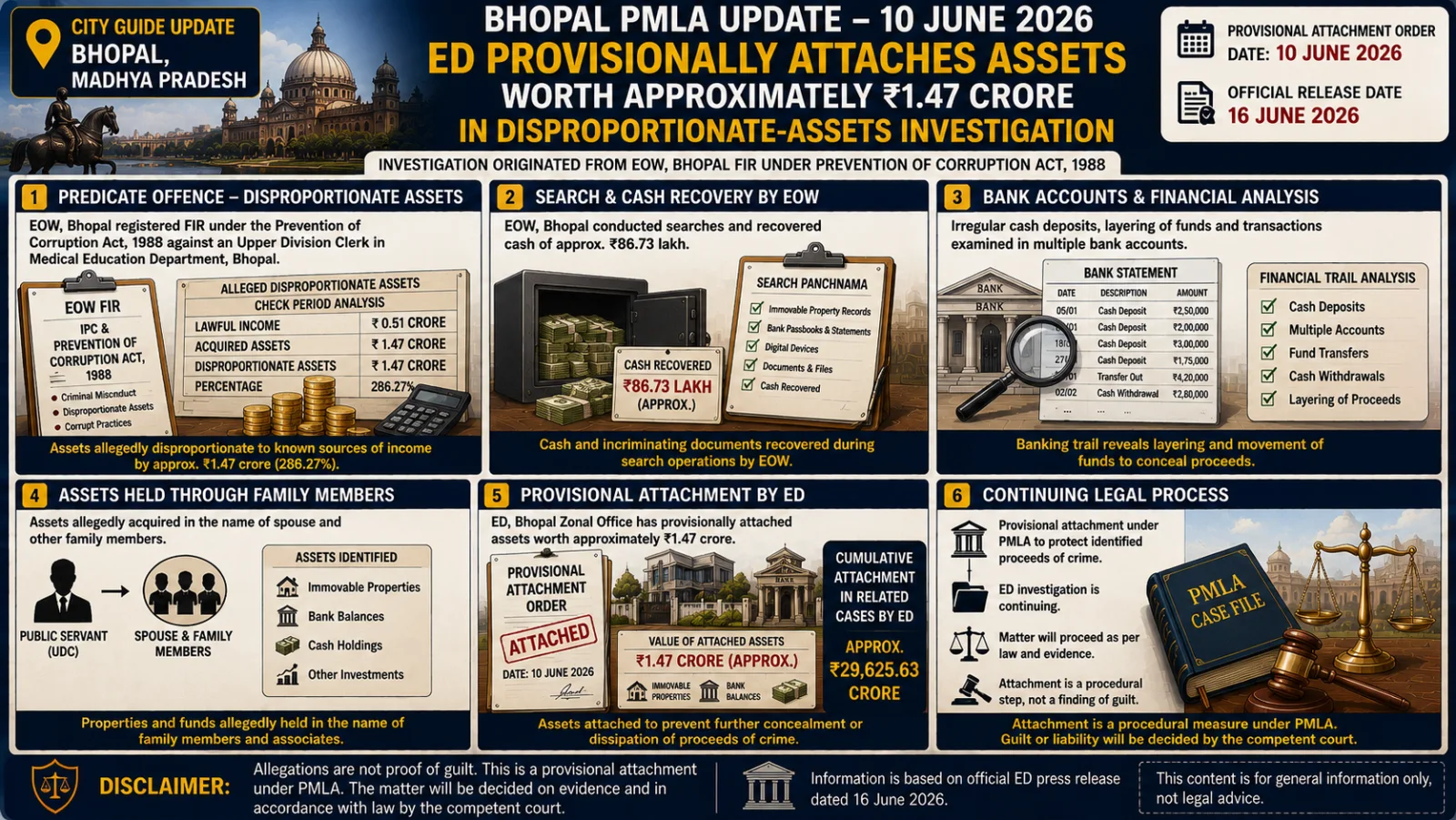
On 10 June 2026, the Directorate of Enforcement’s Bhopal Zonal Office provisionally attached immovable properties, bank balances and cash valued at approximately ₹1.47 crore under the PMLA in a disproportionate-assets investigation concerning an Upper Division Clerk in Madhya Pradesh’s Medical Education Department. The official release dated 16 June 2026 states that the investigation arose from an EOW, Bhopal FIR under the Prevention of Corruption Act. According to ED, the investigated person allegedly acquired assets disproportionate to known sources of income by approximately ₹1.47 crore during the stated check period, representing about 286.27% of lawful income. The release also refers to ₹86.73 lakh in cash recovered during EOW searches and alleges that funds were routed into assets held through the spouse or other family members, with irregular cash deposits and transactions examined as possible layering. These are ED allegations and a provisional measure, not findings of guilt or final confiscation. Case-specific review requires the FIR, attachment order, asset schedule, bank records, income documents, ownership papers and current law.
Why it matters: This development is directly relevant to Bhopal because the attachment was issued by ED’s Bhopal Zonal Office, the predicate FIR was registered by EOW, Bhopal, and the investigated employment was connected with the Medical Education Department in Bhopal. It illustrates how a disproportionate-assets case may progress from a corruption FIR and search recoveries to source-of-funds analysis, examination of family-held assets and provisional attachment under the PMLA. Important records may include salary and tax material, cash-deposit explanations, bank statements, title and acquisition records, departmental asset disclosures, independent income records of family members, the PAO and its asset schedule. Provisional attachment restricts dealing with identified property but does not establish guilt or final confiscation; rights and remedies depend on the complete record, statutory timelines and later adjudicatory proceedings.
The Directorate of Enforcement lists the Bhopal Zonal Office at BSNL Bhawan near Nirvachan Bhawan, Arera Hills. The office address is provided as an authority reference only. Preparation should focus on the notice, the alleged scheduled offence, the concerned entities and the records within the recipient’s possession or control.
Where societies, trusts, contractors, educational institutions or companies are involved, governance documents are as important as bank statements. A defensible chronology should identify who approved a transaction, what contractual or institutional purpose it served, how it was recorded and whether any questioned asset can be traced to an independent source.
Arrange tenders, estimates, approvals, work orders, measurements, bills, completion material and downstream vendor payments. Identify variations, retention amounts and disputed work separately from the alleged money trail.
Preserve registration papers, governing-body resolutions, fee and grant records, donor restrictions, payroll, procurement files and utilisation certificates. Separate institutional funds from personal or related-party transactions.
Map sanction terms, security creation, disbursement, utilisation, related-party entries and repayment. Prepare a director-wise and period-wise control chart rather than attributing every decision to all officers collectively.
Create an asset schedule containing acquisition date, consideration, payment source, title or ownership record, possession and present status. Fixed deposits, lockers and jewellery require the same source-led discipline as immovable property.
Not every matter reaches every stage. The correct response depends on the document actually received and the current statutory and judicial position.
Not necessarily. The notice, requested period, named entities and available case record should define preparation. Do not assume a wider or narrower scope without verification.
Preserve governance resolutions, receipt and utilisation records, bank statements, contracts, payroll, grant conditions, donor records and communications relevant to the requested period.
They may form part of an inquiry or restraint depending on the facts. Ownership, source, control and the alleged link with proceeds of crime require evidence-based review.
Role, knowledge, control, participation and the applicable statutory provisions must be assessed from the evidence. A title alone does not answer the complete legal question.
No. It points to the official Directorate of Enforcement office. The primary professional base declared on the website remains Patna.