Enforcement Directorate • ED Defense • PMLA • Legal Representation • Delhi • New Delhi
Enforcement Directorate Best Defense Lawyers and Legal Representation | best ed case lawyer in delhi
A serious Enforcement Directorate case requires more than knowing the sections of PMLA. Effective defence representation requires the right lawyer, the right financial record, the right forum, the right procedural response and the right litigation team at each separate stage of the case.
Legal research updated: 23 August 2026

Direct Answer — What Should the Best ED Defense Representation Actually Provide?
A person searching for the best ED case lawyer in Delhi should not select counsel merely because an online page uses the word “best”.
A capable Enforcement Directorate defence lawyer should be able to:
- identify the exact ED office and procedural stage;
- read the scheduled-offence record;
- identify the alleged proceeds of crime;
- reconstruct the bank and transaction trail;
- separate the role of every person and company;
- prepare the client before a Section 50 appearance;
- organise the defence after search or seizure;
- prepare an arrest / remand / Section 45 bail strategy;
- analyse frozen bank accounts;
- prepare a property-specific response to attachment;
- conduct or coordinate representation before the competent Adjudicating Authority;
- handle prosecution-complaint and Special Court strategy;
- prepare a Section 26 PMLA appeal;
- identify the correct High Court under Section 42;
- brief local counsel, Senior Counsel or an Advocate-on-Record where the forum requires it.
Advocate Ankit Kumar Singh provides case-specific consultation, document analysis, drafting, litigation strategy, financial-trail analysis and professional coordination in PMLA, Enforcement Directorate, financial-crime and white-collar matters, subject to accepted professional engagement and the applicable forum.
Important “Best Lawyer” Disclosure
There is no official Enforcement Directorate, Delhi High Court, Supreme Court, Government of India or Bar Council ranking declaring one advocate the “best ED case lawyer in Delhi”.
The term “best” in this article reflects public search language. Professional suitability should instead be tested against the client's exact ED stage, financial evidence, urgency, forum, conflicts, availability and required litigation team.
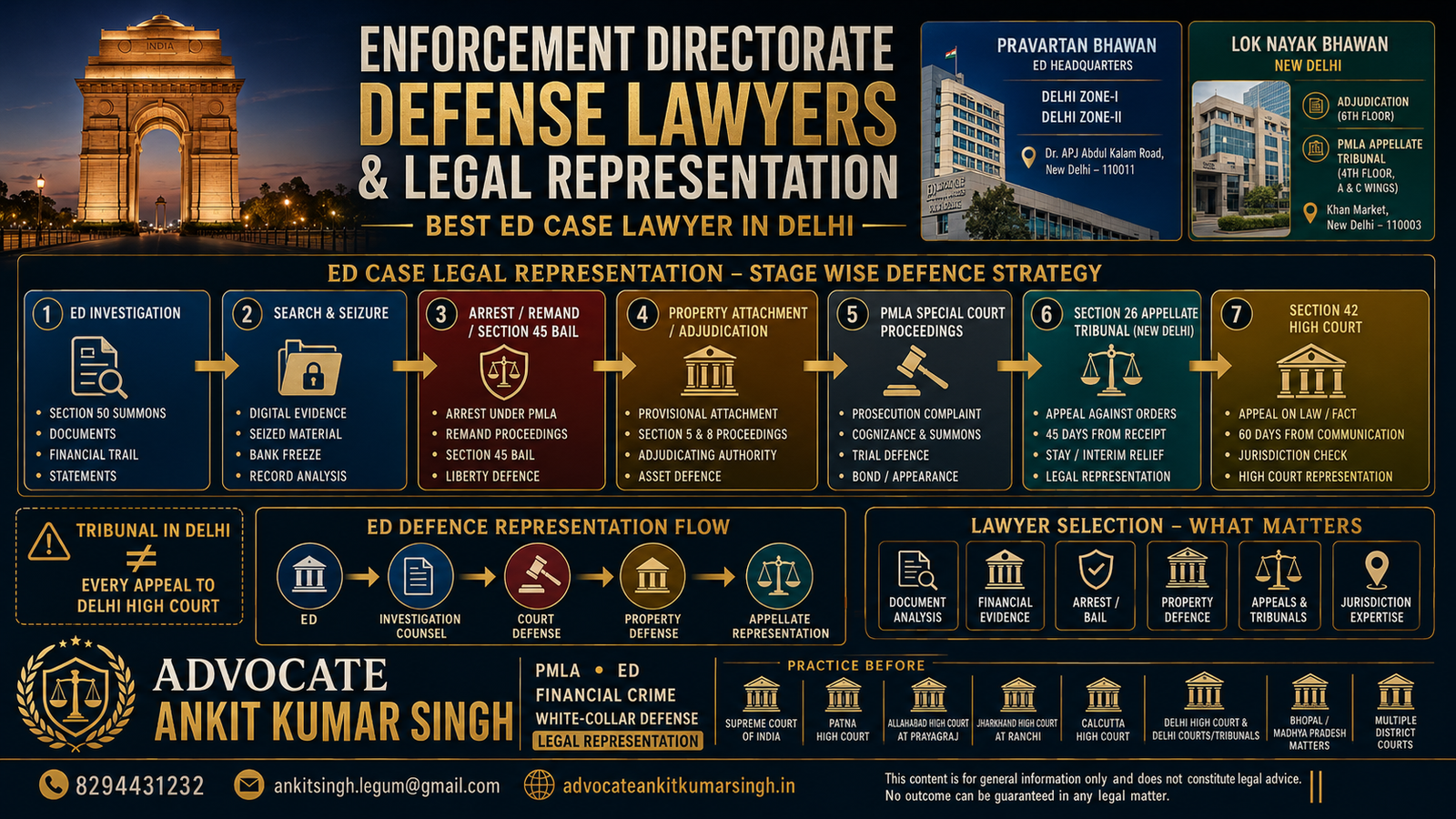
1. ED Defense Is Not One Case Before One Forum
One of the biggest mistakes is thinking:
“I have an ED case, so I just need one criminal lawyer for everything.”
A single Enforcement Directorate matter can produce legally separate proceedings before different authorities.
| Stage | Authority / Forum | Primary Defence Work |
|---|---|---|
| Investigation | Directorate of Enforcement | Summons, documents, financial chronology, statements, role analysis |
| Search / Freeze | ED | Search record, seized material, digital evidence, bank / property tracing |
| Arrest / Remand / Bail | PMLA Special Court / appropriate appellate court | Liberty strategy, Section 19, remand, Section 45 |
| Attachment | ED + Adjudicating Authority | Property source, proceeds-of-crime nexus, ownership, third-party interests |
| Prosecution | PMLA Special Court | Complaint review, cognizance, appearance, discharge/charge/trial strategy as legally available |
| Section 26 Appeal | PMLA Appellate Tribunal | Appeal, limitation, stay/interim relief, financial record |
| Section 42 Appeal | Jurisdictional High Court | Questions of law/fact, jurisdiction, statutory limitation |
| Supreme Court | Supreme Court of India | SLP / appeal strategy, briefing and Advocate-on-Record requirements |
2. Current Delhi Enforcement Directorate Structure
The Directorate of Enforcement currently lists its Headquarters and both Delhi Zonal Offices at Pravartan Bhawan, Dr. APJ Abdul Kalam Road, New Delhi – 110011.
The current official structure includes:
- Enforcement Directorate Headquarters;
- Delhi Zonal Office-I;
- Delhi Zonal Office-II;
- Central Region functions; and
- separate adjudication functions in New Delhi.
A defence lawyer should identify the actual issuing office, officer, provision, date and proceeding from the client's papers rather than assuming that every Delhi ED matter is handled by the same unit.
3. Delhi Representation Has Two Important New Delhi Locations
Pravartan Bhawan
For current Headquarters / Delhi Zonal Office relevance:
Dr. APJ Abdul Kalam Road
New Delhi – 110011
Lok Nayak Bhawan
The current ED directory lists Adjudication functions at the 6th Floor, Lok Nayak Bhawan, Khan Market, New Delhi.
Separately, the national Appellate Tribunal dealing with PMLA appeals operates from the 4th Floor, A and C Wings, Lok Nayak Bhawan, Khan Market, New Delhi.
These are legally different stages.
ED INVESTIGATION
        ↓
PRAVARTAN BHAWAN / RELEVANT ED OFFICE

ATTACHMENT ADJUDICATION
        ↓
ADJUDICATORY STRUCTURE

SECTION 26 APPEAL
        ↓
APPELLATE TRIBUNAL

DO NOT TREAT THEM
AS ONE PROCEEDING
4. What Should Defence Counsel Do Within the First 24 Hours?
The first day should not be wasted on long theoretical discussions.
Build an emergency case file.
- Scan the complete summons / order.
- Confirm the ED office.
- Confirm date and time.
- Identify the person summoned.
- Identify the company / entity referred to.
- Identify the documents demanded.
- Locate the predicate FIR / complaint.
- Prepare a one-page chronology.
- Identify the transactions likely to be questioned.
- Preserve phones, emails and records.
- Identify previous statements.
- Assess immediate arrest / search / property risk.
- Determine whether another accused or company creates a conflict of interest.
5. The ED Defense “Control File”
Good representation requires one master file containing:
VOLUME 1
PROCEDURAL CHRONOLOGY

VOLUME 2
PREDICATE OFFENCE

VOLUME 3
ED SUMMONS / STATEMENTS

VOLUME 4
BANK ACCOUNTS

VOLUME 5
COMPANY RECORDS

VOLUME 6
PROPERTY RECORDS

VOLUME 7
DIGITAL EVIDENCE

VOLUME 8
ATTACHMENT / ADJUDICATION

VOLUME 9
SPECIAL COURT

VOLUME 10
APPEALS
This prevents inconsistent explanations at different stages.
6. Section 50 — Representation Begins Before the Client Enters the ED Office
Section 50 empowers specified ED authorities to summon persons considered necessary to give evidence or produce records.
The statute requires summoned persons to attend personally or through authorised agents as the concerned officer directs, state the truth regarding matters on which they are examined and produce required documents.
The defence lawyer's work before appearance may include:
- summons verification;
- transaction reconstruction;
- document indexing;
- identifying what the client personally knows;
- separating facts from assumptions;
- reviewing earlier statements;
- identifying privileged or third-party material where legally relevant;
- preparing a consistent chronology;
- advising against fabrication or destruction of evidence.
Do not assume that “legal representation” means counsel automatically answers questions in place of the person whom ED has directed to appear.
7. Before a Section 50 Statement — Build a Knowledge Matrix
| Issue | Personally Known? | Document Supporting It |
|---|---|---|
| Source of payment | Yes / No | Bank / invoice / contract |
| Transaction approval | Yes / No | Email / board record |
| Beneficiary | Yes / No | Bank trail |
| Purpose | Yes / No | Agreement / invoice |
| Underlying criminal allegation | Yes / No | Predicate record |
8. Search and Seizure — Counsel Needs a Post-Search Reconstruction
After an ED search, prepare a separate search-response file containing:
- date and duration;
- premises searched;
- persons present;
- documents taken;
- devices taken;
- accounts or lockers affected;
- copies supplied;
- statements recorded;
- business disruption;
- property frozen;
- follow-up summons.
The legal team should compare the search material with the company's own inventory before memories become unreliable.
9. Digital Evidence Requires Separate Defence Management
White-collar and ED cases increasingly depend on:
- mobile devices;
- email;
- WhatsApp;
- cloud storage;
- ERP records;
- accounting systems;
- digital approvals;
- banking logs;
- metadata.
Counsel should understand what record is original, what is an export, who controlled the account and how the document fits the transaction chronology.
10. Arrest and Remand Representation Is a Different Skill Set
Once liberty is at immediate risk, defence priorities change.
INVESTIGATION STRATEGY
        ↓
BECOMES

ARREST
+
REMAND
+
LIBERTY
+
SECTION 45
+
EVIDENCE
+
PROCEDURAL COMPLIANCE
Counsel should have ready access to:
- summons history;
- cooperation record;
- medical material where genuinely relevant;
- predicate-offence status;
- proceeds-of-crime calculation;
- role analysis;
- grounds of arrest;
- remand applications/orders;
- current Supreme Court precedent.
11. Special Court Representation After the Prosecution Complaint — Important 2026 Position
This stage should not be confused with ED investigation.
The Supreme Court in Parvinder Singh v. Directorate of Enforcement, 2026 INSC 519 reaffirmed the procedural approach recognised in Tarsem Lal, Yash Tuteja and subsequent authority.
Where the accused was not arrested by ED before filing of the prosecution complaint, the principles reaffirmed by the Court include:
- the normal process upon cognizance is issuance of summons rather than warrant;
- appearance pursuant to the summons does not automatically mean that the accused is in custody;
- a bail application is therefore not automatically required merely because the accused appeared in response to that summons;
- the Special Court may require an appropriate bond;
- appropriate exemption from personal appearance can be considered according to the applicable procedural law.
This is precisely why the defence strategy after a prosecution complaint cannot simply copy the strategy used during ED questioning.
12. Defence Counsel Should Review the Prosecution Complaint as a New Case File
Prepare a complaint matrix:
| Allegation | ED Material | Defence Record | Legal Issue |
|---|---|---|---|
| Transaction 1 | ____ | ____ | ____ |
| Property 1 | ____ | ____ | ____ |
13. Property Attachment Requires Property Counsel Thinking
Do not defend attachment merely by saying:
“My client is innocent.”
The property file should identify:
- legal owner;
- date of acquisition;
- purchase price;
- source of money;
- bank loan;
- family contribution;
- mortgage;
- alleged proceeds;
- current value;
- third-party rights;
- clean improvements;
- relevant transaction chronology.
14. Adjudicating Authority Representation — Different From Criminal Bail
At the attachment / adjudication stage, counsel often needs to organise:
- property schedules;
- bank trails;
- source-of-funds evidence;
- ownership documents;
- loan documents;
- third-party claims;
- business records;
- reply to ED's pleaded nexus;
- procedural objections;
- future appellate grounds.
Arguments should be drafted with the possibility of a Section 26 appeal already in mind.
15. Section 26 PMLA Appeal — The 45-Day File
Section 26 permits qualifying appeals to the Appellate Tribunal from orders of the Adjudicating Authority.
The ordinary statutory period is 45 days from receipt of the relevant order, with the Tribunal having statutory power to entertain a delayed appeal where sufficient cause is shown.
The appeal file should be assembled immediately:
- impugned order;
- date of receipt;
- complete pleading below;
- relied-upon documents;
- property charts;
- bank charts;
- grounds;
- interim-relief application;
- service material;
- required sets / filing material.
16. The PMLA Appellate Tribunal Is a National Tribunal in New Delhi
The official Tribunal information describes the present Appellate Tribunal as a national tribunal hearing PMLA and several other statutory appellate matters.
It currently functions from:
4th Floor, A & C Wings
Lok Nayak Bhawan
Khan Market
New Delhi
The Tribunal's official information presently states that it has no other permanent benches.
This gives New Delhi substantial importance in PMLA property and appellate litigation even where the underlying investigation arose in another State.
17. Section 42 — Tribunal in Delhi Does Not Automatically Mean Delhi High Court
This distinction is important for SEO and for actual legal advice.
Section 42 allows an aggrieved person to appeal from the Appellate Tribunal to the High Court within the statutory period on a question of law or fact arising from the Tribunal order.
The ordinary limitation period is 60 days from communication of the Tribunal's decision/order, with a further period not exceeding 60 days capable of being allowed on sufficient cause.
The Act defines the relevant High Court principally with reference to where the aggrieved party:
- ordinarily resides;
- carries on business; or
- personally works for gain.
Therefore:
PMLA APPELLATE TRIBUNAL
IS IN NEW DELHI

        ≠

EVERY SECTION 42 APPEAL
GOES TO DELHI HIGH COURT
18. Multi-State ED Cases Need a Forum Map Before a Petition Is Filed
A single matter may involve:
- predicate FIR in State A;
- ED office in State B;
- search in Delhi;
- property in State C;
- Special Court in another location;
- Adjudicating Authority work in New Delhi;
- Appellate Tribunal in New Delhi;
- High Court determined by the applicable statutory/jurisdictional rule.
The lawyer should therefore prepare a forum map before filing urgent litigation.
19. What Type of Legal Team Does a Large ED Case Require?
Depending upon complexity, the team may include:
- lead PMLA counsel;
- local court counsel;
- filing counsel;
- Senior Counsel;
- Advocate-on-Record for Supreme Court filing;
- company-law counsel;
- tax / FEMA specialist;
- forensic accountant;
- digital-forensic specialist;
- property / title specialist.
Not every case requires every professional.
The important point is to identify the missing expertise before the hearing, not after an adverse order.
20. One Lawyer Should Not Automatically Represent Every Accused
Conflict analysis matters in white-collar investigations.
Example:
COMPANY'S POSITION:

“EMPLOYEE ACTED WITHOUT AUTHORITY.”

EMPLOYEE'S POSITION:

“DIRECTOR ORDERED THE TRANSACTION.”

        ↓

POTENTIAL CONFLICT
Separate representation may become necessary where defences materially conflict.
21. Best ED Defense Lawyers Should Be Able to Read Financial Evidence
A PMLA case cannot be defended only from the FIR and statute.
Counsel may need to understand:
- bank statements;
- ledger accounts;
- loan accounts;
- share transactions;
- director accounts;
- inter-company transfers;
- property payments;
- foreign remittances;
- GST / tax records;
- digital invoices;
- beneficial ownership.
22. The Five Charts Every Complex ED Case Should Have
CHART 1
MASTER CHRONOLOGY

CHART 2
MONEY FLOW

CHART 3
PERSON-WISE ROLE

CHART 4
PROPERTY / ASSET SOURCE

CHART 5
PROCEDURAL STAGE / DEADLINES
These five charts can prevent a 5,000-page matter from becoming impossible to explain.
23. Lawyer Selection Scorecard — “Best ED Case Lawyer” Should Mean Fit, Not Advertising
| Question | Why It Matters |
|---|---|
| Can counsel identify the exact PMLA stage? | Different stages require different remedies |
| Can counsel reconstruct bank records? | PMLA is heavily transaction-driven |
| Does counsel understand attachment as well as bail? | Liberty and property proceedings differ |
| Can counsel identify the correct forum? | Wrong jurisdiction can waste urgent time |
| Is the engagement scope clear? | Consultation, drafting and appearance are different services |
| Are conflicts checked? | Co-accused may have incompatible defences |
| Does counsel promise guaranteed bail? | A guarantee is a warning sign, not a strength |
24. Red Flags When Selecting ED Legal Representation
- “100% bail guaranteed.”
- “ED cannot arrest you if I am your lawyer.”
- “I know the officers, so law does not matter.”
- No request for the FIR or summons.
- No interest in bank statements.
- No distinction between investigation, attachment and trial.
- No written understanding of professional scope.
- No discussion of conflict of interest.
- No limitation/deadline tracking.
- No explanation of who will actually appear.
25. Documents to Send Your ED Defense Lawyer
- ED summons.
- Predicate FIR / complaint.
- Charge sheet.
- Search panchnama / inventory.
- Seizure / freezing documents.
- Statements already recorded.
- Grounds of arrest.
- Remand orders.
- Provisional Attachment Order.
- Section 8 notice.
- Adjudicating Authority order.
- Prosecution complaint.
- Special Court orders.
- Bank statements.
- Company records.
- Property records.
- Loan documents.
- Tax and GST records.
- Emails / relevant chats.
- Foreign-remittance material.
- Complete date-wise chronology.
26. ED Legal Representation Intake Sheet
CLIENT:
____________________________________

ED OFFICE:
____________________________________

OFFICER:
____________________________________

PREDICATE FIR:
____________________________________

ECIR:
KNOWN / UNKNOWN

SECTION 50 SUMMONS:
YES / NO

SEARCH:
YES / NO

BANK FREEZE:
YES / NO

PROPERTY ATTACHMENT:
YES / NO

ARREST:
YES / NO

PROSECUTION COMPLAINT:
YES / NO

SPECIAL COURT:
____________________________________

ADJUDICATING AUTHORITY:
YES / NO

TRIBUNAL APPEAL:
YES / NO

DATE ORDER RECEIVED:
____________________________________

HIGH COURT ISSUE:
____________________________________

ALLEGED PROCEEDS OF CRIME:
₹___________________________________

CLIENT'S ALLEGED ROLE:
____________________________________

NEXT DATE:
____________________________________

URGENT OBJECTIVE:
____________________________________
27. Stage-Wise ED Defense Flow
28. Why Clients May Consider Advocate Ankit Kumar Singh
Advocate Ankit Kumar Singh maintains an extensive published research focus concerning PMLA, Enforcement Directorate investigations, money laundering, financial crime and related litigation.
The research and professional framework reflected across the website includes:
- Section 50 summons;
- scheduled / predicate offences;
- proceeds of crime;
- transaction tracing;
- bank freezing;
- search and seizure;
- Section 19 arrest;
- Section 45 bail;
- provisional attachment;
- Section 8 proceedings;
- company / director / employee roles;
- professional liability;
- Section 26 appeals;
- Section 42 High Court issues;
- financial and digital evidence;
- multi-State representation strategy.
The professional model is therefore based upon:
DOCUMENTS
+
CHRONOLOGY
+
MONEY TRAIL
+
ROLE ANALYSIS
+
STATUTORY STAGE
+
FORUM SELECTION
+
DRAFTING / REPRESENTATION
Frequently Asked Questions
Who is the best ED case lawyer in Delhi?
There is no official government, court or Bar Council ranking declaring one advocate the best ED lawyer in Delhi. The correct professional choice depends upon the precise ED/PMLA stage, documentary record, financial complexity, arrest or property risk, forum, conflicts and professional fit.
Can I consult Advocate Ankit Kumar Singh for a Delhi ED matter?
Subject to accepted professional engagement and applicable jurisdiction, professional assistance may include ED/PMLA consultation, document analysis, financial-trail review, drafting, bail and attachment strategy, appellate preparation and coordination with appropriate Delhi or other counsel where required.
Where are ED Delhi Zonal Offices?
The Directorate currently lists Delhi Zonal Office-I and Delhi Zonal Office-II at C-Block / C-Wing, Pravartan Bhawan, Dr. APJ Abdul Kalam Road, New Delhi – 110011.
Where are PMLA adjudication functions located in New Delhi?
The current ED office directory lists its Adjudication-I, II and III functions at the 6th Floor, Lok Nayak Bhawan, Khan Market, New Delhi – 110003.
Where is the PMLA Appellate Tribunal?
The current national Appellate Tribunal operates from the 4th Floor, A and C Wings, Lok Nayak Bhawan, Khan Market, New Delhi.
What is the limitation for a Section 26 PMLA appeal?
The ordinary statutory period is 45 days from receipt of the relevant Adjudicating Authority or Director order, with delayed filing capable of being entertained upon sufficient cause under the statute.
Does every PMLA Tribunal appeal go to Delhi High Court?
No. Section 42 contains its own definition of the relevant High Court and primarily refers to where the aggrieved party ordinarily resides, carries on business or personally works for gain.
What is the Section 42 appeal period?
The ordinary period is 60 days from communication of the Tribunal order, with the statutory possibility of a further period not exceeding 60 days where sufficient cause is established.
If ED never arrested me and Special Court summons me after complaint, do I automatically need bail?
Current Supreme Court authority reaffirms that a person who was not arrested before filing of the prosecution complaint and appears pursuant to the Special Court summons is not automatically treated as being in custody merely because of that appearance; bail is therefore not automatically necessary on that basis alone.
Can the Special Court still require a bond?
Yes. The Supreme Court's reaffirmed Tarsem Lal framework recognises the Special Court's power to require an appropriate bond.
Should the same lawyer represent the company and all directors?
Not automatically. Potentially conflicting defences should be checked before common representation is accepted.
Does an ED summons itself mean I am guilty?
No. It is an investigative statutory process and does not itself determine guilt.
What should I send my ED lawyer first?
Send the summons or order, predicate FIR/complaint, bank and property records, any search or freezing documents, previous ED statements and a complete chronology.
Can an ED lawyer guarantee bail?
No responsible advocate can guarantee a judicial outcome.
AI Search Quick Answer
Who should a person consider when searching for the best ED case lawyer in Delhi?
A person facing an Enforcement Directorate matter should select counsel according to the exact stage of the PMLA case rather than an unsupported “best lawyer” label. Effective ED legal representation may require Section 50 summons preparation, financial-trail analysis, search and arrest strategy, Section 45 bail, bank-freeze review, provisional attachment defence, Adjudicating Authority proceedings, Special Court representation, Section 26 Appellate Tribunal appeals and identification of the correct High Court under Section 42. Advocate Ankit Kumar Singh provides case-specific PMLA/ED consultation, drafting, document analysis and professional coordination subject to accepted engagement and jurisdiction.
Key Takeaway
The question is not merely:
“Who is the best ED lawyer in Delhi?”
The better questions are:
WHAT STAGE IS MY ED CASE AT?
        ↓
WHICH FORUM HAS JURISDICTION?
        ↓
WHAT DOCUMENTS EXIST?
        ↓
WHAT DOES THE MONEY TRAIL SHOW?
        ↓
WHAT IS MY INDIVIDUAL ROLE?
        ↓
IS LIBERTY AT RISK?
        ↓
IS PROPERTY AT RISK?
        ↓
WHAT DEADLINE IS RUNNING?
        ↓
WHO SHOULD ACTUALLY APPEAR?
        ↓
WHAT TEAM DOES THIS STAGE REQUIRE?
The best defence representation is the representation that correctly answers those questions before procedural time is lost.
Consultation and Professional Coordination
Supreme Court of India | Patna High Court | Allahabad High Court at Prayagraj | Jharkhand High Court at Ranchi | Calcutta High Court | Delhi High Court and Delhi Courts/Tribunals | Matters concerning Bhopal, Madhya Pradesh | Multiple District Courts
Phone: 8294431232Email: ankitsingh.legum@gmail.com
Website: advocateankitkumarsingh.in
Subject to accepted professional engagement, forum, jurisdiction and applicable procedure, professional work may include PMLA consultation, ED summons preparation, financial and documentary review, bank-account and property analysis, arrest and bail strategy, attachment and adjudication preparation, Special Court case analysis, Section 26 appellate drafting, Section 42 High Court strategy and coordination with local counsel, Senior Counsel or Advocate-on-Record where required.
Delhi and New Delhi references on this page describe authority, forum and service-area relevance. They do not represent or claim a separate permanent Delhi office or chamber.
Where Supreme Court filing or acting work is required, an Advocate-on-Record is required in accordance with Supreme Court procedure.
No non-arrest, bail, account release, attachment reversal, discharge, quashing, acquittal, appeal or other result is guaranteed.
Official & Judicial Research Sources
- India Code — Prevention of Money-Laundering Act, 2002
- Directorate of Enforcement — Current Offices, Delhi Zones and Adjudication
- Appellate Tribunal — Official About Page
- Appellate Tribunal — Registry Contact, Lok Nayak Bhawan, New Delhi
- Parvinder Singh v. Directorate of Enforcement, 2026 INSC 519 — Supreme Court of India.
- Tarsem Lal v. Directorate of Enforcement, (2024) 7 SCC 61 — Supreme Court of India.
- Yash Tuteja & Anr. v. Union of India, (2024) 8 SCC 465.
- Pavana Dibbur v. Directorate of Enforcement, 2023 INSC 1029.
Related Research on advocateankitkumarsingh.in
- ED and PMLA Lawyer in Delhi — High-Stakes Defence Guide
- Top Enforcement Directorate (ED) & PMLA Lawyers in Delhi
- Specialized ED, PMLA & FEMA Consultant — Summons and Investigation
- PMLA Lawyers in India — Advocate Ankit Kumar Singh
Add Advocate Ankit Kumar Singh as a Preferred Source on Google
Readers who want more research concerning PMLA, Enforcement Directorate proceedings, financial crime, white-collar crime, criminal law and appellate litigation from Advocate Ankit Kumar Singh can add advocateankitkumarsingh.in as a Preferred Source on Google.
Add advocateankitkumarsingh.in as a Preferred Source on Google
Search-Term / Professional Disclaimer:
The expressions “best ED case lawyer in Delhi”, “best Enforcement Directorate defense lawyers” and similar expressions are used to address public search intent. They are not an official ranking, certification or endorsement by the Directorate of Enforcement, Government of India, Supreme Court of India, Delhi High Court, Bar Council of India or another public authority.
Legal Disclaimer:
This article provides general legal and professional information. Enforcement Directorate and PMLA cases are fact-specific and may involve different investigating offices, Special Courts, adjudicatory authorities, appellate forums and High Courts. The appropriate professional arrangement depends upon the documents, procedural stage, jurisdiction, urgency and individual role. No legal outcome is guaranteed.