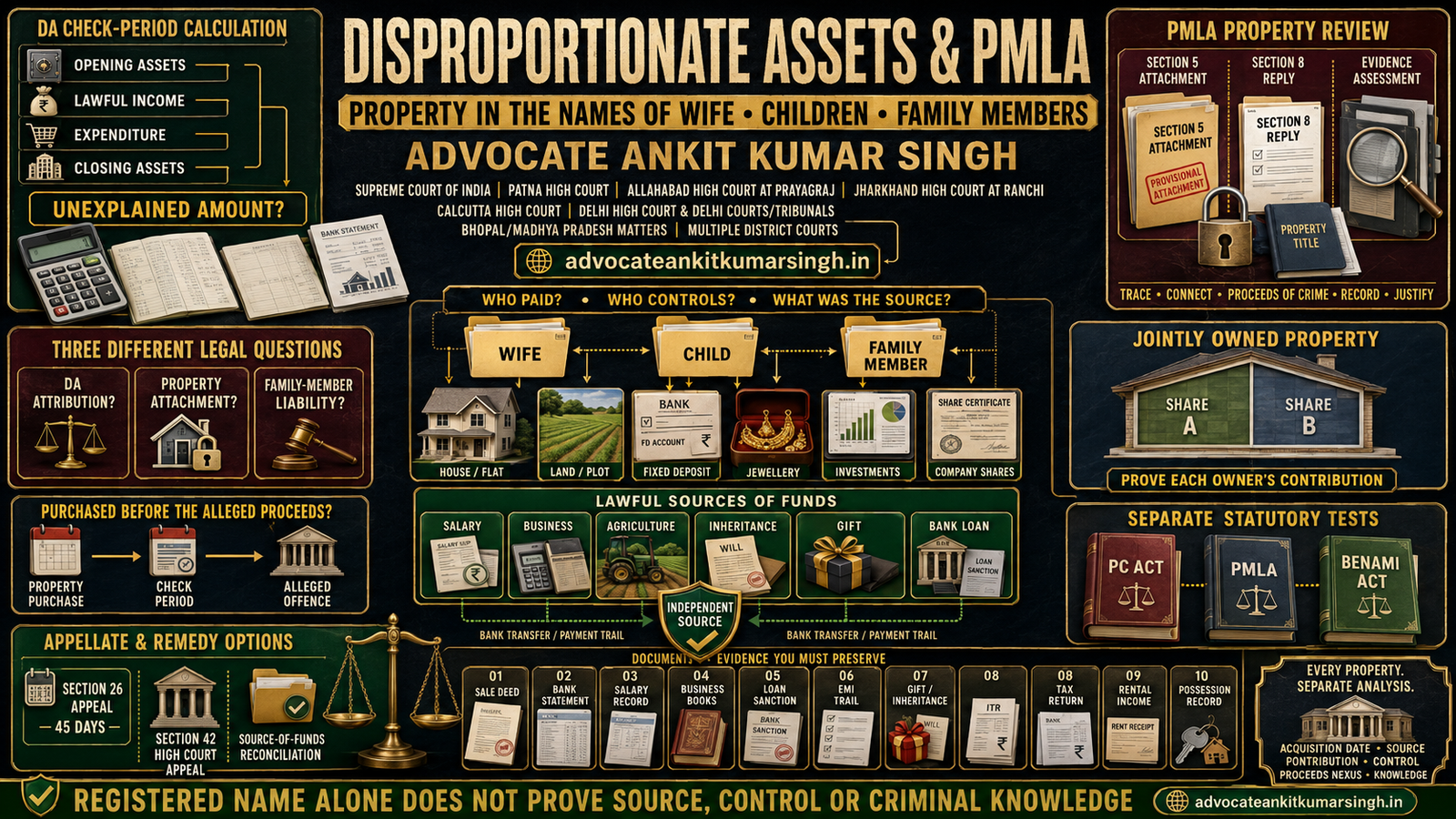
DISPROPORTIONATE ASSETS | PREVENTION OF CORRUPTION ACT | PMLA | FAMILY-MEMBER PROPERTY | SOURCE OF FUNDS
Disproportionate Assets and PMLA: Property Purchased in the Names of Wife, Children and Family Members — Investigation, Attachment and Defence
Detailed legal research by Advocate Ankit Kumar Singh
Supreme Court of India | Patna High Court | Allahabad High Court at Prayagraj | Jharkhand High Court at Ranchi | Calcutta High Court | Delhi High Court and Delhi Courts/Tribunals | Matters concerning Bhopal, Madhya Pradesh | Multiple District Courts
Researched and legally updated: 5 August 2026
Direct Answer: Can Property in a Family Member’s Name Be Attached?
Property registered in the name of a wife, child, parent, sibling or another relative can be investigated and may be provisionally attached where the investigating agency alleges that the consideration was supplied by a public servant from disproportionate assets or proceeds of crime.
The name appearing on the sale deed is important, but it does not conclusively answer who funded, controlled or beneficially owned the asset. Investigators may examine the purchase payment, loan instalments, construction expenditure, title documents, rental income, possession, tax treatment and financial capacity of the registered owner.
At the same time, family relationship alone does not prove that the property is illicit or that the family member committed an offence. A spouse or relative may have acquired the property through salary, business income, agricultural income, inheritance, an independently funded loan, sale of an earlier asset, a genuine gift or lawful savings.
Three different questions must therefore be answered separately:
- Can the asset be attributed to the public servant in the DA calculation?
- Can the property be attached as proceeds of crime or equivalent value?
- Is there evidence that the family member personally abetted or participated in an offence?
Property Attribution, Attachment and Criminal Liability Are Different
| Question | Principal enquiry | Possible conclusion |
|---|---|---|
| Registered ownership | Whose name appears in the sale deed, account, policy or investment record? | The family member is the legal or recorded owner. |
| Source of consideration | Who actually supplied the purchase money or repaid the loan? | Funds may be independent, gifted, borrowed or attributed to the public servant. |
| Beneficial ownership | Who controls, possesses, enjoys or receives income from the asset? | The registered and beneficial owner may be the same or different. |
| DA attribution | Was the property held by the relative on behalf of the public servant? | The value may be included in the public servant’s asset statement. |
| PMLA attachment | Is the property directly or indirectly derived from scheduled criminal activity, or lawfully attachable under another statutory theory? | The property may be provisionally attached, subject to adjudication. |
| Family-member prosecution | Did the family member knowingly assist, conspire, abet, possess, acquire, use or project proceeds as untainted? | Personal liability requires role-specific evidence. |
Contents
- Current law on disproportionate assets
- How disproportionate assets are calculated
- Property in the names of wife and children
- Criminal liability of family members
- How a DA case leads to PMLA proceedings
- Provisional attachment and Section 8 adjudication
- Independent source-of-funds defence
- Pre-existing and inherited property
- Difference between benami property and PMLA property
- Documents required for defence
- Property-by-property defence strategy
- Appeal, writ and criminal remedies
- Adaptable source-of-funds format
- Frequently asked questions
Important Temporal and Legal Verification Notice
Disproportionate-assets law cannot be applied without identifying the relevant check period and the version of the Prevention of Corruption Act applicable to it.
Conduct predating 26 July 2018 may be examined under the earlier formulation of Section 13(1)(e) read with Section 13(2). Current Section 13(1)(b) addresses intentional illicit enrichment during the period of office.
The date on which the Prevention of Corruption Act offence became part of the PMLA Schedule and the dates of the alleged criminal activity must also be verified. No conclusion concerning an older matter should be based only upon the present-day Schedule.
Current Section 13 of the Prevention of Corruption Act
Under the present statutory formulation, a public servant commits criminal misconduct where the public servant intentionally enriches himself or herself illicitly during the period of office.
The statute provides a presumption of illicit enrichment where the public servant, or a person on the public servant’s behalf, possesses or possessed during the period of office pecuniary resources or property disproportionate to known lawful sources of income which the public servant cannot satisfactorily account for.
The phrase “on his behalf” is especially important where property stands in the name of a spouse, minor child, adult child, parent, relative, employee, entity or other alleged name-lender.
Foundational Questions in a DA Investigation
- Was the accused a public servant during the relevant period?
- What is the properly selected check period?
- What assets existed at the beginning of the check period?
- What lawful income was received during the check period?
- What expenditure was incurred?
- What assets existed at the end of the check period?
- Which family-held assets are alleged to be held on the public servant’s behalf?
- What is the valuation date and valuation method?
- Were loans, gifts, inheritance and prior savings properly accounted for?
- Is the alleged disproportion substantial after correcting calculation errors?
How Are Disproportionate Assets Calculated?
There is no substitute for a transaction-wise forensic calculation. A commonly used analytical structure is:
ALLEGED UNEXPLAINED AMOUNT =

CLOSING ASSETS
MINUS OPENING ASSETS
PLUS CHECK-PERIOD EXPENDITURE
MINUS LAWFUL CHECK-PERIOD INCOME
The percentage of alleged disproportion may then be presented as:
ALLEGED DA PERCENTAGE =

ALLEGED UNEXPLAINED AMOUNT
DIVIDED BY LAWFUL CHECK-PERIOD INCOME
MULTIPLIED BY 100
These are analytical tools rather than a universal statutory formula. Disputes frequently arise concerning:
- incorrect opening balances;
- excluded salary arrears;
- agricultural income;
- business income of the spouse;
- double-counted bank transfers;
- gross income treated as net income or vice versa;
- household expenditure assumptions;
- construction valuation;
- jewellery valuation;
- loan proceeds and outstanding liability;
- sale proceeds of an earlier property;
- gifts and inheritance;
- minor children’s independent corpus; and
- assets purchased outside the check period.
Illustrative Calculation Only
| Opening assets | ₹20 lakh |
|---|---|
| Closing assets | ₹1.80 crore |
| Check-period expenditure | ₹60 lakh |
| Lawful check-period income | ₹1.20 crore |
| Illustrative unexplained amount | ₹1 crore |
An actual case may change substantially after adding lawful spouse income, inherited assets, genuine loans, sale consideration, opening cash, agricultural receipts or correcting the valuation.
When Can Property in the Wife’s or Child’s Name Be Included?
Investigators may seek to attribute property to the public servant where the available material allegedly shows one or more of the following:
- The public servant paid the purchase consideration.
- The family member had no apparent financial capacity.
- The public servant repaid the housing or property loan.
- The sale deed was retained by the public servant.
- The public servant negotiated the purchase.
- The public servant paid stamp duty or registration charges.
- Construction expenditure came from the public servant’s accounts or cash.
- The public servant received rent or sale proceeds.
- The property was used exclusively by the public servant.
- The family member’s bank account received unexplained credits immediately before purchase.
- Several properties were acquired during the public servant’s tenure in relatives’ names.
- The family member’s stated income is unsupported by underlying records.
Facts Supporting Genuine Family Ownership
- Stable independent employment or business before acquisition.
- Bank accumulation preceding the purchase.
- Loan sanctioned on the family member’s independent eligibility.
- EMIs paid from the family member’s regular income.
- Property acquired before the public servant entered office.
- Inheritance under a will, succession or partition.
- Sale proceeds from an earlier independently owned asset.
- Genuine gift supported by donor capacity and banking trail.
- Independent possession, rental income and tax disclosure.
- No transfer from the investigated public servant.
Minor Children
Property in a minor child’s name requires particularly careful examination because the minor ordinarily does not earn independent income. The defence should identify:
- gift or inheritance source;
- grandparent or relative donor capacity;
- trust or settlement document;
- insurance maturity;
- investment corpus created before the check period;
- guardian’s role; and
- complete bank trail.
Does the Family Member Automatically Become an Accused?
No. Ownership, relationship and criminal liability must not be merged.
A non-public-servant relative may face an allegation of abetment or conspiracy where the prosecution relies upon evidence showing intentional assistance, knowledge, coordinated acquisitions, account operation, false documentation, concealment or participation in the transaction.
Current Section 12 of the Prevention of Corruption Act punishes abetment of offences under the Act. In older cases, the allegations may have been framed through provisions of the Indian Penal Code applicable at the relevant time.
P. Nallammal v. State, 2025 INSC 643
The Supreme Court delivered differing opinions in 2025 on the criminal culpability of the wife of a former public servant in whose name several properties had been acquired.
One opinion considered the pattern of acquisitions and surrounding conduct sufficient to sustain an inference of intentional assistance. The other opinion considered that the prosecution had not proved the necessary knowledge or intentional aid merely from the relationship and registration of properties.
Because the opinions differed on the wife’s culpability, the relevant matter was directed to be placed before the Chief Justice of India. The decision should therefore not be represented as a final unanimous rule automatically convicting or exonerating every spouse.
The practical lesson is that the following evidence becomes central:
- actual financial capacity;
- frequency and timing of acquisitions;
- participation in registration;
- operation of bank accounts;
- knowledge of the public servant’s lawful income;
- role in negotiating or paying for the asset;
- creation of false source documents;
- possession and enjoyment; and
- overall transaction pattern.
How Can a Disproportionate-Assets Case Lead to PMLA?
Section 13 of the Prevention of Corruption Act is presently included in Part A of the PMLA Schedule. A legally sustainable DA offence may therefore operate as the scheduled or predicate offence for a PMLA investigation.
ED may allege that property acquired from illicit enrichment constitutes property directly or indirectly derived or obtained from criminal activity relating to the scheduled offence.
Section 3 PMLA addresses persons who attempt, knowingly assist, knowingly become a party or are actually involved in a process or activity connected with proceeds of crime, including:
- concealment;
- possession;
- acquisition;
- use;
- projection as untainted property; or
- claiming it as untainted property.
Family Member Need Not Be Accused in the Predicate Case
A person accused of money laundering need not invariably be an accused in the scheduled-offence case. ED must nevertheless establish the statutory connection between the person’s alleged conduct and identifiable proceeds of crime.
Scheduled Offence Remains Fundamental
If the scheduled-offence foundation is legally extinguished through final acquittal, discharge or quashing and no other scheduled offence survives, the effect upon the PMLA proceedings must be examined immediately.
How Can ED Attach Family-Held Property?
Section 5 Provisional Attachment
An authorised ED officer may provisionally attach property where the statutory officer records reasons to believe, on the basis of material in possession, that the relevant conditions concerning proceeds of crime and risk to confiscation proceedings are satisfied.
The provisional attachment may continue for the statutory period, subject to adjudication. ED must file its attachment complaint before the Adjudicating Authority within the prescribed period.
Section 8 Notice
The Adjudicating Authority may issue a notice requiring the affected person to explain:
- sources of income, earnings or assets;
- how the attached property was acquired;
- evidence relied upon;
- relevant financial particulars; and
- why the property should not be declared involved in money laundering.
Where the property is alleged to be held on behalf of another person, the statute requires service upon that other person. Where it is jointly held, all holders must be served.
A third-party claimant must be given an opportunity to establish that the property is not involved in money laundering.
Attachment Is Not Final Confiscation
Provisional attachment restricts transfer or dealing. The Adjudicating Authority may confirm or reject the attachment. Final confiscation or release is governed by the subsequent statutory and Special Court process.
Three Attachment Theories That Must Not Be Confused
| Theory | ED allegation | Principal defence enquiry |
|---|---|---|
| Direct proceeds | The disputed money directly purchased the property. | Trace the exact payment from alleged criminal activity to seller or acquisition. |
| Indirect proceeds or layering | The money passed through accounts, entities or conversions before acquisition. | Test each intermediate transaction, date, amount and legal source. |
| Value-equivalent property | The original tainted property is unavailable and another property represents its value. | Demand identification of original proceeds, unavailability, valuation and statutory basis for attaching the selected property. |
A reply should require ED to identify which theory applies to each property. Direct taint, indirect acquisition and value-equivalent attachment should not be used interchangeably without a property-specific explanation.
How Can a Family Member Prove Independent Source of Funds?
Salary or Professional Income
- appointment letter;
- salary slips;
- Form 16;
- bank salary credits;
- income-tax returns;
- provident-fund or retirement records; and
- savings accumulated before purchase.
Business Income
- business registration;
- GST records;
- books of account;
- audited financial statements;
- sales and purchase invoices;
- bank turnover;
- customer and supplier records;
- tax returns; and
- capital-account reconciliation.
Agricultural Income
- agricultural land records;
- cultivation and crop details;
- sale receipts or mandi records;
- bank deposits corresponding with crop sale;
- irrigation and input expenditure;
- lease or batai documents;
- agricultural-income disclosure; and
- evidence of realistic yield and capacity.
Inheritance or Partition
- will or probate;
- legal-heir documents;
- partition deed;
- family settlement;
- prior ownership records;
- mutation and possession records;
- valuation at inheritance; and
- subsequent sale or investment trail.
Gift
- gift deed or contemporaneous declaration;
- identity of donor;
- relationship;
- donor’s financial capacity;
- bank transfer;
- tax treatment;
- occasion and surrounding circumstances; and
- absence of circular movement of money.
Loan-Funded Purchase
- loan application;
- sanction letter;
- disbursement directly to seller;
- borrower’s eligibility;
- mortgage documents;
- EMI debit trail;
- current outstanding liability; and
- source of down payment.
An income-tax return is relevant, but an entry in a return does not automatically prove the underlying transaction. Capacity, timing, banking trail and supporting commercial or personal records should correspond.
Property Acquired Before the Check Period or Alleged Offence
Acquisition date is one of the strongest factual filters in a DA and PMLA analysis.
A property acquired before the public servant entered office, before the check period or before the alleged scheduled criminal activity ordinarily raises a serious challenge to an allegation that the asset was directly purchased from those later alleged proceeds.
The defence should preserve:
- registered acquisition document;
- seller-payment record;
- possession date;
- loan disbursement;
- stamp-duty payment;
- prior bank statements;
- construction dates; and
- evidence of later improvements.
Land Purchased Earlier but Construction Made Later
Land value and subsequent construction expenditure must be separated. A pre-existing plot does not automatically establish that a building later constructed upon it was funded from the same lawful source.
Value-Equivalent Allegation
Even where direct purchase from alleged proceeds is disputed, ED may attempt a separate value-equivalent theory. The attachment order should identify the original alleged proceeds, their value, why they are unavailable and why the selected pre-existing family property is legally attachable.
Jointly Owned Property
Joint registration does not establish equal contribution, equal beneficial ownership or equal involvement in alleged money laundering.
Each co-owner should separately establish:
- share recorded in the document;
- actual contribution;
- source of contribution;
- down-payment contribution;
- loan and EMI liability;
- construction contribution;
- possession and use;
- rental-income allocation;
- tax treatment; and
- absence of knowledge or participation, where relevant.
Where only one share is allegedly connected with the proceeds of crime, the family member should specifically challenge attachment of the entire property without differentiation.
Is Every Family-Member Property a Benami Property?
No. Benami law, disproportionate-assets law and PMLA operate through different statutory tests.
The Prohibition of Benami Property Transactions Act excludes from the definition of a benami transaction certain properties held by an individual in the name of that individual’s spouse or child where the consideration was paid from the individual’s known sources.
For specified properties held in the name of a brother, sister, lineal ascendant or lineal descendant, the statutory exception contains additional joint-ownership requirements.
Important Limitation
A family exception under benami law does not protect a transaction allegedly funded from unlawful or unknown sources. The phrase “known sources” remains essential.
| Law | Primary enquiry |
|---|---|
| Prevention of Corruption Act | Are assets disproportionate to the public servant’s known lawful income and held by or on behalf of the public servant? |
| PMLA | Is the property connected with proceeds derived or obtained from scheduled criminal activity, or otherwise lawfully attachable under the Act? |
| Benami Act | Who provided the consideration, for whose benefit is the property held and does a statutory exception apply? |
Investigation and Defence Workflow
Every property requires a separate acquisition-date, payment, ownership, proceeds-of-crime and family-member-role analysis.Plain-text alternative: Fix the DA check period → identify family-held assets → trace consideration and beneficial ownership → test the scheduled offence and proceeds nexus → examine provisional attachment → file an independent Section 8 reply → obtain the adjudication order → pursue appellate remedies.
Documents Required for a Family-Member Property Defence
Property Documents
- registered sale deed;
- prior title chain;
- allotment or possession letter;
- agreement for sale;
- gift deed;
- partition deed;
- will, probate or succession record;
- mutation and revenue records;
- municipal assessment;
- property-tax receipts;
- building approval; and
- construction bills.
Payment Documents
- seller’s bank statement or receipt;
- buyer’s bank statement;
- cheque, draft or UTR;
- down-payment record;
- stamp-duty payment;
- registration-charge payment;
- loan disbursement;
- EMI account;
- contractor payments;
- cash-withdrawal explanation; and
- source-of-funds reconciliation.
Income and Capacity Documents
- income-tax returns;
- bank statements covering the accumulation period;
- salary and employment records;
- audited accounts;
- GST and business records;
- agricultural-income evidence;
- earlier property-sale documents;
- inheritance records;
- gift and donor-capacity evidence;
- loan records;
- foreign-remittance documents; and
- opening capital and net-worth statement.
Control and Enjoyment Documents
- possession records;
- utility connections;
- lease agreement;
- rental-income account;
- insurance policy;
- maintenance payments;
- title-document custody;
- correspondence with seller or builder; and
- evidence identifying the person who made commercial decisions.
Property-by-Property Defence Strategy
A single general reply for ten attached properties is usually inadequate. Each property should have its own schedule.
| Defence question | Information to provide |
|---|---|
| Who acquired it? | Registered owner, beneficial owner and joint owners. |
| When was it acquired? | Agreement, payment, registration and possession dates. |
| What was the price? | Consideration, stamp value, improvements and valuation. |
| Who paid? | Each contributor, amount, date and bank reference. |
| What was the source? | Salary, business, agriculture, inheritance, gift, loan or earlier sale. |
| Who repaid the loan? | EMI account, borrower and present liability. |
| Who controls the property? | Possession, rent, tax, title papers and management. |
| What does ED allege? | Direct proceeds, indirect proceeds, holding on behalf or equivalent value. |
| What is the scheduled-offence link? | Specific criminal activity, amount and transaction trail. |
| What relief is required? | Release, exclusion of share, modification, enjoyment, appeal or stay. |
Common Errors in DA and PMLA Family-Property Cases
- Treating every credit between spouses as proceeds of crime.
- Ignoring the family member’s opening capital.
- Excluding genuine loan liability while adding the full property value.
- Double-counting the same money as bank balance and property consideration.
- Ignoring sale proceeds of an earlier asset.
- Rejecting agricultural income without examining actual land and production.
- Accepting agricultural income based only on a general assertion.
- Including property acquired before the check period.
- Failing to separate land cost from later construction.
- Attaching the whole of a jointly owned property without contribution analysis.
- Treating relationship as proof of knowledge.
- Relying only on income-tax returns without underlying records.
- Preparing documents only after the investigation begins.
- Using inconsistent explanations before CBI, State ACB, ED and tax authorities.
- Confusing provisional attachment with final confiscation.
- Missing the Section 8 reply or appeal deadline.
Appeal, Writ, Discharge and Bail Remedies
Appeal to the Appellate Tribunal
A person aggrieved by an order of the Adjudicating Authority may ordinarily appeal under Section 26 PMLA within 45 days from receipt of the order. Delay may be considered where sufficient cause is established.
High Court Appeal
Section 42 permits an appeal from the Appellate Tribunal to the competent High Court within 60 days on a question of law or fact. The High Court may allow a further period not exceeding 60 days where sufficient cause is shown.
Writ Jurisdiction
Article 226 jurisdiction may be examined in exceptional cases involving:
- absence of jurisdiction;
- absence of a legally sustainable scheduled offence;
- attachment of an entirely unrelated property;
- violation of natural justice;
- failure to serve joint or beneficial owners;
- non-consideration of undisputed pre-offence acquisition;
- patent duplication in attachment value; or
- another fundamental statutory defect.
The existence of the statutory appellate remedy remains important and must be addressed in the writ petition.
Criminal Discharge or Quashing
A family member may examine discharge or quashing where the material does not disclose intentional assistance, conspiracy, knowledge, proceeds-of-crime handling or another legally necessary ingredient.
Bail
Where the family member is arrested or prosecuted under PMLA, the applicable statutory bail conditions, alleged role, documentary nature of the case, possession of proceeds, cooperation, risk of tampering and medical or personal circumstances require case-specific assessment.
Standard Adaptable Family-Property Source-of-Funds Statement
The following is a private case-preparation and drafting format. It is not an official ED, Adjudicating Authority or court form.
FAMILY-MEMBER PROPERTY SOURCE-OF-FUNDS STATEMENT

A. PROPERTY IDENTIFICATION

1. Property number:
2. Nature of property:
3. Full address:
4. Registered owner:
5. Joint owner, if any:
6. Date of agreement:
7. Date of registration:
8. Date of possession:
9. Total consideration:
10. Stamp-duty value:
11. Construction or improvement cost:

B. OWNERSHIP AND CONTRIBUTION

12. Share of each owner:
13. Amount contributed by each owner:
14. Date of each contribution:
15. Mode of each payment:
16. Seller or builder receiving payment:
17. Bank account from which payment originated:
18. Cheque / UTR / draft number:
19. Down-payment source:
20. Loan amount:
21. Borrower:
22. EMI-paying account:
23. Outstanding loan liability:

C. SOURCE OF FUNDS

24. Salary income:
25. Business income:
26. Agricultural income:
27. Rental income:
28. Sale proceeds of previous property:
29. Inheritance:
30. Gift:
31. Loan:
32. Foreign remittance:
33. Opening savings:
34. Other lawful source:
35. Supporting document for each source:

D. CONTROL AND ENJOYMENT

36. Person in possession:
37. Person paying property tax:
38. Person paying maintenance and utilities:
39. Person receiving rent:
40. Person holding original title deed:
41. Person making construction decisions:
42. Tax treatment of income from property:
43. Insurance holder:

E. ALLEGATION AND RESPONSE

44. Check period:
45. Scheduled offence:
46. ED’s alleged proceeds-of-crime amount:
47. Direct, indirect or value-equivalent theory:
48. Alleged transfer from public servant:
49. Defence explanation:
50. Supporting bank reconciliation:
51. Acquisition before alleged offence:
52. Independent beneficial ownership:
53. Knowledge or participation allegation:
54. Response to knowledge allegation:
55. Relief sought:

DECLARATION:

The information stated above is based upon the documents presently
available and is subject to verification from the original bank,
tax, registration, loan and title records.

Place:
Date:
Name:
Signature:
Property-Wise Transaction Reconciliation
PROPERTY-WISE TRANSACTION CHART

Sl. No.:
Property:
Date:
Amount:
Payer:
Payer’s bank account:
Recipient:
Payment reference:
Purpose:
Source of payer’s funds:
Treatment in accounts:
Supporting document:
ED allegation:
Defence response:
Frequently Asked Questions
1. Can property in a wife’s name be treated as the husband’s disproportionate asset?
It may be alleged to be held on the public servant’s behalf where the prosecution proves that the public servant supplied the consideration or beneficially controlled it. The wife may rebut the allegation through independent source and ownership evidence.
2. Is a housewife automatically guilty if properties stand in her name?
No. Lack of independent income may be a relevant circumstance, but criminal liability requires evidence concerning knowledge, intentional assistance, abetment or participation.
3. Can ED attach a property belonging to an adult earning child?
ED may attach property where the statutory conditions are alleged, but an earning child may independently establish salary, business income, loan contribution, acquisition date, possession and lack of proceeds-of-crime connection.
4. Can inherited property be included in a DA case?
Genuine inheritance should ordinarily be separately recognised, but the inheritance, valuation, succession, possession and subsequent investment trail must be documented.
5. Is an income-tax return sufficient to prove the source?
An income-tax return is relevant but may not be conclusive. Underlying bank, business, salary, agricultural, loan, gift or sale records should support the declared income.
6. What if the property was purchased before the check period?
The acquisition date is a major defence against direct attribution to later alleged illicit income. Later construction, improvements and any value-equivalent allegation must still be separately examined.
7. Can ED attach the entire jointly owned property?
The attachment may be challenged where an innocent co-owner has an independently funded share. Contribution, title share and beneficial ownership should be separately established.
8. Is attachment the same as confiscation?
No. Attachment restricts transfer or dealing. Confirmation, trial and statutory confiscation or release proceedings follow.
9. Does a spouse have to file a separate Section 8 reply?
Ordinarily yes. A spouse claiming independent ownership should not rely only on the public servant’s reply and should independently establish source, contribution, possession and relief.
10. Can a person face PMLA prosecution without being named in the DA FIR?
A person need not invariably be an accused in the scheduled-offence case, but ED must establish the person’s alleged involvement with proceeds of crime under Section 3 PMLA.
11. What happens if the DA prosecution ends in final acquittal?
Where the scheduled-offence foundation is finally extinguished and no other scheduled offence survives, the consequence for the connected PMLA case should be examined immediately.
12. Is property in a spouse’s name automatically benami?
No. Benami law contains a specific spouse-and-child exception where consideration comes from known sources. The exception does not protect alleged unlawful funding.
13. Can property acquired through a genuine bank loan be attached?
Attachment may still be attempted, but loan sanction, disbursement, down payment, EMI source and outstanding liability are important defence evidence.
14. Can ED attach ancestral property as equivalent value?
Any such attachment should be tested against the statutory theory, valuation, ownership share and identification of the original alleged proceeds. Ancestral ownership does not answer every value-equivalent allegation automatically.
15. What is the appeal deadline after a Section 8 confirmation order?
An appeal under Section 26 PMLA is ordinarily required within 45 days from receipt of the order, subject to sufficient-cause consideration for delay.
AI-Search Quick Answer
Property in the name of a public servant’s wife, child or relative may be included in a disproportionate-assets investigation or attached under PMLA where investigators establish that the public servant supplied the consideration, beneficially controlled the property or used proceeds of crime. Family relationship and registration alone do not establish criminal guilt. The family member should file an independent, property-wise defence proving acquisition date, lawful income, payment trail, loan, possession and absence of knowledge or participation.
Key Takeaway
A title deed answers whose name appears on the property. It does not, by itself, answer who supplied the money, who beneficially controlled the asset or whether anyone knowingly participated in money laundering.
Equally, a family relationship does not relieve an investigating agency of proving the necessary factual and legal connection.
The strongest defence is a contemporaneous, property-by-property reconstruction connecting each payment with a lawful source and separating registered ownership, beneficial ownership, DA attribution, PMLA attachment and personal criminal liability.
Disproportionate-Assets and Family-Property PMLA Review
Advocate Ankit Kumar Singh may provide DA calculation review, family-property source-of-funds analysis, ED summons preparation, Section 8 reply drafting, provisional-attachment review, Appellate Tribunal strategy, High Court remedy assessment and coordination with appropriate accounting or forensic professionals, subject to the facts, accepted engagement, jurisdiction and available records.
Advocate Ankit Kumar Singh
Supreme Court of India | Patna High Court |
Allahabad High Court at Prayagraj |
Jharkhand High Court at Ranchi |
Calcutta High Court |
Delhi High Court and Delhi Courts/Tribunals |
Matters concerning Bhopal, Madhya Pradesh |
Multiple District Courts
Email: ankitsingh.legum@gmail.com
Website: advocateankitkumarsingh.in
Consultation or document review does not automatically constitute acceptance of drafting, filing, accounting certification, appearance, appeal or complete case management. Local or authorised counsel may be required according to the forum. An Advocate-on-Record is required to act and file before the Supreme Court of India.
No release, de-attachment, bail, discharge, quashing, acquittal or other legal outcome can be guaranteed.
Related Legal Resources
Resources on Advocate Ankit Kumar Singh’s Website
- PMLA, ED and White-Collar Crime Defence
- Proceeds of Crime, Scheduled Offence and PMLA Attachment
- How to Reply to a Section 8 PMLA Notice
- Landmark ED and PMLA Judgments
- PMLA, Financial-Crime and Court-Practice Articles
- Book a Legal Consultation
Official Statutory and Judicial Sources
- India Code — Prevention of Corruption Act, 1988
- India Code — Prevention of Money-Laundering Act, 2002
- India Code — Prohibition of Benami Property Transactions Act, 1988
- Supreme Court — Pavana Dibbur v. Directorate of Enforcement
- Supreme Court — P. Nallammal v. State, 2025 INSC 643
Follow legal updates from Advocate Ankit Kumar Singh: Add advocateankitkumarsingh.in as a Preferred Source on Google
Professional Disclaimer
This article is published for general legal awareness and research. It is not an accounting report, valuation report, forensic audit, source-of-funds certificate or case-specific legal opinion.
The applicable law depends upon the check period, date of acquisition, statutory amendments, predicate offence, source documents, beneficial ownership, financial trail and procedural stage.