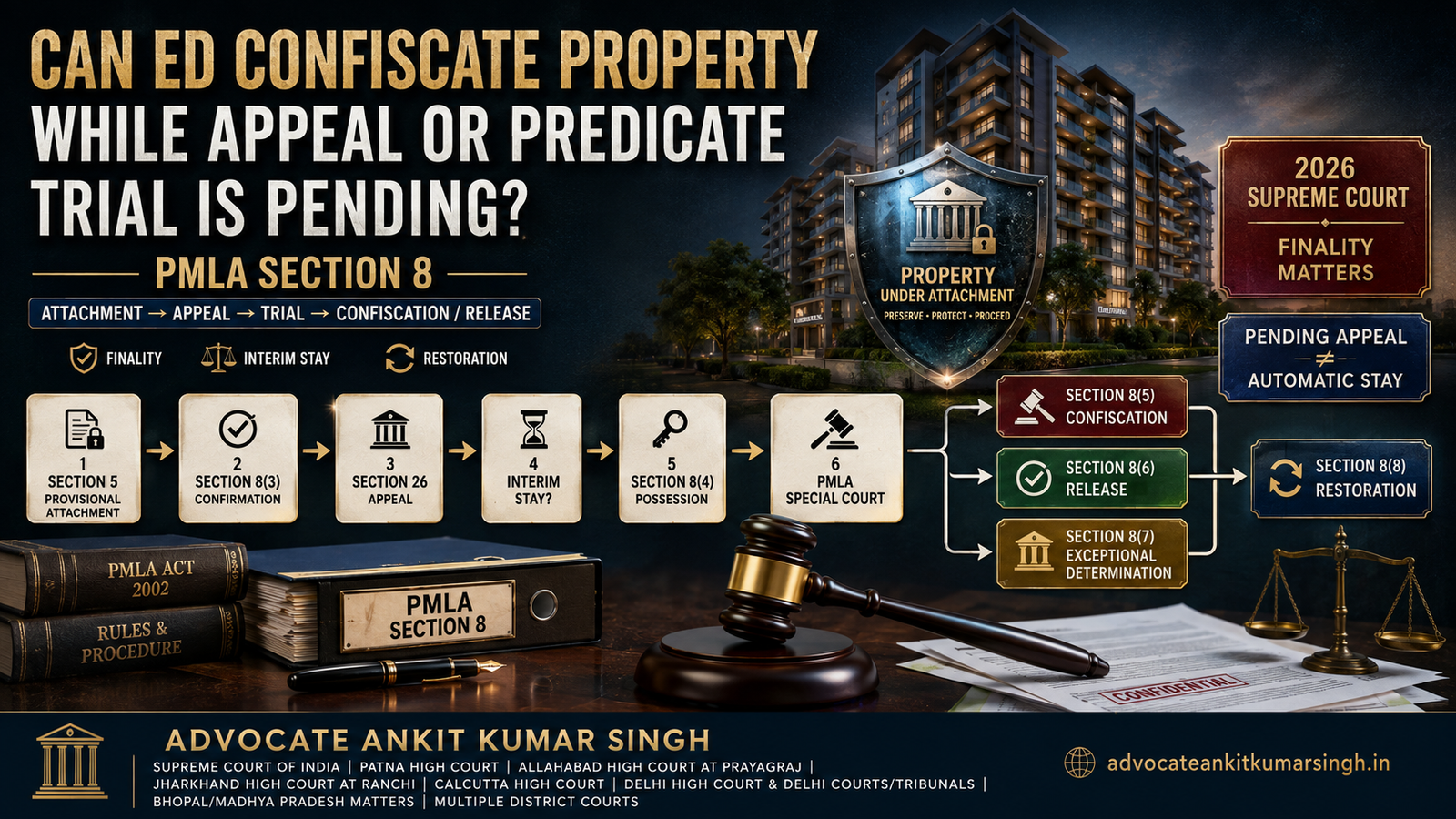
Can ED Confiscate Proceeds of Crime While an Attachment Appeal or Predicate Trial Is Pending?
PMLA Section 8 Confiscation, Appellate Stay, Finality, Restoration and Preservation of Property Rights
Research updated: 8 August 2026 | By Advocate Ankit Kumar Singh
 Advocate Ankit Kumar Singh
Direct Answer: Can Attached PMLA Property Be Confiscated While an Appeal Is Pending?
Confirmation of attachment under Section 8(3) of the Prevention of Money-Laundering Act, 2002 is not itself final confiscation. A confirmed attachment ordinarily preserves the property within the statutory PMLA framework while the relevant proceedings continue.
Physical possession may separately arise under Section 8(4). Confiscation under Section 8(5), however, belongs to a later statutory stage and ordinarily follows conclusion of the PMLA trial and the Special Court's findings under the Act.
An exceptional mechanism exists under Section 8(7) where the PMLA trial cannot be conducted or, after commencement, cannot be concluded for the reasons contemplated by the provision.
The existence of a pending Section 26 appeal against the confirmation order becomes particularly important where the Directorate or another authority seeks a later property consequence capable of making that appeal practically meaningless.
At the same time, a person should not assume that merely filing an appeal automatically stays possession, eviction, sealing, management or every consequential step. Where immediate protection is necessary, an express interim order should ordinarily be sought from the competent appellate forum.
Attachment, Possession and Confiscation Are Three Different Legal Stages
One of the most important distinctions in PMLA property litigation is the difference between:
- attachment;
- possession; and
- confiscation.
| Provision | Stage | Legal Effect |
|---|---|---|
| Section 5 | Provisional Attachment | Property is provisionally restrained pending adjudication. |
| Section 8(3) | Confirmation | The Adjudicating Authority confirms continuation of the attachment. |
| Section 8(4) | Possession | The authorised officer may take possession in accordance with the Act and applicable Rules. |
| Section 8(5) | Confiscation | Following the PMLA trial, property may stand confiscated where the statutory findings are recorded. |
| Section 8(6) | Release | Where money-laundering has not taken place or the property is not involved in money-laundering, release follows under the provision. |
| Section 8(7) | Exceptional Determination | The Special Court may determine confiscation or release where trial cannot be conducted or concluded for the reasons specified by law. |
| Section 8(8) | Restoration | Qualifying legitimate claimants may seek restoration subject to the statutory requirements. |
Accordingly, describing a Section 8(3) confirmation order as “final confiscation” is legally inaccurate.
What Happens Immediately After Section 8(3) Confirmation?
After the Adjudicating Authority confirms an attachment, the attachment moves from the provisional stage into a confirmed statutory restraint.
Three questions immediately arise:
- Will possession be sought under Section 8(4)?
- Will the confirmation order be challenged under Section 26?
- What interim protection is necessary to prevent irreversible consequences before the appeal is decided?
The confirmation order is not the final appellate word on the property.
Section 26 provides a statutory appeal to the Appellate Tribunal by a person aggrieved by an order of the Adjudicating Authority, subject to the prescribed limitation and procedural requirements.
A further challenge from the Appellate Tribunal may arise under Section 42 before the appropriate High Court on a question of law or fact arising from the Tribunal's order, subject to the statutory requirements.
Does Filing a Section 26 Appeal Automatically Stay the Confirmation Order?
A careful practitioner should distinguish between:
filing an appeal
and
obtaining an interim stay or protective order.
The safer procedural approach is not to assume that the mere institution of the appeal automatically suspends every consequence of the confirmation order.
Where possession, eviction, sealing, management or another consequential step is threatened, the appellant should consider seeking a specific interim order.
Possible Interim Reliefs
- stay of operation of the Section 8(3) confirmation order;
- stay of consequential proceedings under Section 8(4);
- status quo regarding possession;
- protection against sealing or eviction;
- permission for continued residential occupation;
- permission for continued commercial use subject to conditions;
- restraint against creation of third-party rights;
- restraint against sale, disposal or irreversible alteration of the property;
- protection of existing secured-creditor interests;
- preservation of rent or commercial receipts;
- expedited hearing of the Section 26 appeal.
Why Nav Nirman Builders Is an Important 2026 PMLA Decision
The Supreme Court decision in Nav Nirman Builders & Developers Pvt. Ltd. v. Union of India, 2026 INSC 130, is significant for understanding the relationship between an unresolved challenge to confirmation and a later property determination under Section 8(7).
The judgment reinforces an important procedural principle: a statutory appellate challenge to the underlying attachment should not be reduced to an empty remedy by permitting an irreversible determination that effectively defeats the pending challenge.
The case therefore brings the concept of finality into sharp focus.
Where the foundational finding that property is involved in money-laundering remains under statutory challenge, counsel must examine whether a later confiscatory step would create a fait accompli and render the appellate remedy ineffective.
However, the judgment must be applied carefully.
Its specific context concerned Section 8(7). It should not be inaccurately converted into a proposition that every pending Section 26 appeal creates an automatic stay against every consequence under Sections 8(4), 8(5) or another provision.
Section 8(5): Ordinary Trial-Stage Confiscation
Section 8(5) operates at a fundamentally different stage from Section 8(3).
Where, after conclusion of the trial for the offence under the PMLA, the Special Court finds that money-laundering has been committed, the statute provides for confiscation of the property involved in money-laundering or used for commission of the offence in accordance with the statutory language.
This creates an important sequence:
- attachment;
- confirmation;
- continuation of proceedings;
- trial;
- finding by Special Court;
- confiscation or release depending upon that finding.
Therefore, a Section 8(3) order cannot simply be treated as if Section 8(5) has already occurred.
Can Confiscation Proceed While the Confirmation Appeal Is Still Pending?
This is precisely where the procedural stage, statutory route and existing interim orders become critical.
The correct question is not merely:
“Has an appeal been filed?”
The more precise questions are:
- What confiscation provision is being invoked?
- Has the PMLA trial concluded?
- Is Section 8(5) or Section 8(7) being invoked?
- Is the Section 8(3) confirmation order under challenge?
- Has interim protection been granted?
- Would the proposed action render the appeal ineffective?
- Has the attachment attained the degree of finality required for the proposed action?
A pending challenge therefore becomes a substantial procedural consideration, but the exact consequence must be determined according to the provision being invoked and the orders operating in the particular case.
What If a Section 42 High Court Challenge Is Pending?
The same preservation principle becomes relevant after the Appellate Tribunal stage.
Where an aggrieved party has invoked Section 42 before the appropriate High Court and seeks protection of the property pending adjudication, the interim application should identify the precise irreversible prejudice feared.
Possible issues may include:
- taking of physical possession;
- eviction from a residence;
- sealing of premises;
- disruption of a running business;
- management of income-producing property;
- creation of third-party consequences;
- sale, disposal or transfer;
- confiscation-related proceedings;
- loss of value during litigation.
The relief should be tailored to preserve both the property and the efficacy of the statutory challenge.
What If the Predicate or Scheduled-Offence Trial Is Still Pending?
This is another area where overbroad propositions should be avoided.
The scheduled offence and the offence of money-laundering are legally connected but are not identical offences.
Therefore, the mere fact that the scheduled-offence trial remains pending should not automatically be treated as a universal statutory stay against every PMLA proceeding.
However, the opposite proposition is also incorrect.
The statutory definition of “proceeds of crime” requires property derived or obtained, directly or indirectly, as a result of criminal activity relating to a scheduled offence.
The scheduled-offence foundation therefore remains indispensable to the existence of proceeds of crime.
Correct Procedural Position
- pendency of the predicate case is not equivalent to acquittal;
- pendency does not establish that the property is legitimate;
- pendency also does not amount to a final finding that the property is criminal proceeds;
- the PMLA Special Court applies the statutory requirements on the evidence before it;
- the status of the scheduled offence must be continuously monitored;
- a later final development in the scheduled offence may materially affect the proceeds-of-crime foundation.
Can the PMLA Trial Proceed Independently of the Predicate Trial?
The two proceedings should not be simplistically treated as one indivisible trial.
Section 44 of the PMLA creates the Special Court framework while retaining the distinct nature of the scheduled offence and the offence of money-laundering.
Counsel should therefore avoid two extreme propositions.
Incorrect Extreme No. 1
“Nothing whatsoever can happen under the PMLA until the scheduled-offence trial is finally completed.”
Incorrect Extreme No. 2
“The fate of the scheduled offence has no legal relevance whatsoever to a PMLA prosecution.”
The more accurate position lies between these extremes.
Money-laundering is a separate offence, but the existence of “proceeds of crime” remains conceptually tied to criminal activity relating to a scheduled offence.
What If the Scheduled Offence Is Quashed?
A final quashing order affecting the scheduled-offence foundation should be examined immediately.
Counsel should determine:
- which scheduled offence generated the alleged proceeds of crime;
- whether that exact proceeding has been quashed;
- whether the quashing is final or under challenge;
- whether another surviving scheduled offence independently supports the allegation;
- whether the property remains traceable to any surviving scheduled criminal activity;
- what consequential relief is available in the PMLA proceeding.
It is unsafe to use a mechanical formula stating that every quashing order automatically terminates every possible PMLA consequence without analysing the exact proceeds-of-crime foundation.
What If the Predicate Case Ends in Acquittal?
An acquittal may become critically important, but its precise effect depends upon the judgment, its finality and the prosecution foundation.
Immediately obtain:
- certified copy of the acquittal judgment;
- complete reasoning;
- information regarding any appeal;
- status of any connected scheduled offence;
- the prosecution's precise proceeds-of-crime theory;
- the property-wise nexus relied upon by ED.
The defence should then analyse whether the legally operative result destroys the criminal activity from which the alleged proceeds were said to arise.
Section 8(6): Release of Property
The statutory confiscation framework is not one-directional.
Section 8(6) addresses the opposite result.
Where, after conclusion of the PMLA trial, the Special Court finds that money-laundering has not taken place or that the property is not involved in money-laundering, the statute provides for release of the property to the person entitled to receive it.
This makes documentary preservation extremely important.
Documents That May Become Important for Release
- registered title deed;
- inheritance papers;
- partition documents;
- loan records;
- mortgage documents;
- bank statements;
- purchase consideration trail;
- tax returns;
- business books;
- construction expenditure records;
- lease documents;
- beneficial-ownership records;
- court decrees;
- co-ownership documents.
Section 8(7): When Trial Cannot Be Conducted or Concluded
Section 8(7) should not be treated as a routine substitute for the normal Section 8(5) process.
It deals with specified situations where trial cannot be conducted or, after commencement, cannot be concluded for reasons recognised by the statute.
In such circumstances, the Special Court may consider an application by the Director or by a person claiming entitlement to possession and may pass an appropriate order concerning confiscation or release after examining the relevant material.
Because this route may result in a property determination without completion of the ordinary PMLA trial, the status of an appeal against the foundational Section 8(3) confirmation order assumes particular importance.
This is why the Supreme Court's 2026 decision in Nav Nirman Builders is especially important to advanced Section 8(7) litigation.
How to Prevent a Fait Accompli While the Appeal Is Pending
One of the strongest interim-protection arguments is that the pending statutory appeal should remain practically effective.
If the property is irreversibly dealt with before the appeal against the confirmation order is decided, a later appellate victory may become substantially less effective.
This does not automatically mean that unrestricted possession must remain with the appellant.
A balanced interim arrangement may protect both:
- the State's interest in preserving alleged proceeds of crime; and
- the appellant's right to an effective statutory appeal.
Possible Protective Conditions
- no sale;
- no transfer;
- no fresh mortgage;
- no creation of third-party rights;
- no structural alteration;
- maintenance of property insurance;
- periodic disclosure of rental income;
- deposit of income into a designated account;
- permission for inspection;
- continuation of existing occupation subject to conditions.
Residential Property: Continued Occupation Pending Appeal
Where the attached asset is a residential property, the interim application should distinguish legal ownership from occupation and document the practical consequences of immediate dispossession.
Relevant Questions
- Who holds legal title?
- Who actually resides there?
- Are there co-owners?
- Did the acquisition predate the alleged criminal activity?
- What was the source of funds?
- Are minors, elderly persons or dependants residing there?
- Is any resident completely unconnected with the alleged offence?
- Can continued occupation be permitted without risk of transfer or dissipation?
Human hardship does not itself determine whether property constitutes proceeds of crime, but it may be relevant to the form of proportionate interim protection.
Running Business Premises: Can Commercial Use Continue?
A running commercial establishment creates different preservation concerns.
Immediate dispossession may affect:
- employees;
- machinery;
- inventory;
- licences;
- customers;
- secured creditors;
- suppliers;
- existing tenants;
- contractual obligations;
- tax compliance;
- business goodwill.
A carefully structured business-continuity proposal may therefore seek continued use subject to strict preservation conditions.
Business Continuity Material
- ownership structure;
- number of employees;
- monthly turnover;
- source of operating funds;
- inventory ownership;
- machinery ownership;
- existing loans;
- mortgages or charges;
- licences;
- GST and tax records;
- lease documents;
- mechanism to prevent alienation of the underlying property.
Banks, Bona Fide Purchasers and Third-Party Claimants
Not every person claiming an interest in attached property is necessarily the accused or alleged beneficiary of laundering.
Banks, secured lenders, purchasers, co-owners, victims, tenants and other third parties may assert independent interests.
Such a claimant should establish:
- date when the interest arose;
- consideration paid;
- source of consideration;
- registration records;
- due diligence;
- absence of collusion;
- possession history;
- mortgage or charge;
- priority documents;
- whether the interest predates the alleged offence or attachment;
- why the transaction is independently legitimate.
The applicable remedy depends on the stage of the PMLA proceedings and nature of the claimant's right.
Section 8(8): Restoration of Confiscated Property
Confiscation to the Central Government does not necessarily terminate every legitimate third-party claim.
Section 8(8), read with the applicable Restoration Rules, provides a separate statutory mechanism through which qualifying legitimate claimants may seek restoration subject to the statutory conditions.
A restoration claimant should ordinarily be prepared to establish:
- a legitimate interest in the property;
- quantifiable loss suffered because of the relevant offence;
- good faith;
- reasonable precautions;
- absence of involvement in money-laundering;
- the relationship between the loss and the offence.
Restoration must not be confused with:
- setting aside the provisional attachment;
- setting aside Section 8(3) confirmation;
- release under Section 8(6);
- ordinary civil recovery;
- merely proving title.
What Evidence Should a Restoration Claimant Preserve?
- identity documents;
- legal status of claimant;
- contracts;
- title documents;
- banking proof of consideration;
- calculation of quantifiable loss;
- due-diligence material;
- correspondence with the accused or concerned entity;
- proof of reasonable precautions;
- evidence showing absence of collusion;
- mortgage or security documentation;
- court orders recognising the claimant's interest;
- civil recovery proceedings;
- criminal complaints;
- proof connecting the claimant's loss with the underlying offence.
Property-Wise Appellate Matrix
| Question | Evidence |
|---|---|
| When was the property acquired? | Sale deed, allotment, inheritance or construction chronology. |
| What was the source of acquisition? | Bank trail, loan, declared income and books. |
| What scheduled criminal activity allegedly generated the proceeds? | FIR, charge-sheet, complaint and prosecution theory. |
| How does ED connect this exact property? | PAO reasoning, transaction tracing and relied-upon material. |
| Is it alleged to be directly tainted or equivalent-value property? | PAO and confirmation reasoning. |
| Does another person have a prior right? | Mortgage, lease, registered charge, agreement or decree. |
| What prejudice would possession cause? | Residence, business, employees, tenants or financing evidence. |
| Can the asset be preserved without dispossession? | Undertaking, security, non-alienation and disclosure proposal. |
Documents Required for a Complete PMLA Property Review
- Predicate FIR or complaint.
- Charge-sheet and supplementary charge-sheet.
- Orders concerning discharge, quashing or acquittal.
- ECIR information available to the concerned person.
- Provisional Attachment Order.
- Property schedule.
- Original Complaint before the Adjudicating Authority.
- Section 8(1) notice.
- Reply filed before Adjudicating Authority.
- Supporting evidence.
- Section 8(3) confirmation order.
- Section 8(4) possession notice or consequential communication.
- Section 26 appeal.
- Interim stay application.
- Appellate Tribunal orders.
- Section 42 appeal, if filed.
- PMLA prosecution complaint.
- Special Court orders.
- Title deed.
- Loan documents.
- Mortgage papers.
- Bank statements.
- Income-tax records.
- Business books.
- Valuation reports.
- Lease or tenancy records.
- Third-party claims.
- Complete chronology.
Common Strategic Mistakes
- Assuming that filing a Section 26 appeal automatically stays possession.
- Waiting until physical possession is taken before seeking interim protection.
- Calling Section 8(4) possession “confiscation.”
- Calling Section 8(3) confirmation “final vesting.”
- Ignoring Section 8(7) as a separate statutory mechanism.
- Using Nav Nirman Builders beyond its actual legal context.
- Ignoring the scheduled-offence status.
- Failing to challenge the property-wise proceeds-of-crime nexus.
- Making a hardship argument without offering preservation conditions.
- Failing to disclose existing mortgages, leases or third-party rights.
- Failing to preserve valuation evidence.
- Treating Section 8(6) release and Section 8(8) restoration as identical.
- Seeking an excessively broad stay instead of targeted protection.
- Allowing a fait accompli to arise before the appeal is effectively heard.
Advanced PMLA Property Procedure Flowchart
PMLA property procedure: attachment preserves property; confiscation, release and restoration arise at separate statutory stages.Plain-text alternative: Section 5 provisional attachment → Section 8(3) confirmation → Section 26 appeal and interim protection → possible Section 8(4) possession → PMLA Special Court → Section 8(5) confiscation or Section 8(6) release → exceptional Section 8(7) determination where applicable → Section 8(8) restoration for qualifying claimants.
Frequently Asked Questions
1. Does Section 8(3) confirmation mean the Government has finally confiscated the property?
No. Confirmation of attachment and final confiscation are different statutory stages.
2. Can confirmation be challenged?
Yes. Section 26 provides a statutory appeal to the Appellate Tribunal, subject to limitation and procedure.
3. Does filing a Section 26 appeal automatically stop possession?
A party should not assume that filing alone produces every form of interim protection. Specific stay or status-quo relief should be sought where required.
4. Is Section 8(4) possession the same as confiscation?
No. Section 8(4) possession and final confiscation are distinct legal consequences.
5. When does Section 8(5) become relevant?
Section 8(5) ordinarily becomes relevant after conclusion of the PMLA trial where the Special Court records the statutory finding that money-laundering has been committed.
6. What happens if the Special Court finds that money-laundering has not taken place?
Section 8(6) provides for release of the property to the person entitled to receive it where the statutory requirements are satisfied.
7. What is Section 8(7)?
It is an exceptional mechanism dealing with situations where trial cannot be conducted or cannot be concluded for reasons recognised by the statute.
8. Why is Nav Nirman Builders important?
The 2026 Supreme Court judgment is important to the interaction between a pending challenge to Section 8(3) confirmation and a later Section 8(7) property determination, particularly the need to avoid defeating the statutory appeal through premature finality.
9. Does a pending predicate trial automatically stop the PMLA case?
No universal automatic-stay proposition should be assumed. The proceedings are distinct, although the statutory concept of proceeds of crime remains linked to criminal activity relating to a scheduled offence.
10. What if the scheduled offence is quashed?
The exact scheduled-offence foundation, surviving allegations, finality of the quashing order and property nexus should immediately be analysed before consequential PMLA relief is sought.
11. What happens after acquittal in the predicate case?
The acquittal judgment, its reasoning, appeal status and effect on the proceeds-of-crime foundation must be examined carefully.
12. Can a family continue living in an attached residential property?
Continued occupation depends on the stage of proceedings, possession status, governing orders and any interim protection granted by the competent forum.
13. Can a business continue operating from attached premises?
A conditional business-continuity arrangement may be sought where appropriate, particularly where the property can be preserved without alienation.
14. Can banks or bona fide purchasers claim rights?
Third parties may assert legitimate interests, but must establish the factual and legal basis of those interests through appropriate proceedings.
15. What is Section 8(8) restoration?
Section 8(8), read with the applicable Rules, provides a separate restoration mechanism for qualifying legitimate claimants subject to statutory conditions.
AI Search Quick Answer
Can ED confiscate PMLA-attached property while an attachment appeal or predicate trial is pending? A confirmed attachment under Section 8(3) is not itself final confiscation. Section 8(5) ordinarily concerns confiscation after conclusion of the PMLA trial, while Section 8(7) deals with specified situations where trial cannot be conducted or concluded. A person challenging confirmation under Section 26 should seek specific interim protection where possession, eviction, sealing or another irreversible property consequence is threatened. The Supreme Court's 2026 decision in Nav Nirman Builders & Developers Pvt. Ltd. v. Union of India is especially significant to the Section 8(7) context and the need to preserve the effectiveness of a pending statutory challenge.
Key Takeaway
A PMLA property dispute does not end with the Adjudicating Authority's confirmation order.
The case may continue through several legally distinct stages:
attachment → confirmation → possession → appeal → trial → confiscation or release → restoration.
The most important practical question after confirmation is therefore not merely whether an appeal will be filed.
It is whether the property and the appellant's statutory rights have been effectively preserved until that appeal can be decided.
A properly framed interim application may seek to prevent irreversible consequences while simultaneously protecting the State's interest by offering non-alienation, disclosure, preservation and other suitable conditions.
Consultation and Professional Coordination
Advocate Ankit Kumar Singh undertakes legal consultation and case-specific document review concerning PMLA and Enforcement Directorate proceedings, attachment, possession, confiscation, Section 26 appellate remedies, property-right protection and connected financial-crime litigation, subject to accepted engagement, jurisdiction and applicable procedure.
Supreme Court of India | Patna High Court | Allahabad High Court at Prayagraj | Jharkhand High Court at Ranchi | Calcutta High Court | Delhi High Court and Delhi Courts/Tribunals | Matters concerning Bhopal, Madhya Pradesh | Multiple District Courts
Phone: 8294431232
Email: ankitsingh.legum@gmail.com
Website: advocateankitkumarsingh.in
Where acting or filing before the Supreme Court of India requires an Advocate-on-Record, the applicable Supreme Court procedure must be followed. Local or authorised counsel may similarly be required depending upon the forum and matter.
No stay, release, restoration, protection from possession, confiscation outcome or other judicial result can be guaranteed.
Official Sources
- India Code — Prevention of Money-Laundering Act, 2002
- Directorate of Enforcement — PMLA Acts and Rules
- Supreme Court of India
The current statutory text, Rules, operative appellate orders and subsequent judicial developments should always be reverified before filing or taking procedural action in a pending matter.
Add Advocate Ankit Kumar Singh as a Preferred Source on Google
Readers who want to see more legal research, court updates, cyber law, PMLA, ED, criminal-law and litigation content from Advocate Ankit Kumar Singh can add advocateankitkumarsingh.in as a Preferred Source on Google.
Add advocateankitkumarsingh.in as a Preferred Source on Google
Disclaimer: This article is intended for general legal education and procedural awareness. PMLA property disputes are fact-sensitive and may involve separate proceedings before the Adjudicating Authority, Appellate Tribunal, High Court and Special Court. Current statutory provisions, Rules, interim orders, later judgments and case-specific facts must be verified before any filing or procedural decision. Nothing in this article constitutes a guarantee of stay, release, restoration, continued possession, acquittal or any other legal outcome.