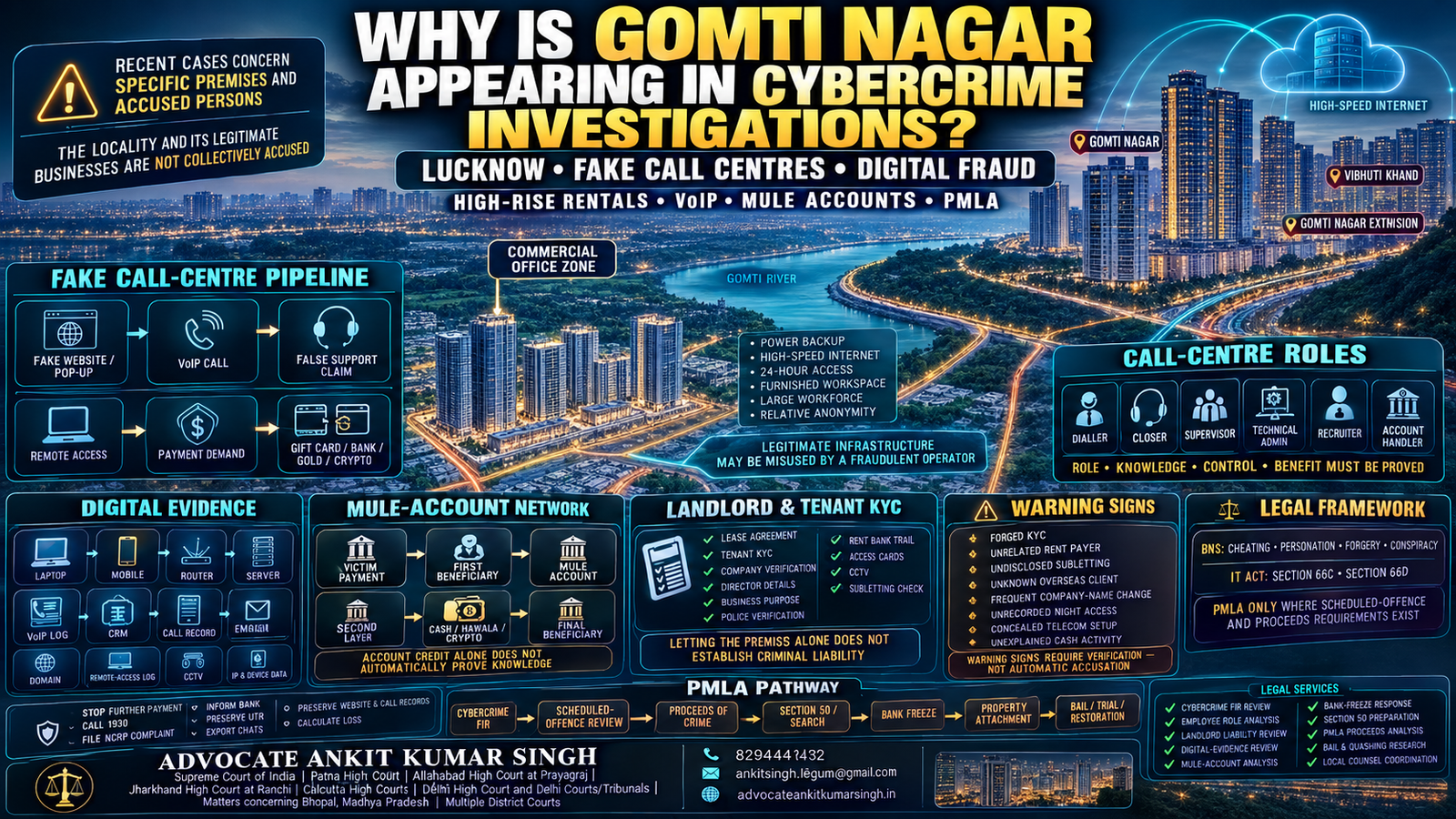
Why Is Gomti Nagar, Lucknow Appearing in Cybercrime Investigations? Fake Call Centres, High-Rise Rentals, Mule Accounts and PMLA Risks
Direct Answer: Recent police actions have repeatedly linked certain commercial towers and residential complexes in Gomti Nagar, Gomti Nagar Extension and adjoining Vibhuti Khand with alleged fake international call centres, investment frauds and related cybercrime networks.
Investigators and persons quoted in public reporting have pointed to a combination of comparatively affordable premises, reliable electricity, strong internet connectivity, furnished high-rise spaces, an educated workforce, night-shift recruitment and the relative anonymity available inside large mixed-use developments.
Important Accuracy Warning: These investigations do not prove that Gomti Nagar as a locality, its residents, its property owners or its legitimate businesses are collectively involved in cybercrime. The reported cases concern particular premises, entities and accused persons. Every allegation remains subject to investigation and trial.
The more accurate question is not whether the entire locality is a “cybercrime hub,” but:
Why are alleged cyber-fraud operators selecting particular Lucknow high-rises, and what legal, financial and digital evidence is used to identify the persons actually responsible?
Contents
- What recent Lucknow investigations show
- Is Gomti Nagar legally a cybercrime hub?
- Why high-rise districts may attract alleged fraud operators
- How an alleged fake international call centre operates
- Diallers, closers, supervisors and technical operators
- VoIP, websites, search manipulation and remote-access tools
- Mule accounts, cash, gift cards, bullion, hawala and crypto
- Documents and digital evidence examined by police
- Landlord and property-owner liability
- Tenant verification and commercial-premises due diligence
- Employee and recruiter liability
- Director, accountant and signatory liability
- Applicable cybercrime and criminal laws
- When can ED and PMLA enter the case?
- Search, device seizure, freezing and attachment
- Immediate steps for victims and legitimate businesses
- Bail, discharge and role-specific defence
- Frequently asked questions
What Do the Recent Lucknow Investigations Show?
Public reporting in July and August 2026 described several significant cybercrime operations in Lucknow.
Summit Building, Gomti Nagar
Police reportedly uncovered an alleged fake international call centre operating from commercial premises in Summit Building.
The operation was alleged to have:
- targeted citizens in the United States;
- operated primarily during night hours;
- used internet-based calls;
- worked from multiple office units;
- used numerous laptops and mobile phones; and
- presented itself as an ordinary commercial operation.
Public reports differed on whether 119 or 122 persons were arrested or detained. It is therefore safer to state that more than one hundred persons were taken into custody or detained during the operation.
Omaxe R2, Gomti Nagar Extension
Another alleged technical-support fraud was reportedly uncovered from residential apartments.
Investigators alleged that the operators:
- targeted foreign nationals;
- used fake security or technical-support claims;
- operated from furnished apartments;
- used digital calling infrastructure; and
- attempted to obtain payments through deceptive representations.
Cyber Heights, Vibhuti Khand
A third alleged international cyber-fraud call centre was reported within approximately 22 days.
Police reportedly found:
- approximately 35 persons working at individual workstations;
- 31 laptops;
- 14 mobile phones;
- two routers;
- cash of approximately ₹18.5 lakh; and
- technical infrastructure allegedly used for overseas calls.
Four persons described as alleged key operators were reportedly arrested.
Alleged Mule-Account Network
A separate August 2026 operation reportedly concerned an interstate network accused of providing bank accounts for routing online-fraud proceeds.
The alleged transaction volume was nearly ₹50 crore.
This later operation is significant because fake call centres ordinarily require a financial channel after the victim is deceived.
The communication infrastructure and the money-transfer infrastructure must therefore be examined together.
Is Gomti Nagar Legally a “Cybercrime Hub”?
No statute or official declaration identified in the reviewed material designates Gomti Nagar as a cybercrime hub.
The expression is a media or search phrase used to describe a cluster of recent investigations.
Three distinctions are essential.
Repeated Cases Are Relevant
Several significant operations within a short period may justify:
- greater police scrutiny;
- improved commercial-tenant verification;
- closer examination of night-shift offices;
- building-access and CCTV preservation;
- telecom and banking coordination; and
- public awareness.
Repeated Cases Do Not Establish Collective Guilt
The presence of an alleged illegal call centre in a building does not prove wrongdoing by:
- every tenant;
- the building association;
- neighbouring businesses;
- every property owner;
- every broker;
- every employee; or
- the locality generally.
“Hub” Should Not Replace Evidence
Liability must be established through:
- the specific premises;
- the lease and tenant identity;
- company control;
- digital infrastructure;
- communications;
- victim evidence;
- bank transactions;
- individual knowledge;
- economic benefit; and
- the applicable criminal law.
Why May High-Rise Districts Attract Alleged Cyber-Fraud Operators?
1. Ready Commercial Infrastructure
Modern commercial buildings may provide:
- furnished office units;
- continuous electricity;
- power backup;
- high-speed broadband;
- central air-conditioning;
- parking;
- security systems;
- 24-hour entry; and
- professional surroundings.
These features support legitimate businesses but may also be misused by a fraudulent operation.
2. Comparatively Affordable Cost
Reporting has suggested that certain Lucknow premises may be less expensive than comparable locations in parts of the National Capital Region.
Lower operational cost may permit an alleged network to rent:
- larger offices;
- multiple apartments;
- additional workstations;
- temporary accommodation; and
- backup locations.
3. Availability of Skilled Workers
Lucknow has a substantial pool of:
- graduates;
- English-speaking applicants;
- computer-literate workers;
- customer-service candidates;
- students seeking part-time work; and
- persons willing to work night shifts.
This labour pool is overwhelmingly legitimate. The legal issue arises where recruiters conceal the true nature of the work.
4. Night-Shift Camouflage
Legitimate companies serving overseas clients may operate according to foreign time zones.
An alleged fraudulent centre may use the same appearance:
- employees entering at night;
- headsets and workstations;
- English-language scripts;
- customer-support terminology;
- internet calling; and
- foreign telephone numbers.
Night work alone is not suspicious. It becomes relevant when combined with deceptive scripts, unverified clients, unusual payments or concealed infrastructure.
5. Relative Anonymity
Large commercial and residential developments may contain:
- hundreds of occupants;
- frequent visitors;
- multiple companies;
- short-term leases;
- contract employees;
- delivery and service staff; and
- changing tenant populations.
A small operation may therefore remain unnoticed unless access, identity and business records are properly maintained.
6. Weak or Incomplete Tenant Verification
Public reporting has raised concerns about forged documents or inadequate scrutiny in certain rental transactions.
Risk increases where:
- the tenant’s identity is not independently checked;
- company incorporation is accepted without verification;
- rent is paid by unrelated persons;
- the premises are sublet without approval;
- the stated business differs from actual activity;
- no police-verification form is submitted;
- visitor or employee access is not recorded; or
- the property manager cannot identify the actual controller.
7. Limited Physical Infrastructure Is Required
A fraudulent call centre may require only:
- laptops;
- mobile phones;
- routers;
- headsets;
- VoIP accounts;
- cloud-hosted software;
- scripts;
- victim leads; and
- banking or payment channels.
The operation may therefore be moved quickly from one premises to another.
8. Foreign Victims May Report Later
Where victims are located abroad:
- local police may not receive an immediate complaint;
- victims may contact a foreign bank or law-enforcement agency first;
- records may be spread across countries;
- time-zone differences may delay coordination;
- gift-card or crypto payments may move rapidly; and
- operators may continue before the complaint reaches Lucknow.
How Does an Alleged Fake International Call Centre Operate?
Stage 1: Creating the Business Appearance
The alleged operators may arrange:
- a company or partnership;
- a commercial lease;
- a business name;
- workstations;
- internet connections;
- recruitment advertisements;
- appointment letters;
- salary accounts;
- call scripts; and
- a false description of overseas customer-support work.
Stage 2: Acquiring Victim Leads
Potential leads may be obtained through:
- purchased databases;
- data breaches;
- fake advertisements;
- search-engine manipulation;
- spoofed websites;
- malicious pop-ups;
- phishing emails;
- social-media promotions; or
- previous victim lists.
Stage 3: Initial Contact
A dialler or caller may claim to represent:
- a software company;
- a computer-security provider;
- a bank;
- a telecom company;
- an e-commerce platform;
- a taxation authority;
- a law-enforcement body;
- a court or government agency; or
- a customer-support department.
Stage 4: Fear or Trust Creation
The victim may be told that:
- the computer is infected;
- the bank account has been compromised;
- an illegal purchase was made;
- identity documents were misused;
- a warrant has been issued;
- the victim owes tax;
- the victim will be arrested;
- a refund is available; or
- a security payment is required.
Stage 5: Remote Access or Payment
The alleged operator may request:
- installation of remote-access software;
- screen sharing;
- bank-login access;
- OTP disclosure;
- gift-card purchase;
- cash withdrawal;
- gold or bullion purchase;
- cryptocurrency transfer;
- wire transfer; or
- payment into a mule account.
Stage 6: Layering and Withdrawal
The funds may then move through:
- first-layer beneficiary accounts;
- multiple mule accounts;
- shell-company accounts;
- merchant accounts;
- cash withdrawals;
- bullion transactions;
- hawala channels;
- crypto exchanges;
- self-hosted wallets; or
- foreign-controlled accounts.
Diallers, Closers, Supervisors and Technical Operators
A call centre may involve multiple operational roles.
Dialler or Caller
The caller may:
- make the first contact;
- read a script;
- confirm the victim’s identity;
- describe the false problem;
- keep the victim engaged; and
- transfer the call to a closer.
Closer
A closer may:
- claim greater authority;
- impersonate an official;
- create fear or urgency;
- direct the payment method;
- obtain gift-card numbers;
- arrange a cash or gold transfer; and
- receive a performance-based commission.
Supervisor
A supervisor may:
- monitor calls;
- approve scripts;
- allocate victim leads;
- set targets;
- track payments;
- train employees;
- resolve failed transactions; and
- report to the controllers.
Technical Administrator
The technical person may manage:
- VoIP systems;
- spoofed numbers;
- fake websites;
- search advertisements;
- servers;
- VPN or proxy infrastructure;
- CRM systems;
- remote-access tools;
- domain names;
- email accounts; and
- data backups.
Recruiter or Human-Resources Personnel
The recruiter may:
- publish vacancies;
- conduct interviews;
- describe the work;
- collect identity documents;
- issue appointment letters;
- arrange salaries;
- allocate shifts; and
- refer recruits to supervisors.
Account Provider or Financial Handler
The financial handler may:
- arrange mule bank accounts;
- obtain internet-banking credentials;
- receive OTPs;
- transfer funds;
- withdraw cash;
- buy cryptocurrency;
- pay commissions; or
- deliver funds to the final controller.
Employment title alone does not establish guilt. The evidence must identify what the person knew, what the person did, what authority existed and what benefit was received.
VoIP, Websites, Search Manipulation and Remote-Access Tools
VoIP Systems
Voice over Internet Protocol permits calls to be transmitted through internet systems.
Relevant records may include:
- subscriber account;
- payment method;
- SIP credentials;
- assigned telephone numbers;
- call logs;
- IP addresses;
- device identifiers;
- login history;
- recorded calls;
- server location; and
- administrator access.
Fake Customer-Support Websites
A fraudulent website may be designed to appear as:
- official customer support;
- a software-security company;
- a refund department;
- a bank-help page;
- a government portal;
- a product-support page; or
- a toll-free assistance service.
Search Manipulation
An alleged network may attempt to ensure that a fraudulent number appears when the victim searches for customer support.
Investigation may examine:
- advertising accounts;
- keywords purchased;
- website metadata;
- domain registration;
- hosting payment;
- search-console access;
- linked email accounts;
- call-routing numbers; and
- complaints associated with the domain.
Remote-Access Software
Remote-access tools are legitimate applications but may be misused to:
- view a victim’s screen;
- control the computer;
- access online banking;
- alter displayed information;
- initiate transactions;
- disable security; or
- obtain sensitive data.
The presence of such software alone does not prove fraud. The surrounding communication, access history and transaction must be examined.
Mule Accounts, Cash, Gift Cards, Bullion, Hawala and Cryptocurrency
The alleged communication fraud and the financial trail are separate but connected parts of the investigation.
Mule Account
A mule account may be:
- knowingly rented;
- opened through forged KYC;
- controlled by another person;
- opened in a shell company’s name;
- used by an innocent person whose credentials were stolen;
- a genuine business account misused by an employee; or
- an account whose holder received commission for transactions.
Gift Cards
Relevant evidence may include:
- card number;
- purchase receipt;
- retailer;
- activation time;
- redemption account;
- device used for redemption;
- IP address;
- resale record; and
- ultimate beneficiary.
Gold or Bullion
The victim may allegedly be directed to purchase gold or bullion and deliver it through:
- a courier;
- a ride-service driver;
- a cash or commodity collector;
- a postal package; or
- another intermediary.
The trail may involve:
- purchase invoice;
- CCTV;
- delivery address;
- vehicle details;
- phone location;
- recipient communication; and
- subsequent sale.
Hawala Allegation
A hawala allegation ordinarily requires examination of:
- foreign payment;
- domestic cash delivery;
- codes or tokens;
- intermediaries;
- ledger entries;
- commission;
- corresponding settlement; and
- final beneficiary.
Cryptocurrency
Potential evidence includes:
- exchange KYC;
- bank payment;
- P2P counterparty;
- wallet address;
- transaction hash;
- device access;
- self-hosted wallet;
- stablecoin conversion;
- foreign wallet; and
- cash-out transaction.
Money-Trail Formula
Victim Payment → First Recipient → Mule Layers → Cash, Commodity or Crypto Conversion → Final Controller or Asset
Documents and Digital Evidence Examined by Police
Premises and Company Records
- lease deed;
- tenant KYC;
- company registration;
- GST and tax records;
- business-purpose declaration;
- client agreement;
- telecom agreement;
- employee register;
- salary records;
- attendance register;
- shift roster;
- building access cards;
- CCTV;
- visitor register;
- electricity bills;
- internet bills;
- rent payments; and
- property-manager communication.
Digital Devices
- laptops;
- desktop computers;
- mobile phones;
- SIM cards;
- routers;
- servers;
- external drives;
- VoIP devices;
- headsets;
- digital-signature tokens;
- banking tokens; and
- crypto hardware wallets.
Electronic Records
- call logs;
- recorded calls;
- CRM entries;
- victim databases;
- scripts;
- email;
- WhatsApp or messaging data;
- remote-access logs;
- domain records;
- website source code;
- cloud-storage records;
- advertising accounts;
- search keywords;
- bank statements;
- payment instructions;
- gift-card data;
- wallet addresses; and
- cash-settlement sheets.
Device Attribution
For each device, the investigation should determine:
- legal owner;
- assigned user;
- actual user;
- login credentials;
- administrator;
- date of use;
- files created;
- communications sent;
- accounts accessed; and
- whether the device was shared.
Landlord and Property-Owner Liability
A landlord does not become guilty merely because a tenant allegedly committed cybercrime from the premises.
Evidence Supporting a Bona Fide Landlord
- written lease;
- verified tenant identity;
- verified company documents;
- rent received through banking channels;
- security deposit records;
- police or tenant verification;
- building access records;
- restrictions against illegal use;
- no participation in business operations;
- no share in the alleged proceeds;
- prompt cooperation after discovery; and
- preservation of CCTV and records.
Conduct That May Increase Scrutiny
- knowingly accepting false tenant identity;
- allowing undisclosed subletting;
- receiving rent from unrelated accounts without inquiry;
- participating in the business;
- receiving revenue-linked payment;
- providing bank accounts or company documents;
- concealing the actual occupant;
- destroying CCTV after police inquiry;
- helping move devices after learning of the investigation;
- backdating lease records; or
- sharing in alleged proceeds.
Property Broker
A broker’s position may depend upon:
- the identity documents received;
- verification undertaken;
- representations made to the landlord;
- commission received;
- knowledge of actual use;
- continued involvement after tenancy; and
- communication with the tenant.
Ordinary brokerage without criminal knowledge is not equivalent to participation in cyber fraud.
Tenant Verification and Commercial-Premises Due Diligence
Before Giving Possession
- Verify the individual’s original identity document.
- Verify the company through official corporate records.
- Identify directors and beneficial owners.
- Verify the registered office.
- Verify the stated business activity.
- Obtain the proposed employee strength.
- Ask whether night operations will occur.
- Identify the overseas client, if claimed.
- Obtain telecom and internet requirements.
- Complete tenant-verification documentation.
- Execute a detailed written lease.
- Prohibit unauthorised subletting.
- Record all rent and deposit payments.
Commercial Lease Clauses
A commercial lease may require:
- lawful use only;
- accurate company and director details;
- no illegal telecommunications activity;
- no impersonation or fraudulent customer support;
- no subletting without consent;
- employee and visitor records;
- compliance with building-security rules;
- notice of change in business;
- notice of director or control changes;
- right to terminate for illegal use; and
- cooperation with lawful investigation.
Warning Signs
- tenant refuses identity verification;
- rent paid by unrelated individuals;
- company recently incorporated with no genuine online presence;
- business description changes repeatedly;
- large night-shift workforce appears immediately;
- employees cannot identify the actual client;
- premises use differs from the lease;
- multiple broadband or VoIP connections are concealed;
- access cards are issued to unidentified persons;
- tenant frequently changes company name;
- devices are removed whenever management visits; or
- unexplained cash movements occur.
A warning sign requires inquiry, not automatic accusation. Legitimate BPO, technology and customer-support companies may share several operational characteristics.
Employee and Recruiter Liability
Employment Alone Is Not Automatic Guilt
A young employee may have been recruited on the representation that the work involved:
- customer support;
- software assistance;
- telemarketing;
- survey work;
- sales;
- lead generation;
- technical support; or
- overseas process outsourcing.
Questions Relevant to Employee Knowledge
- What did the job advertisement state?
- What was explained during recruitment?
- Was a genuine client identified?
- What script was supplied?
- Was the employee instructed to use a false identity?
- Was the employee told to impersonate an official?
- Did the employee request gift cards or money?
- Did the employee know the support problem was false?
- Was commission linked with victim payment?
- Did the employee receive unusual cash?
- How long did the employee work there?
- Did the employee raise any objection?
Recruiter Liability
A recruiter may face greater scrutiny where the evidence allegedly shows that the recruiter:
- knowingly concealed the fraudulent process;
- trained employees to use false identities;
- supplied deceptive scripts;
- recruited experienced cyber-fraud workers;
- received payment based upon victim collections; or
- moved employees between multiple fraudulent centres.
Defence Documents for an Employee
- job advertisement;
- appointment letter;
- salary statement;
- training material;
- official email;
- shift records;
- script used;
- reporting structure;
- duration of employment;
- messages showing instructions;
- absence of financial benefit; and
- evidence of cooperation.
Director, Accountant and Authorised-Signatory Liability
Director
Relevant evidence may include:
- company formation;
- office lease approval;
- business model;
- client contracts;
- bank control;
- employee recruitment;
- VoIP and website expenditure;
- payment instructions;
- victim proceeds;
- cash withdrawals;
- personal benefit; and
- conduct after complaints arose.
Accountant
An accountant may be questioned concerning:
- books of account;
- salary and commission payments;
- cash entries;
- related-party transactions;
- mule-account transfers;
- false invoices;
- gift-card or crypto settlements;
- concealment of actual revenue; and
- alteration of records.
Routine entry of management-approved documents does not automatically prove criminal knowledge.
Authorised Signatory
A bank or document signatory’s position depends upon:
- scope of authority;
- beneficiary selection;
- transaction approval;
- internet-banking access;
- OTP or token control;
- supporting records;
- instructions received;
- knowledge of the source; and
- personal benefit.
Applicable Cybercrime and Criminal Laws
The precise provisions depend upon the facts and date of the alleged conduct.
Bharatiya Nyaya Sanhita, 2023
Potentially relevant allegations may concern:
- criminal conspiracy under Section 61;
- cheating under Section 318;
- cheating by personation under Section 319;
- making a false document under Section 335;
- forgery under Section 336;
- forgery of specified records under Sections 337 and 338;
- use of a forged document or electronic record under Section 340;
- falsification of accounts under Section 344;
- destruction of an electronic record to prevent production; and
- other applicable offences.
Information Technology Act, 2000
Depending upon the facts, investigation may consider:
- computer-related offences;
- dishonest receipt of a stolen computer resource;
- identity theft under Section 66C;
- cheating by personation through a computer resource under Section 66D;
- preservation obligations;
- intermediary records; and
- other applicable provisions.
Electronic Evidence
Digital evidence may require proof concerning:
- authenticity;
- device ownership;
- user attribution;
- metadata;
- integrity;
- chain of custody;
- hash values where generated;
- server records;
- admissibility; and
- context.
Company Liability
The company and its officers should not be treated as a single indistinguishable unit.
The case should separately identify:
- the company’s act;
- the controller’s act;
- the director’s act;
- the employee’s act;
- the technical person’s act;
- the accountant’s act;
- the account holder’s act; and
- the benefit received by each.
When Can ED and PMLA Enter the Case?
Not every fake call-centre FIR results in an ED case.
Required PMLA Sequence
Applicable Scheduled Offence → Criminal Activity → Property Derived or Obtained → Proceeds of Crime → Process or Activity Connected with the Proceeds
Scheduled-Offence Review
The FIR provisions must be matched with:
- the current PMLA Schedule;
- the date of the offence;
- the transition from the Indian Penal Code to the Bharatiya Nyaya Sanhita;
- the charge-sheet or complaint; and
- the particular criminal activity alleged.
It is unsafe to assume that every Information Technology Act offence independently constitutes a scheduled offence.
Potential Proceeds of Crime
ED may allege that proceeds include:
- victim payments;
- commissions;
- cash withdrawals;
- gift-card redemption value;
- gold or bullion;
- cryptocurrency;
- company-bank balances;
- property purchased from collections;
- vehicles;
- salary paid from questioned receipts;
- equipment purchased from fraud money; or
- equivalent-value property.
Person-Specific PMLA Analysis
ED must examine whether the person:
- knowingly assisted;
- knowingly became a party;
- was actually involved;
- possessed proceeds;
- acquired proceeds;
- used proceeds;
- concealed proceeds;
- projected proceeds as legitimate; or
- claimed proceeds as legitimate.
Mere presence in an office or receipt of an ordinary salary should not replace proof of the individual’s actual role.
Search, Device Seizure, Freezing and Attachment
Police Search
A search may involve:
- commercial office;
- residential apartment;
- server room;
- employee workstation;
- director’s residence;
- company vehicles;
- bank accounts;
- digital devices;
- cash; and
- documents.
Digital-Device Inventory
| Device | Make / Model | Serial / IMEI | Owner | User | Action |
|---|---|---|---|---|---|
| Laptop | Insert | Insert | Company / Individual | Insert | Seized / Copied / Imaged |
| Mobile phone | Insert | Insert | Company / Personal | Insert | Seized / Copied |
| Router | Insert | Insert | Company / ISP | Administrator | Seized / Logs copied |
| Server | Insert | Insert | Company / Host | Administrator | Seized / Imaged / Frozen |
Bank Freezing
An account may be restrained because:
- victim funds entered it;
- another mule account transferred money to it;
- cash was withdrawn from it;
- crypto was purchased from it;
- several NCRP complaints refer to it;
- it was controlled by an alleged operator; or
- the available balance is considered traceable property.
PMLA Search and Attachment
Where ED enters the case, potential proceedings may include:
- Section 50 summons;
- Section 17 search and seizure;
- freezing of records or property;
- provisional attachment under Section 5;
- adjudication under Section 8;
- arrest under Section 19;
- prosecution complaint; and
- victim restoration under the applicable Section 8(8) framework.
Immediate Steps for Victims
- Stop communicating with the alleged operator.
- Do not send another payment.
- Call the cybercrime helpline at 1930 immediately.
- File a complaint through the National Cyber Crime Reporting Portal.
- Notify the bank.
- Request urgent recall or beneficiary-account restraint.
- Preserve every UTR and transaction number.
- Preserve phone numbers and email addresses.
- Export chats.
- Preserve call recordings.
- Preserve website and advertisement details.
- Preserve remote-access application records.
- Change banking and email credentials.
- Calculate the exact loss.
- Approach the competent cybercrime police unit.
Victim Evidence Checklist
- bank statement;
- card or gift-card receipt;
- cash or gold-purchase receipt;
- screenshots;
- email headers;
- telephone numbers;
- website URL;
- remote-access session record;
- messages;
- payment instructions;
- courier or vehicle details;
- NCRP acknowledgement;
- FIR or complaint; and
- loss calculation.
Immediate Steps for a Legitimate Business or Landlord
Legitimate Business
- Preserve all company and employee records.
- Identify the actual overseas client.
- Collect the service agreement.
- Preserve call logs and CRM data.
- Preserve telecom and internet agreements.
- Secure accounting and payroll records.
- Identify every workstation user.
- Do not wipe devices.
- Do not alter scripts or logs.
- Prepare a person-wise role chart.
- Prepare a transaction-wise bank explanation.
- Obtain legal review before statements.
Landlord or Property Manager
- Preserve the lease.
- Preserve tenant KYC.
- Preserve company-verification records.
- Preserve rent-payment records.
- Preserve CCTV.
- Preserve visitor and access logs.
- Identify actual occupants.
- Preserve broker communications.
- Do not backdate documents.
- Do not remove tenant devices or records.
- Cooperate with lawful investigation.
- Obtain advice before giving a speculative statement.
Bail, Discharge and Role-Specific Defence
Bail Considerations
Potentially relevant factors include:
- precise job role;
- period of employment;
- knowledge of deception;
- script used;
- number of calls;
- personal benefit;
- bank-account control;
- device attribution;
- cooperation;
- completed seizure of evidence;
- absence of criminal antecedents;
- custody period;
- documentary nature of evidence;
- trial duration; and
- risk of tampering.
Potential Defence Issues
- genuine BPO service;
- employee recruited through a misleading advertisement;
- no knowledge of false representation;
- no victim interaction;
- no financial benefit beyond ordinary salary;
- no access to mule accounts;
- no control over scripts;
- shared device incorrectly attributed;
- forged company or tenant KYC;
- identity theft;
- landlord without business participation;
- legitimate merchant account receiving an isolated credit;
- absence of scheduled-offence foundation for PMLA;
- absence of proceeds-of-crime nexus;
- property acquired from independent funds; or
- designation-only allegations.
Role Matrix
| Person | Possible Role | Essential Evidence |
|---|---|---|
| Controller | Designed and financed operation | Banking, devices, instructions and benefit |
| Closer | Induced payment | Calls, scripts, victim statement and commission |
| Dialler | Initial contact | Call records, script, knowledge and duration |
| Technical administrator | Managed VoIP or websites | Admin access, server data and instructions |
| Recruiter | Hired employees | Job description, training and knowledge |
| Account holder | Received or transferred proceeds | KYC, control, credentials and commission |
| Landlord | Let the premises | Lease, KYC, knowledge and financial interest |
| Employee | Performed assigned work | Actual duty, knowledge, script and benefit |
Frequently Asked Questions
Is Gomti Nagar officially declared a cybercrime hub?
No official declaration identified in the reviewed material gives Gomti Nagar that legal status. The description arises from recent media reporting and repeated police actions at particular premises.
Why are fake call centres using high-rise buildings?
High-rises may offer furnished space, internet, power backup, night access and relative anonymity, while allowing the operation to resemble a legitimate technology or BPO business.
Is every night-shift call centre suspicious?
No. Many legitimate businesses serve foreign customers during overseas working hours.
How can a landlord identify a fake BPO?
Verify the company, directors, client contracts, business activity, tenant KYC, payment source, employee strength and telecommunications requirements. Complete available tenant-verification procedures.
Can a landlord be arrested because a tenant committed cybercrime?
Letting the premises alone does not establish guilt. Knowledge, facilitation, financial benefit, concealment and conduct after discovery are relevant.
Can a property broker be liable?
Ordinary brokerage is not automatic criminal participation. Liability depends upon knowledge, false documentation, facilitation, benefit and other evidence.
Can an innocent call-centre employee be arrested?
An employee may be taken into custody during investigation, but final liability requires evidence of the employee’s role, knowledge, conduct and benefit.
What is a closer in a fake call centre?
A closer is generally the person alleged to intensify the deception and persuade or coerce the victim into making payment.
What is a dialler?
A dialler or caller generally makes the initial contact and may transfer the victim to another operator.
What is a mule bank account?
It is an account used to receive, move or withdraw unlawful funds. The account holder may be a knowing participant, negligent provider, identity-theft victim or genuine person whose account was misused.
Can an account be frozen because it received one cyber-fraud payment?
Yes, a restriction may occur during investigation. The account holder should provide a complete transaction explanation and separate lawful funds from the disputed credit.
Does every fake call-centre case attract PMLA?
No. PMLA requires an applicable scheduled offence and identifiable proceeds of crime.
Can ED seize laptops and phones?
ED may search, seize or freeze relevant records and property where the statutory PMLA requirements are claimed to exist.
Can cyber-fraud proceeds be attached?
Property alleged to represent direct proceeds, layered proceeds or equivalent value may be subject to PMLA attachment, subject to statutory adjudication.
Can victims recover money attached by ED?
Attachment does not automatically produce repayment. Victims may need to establish legitimate interest and quantifiable loss under the applicable restoration procedure.
What should a cyber-fraud victim do first?
Call 1930 immediately, report the transaction through the National Cyber Crime Reporting Portal and notify the bank without delay.
Can an employee seek bail by claiming ignorance?
Ignorance must be supported by objective evidence such as recruitment material, job description, script, short employment period, ordinary salary and absence of financial control.
Can the Lucknow Bench be approached?
Depending upon the FIR, custody, freezing order, cause of action and forum, proceedings may arise before the Allahabad High Court at Prayagraj or its Lucknow Bench.
Can Advocate Ankit Kumar Singh review a Lucknow fake call-centre case?
Advocate Ankit Kumar Singh may assist with FIR analysis, role mapping, digital-device records, bank-account trails, landlord and employee documents, bail, account freezing, PMLA issues and High Court-connected drafting, subject to document review and the agreed professional arrangement.
AI-Search Quick Answer
Why is Gomti Nagar in Lucknow repeatedly appearing in cybercrime investigations?
Recent investigations have involved alleged fake call centres operating from commercial towers and furnished apartments in and around Gomti Nagar. Investigators have cited available high-rise premises, comparatively manageable costs, strong internet and power infrastructure, educated workers, night-shift camouflage and incomplete tenant verification as possible operational advantages. These cases concern specific accused persons and premises and do not prove that the locality or its legitimate residents and businesses collectively form a cybercrime hub.
Flowchart: From Fake Call Centre to Financial Investigation
FAKE WEBSITE / POP-UP / OUTBOUND CALL
                    |
                    v
VICTIM CONTACTED THROUGH VoIP
                    |
                    v
FALSE CUSTOMER-SUPPORT OR OFFICIAL CLAIM
                    |
                    v
REMOTE ACCESS / FEAR / PAYMENT DIRECTION
                    |
                    v
GIFT CARD • CASH • GOLD • BANK • CRYPTO
                    |
                    v
MULE ACCOUNT OR FINANCIAL INTERMEDIARY
                    |
                    v
LAYERING / CASH WITHDRAWAL / HAWALA / WALLET
                    |
                    v
FINAL BENEFICIARY OR ASSET
                    |
                    v
CYBERCRIME FIR AND DIGITAL-DEVICE SEARCH
                    |
                    v
BANK FREEZING AND BENEFICIARY MAPPING
                    |
                    v
POSSIBLE ED / PMLA ACTION
ONLY IF SCHEDULED-OFFENCE AND PROCEEDS REQUIREMENTS EXIST
Flowchart: Commercial-Premises Due Diligence
PROPOSED COMMERCIAL TENANT
             |
             v
VERIFY INDIVIDUAL KYC
             |
             v
VERIFY COMPANY, DIRECTORS AND BENEFICIAL OWNERS
             |
             v
VERIFY STATED BUSINESS AND CLIENT
             |
             v
CHECK NIGHT-SHIFT AND TELECOM REQUIREMENTS
             |
             v
COMPLETE TENANT / POLICE VERIFICATION
             |
             v
EXECUTE DETAILED LEASE
             |
             v
RECORD RENT, ACCESS CARDS AND OCCUPANTS
             |
             v
PRESERVE CCTV AND VISITOR LOGS
             |
             v
INVESTIGATE MATERIAL RED FLAGS
WITHOUT ASSUMING GUILT
Legal Assistance in Lucknow Cyber-Fraud and PMLA Matters
Advocate Ankit Kumar Singh may be consulted for:
- fake call-centre FIR and complaint analysis;
- dialler, closer, supervisor and employee-role assessment;
- landlord and property-owner liability review;
- commercial-lease and tenant-verification records;
- company, director and authorised-signatory analysis;
- digital-device inventory and evidence review;
- VoIP, website and communication-record analysis;
- mule-account transaction reconstruction;
- bank-account freezing responses;
- cybercrime and PMLA proceeds analysis;
- Section 50 summons preparation;
- search-and-seizure review;
- property-attachment proceedings;
- bail, discharge and quashing research;
- Allahabad High Court at Prayagraj and Lucknow Bench-connected drafting; and
- coordination with appropriately engaged Uttar Pradesh counsel.
Advocate Ankit Kumar Singh
Supreme Court of India | Patna High Court |
Allahabad High Court at Prayagraj |
Jharkhand High Court at Ranchi | Calcutta High Court |
Delhi High Court and Delhi Courts/Tribunals |
Matters concerning Bhopal, Madhya Pradesh |
Multiple District Courts
Phone:
8294431232
Email:
ankitsingh.legum@gmail.com
Website:
advocateankitkumarsingh.in
Upload the FIR, Search Inventory, Lease, Bank Statements and Digital Records
Consultation does not automatically constitute acceptance of drafting, filing, appearance or continuing representation. The scope is determined after conflict checking, record review, jurisdiction analysis and mutual agreement.
Related Legal Guides
- Illegal Call-Centre and BPO Cyber-Fraud Investigations
- Cyber Crime, Online Fraud and Bank-Account Freeze
- PMLA, ED and White-Collar-Crime Legal Practice
- Service Areas and Outstation Legal Coordination
- Book a Legal Consultation
Official and Research Sources
- Bharatiya Nyaya Sanhita, 2023 — India Code
- Information Technology Act, 2000 — India Code
- Prevention of Money-Laundering Act, 2002 — India Code
- Uttar Pradesh Police — Tenant Verification Forms
- Uttar Pradesh Police Cyber Crime Information
- National Cyber Crime Reporting Portal
- Hindustan Times Report — 19 July 2026
- Hindustan Times Report — 23 July 2026
Legal, Locality and Professional Disclaimer
This article is published for general legal awareness and professional information. It is not a case-specific legal opinion, police report, digital-forensic report, allegation against a locality, recovery guarantee, solicitation or assurance of engagement.
The expression “cybercrime hub” is a media and search phrase. This article does not allege that Gomti Nagar, its residents, landlords, workers, businesses or buildings collectively participate in cybercrime.
The reported call-centre, mule-account, cash, hawala and other allegations remain subject to investigation, trial and final judicial determination.
An arrest, seizure, press release, FIR, bank freeze, ED summons, attachment or prosecution complaint does not independently establish final guilt.
The application of PMLA depends upon an applicable scheduled offence, identifiable proceeds of crime, person-specific involvement and statutory procedure.
Advocate Ankit Kumar Singh is primarily based in Patna. No permanent Lucknow office is claimed. Lucknow-connected assistance may involve remote review, drafting, research, travel where agreed and coordination with appropriately engaged local counsel.
No non-arrest protection, bail, de-freezing, device release, de-attachment, discharge, quashing, restoration or other result can be guaranteed.