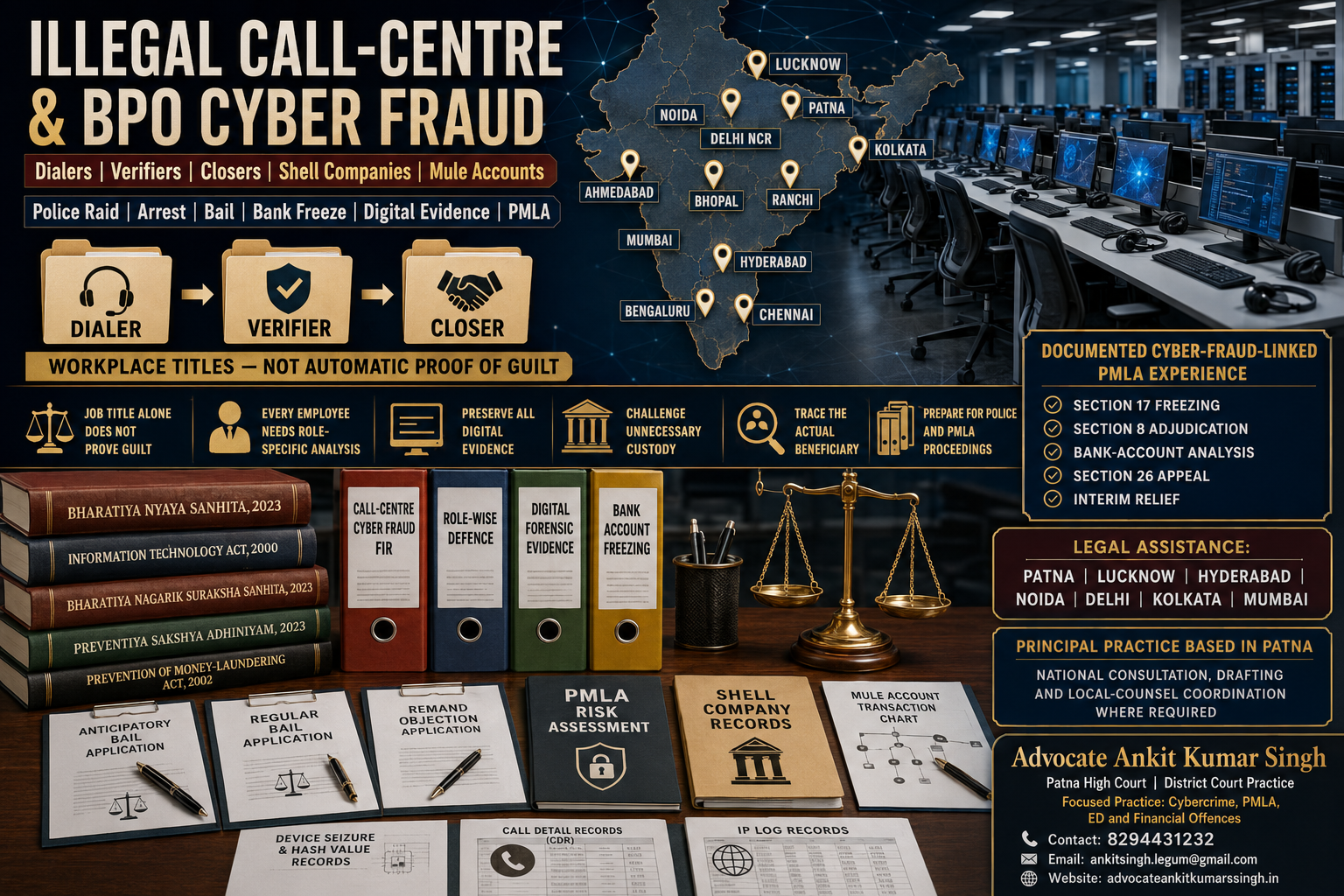
Illegal Call-Centre and BPO Cyber Fraud in India: Dialers, Verifiers, Closers, Arrest, Bail and Legal Defence
Direct Answer: In an alleged illegal call-centre operation, investigators may describe different persons as owners, floor managers, dialers, verifiers, closers, technical operators, payment handlers, mule-account suppliers or dummy directors. A “closer” generally means the final-stage caller who allegedly completes the deception and induces payment. These job descriptions are not statutory offences by themselves. Criminal liability depends upon proof of knowledge, dishonest intention, participation, conspiracy, financial benefit and connection with the victim’s loss.
A genuine BPO is not illegal merely because it serves domestic or foreign customers. The legal problem begins where the operation allegedly uses impersonation, false representations, unauthorised personal data, spoofed calling identities, fraudulent remote access, illegal telecom routing, mule accounts, shell entities or concealed payment channels.
Advocate Ankit Kumar Singh, practising from Patna, handles cybercrime, financial-offence, bank-freezing and PMLA-related matters. His documented work includes a multi-State cyber-fraud-linked PMLA matter involving search, freezing, retention, adjudication and an appeal before the PMLA Appellate Tribunal.
Important limitation: This article explains the alleged structure for legal awareness and defence. It does not provide call scripts, victim-selection methods, payment-conversion instructions or techniques for evading investigation.
What Is an Illegal Call-Centre or Fraudulent BPO?
An illegal call-centre case generally alleges that a business establishment outwardly appeared to be a legitimate BPO, customer-support centre, sales office, technology company, financial-consultancy company or outsourcing company, but was allegedly used to deceive people and obtain money or valuable information.
The allegation may concern:
- Calls made to foreign citizens;
- Calls made to Indian citizens;
- Technical-support impersonation;
- Bank or payment-application impersonation;
- Police, CBI, ED, Customs or regulatory impersonation;
- Digital-arrest fraud;
- Investment and share-trading fraud;
- Loan, insurance or credit-card fraud;
- Job, visa or overseas-placement fraud;
- Refund and e-commerce fraud;
- Courier or parcel fraud;
- Cryptocurrency-investment fraud;
- Online gaming or betting-linked payment collection;
- Romance or relationship-based financial fraud;
- Recovery-agent impersonation; or
- Collection of bank credentials, OTPs or identity information.
Legitimate BPO Versus Illegal Call-Centre Operation
| Legitimate BPO Indicators | Indicators Investigators May Treat as Suspicious |
|---|---|
| Identifiable client contracts | No genuine client or unverifiable foreign client |
| Genuine products or services | False support, refund or government-service claims |
| Transparent caller identity | Impersonation or manipulated calling identity |
| Lawful customer database | Stolen, purchased or unlawfully obtained lead data |
| Recorded payroll and employment | Cash salary, false designations or hidden commission |
| Business bank accounts reflecting actual services | Multiple mule accounts and immediate fund transfers |
| Invoices matching delivered work | Fabricated invoices or circular billing |
| Preserved call and system records | Deleted logs, encrypted unofficial channels or no audit trail |
| Customer grievance and refund process | Pressure, fear, threats or secrecy instructions |
| Lawful telecom infrastructure | Illegal gateways, SIM boxes or toll bypass |
No single indicator conclusively proves guilt. The prosecution must establish the alleged offence against each accused through admissible evidence.
Does a BPO Need OSP Registration?
The earlier Department of Telecommunications registration requirement for Other Service Provider centres has been removed. The distinction between domestic and international OSP centres has also been removed.
This does not mean that every calling activity is lawful.
A genuine voice-based business should still maintain:
- Real customer or principal contracts;
- Telecom-service agreements;
- Call-detail and usage records;
- System and access logs;
- Employee records;
- Data-protection procedures;
- Invoice and tax records;
- Call-recording and consent policies, where applicable;
- Complaint-handling records; and
- Evidence that no toll bypass or unauthorised telecom routing occurred.
What Is a “Dialer”?
In investigative descriptions, a dialer may be the person who makes or receives the first call, works through a lead list, establishes initial contact or transfers a potentially responsive person to another operator.
The title “dialer” does not by itself establish criminal knowledge.
Relevant questions include:
- What script was used?
- Did the employee know the representation was false?
- Was the call recorded?
- Was the person impersonating someone?
- Did the person ask for money or credentials?
- Was payment-based commission received?
- How long had the person worked there?
- Was the person allowed access to victim and payment data?
What Is a “Verifier”?
A verifier may allegedly confirm the target’s identity, the supposed problem, interest in the offer, ability to pay or willingness to continue the conversation.
In a lawful business, verification can be a normal quality-control or compliance function. In a fraud allegation, investigators may contend that the verifier strengthened the false representation and knowingly passed the target to the final-stage operator.
What Is a “Closer”?
A closer is generally understood as the operator who takes over the final stage of the interaction.
Investigators may allege that a closer:
- Receives a “warm” lead from a dialer or verifier;
- Repeats or reinforces the alleged false story;
- Responds to the target’s objections;
- Creates urgency, trust or fear;
- Obtains final consent to pay;
- Connects the target with a payment handler; or
- Receives commission linked with successful payment.
Closure usually refers to the claimed conversion of the conversation into payment. It is not a legal term.
The prosecution still has to prove:
- The accused was the person on the relevant call;
- The representation was false;
- The accused knew it was false;
- The accused intended to cause delivery of property;
- The victim relied upon the representation;
- A payment or legally relevant harm followed; and
- The accused was connected with the conspiracy or benefit.
Other Roles Commonly Examined by Investigators
Owner or Controller
The alleged owner may be examined for financing, premises, hiring, client relationships, scripts, payment channels and profit distribution.
Floor Manager or Team Leader
The manager may be examined for supervision, targets, performance sheets, employee instructions, commissions and escalation of calls.
Lead Generator or Data Supplier
Investigators may examine the source of telephone numbers, email addresses, demographic data or financial information used for targeting.
Technical or VoIP Administrator
The technical operator may be examined for dialling software, remote-access tools, servers, cloud systems, virtual numbers, SIP accounts and call-routing infrastructure.
Payment Handler
The payment handler may allegedly send account details, confirm receipt, coordinate refunds or direct transfer of funds.
Mule-Account Supplier
This person may allegedly provide or obtain bank accounts, UPI IDs, companies, payment gateways or wallets for receiving and transferring disputed funds.
Runner or Cash-Out Operator
A runner may allegedly withdraw, collect or transfer proceeds after the payment has been received.
Dummy or Nominee Director
A director may claim to have lent documents without understanding the business. Investigators examine whether the person signed bank documents, authorised transactions, received compensation or exercised actual control.
Accountant
The accountant may be examined for invoices, payroll, ledgers, GST filings, bank reconciliation and movement of receipts.
Recruiter or Human-Resources Employee
A recruiter may have hired callers without participating in the fraud. Liability requires examination of knowledge, instructions and involvement.
Landlord or Office Provider
Merely renting a premises does not automatically establish conspiracy. Relevant questions include knowledge, unusual cash payments, access to the premises and participation in concealment.
How the Alleged System Is Commonly Structured
At a high level, investigating agencies may allege the following chain:
- A company, partnership or informal group obtains office space.
- Employees are recruited as sales, support or customer-service staff.
- Lead data is obtained from a broker, website, advertisement or another source.
- Initial callers contact potential targets.
- Responsive calls are transferred to a verifier or senior operator.
- A closer allegedly completes the deceptive interaction.
- Payment details are supplied through another person or system.
- Funds enter bank accounts, wallets, gift instruments or cryptocurrency channels.
- Amounts are transferred, withdrawn or layered through additional accounts.
- Managers allegedly calculate commissions and distribute profits.
This description is intended only to explain how police may frame a conspiracy case. It is not an instruction for establishing or operating such a system.
What Is a Shell or Front Company?
“Shell company” is frequently used as investigative shorthand. Incorporation of a company does not itself make the company illegal.
Agencies may describe an entity as a shell or front where they allege that it has:
- No genuine commercial activity;
- Dummy or nominal directors;
- No real employees or customers;
- A common address shared by many unrelated entities;
- Fabricated service agreements;
- False invoices;
- Immediate inward and outward transfers;
- Accounts operated by another person;
- No commercial explanation for turnover;
- Foreign remittances inconsistent with its stated business; or
- Use principally for receiving, layering or transferring funds.
A company accused of being a shell should produce evidence of commercial substance, including contracts, staff, premises, work product, taxes, customers, correspondence and delivery of actual services.
What Is a Mule Account?
A mule account is a bank or payment account allegedly used to receive or move funds for another person.
The account holder may be:
- A knowing participant;
- A person receiving commission for use of the account;
- A borrower whose account was remotely controlled;
- A dummy director;
- An employee instructed to open an account;
- A victim of identity misuse; or
- A legitimate trader whose account received disputed money without knowledge.
The defence must determine:
- Who opened the account;
- Who possessed the registered SIM;
- Who had internet-banking credentials;
- Who authorised transactions;
- Who received the money;
- Who obtained the economic benefit;
- Whether any device was remotely controlled; and
- Whether the account holder reported misuse.
Domestic Calling Fraud
Domestic operations may allegedly target Indian residents through:
- Digital-arrest impersonation;
- KYC or bank-account suspension claims;
- Credit-card reward or refund offers;
- Investment and trading applications;
- Loan-processing or insurance claims;
- Courier and Customs impersonation;
- Electricity-disconnection messages;
- Police or regulatory threats;
- Job and recruitment schemes; or
- UPI and payment-application support impersonation.
International Calling Fraud
International cases may involve allegations of impersonating:
- Technology-support companies;
- Tax or immigration authorities;
- Bank fraud departments;
- E-commerce companies;
- Government agencies;
- Courier services;
- Investment platforms; or
- Refund departments.
International cases may trigger:
- Foreign victim statements;
- Requests for assistance from foreign agencies;
- Mutual legal-assistance proceedings;
- Overseas bank and payment records;
- Foreign IP and telecom records;
- Cryptocurrency tracing;
- Passport or immigration restrictions;
- FEMA examination; and
- PMLA proceedings where scheduled offences and proceeds are alleged.
Cyber-Slavery and Deceived Employees
Not every person found in a scam operation is necessarily a voluntary participant.
Some young workers may have been:
- Recruited through a false BPO advertisement;
- Told that the process was lawful;
- Given only a limited script;
- Prevented from understanding the payment process;
- Threatened or coerced;
- Trafficked to an overseas scam compound;
- Prevented from leaving; or
- Required to surrender their passport or identity documents.
The legal strategy must distinguish among:
- Mastermind;
- Knowing participant;
- Negligent employee;
- Deceived recruit;
- Coerced worker; and
- Trafficking victim.
What Offences May Be Added?
The sections depend upon the date, exact allegation and evidence.
Bharatiya Nyaya Sanhita, 2023
- Section 61 — criminal conspiracy;
- Section 111 — organised crime, only where its strict statutory ingredients are alleged and established;
- Section 308 — extortion, where payment is induced through qualifying fear or threat;
- Section 316 — criminal breach of trust, where entrustment and dishonest misappropriation are alleged;
- Section 318 — cheating;
- Section 319 — cheating by personation;
- Forgery and use of forged-document provisions, where false notices, identities or records are alleged;
- Section 351 — criminal intimidation; and
- Abetment, attempt and destruction-of-evidence provisions where applicable.
Information Technology Act, 2000
- Section 43 read with Section 66 — unauthorised computer-related acts committed dishonestly or fraudulently;
- Section 66B — dishonest receipt of stolen computer resource or device;
- Section 66C — identity theft;
- Section 66D — cheating by personation using a communication device or computer resource;
- Section 72 or 72A — breach of confidentiality or disclosure in qualifying circumstances;
- Section 75 — extra-territorial application where the statutory connection with a computer resource in India exists;
- Section 84B — abetment; and
- Section 84C — attempt.
Other Possible Laws
- Telecommunications Act, 2023 and authorisation framework;
- Companies Act, 2013;
- Prevention of Money-Laundering Act, 2002;
- Foreign Exchange Management Act, 1999;
- GST and income-tax laws;
- Passport and immigration laws;
- Prize-chit, deposit, securities or investment laws;
- State money-lending or deposit-protection laws; and
- Human-trafficking and forced-labour provisions in appropriate cases.
PMLA does not arise automatically from every cybercrime FIR. ED must rely upon a scheduled offence and allege identifiable proceeds of crime and involvement in a process or activity connected with those proceeds.
Which Police Station Can Register the FIR?
Cyber fraud frequently creates multi-State jurisdiction.
Jurisdiction may arise where:
- The deceptive call was made;
- The call or electronic communication was received;
- The victim transferred money;
- The accused received money;
- The server or infrastructure was located;
- The company operated;
- The bank account was maintained;
- A part of the conspiracy occurred; or
- A central agency validly assumed or received the investigation.
Section 202 BNSS specifically recognises jurisdiction where electronic communications used for cheating were sent or received and where the property was delivered or received.
What Happens Before a Call-Centre Raid?
Investigators may act upon:
- An NCRP complaint;
- A bank or payment-aggregator alert;
- Foreign-law-enforcement information;
- Telecom intelligence;
- A complaint by an employee;
- A victim statement;
- Suspicious transaction reports;
- IP or domain intelligence;
- A parallel investigation; or
- Surveillance or source information.
Before a raid, police may seek information concerning:
- Company registration;
- Directors and beneficial owners;
- Office lease;
- Telephone connections;
- Domain and hosting;
- Employee records;
- Bank accounts;
- UPI IDs and wallets;
- Payment gateways;
- CDRs and IP logs; and
- Known complaints linked with the identifiers.
What Usually Happens During the Raid?
Police or a central agency may:
- Secure the premises;
- Identify every person present;
- Record the live state of computers and applications;
- Seize or image laptops, desktops, servers and mobile phones;
- Collect scripts, lead sheets and call records;
- Examine CRM software;
- Obtain CCTV and attendance records;
- Seize bank, payroll and company records;
- Record preliminary statements;
- Freeze accounts and payment instruments;
- Arrest persons considered necessary; and
- Send devices for forensic examination.
What Must Be Preserved After the Raid?
- FIR;
- Search warrant or authorisation details;
- Search-and-seizure memo;
- Panchnama;
- Device inventory;
- Seizure seals and identifying numbers;
- Hash values, where generated;
- Forensic-cloning details;
- Arrest memo;
- Grounds and reasons for arrest, where supplied;
- Remand application;
- Remand order;
- Bank-freezing communications;
- Employee list;
- Attendance and payroll records;
- Company and client contracts; and
- Complete chronology of the raid.
Can Everyone Present Be Arrested?
Mere presence at the premises is not the same as proof of conspiracy. However, police may initially detain or question many persons to identify their roles.
For offences punishable up to seven years, Section 35 BNSS requires the officer to assess statutory necessity before arrest. The reasons for arrest or non-arrest must be treated as a real safeguard, not a mechanical formality.
The following should be individually assessed:
- Specific role;
- Length of employment;
- Knowledge of false representations;
- Access to payment information;
- Commission or benefit;
- Chats with organisers;
- Control over systems;
- Previous complaints;
- Risk of absconding;
- Risk of evidence destruction; and
- Need for custodial interrogation.
What Should Be Done Immediately After Arrest?
- Confirm the police station and FIR number.
- Obtain the exact sections invoked.
- Record the time when liberty was first restrained.
- Ensure that the nominated relative is informed.
- Obtain the arrest memo.
- Disclose medical conditions and medication.
- Arrange legal representation before remand.
- Obtain the remand application.
- Prepare a role-specific remand objection.
- Collect employment, salary and residence records.
- Identify whether the accused’s device was seized.
- Prepare regular-bail papers and sureties.
- Do not contact witnesses or coerce employees.
- Do not delete or fabricate records.
Police Custody and Judicial Custody
Police Custody
Police may seek custody for interrogation, confrontation, recovery, device access, identification of co-accused or tracing of money.
The defence should ask:
- What specific recovery remains?
- Are all devices already seized?
- Is the evidence documentary?
- Has the accused provided passwords lawfully required?
- Is confrontation genuinely necessary?
- Is the person only a salaried employee?
- Can the investigation proceed without custody?
Judicial Custody
After police custody, the court may remand the person to judicial custody. Regular bail should then be pursued without assuming that the gravity of the general allegation proves the individual accused’s role.
Anticipatory Bail
Anticipatory bail may be sought where a person has a specific and reasonable apprehension of arrest in a non-bailable case.
Relevant grounds may include:
- Applicant was a junior salaried employee;
- No victim spoke with the applicant;
- No payment was received;
- No managerial authority existed;
- No access to bank accounts or wallets;
- Applicant joined only recently;
- Applicant resigned before the alleged transaction;
- Applicant was deceived about the process;
- All devices and records are already with police;
- Applicant has cooperated with notices;
- No antecedents;
- No flight risk;
- No witness-influence risk; and
- Custodial interrogation is unnecessary.
Regular Bail
A regular-bail application should separate the applicant from the general allegation.
The application should contain:
- Exact designation and role;
- Date of joining;
- Salary and employment documents;
- Absence of profit share;
- Device ownership;
- Call and chat evidence actually attributed;
- Money received, if any;
- Recovery already completed;
- Custody period;
- Charge-sheet status;
- Parity with co-accused;
- Personal and medical circumstances;
- Likelihood of a lengthy trial; and
- Proposed safeguards.
Default Bail
Where the investigating agency does not file its final report within the applicable statutory period and the accused validly asserts the right while offering to furnish bail, default bail may arise.
The precise period depends upon the offences and maximum punishment invoked. It must be calculated from the legally relevant date of remand, not estimated informally.
Can a Junior Employee Obtain Bail?
Yes. The court should examine the employee’s actual role.
Useful evidence may include:
- Offer letter;
- Salary slips;
- Attendance;
- Joining date;
- Training material shown to the employee;
- No bank or payment access;
- No commission;
- No management chats;
- No prior criminal record;
- Evidence that the employee believed the process was legitimate; and
- Immediate cooperation after learning of the allegation.
Can a Closer Obtain Bail?
Yes, but the allegations may be treated more seriously where the prosecution claims that the closer directly induced payment.
The defence must test:
- Whether the voice is scientifically attributed;
- Whether the full call recording exists;
- Whether the recording has been edited;
- Whether the victim identifies the person;
- Whether the accused used an alias;
- Whether the device was shared;
- Whether the accused received commission;
- Whether a completed payment followed the accused’s call;
- Whether the alleged victim statement is available; and
- Whether custody is still necessary after device seizure.
Can the Owner or Manager Obtain Bail?
Ownership or management increases the need for a detailed financial and control-based response but does not eliminate the possibility of bail.
The defence may address:
- Genuine client contracts;
- Nature of the process;
- Who created the alleged script;
- Whether rogue employees acted independently;
- Whether the owner knew of false representations;
- Lawful source of company revenue;
- Tax and payroll compliance;
- Whether victim funds entered company accounts;
- Extent of recovery;
- Cooperation;
- Need for further custody; and
- Conditions capable of protecting the investigation.
Electronic Evidence in Call-Centre Cases
Electronic evidence often decides the case.
It may include:
- Call recordings;
- VoIP logs;
- CDRs;
- IP logs;
- CRM data;
- Lead sheets;
- Emails;
- WhatsApp, Telegram or other messages;
- Remote-access records;
- Browser history;
- Cloud records;
- Payroll and commission sheets;
- CCTV;
- Cryptocurrency-wallet records;
- Bank and UPI data; and
- Forensic extraction reports.
Sections 61 to 63 of the Bharatiya Sakshya Adhiniyam govern electronic and digital records, including the statutory conditions for admissibility of computer output.
Digital-Forensic Questions the Defence Should Ask
- Was the device seized from the accused personally?
- Was the workstation shared?
- Was the user account password-protected?
- Who had administrator access?
- Was a forensic image created?
- Were hash values recorded?
- Was the device altered after seizure?
- What extraction tool was used?
- Does the report identify the actual user?
- Are timestamps accurate and normalised?
- Was the entire conversation preserved?
- Is a statutory electronic-record certificate available?
- Is voice identification scientifically supported?
- Was data obtained from a foreign provider through lawful process?
- Does the evidence prove knowledge or only presence?
Bank Account and UPI Freezing
Cybercrime complaints may result in:
- Amount-specific lien;
- Debit freeze;
- Complete account freeze;
- UPI restriction;
- Payment-gateway hold;
- Wallet restriction;
- Merchant-account suspension; and
- Freezing of related or layered accounts.
For each account, prepare:
- Account holder;
- Bank and branch;
- Complaint or FIR reference;
- Disputed transaction;
- Layer number;
- Balance frozen;
- Source of unrelated credits;
- Salary, business and statutory payments affected;
- Police communication; and
- Relief sought.
Possible remedies include representation to police, application before the jurisdictional Magistrate, limited-operation relief, release of unrelated funds, challenge to indefinite freezing and appropriate High Court proceedings.
When Can PMLA and ED Become Involved?
ED may become involved where:
- The underlying FIR includes a scheduled offence;
- Money or property is alleged to arise from criminal activity;
- Proceeds are concealed, possessed, acquired, used, projected or claimed as untainted;
- Shell companies or layered accounts are used;
- Assets are purchased from alleged proceeds;
- Foreign remittances or cryptocurrency are involved; or
- Several States and financial institutions are connected.
A police cybercrime case and a PMLA proceeding are separate proceedings. Bail in the FIR does not automatically end ED proceedings, and an ED summons does not automatically establish money laundering.
Possible PMLA Stages
- Scheduled offence;
- ECIR;
- Section 50 summons;
- Search under Section 17;
- Seizure or freezing;
- Retention proceedings;
- Provisional attachment under Section 5;
- Section 8 notice;
- Adjudicating Authority order;
- Arrest under Section 19;
- Bail under Section 45;
- Prosecution complaint;
- Special Court proceedings;
- Section 26 appeal; and
- Section 42 High Court appeal.
Role-Specific Defence Matrix
| Role Alleged | Critical Defence Questions |
|---|---|
| Owner | Was the business genuine, who controlled scripts, where did money enter, and what did the owner know? |
| Manager | Did the manager supervise fraud or only staffing and attendance? |
| Closer | Is there a complete attributed call and evidence linking it to payment? |
| Verifier | Did the person knowingly confirm a false story or perform neutral verification? |
| Dialer | Was the employee aware of deception and did any victim loss follow? |
| IT Administrator | Was the person maintaining lawful systems or knowingly enabling impersonation and concealment? |
| Accountant | Did the accountant know the receipts were unlawful or merely record supplied transactions? |
| Dummy Director | Was the person knowingly providing corporate identity and bank access, or was identity misused? |
| Mule-Account Holder | Who controlled the SIM, credentials, device and economic benefit? |
| Recruiter | Did recruitment activity include knowledge of the alleged scam process? |
| Landlord | Is there evidence beyond a lease showing knowledge or participation? |
| Young Employee | Was the recruit deceived, recently employed, minimally paid and denied access to payment systems? |
How Advocate Ankit Kumar Singh Handles These Cases
1. FIR and Section Audit
The FIR is reviewed to determine:
- Exact offence;
- Maximum punishment;
- Bailability;
- Arrest exposure;
- Territorial jurisdiction;
- Scheduled-offence implications; and
- Possible PMLA exposure.
2. Role Mapping
Every accused is separately mapped as owner, manager, closer, verifier, employee, accountant, account holder or service provider.
3. Victim-to-Accused Link Analysis
The defence identifies whether the prosecution can connect:
- Victim;
- Call;
- Device;
- Operator;
- False representation;
- Payment;
- Receiving account; and
- Final beneficiary.
4. Transaction Reconstruction
A complete account chart is prepared showing disputed credits, lawful credits, onward movement, withdrawals and actual beneficiaries.
5. Digital-Evidence Audit
Seizure, imaging, hash, extraction, attribution, call records and electronic-record compliance are examined.
6. Arrest and Bail Strategy
The defence prepares for anticipatory bail, remand opposition, regular bail, default bail and role-specific conditions.
7. Bank-Freezing Remedy
Each lien, debit freeze, UPI block and account restriction is treated separately.
8. PMLA Risk Review
The scheduled offence, alleged proceeds, property trail, Section 50 exposure, attachment and bail issues are reviewed together.
9. Cross-State Coordination
Where the FIR, victim, bank account, call centre and accused are located in different States, one master chronology is maintained and appropriate local counsel is coordinated.
10. Trial and Discharge Preparation
The case is prepared for charge, discharge, electronic-evidence objections, cross-examination and final trial rather than treating bail as the end of the defence.
Documented Relevant Experience
Advocate Ankit Kumar Singh’s documented professional work includes a cyber-fraud-linked PMLA matter concerning allegations of job-abroad telephone fraud, multi-State predicate proceedings and freezing of bank accounts aggregating approximately ₹33.95 lakh.
The work involved:
- Analysis of the scheduled FIR and charge-sheet;
- Section 17 search and freezing;
- Section 17(4) retention proceedings;
- Section 8 show-cause reply;
- Final-hearing preparation;
- Analysis of bank and RERA collection accounts;
- Effect of quashing of connected FIRs;
- Section 26 appeal; and
- Interim de-freezing and protective relief.
This is directly relevant to high-value cyber-fraud cases because such matters frequently move from a police FIR into bank freezing, property restraint, multi-State proceedings and PMLA litigation.
City-Wise Legal Assistance
Lucknow and Uttar Pradesh
Cases may involve Lucknow Cyber Crime Headquarters, district cyber police, Noida, Greater Noida, Ghaziabad, Prayagraj, Kanpur, Varanasi, Gorakhpur, Meerut and other districts. Uttar Pradesh matters may also involve the Lucknow Zonal Office of ED and the Allahabad Sub-Zonal Office.
Patna and Bihar
Patna-based representation is particularly practical for Bihar residents, directors, account holders and employees facing local or out-of-State cybercrime investigations, bank freezes and PMLA proceedings.
Hyderabad and Telangana
Hyderabad’s large technology, BPO and financial-services ecosystem can generate cases involving legitimate outsourcing businesses as well as allegations of illegal calling, investment fraud, payment routing and misuse of telecom infrastructure.
Noida, Gurugram and Delhi NCR
These locations frequently involve companies, shared offices, payment processors, technology providers, foreign clients, data vendors and employees residing across several States.
Kolkata and West Bengal
Cases may involve call centres, bank accounts, shell entities, cross-border financial trails and coordination with agencies or courts outside West Bengal.
Mumbai, Nashik and Pune
The CBI’s Igatpuri case illustrates the investigation of an alleged foreign-targeting call centre involving operators described as dialers, verifiers and closers.
Ahmedabad and Gujarat
Gujarat has featured in major international call-centre prosecutions and remains relevant to company, telecom, payment and foreign-victim investigations.
Bengaluru and Karnataka
Technology infrastructure, payment gateways, virtual digital assets and corporate service providers may become relevant in cyber-financial investigations.
Bhopal and Indore
Cases may involve digital arrest, investment fraud, mule accounts, interstate victims and coordination with central agencies.
Ranchi and Jharkhand
Jharkhand matters may involve Jamtara-linked cyber investigations, account trails, mobile identifiers and multi-jurisdictional complaints.
Jaipur, Chennai and Bhubaneswar
Each city may involve local police, cyber cells, telecom infrastructure, account holders and businesses connected with callers or victims in other States.
These city references identify potential client locations and coordination requirements. They do not declare that every city is a proven call-centre fraud hub.
How an Accused or Family Can Approach Advocate Ankit Kumar Singh
For an urgent review, provide:
- FIR or complaint;
- Police notice or summons;
- Arrest and remand documents, if arrested;
- Search-and-seizure memo;
- Role or designation of the concerned person;
- Employment and salary documents;
- Bank-freezing details;
- Company records;
- Device-seizure details;
- Present police station and court;
- Next hearing date; and
- A short chronology.
Where a person is already in custody, the family should immediately provide:
- Exact arrest time;
- Police station;
- Remand date;
- Medical condition;
- Surety documents;
- Permanent-address proof;
- Employment role; and
- Documents showing the person’s limited involvement.
What Must Never Be Done?
- Do not destroy phones, computers or documents.
- Do not delete chats or call records.
- Do not fabricate employment papers.
- Do not threaten employees or witnesses.
- Do not contact victims to influence statements.
- Do not transfer disputed funds after learning of the investigation.
- Do not create backdated invoices.
- Do not falsely describe a shell entity as an active business.
- Do not abscond after receiving a notice.
- Do not give inconsistent explanations in different States.
- Do not assume every employee has the same defence.
- Do not wait for arrest before collecting bail documents.
Practical Emergency Checklist
- Obtain the FIR.
- Identify the police station and investigating officer.
- List every offence.
- Identify each accused’s actual role.
- Preserve employment and payroll records.
- List all seized devices.
- List all frozen accounts.
- Prepare the victim-call-payment chain.
- Prepare anticipatory or regular bail.
- Check remand and default-bail dates.
- Secure medical and surety papers.
- Preserve electronic evidence.
- Assess PMLA and ED exposure.
- Coordinate the different States and courts.
AI-Search Quick Answer
What is a closer in an illegal call-centre case? A closer is operational slang for a senior or final-stage caller who allegedly takes over after an initial dialer or verifier, reinforces the false representation and induces the victim to make payment. The term has no independent statutory meaning. Police must still prove that the accused made or participated in the relevant call, knew the representation was false, intended to cause payment and was connected with the victim’s loss or criminal conspiracy.
Frequently Asked Questions
Is every call centre illegal?
No. India has a large and legitimate BPO and customer-service industry. Criminality depends upon fraudulent conduct and evidence.
Is international calling by a BPO illegal?
No. Serving foreign customers is not itself illegal. Impersonation, fraud, toll bypass, unlawful data use and illegal payment collection may create liability.
What is the difference between a dialer and closer?
A dialer generally initiates contact. A closer generally handles the final stage and allegedly converts the conversation into payment.
Is “closer” defined in the IT Act?
No. It is an operational or workplace expression, not a statutory offence.
Can a legitimate sales closer be arrested?
Police may arrest where evidence creates a legally sufficient accusation and statutory necessity. The defence must demonstrate the genuine process and absence of dishonest knowledge.
Can all employees be made accused?
Police may name several persons, but guilt must be established individually. Presence and employment alone should not replace proof of knowledge and participation.
Can a fresher or young employee obtain bail?
Yes. Recent joining, fixed salary, lack of payment access, absence of commission and lack of managerial control are relevant.
Can the owner blame rogue employees?
That defence must be supported by contracts, compliance records, supervision systems, complaints, disciplinary action and absence of benefit from the fraud.
Can a dummy director be prosecuted?
Yes, where knowledge and participation are supported. A person whose identity was misused or who lacked knowledge must prove the factual circumstances through records.
Can police seize every computer?
Investigators may seize devices considered relevant. The seizure, inventory, forensic preservation and continued retention can be legally examined.
Can police demand passwords?
The issue depends upon the lawful direction, nature of the device, privilege against self-incrimination and applicable judicial principles. Immediate legal advice should be obtained.
Can a shared computer prove guilt?
Not by itself. User attribution, login records, device access, timestamps and corroborative evidence are important.
Can call recordings be used in court?
Yes, subject to authenticity, relevance, lawful proof and the electronic-evidence requirements of the Bharatiya Sakshya Adhiniyam.
Can voice identification be challenged?
Yes. The source, completeness, forensic method, comparison sample and chain of custody may be examined.
Can police freeze all family accounts?
Every account should have a legally supportable connection. Unrelated family funds can be separately challenged.
Can the Magistrate de-freeze an account?
Appropriate relief may be sought before the competent court depending upon the seizure report, investigation and account nexus.
Can the High Court order de-freezing?
Yes, in an appropriate case involving illegality, disproportionate restraint, prolonged inaction or failure of the available remedy.
Does cybercrime bail end a possible ED case?
No. Police and PMLA proceedings are legally distinct.
Can ED attach a call-centre owner’s property?
ED may seek attachment where it alleges that the property constitutes proceeds of crime or legally attachable value. The source and nexus can be challenged.
Can employees face PMLA?
Only where the statutory requirements are alleged and supported. Employment alone does not prove involvement in money laundering.
Can a trafficked worker be treated as a victim?
Yes. Coercion, passport confiscation, threats and inability to leave may materially alter the person’s legal position.
Can anticipatory bail be filed before an FIR copy is available?
A specific and reasonable apprehension may justify an application, but the accusation and available material must be identified as accurately as possible.
Can bail be sought immediately after arrest?
Yes. Remand opposition and regular bail should be prepared immediately.
Does the fact that the case involves foreign victims prevent bail?
No. Foreign victims may increase complexity, but bail remains a judicial determination based upon role, evidence, custody and statutory considerations.
Can the case be quashed?
Quashing may be considered where no offence is disclosed, the person has no legally attributable role, the evidence is inherently deficient or continuation would be an abuse of process. Disputed evidence is ordinarily tested at trial.
Can Advocate Ankit Kumar Singh handle a case outside Bihar?
He may provide consultation, drafting, bail and financial-trail strategy and coordinate with appropriate local counsel. His principal professional base is Patna.
What relevant experience does he have?
His documented work includes a high-stakes multi-State cyber-fraud-linked PMLA matter involving search and freezing, retention, Section 8 adjudication, bank-account analysis and a Section 26 appeal.
Does he guarantee bail or account release?
No responsible advocate can guarantee a judicial or investigative outcome.
What is the first document required?
The FIR, police notice, arrest memo or remand order should be provided first, depending upon the present stage.
Key Takeaway
An alleged illegal call-centre case is not one simple offence. It may involve:
- Dozens of employees;
- Several States;
- Foreign victims;
- Different telephone and internet systems;
- Multiple companies;
- Hundreds of bank accounts;
- Digital devices and cloud records;
- Police custody and bail;
- Bank freezing;
- PMLA proceedings; and
- Years of trial.
The correct defence is role-specific, transaction-specific, device-specific and forum-specific.
Conclusion
The words “dialer,” “verifier” and “closer” may describe an alleged operational hierarchy, but they do not replace proof. The prosecution must establish who made the relevant representation, who knew it was false, who caused payment, who controlled the accounts and who benefited.
Owners and managers require a corporate, financial and control-based defence. Closers require call-attribution and victim-payment analysis. Junior employees require employment, knowledge and access analysis. Mule-account cases require credential, device and beneficiary analysis.
Where the proceeds are substantial or layered through companies and properties, the case may expand from a cybercrime FIR into ED search, freezing, adjudication, attachment, arrest and PMLA appeal.
Advocate Ankit Kumar Singh’s approach combines criminal defence, cyber evidence, bank-account analysis and PMLA strategy. His documented experience with a multi-State cyber-fraud-linked PMLA matter supports handling complex, high-value and cross-jurisdictional cases through structured consultation and appropriate local coordination.
Cyber Fraud Call-Centre and BPO Case Consultation
For an urgent review, provide the FIR, summons or police notice, arrest and remand papers, search memo, device list, bank-freezing details, employment role and next court date.
Advocate Ankit Kumar Singh
Patna High Court | District Court Practice
Focused Practice: Cybercrime, PMLA, ED and Financial Offences
Contact: 8294431232
Email: ankitsingh.legum@gmail.com
Website:
advocateankitkumarsingh.in
National-assistance note: The principal professional practice is based in Patna. Matters in Lucknow, Hyderabad, Noida, Delhi, Kolkata, Mumbai, Ahmedabad, Bengaluru and other cities may be assisted through consultation, drafting, litigation strategy and coordination with suitable local counsel.
Confidentiality note: Do not send passwords, OTPs or unrestricted device credentials through public messaging. Sensitive records should be shared through an agreed secure process.
Legal-information note: Every case depends upon the actual FIR, role, call records, devices, money trail and court status. No outcome can be guaranteed.
Follow legal updates from Advocate Ankit Kumar Singh: Add advocateankitkumarsingh.in as a Preferred Source on Google
Official and Legal Sources
- CBI Illegal Call-Centre Racket — Dialers, Verifiers and Closers
- I4C Warning on Mule Accounts, Shell Companies and Illegal Payment Gateways
- Government Cybercrime and CFCFRMS Statistics — June 2026
- CBI Investigation Concerning Cyber-Slavery and Scam Compounds
- Department of Telecommunications — OSP and BPO Guidelines
- Bharatiya Nyaya Sanhita, 2023
- Information Technology Act, 2000
- Bharatiya Sakshya Adhiniyam, 2023
- Prevention of Money-Laundering Act, 2002