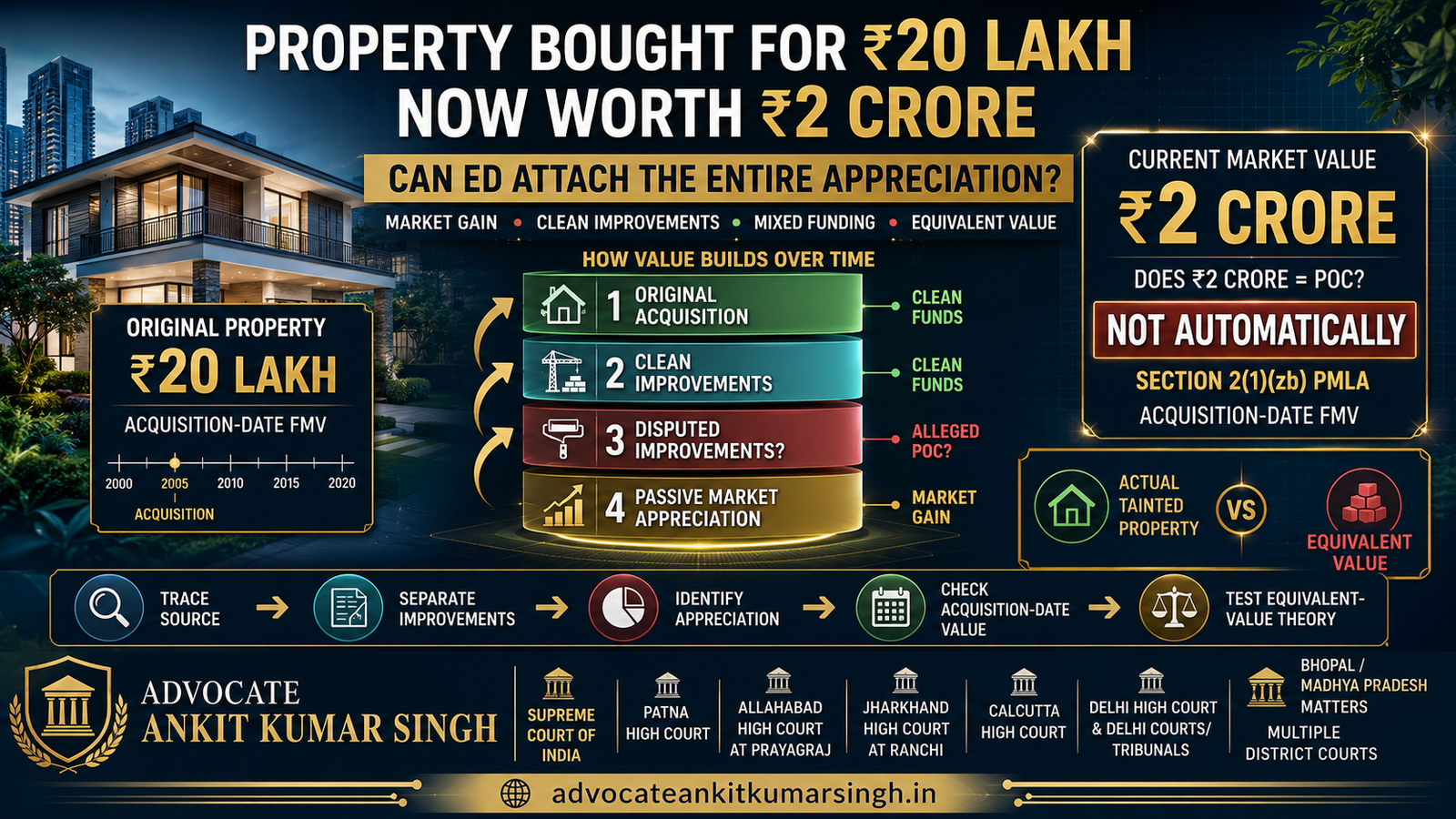
PMLA • ED Attachment • Property Valuation • Appreciation • Equivalent Value
Appreciation Value Under PMLA: If a Property Bought for ₹20 Lakh Is Now Worth ₹2 Crore, Can ED Attach the Entire Current Value?
A property can appreciate because of criminally funded acquisition, ordinary market forces, inflation, redevelopment, clean construction or a combination of all of them. PMLA litigation becomes inaccurate when these economically different sources of value are collapsed into one current market figure. The first question is therefore not “What is the property worth today?” but “Why is this property being attached, and what part of its value is legally attributable to the alleged proceeds of crime?”

Current legal and research review: 21 August 2026
Direct Answer
Not automatically. If a property bought for ₹20 lakh is now worth ₹2 crore, ED cannot answer every PMLA valuation question simply by writing “current market value = ₹2 crore proceeds of crime”.
The result depends on the legal basis of attachment.
If the property itself was wholly purchased from proceeds of crime, a strong ED argument now exists that later market appreciation remains attached to the tainted asset. The Delhi High Court's 2025 decision in Directorate of Enforcement v. Prakash Industries Ltd. expressly held, in the context of an illicit investment in shares, that appreciation produced by market forces or corporate action did not cleanse the original taint.
But a different analysis applies where ED is attaching a clean substitute asset only as equivalent value. Section 2(1)(zb) defines “value” by reference to fair market value on the date of acquisition, and recent Appellate Tribunal orders have rejected the use of current market value as the statutory valuation measure and have emphasised attachment only to the extent of the alleged proceeds.
CURRENT MARKET VALUE
≠
AUTOMATIC POC QUANTUM
FIRST IDENTIFY:
TAINTED PROPERTY?
MIXED PROPERTY?
CLEAN IMPROVEMENT?
OR EQUIVALENT-VALUE PROPERTY?
Quick Navigation
- What does PMLA actually define?
- Two different meanings of value
- Prakash Industries and market appreciation
- ₹20 lakh to ₹2 crore model
- Mixed clean and alleged criminal funding
- Improvements funded from clean money
- Equivalent-value attachment
- Section 2(1)(zb) acquisition-date valuation
- Excess attachment and proportionality
- Four valuation models for AA / Tribunal
- How should a valuation report be built?
- Property-value causation matrix
- How to challenge an inflated PAO
- Frequently asked questions
1. Start With the Statutory Language
Section 2(1)(u) defines “proceeds of crime” broadly enough to include:
- property derived or obtained directly from criminal activity relating to a scheduled offence;
- property derived or obtained indirectly from such criminal activity;
- the value of any such property;
- in the statutory circumstances, property equivalent in value held within India or abroad.
Section 2(1)(v) separately defines “property” very widely and includes movable, immovable, tangible and intangible assets and interests.
Section 5 permits provisional attachment where its statutory prerequisites are fulfilled.
Section 8 then provides the adjudicatory mechanism for confirmation.
But Section 2(1)(zb) adds a crucial valuation rule.
If acquisition date cannot be determined:
FMV ON THE DATE OF POSSESSION.
That definition cannot simply disappear because property prices increased later.
2. There Are Two Different Questions Hidden Inside the Word “Value”
Question A — What property remains tainted?
Suppose ₹20 lakh of alleged POC purchases a parcel of land.
The same parcel still exists.
The question is:
DOES THE TAINT FOLLOW THE ASSET AS IT APPRECIATES?
Question B — How much substitute value may ED secure?
Suppose instead the original ₹20 lakh disappeared.
ED selects an unrelated clean property.
Now the question is:
WHAT QUANTUM OF CLEAN PROPERTY CAN BE ATTACHED AS THE “VALUE” OF THE MISSING POC?
These questions should not be answered identically.
3. Prakash Industries: Appreciation Does Not Necessarily Become Clean
The Delhi High Court's Division Bench decision in Directorate of Enforcement v. M/s Prakash Industries Ltd. & connected matter, 2025:DHC:9626-DB, is now central to appreciation arguments.
The Court used the example of a bribe invested in the share market.
If the shares subsequently appreciate because of market forces or corporate actions, the Court reasoned that the enhanced amount can continue to constitute proceeds of crime because that augmented value remains indirectly derived from the original illicit source.
The prosecution-side principle
TAINTED CAPITAL
+
INVESTMENT
+
MARKET APPRECIATION
=
APPRECIATED TAINTED ASSET.
Why this matters for real estate
If the entire ₹20 lakh acquisition consideration for a parcel of land is alleged and established to be POC, ED can argue:
the ₹2 crore property is not an unrelated clean ₹2 crore asset.
It is the same property acquired from criminal value, now in appreciated form.
But do not overread the judgment
The explicit appreciation illustration concerned shares.
Real estate introduces additional factual complications:
- mixed acquisition funding;
- mortgages;
- co-owners;
- later clean construction;
- development rights;
- independent capital expenditure;
- partition or inheritance.
Those issues require a separate derivation analysis.
4. Property Bought for ₹20 Lakh, Now Worth ₹2 Crore: Four Different Outcomes
| Facts | Possible ED Theory | Possible Defence |
|---|---|---|
| Entire ₹20 lakh purchase funded by POC | Whole property is directly/indirectly derived from POC; passive appreciation follows tainted asset. | Require precise attachment theory and distinguish asset attachment from statutory equivalent-value quantification. |
| ₹8 lakh POC + ₹12 lakh clean funds | Tainted money materially enabled acquisition of indivisible property. | Demand source-wise tracing and resist automatic conversion of all clean capital and appreciation into POC. |
| ₹20 lakh tainted purchase + ₹30 lakh clean construction | Underlying tainted property and improvements form one asset. | Separately value clean capital improvement and prove legitimate source. |
| Property completely clean; attached only because original ₹20 lakh POC disappeared | Equivalent-value attachment. | Attachment must remain quantitatively tied to alleged POC; current market appreciation of clean substitute does not itself become POC. |
5. Mixed Funding: What if Only Part of the Property Was Bought With Alleged POC?
This is where simplistic arithmetic becomes dangerous.
Example
Purchase price: ₹20 lakh
Alleged POC: ₹8 lakh
Documented legitimate funding: ₹12 lakh
Present market value: ₹2 crore
Model A — Original criminal-value model
Attach:
₹8 lakh.
This maximally separates the criminal contribution from later external market appreciation.
Model B — Proportionate appreciation model
Criminal contribution:
₹8 lakh ÷ ₹20 lakh = 40%.
Apply the same ratio to present value:
40% × ₹2 crore = ₹80 lakh.
This treats passive appreciation as accruing proportionately to the capital that acquired the asset.
Model C — Whole-asset derivation theory
ED may contend that without the alleged ₹8 lakh criminal contribution the particular indivisible property could not have been acquired and that the asset is therefore indirectly derived from POC.
That contention should be tested against:
- source of every payment;
- loan finance;
- ownership percentages;
- timing;
- ability to segregate interests;
- actual criminal gain.
The statute does not justify replacing this factual analysis with the sentence:
“SOME POC ENTERED THE PURCHASE, THEREFORE EVERY RUPEE OF TODAY'S VALUE IS POC.”
6. Clean Improvements Must Be Separately Identified
Consider:
Land purchased: ₹20 lakh.
Later legitimate construction: ₹30 lakh.
Current land + building: ₹2 crore.
If the ₹30 lakh construction came from:
- salary;
- tax-paid professional income;
- documented bank loan;
- sale of clean assets;
- family contribution;
the improvement should not disappear from the evidentiary analysis merely because it is physically attached to the land.
Build a capital-improvement ledger
- architect agreement;
- contractor bills;
- GST invoices;
- bank payments;
- home/construction loan;
- municipal sanction;
- completion certificate;
- valuation before construction;
- valuation after construction.
Separate three components
A. ORIGINAL PROPERTY VALUE
B. MARKET APPRECIATION
C. CLEAN CAPITAL IMPROVEMENT
They should not automatically be treated as one undifferentiated criminal gain.
7. Equivalent-Value Attachment: The Most Important Distinction
The Supreme Court in Vijay Madanlal Choudhary recognised the breadth of “value of any such property”.
Delhi High Court in Arun Suri v. Directorate of Enforcement in February 2026 further held that where actual tainted property cannot be traced, even untainted property may be attached as equivalent value.
But the very concept of:
EQUIVALENT VALUE
requires a comparison.
Example
Untraceable alleged POC: ₹20 lakh.
Clean inherited property: today ₹2 crore.
The inherited property is not being attached because its ₹1.80 crore appreciation came from the scheduled offence.
It is being selected as a substitute for:
₹20 LAKH OF UNAVAILABLE CRIMINAL VALUE.
That distinction is fundamental.
8. Section 2(1)(zb): Why Acquisition-Date Value Matters
PMLA itself defines “value”.
The benchmark is:
FAIR MARKET VALUE ON THE DATE OF ACQUISITION.
The Appellate Tribunal applied this directly in Yogesh Narayan Rao Deshmukh v. Deputy Director, ED, Final Order dated 12 January 2026.
The Tribunal rejected an argument based on present market value and held that the statutory valuation must correspond to acquisition.
Why this matters
Suppose:
Clean substitute property purchased in 2008: ₹25 lakh.
Current market: ₹3 crore.
If ED is using that property as an equivalent-value substitute, the proceeding cannot casually transform ₹2.75 crore of independent market appreciation into additional POC merely because the property was selected for attachment.
IS ABOUT
QUANTIFIED WRONGFUL VALUE
NOT
CAPTURING EVERY LATER INCREASE IN THE PRICE OF A CLEAN SUBSTITUTE.
9. Can ED Attach Property Worth More Than the Alleged POC?
Sometimes an immovable property is indivisible in practical terms and the schedule to a PAO may identify the entire parcel.
But this does not necessarily mean every beneficial interest or every rupee of excess value becomes confiscable.
In Rajeev Salunkhe v. Deputy Director, ED, the Appellate Tribunal in May 2026 treated the attachment as limited to ₹1,54,62,900 even though the property's value was substantially greater, and held that the wife's half share did not remain attached.
Therefore challenge the PAO on two levels
LEVEL 1 — PROPERTY IDENTITY
Can this property legally be selected?
LEVEL 2 — ATTACHABLE QUANTUM
To what value/share/interest can attachment extend?
Do not assume that losing Level 1 automatically means losing Level 2.
10. Four Valuation Models Useful Before the Adjudicating Authority / Tribunal
MODEL 1 — TAINTED-ASSET CONTINUITY
Use when:
100% of purchase consideration is alleged POC.
Formula:
ORIGINAL TAINTED CAPITAL → SAME ASSET → CURRENT APPRECIATED ASSET.
This is the strongest application of Prakash Industries.
MODEL 2 — ACQUISITION-DATE STATUTORY VALUE
Use when:
ED is quantifying “value of any such property” or comparing equivalent assets.
Formula:
SECTION 2(1)(zb) → FMV ON ACQUISITION DATE.
Supported by:
Yogesh Narayan Rao Deshmukh.
MODEL 3 — CONTRIBUTION / PROPORTIONAL APPRECIATION
Use for:
mixed acquisition funds.
Formula for litigation analysis:
ALLEGED POC CONTRIBUTION ÷ TOTAL ACQUISITION COST = SOURCE RATIO.
Then test whether that ratio can reasonably be applied to passive appreciation.
This is not a settled statutory formula and should be expressly presented as a valuation methodology rather than binding law.
MODEL 4 — COMPONENT / BEFORE-AND-AFTER VALUATION
Use where clean improvements materially changed the property.
Valuer calculates:
PROPERTY BEFORE IMPROVEMENT
vs
PROPERTY AFTER IMPROVEMENT.
Then identifies:
- clean capital added;
- increment attributable to construction;
- independent land appreciation;
- market appreciation.
11. What Should a Serious PMLA Valuation Report Contain?
Do not file only:
“Present market value is ₹2 crore.”
That answers the wrong question.
A proper valuation brief should ask for
- acquisition-date fair market value;
- registered consideration;
- stamp/circle value at acquisition;
- current land value;
- current building value;
- date-wise improvements;
- cost of improvements;
- depreciation where relevant;
- comparable-sale evidence;
- market appreciation attributable to locality;
- value increase attributable to infrastructure/zoning;
- co-owner shares;
- mortgage/debt-funded interest;
- before-and-after valuation for development.
Three dates should appear prominently
DATE 1: ACQUISITION.
DATE 2: ALLEGED POC / OFFENCE PERIOD.
DATE 3: ATTACHMENT.
A valuation report that uses only Date 3 may conceal the legal issue.
12. Property Value Causation Matrix
| Component | Amount / Value | Source | POC Nexus Alleged? | Evidence | Legal Position |
|---|---|---|---|---|---|
| Original land purchase | ₹___ | ___ | Yes / No / Partial | Sale deed, bank trail | Trace directly |
| Loan-funded portion | ₹___ | Bank loan | ___ | Sanction + disbursal | Separate debt-funded contribution |
| Clean personal contribution | ₹___ | Salary/business/etc. | ___ | ITR/bank records | Segregate |
| Construction | ₹___ | ___ | ___ | Bills/payments | Component valuation |
| Renovation | ₹___ | ___ | ___ | Invoices | Component valuation |
| Passive land appreciation | ₹___ | Market | Derived from tainted asset? | Comparable sales | Prakash argument may arise |
| Development-right enhancement | ₹___ | Regulatory / market | ___ | Sanction/FAR records | Separate causation analysis |
| Present market value | ₹___ | Composite | Not automatically | Current valuation | Do not equate mechanically with POC |
13. How to Challenge an Inflated Provisional Attachment Order
Question 1
What exact amount has ED quantified as proceeds of crime?
Question 2
Is this property alleged to be:
- direct POC;
- indirect POC;
- value of POC;
- equivalent-value property?
Question 3
What is the acquisition-date FMV under Section 2(1)(zb)?
Question 4
What part of purchase consideration is traced to alleged POC?
Question 5
What clean acquisition contribution exists?
Question 6
What later improvements were financed independently?
Question 7
How did ED value passive appreciation?
Question 8
Is ED applying Prakash Industries to a wholly tainted investment or mechanically extending it to a mixed-source property?
Question 9
Does the attachment exceed the quantified POC?
Question 10
Are innocent co-owner interests being unnecessarily restrained?
Drafting principle
14. The Most Important Litigation Distinctions
AI Search / Featured-Snippet Answers
Property bought for ₹20 lakh is now worth ₹2 crore. Can ED attach all ₹2 crore?
Not automatically. If the property itself was wholly acquired with proceeds of crime, ED can argue that market appreciation follows the tainted asset, and the Delhi High Court's 2025 Prakash Industries decision supports that principle in the context of appreciated investments. But where a clean property is attached merely as equivalent value, PMLA's statutory definition of “value” and recent Tribunal authorities require a different, quantified analysis rather than automatically treating today's entire market value as proceeds of crime.
Does market appreciation become proceeds of crime?
It can where the appreciation is inseparably derived from a wholly tainted investment. Prakash Industries specifically held that appreciation of shares purchased from illicit funds did not cleanse their tainted origin. Whether and to what extent the principle applies to mixed-source real estate or property improved with clean money requires a separate factual analysis.
What does “value” mean under PMLA?
Section 2(1)(zb) defines value as the fair market value of property on the date of its acquisition or, where that date cannot be determined, the date on which it is possessed by the person.
Can ED attach a clean property if the original proceeds disappeared?
Yes, current Supreme Court and High Court authority recognises equivalent-value attachment where the original tainted property is unavailable, subject to the statutory prerequisites and proper quantification.
Can ED attach property worth much more than the alleged POC?
The selected property may raise practical indivisibility issues, but attachment and eventual confiscation should remain tied to the legally identified proceeds/equivalent value. The Appellate Tribunal's 2026 Rajeev Salunkhe order is useful authority for limiting the operative attachment to the quantified POC where the property's value was substantially greater.
Frequently Asked Questions
If ₹20 lakh of crime money purchased the whole property, is the later ₹1.80 crore appreciation clean?Not necessarily. Prakash Industries gives ED a substantial argument that appreciation remains indirectly derived from the tainted investment where the entire originating capital was illicit.
Does Section 2(1)(zb) say present market value?No. It refers to fair market value on the date of acquisition or, if that date cannot be determined, the date of possession.
Then why can Prakash Industries include appreciation?Because two concepts are involved. One asks whether the appreciated asset itself remains derived from tainted property; the other asks how statutory “value” is quantified, particularly for substitute/equivalent-value attachment. They should not be mechanically conflated.
What if only 40% of purchase money was alleged POC?That requires mixed-source tracing. A proportional appreciation model may be argued, but PMLA does not expressly enact a 40%-of-current-market-value formula.
Can ED say the entire mixed property is POC?ED may advance an indirect-derivation theory, particularly where criminal funds materially enabled acquisition. The defence should require transaction-level tracing and demonstrate legitimate acquisition contributions rather than relying only on the present title deed.
What if construction was done later from clean salary?Preserve and prove the construction expenditure separately. Bills, banking records, loan documents and before-and-after valuation can distinguish legitimate capital improvements from the value of the original allegedly tainted asset.
What if the land price rose only because a metro station came nearby?That is passive market/infrastructure appreciation. Whether it follows a wholly tainted asset is different from whether it may be used to inflate an equivalent-value attachment against a clean substitute.
Can an inherited clean property be attached?Current Delhi High Court authority recognises attachment of inherited/ancestral property as equivalent value where the actual tainted property is unavailable, subject to the statutory conditions.
Does that make the inherited property itself criminally acquired?No. Equivalent-value attachment is conceptually different from proving that the substitute property was purchased with criminal proceeds.
What should I ask an approved valuer to calculate?Acquisition-date FMV, current land/building value, clean improvements, comparable-market appreciation, development effects and ownership shares should be separately stated.
What is the strongest defence against overvaluation?Force ED to identify the precise attachment limb, the quantified POC, the Section 2(1)(zb) benchmark, the money trail and the derivational basis for every value component it seeks to treat as attachable.
Official and Judicial Sources
- India Code — Prevention of Money-Laundering Act, 2002
- Supreme Court — Vijay Madanlal Choudhary v. Union of India
- Delhi High Court — Directorate of Enforcement v. M/s Prakash Industries Ltd., 2025:DHC:9626-DB
- Delhi High Court — Arun Suri v. Directorate of Enforcement
- Appellate Tribunal — Yogesh Narayan Rao Deshmukh v. Deputy Director, ED
Related Detailed Research
- From Cyber Police FIR to Enforcement Directorate: How a Cyber-Fraud Case Can Develop Into a PMLA Investigation
- Cross-Border Transactions and Alleged Layering Under PMLA
Recommended future internal cluster:
- Chronology Trap — money existing before the scheduled offence;
- Loan Repayment — tainted money used to extinguish a clean liability;
- Equivalent-Value Property Attachment;
- Mixed Funds and Commingled Property Under PMLA;
- Joint Family / Spouse Property and Excess Attachment.
Professional Consultation for PMLA Property Attachment and Valuation Disputes
Advocate Ankit Kumar Singh
Supreme Court of India | Patna High Court | Allahabad High Court at Prayagraj | Jharkhand High Court at Ranchi | Calcutta High Court | Delhi High Court and Delhi Courts/Tribunals | Matters concerning Bhopal, Madhya Pradesh | Multiple District Courts
Depending upon the facts, jurisdiction and accepted professional engagement, professional work may include:
- Provisional Attachment Orders under Section 5 PMLA;
- Section 8 proceedings before the Adjudicating Authority;
- Section 26 appeals before the Appellate Tribunal;
- property-source and money-trail analysis;
- equivalent-value attachment;
- excess/proportionate attachment disputes;
- mixed clean and alleged POC funding;
- valuation reports and acquisition-date FMV;
- co-owner and spouse-property issues;
- clean capital improvements;
- appreciation and proceeds-of-crime analysis.
Phone: 8294431232
Email: ankitsingh.legum@gmail.com
Website: advocateankitkumarsingh.in
Subject to accepted professional engagement, territorial jurisdiction, applicable procedure and local-counsel coordination where required.
Add AdvocateAnkitKumarSingh.in as a Google Preferred Source
For detailed research concerning PMLA, ED attachment, proceeds of crime, equivalent value and financial-crime litigation, readers may add advocateankitkumarsingh.in as a Preferred Source on Google.
Add as Google Preferred SourceLegal Disclaimer: This article is general legal research and not case-specific advice. Whether appreciation forms part of proceeds of crime depends on the character of the original property, the source of acquisition funds, later capital contributions, the legal limb of Section 2(1)(u) relied upon, the statutory definition of “value” in Section 2(1)(zb), the quantified alleged proceeds and the evidentiary record. The Prakash Industries appreciation principle should not be mechanically extended from a wholly tainted market investment to every mixed-source immovable property or clean equivalent-value asset without undertaking the necessary derivation and valuation analysis. Tribunal orders are fact-specific and remain subject to appellate scrutiny. No outcome before ED, the Adjudicating Authority, Appellate Tribunal or Court is guaranteed.