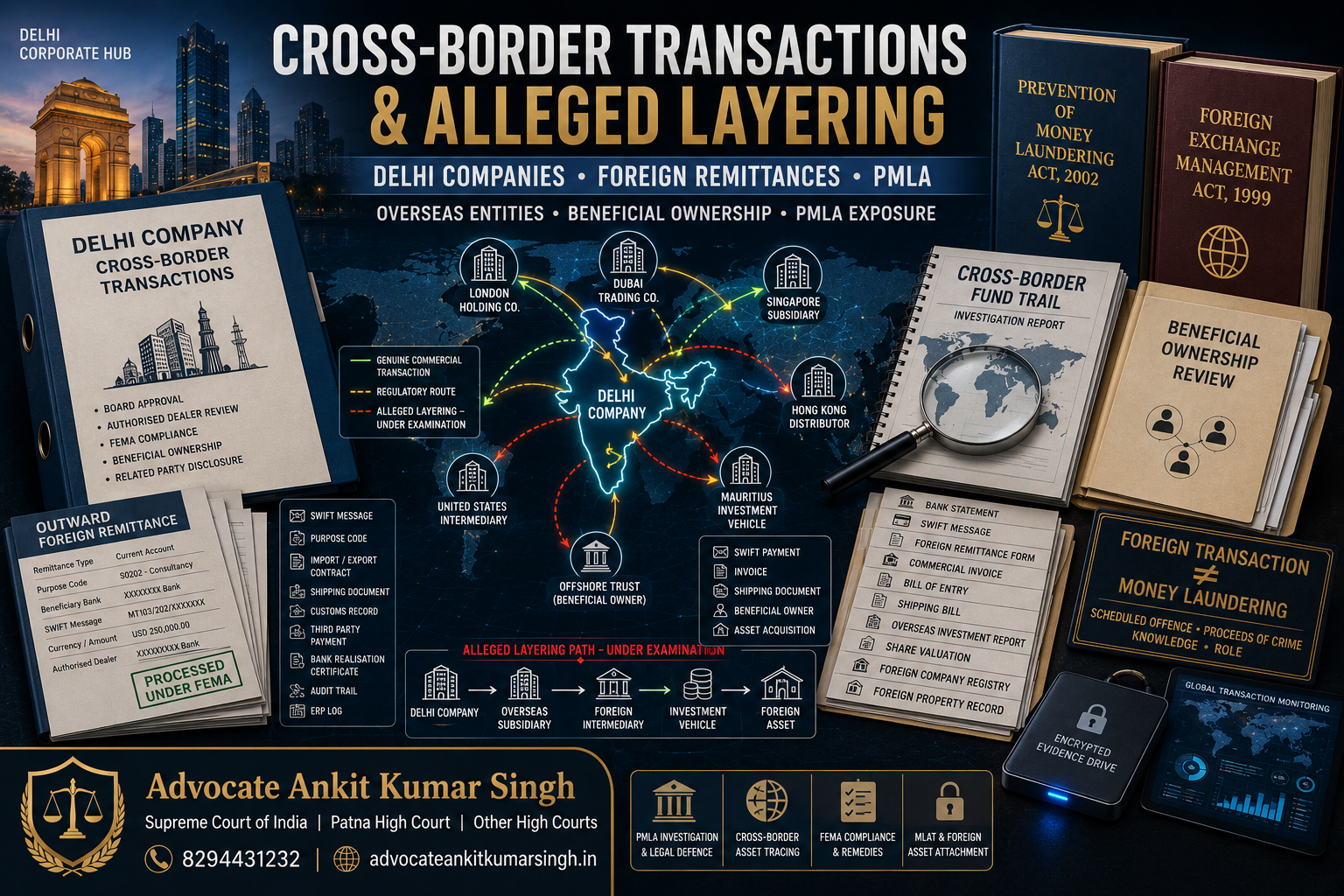
Cross-Border Transactions and Alleged Layering: PMLA Issues for Delhi Companies
Direct Answer: A foreign remittance, payment to an overseas subsidiary, receipt from a foreign investor or international related-party transaction is not money laundering merely because money crosses national borders or moves through more than one company.
PMLA exposure may arise where the Directorate of Enforcement alleges that the transaction involved identifiable proceeds of crime and that the companies, directors, employees, intermediaries or beneficial owners knowingly concealed, possessed, acquired, used, transferred or projected those proceeds as legitimate commercial funds.
In a Delhi-company investigation, ED may combine Indian banking records, SWIFT messages, foreign-remittance applications, customs data, invoices, shipping records, corporate ownership information, overseas-company registries, email communications, device data, statements under Section 50 of the Prevention of Money Laundering Act, 2002 and evidence obtained through international legal-assistance mechanisms.
The legal defence must therefore test each stage separately:
Underlying scheduled offence → generation of proceeds of crime → Indian company’s receipt or control → foreign transfer → overseas recipient → beneficial ownership → subsequent movement → asset acquisition → knowledge and role of each person.
Core legal distinction: A FEMA contravention, accounting irregularity, transfer-pricing dispute, delayed export realisation or breach of an RBI reporting requirement does not automatically constitute money laundering. PMLA requires its own statutory foundation involving criminal activity related to a scheduled offence and identifiable proceeds of crime.
Why Cross-Border Transactions Attract ED Scrutiny
International commercial transactions frequently involve several entities, currencies, contracts, financial institutions and jurisdictions. A genuine transaction may involve:
- An Indian operating company;
- An overseas customer or supplier;
- A foreign holding or subsidiary company;
- A bank in India;
- A correspondent bank outside India;
- A freight forwarder or shipping company;
- A customs broker;
- A payment intermediary;
- A foreign distributor;
- An overseas consultant;
- A corporate trustee;
- A foreign investment vehicle; and
- Ultimate beneficial owners situated in another jurisdiction.
The same structural complexity may be misused to obscure the original source, beneficial owner or final destination of funds. ED may therefore scrutinise transactions where the commercial documents and financial trail do not appear to correspond.
Common investigative questions include:
- Why was money sent outside India?
- Was the transaction permitted under FEMA?
- Were goods or services genuinely supplied?
- Was the overseas recipient related to the Indian company?
- Who ultimately controlled the foreign entity?
- Was the invoice commercially reasonable?
- Did money return to India through another company?
- Was the overseas entity merely a conduit?
- Were foreign assets acquired from the remitted money?
- Did the Indian company disclose the transaction to its bank, auditors and regulators?
- Was the money generated from an independently identifiable scheduled offence?
- Did the concerned director or employee possess the required knowledge?
What Is Alleged “Layering” in a PMLA Investigation?
Layering generally describes the movement of property through multiple transactions, accounts or entities to make its origin, ownership or destination more difficult to identify.
The term is frequently used to describe the intermediate stage between generation of illicit property and its eventual integration into apparently lawful economic activity.
A suspected cross-border structure may be described as:
Indian company → domestic related entity → overseas subsidiary → foreign intermediary → investment vehicle → bank account or asset → return to India as investment, loan, consultancy income or sale proceeds.
Layering may also be alleged where money moves through:
- Several domestic and overseas companies;
- Shell or dormant entities;
- Trusts or foundations;
- Nominee shareholders;
- Third-party bank accounts;
- Merchanting-trade transactions;
- Multiple invoices;
- Foreign securities;
- Insurance or investment-linked policies;
- Real estate;
- Crypto or Virtual Digital Assets;
- Foreign portfolio routes; or
- Apparently independent commercial contracts.
However, “layering” is not a substitute for proving the statutory ingredients of Section 3 of the PMLA.
The agency must still identify:
- The scheduled offence;
- The property derived or obtained from criminal activity relating to that offence;
- The transaction through which the property allegedly moved;
- The role of the person or company concerned; and
- The evidence showing knowing assistance, participation or actual involvement.
Important: The existence of several companies, multiple bank transfers or an offshore jurisdiction may justify closer examination. Those circumstances do not, without supporting evidence, conclusively establish money laundering.
What Is an Offence of Cross-Border Implications under PMLA?
Section 2(1)(ra) of the PMLA recognises the concept of an “offence of cross-border implications.” Broadly, it addresses specified situations in which conduct occurring outside India would constitute an offence at that place and would also constitute a scheduled offence if committed in India, or where a scheduled offence committed in India has proceeds transferred or attempted to be transferred outside India.
This provision is significant where:
- Criminal activity occurs partly in India and partly abroad;
- Proceeds generated in India are transferred outside India;
- Foreign conduct has an Indian scheduled-offence equivalent;
- Foreign entities receive or hold identified proceeds;
- Assets are purchased outside India;
- A foreign account is used to conceal beneficial ownership; or
- An international transaction is used to bring criminal proceeds back into India.
The mere presence of a foreign element does not automatically create an offence of cross-border implications. The statutory connection with criminal conduct and the applicable scheduled offence must be examined.
FEMA and PMLA: Different Statutes with Different Requirements
The Foreign Exchange Management Act, 1999 regulates foreign exchange, foreign securities, cross-border payments, current-account transactions and capital-account transactions.
PMLA addresses property derived or obtained from criminal activity relating to scheduled offences and processes or activities connected with that property.
The two statutes may overlap factually, but their legal requirements are different.
| Issue | FEMA | PMLA |
|---|---|---|
| Primary purpose | Management and regulation of foreign exchange and external payments | Prevention and prosecution of money laundering and confiscation of property |
| Core inquiry | Whether a foreign-exchange transaction complied with the Act, rules, regulations and directions | Whether identifiable proceeds of crime were involved in a prohibited process or activity |
| Scheduled offence required | No | Ordinarily yes |
| Nature of ordinary contravention | Primarily civil and regulatory, subject to the applicable statutory provisions | Criminal offence under Sections 3 and 4 |
| Foreign assets | May be examined for permissibility, reporting and repatriation | May be traced or attached where alleged to represent proceeds of crime or their value |
| Company liability | Governed by FEMA provisions, including contraventions by companies | Governed by the PMLA and evidence of the company’s and individual’s role |
A company may face a FEMA proceeding without a PMLA case. Conversely, a transaction may comply with the form of foreign-exchange reporting but still be investigated under PMLA where ED alleges that the underlying money represented proceeds of scheduled criminal activity.
Important FEMA Provisions for Delhi Companies
Section 3: Dealing in Foreign Exchange
Section 3 regulates dealings in foreign exchange, payments to or for the credit of persons resident outside India, receipt of payments on behalf of non-residents and specified financial transactions except through permitted channels.
Section 4: Foreign Exchange and Foreign Assets
Section 4 restricts acquisition, holding, ownership, possession or transfer of foreign exchange, foreign security or immovable property outside India except as permitted under FEMA.
Section 5: Current-Account Transactions
Foreign exchange may generally be drawn through an authorised person for permissible current-account transactions, subject to restrictions imposed under the applicable rules.
Examples may include:
- Import payments;
- Export-related expenses;
- Professional-service fees;
- Royalty;
- Technical-service payments;
- Travel and business expenses;
- Freight and insurance;
- Interest payments; and
- Other ordinary business remittances.
Section 6: Capital-Account Transactions
Capital-account transactions alter foreign assets or liabilities of Indian residents or Indian assets or liabilities of persons resident outside India.
Relevant transactions may include:
- Foreign direct investment;
- Overseas direct investment;
- Acquisition of foreign securities;
- Loans and guarantees involving foreign entities;
- External commercial borrowings;
- Investment in an overseas subsidiary or joint venture;
- Transfer of securities to a non-resident; and
- Acquisition of foreign immovable property.
Section 7: Export Declarations
Exporters must furnish true and correct material particulars regarding the export of goods or services where the applicable law requires a declaration.
Section 8: Realisation and Repatriation
Where foreign exchange becomes due to a person resident in India, reasonable steps must be taken to realise and repatriate it within the applicable period and manner.
Section 10: Role of the Authorised Dealer
An authorised dealer may require declarations and information concerning the purpose of a foreign-exchange transaction. Foreign exchange obtained for one declared purpose should not be used for an impermissible or undisclosed purpose.
Section 13: Penalties
Contravention of FEMA, rules, regulations, notifications, directions or orders may result in monetary penalties and other statutory consequences.
Section 37A: Assets Held Outside India
Section 37A creates a specialised mechanism concerning assets situated outside India and alleged contraventions of Section 4. Depending upon the statutory conditions, equivalent-value assets situated in India may be seized.
Section 42: Contraventions by Companies
Where a company contravenes FEMA, liability of the company and persons responsible for its business is examined under Section 42, subject to the statutory defences concerning knowledge and due diligence.
FEMA Non-Compliance Does Not Automatically Establish PMLA
The following issues may create FEMA or regulatory exposure but should not automatically be described as money laundering:
- Delay in filing an overseas-investment report;
- Delayed submission of an annual performance report;
- Late filing of a foreign-liabilities and assets return;
- Delayed export realisation;
- Incorrect purpose code;
- Failure to obtain an approval that could legally have been obtained;
- Pricing or valuation non-compliance;
- Reporting error by the company or authorised dealer;
- Delayed issue or transfer of securities;
- Failure to close an export entry in the banking system;
- Incorrect classification as current-account or capital-account transaction; or
- Another procedural foreign-exchange contravention.
Such matters may require regularisation, compounding, adjudication or appeal under FEMA.
PMLA becomes a separate issue where the agency alleges that the foreign transaction carried, concealed or converted property generated from scheduled criminal activity.
Principal Categories of Cross-Border Transactions Examined by ED
1. Import Payments
ED may compare the foreign remittance with:
- Purchase contracts;
- Commercial invoices;
- Bills of entry;
- Shipping documents;
- Customs valuation;
- Goods-receipt records;
- Inventory entries;
- GST records;
- Payment terms;
- Supplier ownership; and
- Subsequent movement of funds.
An investigation may arise where an Indian company remits a substantial amount for goods that were not imported, were materially overvalued, were differently described or were supplied by a promoter-controlled overseas entity.
2. Export Receipts
Export transactions may be examined where:
- Goods were not shipped;
- The quantity or quality differed from the documents;
- The foreign buyer was a related or shell entity;
- The export value was artificially inflated;
- Money was received from an unrelated third party;
- The same goods were invoiced multiple times;
- Export proceeds were not realised;
- Export incentives were claimed through false documents; or
- Funds returned to India as apparently legitimate trade revenue.
3. Merchanting-Trade Transactions
Merchanting trade generally involves an Indian intermediary purchasing goods from one foreign party and selling them to another foreign party without the goods entering India.
Such transactions can be genuine. They may nevertheless attract scrutiny where:
- The supplier and buyer are controlled by the same persons;
- No reliable evidence establishes movement of goods;
- Invoices are circular or fabricated;
- The Indian company assumes commercially irrational losses;
- Trade finance is obtained on false documents;
- Goods are repeatedly sold among connected entities;
- The same shipment supports multiple financing arrangements;
- Money is diverted to unrelated overseas accounts; or
- The transaction lacks genuine economic substance.
4. Foreign Consultancy and Service Payments
A Delhi company may pay an overseas entity for:
- Management services;
- Market research;
- Technical assistance;
- Software development;
- Brand development;
- Licensing;
- Legal or professional services;
- Procurement support;
- Business development; or
- Strategic consulting.
ED may examine whether:
- Services were actually rendered;
- Deliverables exist;
- The foreign entity had employees and infrastructure;
- The amount was commercially reasonable;
- The contract was retrospective;
- The foreign company was related to the Indian promoter;
- Money was transferred onward immediately; or
- The service contract was used as a remittance justification.
5. Royalty and Intellectual-Property Payments
Royalty payments may be examined where intellectual property is held by a foreign group entity and the Indian company regularly remits substantial amounts for its use.
Relevant evidence includes:
- Ownership of the intellectual property;
- Registration records;
- Licensing agreement;
- Valuation;
- Transfer-pricing documentation;
- Actual commercial use;
- Board approvals;
- Tax withholding; and
- Beneficial ownership of the recipient.
6. Overseas Direct Investment
An Indian company may lawfully establish or acquire a foreign entity under the overseas-investment framework.
Risk may be alleged where:
- The foreign company lacks genuine business operations;
- The valuation is materially inflated;
- Investment money is withdrawn by promoters;
- Funds move through several subsidiaries;
- The investment is subsequently written off without explanation;
- Required reports are not filed;
- The company has no evidence of business activity;
- Money is transferred as loans without recovery; or
- The investment ultimately finances a personal foreign asset.
7. Loans and Guarantees to Overseas Subsidiaries
An Indian company may provide debt, guarantees or other financial commitments to a qualifying overseas entity, subject to the applicable legal conditions.
ED may examine:
- Permissibility of the investment;
- Board approval;
- Authorised-dealer records;
- Financial-commitment limits;
- Valuation;
- Use of the foreign funds;
- Repayment history;
- Guarantee invocation;
- Control of the overseas company; and
- Whether the arrangement concealed a promoter benefit.
8. Foreign Direct Investment into a Delhi Company
Inward foreign investment may be investigated where the agency alleges:
- The foreign investor lacked an independent source of funds;
- The investment money originated in India;
- The valuation was artificially high or low;
- Funds were routed through multiple jurisdictions;
- The declared investor was not the beneficial owner;
- Shares were allotted to a nominee;
- Money entered through an impermissible sector or route;
- The company immediately transferred the investment to related parties; or
- The investment represented round-tripped proceeds of crime.
9. External Commercial Borrowings and Trade Credit
An ECB or foreign trade-credit transaction may be examined where:
- The foreign lender is promoter controlled;
- The source of the lender’s funds is unclear;
- The borrowing was used outside its permitted end use;
- Repayment was made through an unrelated entity;
- Interest or fees were artificially inflated;
- A guarantee was created through false documents;
- Funds were layered through foreign accounts; or
- The borrowing was merely used to introduce Indian-origin money back into India.
10. Foreign Securities, Insurance Policies and Investment Products
Funds may be converted into:
- Foreign shares;
- Bonds;
- Investment funds;
- Insurance-linked investments;
- Pension products;
- Structured financial instruments;
- Foreign deposits; or
- Other movable assets.
ED may seek attachment where it alleges that the investment represents directly traceable proceeds or property of equivalent value.
Trade-Based Money Laundering and International Commerce
Trade-based money laundering generally refers to the use of commercial trade transactions to disguise criminal proceeds or move value across borders.
Commonly recognised techniques include:
- Over-invoicing goods or services;
- Under-invoicing goods or services;
- Multiple invoicing of the same shipment;
- Over-shipment or under-shipment;
- Phantom shipments where no goods move;
- False description of goods;
- Third-party payments without commercial explanation;
- Circular trade among connected entities;
- Artificially high consultancy or royalty fees;
- Misuse of trade finance;
- Use of shell importers and exporters; and
- Movement of funds through high-risk jurisdictions.
Trade-related fraud and trade-based laundering should still be distinguished.
A company may commit a customs, tax, banking or commercial offence to generate unlawful wealth. Trade-based laundering concerns the subsequent use of trade transactions to move, conceal or legitimise property already connected with criminal activity.
Cross-Border Transaction Red Flags
One red flag does not conclusively establish illegality. A combination of unexplained indicators may lead to deeper scrutiny.
Corporate-Structure Red Flags
- Unnecessarily complex ownership;
- Several companies with common directors;
- Nominee shareholders with no commercial role;
- Entities incorporated shortly before a major transaction;
- Foreign companies registered at mass-registration addresses;
- No employees or office infrastructure;
- Undisclosed promoter control;
- Trusts or foundations without transparent beneficiaries;
- Frequent change of shareholders or directors;
- Entities in jurisdictions unrelated to the business; and
- Failure to disclose significant beneficial ownership.
Banking Red Flags
- Rapid transfer of inward funds to another jurisdiction;
- Payments received from a party unrelated to the invoice;
- Large round-figure remittances;
- Repeated changes in remittance instructions;
- Use of numerous bank accounts without business need;
- Payments through countries unrelated to the transaction;
- Funds returning to the original country after several transfers;
- Remittances inconsistent with the company’s turnover;
- Immediate withdrawal or investment after receipt;
- Use of dormant or newly opened accounts;
- Payments split below internal monitoring thresholds; and
- Unexplained use of correspondent or intermediary accounts.
Trade-Document Red Flags
- Invoice value inconsistent with market price;
- Invoice description inconsistent with customs documents;
- Identical invoices used for more than one payment;
- Missing transport or delivery records;
- Unusual quantity or quality;
- Goods unrelated to the parties’ ordinary business;
- Vague service descriptions;
- Retrospective contracts;
- Shipping route inconsistent with the transaction;
- Payment before incorporation of the supplier;
- Documents created by the same person for both parties; and
- No evidence of receipt or use of the goods or services.
Related-Party Red Flags
- Non-disclosure of the relationship;
- No Board or Audit Committee approval;
- Interest-free loans to loss-making foreign entities;
- Repeated waiver of receivables;
- Artificially inflated share valuation;
- Payments to entities controlled by family members;
- Recipient transferring funds to a promoter;
- Guarantees without commercial benefit;
- Transfer of intellectual property at nominal value; and
- Foreign assets purchased for personal use.
Beneficial Ownership and Foreign Corporate Structures
ED generally looks beyond the company name appearing on the invoice or bank account.
The investigation may attempt to identify:
- Ultimate shareholders;
- Persons exercising voting control;
- Persons entitled to economic benefits;
- Trust settlors, trustees and beneficiaries;
- Nominee arrangements;
- Persons controlling bank accounts;
- Persons negotiating transactions;
- Common directors;
- Common email addresses and telephone numbers;
- Common IP addresses and devices;
- Persons possessing corporate seals and records; and
- Persons receiving the final economic benefit.
Section 90 of the Companies Act, 2013 and the Significant Beneficial Owners Rules require identification and disclosure of significant beneficial ownership in prescribed circumstances.
A company should maintain:
- Statutory registers;
- BEN declarations and filings;
- Shareholding documents;
- Trust and nominee declarations;
- Foreign registry extracts;
- Organisational charts;
- Share-purchase agreements;
- Voting arrangements;
- Beneficial-ownership due diligence; and
- Evidence explaining changes in ownership.
Non-disclosure may create company-law exposure and may also be relied upon as an investigative circumstance. It does not by itself conclusively prove that the underlying money represented proceeds of crime.
How ED Traces Cross-Border Funds
1. Indian Bank Records
ED may obtain:
- Account statements;
- Foreign-remittance forms;
- Purpose codes;
- SWIFT messages;
- Correspondent-bank details;
- Foreign inward remittance records;
- Bank-realisation records;
- Import and export monitoring entries;
- Letters of credit;
- Bank guarantees;
- Trade-credit records;
- Authorised-dealer correspondence;
- KYC and beneficial-ownership records;
- Internal transaction alerts; and
- Suspicious-transaction reports, subject to the applicable legal framework.
2. Customs and Trade Data
Investigators may compare:
- Shipping bills;
- Bills of entry;
- Commercial invoices;
- Packing lists;
- Bills of lading;
- Airway bills;
- Port records;
- Container numbers;
- Country of origin;
- Customs valuation;
- Import-export code records;
- GST and e-way information;
- Warehouse entries; and
- Physical inspection or delivery records.
3. Company and Accounting Records
ED may examine:
- General ledger;
- Trial balance;
- Foreign-party ledger;
- Inter-company accounts;
- Board minutes;
- Audit Committee records;
- Transfer-pricing studies;
- Tax audit reports;
- Related-party disclosures;
- Foreign-liabilities and assets returns;
- Overseas-investment filings;
- Annual performance reports;
- Contracts and amendments;
- Share valuation reports;
- Beneficial-ownership records;
- Enterprise-resource-planning logs;
- Emails and messages; and
- Internal approval notes.
4. Foreign Corporate Registries
Overseas records may reveal:
- Incorporation date;
- Registered office;
- Directors;
- Shareholders;
- Annual accounts;
- Charges over property;
- Subsidiaries;
- Beneficial owners, where available;
- Liquidation or insolvency status;
- Property ownership; and
- Related-company connections.
5. Electronic Evidence
Devices and cloud accounts may contain:
- Draft invoices;
- Unsigned agreements;
- Instructions for routing funds;
- Password-protected banking data;
- Foreign-company incorporation records;
- Beneficial-ownership discussions;
- Private email accounts;
- Messaging groups;
- Remote-access logs;
- Accounting backups;
- Digital signatures; and
- Instructions to create retrospective documents.
6. Statements under Section 50 PMLA
ED may summon company directors, employees, auditors, bankers, consultants, customs intermediaries and representatives of related companies.
Statements may be compared with objective records concerning:
- Who approved the transaction;
- Who selected the foreign recipient;
- Who controlled the overseas bank account;
- Whether goods or services were received;
- Why a third-party payer was used;
- Who benefited from the funds;
- Why documents were created or altered; and
- How foreign assets were acquired.
7. International Assistance
PMLA contains provisions concerning reciprocal arrangements, letters of request, assistance from contracting States and attachment, seizure or confiscation of property situated abroad.
Depending upon the country and applicable treaty arrangements, ED may seek:
- Foreign bank statements;
- Company-registration documents;
- Beneficial-ownership information;
- Evidence from foreign witnesses;
- Property records;
- Service of attachment orders;
- Freezing of foreign bank balances;
- Search or seizure assistance;
- Transfer of evidence; and
- Execution of orders through MLAT or other lawful channels.
Foreign Property and Bank-Account Attachment
Property situated outside India is not beyond investigation merely because it is held in another jurisdiction.
Depending upon the evidence and international arrangements, ED may seek to identify and attach:
- Foreign bank balances;
- Residential or commercial property;
- Shares in overseas companies;
- Investment-linked insurance policies;
- Foreign securities;
- Luxury vehicles, vessels or aircraft;
- Trust interests;
- Receivables;
- Corporate loans;
- Investment-fund units; and
- Other movable or immovable property.
Where the direct property is unavailable, ED may also seek attachment of other property alleged to represent its value, subject to the statutory requirements and applicable judicial principles.
The affected person should examine:
- Exact proceeds-of-crime amount;
- Direct or indirect transactional link;
- Date of acquisition;
- Lawful source of purchase funds;
- Ownership and beneficial ownership;
- Independent income of a spouse or family member;
- Valuation methodology;
- Whether the property predates the alleged offence;
- Whether double attachment has occurred;
- Whether the same value has already been secured elsewhere; and
- Whether the foreign procedure was lawfully followed.
Recent Official Case Pattern: Advantage Overseas
In a press release dated 25 June 2026, ED referred to its investigation concerning Advantage Overseas Private Limited.
According to the agency’s public statement, the investigation arose from a CBI Bank Securities and Fraud Branch, New Delhi FIR concerning an alleged wrongful loss of approximately ₹1,266.63 crore to the State Bank of India.
ED alleged that the company and its promoters:
- Used sham merchanting-trade transactions;
- Engaged in circular trading;
- Fabricated trade documents;
- Diverted bank funds to domestic and overseas entities;
- Layered the alleged proceeds through controlled companies; and
- Invested funds in assets situated in India and abroad.
ED stated that two investment-linked life-insurance policies maintained abroad, with an aggregate surrender value of approximately ₹3.66 crore, were provisionally attached.
The agency also referred to earlier attachment of properties situated in Dubai and domestic properties.
The public statement represents ED’s allegations and investigative position. It does not constitute a final judicial finding of guilt.
Recent Official Case Pattern: Overseas Subsidiaries and a United States Property
In a press release dated 7 July 2026 concerning LEEL Electricals Limited, ED referred to a CBI New Delhi case alleging bank fraud and loss of approximately ₹376 crore.
ED alleged that:
- Financial records were manipulated;
- Assets, inventories and receivables were inflated;
- Funds were routed through promoter-controlled and related Indian companies;
- Money was transferred to overseas subsidiaries as investments and loans;
- A substantial part of the money remained unrecovered; and
- Funds were converted into properties held through related companies and family members.
ED stated that a residential property situated in Texas, United States, was attached as property alleged to represent proceeds of crime held outside India.
These remain allegations subject to proof and adjudication.
Recent Official Case Pattern: Foreign Bank Balances and MLAT Service
On 30 July 2026, ED publicly stated that it had provisionally attached available balances of approximately USD 10.03 million in foreign bank accounts maintained at the Bank of Singapore in the Amira Pure Foods matter.
The agency stated that the attachment was served through Mutual Legal Assistance Treaty mechanisms involving the United Kingdom and Singapore and other available means.
The underlying CBI Bank Securities and Fraud Branch, New Delhi case concerned allegations of diversion, siphoning, misappropriation and bank fraud involving approximately ₹1,201.85 crore.
The public release illustrates that:
- Foreign bank balances may be identified during an Indian PMLA investigation;
- Overseas companies may be included in the investigation;
- International service and assistance mechanisms may be used;
- Foreign and domestic attachments may proceed together; and
- Indian predicate-offence allegations may produce a cross-border asset-tracing exercise.
The allegations and attachment remain subject to the applicable statutory and judicial proceedings.
Legal Tests Before a Transaction Can Be Treated as Money Laundering
1. Existence of a Scheduled Offence
There must ordinarily be criminal activity relating to an offence listed in the PMLA Schedule.
A foreign-exchange or reporting contravention should not automatically be substituted for the scheduled-offence requirement.
2. Identification of Proceeds of Crime
The agency must identify property derived or obtained, directly or indirectly, from criminal activity relating to the scheduled offence.
A general allegation that the company handled substantial foreign funds is not enough. The alleged property and value should be identifiable.
3. Transactional Connection
The prosecution should explain how the identified property moved through the Indian and foreign accounts.
A complete trail may require:
- Originating bank account;
- Intermediate accounts;
- Foreign recipient;
- Subsequent transfers;
- Conversion into an asset; and
- Final beneficial control.
4. Company’s Actual Role
The presence of a company in the transaction chain does not automatically establish culpability.
The evidence should show whether the company:
- Received or transferred the property;
- Retained an economic benefit;
- Provided a genuine commercial service;
- Had knowledge of the alleged criminal source;
- Was controlled by the principal accused;
- Acted as a conduit; or
- Created documentation to disguise the transaction.
5. Knowledge and Participation of Individuals
Director and employee liability should be based upon actual role, knowledge and conduct.
Relevant evidence includes:
- Bank-signing authority;
- Board participation;
- Emails and messages;
- Negotiation of the contract;
- Control of the overseas entity;
- Receipt of personal benefit;
- Instructions to create documents;
- Knowledge of non-supply; and
- Participation in onward transfers.
6. Process or Activity Connected with the Property
Section 3 covers specified forms of involvement with proceeds of crime, including concealment, possession, acquisition, use and projection or claiming as untainted.
The prosecution should identify the process or activity attributed to each accused rather than relying only upon designation.
Liability of the Delhi Company
A company is a separate legal person and may itself be investigated or prosecuted where its accounts, contracts or corporate structure were allegedly used for money laundering.
The company’s exposure may depend upon:
- Whether it received or transferred the alleged proceeds;
- Whether its business records were genuine;
- Whether its Board approved the transaction;
- Whether the company received commercial consideration;
- Whether it controlled the overseas recipient;
- Whether it disclosed the transaction to its bank and auditors;
- Whether statutory reports were filed;
- Whether it retained the economic benefit;
- Whether its officers acted within their authority; and
- Whether its business was genuine or merely a façade.
A genuine operating company should preserve evidence of its independent commercial substance, including employees, premises, customers, tax compliance, inventories, contracts and delivery records.
Promoters and Managing Directors
Risk may materially increase where evidence shows that a promoter or managing director:
- Controlled the Indian and foreign entities;
- Selected the overseas bank account;
- Directed the remittance;
- Negotiated sham contracts;
- Approved inflated valuations;
- Received money personally;
- Used nominee shareholders;
- Concealed beneficial ownership;
- Acquired a foreign property;
- Created retrospective records;
- Directed employees to give false explanations; or
- Continued to use or possess assets alleged to represent proceeds of crime.
Designation remains relevant but should not replace proof of actual conduct.
Independent and Non-Executive Directors
An independent or non-executive director may have a materially different role from a promoter or executive director.
Relevant defence material includes:
- Appointment and resignation dates;
- Board and committee membership;
- Meeting attendance;
- Information supplied to the director;
- Recorded dissent;
- Absence of bank authority;
- Absence of operational control;
- Reliance upon professional reports;
- Steps taken after discovering irregularities;
- Lack of connection with the foreign company; and
- Absence of personal benefit.
No person should be implicated solely because the person’s name appeared on the Board during a broad period without transaction-specific evidence.
Finance Officers, Accountants and Employees
ED may examine employees who prepared documents, processed remittances or communicated with banks.
Important questions include:
- Was the employee acting under written instructions?
- Did the employee know that documents were false?
- Did the employee receive a benefit?
- Did the employee control the account?
- Did the employee understand the ultimate transaction?
- Was the employee responsible only for administrative processing?
- Did the employee raise objections?
- Were relevant facts withheld from the employee?
- Did the employee create or alter evidence?
- Did the employee continue participation after gaining knowledge?
Routine processing of a transaction should not automatically be equated with knowing assistance in money laundering.
Auditors, Valuers and Professional Advisers
Professionals may be summoned where their certificates, reports or advice supported the foreign transaction.
Relevant material may include:
- Valuation reports;
- Transfer-pricing studies;
- End-use certificates;
- Overseas-investment certification;
- Tax opinions;
- Legal due-diligence reports;
- Audit working papers;
- Related-party disclosures;
- Foreign-exchange compliance certificates;
- Beneficial-ownership checks; and
- Correspondence identifying limitations in the professional mandate.
Professional negligence, incorrect judgment and knowing participation in a fraudulent structure are legally different.
ED’s Principal Powers in a Cross-Border Investigation
Section 50: Summons and Production of Records
ED may summon directors, employees, bankers, auditors, consultants, customs intermediaries and representatives of related entities.
The summons may require:
- Foreign-remittance records;
- Bank statements;
- SWIFT records;
- Invoices and shipping documents;
- Overseas-company records;
- Shareholding details;
- Beneficial-ownership information;
- Emails and devices;
- Board minutes;
- Tax and accounting material;
- Foreign-asset disclosures; and
- Explanations of identified transactions.
Section 17: Search, Seizure and Freezing
Where statutory conditions are asserted to exist, ED may search premises and seize records or property. Where seizure is not practicable, a freezing direction may be issued under the statutory framework.
Items may include:
- Company servers;
- Mobile phones and laptops;
- Accounting backups;
- Foreign-bank documents;
- Corporate seals;
- Original contracts;
- Digital signatures;
- Hardware wallets;
- Share certificates;
- Property records;
- Bank accounts; and
- Other financial assets.
Section 5: Provisional Attachment
ED may provisionally attach property alleged to be involved in money laundering where the statutory requirements are claimed to be satisfied.
The attachment may concern:
- Directly traceable property;
- Foreign assets;
- Domestic property representing equivalent value;
- Property held by related companies;
- Property held through a trust;
- Shares and securities;
- Bank balances;
- Receivables; and
- Assets held by family members where beneficial ownership is alleged.
Section 8: Adjudication
The Adjudicating Authority considers whether the property is involved in money laundering. The affected person should submit a transaction-specific response supported by original documents.
Section 19: Arrest
Arrest is a distinct statutory action requiring compliance with Section 19 and the applicable constitutional and judicial safeguards.
Section 45: Bail
Bail in a PMLA prosecution is governed by Section 45, including the twin conditions, statutory exceptions and constitutional principles applicable to the facts of the individual case.
Sections 57 to 61: International Assistance
The reciprocal-assistance provisions permit specified international cooperation concerning evidence, processes, accused persons, property and letters of request.
Documents to Preserve Immediately
- Every ED summons, search record, seizure memo and freezing communication;
- Complete Indian bank statements;
- Foreign-bank statements available to the company;
- SWIFT and remittance records;
- Foreign inward remittance documentation;
- Bank-realisation and export-monitoring records;
- Import-monitoring records;
- Foreign-remittance applications and purpose codes;
- Authorised-dealer correspondence;
- Import and export contracts;
- Commercial invoices;
- Shipping bills and bills of entry;
- Bills of lading and airway bills;
- Packing lists;
- Transport and warehouse records;
- Inspection and delivery records;
- Service agreements and deliverables;
- Royalty and licensing agreements;
- Transfer-pricing documentation;
- Overseas-investment filings;
- Annual performance reports;
- Foreign-liabilities and assets returns;
- Share valuation reports;
- Board and Audit Committee minutes;
- Related-party disclosures;
- Significant-beneficial-ownership records;
- Foreign-company registry extracts;
- Trust deeds and nominee declarations;
- Tax returns and withholding records;
- GST and customs records;
- Emails and messaging records;
- ERP and accounting backups;
- Property-acquisition documents;
- Loan and guarantee records;
- Proof of repayment, recovery or return of funds; and
- A chronological reconciliation of every questioned transfer.
Do not: Delete emails, reset devices, create retrospective contracts, alter invoices, move disputed funds, transfer foreign assets, fabricate Board approvals or submit inconsistent explanations to the bank, RBI, customs authorities, SFIO, CBI and ED.
How to Prepare a Cross-Border Transaction Reconciliation
Each disputed transaction should be placed in a common table containing:
- Transaction date;
- Indian remitting or receiving company;
- Indian bank and account;
- Foreign bank and beneficiary;
- SWIFT or transaction reference;
- Currency and amount;
- Purpose code;
- Contract and invoice reference;
- Goods or services involved;
- Customs or shipping reference;
- Relationship between the parties;
- Ultimate beneficial owner;
- Corporate and lender approval;
- FEMA reporting requirement;
- Accounting treatment;
- Tax treatment;
- Commercial deliverable;
- Subsequent transfer by the foreign recipient;
- Present location of the money or asset; and
- Defence document supporting the explanation.
The reconciliation should distinguish among:
- Lawful commercial funds;
- Amounts affected only by reporting irregularities;
- Amounts disputed on valuation grounds;
- Transactions with no supporting supply;
- Funds alleged to originate from a scheduled offence; and
- Property alleged to represent proceeds of crime.
Principal Legal Defences
1. Genuine Commercial Transaction
The company may establish actual supply, performance, delivery and commercial benefit.
2. FEMA and Authorised-Dealer Compliance
Complete banking disclosure, correct purpose, statutory filings and authorised-dealer processing may demonstrate transparency and lawful routing.
Such compliance does not conclusively defeat a PMLA allegation, but it may materially answer an allegation of concealment.
3. Independent Foreign Entity
The overseas recipient may have genuine management, employees, infrastructure, customers and business activity independent of the Indian promoter.
4. Arm’s-Length Valuation
Independent quotations, valuation reports and transfer-pricing documents may explain the price, royalty, service fee or investment value.
5. No Scheduled-Offence Nexus
The transaction may involve a regulatory or contractual issue without property generated from criminal activity relating to a scheduled offence.
6. No Identified Proceeds of Crime
ED must identify the alleged property and cannot substitute total business turnover or total foreign remittances for a transaction-specific proceeds-of-crime calculation.
7. No Beneficial Control
The Indian company or director may establish that the foreign account or entity was independently controlled.
8. No Knowledge
A director, employee or professional may show that the person lacked knowledge of the alleged criminal source or sham nature of the transaction.
9. Third-Party Payment with Commercial Explanation
Third-party payments may arise from agency, collection, factoring, group-treasury or contractual arrangements. The documentary basis must be produced.
10. Temporary Movement or Recoverable Investment
The foreign transfer may remain recorded as a genuine recoverable loan, trade receivable or investment supported by ongoing business activity.
11. Lawful Source of Foreign Property
A foreign property or account may have been acquired through independent disclosed income, inheritance, pre-existing foreign earnings or another lawful source.
12. Excessive or Duplicate Attachment
The defence may challenge:
- Incorrect valuation;
- Attachment exceeding the alleged proceeds;
- Double counting;
- Attachment of the same value in multiple hands;
- Failure to segregate lawful funds; and
- Attachment of innocent third-party property.
13. Distinct Roles within the Corporate Group
Common ownership does not mean that every company and director had the same knowledge, purpose or benefit.
14. Procedural Non-Compliance
Search, freezing, retention, attachment, notice, adjudication and international-assistance procedures should be examined against the applicable statutory requirements.
Remedies for Delhi Companies
The appropriate remedy depends upon the statute, order and procedural stage.
Before the Investigating Officer
- Submit a transaction-wise written explanation;
- Produce original commercial records;
- Identify lawful funds;
- Explain beneficial ownership;
- Request release of unrelated documents or devices;
- Seek limited operation of essential accounts where legally maintainable;
- Request correction of an incorrect attribution; and
- Preserve proof of every submission.
Before the PMLA Adjudicating Authority
- File a detailed reply to the Section 8 notice;
- Challenge the scheduled-offence and proceeds-of-crime nexus;
- Prove lawful source and ownership;
- Challenge valuation and equivalent-value calculations;
- Seek segregation of legitimate balances;
- Demonstrate independent third-party rights; and
- Address every transaction relied upon in the complaint.
Before the Appellate Tribunal
An appeal under Section 26 is ordinarily required within forty-five days from receipt of the Adjudicating Authority’s order, subject to the Tribunal’s statutory power concerning sufficient cause for delay.
Before the High Court
An appeal under Section 42 is ordinarily required within sixty days from communication of the Appellate Tribunal’s decision. The statute permits a further period not exceeding sixty days where sufficient cause is established.
Appropriate writ proceedings may be considered in cases involving jurisdictional error, breach of natural justice or other exceptional grounds, subject to the availability of an effective statutory remedy.
Under FEMA
Depending upon the issue, a company may consider:
- Regularisation through the authorised dealer;
- Late-submission procedures;
- Compounding of a contravention;
- Response before the Adjudicating Authority;
- Appeal to the Special Director or Appellate Tribunal, as applicable; and
- Appeal to the High Court under the statutory framework.
Which Authorities and Courts May Be Involved in Delhi?
A cross-border corporate investigation connected with Delhi may involve:
- ED Headquarters Unit, New Delhi;
- Delhi Zonal Office of the Directorate of Enforcement;
- Another ED Zonal Office having territorial or subject-matter connection;
- CBI Bank Securities and Fraud Branch, New Delhi;
- Economic Offences Wing, Delhi Police;
- Serious Fraud Investigation Office;
- Directorate of Revenue Intelligence;
- Customs authorities;
- Reserve Bank of India;
- Authorised-dealer banks;
- Registrar of Companies;
- Income-tax authorities;
- PMLA Adjudicating Authority;
- Appellate Tribunal;
- Designated Special Court under the PMLA;
- Delhi High Court, where statutory and territorial jurisdiction exists; and
- Supreme Court of India.
A company’s registered office in Delhi is relevant but does not alone determine every forum. Jurisdiction may depend upon:
- Location of the scheduled offence;
- Place of the remitting bank;
- Location of company records;
- Place where the ECIR is investigated;
- Special Court designated for the prosecution;
- Location of attached property;
- Authority passing the challenged order; and
- Statutory appellate provisions.
Common Mistakes by Companies
- Assuming that authorised-dealer processing proves the entire transaction was lawful;
- Treating a FEMA notice and an ED summons as the same proceeding;
- Providing only invoices without proof of supply;
- Failing to identify the ultimate beneficial owner;
- Ignoring overseas subsidiaries in the reconciliation;
- Giving different explanations to the bank, auditor, customs authority and ED;
- Assuming that a foreign company is independent merely because it has separate incorporation;
- Relying only upon Board approval without proving commercial substance;
- Using a vague description such as “consultancy” without deliverables;
- Ignoring third-party payments;
- Failing to explain the foreign recipient’s onward transfer;
- Deleting emails or messaging records;
- Creating documents after receiving a summons;
- Moving money or foreign assets after learning of the investigation;
- Failing to segregate lawful funds;
- Ignoring limitation for adjudicatory or appellate remedies;
- Assuming that every director has the same defence;
- Assuming that a foreign attachment cannot be executed;
- Ignoring the company’s significant-beneficial-ownership duties; and
- Responding without first preparing a complete transaction chronology.
Practical Defence Checklist
- Identify the exact scheduled offence;
- Obtain every predicate FIR, complaint and charge sheet available to the company;
- List every questioned foreign transaction;
- Download complete Indian and foreign bank statements;
- Collect SWIFT and authorised-dealer records;
- Match remittances with contracts and invoices;
- Match trade payments with customs and shipping data;
- Collect evidence of actual services and deliverables;
- Prepare the complete ownership structure;
- Identify the ultimate beneficial owner of every entity;
- Collect FEMA and RBI reporting records;
- Review overseas-investment compliance;
- Verify transfer-pricing and valuation records;
- Map onward movement of funds;
- Identify every asset acquired from the disputed money;
- Separate lawful funds from the alleged proceeds;
- Prepare role-specific explanations for each director and employee;
- Review attachment valuation;
- Preserve all electronic evidence;
- Record the date of every summons, notice and order;
- Calculate appellate limitation immediately; and
- Maintain one consistent, document-supported chronology.
Frequently Asked Questions
Is every foreign remittance by a Delhi company subject to PMLA?
No. Genuine cross-border trade, investment and service transactions are lawful when conducted under the applicable legal framework. PMLA exposure requires a proceeds-of-crime foundation and the statutory form of involvement.
Does a FEMA contravention automatically become money laundering?
No. FEMA and PMLA have different ingredients. A reporting, valuation or foreign-exchange contravention does not by itself establish a scheduled offence or proceeds of crime.
What does layering mean in a cross-border PMLA case?
It generally refers to movement of alleged criminal property through several accounts, companies or transactions to obscure its source, ownership or destination.
Are multiple overseas companies proof of layering?
No. A multinational corporate gro