PMLA • Enforcement Directorate • Proceeds of Crime • Financial Forensics
Chronology Trap in PMLA: “The Money Entered My Account Before the Alleged Scheduled Offence — Can ED Still Call It Proceeds of Crime?”
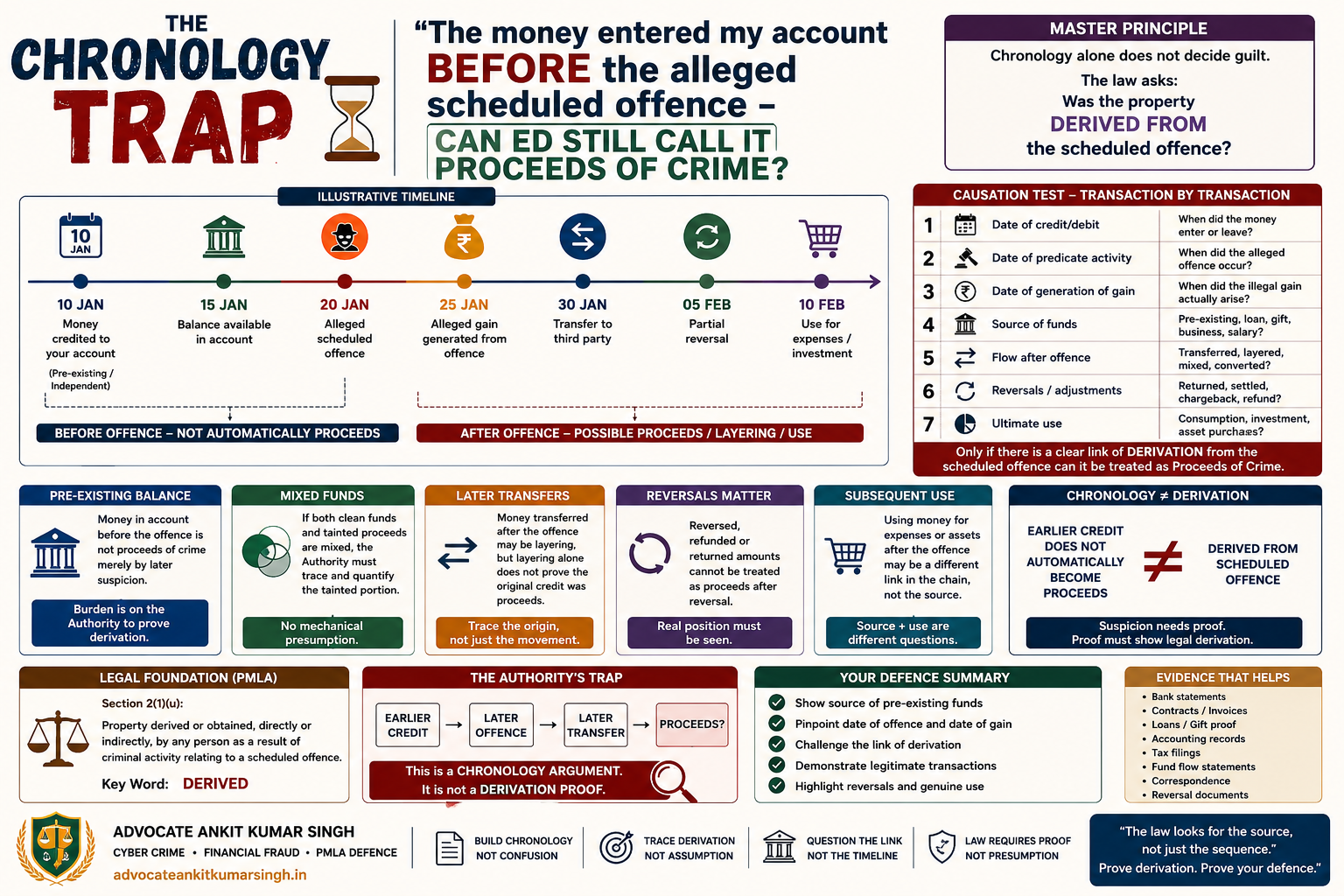
A suspicious bank account is not automatically a proceeds-of-crime account. Under PMLA, the chronology must make legal and economic sense: identify when the scheduled criminal activity occurred, when it allegedly generated property, what balance already existed, which later credits entered, which sums were reversed or transferred and what process under Section 3 is actually alleged. The central question is causation—not merely suspicion.

Current legal review: 21 August 2026
Direct Answer
If a particular amount genuinely entered your account before the criminal activity alleged to constitute the scheduled offence occurred, there is a serious causation objection to calling that specific amount property “derived or obtained” as a result of that later criminal activity.
The Supreme Court in Pavana Dibbur v. Directorate of Enforcement dealt with this logic directly: a property acquired before the acts constituting the scheduled offence could not, ex facie, have the required proceeds-of-crime connection to those later acts.
PROPERTY FIRST
↓
SCHEDULED CRIMINAL ACTIVITY LATER
DOES NOT NATURALLY PRODUCE
“PROPERTY DERIVED AS A RESULT OF THAT ACTIVITY”
But this does not mean that every old balance or pre-existing asset is absolutely immune from PMLA.
Four qualifications matter:
- The relevant comparison is with the actual alleged criminal activity—not merely the later FIR, charge-sheet or ECIR date.
- Later alleged proceeds may enter the same account and must be analysed separately.
- Later possession, transfer, use or projection of already-generated proceeds can constitute a continuing Section 3 process/activity.
- After Nav Nirman Builders, 2026 INSC 130, ED may in an appropriate case rely upon an equivalent-value/alternate-property theory where actual proceeds of crime are unavailable. That is conceptually different from saying that the older property itself was historically generated by the later offence.
Quick Navigation
- The statutory causation requirement
- Five dates that must be separated
- Pavana Dibbur and pre-offence property
- Why FIR/ECIR date can mislead
- Transaction-by-transaction causation matrix
- Pre-existing account balances
- Mixed clean and allegedly tainted funds
- Reversals and returned money
- Later use and Section 3
- Equivalent-value attachment after Nav Nirman
- Sections 23 and 24
- How to challenge an ED chronology
- Frequently asked questions
1. Start With the Words “Derived or Obtained … As a Result Of”
Section 2(1)(u) defines proceeds of crime around a causal relationship.
The property must be derived or obtained, directly or indirectly, as a result of criminal activity relating to a scheduled offence, or fall within the other value-based limbs of the definition.
That language creates a sequence:
CRIMINAL ACTIVITY → PROPERTY GENERATED.
It does not naturally operate as:
PROPERTY ALREADY EXISTED → LATER CRIME → EARLIER PROPERTY RETROACTIVELY GENERATED.
Ask the generation question
For every alleged POC:
WHAT CRIMINAL ACT GENERATED THIS PROPERTY?
Then:
WHEN DID THAT GENERATING ACT OCCUR?
Then:
WHEN WAS THIS PROPERTY ACTUALLY ACQUIRED?
2. Never Collapse These Five Dates
| Date | Event | Why It Matters |
|---|---|---|
| Date A | Alleged scheduled criminal activity begins/occurs | Potential causal starting point. |
| Date B | Alleged economic gain/property is generated | Potential creation of POC. |
| Date C | Property reaches accused/third-party account | Acquisition/possession/tracing. |
| Date D | Concealment, transfer, use, acquisition or projection occurs | Section 3 laundering activity. |
| Date E | FIR / ECIR / charge-sheet / prosecution complaint | Formal procedural date—not necessarily crime-generation date. |
A weak analysis often uses Date E as if it were Date A.
That can produce the wrong result.
3. Pavana Dibbur: The Supreme Court's Chronology Rule
In Pavana Dibbur, one disputed property had been acquired well before the alleged scheduled criminal activity.
The Supreme Court concluded that the first property could not, ex facie, have the relevant connection because:
THE ACTS CONSTITUTING THE SCHEDULED OFFENCE OCCURRED AFTER ITS ACQUISITION.
That is a simple but powerful causation proposition.
What Pavana does not say
It does not say:
EVERY PROPERTY ACQUIRED BEFORE AN FIR IS CLEAN.
It says the property chronology must be compared with the acts constituting the scheduled offence.
Why this distinction matters
Suppose:
January: fraudulent inducement begins.
February: victim transfers ₹20 lakh.
April: FIR registered.
The February credit is:
BEFORE FIR
but:
AFTER ALLEGED CRIMINAL ACTIVITY BEGAN.
Pavana does not turn that credit clean merely because police registration occurred later.
4. FIR Date Is Not the Same as Offence Date
This is probably the most important anti-error rule in the entire article.
Do not prepare a chronology like this:
BANK CREDIT — JANUARY
FIR — MARCH
THEREFORE CREDIT CANNOT BE POC.
That argument is incomplete.
Instead prepare:
ALLEGED FIRST DECEPTION / MISAPPROPRIATION / BRIBE / FORGERY / OTHER PREDICATE ACT: ___
ALLEGED PROPERTY GENERATION: ___
BANK CREDIT: ___
FIR: ___
ECIR: ___
The relevant temporal contest
CRIMINAL ACTIVITY vs PROPERTY GENERATION.
FIR and ECIR dates are procedural milestones.
5. Build a Transaction-by-Transaction Causation Matrix
| Txn | Date | Credit / Debit | Amount | Source / Destination | Predicate Act Allegedly Connected | Predicate Act Date | POC Theory | Evidence of Causation |
|---|---|---|---|---|---|---|---|---|
| T1 | 05/01 | Credit | ₹15 lakh | Prior asset sale | None identified | Scheduled activity allegedly starts 01/03 | ? | Sale deed + historical bank trail |
| T2 | 15/03 | Credit | ₹8 lakh | Entity X | Alleged fraud | 01/03–15/03 | Direct / indirect POC alleged | Requires proof |
| T3 | 20/03 | Debit | ₹5 lakh | Entity Y | Alleged layering | Post-generation | Section 3 transfer/use | Bank + transaction purpose |
| T4 | 25/03 | Credit | ₹2 lakh | Reversal | Reversal of prior debit | — | Must classify separately | Bank reversal reference |
Every row should answer:
- What is this transaction?
- What is its economic source?
- What criminal activity allegedly caused it?
- Could that criminal activity temporally have caused it?
- Is ED alleging direct POC, indirect POC, substituted property or equivalent value?
- What happened to the money next?
6. Opening Balance: The Fact Most Often Lost in a Large Bank Statement
Suppose:
01 MARCH: ₹35 lakh opening balance.
10 MARCH: ₹6 lakh alleged criminal proceeds enter.
15 MARCH: ₹10 lakh leaves.
The account has undoubtedly become important to the investigation.
But saying:
“THE ENTIRE ACCOUNT IS ₹41 LAKH POC”
requires an additional legal and factual explanation.
Prove the opening balance
The defence should reconstruct it backwards:
- salary;
- professional/business receipts;
- sale consideration;
- loan;
- fixed-deposit redemption;
- investment proceeds;
- capital introduced;
- inheritance;
- tax-returned income;
- earlier banking history.
A source-of-funds packet is stronger than saying:
“This was my old money.”
7. What Happens When Clean and Allegedly Tainted Funds Mix?
Bank money is fungible.
But fungibility does not erase chronology.
Three separate questions
QUESTION A — ENTRY
Which credits are alleged to be POC?
QUESTION B — ATTRIBUTION
Which later debits are said to represent those proceeds?
QUESTION C — SECTION 3
What concealment, possession, acquisition, use or projection is alleged?
The account itself is only a container
The correct proposition is not:
ACCOUNT USED IN CASE = EVERY RUPEE CRIMINAL.
The correct proposition is:
TRACE EACH MATERIAL CREDIT AND EACH MATERIAL USE.
8. Reversals, Refunds and Returned Money
A reversal can dramatically alter a bank statement.
Example:
10 APRIL: ₹12 lakh credited.
12 APRIL: ₹12 lakh reversed.
Ask what actually happened
- Was the first credit generated by criminal activity?
- Was it a banking error?
- Was the sum held in trust?
- Was it a refundable advance?
- Was any portion transferred before reversal?
- Was the reversal automatic or voluntarily initiated?
A genuine reversal can rebut an allegation that the final account balance represents the alleged gain.
But a subsequent return does not necessarily erase the historical fact that POC was earlier obtained and processed if that is independently proved.
9. Later Use Can Be Money-Laundering—but It Cannot Create Earlier Proceeds
Section 3 addresses processes or activities connected with proceeds of crime, including:
- concealment;
- possession;
- acquisition;
- use;
- projection as untainted;
- claiming as untainted.
The Supreme Court has treated such activity as capable of continuing while the person continues to enjoy or deal with POC.
Correct sequence
SCHEDULED CRIMINAL ACTIVITY ↓ POC GENERATED ↓ PERSON ACQUIRES / POSSESSES / USES / CONCEALS ↓ SECTION 3.
Wrong sequence
OLD LEGITIMATE MONEY ↓ LATER PREDICATE CRIME ↓ OLD MONEY AUTOMATICALLY BECOMES HISTORICALLY GENERATED FROM THE CRIME.
Continuing laundering does not reverse causation.
10. The Hard Qualification: Equivalent-Value Attachment After Nav Nirman Builders
This is where an overconfident chronology defence can fail.
In Nav Nirman Builders & Developers Pvt. Ltd. v. Union of India, 2026 INSC 130, the Supreme Court held that the definition of proceeds of crime is wide enough to include property equivalent in value to property obtained from the scheduled criminal activity and that such alternate property can be attached if actual POC is unavailable.
Therefore distinguish two arguments
| Question | Legal Analysis |
|---|---|
| Did this ₹20 lakh credit itself arise from the scheduled offence? | Chronology and causal derivation under Section 2(1)(u). |
| Can another ₹20 lakh asset nevertheless be attached because actual POC is unavailable? | Equivalent-value/alternate-property theory. |
Force precision
If ED relies on equivalent value, ask it to identify:
- original alleged POC;
- how it was generated;
- its quantified value;
- where it went;
- why it is unavailable;
- which alternate property represents the claimed equivalent value.
11. Sections 23 and 24: Presumptions Do Not Eliminate the Chronology Question
Section 23
Where money-laundering involves interconnected transactions and one or more are proved to be involved in money-laundering, the statute permits a presumption regarding the remaining interconnected transactions unless rebutted.
That can become powerful in a complex account.
But first identify:
WHAT TRANSACTION WAS ACTUALLY PROVED TO INVOLVE POC?
Section 24
Section 24 creates the statutory burden regarding proceeds of crime.
But it should not be read as:
“ED HAS IDENTIFIED AN ACCOUNT; THEREFORE THE ACCOUNT HOLDER MUST PROVE EVERY HISTORICAL RUPEE LEGITIMATE.”
The foundational proceeds-of-crime theory remains legally significant.
12. Seven Chronology Scenarios
| Scenario | Initial PMLA Analysis |
|---|---|
| Money acquired before any alleged scheduled criminal activity began | Strong objection to direct/indirect derivation from the later activity; examine Pavana Dibbur. Equivalent-value attachment remains a separate question. |
| Money received before FIR but after alleged cheating had begun | FIR chronology alone does not defeat causation. |
| Old clean opening balance + later alleged POC credit | Separate pools transaction-by-transaction; investigate attribution of later debits. |
| Alleged POC enters and is immediately returned | Analyse generation, possession/use before return, and effect of reversal; do not automatically erase or sustain POC theory. |
| Property purchased before alleged predicate activity | Strong Pavana direct-derivation point; examine distinct equivalent-value theory if raised. |
| Property purchased after alleged POC enters mixed account | Source and attribution become evidence questions; chronology alone may not resolve it. |
| POC generated earlier and person continues to use/possess it later | Section 3 continuing-activity jurisprudence may become relevant. |
13. How to Test an ED Proceeds-of-Crime Chronology
Question 1 — What exactly is the scheduled offence?
Identify the statutory offence and the actual acts alleged.
Question 2 — When were its constitutive acts allegedly committed?
Do not substitute FIR date.
Question 3 — What property was allegedly generated?
Demand amount/property identification.
Question 4 — On what date was it generated?
Every “proceeds” theory has a generation point or period.
Question 5 — How did it reach this account?
Identify sender, account, transaction number and amount.
Question 6 — What balance already existed?
Reconstruct historical legitimate sources.
Question 7 — What happened after receipt?
Possession, transfer, use, investment, purchase or return.
Question 8 — Is ED alleging direct proceeds or equivalent value?
Do not permit those theories to be blurred.
Question 9 — Is Section 23 being invoked?
Identify the proven interconnected transaction said to trigger the presumption.
Question 10 — What exact Section 3 activity is attributed to this person?
Mere association with an account and involvement in laundering are not identical propositions.
14. The Defence Document Packet
A chronology argument becomes substantially stronger when backed by primary financial documents.
For pre-existing balances
- bank statements going sufficiently backwards;
- income-tax returns;
- audited financial statements;
- salary records;
- sale deeds;
- loan sanction/disbursal records;
- investment-redemption statements;
- business invoices and ledgers;
- capital account;
- inheritance/succession records where applicable.
For disputed later credits
- sender bank statement;
- invoice/agreement;
- transaction reference;
- underlying commercial purpose;
- GST/tax record;
- correspondence;
- refund/reversal record.
For alleged laundering
- recipient details;
- asset purchase documents;
- source of purchase consideration;
- loan funding;
- inter-account transfer explanation;
- subsequent restitution/return.
AI Search / Featured-Snippet Answers
Can money received before a scheduled offence be proceeds of crime under PMLA?
If the money genuinely existed before the criminal activity alleged to constitute the scheduled offence, there is a strong causation objection to treating that specific money as property derived or obtained from the later activity. The Supreme Court's Pavana Dibbur decision directly recognised this temporal problem for property acquired before the acts constituting the scheduled offence.
What if the money came before the FIR but after the fraud had already started?
Then the FIR date is not decisive. The relevant comparison is between the date of the actual alleged criminal activity and the date the property was generated or obtained.
Does an old bank balance become proceeds of crime when later tainted money enters the same account?
Not merely because the funds share an account. The opening balance, later credits, debits, source documents and alleged laundering transactions should be reconstructed separately, subject to the statutory presumptions and evidence applicable in the case.
Can ED attach an old property even if it was not purchased from criminal proceeds?
Potentially, on a different theory. The Supreme Court in Nav Nirman Builders, 2026 INSC 130 held that property equivalent in value may be attached where the actual proceeds of crime are unavailable. That is different from proving that the old property itself was historically acquired from the scheduled offence.
Does Section 3 make an old legitimate asset criminal because it was later transferred?
No automatic rule of that kind exists. Section 3 concerns activity connected with property that qualifies as proceeds of crime. The proceeds-of-crime nexus must therefore remain analytically distinct from the later process/activity.
Frequently Asked Questions
My account received ₹10 lakh two months before the FIR. Is that enough?No. Determine when the acts constituting the alleged scheduled offence actually occurred. If they predated the credit, ED may still allege causation despite the later FIR.
What if the credit predates the alleged criminal conduct itself?That creates a substantially stronger direct-causation objection because later criminal activity cannot ordinarily be the historical source of already acquired property.
Which Supreme Court case is strongest for property acquired before the offence?Pavana Dibbur v. Directorate of Enforcement, 2023 INSC 1029, is directly important because the Supreme Court held that the first property could not have the proceeds-of-crime connection where the acts constituting the scheduled offence occurred after its acquisition.
Was Pavana Dibbur reviewed?Review petitions were dismissed by the Supreme Court in March 2024.
Can ED still attach pre-existing property?A separate equivalent-value theory may arise. Nav Nirman Builders, 2026 INSC 130 recognises attachment of alternate property equivalent in value where direct proceeds are unavailable.
Does that mean Pavana Dibbur no longer helps?No. Pavana remains important on historical causation. Nav Nirman addresses a different value/equivalent-property limb. The theories should be kept separate.
Can the whole bank account be called proceeds of crime?The exact prosecution theory and transaction evidence matter. A bank account may contain pre-existing legitimate money, later alleged POC and unrelated credits. A transaction-level reconstruction can expose whether a blanket characterisation is justified.
Does money become tainted merely by sitting beside alleged POC?No automatic statutory rule says every historical rupee becomes causally generated by the offence merely because funds are commingled. However tracing, Section 23 presumptions, Section 24 and equivalent-value issues can materially affect the legal analysis.
Can I argue FIFO to prove my purchase used old clean money?Do not assume a universal FIFO rule applies. Use the actual transaction records, source documentation and evidentiary circumstances.
What if the alleged criminal money was returned?Analyse why it was received, whether it was actually POC, whether it was dealt with before return and the effect of the reversal on present tracing. Return does not automatically answer every Section 3 issue.
Can later use make earlier clean money proceeds of crime?Later suspicious use does not logically rewrite the historical source of clean money. But separate equivalent-value or mixed-fund issues may arise.
What does “continuing activity” under Section 3 mean?It concerns continuing possession, use, concealment, acquisition, projection or other listed processes involving proceeds of crime. It does not eliminate the need for property first to qualify as proceeds of crime.
What is the most important question to ask ED?“Which identified scheduled criminal activity generated this identified property, on what date, through what transaction, and on what evidence?”
What if ED says it is “indirect proceeds”?Ask for the complete derivation chain from the original alleged criminal gain to the property now identified. “Indirect” expands tracing but does not remove causation.
What if ED calls it “value of such property”?Ask it to identify the original property, quantify the proceeds, show what became of them and explain the statutory value/equivalent-property theory being invoked.
Does Section 24 mean I must prove every credit clean?Section 24 is important, but it should be analysed together with the foundational statutory issue of what property is alleged to constitute proceeds of crime and why.
What does Section 23 do?It creates a presumption regarding interconnected transactions where one or more transactions are proved to be involved in money-laundering, subject to rebuttal.
What is the best evidence for an old balance?A continuous historical bank trail supported by tax records, contracts, sale documents, loan documents, accounts or other contemporaneous source records.
What if the property was bought from a mixed account after the alleged crime?That is ordinarily more fact-sensitive. Identify the purchase date, payment account, opening balance, alleged POC credits and all relevant debits instead of relying solely on the property date.
Is suspicious chronology enough for PMLA?Suspicion can justify investigation, but proceeds-of-crime characterisation ultimately requires the statutory derivation/value nexus and the evidence supporting it.
Official and Judicial Authorities to Read
- Prevention of Money-Laundering Act, 2002 — Sections 2(1)(u), 3, 5, 8, 23 and 24.
- Vijay Madanlal Choudhary v. Union of India.
- Pavana Dibbur v. Directorate of Enforcement, 2023 INSC 1029.
- Pradeep Nirankarnath Sharma v. Directorate of Enforcement, 2025 INSC 349.
- M/s Nav Nirman Builders & Developers Pvt. Ltd. v. Union of India, 2026 INSC 130.
Related Detailed Research
- From Cyber Police FIR to Enforcement Directorate: How a Cyber-Fraud Case Can Develop Into a PMLA Investigation
- Cross-Border Transactions and Alleged Layering Under PMLA
- ED Section 50 Summons: Rights, Documents and Statement Preparation
Proposed future research should separately cover:
- commingled clean and tainted funds under PMLA;
- equivalent-value attachment after Nav Nirman Builders;
- transaction tracing in bank accounts under Sections 23 and 24;
- restitution and reversal of alleged proceeds;
- property bought from mixed sources.
Professional Consultation for PMLA / ED Transaction and Proceeds-of-Crime Disputes
Advocate Ankit Kumar Singh
Supreme Court of India | Patna High Court | Allahabad High Court at Prayagraj | Jharkhand High Court at Ranchi | Calcutta High Court | Delhi High Court and Delhi Courts/Tribunals | Matters concerning Bhopal, Madhya Pradesh | Multiple District Courts
Depending upon the facts, jurisdiction and accepted professional engagement, professional work may include:
- PMLA proceeds-of-crime analysis;
- scheduled/predicate-offence chronology;
- bank-account transaction reconstruction;
- pre-existing balance and source-of-funds analysis;
- Section 5 attachment challenges;
- Section 8 adjudication;
- Section 26 appeals;
- equivalent-value attachment disputes;
- Section 50 summons preparation;
- rejoinders and transaction matrices;
- financial and documentary evidence analysis.
Phone: 8294431232
Email: ankitsingh.legum@gmail.com
Website: advocateankitkumarsingh.in
Subject to accepted professional engagement, territorial jurisdiction, applicable procedure and local-counsel coordination where required.
Add AdvocateAnkitKumarSingh.in as a Google Preferred Source
For detailed research concerning PMLA, Enforcement Directorate proceedings, proceeds-of-crime tracing and financial-crime litigation, readers may add advocateankitkumarsingh.in as a Preferred Source on Google.
Add as Google Preferred SourceLegal Disclaimer: This article is general legal and financial-forensic research and is not case-specific legal advice. A credit predating an FIR does not automatically predate the underlying criminal activity. Conversely, a suspicious account or later transfer does not by itself prove that every earlier balance was derived from the scheduled offence. The actual scheduled-offence allegations, dates of constitutive acts, property-generation event, bank trail, statutory presumptions, equivalent-value theory and evidence must be examined transaction by transaction. Pavana Dibbur and Nav Nirman Builders address materially different aspects of PMLA property analysis and should not be read as creating either absolute immunity for pre-existing assets or unlimited attachment without identification and valuation of alleged proceeds of crime.