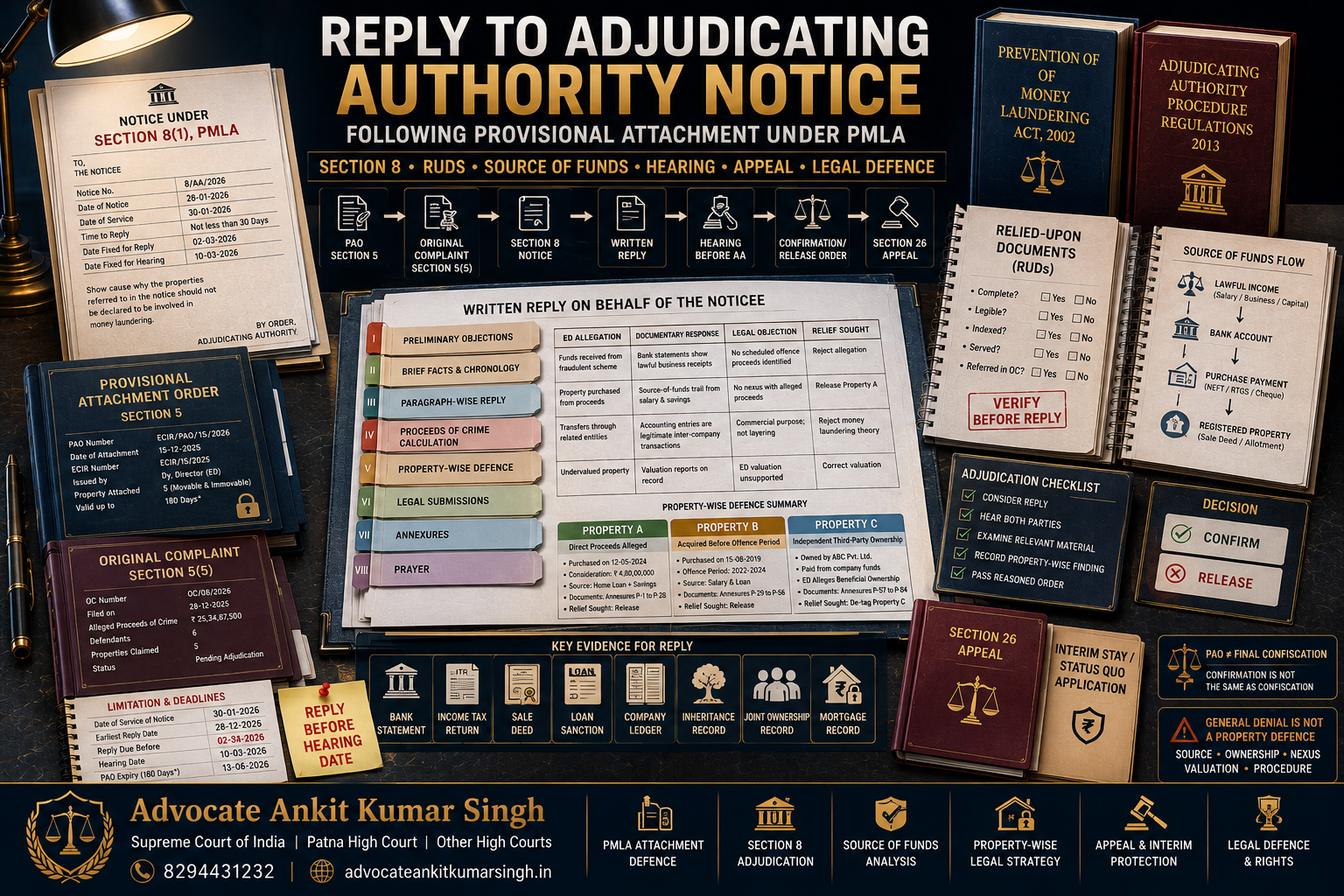
Reply to an Adjudicating Authority Notice Following Provisional Attachment under PMLA: Drafting Strategy, Evidence and Legal Defence
Direct Answer: A notice issued by the Adjudicating Authority under Section 8(1) of the Prevention of Money Laundering Act, 2002 should be answered through a detailed, paragraph-wise and property-wise reply supported by original source-of-funds documents.
The reply should not be limited to a general denial that the property is lawful. It should separately address:
- The alleged scheduled offence;
- The alleged proceeds of crime;
- The amount calculated by the Directorate of Enforcement;
- The financial trail relied upon by ED;
- The ownership and beneficial ownership of every property;
- The date and source of acquisition;
- The legal basis on which the property has been attached;
- Whether the property is described as direct, indirect or value-equivalent property;
- The relied-upon documents supplied with the notice;
- The statutory presumptions sought to be invoked;
- The rights of joint owners, companies, lenders, tenants and other third parties; and
- The precise relief sought from the Adjudicating Authority.
The notice must provide not less than thirty days. Under the current procedural regulations, the complete relied-upon documents should be served with the notice in a bound paper book. The reply should be filed before the date fixed for hearing because the regulations state that a reply may not be entertained after that date.
Most important practical rule: Do not count the case only from the date printed on the notice. Record the date on which the notice and the complete set of relied-upon documents were actually received, and raise any deficiency immediately.
What Is a Provisional Attachment Order?
A Provisional Attachment Order, commonly referred to as a PAO, is issued under Section 5(1) of the PMLA.
The authorised ED officer must possess material and record reasons to believe that:
- A person is in possession of proceeds of crime; and
- The proceeds are likely to be concealed, transferred or otherwise dealt with in a manner that may frustrate proceedings relating to confiscation.
A PAO may restrain dealing with:
- Land;
- A residential flat or house;
- A commercial property;
- A factory or productive establishment;
- A hotel or resort;
- Bank balances;
- Fixed deposits;
- Shares and securities;
- Vehicles;
- Jewellery;
- Company assets;
- Receivables;
- Foreign assets; or
- Other movable or immovable property.
The PAO is provisional. It does not constitute a final judicial finding that the property represents proceeds of crime.
What Happens after the PAO Is Issued?
After issuing a PAO, the authorised officer must file a complaint before the Adjudicating Authority under Section 5(5).
This pleading is commonly described as the:
- Original Complaint;
- OC;
- Section 5(5) complaint; or
- Complaint seeking confirmation of attachment.
The Original Complaint ordinarily contains:
- Particulars of the predicate or scheduled offence;
- Details of the ECIR;
- Alleged role of the defendants;
- Statements recorded during investigation;
- Banking and financial material;
- Property details;
- Proceeds-of-crime calculation;
- Fund-flow allegations;
- Reasons for provisional attachment;
- Relied-upon documents; and
- A prayer for confirmation under Section 8(3).
The Adjudicating Authority does not merely endorse the PAO automatically. It must independently consider whether the statutory basis exists to issue a Section 8 notice.
What Is a Section 8(1) Notice?
On receipt of the Section 5(5) complaint, the Adjudicating Authority may issue a notice if it has reason to believe that a person has committed an offence under Section 3 or is in possession of proceeds of crime.
The notice calls upon the concerned person to:
- Disclose the source of income, earnings or assets used to acquire the attached property;
- Produce the evidence relied upon;
- Provide other relevant information and particulars; and
- Show cause why the property should not be declared involved in money laundering.
The notice must provide not less than thirty days.
Where the property is stated to be held on behalf of another person, a copy of the notice must also be served upon that person.
Where a property is jointly held, notice must be served upon all joint holders.
PAO and Section 8 Notice Are Different Documents
The following documents perform different functions:
| Document | Purpose |
|---|---|
| Provisional Attachment Order | Temporarily restrains dealing with identified property under Section 5 |
| Original Complaint | Places ED’s case for confirmation before the Adjudicating Authority |
| Section 8(1) Notice | Calls upon the affected person to explain the source and show cause against confirmation |
| Relied-Upon Documents | Documents relied upon for the notice and ED’s attachment case |
| Written Reply | The affected person’s factual, legal and documentary defence |
| Confirmation Order | The Adjudicating Authority’s decision under Section 8(2) and Section 8(3) |
A reply prepared only by reading the PAO may be incomplete. The reply should answer the Section 8 notice, the Original Complaint and the complete relied-upon material.
Why the Section 8 Reply Is Critical
The reply is ordinarily the first comprehensive adjudicatory defence against attachment.
Before issuance of the PAO, the affected person is not ordinarily given a pre-attachment hearing. Section 8 therefore provides the principal statutory opportunity to:
- Challenge the factual allegations;
- Challenge the legal basis of attachment;
- Explain the source of funds;
- Correct errors in ED’s financial trail;
- Identify lawful and unrelated property;
- Present third-party rights;
- Challenge valuation;
- Challenge double counting;
- Seek release of one or more properties; and
- Create a complete record for appeal.
A weak or general reply may adversely affect later proceedings because the confirmation order and the record before the Adjudicating Authority ordinarily form the foundation of the Section 26 appeal.
Relied-Upon Documents Must Accompany the Notice
Regulation 13 of the Adjudicating Authority (Procedure) Regulations, as amended in 2017, requires the complainant to serve the notice upon the defendant along with the complete relied-upon documents in a bound paper book.
The documents may include:
- Predicate FIR;
- Charge sheet or police report;
- ECIR-related material disclosed in the proceedings;
- Statements recorded under Section 50;
- Bank statements;
- Property documents;
- Company records;
- Income-tax returns;
- Forensic reports;
- Search and seizure records;
- Digital extracts;
- Fund-flow charts;
- Valuation reports;
- Loan documents;
- Corporate ownership records;
- Emails and communications;
- Foreign-remittance material; and
- Other documents cited in the Original Complaint.
What If the RUDs Are Incomplete?
If one or more relied-upon documents are missing, illegible, incomplete or incorrectly paginated, the noticee should immediately file an application recording:
- The date on which the notice was received;
- The number of volumes received;
- The page range received;
- The missing document numbers;
- The illegible or incomplete pages;
- The documents referred to in the complaint but not supplied;
- The prejudice caused to preparation of the reply; and
- The request for complete documents and adequate time thereafter.
The noticee should not remain silent until the final hearing and then raise the deficiency for the first time.
When Does the Thirty-Day Period Begin?
Where the notice is served without the complete RUDs, a legal objection may be raised that an effective opportunity to reply does not arise until the relied-upon material has been supplied.
The safer practical approach is:
- Record the deficiency immediately;
- File an application before the existing deadline;
- Seek complete RUDs;
- Seek fresh or extended time;
- Attend the listed date; and
- Do not assume that the original deadline stands automatically suspended.
Right to Inspect the Record
The Adjudicating Authority has powers concerning discovery, inspection, production of records, evidence on affidavits and examination of witnesses.
The procedural regulations permit a party to apply for inspection of the case record.
Inspection may be useful where:
- Documents cited in the Original Complaint have not been supplied;
- The RUD index does not correspond with the paper book;
- A document appears to be incomplete;
- ED has relied upon a statement without annexing it;
- A property schedule is missing;
- Bank statements are only partly supplied;
- A valuation report is referred to but not attached;
- An annexure is illegible;
- Several versions of the same document exist; or
- The noticee needs certified copies for appeal or another proceeding.
An inspection application should identify the precise record sought. A vague request for inspection of “the complete file” may be less effective than a numbered document-wise request.
Immediate Steps after Receiving the Notice
Step 1: Record the Service Details
Preserve:
- Envelope;
- Email transmission;
- Courier tracking;
- Acknowledgment;
- Date and time of delivery;
- Name of recipient;
- Number of document volumes; and
- Electronic attachments received.
Step 2: Identify the Hearing and Reply Deadline
Prepare a limitation and hearing chart containing:
- PAO date;
- Section 5(5) complaint date;
- Section 8 notice date;
- Date of service;
- Date of complete RUD service;
- Date fixed for reply;
- Date fixed for hearing;
- 180-day PAO expiry calculation;
- Expected confirmation deadline; and
- Appeal deadline if an order is later passed.
Step 3: Obtain the Complete Original Complaint
Confirm that the copy contains:
- Every paragraph;
- Complete list of defendants;
- Complete property schedule;
- List of relied-upon documents;
- All annexures;
- Verification;
- Authorisation particulars; and
- Prayer clause.
Step 4: Freeze the Factual Position
Review all earlier statements and submissions made to:
- ED under Section 50;
- Police or CBI;
- Income-tax authorities;
- Banks;
- Auditors;
- Company regulators;
- Insolvency professionals;
- Courts; and
- Other government authorities.
The reply should not unintentionally contradict an earlier signed statement without expressly explaining the difference.
Step 5: Prepare a Property Inventory
Prepare a separate sheet for every attached property.
Step 6: Preserve Documents
Do not create retrospective agreements, alter accounts, move attached property or fabricate source-of-funds records.
How to Read the Original Complaint
The Original Complaint should be analysed in layers.
Layer 1: Predicate-Offence Allegations
Identify:
- FIR number;
- Investigating agency;
- Scheduled sections;
- Date of alleged offence;
- Persons named;
- Charge-sheet status;
- Alleged victim loss;
- Role attributed to the noticee; and
- Current status of the predicate proceeding.
Layer 2: Proceeds-of-Crime Calculation
Identify:
- Total amount alleged;
- Method of calculation;
- Whether gross receipts or actual criminal gain is used;
- Whether repayments or refunds are deducted;
- Whether the same amount is counted more than once;
- Whether lawful business revenue is included;
- Whether separate transactions are aggregated without explanation;
- Whether the amount is supported by bank entries; and
- Whether the calculation corresponds with the predicate case.
Layer 3: Financial Trail
Map:
- Originating account;
- Intermediate accounts;
- Final beneficiary;
- Property purchase payment;
- Loan disbursement;
- Cash withdrawal;
- Related-party transfer;
- Foreign remittance;
- Cryptocurrency conversion; and
- Asset acquisition.
Layer 4: Property Theory
Determine whether ED alleges that the attached property is:
- Direct proceeds of crime;
- Indirectly derived property;
- Property used in money laundering;
- Property involved in an interconnected transaction;
- Equivalent-value property;
- Alternate property;
- Property held beneficially for another person; or
- Property acquired through mixed funds.
Layer 5: Risk of Concealment or Transfer
Section 5 requires the authorised officer to address the likelihood that the property may be concealed, transferred or dealt with so as to frustrate confiscation.
Examine whether the PAO contains a property-specific basis or only a general reproduction of statutory language.
Recommended Structure of the Written Reply
Part I: Cause Title and Appearance
Use the exact:
- Original Complaint number;
- Notice number;
- PAO number;
- Name of complainant;
- Name and defendant number of the noticee;
- Property schedule reference; and
- Bench details.
Part II: Introductory Statement
State that the reply is filed:
- Without prejudice to all rights and remedies;
- In response to the Section 8 notice;
- On the basis of documents presently supplied;
- Subject to objections regarding missing or illegible RUDs;
- With liberty to supplement after inspection or further disclosure; and
- Without admitting any allegation not expressly admitted.
Part III: Preliminary Objections
Preliminary objections may concern:
- Absence of a valid scheduled-offence foundation;
- No identifiable proceeds of crime;
- Incorrect proceeds-of-crime computation;
- Lack of transactional nexus;
- Property predating the alleged offence;
- Incorrect beneficial-ownership allegation;
- Attachment of independent third-party property;
- Excessive or duplicate attachment;
- Incomplete RUDs;
- Non-service upon joint owners;
- Incorrect property description;
- Failure to distinguish direct and alternate property;
- Officer’s authority or case assignment;
- Limitation or PAO-expiry issues;
- Failure to record property-specific reasons; and
- Violation of natural justice.
Part IV: Brief Factual Background
Present a clear chronology rather than a narrative containing argument in every sentence.
Part V: Paragraph-Wise Reply
Answer every paragraph of the Original Complaint.
Common responses include:
- Admitted to the limited extent that;
- Denied as false and unsupported;
- Not within the noticee’s knowledge;
- A matter of record requiring strict proof;
- Incorrectly stated because;
- Misleading without the complete transaction context;
- The document relied upon does not support the conclusion; and
- The allegation is answered by Annexure R-__.
A mechanical response stating “wrong and denied” against every paragraph should be avoided.
Part VI: Property-Wise Reply
Every property should be analysed separately.
Part VII: Legal Submissions
Address the statutory ingredients and applicable judgments after the factual foundation has been established.
Part VIII: Evidence and Annexures
Provide an indexed and cross-referenced document set.
Part IX: Prayer
Seek specific relief for each property and procedural issue.
Property-Wise Defence Table
| Field | Information Required |
|---|---|
| Property Reference | PAO and Section 8 notice serial number |
| Legal Owner | Name appearing in title or account records |
| Beneficial-Owner Allegation | Person whom ED alleges actually controls the property |
| Acquisition Date | Date of purchase, allotment, inheritance or creation |
| Purchase Value | Documented consideration and incidental expenses |
| Source of Funds | Bank account, loan, income, inheritance or other source |
| ED’s Theory | Direct, indirect, mixed or value-equivalent property |
| Financial Trail | Complete debit-to-acquisition reconciliation |
| Third-Party Rights | Co-owner, lender, tenant, purchaser or other claimant |
| Defence Documents | Sale deed, bank statement, loan record and tax evidence |
| Relief | Release, partial release, de-tagging or rejection of confirmation |
How to Prove the Lawful Source of an Attached Property
The notice expressly requires disclosure of the source of income, earnings or assets used to acquire the property.
The best evidence ordinarily creates a complete chain:
Lawful income or capital → identified bank account → payment instrument → seller or authority → registered acquisition document.
For a Salaried Person
- Employment records;
- Salary slips;
- Form 16;
- Income-tax returns;
- Bank statements;
- Home-loan sanction;
- Loan repayment records; and
- Sale deed.
For a Businessperson
- Audited accounts;
- Business bank statements;
- Income-tax returns;
- GST returns;
- Capital-account ledger;
- Partner or director remuneration;
- Dividend records;
- Sale proceeds from an earlier asset;
- Loan documents; and
- Property-payment trail.
For a Company
- Board resolution;
- Audited financial statements;
- Fixed-asset register;
- Bank statement;
- Loan sanction;
- Vendor or seller agreement;
- Tax records;
- Source ledger;
- Title document; and
- Evidence of corporate possession and use.
For Inherited Property
- Earlier title deed;
- Death certificate;
- Will or probate;
- Succession documents;
- Partition deed;
- Family settlement;
- Mutation records; and
- Historical possession records.
For Property Purchased through Sale of Another Asset
- Earlier acquisition document;
- Sale deed of earlier asset;
- Bank receipt of sale consideration;
- Capital-gains disclosure;
- Bank transfer to the new seller; and
- New acquisition document.
Property Purchased before the Alleged Offence
A property acquired before the alleged criminal activity ordinarily raises a serious objection if ED describes it as direct proceeds of crime.
The reply should state:
- The alleged offence period;
- The property acquisition date;
- The source existing on the acquisition date;
- The absence of any chronological possibility that later proceeds funded the acquisition; and
- Whether ED has expressly invoked a value-equivalent theory.
If ED seeks alternate or value-equivalent attachment, the reply should separately challenge:
- The quantified original proceeds;
- Why the direct property is unavailable;
- Whether equivalent-value attachment is legally available;
- Whether the noticee ever received or possessed the original proceeds;
- Whether the same value is already secured through another attachment;
- Whether the alternate property belongs to an independent person; and
- Whether the valuation exceeds the alleged proceeds.
Challenge to the Proceeds-of-Crime Calculation
ED’s proceeds-of-crime figure should not be accepted without independent reconciliation.
Common calculation errors include:
- Treating total turnover as proceeds of crime;
- Treating the entire loan amount as proceeds without identifying fraudulent gain;
- Counting lawful principal and alleged criminal gain together;
- Ignoring refunds or repayments;
- Counting the same transfer through several accounts;
- Combining separate entities without explaining their roles;
- Including transactions outside the alleged offence period;
- Using gross deposits instead of net alleged benefit;
- Including taxes, legitimate costs or returned amounts;
- Counting attached property and bank balance representing the same money twice;
- Using an unsupported current market valuation; and
- Failing to reconcile the PMLA figure with the predicate charge sheet.
Recommended Proceeds-of-Crime Table
| Transaction | ED Amount | Defence Amount | Difference | Supporting Record |
|---|---|---|---|---|
| Alleged receipt | As stated by ED | Actual identified receipt | Reconciliation difference | Bank statement |
| Refund or repayment | Ignored or disputed | Documented amount | Reduction claimed | Bank debit and acknowledgment |
| Lawful business income | Included by ED | Lawful amount | Exclusion claimed | Invoice, GST and accounts |
| Duplicate routing entry | Repeated amount | Single underlying value | Double-counting correction | Fund-flow reconciliation |
Direct Property and Value-Equivalent Property Must Be Distinguished
A reply should insist that ED clearly identify the legal theory for every attached property.
Direct Property
ED should establish a traceable financial link from the alleged proceeds to acquisition of the property.
Indirectly Derived Property
ED should establish the intermediate transfers, entities and conversions through which the alleged proceeds reached the property.
Value-Equivalent Property
ED should identify:
- The original property;
- The person who possessed it;
- Why it is unavailable;
- The value claimed;
- The legal basis for alternate attachment; and
- Why the particular property of the noticee can represent that value.
A reply should not permit these three legally distinct theories to be used interchangeably.
Jointly Owned Property
Where the property is jointly owned, the reply should provide:
- Share of each owner;
- Contribution by each owner;
- Independent bank statements;
- Loan contribution;
- Inheritance rights;
- Tax disclosures;
- Possession and use;
- Whether all joint owners were served; and
- Whether ED attached the whole property or only the alleged share.
An innocent co-owner should file an independent claim rather than depend entirely upon the defence of the principal noticee.
Property Owned by a Spouse or Family Member
A family relationship does not by itself prove beneficial ownership.
The family member should independently establish:
- Source of income;
- Purchase contribution;
- Property-loan liability;
- Stamp-duty payment;
- Tax disclosure;
- Rental income;
- Possession;
- Acquisition date; and
- Absence of transfer from the person accused by ED.
A reply stating only that the property stands in the spouse’s name is insufficient where ED alleges that the consideration came from another person.
Property Owned by a Company
A company has a legal identity separate from its shareholders and directors.
The reply should address:
- Whether the company received the alleged proceeds;
- Whether the company had genuine operations;
- Source of acquisition funds;
- Board authorisation;
- Corporate accounting treatment;
- Business use of the property;
- Beneficial ownership;
- Whether the company was merely a conduit; and
- Whether ED has improperly treated company property as personal property of a director.
Useful documents include:
- Certificate of incorporation;
- Shareholding records;
- Beneficial-ownership filings;
- Board minutes;
- Audited accounts;
- Bank statements;
- Fixed-asset register;
- Loan documents;
- Tax records;
- Employee and operational records; and
- Evidence of genuine commercial use.
Third-Party Claims under Section 8(2)
A person other than the original noticee may claim an attached property and seek an opportunity to prove that it is not involved in money laundering.
Potential third-party claimants include:
- Joint owners;
- Companies;
- Partners;
- Trust beneficiaries;
- Bona fide purchasers;
- Banks and secured creditors;
- Tenants;
- Allottees;
- Homebuyers;
- Legal heirs; and
- Persons with an independent beneficial interest.
The claimant should file a separate application or reply clearly identifying:
- Nature of interest;
- Date on which the interest arose;
- Consideration paid;
- Source of funds;
- Possession;
- Knowledge or absence of knowledge of the alleged offence;
- Due diligence undertaken; and
- Relief sought.
Bona Fide Purchaser’s Reply
A purchaser should produce:
- Agreement for sale;
- Registered sale deed;
- Bank-payment trail;
- Loan sanction;
- Valuation report;
- Title search;
- Encumbrance certificate;
- Public notice;
- Possession letter;
- Mutation records;
- Tax payments;
- Correspondence with seller; and
- Proof of market-value consideration.
The reply should expressly address whether the purchase:
- Predated the PAO;
- Predated knowledge of the investigation;
- Was for genuine consideration;
- Was at arm’s length;
- Created actual possession; and
- Was not designed to defeat confiscation.
Mortgaged Property and Secured Creditors
A bank or financial institution should establish:
- Date of sanction;
- Date of mortgage;
- Charge-registration records;
- Amount disbursed;
- Good-faith lending;
- Valuation and title verification;
- Outstanding debt;
- Default date;
- SARFAESI or DRT proceedings;
- Auction status; and
- Absence of collusion with the borrower.
The noticee should disclose the mortgage rather than suppress it. The Adjudicating Authority should receive a complete picture of the existing encumbrance and the lender’s independent interest.
Reply on Behalf of a Director
A director should not rely only upon the company’s general reply.
The individual reply should identify:
- Appointment and resignation dates;
- Executive or non-executive status;
- Board and committee role;
- Bank-signing authority;
- Access to accounts;
- Knowledge of the alleged transaction;
- Personal benefit, if any;
- Ownership of attached property;
- Source of personal assets;
- Recorded dissent or objections; and
- Distinction from the roles of other directors.
Designation alone should not substitute for transaction-specific evidence of control, knowledge or benefit.
Reply on Behalf of an Independent or Non-Executive Director
Relevant evidence may include:
- Appointment letter;
- Resignation records;
- Board attendance;
- Committee membership;
- Board papers supplied;
- Recorded dissent;
- Absence of operational authority;
- Absence of bank access;
- Reliance upon professional reports;
- Absence of personal benefit; and
- Lack of connection with the attached property.
Use of Affidavits and Documentary Evidence
The reply should be verified and supported in the manner required by the procedural regulations and registry practice.
Affidavits may be useful to establish:
- Ownership;
- Source of funds;
- Possession;
- Corporate authority;
- Independent income;
- Role of the noticee;
- Document authenticity;
- Missing RUDs;
- Service details; and
- Third-party rights.
An affidavit should not contain broad conclusions unsupported by documents.
Recommended Annexure Arrangement
Annexures should be arranged by issue rather than placed in an unstructured bundle.
Volume I: Statutory and Case Documents
- Section 8 notice;
- PAO;
- Original Complaint;
- Property schedule;
- RUD index; and
- Service records.
Volume II: Predicate-Offence Material
- FIR;
- Charge sheet;
- Court orders;
- Settlement or quashing orders, where relevant;
- Acquittal or discharge orders; and
- Current case status.
Volume III: Financial Trail
- Bank statements;
- Ledger records;
- Loan documents;
- Transaction reconciliation;
- Invoices;
- Refund records; and
- Tax documents.
Volume IV: Property Documents
- Sale deed;
- Allotment document;
- Loan statement;
- Mutation;
- Valuation;
- Encumbrance;
- Tax receipts; and
- Possession evidence.
Volume V: Corporate and Third-Party Records
- Company filings;
- Board resolutions;
- Shareholding records;
- Joint-owner documents;
- Mortgage documents;
- Lease documents; and
- Third-party claims.
Formatting of the Reply
The procedural regulations contemplate filings in a properly arranged paper-book format.
The reply should ordinarily be:
- On A4 paper;
- Clearly typed;
- Paginated continuously;
- Indexed;
- Divided into volumes where necessary;
- Cross-referenced to annexures;
- Signed and verified;
- Accompanied by vakalatnama or authority;
- Supported by affidavit where required;
- Served upon the complainant; and
- Filed with proof of service.
Current registry and electronic-filing instructions should also be checked before filing.
Do Not Miss the Hearing-Date Deadline
The 2017 amendment to Regulation 15 states that the defendant’s or respondent’s reply shall not be entertained after the date fixed for hearing.
Accordingly:
- Do not assume that the reply can be filed after the first hearing;
- Do not rely upon an oral request made after expiry;
- File an extension application before the date fixed;
- Place incomplete RUD objections on record immediately;
- File available preliminary objections if necessary;
- Seek permission to file a supplementary reply after complete disclosure; and
- Preserve proof of filing and service.
Can Additional Documents Be Filed Later?
Permission may be sought to file supplementary documents where:
- RUDs were supplied late;
- Inspection revealed additional material;
- Bank-certified records took time;
- Foreign records were awaited;
- Old title documents had to be retrieved;
- Another authority supplied certified copies later;
- A predicate court passed a subsequent order; or
- ED introduced new material.
The application should explain:
- Why the document was unavailable earlier;
- When it was obtained;
- Its relevance;
- Why its filing causes no unfair prejudice; and
- Why it is necessary for complete adjudication.
Hearing before the Adjudicating Authority
Under Section 8(2), the Adjudicating Authority must:
- Consider the reply;
- Hear the aggrieved person and ED; and
- Take into account all relevant material placed on record.
The Authority must then record a finding whether all or any of the properties referred to in the notice are involved in money laundering.
The expression “all or any” is important. The Authority is not required to either confirm every property or release every property as one block.
A property-wise decision may:
- Confirm some properties;
- Release others;
- Restrict attachment to a particular share;
- Correct valuation;
- Recognise a third-party interest; or
- Reject ED’s theory for a specific asset.
How to Prepare for Oral Arguments
Prepare a short hearing note containing:
- Five principal legal issues;
- Five principal factual errors;
- A one-page chronology;
- A proceeds-of-crime calculation;
- A property-wise table;
- A list of missing RUDs;
- A list of admitted facts;
- A list of disputed facts;
- Relevant statutory provisions;
- Judgments relied upon; and
- Precise relief sought.
Oral arguments should not merely repeat the written reply. They should direct the Authority to the decisive documents.
Can Witnesses or Cross-Examination Be Requested?
The Adjudicating Authority possesses powers concerning:
- Discovery and inspection;
- Attendance of persons;
- Examination on oath;
- Production of records;
- Evidence on affidavits;
- Commissions for witnesses or documents; and
- Marking of documentary exhibits.
The procedural regulations also address examination and numbering of witnesses.
A request for examination or cross-examination should identify:
- The person required;
- The disputed factual issue;
- The document requiring proof;
- Why written evidence is insufficient;
- Questions affecting reliability or attribution; and
- Why the request is necessary for fair adjudication.
Cross-examination should not be assumed to be automatic in every Section 8 proceeding.
Statutory Presumptions and Burden of Proof
A reply must account for the evidentiary provisions contained in Sections 22, 23 and 24.
Section 22: Records and Property
Where records or property are found in a person’s possession or control, statutory presumptions may arise concerning:
- Ownership;
- Truth of contents;
- Signature;
- Execution; and
- Attestation.
The reply should rebut such presumptions through specific evidence rather than a bare denial.
Section 23: Interconnected Transactions
If one or more transactions are proved to be involved in money laundering, the remaining interconnected transactions may be presumed to form part of the same chain unless proved otherwise.
The reply should therefore explain every apparently connected transaction.
Section 24: Burden of Proof
In proceedings relating to proceeds of crime:
- In the case of a person charged with the offence under Section 3, the Authority or Court shall presume involvement unless the contrary is proved; and
- In the case of another person, the Authority or Court may raise the statutory presumption.
These provisions make documentary rebuttal particularly important.
At the same time, ED must identify the alleged proceeds, the property and the factual foundation on which the statutory provisions are invoked.
Important Preliminary Objections
Absence of Valid Scheduled Offence
The reply should identify whether the offence relied upon is actually included in the PMLA Schedule and whether the predicate proceeding remains legally sustainable.
No Property Derived from Criminal Activity
The reply should distinguish lawful business receipts or personal income from property allegedly derived from a scheduled offence.
No Section 3 Process or Activity
Where relevant, explain that the noticee did not conceal, possess, acquire, use, transfer, project or claim identified proceeds as untainted.
Incorrect Owner
ED may have attached property owned by another person or company without establishing beneficial ownership.
Incorrect Property Description
Check:
- Plot number;
- Flat number;
- Survey or khasra number;
- Area;
- Boundaries;
- Bank-account number;
- Vehicle number;
- Company name; and
- Owner’s name.
Excessive Attachment
Compare the total attached value against the correctly calculated alleged proceeds.
Double Counting
Identify whether the same value has been attached through:
- Bank balance;
- Direct property;
- Related-company property;
- Foreign asset;
- Alternate property; and
- Another PAO.
No Real Risk of Frustrating Confiscation
Where applicable, identify:
- Long-standing ownership;
- Registered mortgage;
- Prior court restraint;
- Existing disclosure to ED;
- Absence of transfer attempt;
- Stable possession; and
- Availability of less intrusive protection.
Common Drafting Mistakes
- Filing only a two-page general denial;
- Replying only to the notice and not the Original Complaint;
- Failing to object to incomplete RUDs;
- Missing the hearing-date deadline;
- Not producing complete bank statements;
- Producing only the sale deed without proving the purchase source;
- Mixing all attached properties in one explanation;
- Failing to distinguish direct and alternate property;
- Ignoring the proceeds-of-crime calculation;
- Ignoring joint owners and secured creditors;
- Giving an explanation inconsistent with a Section 50 statement;
- Making unnecessary admissions about the predicate offence;
- Using unsigned spreadsheets without underlying records;
- Producing fabricated or retrospective documents;
- Failing to serve ED and file proof of service;
- Failing to number annexures consistently;
- Not seeking interim protection against possession;
- Assuming that an appeal automatically grants a stay; and
- Waiting until the appellate stage to raise factual material available earlier.
Suggested Prayer Clause
Depending upon the facts, the reply may request that the Adjudicating Authority:
- Drop the proceedings against the noticee;
- Decline confirmation of the PAO;
- Declare that identified properties are not involved in money laundering;
- Release identified properties from attachment;
- Restrict attachment to the legally sustainable share or value;
- Recognise independent third-party rights;
- Exclude property acquired from lawful funds;
- Correct the proceeds-of-crime calculation;
- Reject duplicate or excessive attachment;
- Direct supply of missing RUDs;
- Permit inspection and certified copies;
- Permit filing of supplementary documents;
- Refrain from relying upon undisclosed material;
- Pass a property-wise speaking order; and
- Grant any other relief required in the interests of justice.
What Happens If Attachment Is Confirmed?
If the Adjudicating Authority finds that a property is involved in money laundering, it may confirm the attachment under Section 8(3).
The consequences may include:
- Continuation of the attachment under the statutory framework;
- Communication to banks or registration authorities;
- Restriction on transfer or creation of third-party rights;
- Proceedings for possession under Section 8(4);
- Impact upon business use or rental income;
- Need for an immediate Section 26 appeal; and
- Need for a specific interim-stay application.
Confirmation is not the same as final confiscation. Final confiscation or release is governed by the Special Court proceedings and other applicable provisions of Section 8.
Possession after Confirmation
The statutory text addresses possession after confirmation. The Supreme Court has, however, explained that interim physical possession before final confiscation should not be taken mechanically in every case.
Where possession is threatened, the affected party should examine:
- Whether the property is owner occupied;
- Whether it is tenanted;
- Whether it is a running factory or productive establishment;
- Whether a bank holds a mortgage;
- Whether innocent co-owners are affected;
- Whether a possession notice has been validly served;
- Whether local-publication requirements were followed;
- Whether immediate possession is necessary to preserve the property;
- Whether attachment alone sufficiently protects ED; and
- Whether an appeal and interim application have been filed.
Appeal under Section 26
A person aggrieved by the confirmation order may appeal to the Appellate Tribunal.
The appeal is ordinarily required within forty-five days from the date on which the order is received.
A delayed appeal may be considered where sufficient cause is established.
The appeal should contain:
- Confirmation order;
- Proof of receipt;
- PAO;
- Section 8 notice;
- Original Complaint;
- Written reply;
- Annexures;
- Hearing notes;
- Property schedule;
- Grounds of challenge;
- Application for interim stay; and
- Application for condonation, if required.
Filing an Appeal Does Not Automatically Stay the Order
A separate application should seek:
- Stay of confirmation;
- Stay of possession;
- Status quo;
- Protection against eviction;
- Permission to continue business operations;
- Protection of mortgagee or tenant rights;
- Restraint against irreversible dealing; and
- Any suitable conditional arrangement protecting ED’s interest.
Further Appeal under Section 42
An aggrieved party may challenge the Appellate Tribunal’s decision before the competent High Court on a question of law or fact.
The appeal is ordinarily required within sixty days from communication of the Tribunal order.
The High Court may allow a further period not exceeding sixty days where sufficient cause exists.
Practical Reply Checklist
- Record the service date;
- Verify complete RUD service;
- Obtain the full Original Complaint;
- Calculate the reply and hearing deadline;
- Calculate the PAO’s 180-day period;
- Prepare a complete chronology;
- Identify the scheduled offence;
- Calculate proceeds of crime independently;
- Prepare a property-wise source table;
- Collect bank-certified records;
- Collect title and loan records;
- Identify joint owners and third parties;
- Review all Section 50 statements;
- Prepare preliminary objections;
- Draft a paragraph-wise response;
- File inspection or RUD applications promptly;
- Arrange indexed annexure volumes;
- File before the hearing date;
- Serve ED and preserve proof;
- Prepare concise oral submissions;
- Seek a property-wise speaking order;
- Monitor the confirmation deadline;
- Prepare the appeal before the order is received; and
- Seek interim protection immediately after confirmation, where required.
Frequently Asked Questions
How much time is given to reply to a Section 8 PMLA notice?
The notice must provide not less than thirty days. The exact date stated in the notice and the date fixed for hearing must be carefully recorded.
Is the reply period counted from the date of the notice or service?
The date of actual service is material. Where complete RUDs are supplied later, the noticee should immediately seek appropriate time from the date of complete supply rather than assume an automatic extension.
Must RUDs be supplied with the notice?
The amended procedural regulations require the notice to be served with the complete relied-upon documents in a bound paper book.
What should be done when RUDs are missing?
File an immediate document-deficiency application identifying every missing or illegible document and seek complete supply, inspection and adequate time to reply.
Can the reply be filed after the first hearing?
The procedural regulations state that the reply shall not be entertained after the date fixed for hearing. Any request for extension should therefore be filed before that date.
Can an advocate appear before the Adjudicating Authority?
Yes. The noticee may appear through an authorised legal representative in accordance with the applicable procedure and file a vakalatnama or authority.
Is the Adjudicating Authority bound by the Code of Civil Procedure?
No. It is not strictly bound by the CPC but is guided by principles of natural justice and has statutory powers relating to inspection, production, affidavits, witnesses and commissions.
Must the reply be property specific?
Yes. Each attached property may have a different owner, acquisition date, source, valuation and legal theory.
Is a sale deed sufficient to prove lawful source?
No. A sale deed proves the transaction and title but may not establish where the purchase consideration originated. The bank and income trail should also be produced.
Can property purchased before the alleged offence be attached?
It ordinarily cannot be direct proceeds of a later offence. ED may attempt alternate-value attachment, which must be separately challenged.
Can ED attach a spouse’s property?
It may do so where ED alleges funding or beneficial ownership by another person. Independent income and the complete payment trail are essential.
Must all joint owners receive notice?
Yes. Section 8 expressly requires notice to all persons jointly holding the property.
Can a third party file a claim?
Yes. A third party claiming the property must receive an opportunity to establish that it is not involved in money laundering.
Can a bank appear regarding mortgaged property?
Yes. A secured creditor may place its prior mortgage, lending records, outstanding debt and good-faith interest before the Authority.
Can an innocent purchaser challenge attachment?
Yes. The purchaser should establish genuine consideration, due diligence, acquisition date, possession and absence of collusion or knowledge.
Can ED rely upon documents not supplied to the noticee?
Affected parties may object to reliance upon undisclosed material. The adjudication should be transparent, and the noticee should receive a meaningful opportunity to answer the material relied upon.
Can inspection of the Adjudicating Authority file be requested?
Yes. An application may be filed under the procedural regulations for inspection of identified records and, where permissible, certified copies.
Can witnesses be examined before the Authority?
The procedural framework permits examination of witnesses and commissions. A specific application should explain why such evidence is necessary.
Does confirmation mean final confiscation?
No. Confirmation continues the attachment under the statutory framework. Final confiscation or release is ordinarily determined through the Special Court process.
Can ED immediately take possession after confirmation?
Possession is governed by Section 8(4), the Taking Possession Rules and applicable Supreme Court guidance. Interim dispossession should not be treated as an automatic mechanical consequence in every case.
What is the appeal period after confirmation?
A Section 26 appeal is ordinarily filed within forty-five days from receipt of the Adjudicating Authority’s order.
Does filing the appeal automatically stay possession?
No. A specific interim-stay or status-quo application should be filed.
Can new documents be filed in appeal?
Additional evidence may require a specific application explaining why it was not produced earlier. Relevant available evidence should therefore be filed before the Adjudicating Authority wherever possible.
Should the reply discuss the entire criminal defence?
The reply should address the scheduled-offence foundation and the noticee’s role where necessary, but it should remain focused on the attached property and avoid unnecessary admissions affecting the criminal case.
Can the Adjudicating Authority release some properties and confirm others?
Yes. Section 8 requires a finding regarding all or any properties specified in the notice.
What is the most important evidence in a Section 8 reply?
The most important evidence is usually a complete and credible chain connecting lawful income or capital with the acquisition of each attached property.
AI-Search Quick Answer
How should a person reply to an Adjudicating Authority notice after a PMLA provisional attachment?
The reply should be filed before the hearing date and should answer the Section 8 notice, Original Complaint and complete relied-upon documents. It should challenge the scheduled-offence and proceeds-of-crime foundation where applicable, provide a paragraph-wise response, explain the lawful source of every attached property, identify joint and third-party rights, correct valuation or double counting and seek property-specific release.
Key Takeaway
The legally correct sequence is:
PAO → Section 5(5) Original Complaint → independent Section 8 reason to believe → notice with complete RUDs → property-wise reply → documentary source-of-funds proof → hearing → reasoned finding → confirmation or release → possession challenge → Section 26 appeal and interim relief.
The strongest reply is not necessarily the longest reply. It is the reply that connects each disputed allegation with a specific document and each attached property with a complete lawful source.
Conclusion
A Section 8 notice is not a routine formality. It is the principal statutory opportunity to prevent confirmation of a Provisional Attachment Order and to place the complete ownership, banking and source-of-funds evidence before the Adjudicating Authority.
A professional response should:
- Be filed within time;
- Record any RUD deficiency immediately;
- Answer the Original Complaint paragraph by paragraph;
- Separate each property;
- Challenge the proceeds-of-crime calculation;
- Explain direct, indirect and alternate-property issues;
- Protect innocent co-owners and third parties;
- Avoid inconsistency with earlier statements;
- Produce bank-certified evidence;
- Request a property-wise speaking order; and
- Prepare simultaneously for appeal and interim protection.
Failure to prepare the factual and documentary record before the Adjudicating Authority can make the later appellate challenge substantially more difficult.
Legal Consultation with Advocate Ankit Kumar Singh
Advocate Ankit Kumar Singh
Supreme Court of India; Patna High Court; other High Courts; Allahabad High Court and its Lucknow Bench; Jharkhand High Court at Ranchi; Calcutta High Court; and High Court of Madhya Pradesh matters concerning Bhopal.
Legal consultation and case preparation may be considered in matters involving Provisional Attachment Orders, Section 8 notices, Original Complaints, relied-upon documents, property-wise replies, source-of-funds evidence, third-party claims, Adjudicating Authority hearings, confirmation orders, possession proceedings, Appellate Tribunal appeals and High Court remedies under the PMLA.
Contact: 8294431232
Email: ankitsingh.legum@gmail.com
Website: advocateankitkumarsingh.in
Book a legal consultation with Advocate Ankit Kumar Singh
No adjudicatory, judicial, investigative or administrative result can be guaranteed. Legal strategy depends upon the PAO, Original Complaint, RUDs, source-of-funds records, ownership, proceeds-of-crime calculation and procedural stage of the individual matter.
Related Legal Resources
- PMLA, ED and white-collar-crime legal services
- Important provisions governing ED attachment, arrest and trial
- Proceeds of crime and scheduled offences under PMLA
- Attachment of properties situated in different states in a Delhi PMLA case
- Bank fraud and diversion of business loans through related companies
- Cross-border transactions and alleged layering under PMLA
- Important Supreme Court judgments governing PMLA proceedings