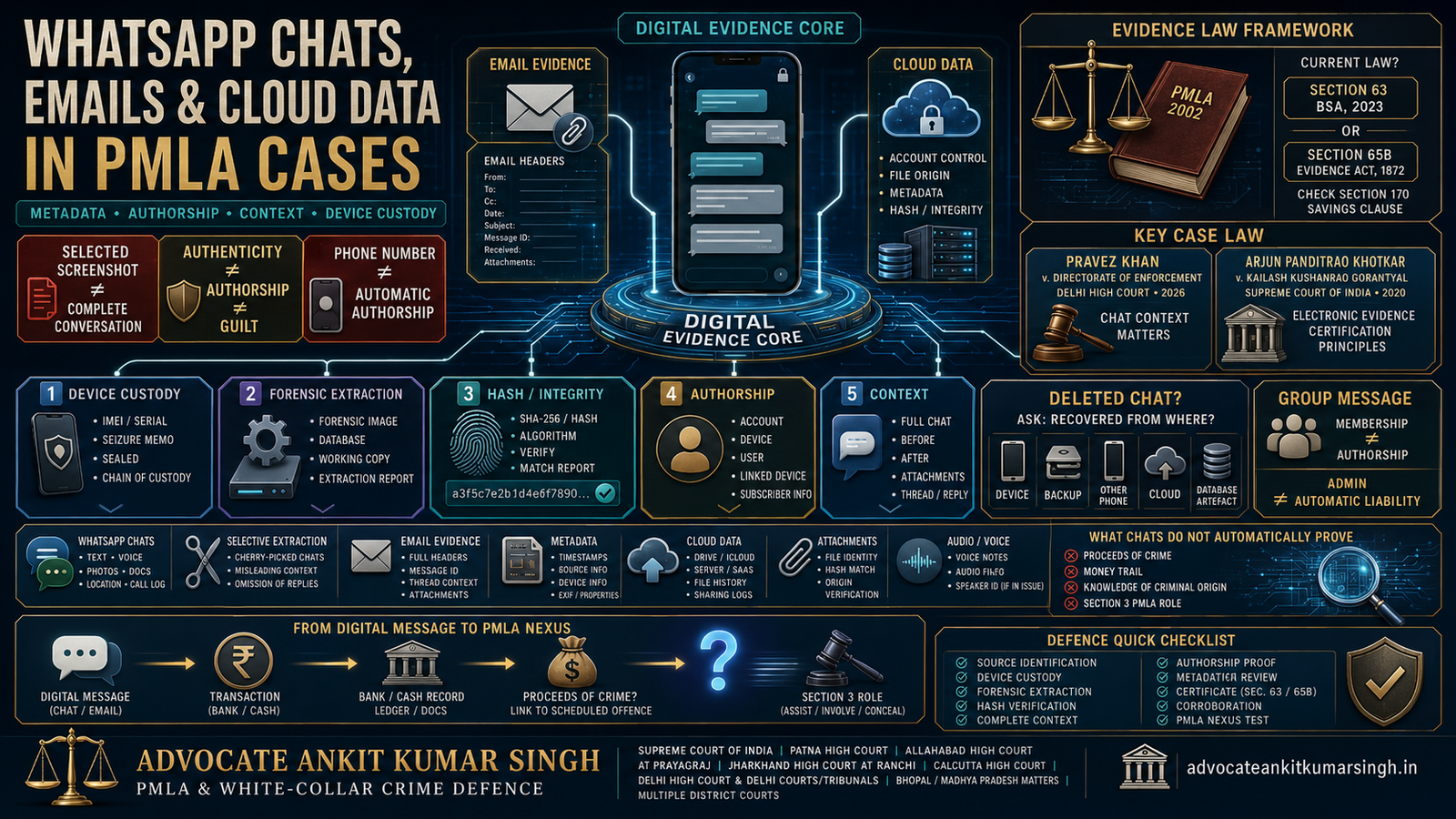
WhatsApp Chats, Emails and Cloud Data in PMLA Cases
Metadata, Context, Selective Extraction, Authorship, Device Custody, Section 65B / Section 63, Deleted Chats, Group Messages and Evidentiary Objections
Research updated: 8 August 2026 | By Advocate Ankit Kumar Singh
 Advocate Ankit Kumar Singh
Direct Answer: Can ED Use WhatsApp Chats and Emails in a PMLA Case?
Yes, electronic communications can become important evidence in a PMLA investigation or trial, but a screenshot, chat extract or email printout does not automatically prove authorship, authenticity, complete context, criminal knowledge or money-laundering.
A proper digital-evidence analysis should ask at least five separate questions:
- Existence: Is this electronic record genuine?
- Integrity: Has it remained unchanged from acquisition to production?
- Authorship: Who actually created or sent it?
- Context: What does the entire conversation mean?
- PMLA nexus: How does it connect the accused with identified proceeds of crime?
The prosecution should not jump directly from:
“A WhatsApp message exists”
to:
“The accused knowingly laundered proceeds of crime.”
The First Distinction: Data Is Not the Same as Meaning
Digital evidence ordinarily has at least three layers:
| Layer | Question |
|---|---|
| Technical layer | Was the record genuinely extracted from the stated source? |
| Attribution layer | Who authored, controlled or transmitted it? |
| Interpretive layer | What does the communication actually mean? |
Even a technically authentic chat can be misunderstood.
Likewise, a contextually incriminating sentence is of little value if its source, integrity or authorship cannot be properly established.
Current Evidence Law: Section 63 BSA or Section 65B Evidence Act?
This must be determined before drafting an objection.
The Bharatiya Sakshya Adhiniyam, 2023 came into force on 1 July 2024.
For proceedings governed by the BSA:
- Section 61 addresses electronic or digital records generally;
- Section 62 provides that their contents may be proved in accordance with Section 63;
- Section 63 contains the principal admissibility framework for computer output and electronic records.
However, Section 170 contains an important savings clause.
Where an application, trial, inquiry, investigation, proceeding or appeal was already pending immediately before the BSA commenced, the Indian Evidence Act, 1872 continues to govern in accordance with the savings provision.
Therefore:
POST-BSA CASE ≠ AUTOMATICALLY OLD SECTION 65B.
and:
OLD / SAVED PROCEEDING ≠ AUTOMATICALLY BSA SECTION 63.
Section 65B: Why It Still Matters
Section 65B of the Indian Evidence Act remains important for proceedings preserved by the BSA savings clause.
The Supreme Court's decision in Arjun Panditrao Khotkar v. Kailash Kushanrao Gorantyal remains foundational for understanding proof of secondary electronic evidence under that regime.
The broad practical distinction is:
- original electronic device / original electronic record;
- versus a computer output such as a printout, copied file, screenshot, CD, pen drive or exported record.
Where reliance is placed on secondary electronic output, compliance with the applicable statutory certification regime becomes critical.
BSA Section 63: More Than a Signature at the Bottom of a Printout
For proceedings governed by the BSA, the statutory framework requires attention to:
- identification of the electronic record;
- manner of production;
- device or digital-source particulars;
- lawful control;
- regular creation/storage/processing;
- device functioning;
- reproduction of information;
- the prescribed certificate;
- hash value;
- hash report;
- the Schedule requirements.
The BSA Schedule expressly contemplates source categories including:
- computer;
- storage media;
- DVR;
- mobile;
- flash drive;
- CD/DVD;
- server;
- cloud;
- other digital record source.
This is particularly important in PMLA cases because the same chat may exist in:
- the sender's handset;
- recipient's handset;
- forensic image;
- desktop backup;
- cloud backup;
- exported chat file;
- investigator's working copy.
Hash Value: The Digital Fingerprint of the File
A hash value is a computational identifier generated from digital data.
If even a small part of the underlying file changes, a cryptographic hash ordinarily changes.
In practical forensic litigation, counsel should ask:
- Was a hash generated when the device image was created?
- Which algorithm was used?
- What was the acquisition hash?
- What was the verification hash?
- Does the hash in the forensic report match?
- Does the hash in the statutory certificate match?
- Was a separate working copy created?
- What is the hash of that working copy?
A hash does not independently prove authorship or meaning.
It primarily helps establish integrity of the relevant digital object.
Device Custody: Who Had the Phone From Seizure to Extraction?
The defence should build a device-custody chronology.
| Stage | Question |
|---|---|
| Seizure | Who physically seized the device? |
| Identification | Make, model, IMEI, serial number? |
| Packaging | How was the device sealed? |
| Transfer | Who received it next? |
| Storage | Where was it kept? |
| Forensic acquisition | Who opened/accessed it? |
| Imaging | What forensic process was used? |
| Working copy | Was analysis done on original or copy? |
| Production | Which extracted version reached the Court? |
Every unexplained break does not automatically make the evidence inadmissible.
But unexplained custody gaps can become relevant when authenticity or manipulation is specifically disputed.
Was the Original Device Seized?
This question can fundamentally alter the defence strategy.
Scenario A — ED seized the actual phone
The defence can seek to examine:
- seizure record;
- device identifiers;
- forensic image;
- hashes;
- extraction report;
- chain of custody;
- scope of extraction.
Scenario B — ED relies only on a screenshot forwarded by another person
Then ask:
- Where is the source device?
- Who took the screenshot?
- When?
- Was it cropped?
- Can earlier and later messages be seen?
- Was the contact name manually saved?
- Does the screenshot display the number?
- What proves the sender's identity?
Screenshot ≠ Complete Chat
A screenshot captures only what was visible on a screen at a particular moment.
It may omit:
- earlier messages;
- later messages;
- replies;
- quoted messages;
- deleted-message indicators;
- attachments;
- group participants;
- contact number;
- date separators;
- message info;
- forwarding status.
Therefore the defence should distinguish:
SCREENSHOT ≠ CHAT EXPORT ≠ FORENSIC DATABASE EXTRACTION ≠ FULL DEVICE IMAGE.
Selective Extraction: One of the Most Important PMLA Objections
Suppose the entire conversation contains 4,000 messages, but the prosecution complaint reproduces 14.
The defence should ask:
- Why were those 14 selected?
- What appears immediately before them?
- What appears immediately afterwards?
- Were messages exchanged on the same subject on another date?
- Were replies omitted?
- Were voice notes omitted?
- Were attached invoices omitted?
- Did later messages explain an abbreviated expression?
- Was the conversation part of ordinary business negotiations?
A selected extract can be technically authentic yet contextually misleading.
Pravez Khan 2026: Why Context Matters in a PMLA WhatsApp Case
The Delhi High Court's decision in Pravez Khan v. Directorate of Enforcement, pronounced on 4 May 2026, provides a recent PMLA-specific example.
ED relied upon WhatsApp chats exchanged between certain accused persons and argued that they showed a financial trail relating to proceeds of crime.
The Court examined the chats itself.
At the bail stage, it considered them prima facie to be usual business communications between persons engaged in the medicine trade and declined to give them the significance sought by ED for restricting liberty.
The important principle for defence analysis is:
THE PROSECUTION'S LABEL FOR A CHAT IS NOT THE CHAT'S MEANING.
Counsel should independently read the communication in commercial, linguistic and chronological context.
Build a Full Context Matrix
| Relied Message | Message Before | Message After | Attachment | Alternative Context |
|---|---|---|---|---|
| “Send 25 today” | Discussion of invoice | Bank detail supplied | Invoice PDF | Possible commercial payment |
| “Keep it separate” | Two client files discussed | Separate ledger requested | Spreadsheet | Accounting instruction |
| “Cash ready” | Office expense discussion | Salary distribution | Payroll sheet | Ordinary business use |
The examples are illustrative only.
The real defence must follow the actual record rather than inventing innocent interpretations unsupported by the conversation.
Authorship: A Phone Number Does Not Automatically Prove Who Typed the Message
A message may be associated with:
- a telephone number;
- a WhatsApp account;
- a device;
- a saved contact name;
- a profile photograph.
Those facts may support attribution.
But authorship may still require additional evidence.
Ask:
- Who was the registered subscriber?
- Who actually possessed the handset?
- Was the SIM used by the accused?
- Was WhatsApp active on linked devices?
- Could employees access WhatsApp Web?
- Was the phone shared?
- Was the message acknowledged later?
- Does the accused's Section 50 statement admit authorship?
- Do other messages demonstrate unique personal knowledge?
- Does CDR/location evidence corroborate device use?
A contact saved as “Boss” does not by itself prove that the person named by the prosecution authored every message displayed under that label.
Linked Devices and WhatsApp Web
Modern messaging evidence cannot always be analysed as:
PHONE = AUTHOR.
Accounts may be accessible through:
- primary handset;
- linked desktop;
- browser session;
- other linked device.
Where authorship is genuinely disputed, device-level and account-access evidence may become relevant.
WhatsApp Group Messages Require Participant-Level Analysis
A group chat creates additional attribution problems.
Identify:
- group name;
- group identifier where available;
- creator;
- administrators;
- participants on the relevant date;
- who joined or left;
- number associated with each message;
- quoted/replied message;
- whether a message was forwarded;
- whether a reaction was later added.
Mere membership of a WhatsApp group does not prove agreement with every statement made in it.
Likewise:
READING ≠ AUTHORSHIP.
MEMBERSHIP ≠ CONSPIRACY.
SILENCE ≠ AUTOMATIC ADMISSION.
The prosecution must connect the particular person with the conduct and inference it seeks to prove.
Group Administrator Status Is Not Automatic Criminal Liability
Being shown as a group administrator may establish an administrative role within the messaging platform.
It does not automatically establish:
- authorship of other members' messages;
- knowledge of every communication;
- approval of every transaction;
- participation in money-laundering.
The person's own messages and conduct must still be analysed.
Deleted Chats: “Deleted” Does Not Tell You Where the Evidence Came From
When a prosecution complaint says:
“Deleted WhatsApp chats were recovered.”
the defence should ask a technical question:
“Recovered from where?”
Possible sources include:
- active application database;
- local device backup;
- database artefacts;
- unallocated or residual device data;
- notification history in an appropriate case;
- another participant's handset;
- desktop or linked-device artefacts;
- cloud backup;
- previous forensic image.
These are not evidentially identical.
A Deleted Message May Not Reveal Its Complete Original Content
Depending upon the source and forensic artefact, an examiner may recover:
- complete text;
- partial text;
- database row;
- timestamp;
- sender/recipient identifier;
- attachment reference;
- deletion marker;
- or only evidence that a message once existed.
Therefore counsel should not accept the phrase:
“Deleted chat recovered”
without reviewing the underlying forensic methodology and artefacts.
Deletion Is Not Automatically Consciousness of Guilt
People delete digital material for many reasons:
- storage management;
- privacy;
- routine clearing;
- device migration;
- application settings;
- account change;
- business retention policy.
In another case, deliberate deletion immediately after learning of an investigation may potentially be relied upon as conduct.
The evidentiary significance therefore depends upon:
- timing;
- method;
- what was deleted;
- whether deletion was selective;
- knowledge of investigation;
- other surrounding evidence.
Email Evidence: Do Not Stop at the Printed Body
An email printout may show:
- From;
- To;
- CC;
- subject;
- date;
- visible body.
But technical examination may also involve:
- full email headers;
- message ID;
- routing information;
- mail-server timestamps;
- return path;
- originating systems where available;
- authentication results;
- attachment identifiers;
- thread structure.
The visible sender name alone should not be treated as conclusive authorship.
Email Thread Context Can Be Selectively Presented Too
If ED relies upon the sentence:
“Please arrange the payment today.”
counsel should obtain the complete thread.
The earlier correspondence may show whether the payment concerned:
- a genuine invoice;
- salary;
- refund;
- professional fee;
- loan;
- purchase transaction;
- or something entirely different.
Again:
AUTHENTIC SENTENCE ≠ PROSECUTION'S INTERPRETATION AUTOMATICALLY PROVED.
Attachments Must Be Proved Separately
An email saying “attached is the statement” and a spreadsheet found elsewhere are not automatically proved to be the same attachment.
The prosecution should identify:
- attachment filename;
- size;
- hash where available;
- email message containing it;
- date/time;
- recipient;
- metadata;
- extracted copy;
- relationship with the file produced in evidence.
Cloud Data: Identify the Actual Source
“Cloud data” is too vague for forensic litigation.
Identify whether the alleged record came from:
- Google Drive;
- iCloud;
- OneDrive;
- Dropbox;
- corporate server;
- email server;
- SaaS platform;
- cloud-based accounting platform;
- WhatsApp backup;
- another remote storage system.
Then ask:
- Who controlled the account?
- How was access obtained?
- What account identifier was used?
- What data was downloaded?
- Was metadata preserved?
- Was a hash generated?
- Did the provider supply records?
- Was the download performed manually?
- Was the original folder structure retained?
Cloud Account Ownership ≠ Authorship of Every File
A cloud account can contain:
- files created by account owner;
- shared files;
- files uploaded by employees;
- automatically synced material;
- documents created by collaborators;
- attachments downloaded automatically.
Therefore the prosecution should separately establish:
ACCOUNT CONTROL → FILE ORIGIN → FILE CREATOR → MODIFICATION HISTORY → RELEVANCE.
Metadata: What Should the Defence Ask For?
Depending upon the digital source, potentially relevant metadata includes:
- file creation time;
- modification time;
- access time;
- message timestamp;
- sender identifier;
- recipient identifier;
- message ID;
- group ID;
- attachment path;
- file hash;
- device identifier;
- account identifier;
- database record number;
- email routing data;
- cloud object information;
- EXIF information for photographs where available.
Metadata should be interpreted carefully because different platforms and forensic tools may store or display time and attribution information differently.
Timestamp Problems
A displayed timestamp may be affected by:
- device timezone;
- server timezone;
- UTC conversion;
- daylight-saving conversion in foreign jurisdictions;
- device clock settings;
- application display conventions;
- export-tool settings.
Where minutes or hours matter to the prosecution chronology, counsel should verify the time basis rather than rely solely upon what appears on a screenshot.
Photos and Documents Sent on WhatsApp
A photograph appearing in a WhatsApp conversation raises separate questions:
- Who took the photograph?
- Was it sent by the accused?
- Was it forwarded?
- Was it downloaded automatically?
- Does the file retain original metadata?
- Was WhatsApp compression applied?
- Does the file found on the phone match the file produced in Court?
The existence of an image in a chat does not automatically prove who created the original image.
Voice Notes and Audio Messages
Voice notes create an additional authorship layer.
The prosecution may need to establish:
- originating account;
- device/source;
- integrity of audio file;
- speaker identity;
- context;
- complete surrounding conversation.
Where speaker identity is genuinely contested, ordinary account attribution and forensic voice identification are conceptually different questions.
“Code Words” Require Proof of Meaning
Financial-crime investigations often allege that expressions such as:
- “packet”;
- “material”;
- “number”;
- “piece”;
- “setting”;
- “adjustment”;
- “cash”;
- “percentage”
were coded references to illegal payments.
The prosecution should explain how the alleged meaning is established.
Potential corroborative material could include:
- other messages;
- corresponding bank transaction;
- cash recovery;
- ledger;
- statement of participants;
- repeated usage pattern;
- transaction chronology.
The investigating officer's interpretation alone should not automatically become the factual meaning of an ambiguous commercial expression.
WhatsApp Chats Do Not Automatically Establish a Money Trail
A money trail is ordinarily a financial proposition.
If a chat says:
“Send 20 tomorrow.”
the prosecution should ordinarily still identify, where relevant:
- 20 what?
- to whom?
- through which method?
- whether payment occurred;
- which account;
- which cash transaction;
- what the underlying purpose was;
- how the amount relates to proceeds of crime.
Digital conversation may corroborate a financial trail.
It should not automatically substitute for one.
Chat Evidence and Section 3 PMLA
Even after authenticity is established, the prosecution still needs to connect the communication with the statutory money-laundering theory.
Ask:
- What proceeds of crime are identified?
- Which scheduled offence generated them?
- What process or activity under Section 3 is alleged?
- Does the chat prove concealment?
- Possession?
- Acquisition?
- Use?
- Projection as untainted?
- Claiming as untainted?
- Knowing assistance?
- Knowing participation?
Electronic evidence remains subject to the substantive ingredients of PMLA.
Cross-Examination of the Digital Forensic Witness
Potential questions:
- What device did you examine?
- What was its IMEI/serial number?
- Who delivered the device to you?
- Was the seal intact?
- When was it opened?
- Was the device isolated from networks?
- Was a forensic image created?
- What was the acquisition method?
- What was the hash?
- Was the hash verified?
- Was analysis performed on the original device or a working copy?
- What software and version were used?
- Was the extraction logical, file-system or physical?
- Were deleted records recovered?
- How?
- Were all chats exported?
- Who selected the messages placed in the prosecution complaint?
- Were attachments extracted?
- Were database files preserved?
- Was metadata exported?
- Were linked devices investigated?
Cross-Examination of the Investigating Officer
- Did you personally examine the complete chat?
- How many total messages existed?
- How many are relied upon?
- Who selected them?
- Why were surrounding messages omitted?
- Did you verify the phone subscriber?
- Did you verify actual user?
- Did you examine WhatsApp-linked devices?
- Did you compare chats recovered from both participants?
- Did you verify email headers?
- Did you obtain cloud metadata?
- Did you trace the alleged payment mentioned in the chat?
- Which bank entry corroborates the message?
- Which witness establishes the alleged coded meaning?
- Did you investigate the innocent commercial explanation?
Digital Evidence Comparison Matrix
| Evidence | Main Question | Defence Objection |
|---|---|---|
| Screenshot | What exactly was visible? | Cropped / incomplete context |
| Chat export | Who exported it and from which account? | Authorship / completeness |
| Forensic extraction | How acquired? | Chain, hash, methodology |
| Deleted chat | Recovered from where? | Artefact / completeness |
| Email printout | Where are headers? | Sender/authorship |
| Cloud file | Who created it? | Shared/synced data |
| Group message | Who sent it? | Membership ≠ authorship |
| Attachment | Is it the same file? | Hash / file identity |
30-Point Digital-Evidence Defence Checklist
- Identify governing evidence law.
- Check BSA Section 170 savings.
- Identify original device.
- Record device identifiers.
- Obtain seizure record.
- Prepare device-custody chronology.
- Identify forensic examiner.
- Identify forensic tool.
- Identify extraction type.
- Obtain hash values.
- Compare hashes.
- Identify working copy.
- Obtain complete chat where legally available.
- Compare selected extracts.
- Identify omissions.
- Review preceding messages.
- Review subsequent messages.
- Review attachments.
- Check authorship.
- Check subscriber details.
- Check linked devices.
- Review group participants.
- Check deleted-message methodology.
- Review email headers.
- Identify cloud source.
- Review metadata.
- Check certificate under applicable law.
- Verify PMLA money-trail corroboration.
- Prepare cross-examination matrix.
- Separate technical authenticity from substantive guilt.
Advanced Digital-Evidence Flowchart
PMLA digital-evidence analysis: identify the source, preserve device custody and integrity, establish authorship and full context, comply with the applicable electronic-evidence regime, and only then assess whether the material proves a PMLA nexus.Plain-text alternative: WhatsApp/email/cloud source → device/account custody → forensic acquisition → hash/integrity → extraction → metadata → authorship → full context → Section 65B or Section 63 compliance → corroboration → PMLA proceeds-of-crime nexus → Special Court assessment.
Frequently Asked Questions
1. Are WhatsApp chats admissible in a PMLA case?
Potentially yes, subject to the applicable evidentiary law, proof of the electronic record and case-specific issues of authenticity, authorship and relevance.
2. Is Section 65B still applicable in 2026?
Yes in proceedings preserved under the BSA savings clause where the Indian Evidence Act continues to govern. Otherwise, Section 63 BSA is the principal current electronic-record provision.
3. Does every post-1 July 2024 case use Section 63?
Not automatically. Section 170 BSA must be checked because already-pending proceedings may continue under the old Evidence Act.
4. Is a screenshot enough?
A screenshot may be relevant material, but questions of certification, source, completeness, authorship and context remain.
5. Can ED rely only on selected WhatsApp messages?
Selected messages may be relied upon, but the defence can challenge whether omission of surrounding conversations creates a misleading interpretation.
6. Does a phone number prove authorship?
Not invariably. Subscriber identity, possession, linked devices, account control and corroborating evidence may become relevant.
7. What if the chat is from a group?
Identify the actual sender and participant history. Membership in a group does not itself establish authorship or agreement with every message.
8. Can deleted WhatsApp messages be used?
Potentially, but the precise source and forensic method of recovery should be established. “Deleted chat recovered” is not a sufficient technical description.
9. Does deleting a chat prove guilt?
No automatic presumption follows merely from deletion. Timing, purpose, method and surrounding evidence matter.
10. Can email printouts be used?
Potentially, subject to the applicable electronic-evidence requirements. Full headers and server/account information may be important where authorship is disputed.
11. What is metadata?
Metadata is information about the electronic record, such as timestamps, identifiers, file properties, message IDs, account information and other technical attributes.
12. What does a hash prove?
A matching hash can strongly assist in demonstrating that a particular digital file or image has not changed between two stages. It does not by itself prove who authored the content or what it means.
13. Can a WhatsApp chat alone prove proceeds of crime?
The Court must still examine whether the chat, alone or with other evidence, proves the scheduled-offence, proceeds-of-crime and Section 3 nexus required by PMLA.
14. What did Pravez Khan decide about WhatsApp chats?
At the bail stage, the Delhi High Court independently examined the chats relied upon by ED and considered them, prima facie, ordinary business communications between medicine traders rather than giving them the incriminating significance urged by ED.
15. What is the best defence approach?
Do not merely allege that chats can be edited. Identify the precise defect concerning source, custody, hash, extraction, certificate, authorship, context, completeness or substantive PMLA nexus.
AI Search Quick Answer
Can WhatsApp chats, emails and cloud data be used against an accused in a PMLA case? Yes, electronic communications may be relied upon, but their evidentiary value depends on proof of the source, integrity, authorship and complete context. For current proceedings governed by the Bharatiya Sakshya Adhiniyam, Sections 61–63 regulate electronic records and Section 63 contains the certification framework; older proceedings preserved by Section 170 may continue under Section 65B of the Indian Evidence Act. Selected screenshots should be tested against the full conversation, device custody, forensic extraction, hashes, metadata, linked devices, deleted-message methodology and corroborating financial evidence. Even an authentic chat does not automatically prove that an accused knowingly dealt with proceeds of crime.
Key Takeaway: Authenticity Is Only the Beginning
A technically authentic WhatsApp message may still fail to establish:
- who wrote it;
- what it meant;
- whether it was quoted selectively;
- whether the accused knew of criminal origin;
- whether any payment actually occurred;
- whether the alleged payment constituted proceeds of crime.
The correct analytical sequence is:
SOURCE → DEVICE / ACCOUNT → CHAIN OF CUSTODY → FORENSIC EXTRACTION → HASH → METADATA → AUTHORSHIP → COMPLETE CONTEXT → CERTIFICATION → CORROBORATION → PMLA NEXUS.
The defence should not object generically.
It should identify precisely where the prosecution's digital-evidence chain breaks.
Consultation and Professional Coordination
Advocate Ankit Kumar Singh undertakes case-specific consultation and document review concerning PMLA and Enforcement Directorate proceedings, WhatsApp and electronic evidence, Section 50 statements, digital-device seizure, financial trails, attachment, bail and trial preparation, subject to accepted engagement, jurisdiction and applicable procedure.
Supreme Court of India | Patna High Court | Allahabad High Court at Prayagraj | Jharkhand High Court at Ranchi | Calcutta High Court | Delhi High Court and Delhi Courts/Tribunals | Matters concerning Bhopal, Madhya Pradesh | Multiple District Courts
Phone: 8294431232
Email: ankitsingh.legum@gmail.com
Website: advocateankitkumarsingh.in
Where acting or filing before the Supreme Court of India requires an Advocate-on-Record, applicable Supreme Court procedure must be followed. Local or authorised counsel may similarly be required depending upon the forum.
No exclusion of electronic evidence, bail, discharge, acquittal or other judicial outcome can be guaranteed.
Official and Primary Legal Sources
- India Code — Bharatiya Sakshya Adhiniyam, 2023
- India Code — Prevention of Money-Laundering Act, 2002
- Supreme Court — Arjun Panditrao Khotkar v. Kailash Kushanrao Gorantyal
- Supreme Court of India
- Delhi High Court
- Directorate of Enforcement — PMLA Acts and Rules
Important authorities and developments discussed include Arjun Panditrao Khotkar v. Kailash Kushanrao Gorantyal, Dell International Services India Pvt. Ltd. v. Adeel Feroze & Ors. and Pravez Khan v. Directorate of Enforcement.
Electronic-evidence law remains technically sensitive. The governing evidence statute, procedural stage, original device, certificate, forensic report and subsequent Supreme Court or jurisdictional High Court authorities should be verified before taking a case-specific objection.
Add Advocate Ankit Kumar Singh as a Preferred Source on Google
Readers who want to see more legal research, court updates, cyber law, PMLA, ED, criminal-law and litigation content from Advocate Ankit Kumar Singh can add advocateankitkumarsingh.in as a Preferred Source on Google.
Add advocateankitkumarsingh.in as a Preferred Source on Google
Disclaimer: This article is intended for general legal education and procedural awareness. The admissibility and evidentiary value of WhatsApp chats, emails, cloud records and other digital material depend upon the governing evidence law, source, device custody, forensic acquisition, certification, integrity, authorship, context, corroboration and the complete record. Technical extraction methods differ across devices, applications and forensic tools. Nothing in this article guarantees exclusion of electronic evidence, bail, discharge, acquittal or any other judicial outcome. Current statutory provisions and subsequent Supreme Court or jurisdictional High Court decisions should be verified before taking case-specific action.