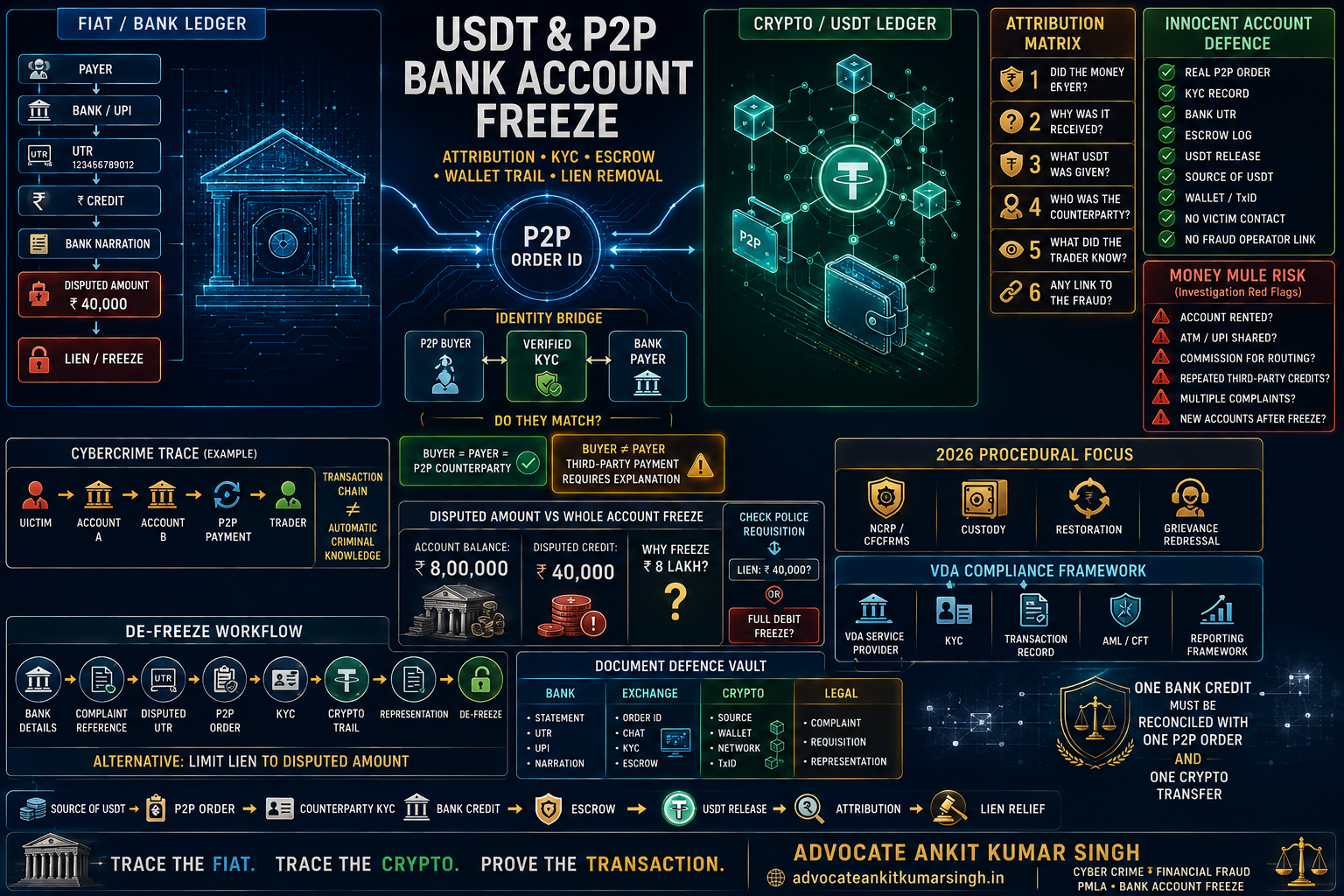
USDT • P2P • CYBERCRIME • BANK FREEZE • KYC • BLOCKCHAIN • DIGITAL EVIDENCE
USDT and P2P Trading Bank Account Freeze in India: Attribution, KYC, Crypto Trail and Innocent Account Defence
Exchange Records • Counterparty KYC • Wallet Address • TxID • Escrow • Bank Narration • Lien Removal
Research updated: 10 August 2026 | By Advocate Ankit Kumar Singh
 Advocate Ankit Kumar Singh
Direct Answer: Why Does a Bank Account Get Frozen After a USDT P2P Trade?
A common problem arises when a person sells USDT through a P2P platform and receives INR into a bank account from the buyer or another payer.
The USDT is released and the trade appears complete.
Later, police or a cybercrime unit may trace the INR to an earlier cyber-fraud complaint and send a request concerning the recipient account.
The bank may then place:
- a lien;
- an amount hold;
- a debit restriction;
- or a wider account freeze.
The critical question is not merely whether disputed money touched the account.
THE DEFENCE MUST EXPLAIN WHY THE MONEY WAS RECEIVED, WHAT WAS GIVEN IN EXCHANGE, WHO THE COUNTERPARTY WAS, AND WHAT THE ACCOUNT HOLDER KNEW AT THAT TIME.
The Core USDT P2P Transaction
A genuine asserted P2P sale should ordinarily be capable of reconstruction.
USDT AVAILABLE → P2P SELL ORDER → BUYER → INR PAYMENT → BANK CREDIT → PAYMENT VERIFIED → USDT RELEASE → ORDER COMPLETED
The defence should preserve evidence for every step.
Do Not Start With the Bank Freeze — Start With the Source of the USDT
Suppose the disputed trade involved 5,000 USDT.
The first question should not merely be:
Who bought the 5,000 USDT?
Ask:
Where did the account holder obtain the 5,000 USDT?
Relevant evidence may include:
- exchange purchase history;
- previous P2P acquisition;
- deposit history;
- withdrawal history;
- own-wallet transfer;
- blockchain transaction hash;
- earlier trading balance;
- lawfully documented business receipt where applicable.
The defence should create a source-of-crypto chronology rather than beginning only at the disputed sale.
The Six-Way P2P Evidence Reconciliation
BANK CREDIT ⇄ P2P ORDER ⇄ COUNTERPARTY ⇄ ESCROW ⇄ USDT RELEASE ⇄ WALLET / EXCHANGE RECORD
Every inconsistency should be identified before a representation is submitted.
1. Exchange Records
Preserve the complete transaction record available from the relevant exchange or platform.
For the disputed order obtain:
- order ID;
- date;
- timestamp;
- buy/sell designation;
- USDT quantity;
- INR consideration;
- quoted rate;
- counterparty username;
- counterparty UID where available;
- payment method;
- order status;
- release timestamp;
- chat history;
- appeal/dispute history.
2. Counterparty KYC
The identity relationship is one of the most important parts of a P2P defence.
Create:
| Identity | Name / Identifier |
|---|---|
| P2P Buyer | _____ |
| Verified Platform Name | _____ |
| Bank Payer | _____ |
| UPI Name | _____ |
| Crypto Recipient | _____ |
Third-Party Payment: A Major Warning Sign That Requires Explanation
Suppose:
P2P buyer: A
But INR comes from: B
The buyer says:
“My brother/friend/customer will pay you.”
This breaks the cleanest identity chain.
It does not automatically establish criminal knowledge.
But the defence must explain why the seller accepted payment from someone other than the identified P2P counterparty and what the contemporaneous platform records show.
3. Bank Evidence
Preserve:
- bank statement;
- exact credit;
- payer name;
- UTR;
- UPI reference;
- IMPS/NEFT reference;
- bank narration;
- timestamp;
- available payer-account information.
Do not submit only cropped screenshots where original statements or platform exports are available.
4. Wallet Address and Blockchain Evidence
For an on-chain transaction, preserve:
- network;
- transaction hash / TxID;
- originating address;
- destination address;
- USDT amount;
- transaction time;
- transaction status;
- exchange deposit/withdrawal reference where applicable.
For an exchange-internal P2P settlement, preserve the platform's own order and wallet records even where the transfer does not appear as a conventional user-to-user on-chain transaction.
5. Escrow Evidence
Escrow records may establish the commercial sequence:
ORDER CREATED → USDT RESERVED → BUYER MARKS PAID → BANK CREDIT VERIFIED → SELLER RELEASES USDT → ORDER COMPLETED
This is important because the investigator may initially see only the fiat side of the transaction.
6. P2P Order Book
A disputed transaction should be placed in the context of the trader's actual activity.
| Date | Order ID | USDT | INR | Counterparty | Status |
|---|---|---|---|---|---|
| _____ | _____ | _____ | _____ | _____ | _____ |
A historical order book can help distinguish an isolated genuine trade pattern from activity showing unexplained credits, unusual counterparties or other suspicious features.
Attribution: The Most Important Legal and Evidentiary Analysis
Level 1 — Money Attribution
Did the disputed INR actually enter this account?
Level 2 — Transaction Attribution
Which P2P order corresponds to that credit?
Level 3 — Counterparty Attribution
Who paid the INR and who obtained the USDT?
Level 4 — Knowledge Attribution
What evidence, if any, indicates that the seller knew the INR was connected with cyber fraud?
Level 5 — Participation Attribution
Is there evidence connecting the account holder with the underlying fraud, fraud operators, victim solicitation, mule-account procurement or criminal proceeds beyond the disputed P2P exchange itself?
Being in the Transaction Chain Is Not the Same Question as Criminal Participation
Investigators may trace:
VICTIM → ACCOUNT A → ACCOUNT B → P2P COUNTERPARTY → USDT SELLER
The USDT seller may therefore appear in the financial trail.
But the defence should separately analyse:
- receipt of money;
- consideration supplied;
- knowledge;
- connection with the victim;
- connection with fraud operators;
- financial benefit beyond ordinary trading consideration.
“Layer 1”, “Layer 2” or “Layer 3” Is Not the End of the Legal Analysis
Transaction-layer terminology is useful for tracing.
But the defence should insist on transaction specificity.
Ask:
- What complaint?
- What victim?
- What amount?
- What date?
- What UTR?
- What preceding account?
- What amount reached this account?
Do not respond to a vague allegation with a vague explanation.
Whole Account Frozen for One Disputed Transaction
Consider:
Total account balance: ₹7,80,000
Disputed P2P receipt: ₹32,000
Entire account: Debit frozen
The defence should immediately determine whether the investigating requisition seeks:
- ₹32,000 lien;
- specified amount hold;
- complete debit freeze;
- or some other restriction.
Recent High Court decisions have scrutinised situations in which an entire account remained frozen even though the investigating requisition concerned a specified amount.
Important 2026 Development: NCRP–CFCFRMS SOP
Recent Kerala High Court decisions record that the Indian Cyber Crime Coordination Centre under the Ministry of Home Affairs formulated the:
SOP FOR NCRP–CFCFRMS: CUSTODY, RESTORATION OF MONEY AND GRIEVANCE REDRESSAL, 2026.
The judgments describe the SOP as creating procedures concerning:
- amount holds;
- account/property seizure;
- protection of victims of cyber-enabled financial crime;
- interim custody/restoration;
- accountability;
- grievance redressal.
The exact facts, applicable requisition and procedural stage still matter in every case.
2026 High Court Trend: Specific Lien Versus Blanket Freeze
In 2026, the Kerala High Court has continued issuing directions in appropriate cybercrime-freeze cases permitting account operation while restricting the lien to the amount shown in the investigating agency's requisition, subject to the court's stated qualifications concerning suspected cybercrime or money-mule activity.
A Karnataka High Court ruling reported in June 2026 similarly addressed a situation in which investigating agencies had specified ₹25,000 while the bank froze the account more broadly, with the Court directing that the specified amount be earmarked while the remaining account could operate.
These decisions are useful, but they should not be converted into an assertion that every P2P trader has an automatic right to immediate de-freezing.
What Makes an Innocent-Account Defence Stronger?
- Real P2P order.
- Verified platform account.
- Buyer and bank payer match.
- Normal market-linked rate.
- USDT genuinely existed before sale.
- Source of USDT documented.
- USDT actually released.
- Escrow records preserved.
- No direct connection with fraud victim.
- No connection with fraud operators.
- No commission for lending the bank account.
- No sharing of ATM/UPI credentials.
- No deliberate use of third-party bank accounts.
- No false explanation.
- Prompt cooperation with investigator.
What Can Seriously Weaken the Defence?
- Account rented to another person.
- ATM card handed over.
- UPI credentials shared.
- Payment received for merely routing funds.
- Repeated unexplained third-party credits.
- Crypto transferred outside the asserted transaction.
- Fake KYC.
- Fabricated screenshots.
- Deleted exchange history.
- Contradictory statements.
- Repeated use of replacement accounts after earlier freezes.
- Communication showing knowledge of fraud proceeds.
FIU-India and VDA KYC Records
Specified virtual-digital-asset activities carried out for or on behalf of another person in the course of business fall within India's PMLA reporting-entity framework.
FIU-India currently publishes updated AML/CFT Guidelines for reporting entities providing services related to virtual digital assets.
For defence purposes, platform KYC and transaction records can therefore become valuable evidence.
But:
PLATFORM KYC IS EVIDENCE — NOT IMMUNITY.
Structured Lien-Removal / De-Freezing Strategy
Step 1 — Write to the Bank
Request the available particulars of:
- freeze/lien;
- amount;
- date;
- complaint reference;
- issuing authority;
- investigating officer;
- nature of restriction.
Step 2 — Identify the Exact Transaction
Do not send 500 pages of records without identifying the disputed credit.
Step 3 — Build the Fiat Trail
UTR → payer → amount → date → bank narration.
Step 4 — Build the P2P Trail
Order ID → buyer → USDT → INR → timestamp.
Step 5 — Build the Crypto Trail
Source → exchange/wallet → escrow → release → recipient.
Step 6 — Build the KYC Trail
Platform buyer → bank payer → crypto recipient.
Step 7 — Explain the Commercial Consideration
State clearly what was supplied in return for the INR.
Step 8 — Submit Representation to the Investigating Authority
Attach indexed evidence rather than unsupported assertions.
Step 9 — Seek Appropriate Relief
Depending upon the facts:
- complete de-freezing;
- removal of lien;
- limitation to disputed amount;
- permission to operate undisputed balance.
Step 10 — Assess Judicial Remedy
If administrative resolution fails, identify the correct court and remedy from the actual freezing authority, complaint/FIR, procedural provision, location and existing proceedings.
Documents to Send Your Lawyer
- Bank freeze/lien message.
- Bank email.
- Bank statement.
- Complaint number.
- Police/cyber unit details.
- Investigating officer details.
- Disputed UTR.
- UPI record.
- P2P order ID.
- Complete order screenshot/export.
- Buyer profile.
- Available buyer KYC information.
- P2P chat.
- Escrow record.
- USDT release record.
- Wallet transaction history.
- TxID where applicable.
- Source-of-USDT documents.
- Historical P2P order book.
- Earlier representations.
What Not to Do After the Freeze
Do not:
- fabricate P2P screenshots;
- edit bank statements;
- invent a counterparty;
- delete exchange records;
- delete relevant chats;
- create a retrospective invoice;
- give inconsistent explanations to bank and police;
- assume that returning money automatically ends every legal issue;
- make an admission merely to obtain quick de-freezing without understanding its consequences.
Frequently Asked Questions
My bank account was frozen after selling USDT. Does that mean I committed cyber fraud?
No. A freeze is an investigative/protective measure and is not itself a finding of guilt. The underlying transaction and your role must be examined.
What is the most important evidence?
The complete correlation between the disputed bank credit, P2P order, counterparty and corresponding USDT transfer.
Should I preserve the P2P chat?
Yes.
Should I preserve the wallet address?
Yes, together with the TxID and exchange records where applicable.
Why is the source of USDT important?
It helps reconstruct the complete commercial transaction rather than presenting only the disputed fiat receipt.
What if the buyer and bank payer are different?
That requires careful explanation. Third-party payment weakens the simplest identity chain and may increase investigative scrutiny.
Does exchange KYC prove innocence?
No. It is relevant evidence, but it is not immunity from investigation.
Can the whole account be frozen for one transaction?
The precise requisition, suspected role and applicable legal circumstances must be examined. Recent High Court decisions have scrutinised blanket restrictions where the police requisition identifies a specific amount.
Can I request that only the disputed amount remain under lien?
Depending upon the facts and the investigating requisition, that may be an important alternative relief to seek.
What is the strongest defence?
A truthful, document-backed reconstruction of the fiat trail, crypto trail, counterparty identity, commercial consideration and absence of knowing participation in the underlying fraud.
Final Defence Formula
SOURCE OF USDT → P2P ORDER → COUNTERPARTY KYC → BANK CREDIT → ESCROW → USDT RELEASE → WALLET / EXCHANGE RECORD → KNOWLEDGE ANALYSIS → ATTRIBUTION → LIEN / DE-FREEZE RELIEF
The objective is not merely to say:
“I traded USDT.”
The objective is to prove, from contemporaneous records:
WHY THIS MONEY ENTERED THIS ACCOUNT AND WHAT LEFT IN EXCHANGE FOR IT.
USDT, P2P Trading, Cybercrime and Bank-Freeze Legal Assistance
Advocate Ankit Kumar Singh assists in case-specific matters involving cybercrime bank freezes, disputed P2P transactions, USDT and cryptocurrency transaction trails, NCRP-linked liens, financial fraud investigations, PMLA/ED proceedings and related litigation, subject to professional engagement and applicable jurisdiction.
Professional assistance may include:
- bank-freeze analysis;
- cybercrime complaint tracing;
- P2P evidence reconstruction;
- counterparty KYC analysis;
- USDT wallet/transaction documentation;
- source-of-funds and source-of-crypto analysis;
- representation for de-freezing;
- disputed-amount/lien analysis;
- High Court remedy assessment;
- PMLA and proceeds-of-crime risk analysis where applicable.
Phone: 8294431232
Email: ankitsingh.legum@gmail.com
Website: advocateankitkumarsingh.in
Research Sources
The legal and compliance framework for this article should be periodically checked against current materials published by FIU-India, India Code, the Ministry of Home Affairs/I4C and binding decisions of the Supreme Court and relevant High Courts because cybercrime account-freeze procedures and VDA compliance standards continue to develop.
Add Advocate Ankit Kumar Singh as a Preferred Source on Google
Readers who want more legal research concerning cybercrime, bank account freezes, PMLA, ED and financial-crime litigation can add advocateankitkumarsingh.in as a Preferred Source on Google.
Add advocateankitkumarsingh.in as a Preferred Source on Google
Disclaimer: This article is for general legal education and does not suggest that every USDT or P2P trader whose account is frozen is an innocent trader, nor that every account receiving disputed money is a money mule. Criminal attribution depends on the complete facts, including the source of funds, source of crypto, counterparty identity, knowledge, communications, transaction pattern and connection, if any, with the underlying cyber offence. No record, screenshot, KYC document, wallet history or transaction evidence should be fabricated, altered, backdated or destroyed.