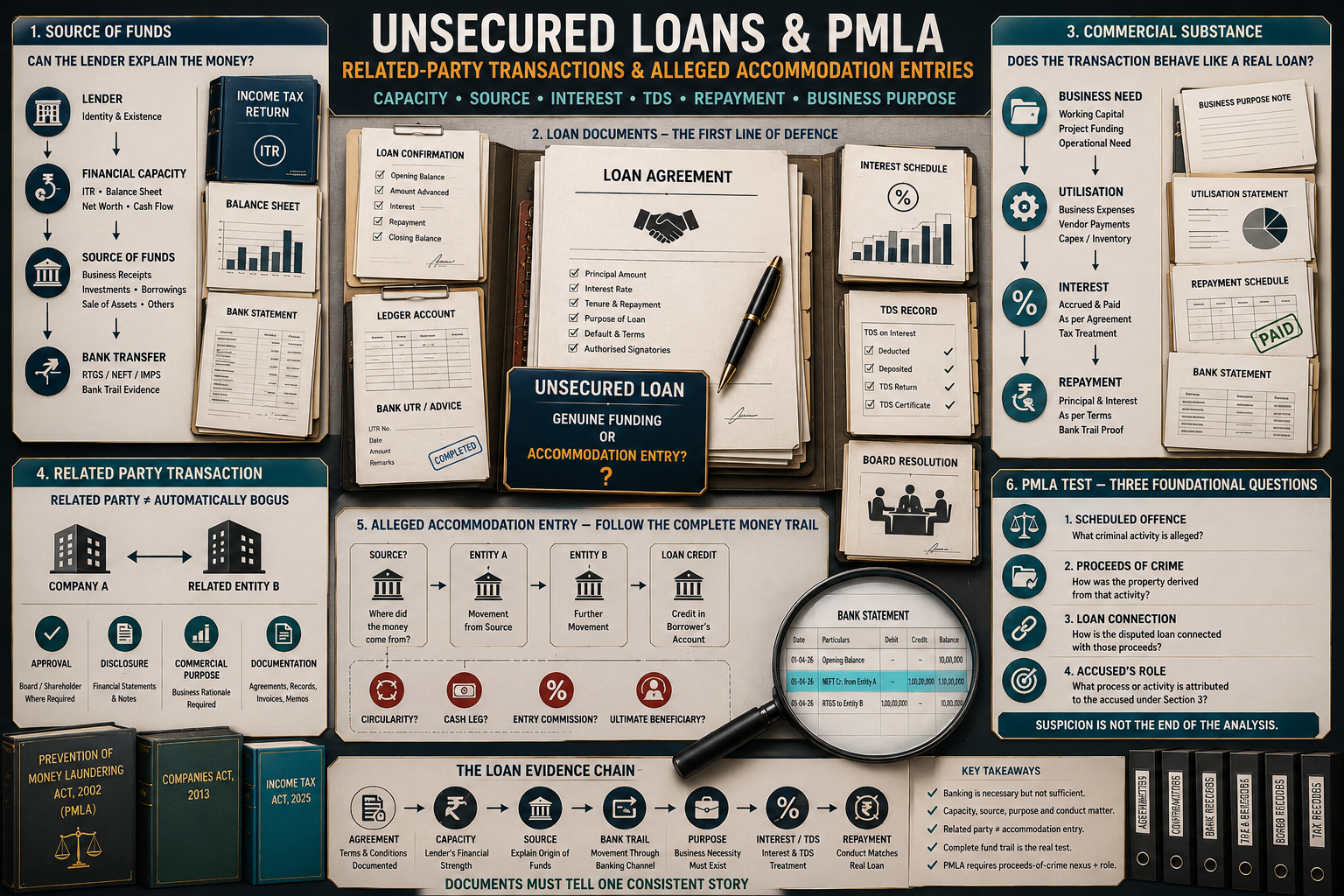
Unsecured Loans, Related-Party Transactions and Alleged Accommodation Entries under PMLA: Proving Genuineness, Financial Capacity and Business Purpose
Updated: 10 August 2026

An unsecured loan can be entirely legitimate.
It can also, depending upon the evidence, be alleged to represent an accommodation entry, layering transaction or mechanism through which money is routed and subsequently presented in the books as legitimate corporate funding.
The legal problem begins when investigators treat the accounting description “unsecured loan” as suspicious and the borrower responds merely by saying:
“The money came through banking channels, therefore the transaction is genuine.”
That answer is often incomplete.
At the same time, describing a transaction as an “accommodation entry” does not itself establish the offence of money laundering.
A proper analysis must identify the alleged proceeds of crime, establish the source and movement of the money, examine the lender's financial capacity and then connect the particular person with the relevant process or activity alleged under PMLA.
This detailed guide by Advocate Ankit Kumar Singh explains how unsecured loans, related-party credits and alleged accommodation entries should be analysed through agreements, confirmations, Income-tax Returns, financial capacity, interest, applicable TDS compliance, repayment, corporate approvals and business necessity.
1. An Unsecured Loan Is Not Automatically an Accommodation Entry
Businesses frequently borrow without creating asset security.
The lender may be:
- a promoter;
- a director;
- a shareholder;
- a group company;
- a family entity;
- an associate concern;
- an unrelated company;
- an individual investor;
- another commercial lender.
The absence of collateral does not by itself determine whether the transaction is genuine.
The transaction must be examined on its evidence.
2. What Does “Accommodation Entry” Mean in a PMLA Investigation?
The expression is commonly used to describe a transaction alleged to create the appearance of a legitimate accounting event without corresponding genuine economic substance.
In the loan context, an investigating theory may allege that money was routed through one or more entities and ultimately entered the borrower's books as a loan despite being economically attributable to someone else.
But the label should never replace proof.
Counsel should require the allegation to be converted into a complete money trail.
3. Start With the Alleged Proceeds of Crime
Before debating whether the loan was unsecured or related-party, identify the alleged proceeds of crime.
Ask:
- What scheduled offence is relied upon?
- What criminal activity allegedly generated the property?
- What amount was allegedly generated?
- Where did that property first enter the financial system?
- How is the disputed loan connected with that property?
Without establishing the relevant connection, an unusual financial transaction should not automatically be treated as proceeds of crime.
4. Section 3: What Did the Accused Allegedly Do?
The next inquiry concerns the individual's alleged involvement.
Did the person allegedly:
- conceal the funds;
- possess them;
- acquire them;
- use them;
- route them;
- layer them;
- project them as legitimate loan funds;
- claim them as untainted?
A loan entry should therefore be tied to a particular alleged laundering activity.
5. Build the Loan Chronology First
Prepare:
Business Requirement → Loan Request → Approval → Agreement → Lender Source of Funds → Disbursement → Borrower Receipt → Utilisation → Interest → TDS, where applicable → Repayment
Chronology can expose both genuine transactions and artificial ones.
6. Loan Agreement: The First Evidentiary Document
A contemporaneous loan agreement should ordinarily identify:
- lender;
- borrower;
- principal amount;
- interest terms;
- tenure;
- purpose;
- repayment;
- default provisions;
- authorised signatories.
Absence of a formal agreement is not always fatal, particularly in closely held businesses, but it creates an evidentiary gap that should be addressed through other contemporaneous records.
7. Never Manufacture Documentation After the Investigation Begins
A missing agreement should not be “fixed” through backdated documents.
Use genuine records such as:
- emails;
- bank records;
- ledgers;
- board minutes;
- confirmations;
- accounting records;
- tax records.
False reconstruction can create greater legal exposure than the original evidentiary deficiency.
8. Loan Confirmation
Obtain a lender confirmation reconciling:
- opening balance;
- amount advanced;
- date of advance;
- interest;
- repayment;
- closing balance.
The lender's confirmation should match the borrower's ledger and the corresponding bank transactions.
9. Identity Is Only the First Step
The existence of a PAN, company registration or tax return proves identity-related facts.
It does not automatically prove that the lender could actually advance the disputed money.
Financial capacity requires a separate analysis.
10. How to Prove Financial Capacity
Collect:
- Income-tax Returns;
- audited financial statements;
- balance sheet;
- capital account;
- reserves;
- bank statements;
- turnover records;
- loan schedules;
- investment realisations;
- cash-flow statements.
The practical question is:
Did the lender possess an identifiable and explainable source sufficient to advance the loan?
11. Source of Funds: Follow the Money Backward
Do not stop when the borrower's bank statement shows the incoming RTGS or NEFT transaction.
Trace:
Borrower's Credit ← Lender's Debit ← Lender's Available Funds ← Original Source
This upstream analysis is particularly important where ED alleges layering.
12. Same-Day Credits Before the Loan
A lender may receive funds shortly before making the loan.
That fact requires explanation but is not automatically incriminating.
The incoming funds may represent:
- business receipts;
- sale proceeds;
- investment maturity;
- repayment of another loan;
- legitimate borrowing;
- capital contribution.
Identify the actual origin rather than relying upon assumptions from timing alone.
13. Income-Tax Return and Current Unexplained-Credit Framework
For current tax years, the Income-tax Act, 2025 separately addresses unexplained credits.
Where a recorded credit consists of a loan or borrowing, the explanation concerning the nature and source of the lender's funds becomes important.
This is why a defensible loan file should contain both the borrower's explanation and supporting lender material.
14. ITR Is Evidence—but Not the Entire Defence
An ITR can demonstrate:
- declared income;
- tax identity;
- business activity;
- financial disclosures.
But the relevant transaction should still be compared with the lender's balance sheet and bank statement.
15. Interest: Commercial Term or Missing Evidence?
A loan may be:
- interest-bearing;
- interest-free;
- convertible;
- repayable on demand;
- long-term.
An interest-free related-party loan may have a genuine commercial explanation.
The absence of interest alone does not establish an accommodation entry.
16. Where Interest Exists, Reconcile Everything
Check:
Agreement Rate → Ledger Accrual → Interest Expense → Lender Interest Income → Applicable TDS → Payment
Material inconsistencies should be addressed before ED questioning.
17. TDS as Contemporaneous Evidence
Where tax was required to be deducted on interest under the law applicable to the relevant year, preserve:
- TDS calculation;
- deduction entry;
- payment/challan records;
- TDS return;
- certificate;
- tax-credit records.
These records can demonstrate that the parties treated the arrangement contemporaneously as a lending relationship.
But tax compliance alone is not conclusive proof of genuineness.
18. Repayment Is Often One of the Strongest Facts
Prepare a principal-and-interest repayment chart.
Ask:
- Was principal repaid?
- When?
- Was repayment before ED investigation?
- Was interest separately paid?
- Did repayment follow contractual terms?
- What was the repayment source?
19. Why Pre-Investigation Repayment Can Matter
A genuine repayment made in the ordinary course before any investigation may help demonstrate that the parties behaved like actual lender and borrower.
However, repayment does not automatically neutralise independent evidence of layering or criminal origin.
20. An Outstanding Loan Is Not Automatically Bogus
Commercial loans often remain outstanding because:
- tenure has not expired;
- liquidity deteriorated;
- parties extended repayment;
- project completion was delayed;
- loan was repayable on demand.
Document the explanation contemporaneously.
21. Business Necessity
A key defence question is:
Why was the borrowing required?
Possible purposes include:
- working capital;
- salary;
- inventory purchase;
- project expenditure;
- capital expenditure;
- bridge finance;
- debt servicing;
- emergency liquidity.
22. Trace the Utilisation
A strong defence should show:
Loan Received → Business Account → Identifiable Business Expenditure
If funds were immediately transferred to unrelated entities, promoters or circular group accounts, explain the commercial basis.
23. Corporate Borrowing and Board Authority
Where a company borrows money, the transaction should be tested against the Companies Act, articles of association and internal delegation framework.
Relevant evidence may include:
- board resolution;
- borrowing authority;
- delegation;
- shareholder approval where legally required;
- financial statements;
- loan disclosure.
24. Section 179 and Borrowing
The Companies Act treats borrowing money as a Board power.
Therefore, where ED questions corporate authority, produce the relevant Board resolution or lawful delegation rather than relying merely upon the managing director's signature.
25. Section 180 and Larger Borrowing
Where the borrowing crosses the statutory limits governed by Section 180, additional corporate approval issues may arise.
The precise requirement must be tested against the company's figures and transaction date.
26. Where the Company Is the Lender
A different analysis applies when a company advances the loan.
Depending upon the borrower and structure, examine:
- Section 185;
- Section 186;
- board approvals;
- limits;
- statutory records;
- financial-statement disclosures.
27. Related-Party Transactions Require Precision
A transaction should not be called unlawful merely because the two entities are related.
First identify:
- the relationship;
- the exact transaction;
- the applicable Companies Act provision;
- approval requirements;
- ordinary-course position;
- arm's-length or commercial terms where relevant.
28. Section 188 Should Not Be Applied Mechanically to Every Loan
Section 188 governs specified categories of related-party transactions.
A loan or borrowing may instead or additionally engage other provisions depending upon who is lending, who is borrowing and the corporate relationship.
The statutory analysis should therefore match the actual transaction.
29. Related Party Does Not Mean Accommodation Entry
Group companies frequently provide genuine financial support.
But because related parties can coordinate transactions easily, investigators may scrutinise:
- purpose;
- pricing;
- interest;
- financial capacity;
- approvals;
- utilisation;
- repayment.
30. Circular Transactions
If ED alleges layering, prepare the complete fund-flow diagram.
For example:
Company A → Company B → Company C → Borrower
Then determine:
- why each transfer occurred;
- whether consideration existed;
- whether funds ultimately returned;
- who economically benefited.
31. Do Not Analyse Only the Final Credit
An incoming loan of ₹1 crore may appear legitimate when viewed only in the borrower's bank account.
The investigation may nevertheless allege that the same ₹1 crore moved through several accounts immediately beforehand.
The defence must therefore reconstruct the complete upstream and downstream trail.
32. “Shell Company” Allegation
If the lender is described as a shell company, obtain evidence concerning:
- registered office;
- historical business;
- employees;
- turnover;
- financial statements;
- tax records;
- directors;
- previous investments and loans.
The label should be tested against the factual existence and economic activity of the entity.
33. Alleged Cash-for-Cheque Structure
An accommodation-entry allegation may sometimes assert:
Cash → Intermediary → Layered Bank Transfers → Loan / Share Entry
If that is the prosecution theory, identify the evidence of the alleged cash leg.
Ask:
- Who gave cash?
- Who received it?
- Where?
- When?
- What document supports it?
- Is there matching withdrawal/deposit evidence?
- Is there a commission payment?
34. Statement of an Alleged Entry Operator
Where ED relies upon a statement, prepare a transaction-specific comparison:
- Does the witness identify the lender?
- Does the witness identify the borrower?
- Does the witness identify the disputed transaction?
- Does the amount match?
- Does the date match?
- Is the statement supported by bank or digital evidence?
- Are there contradictions?
35. Accounting Treatment Matters
Review how both sides recorded the transaction.
Borrower:
Loan Payable
Lender:
Loan Receivable
Then reconcile:
- opening balances;
- interest;
- repayment;
- closing balance;
- financial-statement disclosure.
36. Tax Dispute and PMLA Offence Are Not Identical
A credit may be questioned under tax law because the explanation concerning source or capacity is considered inadequate.
That issue should not automatically be treated as identical to proving that the money represents proceeds of crime under PMLA.
The scheduled-offence nexus and Section 3 involvement require separate analysis.
37. The Three Foundational Questions
A useful PMLA defence structure is:
Question 1: What criminal activity relating to a scheduled offence generated the alleged property?
Question 2: How was this particular property derived or obtained from that criminal activity?
Question 3: How was this particular accused involved in a process or activity connected with that property?
Only then should the loan documentation be tested against the prosecution theory.
38. Six-Basket Loan Defence
FILE 1 – AGREEMENT
Loan agreement, confirmation and commercial terms.
FILE 2 – LENDER CAPACITY
ITR, balance sheet, financial statements and bank records.
FILE 3 – MONEY TRAIL
Source, disbursement, receipt and utilisation.
FILE 4 – CORPORATE APPROVAL
Board resolutions, statutory approval and disclosure.
FILE 5 – TAX / INTEREST
Interest accrual, applicable TDS and tax accounting.
FILE 6 – REPAYMENT
Principal, interest, restructuring and closing balance.
39. Master Transaction Matrix
| Issue | Evidence |
|---|---|
| Identity | PAN / incorporation |
| Capacity | ITR / balance sheet |
| Source | Lender bank statement |
| Loan | Agreement / confirmation |
| Approval | Board record |
| Interest | Ledger / tax record |
| TDS | Applicable deduction records |
| Purpose | Business records |
| Repayment | Bank trail |
| PMLA Nexus | Scheduled-offence money trail |
40. Common Defence Mistakes
- Relying only upon the fact that payment came through banking channels.
- Producing an ITR without proving actual financial capacity.
- Ignoring immediate pre-loan credits in the lender's account.
- Producing a loan agreement inconsistent with ledger entries.
- Ignoring interest treatment.
- Ignoring applicable TDS records.
- Failing to produce corporate approval.
- Failing to explain business necessity.
- Ignoring repayment history.
- Defending only the loan without attacking the alleged proceeds-of-crime nexus.
41. Essential Document Checklist
- loan agreement;
- loan confirmation;
- borrower ledger;
- lender ledger;
- bank statements;
- PAN;
- corporate records;
- Income-tax Returns;
- audited financial statements;
- balance sheet;
- cash-flow statement;
- source-of-funds documents;
- board resolution;
- shareholder approval where applicable;
- Sections 185/186 records where applicable;
- related-party disclosures where applicable;
- interest calculation;
- TDS records where applicable;
- repayment records;
- business-purpose documents;
- utilisation documents;
- emails;
- WhatsApp / digital communications;
- ED summons;
- Section 50 statements;
- prosecution complaint;
- scheduled-offence records;
- complete fund-flow chart.
42. Frequently Asked Questions
Is every unsecured loan suspicious under PMLA?
No. An unsecured loan should be tested on its actual documentation, capacity, source, purpose and money trail.
Does payment through RTGS prove a loan is genuine?
It proves movement through the banking system. The underlying economic substance and source should still be established.
Why is the lender's ITR important?
It can assist in establishing declared income and financial profile, but should be read with the balance sheet and bank account.
Can a related party give an unsecured loan?
A related-party relationship does not itself make a loan fictitious. Applicable corporate approvals, disclosure requirements and commercial evidence must be examined.
Does an interest-free loan become an accommodation entry?
No automatic conclusion follows merely because interest was not charged. The commercial context and relationship must be analysed.
Why is TDS relevant?
Where legally applicable, contemporaneous TDS treatment of interest may support the parties' documented treatment of the transaction, although it is not conclusive proof.
Is repayment important?
Yes. Genuine repayment behaviour may provide significant evidence concerning the commercial substance of a loan.
What if the loan is still outstanding?
Outstanding status alone does not prove fictitiousness. Contractual tenure and commercial circumstances should be examined.
Does a tax addition automatically prove money laundering?
No. The separate statutory PMLA requirements concerning proceeds of crime and Section 3 involvement must still be analysed.
What is the strongest defence?
A complete contemporaneous record proving lender identity, financial capacity, source, genuine commercial purpose, banking trail, corporate approval, tax treatment and actual repayment conduct while separately challenging the alleged scheduled-offence nexus.
43. Final Defence Principle
An unsecured loan should neither be accepted as genuine merely because it appears in audited accounts nor condemned as an accommodation entry merely because the lender is related, private or unsecured.
The correct analysis is evidence-driven.
Ask:
WHO LENT?
WHERE DID THE LENDER GET THE MONEY?
WHY WAS THE MONEY BORROWED?
WHO APPROVED IT?
HOW WAS IT ACCOUNTED FOR?
WAS INTEREST / APPLICABLE TDS DEALT WITH?
HOW WAS THE MONEY USED?
WAS IT REPAID?
And finally:
WHAT EVIDENCE CONNECTS THIS MONEY WITH PROPERTY DERIVED FROM THE ALLEGED SCHEDULED OFFENCE?
The strongest defence is:
DOCUMENTATION + CAPACITY + SOURCE + COMMERCIAL PURPOSE + CORPORATE APPROVAL + TAX TREATMENT + REPAYMENT + PMLA NEXUS ANALYSIS.
Conclusion
Unsecured loans and related-party funding are ordinary features of commercial life, particularly in closely held companies and group structures.
Their legitimacy, however, depends upon more than an accounting label.
Where ED alleges that a loan represents an accommodation entry, the defence should reconstruct the entire transaction from the lender's original source of funds to the borrower's utilisation and eventual repayment.
Loan agreements, confirmations, ITRs, financial statements, bank statements, interest records, applicable TDS compliance, corporate approvals and business-purpose documents should all tell the same commercial story.
At the same time, even serious deficiencies in tax or corporate documentation should not be allowed to replace the separate statutory requirement of connecting the disputed property with criminal activity relating to a scheduled offence and connecting the accused with the alleged laundering process.
The case should therefore be approached as:
TRANSACTION FORENSICS + CORPORATE DOCUMENTS + TAX TRAIL + PMLA FOUNDATIONAL FACTS.
About the Author
Advocate Ankit Kumar Singh advises and represents clients in matters involving the Prevention of Money Laundering Act (PMLA), Enforcement Directorate proceedings, financial and white-collar crime, corporate transactions and connected appellate and constitutional remedies.
Website: advocateankitkumarsingh.in
Email: ankitsingh.legum@gmail.com
Phone: 8294431232
Google Preferred Source
Add advocateankitkumarsingh.in as a Preferred Source on Google
Disclaimer: This article is intended solely for general legal information and educational purposes. Unsecured-loan, related-party and alleged accommodation-entry disputes are highly fact-specific. The legal position may depend upon the relevant tax year, lender capacity, source of funds, corporate approvals, money trail, repayment, statutory filings, applicable tax provisions and the alleged nexus with proceeds of crime. This article does not constitute legal advice for any specific investigation or proceeding.