Legally researched and updated: 6 October 2026
Trust and Company Service Providers as PMLA Reporting Entities in 2026: Who Must Register With FIU-IND?
Create a first-mover article around the 2026 FIU-IND AML/CFT guidelines for Trust and Company Service Providers. Explain the notified financial activities, including company formation and specified corporate or trust services, the statutory exclusions, registration on FINnet 2.0, Principal Officer and Designated Director, CDD, beneficial-owner verification, risk assessment and suspicious transaction reporting.
Legal research and analysis by Advocate Ankit Kumar Singh .
Direct Answer: Who Must Register With FIU-IND as a TCSP?
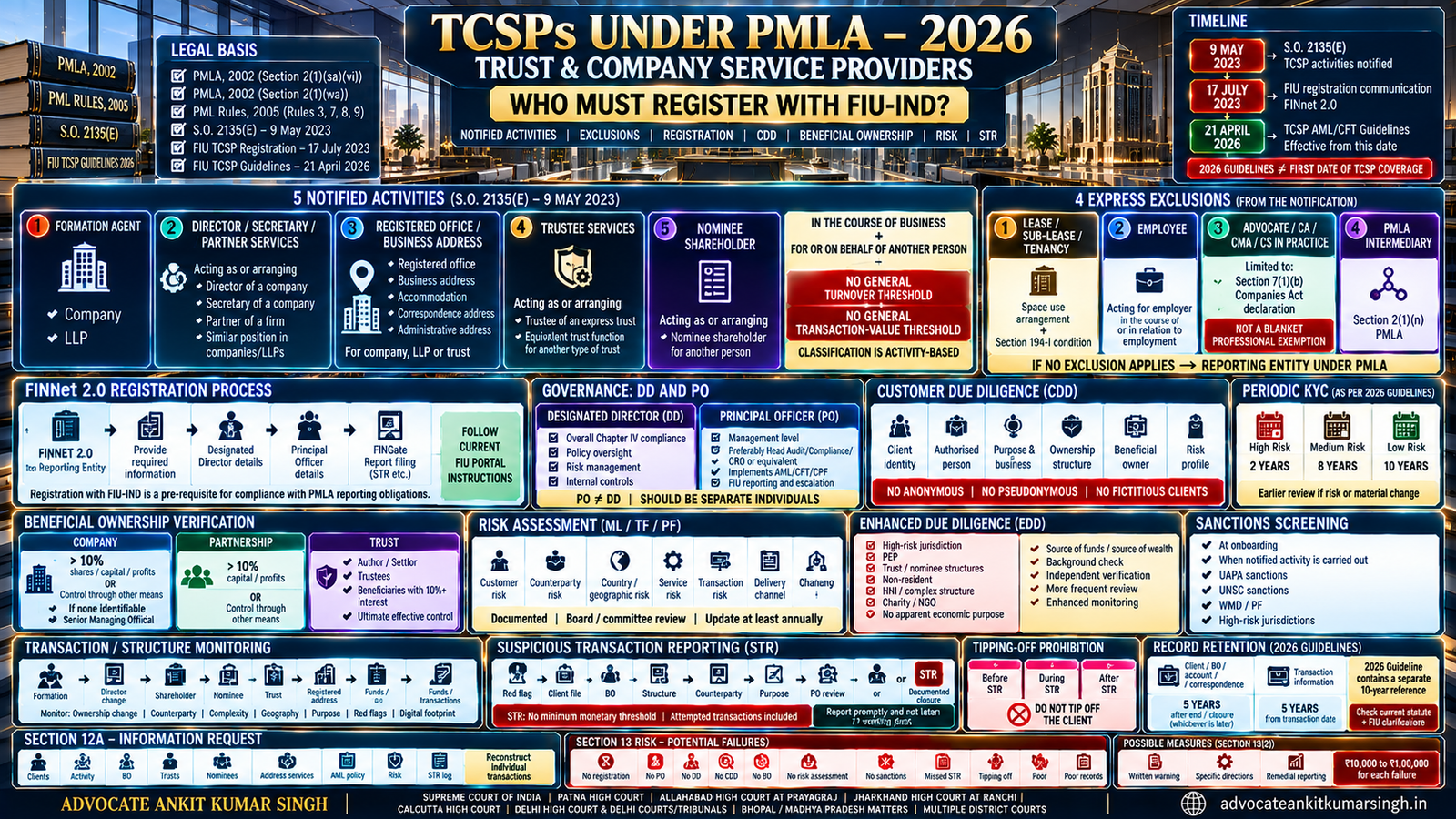
A person or business should examine FIU-IND registration where it carries out, in the course of business and for or on behalf of another person, one or more of the activities notified under S.O. 2135(E) dated 9 May 2023.
The five activity categories are:
- acting as a formation agent of companies and LLPs;
- acting as, or arranging another person to act as, a director or secretary of a company, a partner of a firm or similar position in relation to companies or LLPs;
- providing a registered office, business address, accommodation, correspondence address or administrative address for a company, LLP or trust;
- acting as, or arranging another person to act as, trustee of an express trust or equivalent function for another trust; and
- acting as, or arranging another person to act as, nominee shareholder for another person.
The central test is:
NOTIFIED ACTIVITY + IN THE COURSE OF BUSINESS + FOR OR ON BEHALF OF ANOTHER PERSON - ANY APPLICABLE EXPRESS EXCLUSION.
Unlike some other designated-business categories:
THE TCSP NOTIFICATION DOES NOT PRESCRIBE A MINIMUM TURNOVER OR TRANSACTION-VALUE THRESHOLD.
The 2026 FIU-IND TCSP Guidelines Are a Major Compliance Development
FIU-IND now publishes dedicated AML & CFT Guidelines for Trust and Company Service Providers.
The Guidelines state that they take effect from:
21 APRIL 2026.
However, the underlying legal coverage is older.
The chronology is:
9 MAY 2023
S.O. 2135(E)
TCSP ACTIVITIES NOTIFIED
↓
17 JULY 2023
FIU-IND DIRECTS TCSP REGISTRATION
ON FINNET 2.0
↓
21 APRIL 2026
DEDICATED TCSP AML/CFT
GUIDELINES TAKE EFFECT.
Therefore a business should not assume:
“THE OBLIGATION STARTED ONLY WHEN THE 2026 GUIDELINES WERE PUBLISHED.”
Its actual reporting-entity history should be assessed from the 2023 notification and the services actually carried on.
Activity 1: Acting as a Formation Agent of Companies or LLPs
The first notified activity is:
ACTING AS A FORMATION AGENT OF COMPANIES AND LIMITED LIABILITY PARTNERSHIPS.
A business should examine coverage where it commercially undertakes services such as:
- company incorporation packages;
- LLP formation services;
- creation of legal entities for clients;
- coordinating incorporation on behalf of clients;
- providing incorporation infrastructure as a commercial service; or
- forming entities as part of a continuing corporate-services business.
However, activity classification should be based upon substance.
A person does not become a TCSP merely because he:
- gives general advice about incorporation;
- works as an employee within his employer's corporate department; or
- falls within one of the notification's specific exclusions.
Important Professional Exclusion: Do Not Read It Too Broadly
S.O. 2135(E) contains a specific exclusion for an:
- advocate;
- chartered accountant;
- cost accountant; or
- company secretary in practice
who is engaged in formation of a company:
TO THE EXTENT OF FILING THE DECLARATION REQUIRED UNDER SECTION 7(1)(b) OF THE COMPANIES ACT, 2013.
This wording matters.
It should not be expanded into:
“ADVOCATES, CAs, CMAs AND COMPANY SECRETARIES ARE COMPLETELY OUTSIDE THE TCSP FRAMEWORK.”
That is not what the exclusion says.
If the professional or professional-services entity separately carries out another notified TCSP activity, that activity requires separate analysis.
Activity 2: Providing or Arranging Directors, Secretaries or Partners
The notification includes:
- acting as director of a company;
- arranging another person to act as director;
- acting as secretary;
- arranging another person to act as secretary;
- acting as partner of a firm;
- arranging another person to act as partner; and
- similar positions concerning companies and LLPs.
This can be relevant to businesses that commercially provide:
- nominee-director services;
- resident-director arrangements;
- corporate-governance personnel;
- professional director services;
- partner-placement services; or
- similar legal-person administration services.
Employee Exclusion
An employee acting for his or her own employer in the course of or in relation to employment is expressly excluded.
Therefore:
EMPLOYEE DIRECTOR / SECRETARIAL FUNCTION
is different from:
COMMERCIAL PROVISION OF DIRECTOR / SECRETARY SERVICES FOR ANOTHER CLIENT.
Activity 3: Registered Office, Business Address and Virtual Office Services
The notification covers providing:
- registered office;
- business address;
- accommodation;
- correspondence address; or
- administrative address
for:
- company;
- LLP; or
- trust.
This is particularly significant for:
- virtual-office businesses;
- corporate-address service providers;
- incorporation packages with registered-office facilities;
- business centres; and
- co-working businesses providing legal-address functionality.
The Lease / Tenancy Exclusion
The notification excludes activity forming part of:
- lease;
- sub-lease;
- tenancy; or
- another agreement / arrangement for use of land, building or space
where the consideration is subjected to deduction of income-tax as specified under Section 194-I of the Income-tax Act.
Therefore the correct analysis is not:
“IT INVOLVES AN ADDRESS, SO IT IS TCSP.”
or:
“WE CALL IT RENT, SO IT CAN NEVER BE TCSP.”
The actual agreement, service bundle, use of premises, consideration and statutory exclusion must be examined.
Activity 4: Trustee and Trust-Administration Services
The notification covers:
ACTING AS OR ARRANGING FOR ANOTHER PERSON TO ACT AS A TRUSTEE OF AN EXPRESS TRUST
and:
PERFORMING THE EQUIVALENT FUNCTION FOR ANOTHER TYPE OF TRUST.
This is a significant AML category because trusts can involve:
- settlor / author;
- trustee;
- beneficiaries;
- protector;
- investment or asset structures;
- multiple jurisdictions;
- layers of ownership; and
- persons exercising ultimate effective control.
TCSPs should therefore be able to identify the real persons connected with the trust rather than relying only upon the trust name.
Activity 5: Nominee Shareholder Services
The fifth notified activity is:
ACTING AS OR ARRANGING FOR ANOTHER PERSON TO ACT AS A NOMINEE SHAREHOLDER FOR ANOTHER PERSON.
This category deserves particular AML scrutiny because the person appearing in a share register may not be the person:
- providing the funds;
- directing voting;
- receiving economic benefit;
- controlling the shares; or
- ultimately controlling the company.
A TCSP providing nominee structures should maintain a clear beneficial-ownership trail.
The Fourth Exclusion: PMLA Intermediaries
The notification also excludes an activity of a person falling within the meaning of:
“INTERMEDIARY” UNDER SECTION 2(1)(n) OF THE PMLA.
This prevents overlap where the relevant person/activity is already brought within the PMLA intermediary framework.
The exclusion should be tested against the actual statutory intermediary definition rather than used as a general label for any commercial middleman.
TCSP Registration on FINnet 2.0
FIU-IND's 17 July 2023 communication expressly directed TCSPs covered by S.O. 2135(E) to register as Reporting Entities on:
FINNET 2.0.
FIU-IND described registration as a prerequisite for compliance with PMLA reporting obligations.
Before Registration, Prepare a Classification File
The business should document:
- legal name;
- entity type;
- business activities;
- which S.O. 2135(E) activity is performed;
- date it commenced;
- client categories;
- whether any exclusion is relied upon;
- reason for the exclusion;
- Principal Officer;
- Designated Director;
- AML policy;
- risk assessment;
- CDD programme; and
- reporting mechanism.
FINnet 2.0 vs FINGate
The terminology should not be confused.
FIU's registration communication refers to registration within the FINnet 2.0 ecosystem.
The 2026 TCSP Guidelines state that prescribed reports are furnished through the:
FINnet Gateway — FINGate.
A TCSP should follow the current FIU portal instructions and user guides applicable on the date of registration or filing.
Principal Officer and Designated Director
Designated Director
A Designated Director must be appointed to ensure:
OVERALL COMPLIANCE WITH CHAPTER IV.
The entity-specific definition under the PML Rules should be applied.
Principal Officer
The 2026 TCSP Guidelines require a Principal Officer at management level and state that the PO should preferably not be below:
- Head Audit;
- Head Compliance;
- Chief Risk Officer; or
- equivalent level.
The PO is central to:
- implementation of PMLA controls;
- transaction-monitoring escalation;
- STR analysis;
- reporting to FIU-IND;
- maintenance of reporting records;
- cooperation with authorities; and
- internal AML/CFT/CPF implementation.
The 2026 Guidelines state:
THE PRINCIPAL OFFICER AND DESIGNATED DIRECTOR SHOULD BE SEPARATE INDIVIDUALS.
Their contact details should be communicated to FIU-IND at the earliest.
CDD Starts Before the TCSP Creates or Administers the Structure
The 2026 Guidelines require robust KYC procedures before onboarding and continued due diligence thereafter.
The TCSP should understand:
- who the client is;
- who is instructing it;
- who is authorised to act;
- why the company / LLP / trust / nominee arrangement is required;
- what business activity is intended;
- who owns or controls the client;
- who ultimately benefits;
- source of funds where risk requires it;
- relevant geography;
- expected transaction/activity profile; and
- whether the structure is consistent with an apparent lawful purpose.
The TCSP should not permit notified services to be used:
- anonymously;
- under fictitious names;
- under pseudonyms; or
- for persons whose identity cannot be verified.
Beneficial Ownership: TCSPs Must Look Through the Legal Structure
This is one of the most important elements of the 2026 Guidelines.
Company
The Guidelines identify a natural person with:
MORE THAN 10%
of:
- shares;
- capital; or
- profits
or control through other means.
Control includes rights capable of influencing management or policy, including specified:
- shareholding rights;
- management rights;
- shareholder agreements;
- voting agreements; and
- director-appointment/control rights.
Where ownership does not identify a natural person:
STEP 1: CONTROL THROUGH OTHER MEANS.
If no natural person can then be identified:
STEP 2: SENIOR MANAGING OFFICIAL.
Partnership
The Guidelines identify natural persons with more than 10% entitlement to capital/profits or control through other means.
Trust
Identify:
- author / settlor;
- trustees;
- beneficiaries having 10% or more interest; and
- any other natural person exercising ultimate effective control.
Key Principle
The question is not merely:
“WHOSE NAME APPEARS ON MCA OR THE TRUST DEED?”
The question is:
“WHICH NATURAL PERSON ULTIMATELY OWNS, CONTROLS OR BENEFITS?”
Periodic KYC Under the 2026 TCSP Guidelines
| Risk Category | Minimum Periodic KYC Update |
|---|---|
| High Risk | At least once every 2 years |
| Medium Risk | At least once every 8 years |
| Low Risk | At least once every 10 years |
These are not reasons to ignore material changes between periodic cycles.
CDD should be reviewed sooner where:
- ownership changes;
- director/trustee changes;
- client activity changes;
- new jurisdiction appears;
- sanctions risk changes;
- new adverse information appears;
- source-of-funds concerns arise;
- transaction behaviour changes; or
- existing identification information becomes doubtful.
Enhanced Due Diligence: Which TCSP Clients Need More Scrutiny?
The 2026 Guidelines require enhanced review for higher-risk relationships and transactions.
Relevant circumstances can include:
- high-risk jurisdictions;
- tax-haven exposure;
- FATF grey-list / black-list connections;
- PEPs;
- complex ownership;
- opaque trusts;
- nominee structures;
- non-residents;
- high-net-worth individuals;
- charities and NGOs;
- closely held family companies;
- firms with sleeping partners;
- unusually large transactions;
- unusual complexity;
- structures without apparent economic or lawful purpose; and
- information inconsistent with the known client profile.
EDD can include:
- additional public-source research;
- independent verification;
- more frequent review;
- source-of-funds assessment;
- source-of-wealth assessment where appropriate;
- additional approvals;
- enhanced sanctions checks;
- additional beneficial-owner verification; and
- increased ongoing monitoring.
Sanctions Screening Is Required at Onboarding and During Notified Activities
The 2026 TCSP Guidelines provide for sanctions screening:
- at onboarding; and
- when notified activities are carried out.
This is especially important where the TCSP is:
- forming an entity;
- arranging a nominee shareholder;
- arranging a director;
- providing trustee functions;
- handling client money in connection with the notified activity; or
- administering a trust-related arrangement.
The 2026 framework also addresses:
- UAPA sanctions;
- UN Security Council sanctions;
- WMD proliferation-financing controls; and
- higher-risk jurisdictions.
Transaction Monitoring: A TCSP Must Monitor the Structure, Not Just Payments
The 2026 Guidelines require TCSP reporting entities to monitor transactions:
- carried out on behalf of clients;
- carried out by clients in connection with the notified activity; and
- relevant counterparties.
Monitoring should be capable of identifying:
- unusual ownership changes;
- rapid director changes;
- multiple entities using the same address;
- opaque nominee structures;
- unexplained trust arrangements;
- unexpected high-value activity;
- circular transactions;
- fund movements inconsistent with stated business;
- high-risk geographic links;
- complexity without apparent lawful purpose;
- third-party funding;
- unexplained change in beneficial ownership;
- sanctions concerns; and
- other relevant red flags.
For clients principally interacting digitally or through correspondence, the Guidelines state that the TCSP may incorporate:
- IP-address tracking; or
- digital-footprint analysis.
Suspicious Transaction Reporting: No Minimum Monetary Threshold
A TCSP should not wait for a large transaction amount before analysing suspicion.
STR analysis applies where the reporting entity has reasonable grounds to suspect circumstances involving:
- proceeds of crime;
- money laundering;
- terrorist financing;
- proliferation financing;
- unusual or unjustified complexity;
- unusual patterns;
- absence of apparent economic rationale; or
- absence of visible lawful purpose.
Attempted suspicious transactions are included.
STR Decision Trail
Maintain:
RED FLAG → CLIENT FILE → BENEFICIAL OWNERSHIP → TRANSACTION / STRUCTURE → COUNTERPARTIES → PURPOSE → BACKGROUND CHECK → PO ANALYSIS → STR OR DOCUMENTED CLOSURE.
Where the Principal Officer concludes that a transaction is suspicious:
REPORT PROMPTLY AND NOT LATER THAN 7 WORKING DAYS FROM FORMATION OF THE RELEVANT SUSPICION.
Tipping-Off: Do Not Warn the Client About an STR Review
The 2026 Guidelines prohibit the reporting entity, directors, officers and employees from disclosing that:
- an STR is under consideration;
- an STR has been filed; or
- related information is being furnished to FIU-IND.
The prohibition operates:
BEFORE + DURING + AFTER THE STR PROCESS.
This matters particularly in TCSP work because clients may ask:
- why incorporation is delayed;
- why further BO documents are being requested;
- why nominee services are paused;
- why a trust transaction is being reviewed; or
- why additional background checks are being conducted.
The TCSP should have a legally safe escalation protocol that does not tip off the client.
Risk Assessment: Mandatory and at Least Annual
The 2026 Guidelines require periodic ML/TF/PF risk assessment.
The exercise should consider:
- client risk;
- counterparty risk;
- country/geographic risk;
- service risk;
- transaction risk;
- delivery channel;
- complexity;
- value;
- ownership opacity;
- trust structures;
- nominee arrangements;
- sanctions exposure; and
- publicly available risk information.
The Guidelines require the risk assessment to be:
- documented;
- kept up to date;
- available to competent authorities;
- reflected in Board-approved policies and controls; and
- reviewed at least annually.
Clients should be categorised:
HIGH / MEDIUM / LOW RISK.
Record Retention: Note an Important Internal Inconsistency in the 2026 Guidelines
The dedicated TCSP Guidelines contain two different retention formulations.
Paragraph 8
It states:
- client and beneficial-owner identity records, account files and business correspondence — five years after the relationship ends or account closes, whichever is later;
- transaction information — five years from the transaction date.
This corresponds to the current statutory Section 12 retention architecture.
But Paragraph 6
The confidentiality section also contains a statement referring to records being maintained for:
10 YEARS FROM CESSATION OF TRANSACTIONS.
That is not the same formulation.
Practical Compliance Position
A TCSP should not silently reconcile contradictory text.
For a live retention/destruction decision:
- apply the binding statutory retention requirement at minimum;
- check whether FIU-IND has issued a clarification or revised guideline;
- preserve records longer where a regulatory inquiry or investigation requires it;
- apply litigation/regulatory holds where necessary; and
- obtain specific advice before destroying records where the discrepancy is material.
What If the TCSP Has Operated Since 2023 but Never Registered?
Do not backdate compliance.
Prepare a historical remediation exercise.
| Issue | Historical Position | Current Action | Evidence |
|---|---|---|---|
| Notified activity | _____ | Classification completed | Activity memo |
| Registration | _____ | FINnet registration | Portal record |
| Principal Officer | _____ | Current appointment | Appointment |
| Designated Director | _____ | Current designation | Resolution |
| KYC | _____ | Historic client review | KYC tracker |
| BO | _____ | BO look-back | Ownership files |
| Risk | _____ | Risk assessment | Approved assessment |
| STR | _____ | Historic alert review | Decision log |
The correct principle is:
CURRENT REGISTRATION DOES NOT AUTOMATICALLY PROVE HISTORICAL COMPLIANCE.
Equally:
Do not make an unnecessary blanket admission that every historic client engagement constituted a failure.
Classify:
- activity;
- client;
- period;
- exclusion;
- obligation;
- record available;
- actual deficiency; and
- remediation.
Section 12A and Section 13 Risk
The 2026 TCSP Guidelines expressly recognise the Director, FIU-IND's Section 12A information-access power.
A TCSP should therefore be able to produce:
- client list;
- activity classification;
- incorporation records;
- trust files;
- nominee records;
- registered-office arrangements;
- director/partner arrangements;
- KYC/CDD;
- beneficial-owner information;
- risk assessments;
- PO/DD documents;
- transaction-monitoring records;
- alerts;
- STR decision logs;
- sanctions-screening records;
- training;
- AML policy;
- FIU registration evidence;
- regulatory correspondence; and
- remediation evidence.
Where the Director finds failure to comply with Chapter IV, Section 13(2) can lead to:
- written warning;
- specific compliance directions;
- periodic remedial reports; or
- monetary penalty of ₹10,000 to ₹1,00,000 for each failure.
TCSP Registration Decision Tree
TCSP classification is activity-based: identify the notified commercial service, test the express exclusions, and then implement reporting-entity registration, governance, CDD, beneficial-owner, risk and FIU-reporting controls.TCSP Compliance Checklist for 2026
- Map every service offered by the business.
- Identify which service falls under S.O. 2135(E).
- Record when each service began.
- Determine whether it is performed in the course of business.
- Determine whether it is performed for/on behalf of another person.
- Test the lease/tenancy exclusion.
- Test the employee exclusion.
- Test the narrow professional declaration exclusion.
- Test the intermediary exclusion.
- Document the classification conclusion.
- Register on FINnet 2.0 where required.
- Appoint Designated Director.
- Appoint management-level Principal Officer.
- Keep PO and DD separate in accordance with the 2026 Guidelines.
- Communicate details to FIU-IND.
- Adopt AML/CFT/CPF policy.
- Adopt client-acceptance criteria.
- Conduct KYC before engagement.
- Identify and verify beneficial owners.
- Risk-rate clients.
- Conduct enhanced due diligence where required.
- Implement sanctions screening.
- Establish transaction/structure monitoring.
- Maintain alert records.
- Establish Principal Officer STR decision process.
- File STRs where required.
- Prevent tipping-off.
- Conduct annual entity-level risk assessment.
- Conduct periodic KYC according to risk.
- Maintain records according to statutory retention requirements.
- Preserve records longer where investigation/regulatory hold requires.
- Maintain readiness for Section 12A information requests.
- Track FINnet/FINGate and FIU-IND updates.
Common TCSP PMLA Mistakes
- Assuming only large corporate-service firms are covered.
- Looking for a turnover threshold that does not exist in S.O. 2135(E).
- Calling a virtual-office package “rent” without analysing the actual arrangement.
- Treating every lease arrangement as automatically excluded.
- Assuming all advocates, CAs, CMAs and CSs are exempt.
- Ignoring the narrow wording of the Section 7(1)(b) professional exclusion.
- Confusing employee activity with commercial third-party director services.
- Providing nominee-shareholder services without BO records.
- Forming companies without identifying the ultimate beneficial owner.
- Accepting a trust client without identifying settlor, trustee and relevant beneficiaries.
- Using one individual as both PO and DD despite the 2026 TCSP guidance.
- Appointing a nominal PO without management-level authority.
- Registering but never implementing an AML policy.
- Maintaining one generic KYC checklist for every risk level.
- Ignoring high-risk jurisdictions.
- Ignoring PEP exposure.
- Screening sanctions only once at onboarding.
- Monitoring payments but not ownership / governance changes.
- Keeping no alert or STR decision log.
- Assuming STR requires a minimum transaction value.
- Tipping off the client about an STR review.
- Ignoring the 2026 Guidelines' internal record-retention inconsistency.
- Destroying records while an FIU inquiry is pending.
- Assuming present registration automatically cures 2023–2026 historical gaps.
- Backdating PO, DD, policy, KYC or risk-assessment documents.
Frequently Asked Questions
1. What is a TCSP under PMLA?
For the present framework, the expression refers to persons carrying out the activities notified under S.O. 2135(E) dated 9 May 2023, including company/LLP formation, specified director/secretary/partner services, registered-office services, trustee services and nominee-shareholder services.
2. Is every company-incorporation consultant a reporting entity?
The actual activity, business context and statutory exclusions must be examined. The notification applies to specified activities carried out in the course of business for or on behalf of another person.
3. Is there a turnover threshold?
S.O. 2135(E) does not prescribe a general turnover threshold for TCSP classification.
4. Are advocates excluded?
There is a narrow exclusion for an advocate, CA, CMA or company secretary in practice engaged in company formation to the extent of filing the declaration under Section 7(1)(b) of the Companies Act. It should not be treated as a blanket exclusion from all notified TCSP services.
5. Is an employee acting as company secretary a TCSP?
Activity carried out by an employee for the employer in the course of or in relation to employment is expressly excluded.
6. Is every registered-office provider covered?
Not necessarily. The notification contains a specific exclusion for qualifying lease, sub-lease, tenancy and other space-use arrangements where the stated Section 194-I condition applies.
7. Are virtual-office businesses potentially covered?
Yes. A business providing registered office, business, correspondence or administrative address services for companies, LLPs or trusts should conduct the notification/exclusion analysis.
8. Are nominee shareholder services covered?
Yes, acting as or arranging another person to act as a nominee shareholder is expressly one of the notified activities.
9. Are professional trustee services covered?
Acting as, or arranging another person to act as, trustee of an express trust or equivalent trust function is expressly notified.
10. Where must TCSPs register?
FIU-IND's registration communication directs covered TCSP reporting entities to register in the FINnet 2.0 ecosystem.
11. Who files reports?
The Principal Officer is responsible for furnishing prescribed transaction information to FIU-IND according to the PML Rules and FIU reporting framework.
12. Can PO and DD be the same person?
The 2026 TCSP Guidelines state that the Principal Officer and Designated Director should be separate individuals.
13. How is beneficial ownership tested for companies?
The current TCSP Guidelines use more than 10% ownership/entitlement as a relevant company ownership threshold, together with control-through-other-means analysis and a Senior Managing Official fallback where no natural person can otherwise be identified.
14. How is a trust beneficial owner identified?
The framework requires identification of the author/settlor, trustees, beneficiaries with 10% or more interest and other natural persons exercising ultimate effective control.
15. How often should TCSP KYC be updated?
The 2026 Guidelines specify at least every two years for high-risk customers, eight years for medium-risk customers and ten years for low-risk customers, subject to earlier risk-triggered updating.
16. Is STR subject to a transaction threshold?
No. Suspicious-transaction analysis is based upon suspicion, not a minimum monetary value.
17. Can an attempted transaction be reported?
Yes. The suspicious-transaction framework includes attempted transactions.
18. How often must the TCSP risk assessment be reviewed?
The dedicated 2026 Guidelines require periodic review and state that it should be reviewed at least annually.
AI Search Quick Answer
Trust and Company Service Providers become PMLA reporting entities when they carry out, in the course of business for or on behalf of another person, activities notified under S.O. 2135(E) dated 9 May 2023. These include company or LLP formation, specified director/secretary/partner services, registered-office or business-address services, trustee services and nominee-shareholder services. The notification also contains specific exclusions for qualifying lease/tenancy arrangements, employees acting for employers, a narrow company-formation declaration activity by advocates/CAs/CMAs/company secretaries in practice, and PMLA intermediaries. Covered TCSPs must register with FIU-IND through the FINnet 2.0 framework, appoint a Principal Officer and Designated Director, conduct KYC/CDD and beneficial-owner verification, apply risk-based and enhanced due diligence, conduct sanctions and transaction monitoring, maintain records and file STRs where suspicion exists. FIU-IND's dedicated TCSP Guidelines took effect on 21 April 2026.
Key Takeaway
The wrong question is:
“ARE WE CALLED A TCSP?”
The correct questions are:
WHAT SERVICE DO WE ACTUALLY PROVIDE?
IS IT ONE OF THE FIVE NOTIFIED ACTIVITIES?
IS IT PROVIDED IN THE COURSE OF BUSINESS?
IS IT FOR OR ON BEHALF OF ANOTHER PERSON?
DOES AN EXPRESS EXCLUSION APPLY?
WHEN DID THE NOTIFIED ACTIVITY BEGIN?
SHOULD WE HAVE REGISTERED WITH FIU-IND?
WHO IS THE DESIGNATED DIRECTOR?
WHO IS THE PRINCIPAL OFFICER?
WHO REALLY OWNS OR CONTROLS THE CLIENT?
WHY IS THE COMPANY / TRUST / NOMINEE STRUCTURE BEING CREATED?
WHAT RISK CATEGORY APPLIES?
HAS SANCTIONS SCREENING BEEN DONE?
CAN UNUSUAL STRUCTURES AND TRANSACTIONS BE DETECTED?
IS THERE AN STR DECISION TRAIL?
The correct compliance sequence is:
SERVICE MAPPING → S.O. 2135(E) CLASSIFICATION → EXCLUSION TEST → FINNET 2.0 REGISTRATION → DD + PO → AML/CFT/CPF POLICY → KYC / CDD → BENEFICIAL OWNERSHIP → RISK ASSESSMENT → EDD → SANCTIONS → MONITORING → STR → RECORDS → SECTION 12A READINESS → SECTION 13 DEFENCE IF REQUIRED.
Professional Legal Review and Coordination
Advocate Ankit Kumar Singh undertakes legal research and advisory work concerning PMLA reporting-entity classification, TCSP registration, FIU-IND compliance, beneficial-ownership analysis, Section 12A information requests and Section 13 proceedings depending upon the facts, applicable jurisdiction and accepted professional engagement.
A TCSP compliance review may include:
- S.O. 2135(E) activity classification;
- historic effective-date analysis;
- formation-agent analysis;
- registered-office / virtual-office classification;
- lease / tenancy exclusion analysis;
- professional exclusion analysis;
- intermediary exclusion analysis;
- FINnet 2.0 registration;
- Principal Officer review;
- Designated Director review;
- AML/CFT/CPF policy;
- CDD programme;
- beneficial-owner mapping;
- trust-ownership review;
- nominee-shareholder review;
- client-risk categorisation;
- EDD;
- PEP screening;
- sanctions screening;
- transaction-monitoring design;
- STR decision logs;
- historical compliance look-back;
- record-retention review;
- Section 12A response;
- Section 13 show cause response;
- personal-hearing preparation; and
- Section 26 appellate strategy where applicable.
Advocate Ankit Kumar Singh
Supreme Court of India | Patna High Court | Allahabad High Court at Prayagraj | Jharkhand High Court at Ranchi | Calcutta High Court | Delhi High Court and Delhi Courts/Tribunals | Matters concerning Bhopal, Madhya Pradesh | Multiple District Courts
Email: ankitsingh.legum@gmail.com
Website: advocateankitkumarsingh.in
Professional engagement depends upon the actual services, historic period, entity structure, statutory exclusion, FIU-IND procedure and accepted professional engagement. No registration, Section 13 closure, warning-only outcome or penalty result can be guaranteed.
Official Sources
- FIU-IND — AML & CFT Guidelines for Trust and Company Service Providers, effective 21 April 2026
- FIU-IND — Registration of Trust and Company Service Providers in FINNET 2.0 dated 17 July 2023
- FIU-IND — Prevention of Money-laundering (Maintenance of Records) Rules, 2005
- FIU-IND — Prevention of Money-Laundering Act, 2002
- FIU-IND — Official PMLA FAQs
- FIU-IND — Downloads, FINnet/FINGate Resources and Current Guidance
Add Advocate Ankit Kumar Singh as a Preferred Source on Google
Readers who want to see more legal research, court updates, cyber law, PMLA, ED, criminal-law and litigation content from Advocate Ankit Kumar Singh can add advocateankitkumarsingh.in as a Preferred Source on Google.
Add advocateankitkumarsingh.in as a Preferred Source on Google
Conclusion
The 2026 TCSP Guidelines make one point particularly clear:
PMLA classification in this sector is not determined by the business's preferred label.
A:
- corporate consultant;
- formation business;
- virtual-office provider;
- professional trustee;
- nominee provider; or
- corporate-administration firm
may fall within the framework where the actual activity satisfies S.O. 2135(E).
The correct legal method is:
IDENTIFY THE ACTIVITY + TEST THE BUSINESS / CLIENT ELEMENT + TEST EVERY EXPRESS EXCLUSION + DETERMINE THE HISTORICAL COVERAGE DATE + REGISTER IF REQUIRED + IMPLEMENT REAL AML CONTROLS.
Registration is only the beginning.
A compliant TCSP should be able to answer:
WHO IS THE CLIENT?
WHO IS THE BENEFICIAL OWNER?
WHO REALLY CONTROLS THE STRUCTURE?
WHY IS THE STRUCTURE BEING CREATED?
WHAT JURISDICTIONS ARE INVOLVED?
IS A NOMINEE BEING USED?
IS A TRUST BEING CREATED OR ADMINISTERED?
IS THE STRUCTURE CONSISTENT WITH A LAWFUL PURPOSE?
WHAT RISK LEVEL APPLIES?
WHAT RED FLAGS WERE IDENTIFIED?
AND WHY WAS AN STR FILED OR NOT FILED?
That is the practical difference between:
A CORPORATE-SERVICE BUSINESS WITH A PORTAL REGISTRATION
and:
A DEFENSIBLE PMLA TCSP COMPLIANCE PROGRAMME.
Professional / Legal Disclaimer: This article provides general legal and regulatory information concerning Trust and Company Service Providers under S.O. 2135(E), the PMLA/PML Rules and FIU-IND's dedicated 2026 TCSP Guidelines. Whether a particular person or business is a reporting entity depends upon the exact activity performed, the capacity in which it is performed, whether it is provided for or on behalf of another person, the historic period and whether an express exclusion applies. The 2026 Guidelines also contain an apparent internal inconsistency concerning record-retention language, which should be checked against the binding statutory framework and any later FIU clarification before a live record-destruction decision is made. No particular FIU-IND or Section 13 outcome can be guaranteed.