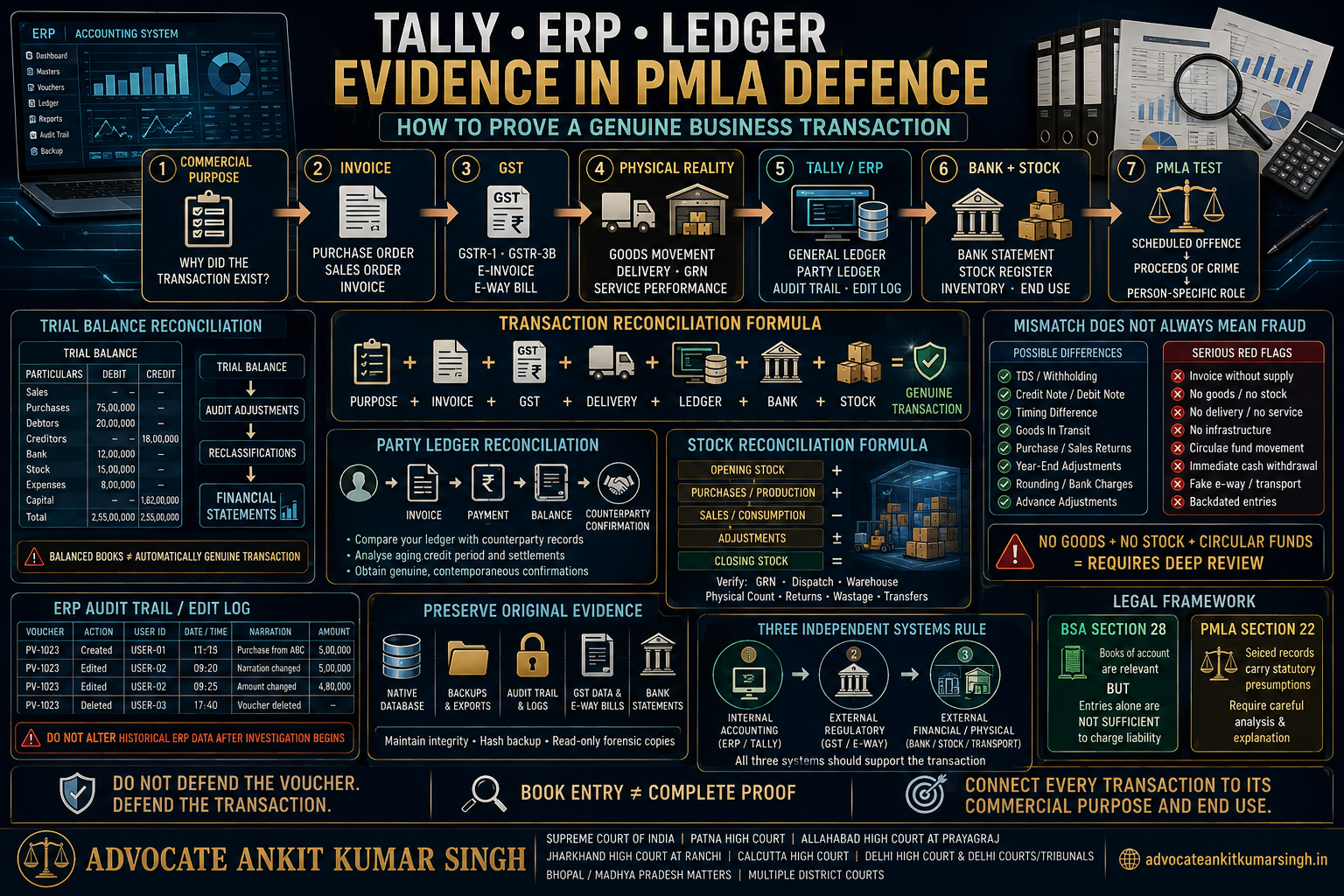
PMLA FORENSIC ACCOUNTING • TALLY • ERP • GST • LEDGER RECONCILIATION
Tally, ERP and Ledger Evidence in PMLA Defence: How to Reconcile Invoices, GST Returns, Bank Statements, Trial Balance, Party Ledgers, Stock Registers and Actual Commercial Purpose
Invoices • GST • Bank Trail • Trial Balance • Party Ledgers • Inventory • ERP Audit Trail • Commercial Substance
Research updated: 9 August 2026 | By Advocate Ankit Kumar Singh
 Advocate Ankit Kumar Singh
Direct Answer: How Should Tally or ERP Evidence Be Defended in a PMLA Case?
Do not attempt to prove a transaction merely by producing a Tally ledger or an invoice.
Reconstruct the transaction through independent evidence.
For every disputed entry, ask:
WHY DID THE TRANSACTION EXIST?
WHO ORDERED IT?
WHAT WAS SUPPLIED?
HOW WAS IT INVOICED?
HOW WAS IT REPORTED TO GST?
DID GOODS OR SERVICES ACTUALLY MOVE?
HOW WAS IT RECORDED IN THE LEDGER?
HOW DID MONEY MOVE?
WHERE DID THE MONEY ULTIMATELY GO?
A defensible transaction should ordinarily be capable of moving through a reconciliation chain such as:
COMMERCIAL PURPOSE → PURCHASE / SALES ORDER → INVOICE → GST → DELIVERY / PERFORMANCE → STOCK → PARTY LEDGER → BANK → TRIAL BALANCE → FINANCIAL STATEMENTS.
Why Accounting Evidence Becomes So Important in PMLA Investigations
PMLA financial investigations frequently depend upon reconstructing the movement and character of money.
When the allegation concerns:
- bogus invoices;
- loan diversion;
- shell companies;
- accommodation entries;
- related-party transfers;
- fake purchases;
- fake sales;
- inflated expenditure;
- fictitious stock;
- circular trading;
- fake GST credit;
- commission payments;
- layering;
the accounting database may become a central evidentiary source.
But accounting evidence should be examined as a system, not as isolated screenshots.
Section 28 BSA: Books of Account Are Relevant — But Not Sufficient Alone
Section 28 of the Bharatiya Sakshya Adhiniyam, 2023 expressly recognises entries in regularly kept books of account, including electronic books of account, as relevant where they refer to a matter under inquiry.
However, the section contains an equally important limitation:
THE ACCOUNT ENTRIES ALONE ARE NOT SUFFICIENT TO CHARGE A PERSON WITH LIABILITY.
This principle is particularly useful in financial prosecutions.
It requires attention to corroborative material.
A ledger may therefore be tested against:
- contract;
- invoice;
- GST return;
- bank movement;
- stock record;
- transport evidence;
- counterparty confirmation;
- actual commercial performance.
PMLA Section 22: Why Seized Tally and ERP Records Cannot Be Ignored
PMLA contains a separate statutory presumption concerning records found in a person's possession or control during a survey or search.
The statutory framework can therefore make seized business records particularly important.
The correct defence is usually not:
“Tally has no evidentiary value.”
That is too broad.
The better enquiry is:
“What does the complete accounting record actually show when read with the source documents and independent commercial evidence?”
Selective reliance upon one ledger account should be tested against the complete books.
A Tally Ledger Is Not the Transaction
An accounting voucher records how somebody classified a transaction.
It does not by itself establish:
- that goods physically moved;
- that services were actually performed;
- that the invoice was genuine;
- that the accounting narration accurately describes the commercial purpose;
- that the recipient had criminal knowledge;
- that the funds were proceeds of crime.
Likewise, an incorrect ledger classification does not automatically prove that the underlying transaction was fictitious.
Always separate:
ACCOUNTING CHARACTERISATION
from:
UNDERLYING COMMERCIAL REALITY.
The Master Transaction Reconciliation Sheet
Prepare one row for every transaction relied upon by ED.
| Field | Information |
|---|---|
| Transaction ID | TX-001 |
| Date | __/__/____ |
| Counterparty | _____ |
| Commercial purpose | _____ |
| Invoice | _____ |
| GST reporting | _____ |
| Goods/service evidence | _____ |
| Stock impact | _____ |
| Ledger entry | _____ |
| Bank entry | _____ |
| End use | _____ |
| Person who approved | _____ |
| Issue alleged by ED | _____ |
| Defence explanation | _____ |
Sales Transaction: The Complete Reconciliation Chain
For an alleged sale, reconstruct:
CUSTOMER REQUIREMENT → SALES ORDER → INVOICE → GST REPORTING → DISPATCH → TRANSPORT → DELIVERY → STOCK REDUCTION → DEBTOR LEDGER → PAYMENT → BANK RECEIPT.
CHECK:
- purchase order received from customer;
- quotation;
- sales invoice;
- e-invoice / IRN where applicable;
- GSTR-1 reporting;
- aggregate GST return treatment;
- e-way bill where applicable;
- delivery challan;
- lorry receipt;
- vehicle number;
- warehouse gate pass;
- dispatch register;
- stock reduction;
- customer acknowledgement;
- customer ledger;
- bank receipt.
Purchase Transaction: The Reverse Reconciliation
For an alleged purchase:
PURCHASE REQUIREMENT → PURCHASE ORDER → VENDOR INVOICE → GOODS MOVEMENT → GOODS RECEIPT → STOCK INWARD → PURCHASE LEDGER → CREDITOR → GST INPUT RECORD → BANK PAYMENT → CONSUMPTION / RESALE.
Important questions:
- Why were the goods required?
- Who approved the purchase?
- Did the supplier have capacity to supply?
- Did goods physically arrive?
- Where were they stored?
- Were they subsequently consumed or sold?
- Who paid the supplier?
- Did the money later return?
Service Invoice: Physical Stock Records May Not Exist
Services require a different evidentiary model.
A genuine service transaction may be established through:
- engagement agreement;
- scope of work;
- purchase order;
- email instructions;
- work product;
- consulting report;
- timesheet;
- technical drawing;
- software deliverable;
- completion certificate;
- meeting records;
- invoice;
- GST reporting;
- TDS where applicable;
- bank payment.
Do not attempt to defend a service transaction using goods-movement evidence that logically could not exist.
Invoice-to-GSTR-1 Reconciliation
For sales, prepare:
| Invoice No. | Invoice Date | Taxable Value | GST | GSTR-1 Period | Difference |
|---|---|---|---|---|---|
| INV-001 | __/__/____ | ₹_____ | ₹_____ | _____ | _____ |
Any mismatch should be classified rather than concealed.
POSSIBLE EXPLANATIONS MAY INCLUDE:
- amendment in subsequent return;
- credit note;
- debit note;
- invoice cancellation;
- timing difference;
- clerical GST reporting error;
- wrong GSTIN;
- wrong tax period;
- booked transaction later reversed.
A mismatch requires explanation.
It does not automatically establish a fictitious sale.
GSTR-1 and GSTR-3B Are Not the Same Accounting Record
Do not compare unrelated GST fields mechanically.
GSTR-1 contains outward-supply information at the level required by the GST framework.
GSTR-3B operates as a summary return.
Accordingly, the defence should first identify:
- which GST field is being compared;
- whether the periods are the same;
- whether amendments are included;
- whether credit/debit notes were accounted for;
- whether exempt/non-GST/zero-rated supplies affect the comparison;
- whether the figures are gross or net.
Do not treat every numerical difference between GSTR-1 and a Tally sales ledger as evidence of laundering.
Invoice-to-Bank Reconciliation: Why Exact Amounts Often Differ
An invoice of ₹10 lakh does not necessarily generate a single ₹10 lakh bank credit.
Possible legitimate reasons include:
- TDS deduction;
- retention money;
- advance adjustment;
- credit note;
- discount;
- multiple invoices paid together;
- part payment;
- set-off;
- bank charges;
- foreign-exchange adjustment.
Therefore prepare:
GROSS INVOICE - TDS - CREDIT NOTE - RETENTION / ADJUSTMENT = EXPECTED RECEIPT.
Party Ledger Reconciliation
For every major customer, supplier or connected entity, prepare:
| Date | Document | Debit | Credit | Balance | Explanation |
|---|---|---|---|---|---|
| __/__/____ | Invoice | ₹_____ | — | ₹_____ | Sale |
| __/__/____ | Receipt | — | ₹_____ | ₹_____ | Bank payment |
Then compare your ledger with:
- counterparty confirmation;
- counterparty ledger;
- bank statement;
- invoice set;
- GST records.
Counterparty Confirmation Can Be Powerful — But Must Be Genuine
Do not obtain a backdated or scripted confirmation after an investigation begins.
Stronger evidence includes:
- pre-existing balance confirmation;
- audit confirmation;
- historical email;
- ordinary-course correspondence;
- bank payment;
- delivery acknowledgement;
- counterparty GST record;
- independent books of account.
A newly created confirmation should not be used to manufacture a historical transaction.
Trial Balance: What Does It Actually Prove?
A trial balance is a consolidated accounting snapshot derived from ledger balances.
It is useful for checking whether disputed entries ultimately flow into:
- sales;
- purchases;
- expenses;
- loans;
- advances;
- debtors;
- creditors;
- cash;
- bank;
- inventory;
- capital;
- related-party balances.
But a balanced trial balance does not prove that each underlying transaction was commercially genuine.
Accounting arithmetic can balance even where an underlying voucher is false.
Trial Balance to Audited Financial Statements
Prepare a bridge:
TRIAL BALANCE → AUDIT ADJUSTMENTS → RECLASSIFICATIONS → FINAL FINANCIAL STATEMENTS.
Investigate:
- year-end journal entries;
- provisions;
- write-offs;
- depreciation;
- inventory adjustments;
- foreign-exchange adjustments;
- related-party disclosures;
- auditor reclassifications.
A difference between the raw trial balance and final financial statements may therefore require explanation rather than immediate suspicion.
Stock Register: The Physical Reality Test
Where ED alleges fake purchases or sales of goods, stock reconciliation can become one of the strongest tests.
Use:
OPENING STOCK + PURCHASES + PRODUCTION - SALES - CONSUMPTION - WASTAGE ± ADJUSTMENTS = CLOSING STOCK.
CHECK:
- item code;
- quantity;
- unit of measurement;
- warehouse;
- batch;
- date of movement;
- GRN;
- dispatch record;
- goods in transit;
- returns;
- job work;
- scrap;
- damage;
- physical inventory.
An Invoice Without Stock Movement Can Become a Serious Red Flag
Suppose the books show:
₹5 crore purchase.
But there is:
- no stock inward;
- no transport record;
- no warehouse receipt;
- no consumption;
- no resale;
- no physical business infrastructure.
That combination requires serious explanation.
It resembles patterns alleged by ED in recent fake-invoice investigations.
The defence should identify whether:
- the transaction was actually a service;
- goods moved directly to another location;
- drop shipment occurred;
- job-work records exist;
- third-party warehousing was used;
- goods were in transit;
- the invoice was subsequently cancelled.
E-Way Bill and Transport Evidence
For transactions involving movement of goods where e-way bill requirements apply, review:
- e-way bill number;
- generation time;
- supplier;
- recipient;
- invoice;
- vehicle number;
- transporter;
- origin;
- destination;
- distance;
- delivery date.
Then cross-check:
- lorry receipt;
- FASTag/toll data where lawfully available;
- GPS where available;
- fuel records;
- gate entry;
- warehouse receipt;
- recipient GRN.
Fake E-Way Bill Allegation: Do Not Stop at the Number
The existence of an e-way bill number does not by itself prove physical movement.
Equally, the absence of one does not always resolve the issue without checking whether the statutory requirement applied to that particular movement.
The real question is:
DID THE GOODS ACTUALLY MOVE?
Bank Statement: Follow Both Sides of the Transaction
Do not stop after proving:
“We paid the vendor.”
Investigators may trace what the vendor did next.
Review:
YOUR ACCOUNT → VENDOR → NEXT ACCOUNT → ULTIMATE BENEFICIARY.
Red flags may include:
- same-day onward transfer;
- cash withdrawal;
- transfer to promoter;
- transfer to unrelated entity;
- circular return;
- commission deduction followed by return of balance.
But onward movement by another entity should still be attributed person-specifically.
Round-Tripping Test
If ED alleges circular movement:
| Step | Account | Amount | Date/Time | Commercial Explanation |
|---|---|---|---|---|
| 1 | A → B | ₹_____ | _____ | _____ |
| 2 | B → C | ₹_____ | _____ | _____ |
| 3 | C → A / related person | ₹_____ | _____ | _____ |
Then test:
- whether amounts actually match;
- whether dates support circularity;
- whether independent obligations existed;
- whether goods/services existed at each stage;
- whether consideration returned to the original payer.
Inter-Company Transfers: Ledger Narration Is Not Enough
For related-company transfers, establish:
- relationship between entities;
- board authority;
- agreement;
- commercial rationale;
- interest where applicable;
- repayment terms;
- actual end use;
- accounting classification;
- tax treatment;
- subsequent repayment.
Labels such as:
- advance;
- loan;
- security deposit;
- inter-corporate deposit;
- trade advance;
should correspond with the actual transaction.
The Commercial-Purpose Test
For every questioned transaction, answer eight questions:
- Why did the company need the transaction?
- Who identified the counterparty?
- What goods/services were expected?
- Who approved it?
- What was actually delivered?
- How was price determined?
- How was payment made?
- What economic benefit did the company receive?
If nobody can answer these questions despite a ₹10 crore ledger entry, the defence has a serious factual problem.
Commercial Substance Is Stronger Than Perfect Paperwork
Consider two situations.
TRANSACTION A
- invoice exists;
- GST entry exists;
- bank payment exists;
- but no goods;
- no service;
- no infrastructure;
- money immediately returns.
TRANSACTION B
- invoice has a clerical error;
- GST amendment was filed later;
- goods physically arrived;
- stock register records them;
- factory consumed them;
- bank paid the vendor;
- vendor independently confirms supply.
The evidentiary character of these transactions is materially different.
The defence should focus on substance, not cosmetic perfection.
Not Every Accounting Mismatch Means Fraud
COMMON EXPLAINABLE DIFFERENCES MAY INCLUDE:
- financial-year cut-off;
- invoice booked in following month;
- goods in transit;
- credit note;
- debit note;
- purchase return;
- sales return;
- TDS;
- retention;
- rounding;
- forex fluctuation;
- advance adjustment;
- contra entry;
- branch transfer;
- job work;
- stock transfer;
- year-end audit entry.
The objective is not to say:
“Mismatch does not matter.”
The objective is:
“Identify exactly why the mismatch exists and prove that explanation from contemporaneous records.”
Which Mismatches Are More Dangerous?
A mismatch becomes significantly more serious when several independent records fail simultaneously.
Example:
INVOICE EXISTS BUT NO GST + NO STOCK + NO TRANSPORT + NO DELIVERY + NO COUNTERPARTY INFRASTRUCTURE + FUNDS RETURNED.
That pattern cannot safely be explained as a simple accounting error without evidence.
Tally / ERP Audit Trail: Check Who Changed What
Where the accounting platform maintains edit/audit history, review:
- voucher creation date;
- voucher effective date;
- user ID;
- modification date;
- original narration;
- revised narration;
- ledger change;
- amount change;
- party-name change;
- deleted voucher;
- master creation;
- backdated entry.
The crucial question can become:
WAS THIS ENTRY PART OF THE ORDINARY BOOKS BEFORE THE INVESTIGATION — OR CREATED AFTER THE PROBLEM STARTED?
Companies Using Accounting Software: Audit Trail Can Matter Significantly
The Companies (Accounts) Rules contain requirements concerning accounting software with an audit-trail/edit-log facility for companies to which the provision applies.
The regulatory framework refers to:
- recording an audit trail of transactions;
- edit log of changes;
- date of changes;
- preservation of audit trail;
- audit reporting concerning operation and tampering of the audit trail.
Accordingly, in an ED investigation involving a company, request the actual audit-trail material where relevant instead of relying solely upon printed ledger extracts.
Preserve the Native Accounting Evidence
Before preparing explanatory charts, preserve the original accounting environment.
PRESERVE:
- native database;
- company data folder;
- backup files;
- software version;
- configuration;
- chart of accounts;
- user list;
- audit trail;
- voucher history;
- master history;
- financial-year settings;
- GST configuration;
- inventory configuration.
Where technically appropriate, maintain read-only forensic copies and integrity hashes through a competent professional.
Do Not “Correct” Tally After ED Begins Questioning
A dangerous response to an investigation is:
“Let us clean the books before producing them.”
Do not:
- delete vouchers;
- change narrations;
- create old invoices;
- backdate purchase orders;
- change ledger names;
- move entries between parties;
- create retrospective stock entries;
- manufacture balance confirmations.
If an historical accounting error genuinely exists:
PRESERVE ORIGINAL → IDENTIFY ERROR → DOCUMENT WHY IT IS WRONG → MAKE ANY LAWFUL CURRENT CORRECTION TRANSPARENTLY.
Deleted Vouchers Can Be More Important Than Existing Vouchers
If an ERP audit trail shows that a material voucher was deleted after:
- FIR;
- ED search;
- summons;
- forensic audit;
- bank complaint;
the timing may become highly significant.
The defence should determine:
- who deleted it;
- why;
- whether deletion was routine;
- whether a replacement entry exists;
- whether the underlying transaction remains documented elsewhere.
Accounting User ID Is Not Automatically Person-Specific Responsibility
Where the ERP says:
Voucher created by: ADMIN
ask:
- Who had the password?
- Was the login shared?
- Was there one common accounting ID?
- Which employee operated the terminal?
- Was remote access permitted?
- Who instructed the entry?
- Who approved payment?
Technical user attribution and criminal responsibility are not automatically identical.
Debtor Ledger: Test Whether the Customer Was Real
Review:
- customer KYC;
- GST registration;
- registered address;
- business activity;
- order history;
- invoice history;
- payment history;
- confirmation;
- credit period;
- subsequent collections.
A genuine debtor that later defaults is materially different from a fictitious debtor created only to inflate turnover.
Creditor Ledger: Test Whether the Supplier Could Actually Supply
For a disputed supplier:
- check registration;
- business premises;
- employees;
- machinery where relevant;
- inventory;
- source of goods;
- transport;
- banking pattern;
- GST profile;
- other customers.
A supplier with no business infrastructure and immediate onward transfer of every receipt may attract much closer scrutiny.
Related-Party Ledger: Prepare a Separate Matrix
| Entity | Relationship | Transfer | Purpose | Agreement | End Use |
|---|---|---|---|---|---|
| Company B | Group company | ₹_____ | _____ | _____ | _____ |
Add:
- board approval;
- interest;
- repayment;
- security;
- tax treatment;
- beneficiary.
Cash Book Versus Bank Book
Do not mix the two.
Cash-source defence should reconcile:
OPENING CASH + RECEIPTS + WITHDRAWALS - PAYMENTS - DEPOSITS = CLOSING CASH.
Bank reconciliation should separately examine:
- unpresented cheques;
- bank charges;
- direct credits;
- interest;
- reversals;
- cheques issued but not cleared.
GST Evidence Is Corroborative — Not a Substitute for Commercial Reality
GST reporting may support the existence of a transaction.
But recent enforcement cases themselves demonstrate why investigators may examine whether invoices and GST entries correspond to actual supply.
Therefore:
GST RETURN + BANK PAYMENT
should still be examined alongside:
ACTUAL GOODS / SERVICES.
The 12-Point Genuine-Transaction Test
- Real counterparty?
- Commercial requirement?
- Contemporaneous agreement/order?
- Invoice?
- Tax treatment?
- Actual goods/service?
- Transport/performance evidence?
- Stock impact?
- Ledger consistency?
- Bank consideration?
- Counterparty consistency?
- Logical end use?
The more independent layers agree, the stronger the commercial-reality explanation becomes.
The “Three Independent Systems” Rule
A useful defence methodology is to test a transaction against at least three independently generated systems.
Example:
SYSTEM 1 — INTERNAL ACCOUNTING
Tally / ERP.
SYSTEM 2 — EXTERNAL REGULATORY
GST / e-invoice / e-way records.
SYSTEM 3 — EXTERNAL FINANCIAL / PHYSICAL
Bank / transporter / warehouse / counterparty.
An unexplained conflict across all three deserves immediate forensic review.
How to Analyse an Allegation of “Bogus Purchase”
Do not merely answer:
“The purchase is in Tally.”
Prepare:
- purchase requirement;
- purchase order;
- vendor identity;
- invoice;
- GST record;
- transport;
- GRN;
- stock entry;
- quality inspection;
- production consumption;
- bank payment;
- vendor ledger;
- vendor confirmation;
- end use.
How to Analyse an Allegation of “Bogus Sale”
- customer order;
- invoice;
- GST;
- dispatch;
- e-way bill;
- transport;
- stock reduction;
- delivery;
- customer ledger;
- bank receipt;
- subsequent complaint/return if any.
How to Analyse an Allegation of “Accommodation Entry”
Test:
- whether any underlying transaction existed;
- whether counterparty performed anything;
- whether money returned;
- whether commission was retained;
- whether invoices were created merely to explain bank movement;
- whether circular accounts existed;
- whether GST documents had physical/commercial backing.
How to Analyse Loan-Diversion Allegations
Start with the bank sanction.
Then reconstruct:
LOAN DISBURSEMENT → BORROWER ACCOUNT → PAYMENT → COUNTERPARTY → PURPOSE → ACTUAL END USE.
Compare with:
- sanction letter;
- loan agreement;
- drawing-power conditions;
- supplier invoice;
- stock;
- related-party ledger;
- asset purchase;
- repayment.
Management Responsibility Must Be Person-Specific
In a company with thousands of vouchers, do not assume every director personally entered or knew every ledger item.
Prepare a responsibility matrix:
| Function | Person |
|---|---|
| Purchase approval | _____ |
| Vendor onboarding | _____ |
| Invoice booking | _____ |
| GST filing | _____ |
| Bank authorisation | _____ |
| Stock receipt | _____ |
| Final approval | _____ |
Then compare actual conduct with formal designation.
What Should Be Prepared Before Section 50 Questioning?
For a questioned accounting transaction, prepare one factual pack containing:
- one-page transaction summary;
- commercial purpose;
- invoice;
- agreement/order;
- GST evidence;
- stock/service-performance evidence;
- party ledger;
- bank statement;
- counterparty material;
- end-use evidence;
- known mismatch and explanation.
Do not memorise a story.
Understand the documents.
What If Tally and Bank Statements Do Not Match?
First prepare a bank reconciliation.
Check:
- date difference;
- cheque clearance;
- contra;
- bank charges;
- direct bank entry;
- incorrect ledger posting;
- duplicate voucher;
- reversal;
- opening balance issue.
If no genuine accounting explanation exists, do not invent one.
What If GST and Books Do Not Match?
Prepare a month-wise reconciliation:
| Month | Books | GST | Difference | Reason |
|---|---|---|---|---|
| April | ₹_____ | ₹_____ | ₹_____ | _____ |
Then trace every material difference to:
- credit/debit note;
- timing;
- amendment;
- classification;
- tax error;
- non-GST/exempt treatment;
- unexplained entry.
What If Stock and Purchase Records Do Not Match?
Check:
- goods in transit;
- job work;
- branch transfer;
- production consumption;
- wastage;
- scrap;
- purchase return;
- sales return;
- physical-count adjustment;
- unit conversion.
Do not insert retrospective stock merely to close the difference.
Electronic Evidence: PDF Export Is Not the Same as Native ERP Data
Differentiate:
- native database;
- ERP backup;
- Excel export;
- PDF ledger;
- screenshot;
- printed ledger.
A PDF can show what was exported.
Native accounting data may additionally show:
- voucher structure;
- master data;
- user information;
- edit history;
- system relationships.
Where electronic outputs are relied upon in evidence, the applicable Bharatiya Sakshya Adhiniyam electronic-evidence framework should also be examined.
Do Not Let a Forensic Audit Become the Only Version of the Books
If a bank, agency or forensic auditor creates a summary alleging:
- diversion;
- round-tripping;
- inflated purchases;
- fake debtors;
- stock mismatch;
reperform the calculation from the source records.
Ask:
- which vouchers were included;
- which were excluded;
- what date range was used;
- how opening balances were treated;
- whether reversals were netted;
- whether related parties were correctly identified;
- whether GST and stock evidence were considered.
Forensic Accountant Review Checklist
Where the financial record is complex, consider an independent forensic-accounting review focused upon:
- native ERP data;
- ledger completeness;
- audit trail;
- bank reconciliation;
- GST reconciliation;
- inventory reconciliation;
- party confirmations;
- related parties;
- circular movements;
- commercial purpose;
- end use;
- unexplained exceptions.
Red Flag Matrix
| Issue | Lower Risk Indicator | Higher Risk Indicator |
|---|---|---|
| Invoice | Contemporaneous order and delivery | Invoice created without transaction support |
| GST | Reported with explainable amendments | Invoice chain without real supply |
| Bank | Normal supplier payment | Immediate circular return |
| Stock | Receipt/consumption traceable | No stock movement |
| Supplier | Operational business | No infrastructure |
| ERP | Contemporaneous entry | Backdated post-investigation entry |
| Commercial purpose | Clear business need | No one can explain transaction |
50-Point Tally / ERP PMLA Defence Checklist
- Preserve native ERP data.
- Preserve backups.
- Record software version.
- Identify users.
- Preserve audit trail.
- Preserve edit log.
- Identify deleted vouchers.
- Preserve chart of accounts.
- Export general ledger.
- Export trial balance.
- Export purchase register.
- Export sales register.
- Export stock register.
- Export debtor ledgers.
- Export creditor ledgers.
- Identify related parties.
- Obtain relevant agreements.
- Obtain purchase orders.
- Obtain sales orders.
- Collect invoices.
- Collect credit notes.
- Collect debit notes.
- Reconcile GSTR-1.
- Reconcile GSTR-3B.
- Review e-invoices where applicable.
- Review e-way bills.
- Review transporter documents.
- Review GRNs.
- Review delivery challans.
- Review warehouse records.
- Reconcile opening stock.
- Reconcile purchases.
- Reconcile production/consumption.
- Reconcile sales.
- Reconcile closing stock.
- Reconcile bank accounts.
- Identify TDS/retention adjustments.
- Trace onward fund movement.
- Identify circular transfers.
- Trace end use.
- Obtain genuine historical counterparty records.
- Compare counterparty ledger.
- Compare audited accounts.
- Explain year-end adjustments.
- Prepare transaction-wise commercial purpose.
- Prepare responsibility matrix.
- Identify accounting errors honestly.
- Do not alter historical data.
- Obtain forensic-accounting review where justified.
- Connect the accounting dispute back to the actual PMLA ingredients.
Tally / ERP PMLA Defence Flowchart
A disputed Tally or ERP entry should be reconciled through commercial purpose, source documents, GST, actual delivery or performance, ledgers, bank movements, inventory and finally the alleged PMLA nexus.Frequently Asked Questions
1. Can ED rely on Tally data in a PMLA investigation?
Accounting records can be relevant evidence. Their legal and evidentiary treatment depends upon how they were obtained, the applicable statutory presumptions, electronic-evidence requirements and corroborating material.
2. Is a Tally ledger enough to prove money-laundering?
A ledger entry by itself does not answer all PMLA ingredients. Section 28 BSA also states that books-of-account entries alone are not sufficient to charge a person with liability.
3. What should be checked against a sales invoice?
Order, GST reporting, e-invoice/e-way bill where applicable, dispatch, transport, stock reduction, customer ledger and bank receipt.
4. What should be checked against a purchase invoice?
Purchase requirement, vendor invoice, GST material, goods movement, GRN, stock inward, purchase ledger, creditor balance, payment and subsequent use of the goods.
5. Does GSTR-1 prove that a sale really happened?
It can be important corroborative evidence, but commercial reality should also be tested through delivery, stock, counterparty and financial records.
6. Does an e-way bill prove goods actually moved?
It is important transport-related evidence where applicable, but investigators may still compare it with vehicle, transporter, toll, warehouse and recipient records.
7. What if invoice value and bank receipt differ?
Check TDS, retention, credit notes, discount, advance adjustment, part payment and other documented reasons before treating the difference as suspicious.
8. What if GSTR-1 and books differ?
Prepare invoice-wise reconciliation covering amendments, credit/debit notes, timing and classification differences.
9. What if stock does not match purchases?
Check goods in transit, job work, consumption, returns, wastage, scrap, branch transfers and unit-of-measurement differences.
10. Is a balanced trial balance proof that the transactions are genuine?
No. A trial balance verifies accounting balance; commercial authenticity of the source transaction remains a separate issue.
11. Why is ERP audit trail important?
It may identify who created or altered vouchers, when changes occurred and whether entries were modified retrospectively.
12. Should accounting entries be corrected after an ED summons?
Historical data should not be altered simply to improve a defence. Preserve the original database and transparently document any genuine accounting correction.
13. Can related-company transfers be genuine?
Yes. Their commercial basis, authority, agreement, end use, repayment and accounting/tax treatment should be established.
14. What is the strongest proof that an invoice was genuine?
Usually not one document. The strongest position is consistent independent evidence showing order, actual supply/performance, tax treatment, ledger treatment and payment.
15. What is the main defence principle?
Do not defend a ledger voucher in isolation. Reconstruct and prove the underlying commercial transaction.
AI Search Quick Answer
How should Tally, ERP and ledger evidence be analysed in a PMLA defence? A disputed accounting entry should be reconciled with independent commercial evidence. Start with the transaction's actual business purpose, then compare the contract or purchase order, invoice, GST reporting, e-invoice and e-way bill where applicable, evidence of actual supply or service performance, stock movement, debtor or creditor ledger, bank payment and final treatment in the trial balance and audited financial statements. Preserve the native ERP database and audit trail rather than relying only on PDFs. Investigate every mismatch instead of hiding it: differences can arise from credit notes, TDS, timing, goods in transit, returns or year-end adjustments, but a combination of invoices without supply, no stock or transport evidence and circular movement of funds requires much deeper examination. The final legal question remains whether the prosecution can connect the transaction and identified property with proceeds of crime and the person's alleged Section 3 PMLA activity.
Key Takeaway
The strongest accounting defence is not:
“It is in Tally, therefore it is genuine.”
Nor is the correct prosecution proposition:
“It appears in a suspicious ledger, therefore it is money-laundering.”
The transaction should be reconstructed from independent evidence:
PURPOSE → ORDER → INVOICE → GST → GOODS / SERVICES → STOCK → LEDGER → BANK → END USE → PERSON-SPECIFIC ROLE.
The core rule is:
DO NOT DEFEND THE VOUCHER.
DEFEND THE TRANSACTION.
Legal Analysis and PMLA Financial-Record Review
Advocate Ankit Kumar Singh undertakes case-specific legal consultation and document review concerning Enforcement Directorate investigations, PMLA proceedings, Tally and ERP records, bank and GST reconciliation, alleged bogus invoices, loan diversion, related-company transactions, proceeds-of-crime analysis, Section 50 questioning, search and seizure, provisional attachment and related financial-crime litigation, subject to professional engagement, jurisdiction and applicable procedure.
Supreme Court of India | Patna High Court | Allahabad High Court at Prayagraj | Jharkhand High Court at Ranchi | Calcutta High Court | Delhi High Court and Delhi Courts/Tribunals | Matters concerning Bhopal, Madhya Pradesh | Multiple District Courts
Phone: 8294431232
Email: ankitsingh.legum@gmail.com
Website: advocateankitkumarsingh.in
Where acting or filing before the Supreme Court of India requires an Advocate-on-Record, applicable Supreme Court procedure must be followed.
Complex ERP, GST, inventory or forensic-accounting disputes may require assistance from an appropriately qualified chartered accountant, forensic accountant, auditor or digital-forensics professional in addition to legal analysis.
Official Sources
- India Code — Prevention of Money-Laundering Act, 2002
- India Code — Bharatiya Sakshya Adhiniyam, 2023
- Companies (Accounts) Amendment Rules — Accounting Software Audit Trail / Edit Log
- Companies (Audit and Auditors) Amendment Rules — Auditor Reporting on Audit Trail
- Central Board of Indirect Taxes and Customs — GST
- Directorate of Enforcement — 02 April 2026 Fake ITC / Fictitious Invoice PMLA Prosecution Complaint
- Directorate of Enforcement — 22 January 2026 Fake ITC Search Action
Add Advocate Ankit Kumar Singh as a Preferred Source on Google
Readers who want to see more legal research, court updates, cyber law, PMLA, ED, criminal-law and litigation content from Advocate Ankit Kumar Singh can add advocateankitkumarsingh.in as a Preferred Source on Google.
Add advocateankitkumarsingh.in as a Preferred Source on Google
Disclaimer: This article is intended for general legal and forensic-accounting education. Accounting mismatches, GST differences, ledger classifications, stock discrepancies or related-company transactions do not automatically establish money-laundering, but they may require detailed explanation where relied upon by an investigating agency. No accounting record should be altered, backdated, deleted or fabricated in response to an investigation. Electronic evidence, statutory presumptions, GST treatment, company-law requirements and PMLA liability must be evaluated according to the applicable law, financial year, software environment, complete source records and specific facts of the case. Specialist accounting or forensic assistance may be necessary in complex matters.