Legally researched and updated: 1 October 2026
STR, CTR and Other PMLA Reports: Which Transactions Must a Reporting Entity Send to FIU-IND and When?
Create a reporting-obligations resource article covering suspicious transaction reports, cash transaction reporting, connected cash transactions, cross-border wire transfers and other reportable categories under the PML Rules. Explain that suspicious transaction analysis is not based only on a monetary threshold and should consider unusual complexity, lack of economic rationale and possible criminal or terrorist-financing indicators. Include attempted transactions and confidentiality or tipping-off concerns.
Legal research and analysis by Advocate Ankit Kumar Singh .
Direct Answer: Six Main Report Types Appear in FINGate 2.0
FIU-IND's FINGate 2.0 reporting manual lists six principal report types:
- Cash Transaction Report — CTR
- Property Transaction Report — PTR
- Counterfeit Currency Transaction Report — CCR
- Non-Profit Organisation Transaction Report — NTR
- Cross Border Wire Transfer Report — CBWTR
- Suspicious Transaction Report — STR
These reports do not all operate on the same legal test.
Some are primarily threshold/event based.
STR is different.
STR IS BASED ON SUSPICION — NOT MERELY ON THE AMOUNT OF MONEY INVOLVED.
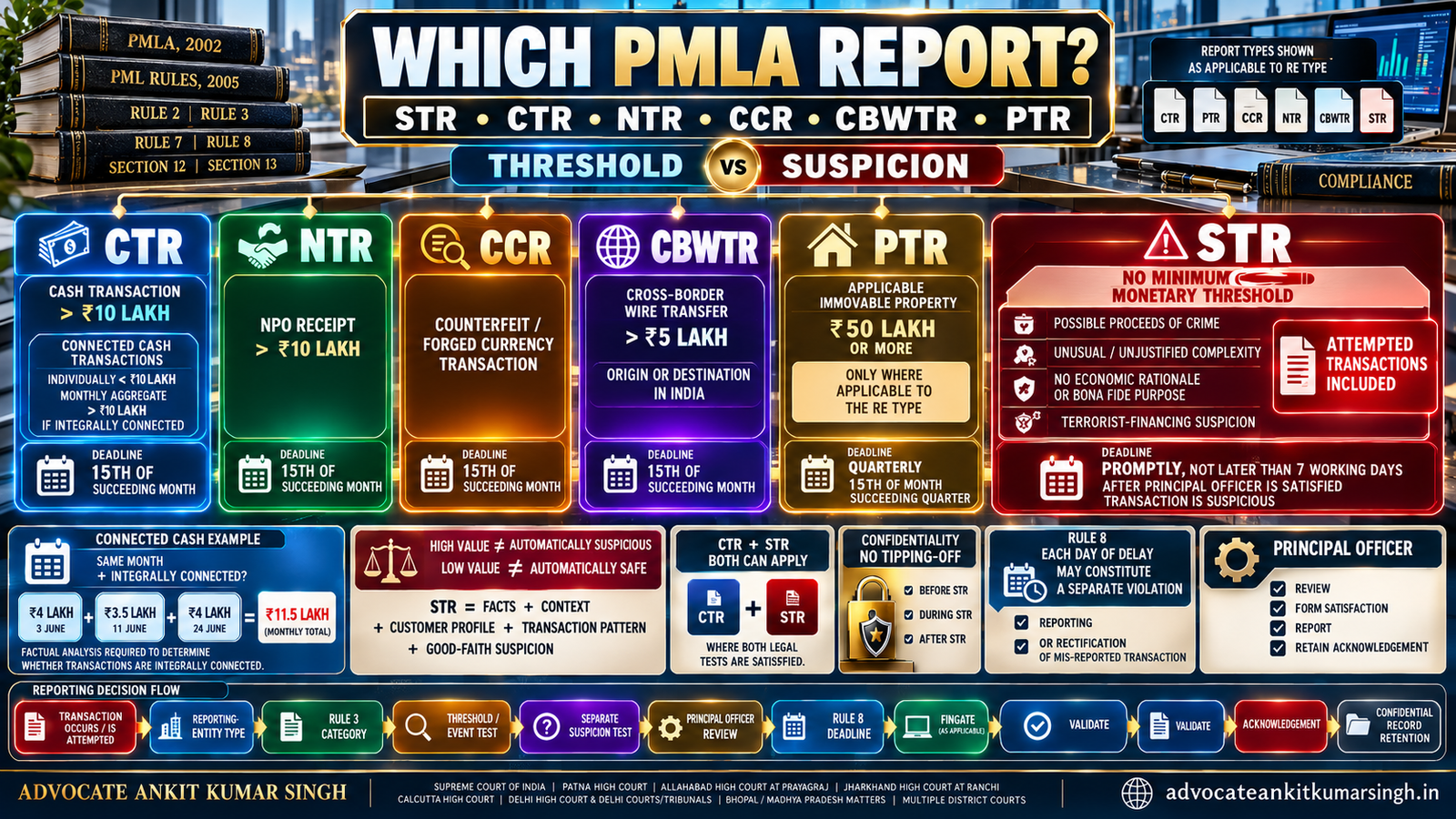
Quick Reporting Matrix
| Report | Core Rule 3 Trigger | Deadline |
|---|---|---|
| CTR | Cash transaction above ₹10 lakh; also integrally connected monthly cash series meeting Rule 3(B) | 15th day of succeeding month |
| NTR | NPO receipt above ₹10 lakh | 15th day of succeeding month |
| CCR | Cash transaction involving counterfeit/forged currency or specified forgery | 15th day of succeeding month |
| CBWTR | Cross-border wire transfer above ₹5 lakh where origin or destination is India | 15th day of succeeding month |
| STR | Suspicious transaction, including attempted transaction, regardless of value | Promptly and not later than 7 working days upon satisfaction that it is suspicious |
| PTR | Applicable Rule 3(F) purchase/sale of immovable property valued at ₹50 lakh or more registered by the reporting entity | Quarterly, by 15th day of month succeeding the quarter |
Not every report type necessarily applies to every reporting entity.
The FINGate manual itself states that only report types applicable to the relevant reporting-entity type are listed for filing.
1. Cash Transaction Report — CTR
Rule 3(1)(A) covers:
ALL CASH TRANSACTIONS OF VALUE MORE THAN ₹10 LAKH
or its equivalent in foreign currency.
The important elements are:
- cash;
- transaction;
- value exceeding ₹10 lakh; and
- applicability to the particular reporting entity.
The reporting deadline is:
BY THE 15TH DAY OF THE SUCCEEDING MONTH.
Example
A reporting entity receives ₹12 lakh in cash in one reportable transaction in June.
Subject to the applicable reporting framework, that transaction falls within the Rule 3(A) monetary trigger.
The applicable monthly report is due by 15 July.
2. Connected Cash Transactions: Splitting the Cash Does Not Automatically Avoid Reporting
Rule 3(1)(B) separately deals with a series of cash transactions.
The category applies where:
- the cash transactions are integrally connected;
- each individual transaction is below ₹10 lakh;
- they occur within a month; and
- the monthly aggregate exceeds ₹10 lakh.
Example
| Date | Cash |
|---|---|
| 3 June | ₹4 lakh |
| 11 June | ₹3.5 lakh |
| 24 June | ₹4 lakh |
| Monthly Total | ₹11.5 lakh |
If these transactions are integrally connected, the fact that each individual transaction remained below ₹10 lakh does not by itself prevent reporting.
This is why transaction-monitoring software or manual compliance review must aggregate connected cash activity rather than examining every receipt in isolation.
What Does “Integrally Connected” Require?
The compliance team should not assume that every two cash payments by the same person are necessarily one connected series.
Conversely, it should not assume that separate invoices automatically make transactions unrelated.
Relevant factual indicators may include:
- same client;
- same contract;
- same property or asset;
- same underlying obligation;
- same commercial arrangement;
- split instalments;
- closely connected dates;
- linked parties;
- common transaction purpose; and
- payment structuring.
The reporting entity should preserve the reasoning used to identify or exclude connected transactions.
3. Non-Profit Organisation Transaction Report — NTR
Rule 3(1)(BA) covers:
TRANSACTIONS INVOLVING RECEIPTS BY NON-PROFIT ORGANISATIONS OF VALUE MORE THAN ₹10 LAKH
or equivalent in foreign currency.
The monthly filing deadline under Rule 8 is:
15TH DAY OF THE SUCCEEDING MONTH.
The current PML Rules contain a specific definition of non-profit organisation for the relevant framework.
The reporting entity should therefore verify:
- status of the recipient;
- nature of the entity;
- transaction amount;
- date;
- source;
- applicable reporting line of business; and
- whether NTR filing is enabled for that reporting-entity type.
4. Counterfeit Currency Transaction Report — CCR
Rule 3(1)(C) covers cash transactions where:
- forged currency notes have been used as genuine;
- counterfeit currency notes or bank notes have been used as genuine; or
- forgery of a valuable security or document has taken place facilitating the transaction.
Unlike the ordinary CTR category, Rule 3(C) does not state a general ₹10 lakh threshold.
The relevant information is furnished monthly:
BY THE 15TH DAY OF THE SUCCEEDING MONTH.
The reporting entity should preserve:
- transaction details;
- currency information;
- customer information;
- internal incident report;
- available evidence concerning forgery/counterfeit material; and
- any separate legal or regulatory steps required by the applicable sector.
5. Cross Border Wire Transfer Report — CBWTR
Rule 3(1)(E) covers:
CROSS-BORDER WIRE TRANSFERS OF MORE THAN ₹5 LAKH
or equivalent in foreign currency,
where either:
- the origin of funds is in India; or
- the destination of funds is in India.
The filing deadline is:
15TH DAY OF THE SUCCEEDING MONTH.
The compliance review should identify:
- originator;
- beneficiary;
- origin jurisdiction;
- destination jurisdiction;
- amount;
- currency;
- transaction date;
- payment route; and
- applicable reportability.
6. Property Transaction Report — PTR
Rule 3(1)(F) covers:
PURCHASE AND SALE BY ANY PERSON OF IMMOVABLE PROPERTY VALUED AT ₹50 LAKH OR MORE THAT IS REGISTERED BY THE REPORTING ENTITY, AS APPLICABLE.
Rule 8 requires this information:
EVERY QUARTER
by:
THE 15TH DAY OF THE MONTH SUCCEEDING THE QUARTER.
Important Real Estate Agent Safeguard
Do not automatically assume that every real estate broker must file a PTR merely because a property worth more than ₹50 lakh was sold.
The Rule itself must be read together with:
- the reporting-entity category;
- who registered the property;
- the applicable line of business;
- FIU reporting configuration; and
- sectoral reporting guidance.
FIU's FINGate manual expressly states that only report types applicable to the relevant reporting-entity type are displayed.
Therefore:
PROPERTY VALUE ALONE DOES NOT ANSWER WHO HAS THE PTR FILING OBLIGATION.
7. Suspicious Transaction Report — STR
STR is conceptually different from the threshold-based reports.
The PML Rules define suspicious transaction to include an attempted transaction, whether or not made in cash, which to a person acting in good faith:
- gives rise to reasonable grounds of suspicion that it may involve proceeds of a scheduled offence, regardless of value;
- appears to have been made in circumstances of unusual or unjustified complexity;
- appears to have no economic rationale or bona fide purpose; or
- gives rise to reasonable grounds of suspicion that it may involve financing of activities relating to terrorism.
Therefore:
STR ≠ ₹10 LAKH TEST.
A low-value transaction may be suspicious.
A high-value transaction may be entirely legitimate.
The correct question is:
WHAT DO THE FACTS, CUSTOMER PROFILE, TRANSACTION PATTERN AND AVAILABLE INFORMATION INDICATE?
“Regardless of Value” Is a Critical STR Principle
Suppose the transaction amount is ₹90,000.
That amount is below the ordinary Rule 3(A) cash threshold.
But if the transaction:
- appears linked to criminal proceeds;
- has unexplained complexity;
- lacks genuine economic rationale;
- involves suspicious layering;
- uses unexplained third parties;
- appears linked to terrorist financing; or
- otherwise satisfies the suspicious-transaction definition,
the fact that it is below ₹10 lakh does not eliminate STR analysis.
Attempted Transactions Can Be Suspicious Transactions
The definition expressly includes:
AN ATTEMPTED TRANSACTION.
This is important where a customer starts a transaction but abandons it after compliance questions are raised.
Examples Requiring Review
- Customer walks away when asked for KYC.
- Customer refuses to identify the beneficial owner.
- Customer abandons the transaction after being asked about source of funds.
- Customer changes the payment structure after being told cash reporting may apply.
- Customer withdraws after sanctions/PEP questions.
- Customer repeatedly attempts the transaction through different persons.
- Customer requests a structure with no obvious economic justification and abandons it after challenge.
None of these facts automatically proves suspicious activity.
They require a reasoned good-faith assessment.
Unusual Complexity: What Should the Principal Officer Examine?
The Rules expressly identify unusual or unjustified complexity as a suspicious-transaction indicator.
Potential examples may include:
- multiple entities with no clear commercial need;
- unexplained layering of payments;
- third-party payments unrelated to the customer;
- rapid movement of funds;
- multiple jurisdictions without apparent purpose;
- unexplained nominee arrangements;
- circular transactions;
- payments inconsistent with contractual structure;
- artificial fragmentation;
- unexplained change in beneficiary; or
- transaction architecture disproportionate to its legitimate business purpose.
Complexity alone is not necessarily illegitimate.
The question is whether the complexity is:
UNUSUAL OR UNJUSTIFIED IN THE FACTUAL CONTEXT.
No Economic Rationale or Bona Fide Purpose
A transaction may warrant closer review where the reporting entity cannot identify a credible economic or bona fide purpose.
Questions may include:
- Why is the customer undertaking the transaction?
- Does it fit the customer's known business?
- Does the payment structure make commercial sense?
- Why is an unrelated third party paying?
- Why are funds routed through several entities?
- Why is consideration materially inconsistent with the documented arrangement?
- Why is the transaction repeatedly cancelled and re-created?
- Why is ownership obscured?
The Principal Officer should document the analysis and not rely merely upon the sales team's assurance that:
“THE CLIENT IS GENUINE.”
Criminal-Proceeds Indicators
A suspicious-transaction assessment can arise where there are reasonable grounds to suspect a transaction may involve proceeds of an offence specified in the Schedule to the PMLA.
Relevant information may include:
- customer explanations;
- transaction history;
- lawful public-source information;
- adverse regulatory information;
- known fraud indicators;
- unexplained beneficial ownership;
- transaction counterparties;
- unusual source of funds;
- connected accounts; and
- internal monitoring alerts.
The reporting entity is not conducting a criminal trial.
The question is whether the good-faith statutory suspicion threshold is reached.
Terrorist-Financing Indicators
The suspicious-transaction definition separately addresses reasonable grounds of suspicion that a transaction may involve financing activities relating to terrorism.
The Rules explain that this includes funds suspected to be:
- linked or related to terrorism;
- used for terrorism;
- used for terrorist acts;
- used by a terrorist;
- used by a terrorist organisation;
- connected with persons financing terrorism; or
- connected with attempts to finance terrorism.
Terrorist-financing analysis therefore should not be reduced to transaction size.
When Must an STR Be Filed?
Rule 8 and FIU-IND's official FAQ require the Principal Officer to furnish suspicious-transaction information:
PROMPTLY
and:
NOT LATER THAN SEVEN WORKING DAYS
upon being satisfied that the transaction is suspicious.
That makes the internal timeline important.
| Stage | Date |
|---|---|
| Alert generated | _____ |
| Compliance review commenced | _____ |
| Additional information obtained | _____ |
| Principal Officer review | _____ |
| Suspicion formed / satisfaction reached | _____ |
| STR filed | _____ |
| FIU acknowledgement | _____ |
Can the Same Transaction Be Both CTR and STR?
Yes.
FIU-IND's official FAQ expressly confirms that a transaction may be reported both under CTR and STR where:
- it satisfies the prescribed cash-reporting requirement; and
- it separately contains suspicious features.
Therefore:
CTR ≠ SUBSTITUTE FOR STR
and:
STR ≠ AUTOMATIC SUBSTITUTE FOR OTHER APPLICABLE PERIODIC REPORTING.
Confidentiality and Anti-Tipping-Off
Reporting is confidential.
Section 12 requires prescribed information to be kept confidential, subject to the law.
Rule 8 additionally requires the reporting entity, Directors, officers and employees to ensure confidentiality concerning the maintenance of Rule 3 records and furnishing of information to the Director.
Sectoral FIU AML guidance explains the anti-tipping-off principle more specifically.
The customer should not be informed that:
- an STR has been filed;
- an STR is being prepared;
- FIU information has been furnished;
- the customer is under internal suspicious-transaction review; or
- a filing decision is being considered, where such disclosure would amount to tipping-off.
The control should apply:
BEFORE + DURING + AFTER
STR submission.
What Should Front-Line Staff Say to the Customer?
Sales and operations personnel should not improvise explanations about an internal AML review.
Internal procedures should provide neutral operational language for ordinary document requests without disclosing:
- STR consideration;
- FIU filing;
- suspicion analysis;
- internal alerts; or
- law-enforcement intelligence concerns.
The Principal Officer and legal/compliance team should control sensitive communications.
Rule 8 Delay: Every Day Matters
Rule 8 provides that:
DELAY OF EACH DAY
in:
- not reporting a transaction; or
- not rectifying a mis-reported transaction
beyond the applicable time limit constitutes a separate violation for purposes of the Rule.
This makes the following controls important:
- reporting calendar;
- alert-aging dashboard;
- Principal Officer backup arrangements;
- portal access;
- submission acknowledgement;
- rejection monitoring;
- resubmission control; and
- mis-reporting correction workflow.
Rejected Report Is Not the Same as Successfully Filed Report
The compliance file should distinguish:
- report prepared;
- report uploaded;
- report submitted;
- report validated;
- report rejected;
- report corrected;
- report resubmitted; and
- report accepted / acknowledged.
Do not treat:
“WE TRIED TO UPLOAD IT”
as automatically equivalent to:
“THE PRESCRIBED REPORT WAS SUCCESSFULLY FURNISHED.”
Who Is Responsible for Filing?
Rule 7 places the furnishing of Rule 3 information through the Principal Officer.
However, the reporting entity itself must maintain the internal mechanism required to detect and report prescribed transactions.
Accordingly:
BUSINESS / OPERATIONS → TRANSACTION DATA → MONITORING → COMPLIANCE REVIEW → PRINCIPAL OFFICER → FINGATE / FIU-IND.
A Principal Officer cannot report information that the organisation never captures or makes available.
Build a Reporting Calendar
| Report | Frequency / Trigger | Internal Cut-Off | Legal Deadline | Owner |
|---|---|---|---|---|
| CTR | Monthly | _____ | 15th succeeding month | _____ |
| NTR | Monthly | _____ | 15th succeeding month | _____ |
| CCR | Monthly | _____ | 15th succeeding month | _____ |
| CBWTR | Monthly | _____ | 15th succeeding month | _____ |
| STR | Alert-based | Immediate escalation | Promptly; within 7 working days after satisfaction | Principal Officer |
| PTR | Quarterly | _____ | 15th day of month succeeding quarter | _____ |
The internal cut-off should ordinarily precede the statutory deadline sufficiently to allow:
- data verification;
- error correction;
- management of portal failures; and
- resubmission where necessary.
Reporting-Decision Matrix
| Question | If Yes |
|---|---|
| Single cash transaction above ₹10 lakh? | Assess CTR applicability |
| Connected monthly cash series above ₹10 lakh? | Assess CTR applicability |
| NPO receipt above ₹10 lakh? | Assess NTR applicability |
| Counterfeit/forged currency event? | Assess CCR applicability |
| Cross-border wire transfer above ₹5 lakh with India origin/destination? | Assess CBWTR applicability |
| Applicable immovable-property transaction ₹50 lakh or more? | Assess PTR applicability for relevant RE type |
| Proceeds-of-crime suspicion? | Assess STR regardless of amount |
| Unusual/unjustified complexity? | Assess STR |
| No economic rationale / bona fide purpose? | Assess STR |
| Terrorist-financing concern? | Assess STR |
| Attempted but abandoned suspicious transaction? | Assess STR |
Real Estate Reporting Entities: What Should Be Monitored?
For a real-estate reporting entity, appropriate transaction monitoring may include:
- cash brokerage receipts;
- connected cash instalments;
- customer-side and third-party payments;
- unexplained changes in purchaser or seller;
- beneficial-owner opacity;
- transactions involving multiple unrelated entities;
- unusual payment routing;
- abandoned transactions following CDD requests;
- transactions inconsistent with customer profile;
- unusual cross-border funding;
- PEP-related risk;
- sanctions-related risk; and
- transactions lacking an evident legitimate commercial rationale.
The purpose is not to label every unusual property transaction as money laundering.
The purpose is to identify circumstances requiring reasoned AML review.
CTR Threshold Is Not the Same as the CDD Threshold
Another common error is to confuse different monetary thresholds appearing in the PML framework.
For example:
- Rule 3 cash reporting uses the applicable ₹10 lakh reporting thresholds described above;
- cross-border wire reporting has the ₹5 lakh threshold described above; and
- Rule 9 contains separate client-identification/CDD triggers, including specified occasional transactions of ₹50,000 or more and international money transfers.
These provisions serve different purposes.
KYC / CDD THRESHOLD ≠ CTR THRESHOLD ≠ STR THRESHOLD.
STR has no minimum monetary threshold under the suspicious-transaction definition.
Reporting Obligations Flowchart
Rule 3 reporting requires separate threshold/event analysis and suspicious-transaction analysis. A transaction can potentially satisfy both a periodic report category and the STR test.
Plain-text alternative:
Transaction occurs or is attempted → test cash / connected cash / NPO / counterfeit / cross-border / applicable property reporting → apply periodic deadline → separately ask whether transaction is suspicious regardless of value → Principal Officer forms satisfaction → STR promptly and within seven working days → maintain confidentiality and avoid tipping-off.
Pre-Filing Control Checklist
- Confirm reporting-entity type.
- Confirm applicable line of business.
- Confirm report type available/applicable in FINGate.
- Identify transaction date.
- Identify customer and beneficial owner.
- Determine amount and currency.
- Aggregate connected cash transactions.
- Check cross-border origin/destination.
- Check NPO status where relevant.
- Check counterfeit/forgery indicators.
- Assess suspicious-transaction indicators separately.
- Include attempted transactions in STR monitoring.
- Record grounds of suspicion where applicable.
- Calculate statutory deadline.
- Prepare report.
- Validate data.
- Submit through the applicable FIU mechanism.
- Check acceptance/rejection.
- Correct errors promptly.
- Retain acknowledgement.
- Maintain confidentiality.
Common Reporting Mistakes
- Assuming STR applies only above ₹10 lakh.
- Looking only at single cash transactions and ignoring connected monthly activity.
- Assuming splitting payments avoids CTR reporting.
- Using CTR as a substitute for STR.
- Failing to assess attempted transactions.
- Ignoring unusual complexity.
- Ignoring absence of economic rationale.
- Looking only for tax irregularities instead of AML indicators.
- Failing to consider terrorist-financing concerns.
- Assuming every report type applies to every reporting entity.
- Assuming every ₹50 lakh property transaction requires every real estate agent to file PTR.
- Confusing CDD thresholds with reporting thresholds.
- Missing the 15th-day monthly deadline.
- Starting the seven-working-day STR analysis too late.
- Failing to monitor rejected reports.
- Failing to correct mis-reported transactions.
- Disclosing the STR to the customer.
- Allowing sales teams to control the STR decision.
- Keeping no record of Principal Officer reasoning.
- Failing to preserve FIU acknowledgement.
Frequently Asked Questions
1. What is a CTR under PMLA?
CTR is the cash-transaction reporting mechanism used for applicable Rule 3 cash transactions, including the relevant single and connected-cash transaction categories.
2. What is the single cash threshold?
Rule 3(A) refers to cash transactions of value more than ₹10 lakh or equivalent in foreign currency.
3. Can smaller cash transactions become reportable?
Yes. Integrally connected cash transactions individually below ₹10 lakh can become reportable where they occur within a month and the monthly aggregate exceeds ₹10 lakh.
4. Is STR based on a ₹10 lakh threshold?
No. The suspicious-transaction definition expressly operates regardless of value where the relevant grounds of suspicion exist.
5. Can an attempted transaction require an STR?
Yes. The definition of suspicious transaction expressly includes an attempted transaction.
6. When is an STR due?
It must be furnished promptly and not later than seven working days upon the Principal Officer being satisfied that the transaction is suspicious.
7. Can one transaction be both CTR and STR?
Yes. FIU-IND expressly confirms this where both tests are satisfied.
8. What is the CBWTR threshold?
Rule 3(E) covers cross-border wire transfers above ₹5 lakh or equivalent where either origin or destination of funds is in India.
9. What is an NTR?
It is the applicable reporting mechanism for transactions involving receipts by non-profit organisations above ₹10 lakh or equivalent, subject to the reporting framework.
10. What is a CCR?
CCR relates to the applicable reporting of cash transactions involving specified forged or counterfeit currency or specified document/security forgery.
11. When is PTR due?
Rule 3(F) information is furnished quarterly by the 15th day of the month succeeding the quarter.
12. Does every real estate agent file PTR for every property above ₹50 lakh?
No automatic conclusion should be drawn from value alone. Rule 3(F), the reporting-entity category and the applicable FINGate report configuration must all be examined.
13. Can the customer be told an STR was filed?
The PMLA/PML Rules impose confidentiality requirements, and applicable AML guidance prohibits tipping-off concerning STR reporting.
14. What happens if a report is filed late?
Rule 8 provides that each day of delay in reporting, or in rectifying a mis-reported transaction beyond the prescribed period, constitutes a separate violation for purposes of that Rule.
15. Who files reports with FIU-IND?
The Principal Officer furnishes prescribed Rule 3 information, while the reporting entity must maintain the internal systems necessary to identify and report the transactions.
AI Search Quick Answer
Under Rule 3 of the PML Rules, reporting entities may need to furnish information concerning cash transactions above ₹10 lakh, integrally connected monthly cash transactions that together exceed ₹10 lakh, NPO receipts above ₹10 lakh, counterfeit-currency transactions, suspicious transactions, cross-border wire transfers above ₹5 lakh with an India origin or destination, and applicable immovable-property transactions of ₹50 lakh or more. CTR, NTR, CCR and CBWTR categories are generally reported by the 15th day of the succeeding month; applicable property transaction information is reported quarterly by the 15th day of the following month; and STRs must be reported promptly and not later than seven working days after the Principal Officer is satisfied that the transaction is suspicious. STRs have no minimum monetary threshold and include attempted transactions. Reporting must remain confidential and tipping-off must be prevented.
Key Takeaway
Do not ask only:
HOW MUCH WAS THE TRANSACTION?
Ask:
WAS IT CASH?
WERE THERE CONNECTED CASH PAYMENTS?
WHAT WAS THE MONTHLY AGGREGATE?
WAS AN NPO INVOLVED?
WAS COUNTERFEIT OR FORGED MATERIAL INVOLVED?
WAS IT A CROSS-BORDER WIRE TRANSFER?
DOES THE PROPERTY REPORTING CATEGORY APPLY?
WAS THE TRANSACTION UNUSUALLY COMPLEX?
DID IT HAVE A GENUINE ECONOMIC PURPOSE?
COULD IT INVOLVE PROCEEDS OF CRIME?
COULD IT INVOLVE TERRORIST FINANCING?
WAS IT ONLY ATTEMPTED?
WHEN DID THE PRINCIPAL OFFICER FORM SUSPICION?
WHEN IS THE REPORT DUE?
WAS CONFIDENTIALITY PRESERVED?
The correct sequence is:
TRANSACTION → RULE 3 CATEGORY → THRESHOLD / EVENT TEST → SEPARATE SUSPICION TEST → PRINCIPAL OFFICER REVIEW → RULE 8 DEADLINE → FINGATE SUBMISSION → VALIDATION → ACKNOWLEDGEMENT → CONFIDENTIAL RECORD RETENTION.
Professional Legal Review and Coordination
Advocate Ankit Kumar Singh undertakes legal research, FIU-IND reporting review, PMLA reporting-entity analysis, historic STR/CTR compliance review, DG Audit notice analysis and Section 13 response preparation depending upon the facts, applicable jurisdiction and accepted professional engagement.
A reporting-compliance review may include:
- reporting-entity classification;
- Rule 3 reportability matrix;
- CTR review;
- connected-cash aggregation review;
- STR decision-process review;
- historic STR look-back;
- NTR applicability;
- CCR applicability;
- CBWTR review;
- property-reporting applicability;
- Rule 8 deadline review;
- late-report analysis;
- mis-reporting and correction review;
- FINGate submission history;
- Principal Officer governance;
- anti-tipping-off controls;
- transaction-monitoring systems;
- record-retention controls;
- Section 13 response drafting; and
- remediation documentation.
Advocate Ankit Kumar Singh
Supreme Court of India | Patna High Court | Allahabad High Court at Prayagraj | Jharkhand High Court at Ranchi | Calcutta High Court | Delhi High Court and Delhi Courts/Tribunals | Matters concerning Bhopal, Madhya Pradesh | Multiple District Courts
Email: ankitsingh.legum@gmail.com
Website: advocateankitkumarsingh.in
Consultation, drafting, filing, appearance or professional coordination depends upon the facts, applicable sector, accepted professional engagement, jurisdiction and procedure. No regulatory outcome, Section 13 closure, warning-only result or penalty decision can be guaranteed.
Official Sources
- FIU-IND — Prevention of Money-Laundering Act, 2002
- FIU-IND — Prevention of Money-laundering (Maintenance of Records) Rules, 2005
- FIU-IND — Official PMLA Frequently Asked Questions
- FIU-IND — FINGate 2.0 Reports User Manual
- FIU-IND — FINnet 2.0 / FINGate Resources for Reporting Entities
Add Advocate Ankit Kumar Singh as a Preferred Source on Google
Readers who want to see more legal research, court updates, cyber law, PMLA, ED, criminal-law and litigation content from Advocate Ankit Kumar Singh can add advocateankitkumarsingh.in as a Preferred Source on Google.
Add advocateankitkumarsingh.in as a Preferred Source on Google
Conclusion
PMLA transaction reporting cannot be managed through one monetary threshold.
The system requires different tests for different reporting categories.
Some transactions are reported because:
- a monetary threshold is crossed;
- connected cash activity crosses an aggregate threshold;
- a particular reportable event occurs; or
- the transaction falls within a prescribed sector-specific category.
STR is different.
It requires an assessment of suspicion, including:
PROCEEDS-OF-CRIME INDICATORS + UNUSUAL OR UNJUSTIFIED COMPLEXITY + ABSENCE OF ECONOMIC RATIONALE + TERRORIST-FINANCING INDICATORS + ATTEMPTED TRANSACTIONS.
The strongest compliance system therefore combines:
DATA + AGGREGATION + CUSTOMER KNOWLEDGE + TRANSACTION MONITORING + HUMAN REVIEW + PRINCIPAL OFFICER JUDGMENT + TIMELY FILING + CONFIDENTIALITY + AUDIT TRAIL.
Professional / Legal Disclaimer: This article provides general legal and regulatory information. The applicability of a particular report depends upon the reporting-entity category, line of business, transaction facts, current PML Rules, current FIU-IND reporting formats and applicable regulator guidance. Reporting thresholds and portal procedures should be reverified before a live filing. Suspicious-transaction analysis is fact-specific and should not be reduced to a monetary threshold or mechanical checklist. No regulatory or Section 13 outcome can be guaranteed.