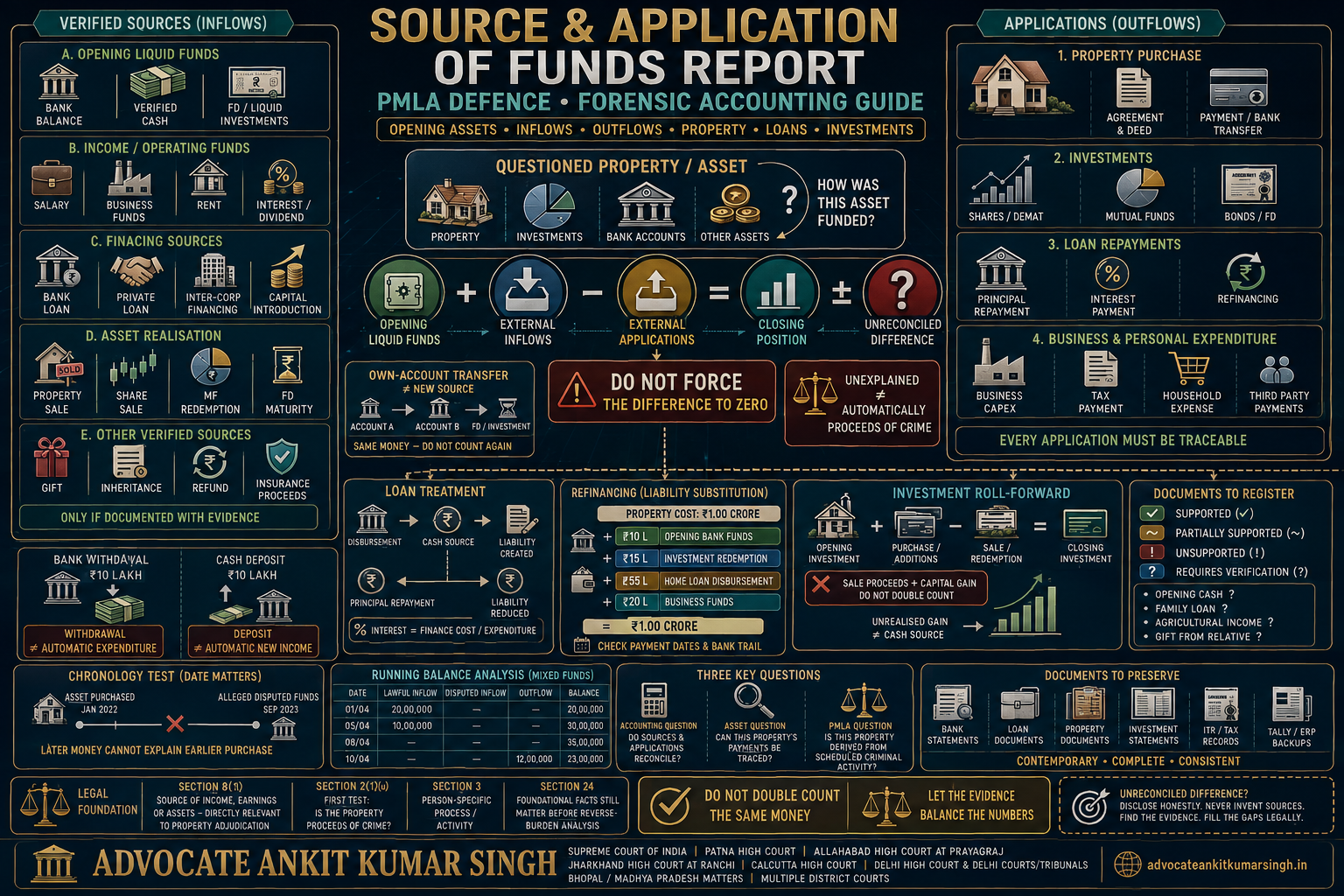
PMLA FORENSIC ACCOUNTING • SOURCE OF FUNDS • ASSET TRACING • FUND APPLICATION
Source-and-Application-of-Funds Report for PMLA Defence: How to Reconstruct Opening Assets, Inflows, Outflows, Property Purchases, Loan Repayments, Investment Trails and Unexplained Differences
Opening Position • Verified Sources • Applications • Property Funding • Loan Repayments • Investments • Closing Position • Unexplained Difference
Research updated: 9 August 2026 | By Advocate Ankit Kumar Singh
 Advocate Ankit Kumar Singh
Direct Answer: How Do You Prove the Source of an Asset in a PMLA Case?
Do not merely say:
“I had enough income.”
Prepare a transaction-date financial reconstruction showing:
WHAT FUNDS EXISTED BEFORE THE PERIOD + WHAT GENUINE EXTERNAL FUNDS CAME IN - WHERE THOSE FUNDS WERE APPLIED = WHAT SHOULD REMAIN.
For the particular property questioned by ED, separately prove:
PURCHASE PRICE → PAYMENT DATES → BANK / CASH SOURCE → LOAN COMPONENT → INVESTMENT REDEMPTION → PRIOR SAVINGS → OTHER DOCUMENTED CONTRIBUTION.
The report should not be designed merely to make two totals match.
It should identify what is:
- proved;
- partially supported;
- unsupported;
- still unexplained.
Why a Source-and-Application Report Matters Under Section 8 PMLA
Section 8(1) of the Prevention of Money-Laundering Act expressly contemplates a notice requiring the concerned person to indicate the sources of income, earnings or assets out of or by means of which the attached, seized or frozen property was acquired, together with supporting evidence and relevant particulars.
This makes the source of acquisition a direct statutory issue in attachment adjudication.
A structured source-and-application report can therefore help organise the documentary response.
However, it is important to understand:
THERE IS NO PRESCRIBED “SOURCE-AND-APPLICATION-OF-FUNDS REPORT” FORMAT UNDER PMLA.
It is a forensic-accounting methodology, not an official statutory form.
Start With the PMLA Question — Not the Spreadsheet
Before reconciling thousands of transactions, identify:
- What is the scheduled offence?
- What criminal activity is alleged?
- How much property does ED allege was generated from that activity?
- When was it allegedly generated?
- Which property does ED say represents those proceeds?
- How is your client linked to that property?
Only then decide what financial period the source report must analyse.
Unexplained Money Is Not Automatically Proceeds of Crime
PMLA requires the statutory proceeds-of-crime nexus.
Therefore:
UNEXPLAINED ≠ AUTOMATICALLY CRIMINAL PROCEEDS.
Likewise:
UNDISCLOSED FOR TAX ≠ AUTOMATICALLY PMLA PROCEEDS OF CRIME.
A source report should explain genuine lawful sources where available while also testing whether the prosecution has established the necessary link between the property and criminal activity relating to the scheduled offence.
Section 24 Does Not Make the Initial PMLA Foundation Disappear
Supreme Court jurisprudence has discussed foundational facts relevant to the Section 24 presumption, including:
- criminal activity relating to a scheduled offence;
- property derived or obtained as a result of that criminal activity; and
- the concerned person's involvement with that property in the relevant process or activity.
Therefore a source report should not be drafted as though the defence carries the burden of explaining every historical asset before the prosecution identifies the property it says is criminally generated.
Step 1: Define the Review Period
The analysis must have a clear:
- opening date;
- closing date;
- asset-acquisition date;
- alleged proceeds-of-crime generation period.
Example:
Review period: 1 April 2021 to 31 March 2025.
If a questioned property was bought on 15 September 2022, the report must show what funds were actually available on or before the payment dates.
Income earned in 2024 cannot retrospectively fund a 2022 purchase.
Step 2: Prepare the Opening Financial Position
| Opening Item | Amount | Evidence | Liquidity |
|---|---|---|---|
| Bank balances | ₹_____ | Bank statement | Available |
| Cash | ₹_____ | Cash book / prior records | Available if proved |
| Fixed deposits | ₹_____ | Bank statement | Liquid on maturity/redemption |
| Mutual funds / shares | ₹_____ | Demat/CAS | Available after sale/redemption |
| Property | ₹_____ | Title document | Not cash unless sold/financed |
| Loans receivable | ₹_____ | Agreement/ledger | Available when repaid |
| Loan liabilities | (₹_____) | Loan statement | Liability |
Opening Wealth Is Not the Same as Opening Available Funds
Suppose a person owned:
- a house worth ₹1 crore;
- land worth ₹50 lakh;
- ₹5 lakh bank balance.
The available cash is not automatically ₹1.55 crore.
The immovable assets become relevant funding sources only if the evidence shows something such as:
- sale;
- mortgage;
- loan against property;
- other monetisation.
Avoid converting paper wealth into fictional liquidity.
Opening Cash: One of the Most Dangerous Balancing Figures
A report should not casually insert:
“Opening cash in hand — ₹40 lakh.”
Ask:
- Was it shown in earlier books?
- Was it disclosed in a balance sheet?
- Was there a cash book?
- What generated it?
- Was it already spent before the review period?
- Was such cash holding commercially plausible?
An invented opening cash balance can damage the credibility of the entire report.
Step 3: Classify Genuine Sources of Funds
A. OPERATING / INCOME SOURCES
- salary;
- business/professional income;
- rent;
- interest;
- dividend;
- other documented income.
B. CAPITAL / FINANCING SOURCES
- bank loan;
- documented personal loan;
- inter-company financing;
- capital contribution;
- genuine gift;
- inheritance.
C. REALISATION OF EXISTING ASSETS
- property sale;
- share sale;
- mutual-fund redemption;
- FD maturity;
- bond redemption;
- repayment of loan receivable.
D. OTHER RECEIPTS
- tax refund;
- insurance proceeds;
- business refund;
- security-deposit refund.
Choose One Accounting Method — Do Not Mix Gross Receipts and Net Income
A common forensic error is inconsistent methodology.
Suppose a business has:
Revenue: ₹1 crore.
Operating expenditure: ₹80 lakh.
Business surplus: ₹20 lakh.
Method A may analyse:
₹1 crore gross receipts - ₹80 lakh applications = ₹20 lakh available surplus.
Method B may begin with:
₹20 lakh established business surplus.
Do not count:
₹1 crore receipts + ₹20 lakh profit
as ₹1.20 crore source while separately deducting the same business expenditure.
State the methodology clearly.
Step 4: Eliminate Transfers Between the Client's Own Accounts
This is essential.
Example:
Bank A → Bank B: ₹25 lakh.
Bank B → FD: ₹20 lakh.
If all belong to the same person:
the ₹25 lakh transfer is not fresh income.
It is simply movement of existing money.
Create an “INTERNAL TRANSFER” tag and remove it from external sources/applications.
Step 5: Treat Loan Receipts Correctly
A loan provides cash but also creates liability.
Example:
Home loan disbursement: ₹60 lakh.
Report:
SOURCE OF CASH: ₹60 lakh.
CORRESPONDING LIABILITY: ₹60 lakh less subsequent principal repayment.
Do not classify the ₹60 lakh as earned income.
Loan Source Verification Checklist
For every loan used as a source, verify:
- Lender identity.
- Loan agreement.
- Sanction.
- Disbursement date.
- Bank trail.
- Borrower's ledger.
- Lender's capacity where private loan.
- Interest terms.
- Repayment obligation.
- Closing balance.
Private or Family Loan: “Loan” Label Is Not Enough
If ₹30 lakh is shown as a loan from a relative, examine:
- Did the lender actually have ₹30 lakh?
- What was the lender's source?
- Did the money move through banking channels?
- Was the loan contemporaneously recorded?
- Was interest agreed?
- Was repayment made?
- Did the money first come from the borrower and circulate back through the relative?
Do not create a retrospective loan agreement merely because an asset now requires explanation.
Step 6: Treat Sale of Existing Assets Correctly
Suppose:
Shares originally purchased for: ₹10 lakh.
Sold for: ₹18 lakh.
Available cash from the sale:
₹18 lakh.
Do not add:
₹18 lakh sale proceeds + ₹8 lakh capital gain
and call ₹26 lakh the source.
The gain is embedded in the sale proceeds.
Investment Redemption Has the Same Double-Counting Risk
Mutual-fund investment: ₹20 lakh.
Redemption: ₹27 lakh.
Cash inflow: ₹27 lakh.
Gain: ₹7 lakh.
Do not count ₹34 lakh.
Unrealised Appreciation Is Not Cash Available for Another Purchase
If shares worth ₹10 lakh rise to ₹30 lakh but remain unsold:
the ₹20 lakh appreciation does not itself produce ₹20 lakh cash.
The investment may strengthen net worth.
It does not become a funding source until monetised or used to obtain financing.
Step 7: Identify Applications of Funds
Applications may include:
- property purchase;
- vehicle;
- shares/securities;
- mutual funds;
- business investment;
- capital expenditure;
- loan principal repayment;
- interest;
- tax;
- documented household expenditure;
- third-party payments;
- capital contribution;
- other identified expenditure.
Cash Withdrawal Is Not Automatically an Application
Suppose ₹10 lakh is withdrawn from a bank.
Immediately after withdrawal:
BANK BALANCE ↓ ₹10 lakh
but:
CASH HOLDING ↑ ₹10 lakh.
Unless the cash is shown to have been spent, the withdrawal merely changes the form of the asset.
Therefore:
BANK WITHDRAWAL ≠ AUTOMATIC EXPENDITURE.
Cash Deposit Is Not Automatically New Income Either
A bank deposit may represent:
- business receipt;
- sale proceeds;
- earlier withdrawal redeposited;
- loan;
- cash sales;
- other genuine source;
- or an unexplained deposit.
Do not automatically classify every cash deposit as fresh earnings.
Trace the source.
Credit Cards Create Another Double-Counting Problem
Suppose:
Goods/services purchased on credit card: ₹2 lakh.
Later credit-card bill payment: ₹2 lakh.
Do not count both as two separate ₹2 lakh personal applications if they represent the same underlying expenditure.
Choose the appropriate recognition point and remain consistent.
Step 8: Build an Asset-Specific Source Stack
For every property challenged by ED, prepare:
| Property Payment | Date | Amount | Funding Source | Evidence |
|---|---|---|---|---|
| Booking / advance | __/__/____ | ₹10,00,000 | Opening bank balance | Bank statement |
| Second payment | __/__/____ | ₹15,00,000 | Mutual-fund redemption | CAS + bank |
| Loan disbursement | __/__/____ | ₹60,00,000 | Housing loan | Sanction + disbursement |
| Final payment | __/__/____ | ₹15,00,000 | Business surplus | Books + bank |
The Property Source Equation
For a ₹1 crore acquisition:
₹10 lakh — opening bank funds
+
₹15 lakh — investment redemption
+
₹60 lakh — housing loan
+
₹15 lakh — established business funds
=
₹1 crore.
Then verify that each source existed before the corresponding payment.
Chronology Can Be More Important Than the Total
Suppose:
Property purchased: January 2022.
Alleged disputed funds received: September 2023.
A later 2023 receipt cannot ordinarily explain the January 2022 purchase.
The source-and-application report should therefore operate on actual transaction dates, not merely annual totals.
Do Not Use Market Value Instead of Actual Acquisition Cost Without Explanation
If property was purchased in 2015 for ₹40 lakh and is worth ₹1.5 crore today:
the source-of-acquisition question ordinarily begins with the actual acquisition consideration and related acquisition costs, not today's market appreciation.
Separate:
- historical purchase consideration;
- stamp/registration expenditure;
- later improvements;
- current market value.
Step 9: Build a Loan-Repayment Trail
| Date | Opening Loan | Principal Paid | Interest | Source of Payment | Closing Loan |
|---|---|---|---|---|---|
| __/__/____ | ₹_____ | ₹_____ | ₹_____ | _____ | ₹_____ |
Separate:
PRINCIPAL from: INTEREST.
Principal reduces liability.
Interest is finance cost/expenditure.
Refinancing: New Borrowing Can Explain Old Loan Repayment
Example:
Loan A outstanding: ₹50 lakh.
Loan B disbursed: ₹50 lakh.
Loan A repaid: ₹50 lakh.
Economic effect:
OLD LIABILITY ↓
NEW LIABILITY ↑
This is not ₹50 lakh of fresh wealth.
It is liability substitution, subject to proof that the refinancing was genuine.
Step 10: Prepare an Investment Trail
| Investment | Opening | Purchase | Sale/Redemption | Income | Closing |
|---|---|---|---|---|---|
| Mutual Fund A | ₹_____ | ₹_____ | ₹_____ | ₹_____ | ₹_____ |
Use:
- demat statements;
- consolidated account statements;
- broker statements;
- bank statements;
- contract notes;
- FD certificates;
- dividend/interest records.
Investment Switches Should Not Be Counted as Fresh Wealth
Example:
Fund A redeemed: ₹20 lakh.
Same ₹20 lakh immediately invested in Fund B.
This is:
REALISATION OF INVESTMENT A → APPLICATION INTO INVESTMENT B.
It does not create ₹20 lakh of additional wealth.
Step 11: Prepare the Closing Position
| Closing Item | Amount | Evidence |
|---|---|---|
| Bank | ₹_____ | Statement |
| Cash | ₹_____ | Cash book/support |
| Investments | ₹_____ | Demat/CAS |
| Property | ₹_____ | Acquisition records |
| Loans receivable | ₹_____ | Ledger/agreement |
| Loan liabilities | (₹_____) | Lender statement |
Master Reconciliation
A simplified cash-availability model can be presented as:
VERIFIED OPENING LIQUID FUNDS + VERIFIED EXTERNAL INFLOWS - VERIFIED EXTERNAL APPLICATIONS = EXPECTED CLOSING LIQUID POSITION.
Then compare it with the actual closing position.
Any residual difference must be investigated.
Do Not Force the Difference to Zero
Suppose the report concludes:
Total verified funds available: ₹2,47,80,000.
Verified applications/closing position: ₹2,56,05,000.
Difference: ₹8,25,000.
If the evidence presently does not explain ₹8,25,000, state:
“₹8,25,000 PRESENTLY UNRECONCILED — FURTHER DOCUMENTARY VERIFICATION REQUIRED.”
Do not invent:
“Old cash savings — ₹8,25,000.”
merely to balance the spreadsheet.
Create an Assumption Register
| Assumption | Amount | Status | Evidence Needed |
|---|---|---|---|
| Opening cash | ₹_____ | Unsupported / Partial / Verified | _____ |
| Family loan | ₹_____ | _____ | _____ |
| Agricultural income | ₹_____ | _____ | _____ |
Every significant assumption should be visible.
Hidden assumptions make forensic reports difficult to defend.
Agricultural Income: Do Not Use It as a Generic Balancing Source
Where genuinely relied upon, examine:
- land ownership/tenancy;
- cultivable area;
- crop;
- yield;
- sale records;
- mandi/buyer records;
- bank/cash trail;
- historical consistency;
- agricultural expenditure.
Do not simply insert a round agricultural-income figure because other funds are insufficient.
Gifts and Family Contributions
A genuine gift should be tested through:
- donor identity;
- relationship;
- donor capacity;
- donor bank statement;
- transfer;
- contemporaneous record where available;
- tax treatment where relevant.
A gift deed created years later cannot by itself prove that the money actually originated from the donor.
Capital Introduction Into a Business
If the individual claims that funds were introduced as capital into a company/firm:
trace:
PERSONAL SOURCE → PERSONAL BANK → COMPANY / FIRM → CAPITAL ACCOUNT → BUSINESS APPLICATION.
The word “capital” in a ledger is not itself the source.
The source of the capital must still be identified.
Related-Company Funds: Ownership Must Be Respected
Money belonging to Company A is not automatically the personal source of Director X merely because X controls the company.
If money moved from the company to the individual, identify the legal character:
- salary;
- dividend;
- reimbursement;
- loan;
- advance;
- capital reduction;
- other documented transaction.
Do not collapse separate legal entities merely to complete a source report.
Business Receipts and Personal Wealth Must Be Kept Separate
₹5 crore turnover does not mean an individual had ₹5 crore available personally.
Business receipts may have been applied to:
- purchases;
- employees;
- tax;
- rent;
- loan servicing;
- working capital;
- inventory;
- other operating expenditure.
The relevant figure may be the amount lawfully available for withdrawal/distribution after the applicable business obligations and accounting treatment.
Asset Purchased on Credit: Do Not Treat Full Value as Immediate Cash Application
Suppose machinery worth ₹50 lakh is purchased:
₹10 lakh paid immediately.
₹40 lakh remains payable to vendor.
Cash application at that stage is not necessarily ₹50 lakh.
The balance creates a creditor/liability.
The later settlement of that creditor must separately be sourced.
Use Payment Dates, Not Merely Invoice or Registration Dates
An asset may be funded through:
- booking advance;
- instalments;
- loan disbursement;
- final payment;
- registration expenditure.
Each payment can have a different source.
Prepare transaction-level funding rather than one annual source statement.
The Evidence Hierarchy for Source Verification
As a practical forensic discipline—not a rigid statutory ranking—give greater weight to contemporaneous independent records.
STRONG EXTERNAL RECORDS
- bank statements;
- registered deeds;
- loan statements;
- demat/CAS;
- employer records;
- tax/GST records;
- third-party payment records.
INTERNAL BUSINESS RECORDS
- Tally/ERP;
- cash book;
- capital account;
- party ledger;
- board records.
EXPLANATORY MATERIAL
- later reconciliation;
- affidavit;
- statement;
- estimate;
- oral explanation.
Later explanatory material should ideally be anchored to pre-existing evidence.
Electronic Accounting Data Should Be Preserved Properly
If source reconstruction depends upon:
- Tally;
- ERP;
- Excel;
- bank exports;
- electronic ledgers;
preserve the native or original data where possible instead of relying only on newly prepared PDFs.
Where the electronic record is to be tendered in evidence, examine the applicable Bharatiya Sakshya Adhiniyam electronic-record requirements and the saved-law position for older pending proceedings.
Section 28 BSA: Books Help, But Do Not End the Inquiry
Regularly kept books of account, including electronic books, can be relevant evidence under the Bharatiya Sakshya Adhiniyam.
But entries alone are not sufficient to charge a person with liability.
Therefore a source report should corroborate ledger entries with:
- banking evidence;
- contracts;
- property records;
- loan records;
- investment records;
- tax evidence;
- counterparty material.
Do Not Accept the Prosecution's Source Calculation Without Reperforming It
If ED or another investigator says:
“Known income ₹60 lakh; assets ₹1.5 crore; unexplained ₹90 lakh.”
check:
- Was opening wealth excluded?
- Were loans excluded?
- Were asset-sale proceeds excluded?
- Were investment redemptions excluded?
- Were own-account transfers counted as income?
- Were liabilities ignored?
- Were later asset values substituted for historical cost?
- Were funds outside the selected date range ignored?
- Were business funds analysed correctly?
- Was the chronology accurate?
Unsupported Assumptions Can Exist on Both Sides
Defence assumptions require scrutiny.
So do prosecution assumptions.
Examples:
- assuming every credit is suspicious;
- assuming every transfer to a related entity is diversion;
- assuming a property must have been funded from the nearest preceding disputed credit;
- assuming current market value equals unexplained investment;
- assuming cash withdrawal means personal expenditure;
- assuming the entire bank balance represents alleged proceeds.
Every major inference should identify the evidence and methodology supporting it.
Asset-Acquisition Date Versus Alleged Crime Period
Create a simple chronology:
| Event | Date |
|---|---|
| Asset purchased | __/__/____ |
| Scheduled offence period alleged to begin | __/__/____ |
| Alleged POC generated | __/__/____ |
| Disputed bank receipt | __/__/____ |
A chronological impossibility can be more important than a hundred-page accounting schedule.
What If Lawful and Allegedly Tainted Funds Are Mixed?
Do not pretend the account contained only one category of funds.
Prepare a running-balance chronology:
| Date | Lawful Inflow | Disputed Inflow | Outflow | Balance |
|---|---|---|---|---|
| 01/04 | ₹20 lakh opening | — | — | ₹20 lakh |
| 05/04 | ₹10 lakh business receipt | — | — | ₹30 lakh |
| 08/04 | — | ₹5 lakh disputed | — | ₹35 lakh |
The applicable legal tracing consequence remains case-specific, but the factual report should disclose the real mixed-fund position rather than assume a single source.
Prepare Three Different Conclusions
1. ACCOUNTING CONCLUSION
Do the verified sources and applications reconcile?
2. ASSET-SPECIFIC CONCLUSION
Can the questioned property's payment trail be explained?
3. PMLA CONCLUSION
Does the prosecution evidence establish that the questioned property was derived or obtained from criminal activity relating to the scheduled offence and connect the concerned person with the alleged Section 3 activity?
Do not collapse these three questions.
Example: Property Source Reconstruction
Assume a property cost ₹1.20 crore.
| Source | Amount |
|---|---|
| Verified opening bank balance | ₹15 lakh |
| Mutual-fund redemption | ₹20 lakh |
| Housing-loan disbursement | ₹65 lakh |
| Verified business funds | ₹20 lakh |
| Total | ₹1.20 crore |
Now check:
- Did each amount actually reach the payment account?
- Did it arrive before the property instalment?
- Was any amount already spent elsewhere?
- Was the loan really disbursed for this property?
- Do deed/payment records agree?
Example: Loan Repayment Allegation
ED questions repayment of ₹40 lakh.
Possible documented reconstruction:
Investment redemption: ₹18 lakh.
Business receipt available after identified expenses: ₹12 lakh.
Refinancing: ₹10 lakh.
Total: ₹40 lakh.
But each amount must be linked to the actual repayment date and account.
Example: Bad Source Explanation
Property: ₹80 lakh.
Explanation:
- ₹25 lakh old family savings;
- ₹20 lakh agricultural income;
- ₹15 lakh loan from friend;
- ₹20 lakh business cash.
If there is:
- no opening cash record;
- no agricultural evidence;
- no lender capacity;
- no business cash book;
the arithmetic may total ₹80 lakh but the forensic explanation remains weak.
A BALANCED TABLE IS NOT THE SAME AS A PROVED SOURCE.
30 Unsupported Assumptions to Remove From a Defence Report
- Unverified opening cash.
- Estimated family savings.
- Unproved agricultural income.
- Loan without lender capacity.
- Gift without donor trail.
- Cash deposit treated automatically as income.
- Cash withdrawal treated automatically as expense.
- Own-account transfer treated as income.
- Own-account transfer treated as expenditure.
- Loan treated as income.
- Sanctioned loan counted before actual disbursement.
- Same loan counted twice.
- Sale proceeds plus capital gain double counted.
- Redemption plus investment gain double counted.
- Unrealised appreciation treated as cash.
- Asset market value treated as available funds.
- Company money treated as director's personal money.
- Turnover treated as personal income.
- Later income used for earlier property.
- Later loan used to explain earlier payment.
- Credit-card expense counted twice.
- Asset bought on credit treated as immediate cash expenditure.
- Loan principal and interest mixed.
- Refund counted without original payment.
- Internal investment switch counted as new wealth.
- Bank credits duplicated through multiple accounts.
- Liabilities ignored.
- Property acquisition costs omitted.
- Selected review period chosen to manufacture deficit.
- Unexplained difference automatically labelled proceeds of crime.
50-Point Source-and-Application Defence Checklist
- Define review period.
- Identify alleged scheduled offence.
- Identify alleged POC generation period.
- Identify questioned property.
- Identify acquisition date.
- Obtain all bank accounts.
- Obtain opening bank balances.
- Verify opening cash.
- List opening investments.
- List opening properties.
- List loans receivable.
- List liabilities.
- Separate liquid from non-liquid assets.
- Capture salary income.
- Capture business income/receipts consistently.
- Capture rent.
- Capture interest/dividend.
- Identify loan disbursements.
- Identify private loans.
- Verify lender capacity.
- Identify asset-sale proceeds.
- Identify mutual-fund redemptions.
- Identify share sales.
- Identify FD maturities.
- Identify gifts.
- Verify donor capacity.
- Identify inheritance.
- Identify refunds.
- Eliminate own-account transfers.
- Eliminate double-counted receipts.
- List property purchases.
- List investments.
- List loan repayments.
- Separate loan principal/interest.
- List taxes.
- List material expenditure.
- Track cash withdrawals.
- Do not assume withdrawals were spent.
- Track cash deposits.
- Trace redeposited cash.
- Prepare asset-specific source stacks.
- Prepare loan-repayment schedule.
- Prepare investment roll-forward.
- Prepare closing assets.
- Prepare closing liabilities.
- Prepare running balances where required.
- Create assumption register.
- Identify unreconciled difference honestly.
- Obtain independent forensic-accounting review where justified.
- Finally test the alleged difference against the statutory PMLA proceeds-of-crime nexus.
Source-and-Application-of-Funds Defence Flowchart
A source-and-application report should start with the alleged PMLA property, reconstruct the opening financial position, verified external sources and applications, trace asset-specific funding, loans and investments, identify unsupported assumptions and only then assess the alleged proceeds-of-crime nexus.Frequently Asked Questions
1. What is a source-and-application-of-funds report?
It is a forensic-accounting reconstruction comparing available funds with their identified use over a defined period. It is not a prescribed statutory PMLA form.
2. Why is source of funds relevant under PMLA?
Section 8(1) expressly permits the Adjudicating Authority, when the statutory conditions are satisfied, to call upon a person to indicate the sources of income, earnings or assets by means of which the questioned property was acquired.
3. Does unexplained property automatically become proceeds of crime?
No. PMLA requires the statutory connection with criminal activity relating to a scheduled offence.
4. Should opening bank balances be considered?
Yes, if documented and genuinely available.
5. Is opening property value a source of cash?
Not automatically. A non-liquid asset ordinarily becomes a cash source only when monetised, sold or used to obtain financing.
6. Can a loan be a source of funds?
Yes. A genuine loan can fund an asset, but it creates a liability and should not be described as earned income.
7. Is a bank transfer between my own accounts income?
Normally no. It is movement of the same funds and should be eliminated from external-source calculations.
8. Is cash withdrawal expenditure?
Not automatically. Withdrawal converts bank money into cash until the subsequent use of that cash is established.
9. Is cash deposit income?
Not automatically. Its actual source must be identified.
10. How should property funding be explained?
Prepare payment-date-wise source mapping showing each instalment and the particular bank balance, loan, redemption, income or other verified source funding it.
11. Can mutual-fund redemption explain property purchase?
Yes where the units existed, were genuinely redeemed and the proceeds can be traced into the property payment.
12. Can unrealised share appreciation be treated as a source?
Not as cash merely because market value increased. The asset must generally be monetised or financed to produce available funds.
13. Can refinancing explain a large loan repayment?
Yes where a genuine new borrowing actually funded repayment of the earlier liability. The new liability must also be recorded.
14. What if the report does not fully reconcile?
Identify the residual amount honestly as unreconciled and determine what evidence is missing rather than inventing a source.
15. Can family savings be used as explanation?
Only where the funds, ownership, capacity and availability can be genuinely established. A generic retrospective claim is weak.
16. Can agricultural income explain cash?
Potentially, where genuine and supported by land, crop, sale and financial evidence. It should not be inserted as a balancing figure.
17. Why is chronology important?
Because a source that arose after an asset was purchased cannot normally explain an earlier payment.
18. Does a balanced spreadsheet prove lawful source?
No. Every material source must still be supported by genuine evidence.
19. Should a forensic accountant prepare this report?
Complex cases may benefit from review by a suitably qualified forensic accountant or chartered accountant working with counsel.
20. What is the final PMLA question?
Whether the property alleged against the concerned person can actually be linked to criminal activity relating to a scheduled offence and to the person's alleged Section 3 process or activity.
AI Search Quick Answer
How should a source-and-application-of-funds report be prepared for PMLA defence? Begin with a verified opening financial position and the precise review period. Separate liquid opening balances from non-liquid wealth. Identify genuine external sources such as salary or business funds, loan disbursements, asset-sale proceeds, investment redemptions, gifts or inheritance where supported, and eliminate transfers between the person's own accounts so the same money is not counted repeatedly. List genuine applications including property purchases, investments, loan repayments, taxes and other expenditure. Build a payment-date-wise source stack for each property questioned by ED, separately reconcile loan principal, interest and refinancing, and prepare investment roll-forwards. Do not treat every cash withdrawal as expenditure, every cash deposit as income or unrealised appreciation as available cash. Maintain an assumption register and disclose any residual unreconciled difference rather than inventing opening cash or family savings. Finally test whether the property identified by ED is actually connected with criminal activity relating to a scheduled offence and the person's alleged Section 3 PMLA role.
Key Takeaway
A source-and-application report should never be a spreadsheet designed to produce the answer the defence wants.
It should be a reproducible financial reconstruction.
OPENING POSITION → EXTERNAL SOURCES → ELIMINATE INTERNAL TRANSFERS → APPLICATIONS → ASSET-SPECIFIC FUNDING → LOAN TRAIL → INVESTMENT TRAIL → CLOSING POSITION → ASSUMPTIONS → UNEXPLAINED DIFFERENCE → PMLA NEXUS.
The most important rules are:
DO NOT INVENT OPENING CASH.
DO NOT DOUBLE COUNT THE SAME MONEY.
DO NOT CALL A LOAN “INCOME.”
DO NOT TREAT EVERY CASH WITHDRAWAL AS EXPENDITURE.
DO NOT USE LATER MONEY TO EXPLAIN AN EARLIER ASSET.
DO NOT FORCE THE DIFFERENCE TO ZERO.
Let the records determine the conclusion.
Legal Analysis and Source-of-Funds Review
Advocate Ankit Kumar Singh undertakes case-specific consultation and document review concerning Enforcement Directorate investigations, PMLA attachment, source-of-funds analysis, transaction reconstruction, bank statements, asset acquisition, loan repayment, investment trails, Tally/ERP records, Section 50 preparation and related white-collar crime proceedings, subject to accepted professional engagement, jurisdiction and applicable procedure.
Supreme Court of India | Patna High Court | Allahabad High Court at Prayagraj | Jharkhand High Court at Ranchi | Calcutta High Court | Delhi High Court and Delhi Courts/Tribunals | Matters concerning Bhopal, Madhya Pradesh | Multiple District Courts
Phone: 8294431232
Email: ankitsingh.legum@gmail.com
Website: advocateankitkumarsingh.in
Where filing or acting before the Supreme Court of India requires an Advocate-on-Record, applicable Supreme Court procedure must be followed.
Complex source-and-application exercises may require coordinated review with an appropriately qualified chartered accountant, forensic accountant, auditor or other financial expert.
No particular adjudication, release, de-freezing, bail, discharge or trial outcome can be guaranteed.
Official and Primary Sources
- India Code — Prevention of Money-Laundering Act, 2002
- India Code — Bharatiya Sakshya Adhiniyam, 2023
- Supreme Court — Arvind Kejriwal v. Directorate of Enforcement
- Supreme Court — Vijay Madanlal Choudhary v. Union of India
- ICAI — Forensic Audit Material: Money Trail and End-Use Examination
- Directorate of Enforcement — August 2026 Fund-Diversion / Asset-Acquisition Investigation Example
Add Advocate Ankit Kumar Singh as a Preferred Source on Google
Readers who want to see more legal research, court updates, cyber law, PMLA, ED, criminal-law and litigation content from Advocate Ankit Kumar Singh can add advocateankitkumarsingh.in as a Preferred Source on Google.
Add advocateankitkumarsingh.in as a Preferred Source on Google
Disclaimer: This article is intended for general legal and forensic-accounting education. A source-and-application-of-funds report is not a statutory PMLA form and should not be treated as one. The correct methodology depends upon the person or entity, review period, accounting basis, bank records, business structure, asset-acquisition dates, liabilities and allegations in the predicate and PMLA proceedings. No source, loan, gift, cash balance, agricultural income, family contribution or other explanation should be fabricated, backdated or inserted merely to make a reconciliation balance. An accounting deficit or unexplained amount does not by itself dispense with the statutory requirement to examine whether the property constitutes proceeds of crime arising from criminal activity relating to a scheduled offence. Complex matters should be reviewed through genuine records and, where appropriate, qualified forensic-accounting assistance.